Boeing Chief Executive Officer Dave Calhoun will leave the company at the end of the year, the Renton, Wash.-based aircraft manufacturer said on Monday. Calhoun has been CEO of the company since January, 2020.
The company is embroiled after several mishaps with its aircraft have made the news this year. And it’s not just Calhoun who is leaving.
Board Chairman Larry Kellner has informed the board he will not stand for re-election at the upcoming Annual Shareholder meeting, which has not been announced but is believed by Must Read Alaska to be April 30. The board elected Steve Mollenkopf to succeed Kellner as independent board chair. Mollenkopf will lead the board’s process of selecting Boeing’s next CEO.
Calhoun will stay on until the end of the year to ensure a stable transition.
Stan Deal, president and CEO of Boeing Commercial Airplanes, will retire from the company. Stephanie Pope, chief operating officer of The Boeing Company with responsibility for overseeing the performance of Boeing’s three business units, has been appointed to lead BCA, effective Monday.
The shakeup comes after a Jan. 5 incident in which a door plug blew off of a Boeing 737-9 MAX while it was in flight. The preliminary report from the National Transportation Safety Board said it was an incorrectly installed door plug that was missing its bolts. Although the plane safely landed and injuries were minor, it drew attention to the work quality at Boeing. The FAA inspection of the facility resulted in a report that cast doubts on the quality controls at Boeing.
The damage to the company’s reputation after the door-plug failure in January has been dramatic. Boeing stock shares lost about one-quarter of their value. After Monday’s announcement they popped up 2.3% in early morning trading, and have held in the positive territory, now trading at $191.20 per share.
The iconic Boeing 737s are the jets most Alaskans fly on as they are coming and going from the state and flying from hub communities inside Alaska. They are the workhorse of the Alaska Airlines fleet, which dominates state travel options. Alaska Air Group has a fleet of 231 Boeing 737 aircraft, with an average age of 9.7 years. Southwest Airlines has the world’s largest fleet of 737s, with 820 of the narrow-body aircraft.
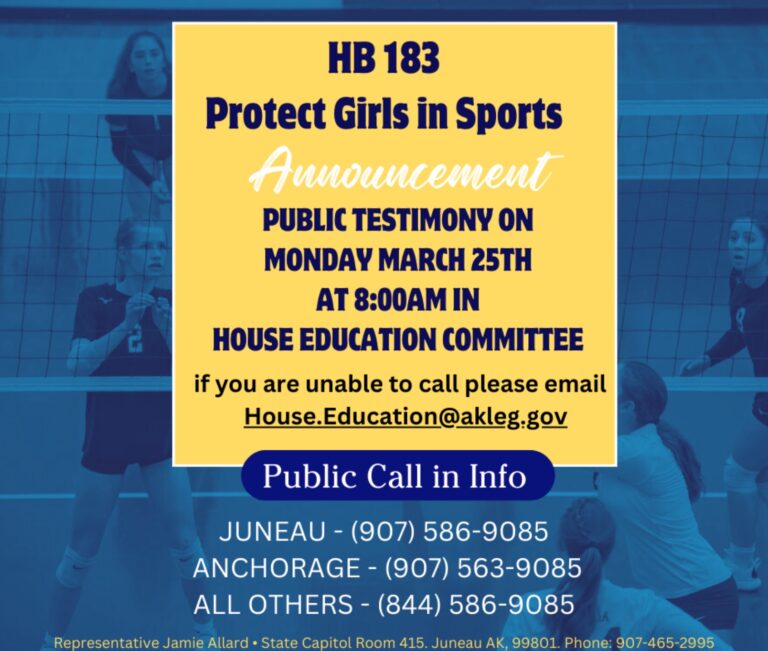
House Bill 183, to protect Alaska’s girl athletes from having transgenders take over their teams and competitions, is the subject of a public hearing on Monday at 8 am in the Alaska House Education Committee.
Last week, the committee heard from NCAA champion swimmer Riley Gaines and others in the athletic realm about the need to protect girls from boys who decide they’d rather compete in the girls’ divisions.
On Monday, the committee will hear from the ACLU-Alaska, which has put out an action alert for its supporters to call in and oppose the bill, which the group claims is anti-transgender.
The bill says it’s the intent of the Legislature that maintaining fairness in athletic opportunities for women is an important state interest; requiring the designation of separate sex-specific athletic teams or sports is necessary to maintain fairness in athletic opportunities for women; significant biological and physiological differences between males and females, including greater strength, speed, and endurance capabilities among males on average, provide a competitive advantage to male athletes in sports; and having separate sex-specific teams furthers efforts to promote sex equality and that discrimination against women and girls in sports is counter to that effort.
In order to preserve an even playing field in school athletic programs and maintain opportunities for female athletes to demonstrate their strength, skills, and athletic abilities, and to provide female athletes with opportunities to obtain recognition and accolades, college scholarships, and the numerous other long-term benefits that result from participating and competing in athletic endeavors, state Statute would be amended to read that schools whose students or teams compete in athletics must designate teams for male and for female, or coeducational/mixed team or sport. The team members would be based on biological sex listed on their birth certificates.
“Girls who participate in sports reap huge benefits for a lifetime. They gain confidence, good habits, strong bodies, and bones, and have a lower chance of osteoporosis, breast cancer, and depression,” said the bill’s prime sponsor, Rep. Jamie Allard. “They have a more positive body image and higher levels of self- esteem. They grow into strong women who are leaders and role models in our communities. They carry the lessons learned far beyond the playing field. And thanks to Title IX, their right to equal opportunities in sports and education is federally protected.”
Letters in support and opposed to the bill have been received by the committee.
Sarah King Hnilica wrote from Fairbanks that
I am writing to you today to show that “I, as well as others in the community, are strongly against HB 183. I feel like this is a step backwards for all human rights regardless of how someone might identify. HB 183 violates students privacy as it sounds like it would require educators and coaches to decide and police whether a student is trans or not. That is absolutely not acceptable and violates medical rights of the student. I am very disappointed in our legislature for even considering such a harmful bill as this. Students have the right to play sports. Please consider how detrimental this bill would be to the emotional and social well being of students.”
Irene Quednow of Anchorage wrote another perspective: “Even with a sex change surgery and hormone therapy there are physical aspects like bone density and greater physical strength that will not change in a transgender male, putting the person at a great advantage in competition with women that is simply unfair.”
Quednow noted that last year Alaska celebrated Lydia Jacoby’s gold medal in the Olympics.
“One of our own Alaskan incredible women athletes. That would most likely never have happened if a transgender male would have competed in the same swimming competition as Lydia,” Quednow wrote. “The argument is being made that it will gravely affect the self esteem of the transgender person if they are not allowed to compete in women’s sports. What about the self esteem of the women’s athletes? Why would they put all the hard work in to compete when their opponent in the competition has such a huge and unfair advantage? That is a huge blow to their self esteem. By allowing transgender males to compete in women’s sports you are telling all women that their hard work and accomplishments mean nothing and one person’s self esteem is more important than another person’s self esteem. And that is never ok.”
The National Transportation Safety Board will hold a hearing Aug. 6 and 7 on its investigation into how and why a door plug departed from a Boeing 737-9 MAX passenger jet during flight.
The NTSB conducts investigative hearings to assist in obtaining information necessary to determine the facts, circumstances, and probable cause of a transportation accident or incident under investigation and to make recommendations to improve transportation safety.
While the investigative hearing is open to the public, only NTSB board members, investigators, scheduled witnesses and parties to the hearing are allowed to participate. The hearing will also be livestreamed. The location and other details about the hearing will be announced in the coming weeks.
The accident occurred Jan. 5, when a left exit door plug at Row 26 separated from the aircraft, operated as Alaska Airlines Flight 1282, at an altitude of about 16,000 feet shortly after departing Portland, Ore. en route to Ontario, Calif.
Following the loss of the door plug, which resulted in a rapid decompression of the cabin, the flight crew returned to Portland where the airplane landed safely. Of the 171 passengers and six crewmembers onboard, eight reported minor injuries.
Independent candidate for president Robert F. Kennedy, Jr. has raised $33,430.28 from Alaska residents, according to a Federal Election Commission report showing donations from February 2023 through February 2024. That’s more than he has raised for his campaign from West Virginia, Mississippi, South Dakota, and North Dakota residents.
Kennedy comes from a long Democratic lineage. His uncle was President John F. Kennedy, his father was Sen. Robert F. Kennedy — both were assassinated. His uncle was Sen. Ted Kennedy. Although a lifelong Democrat, he’s a skeptic and doesn’t toe the party line. Kennedy, after gaining no traction in the Democratic Party, switched his candidacy in October, decided to run for president unaligned with either major party, and has become more of a populist.
About 21,000 donors in all have given Kennedy’s campaign at least $200 each since he declared his independent run in October; a POLITICO analysis found that 74% of them are new donors — they did not make any political donations during the 2020 cycle.
In Alaska, those Kennedy donors come from a wide variety of work — pilots, contractors, homemaker, but very few who are employed by local, state, or federal governments. He has about 195 donations from Alaskans, some of them giving more than once. Government-employed Democrats are sticking with Biden, according to the FEC reports, while some libertarians are leaning toward Kennedy, although they may bounce after the Libertarians’ national nominating convention, May 24-26.
Donald Trump has raised $337,627.10 from Alaskans, more than Nebraska ($322,883.31), Wyoming ($258,776.12), Maine ($227,553.92), Hawaii ($226,797.53), South Dakota ($222,829.26), Delaware ($188,222.74), North Dakota ($156,366.12), Rhode Island ($119,541.19), District of Columbia ($68,147.59), and Vermont ($63,821.58). The vast majority of his donors are either retired, working in the private sector, or are self-employed. Trump has 8,647 donations from Alaskans, some of them donating more than once.
Joe Biden has raised $90,295.44 from Alaskans, more than Wyoming ($77,991.23), Mississippi ($77,991.07), Nebraska ($76,522.65), South Dakota ($55,838.03) and North Dakota ($41,286.80). The vast majority of his Alaska donors are not employed or work for government, Native entities, or non-profits. He has 640 contributions from Alaskans, some of them donating more than once.
Kennedy is an environmental lawyer who mainstream media says gives out anti-Covid-vaccine misinformation and public health conspiracy theories. His economic views are a mix of liberal, conservative, and libertarian. He is generally a skeptic of vaccines, however. He has been spurned and vilified by the Democrats, in the same way former Rep. Tulsi Gabbard of Hawaii was vilified when she tried to help the Democrat Party self-correct.
The largest criminal bonds in history have been eclipsed by the bond amount set for Donald Trump in his civil trial involving whether he gave false information about the worth of his assets, in order to get better loan terms from banks.
The $464 million was initially $454 million set by Judge Arthur Engoron in February, but is now $464 million, with amounts the judge says is owed by his sons Eric Trump and Donald Trump Jr., as well as the Trump Organization and the interest that is accruing since the judge ruled.
Trump has until Monday to come up with the amount, which he says he can’t come up with that fast. Trump says that the judicial system is corrupt and is planning to take Trump Tower, one of his signature New York properties. It’s possible there will be public offering of TruthSocial stock on Monday, which could help him raise the money, as he could cash out some of his shares to pay his bond.
Trump is opening an entity that will trade as “DJT,” and may be valued at more than $5 billion, even though the social media platform has little revenue and loses money.
Trump has called the nearly half-billion-dollar bond in his civil case “unConstitutional” and “un-American.”
“No one’s ever seen a bond this size,” Eric Trump said during a Sunday interview with Fox News’ Maria Bartiromo. “Every single person, when I came to them saying ‘hey, can I get a half-billion-dollar bond?’ They were laughing. Top executives of large insurance companies had never seen anything of this size.”
According to Southern Bail Bonds, these are the largest bonds ever set in American history:
Donald Trump – Bail amount: $464 million
What makes this bond side unusual is that this is a civil case. “Criminal bail makes sure someone comes back for their court date. The reason Trump’s bond is so big is because of the serious accusations and the large amount of money involved in the lawsuit. This makes it one of the biggest bond amounts in a legal case in the U.S., showing how different and significant it is compared to bail for criminal cases,” Southern Bail Bonds explains.
Sam Bankman-Fried – Bail amount: $250 million (Revoked due to witness tampering, SBF is in prison)
Sam Bankman-Fried, the founder of the crypto trading platform FTX and the Alameda Research hedge fund, was given a $250 million bail, which was revoked when he was found to have tampered with witnesses. Bankman-Fried was one of the largest donors to Democrat campaigns before his scheme unraveled and he went to prison.
Junk bond trader Michael Milken faced charges for insider trading and in 1989, his $259 million bail set a precedent. He pled guilty to felony charges for having violated U.S. securities laws.
Julius Meinl – Bail amount: $133 million
Julius Meinl V, a British businessman and currently believed to be a resident in Czech Republic, came from a wealthy banking family and put together an illegal scheme involving secret share buybacks and money laundering. On Dec. 31, 2014, Meinl and four other entities of Meinl Bank were charged over a 212 million euro dividend paid out by his private bank. The case is still pending.
Raj Rajaratnam – Bail amount: $100 million
Raj Rajaratnam is a Sri Lankan-American and founder of the Galleon Group, a hedge fund management firm based in New York City. In 2009, the FBI arrested him for insider trading, and in 2011 he was found guilty on all 14 counts of conspiracy and securities fraud. He was sentenced to 11 years in prison and fined over $150 million.
Bernie Madoff – Bail amount: $10 million
Bernie Madoff ran the largest Ponzi scheme in history, worth over $18 billion. His criminal activity was discovered in 2008, during the financial collapse of banks that had made reckless bets on real estate. When investors started withdrawing money from Madoff’s fund, he ran out of money to pay them. He received a 150-year prison sentence.
On CNN’s Sunday morning “Inside Politics Sunday with Manu Raju,” Alaska Sen. Lisa Murkowski again is on tape stating she “absolutely” won’t vote for Donald Trump for president and she would not say whether she plans to leave the Republican Party.
Murkowski was one of seven Senate Republicans who voted to convict Trump in his second impeachment trial, a vote that was taken after he was no longer president and was once again a private citizen.
“I wish that as Republicans, we had … a nominee that I could get behind,” Murkowski told Raju, as they walked through the halls of the Hart Senate Building. “I certainly can’t get behind Donald Trump.”
The party’s shift toward Trump has Murkowski rethinking her future within the Republican Party, and even when pressed, she would not say if she will remain a Republican.
“Oh, I think I’m very independent minded. I just regret that our party is seemingly becoming a party of Donald Trump.”
Asked if she might become an independent, Murkowski replied, “I am navigating my way through some very interesting political times. Let’s just leave it at that.”
Murkowski was elected through ranked-choice voting and open primaries brought to Alaska by Murkowski’s surrogates at Alaskans for Better Elections. Without having to face a Republican primary in 2022, she was able to beat Republican-endorsed Kelly Tshibaka in the general election, because Democrats crossed over to block the Republicans’ preference and mark Murkowski in either their first-choice or second-choice slot on the ranked-choice ballot.
Last year, she told reporters the party was too extreme for her.
“We should be concerned about this as Republicans. I’m having more ‘rational Republicans’ coming up to me and saying, ‘I just don’t know how long I can stay in this party,’” Murkowski said. “Now our party is becoming known as a group of kind of extremist, populist over-the-top [people] where no one is taking us seriously anymore.”
She was addressing the opportunity that Republicans have for taking back the White House. And she hinted last year that she was disenchanted with her political home.
“You have people who felt some allegiance to the party that are now really questioning, ‘Why am I [in the party?]” Murkowski told The Hill reporter Alexander Bolton. “I think it’s going to get even more interesting as we move closer to the elections and we start going through some of these primary debates.
“Is it going to be a situation of who can be more outlandish than the other?” she asked, rhetorically. If she had anything nice to say about Republicans, the reporter did not take notice.
The latest Data for Progress poll of Alaskans shows that Trump will win the state with 53% of the vote.
A bill passed the Alaska House of Representatives on Friday that would raise the age of sexual consent to 18; the current legal age is 16. The bill will be on the House calendar for a third reading and final vote on Monday.
House Bill 264 passed on a vote of 32-6. If passed by the Senate, Alaska would become the 13th state to have 18 as the age of consent, joining Arizona, California, Delaware, Florida, Idaho, Kentucky, North Dakota, Oregon, Tennessee, Utah, Virginia, and Wisconsin.
The bill was originally about sexual abuse of minors, requiring shelters for runaway minors to screen minors for victimization relating to sexual abuse, sex trafficking, and commercial sexual exploitation. Then the amendments came.
The kink in the bill is the amendment Rep. Andrew Gray earlier tried to wedge into House Bill 67, another bill related to sexual offenders, but he was stymied because legislators remarked that it would change the fiscal note. This time, Gray succeeded on the floor of the House in a new bill. And the Anchorage Democrat got the job done with a handwritten amendment.
The new standard would mean that an adult could be convicted of sexual abuse of a minor for having sex with a high school student who is 17 years and 11 months of age. That’s first-degree abuse of a minor, punishable by up to 99 years in prison. It would include a high school senior having sex with another high school junior or senior.
“My amendment (much smaller than what I wanted — I could only write so fast) did not change ‘close in age’ exemption which in Alaska is 4 years (older or younger). The amendment I did was to first degree sexual assault which requires the older person to be in a position of authority like a teacher or law enforcement officer — it is unlikely that folks who have achieved that position would be within four years of a 16 or 17 year old,” Gray said in an explanation.
There is, however, an issue with this amendment which has not been addressed yet in the State House. The bill creates a conflict with existing parole agreements for sex offenders.
The problem is exemplified in the case of Evan Fischer, who was the former owner/manager of Frontier Tutoring, the man for whom Rep. Calvin Schrage worked as executive director before going into politics.
Fischer was paroled in 2023 after serving only six years of his 23-year sentence. During parole negotiations, Fischer’s legal counsel argued “the States restricts the age of people who the defendant can be in contact with as 18, but this also is already set in his special conditions, as 16. Since they conflict and 16 is the standard all sexual offenders are required to adhere to the defendant believes 16 is appropriate.”
Evan Fischer’s argument in favor of being able to have contact with 16-year-olds, agreed to by the judge in his parole contract.
The State agreed with Fischer’s arguments, and released him early with full permission to use social media services to seek contact with children 16 and older if he so pleases. As noted by Fischer’s legal counsel, the State of Alaska views this arrangement to be “the standard.”
At the time of Fischer’s trial in 2017 Assistant Attorney General Thomas J. Aliberti stated that Fischer “was the most dangerous and reprehensible type of sexual predator. Mr. Fischer presented himself as one who was interested in bettering the lives of the community’s youth, when in actuality he was a wolf in sheep’s clothing, a man who used his authority to gain access and control over a minor to satisfy his own sexual interest. An appropriate sentence in this case is one that is severe enough that it not only protects the community from Mr. Fischer but sends a message to all those who would think about using their positions of authority to sexually abuse and sexually exploit minors that this is not tolerated in the State of Alaska.”
Rep. Schrage, who worked for Fischer, voted in favor of this amendment, which also has an allowance for an 18-year-old to marry and have sex with a 16-year-old.
The amendment to HB 264 increasing the age of consent has not addressed how existing parole contracts would be affected. Rep. Gray’s amendment may have a mixed message, in that the state is exerting authority in cracking down on high school sweethearts while simultaneously allowing convicted child rapists to have “contact” with 16-year-olds, since the parole agreement notes that is the age of consent.
The bill may be especially hard on Alaska Native villages, where sexual activity between minors and adults is a known problem. If the bill passes, villages may end up losing many more of their men to prison; Alaska Natives already comprise 47% of the sexual assault arrests in the state, while representing 20% of the population.
According to a state report issued in 2019, Alaska Native females were reported to have the highest victimization rate of any gender or racial group, comprising 50.4% of all reported victims. The median age of female victims was 18, while the most common age was 15. The median age of male victims was 10, while the most common age was 5. In the reported relationships between the victims and suspects, 11% identified the suspect as a stranger. With victims under the age of 11, less than 2% of the reported relationship involved a stranger, whereas 17% of victims aged 18 and over reported the suspect was a stranger.
“There are a lot more child sexual abuse cases than are being reported,” said child psychologist Dolores Subia BigFoot, who directs the Native American Programs at the Center on Child Abuse and Neglect at the University of Oklahoma Health Sciences Center, as quoted by the Tucson Weekly. “There’s a lot of child sexual abuse cases that are not being investigated, and there’s a lot of child sexual abuse cases that are not being prosecuted.”
Do you remember in 2021 how crazy and hostile the FDA and CDC were over Americans turning to Ivermectin to treat Covid? People who could not get “human” Ivermectin resorted to “horse paste” Ivermectin, they were so desperate to treat Covid-19.
The federal government discredited the use of any Ivermectin to treat Covid-19. Why? Possibly because it would have been difficult to get Emergency Use Authorization for Moderna and Pfizer “vaccines” if there had been a safe, effective, and cheap treatment available.
Finally, the FDA has settled the lawsuit over its misinformation campaign. Of course, the FDA has not admitted to any wrongdoing, nor does it agree with the ruling.
Many of us found a way to get Ivermectin pills and used them to treat Covid. We also had a few brave doctors who were willing to risk their licenses to practice medicine.
Even today, doctors are losing their licenses to practice, or having their licenses restricted, including Dr. Ryan Cole whose license in Washington state was restricted last month by the Washington Medical Board.
Back in September of 2023, the Fifth Circuit Court determined the FDA did not have the authority to say one shouldn’t take Ivermectin as the FDA is not a physician.
The court said the FDA “overstepped its authority with a campaign warning people not to take the drug.”
Drs. Robert Apter and Mary Talley Bowden who brought the lawsuit stated between them they had treated about 9,000 Covid patients with a survival rate of 99% with the use of Ivermectin.
Dr. Paul Marik was also a plaintiff in the lawsuit. He resigned from Eastern Virginia Medical School in 2021 after being attacked over his used of Ivermectin and other Covid-19 treatments. Marik said drugs like Ivermectin, originally an anti-parasite medicine whose creators won the Nobel Prize for formulating, is a safe and effective way to treat patients in the early stages of Covid, and was a low-cost and low-risk alternative to other treatments.
When the FDA began a public relations campaign in the spring of 2021 it mentioned people using large doses of the drug intended for livestock.
The FDA sent letters to state medical boards and pharmacy boards warning against the use of Ivermectin to treat Covid, saying the use of high doses was dangerous. This warning prevented these doctors from using appropriate amounts of Ivermectin to treat patients. It also led to disciplinary actions being taken against them.
“The FDA’s campaign, coupled with their advocacy of ivermectin, caused them problems: A major Houston hospital system forced Talley Bowden to resign her privileges; Apter was referred to physician regulatory boards of Arizona and Washington state for discipline; Marik was forced to resign from his post at Eastern Virginia Medical School, where he was a medical professor and chief of pulmonary and critical care,” a report from Courthouse News says.
Because of the FDA’s campaign, numerous mainstream media outlets ran with the story about using Ivermectin as horse medicine without ever mentioning that Ivermectin also came in a human-appropriate dosage, as a pill, rather than a paste. More importantly, doctors have the right to use off-label drugs for treatment of other illnesses if they believe them to be effective.
The FDA has been ordered to take down the consumer social media warning, “Why You Should Not Use Ivermectin to Treat or Prevent COVID-19.”
And the FDA must also delete all social media posts and not repost the posts they placed on various social media pages that read, “You are not a horse. You are not a cow. Seriously, y’all. Stop it.”
The agency is also required to delete and not repost the Instagram post saying, “You are not a horse. Stop it with the #ivermectin. It’s not authorized for treating #COVID,”
And the FDA must also remove its Twitter post that reads, “Hold your horses, y’all. Ivermectin may be trending, but it isn’t authorized or approved to treat Covid.
Those doctors who filed this lawsuit and paid a pretty hefty price concerning their licensure said this campaign led to “attempts by the FDA to influence or intervene in the doctor-patient relationship.” That’s exactly what our Alaska health care providers who believed in early treatment of Covid-19 said.
For the doctors who filed and won this lawsuit, it finally vindicates those who are doing what doctors should do—preserve their doctor-patient relationship and reiterates “that the FDA overstepped its regulatory authority by trying to dictate appropriate medical care.”
Let’s not forget the role that the mainstream media played in disparaging those who wanted to try to treat Covid with Ivermectin. In a “fact-checking” article in 2021, the Anchorage Daily News wrote:
“Ivermectin meant for livestock was in high demand at some Alaska feed stores after it gained traction on social media as a purported treatment for COVID-19. The FDA has approved ivermectin in both people and animals for some parasitic worms and for head lice and skin conditions — but the FDA hasn’t approved its use in treating or preventing COVID-19 in humans. The agency has strongly urged people not to use it to treat COVID-19, especially since many were turning to formulations meant for animals, not humans.”
The newspaper continued, attacking Kenai then-Mayor Charlie Pierce and Anchorage Mayor Dave Bronson, “Kenai Peninsula BoroughMayor Charlie Pierce, who has no background in health or medicine, publicly backed the use of the treatment. Speaking at an Anchorage Rotary Club meeting last week, Bronson claimed the treatment worked very well.
“It’s an approved drug and it’s very effective,” Bronson said. “It’s not a horse pill,” the newspaper reported. Across America journalists with no medical training criticized those who supported Ivermectin as a possible treatment. They pushed the government’s propaganda and have never been held accountable.
The legal settlement to this was a long time coming. Or is this an effort by the federal government to simply sweep away evidence of its wrongdoing when it comes to social media misinformation to make it easier for their next go around for, say, Disease X?
Just remember, you are not a horse … and the FDA is not your doctor.
Linda Boyle, RN, MSN, DM, was formerly the chief nurse for the 3rd Medical Group, JBER, and was the interim director of the Alaska VA. Most recently, she served as Director for Central Alabama VA Healthcare System. She is the director of the Alaska Covid Alliance.
As a staunch advocate for constitutional rights and individual freedoms, I hold a libertarian perspective when it comes to our government’s role in protecting our fundamental liberties. Both the Preamble to the United States Constitution and the Constitution of the State of Alaska outline the core principles upon which our government is built, emphasizing the importance of safeguarding the rights and welfare of our citizens.
The Preamble to the United States Constitution begins with the iconic phrase, “We the People,” highlighting that the government derives its authority from the citizens it serves. It outlines key objectives, including establishing justice, ensuring domestic tranquility, providing for the common defense, promoting the general welfare, and securing the blessings of liberty. Similarly, the Alaska Constitution underscores principles such as promoting the common welfare, responsible development and conservation of resources, encouragement of education and morality, and protection of individual rights.
It is a story of how top-down government is removing the parent/child relationship and replacing it with an artificial outcome paid for by our tax dollars in Alaska.
It is one of the saddest stories I’ve ever read. In fall of 2021, the parents learned their daughter was being transitioned by her public school with a new made up name on her school ID. All of this was behind the backs of these parents.
Here is an excerpt:
“They (school employees) proceeded to tell me I have no say over anything my daughter wants to go by or what’s in her record or anything,” Susie said. “The only thing I had a say over was what her name was on her transcript. And the only way that changes is with a court-documented name change. But otherwise, their wording to me was that it was illegal for me to insist on a certain name or anything in the yearbook or on her ID.”
What is incredible is that there are untold numbers of parents who are going through this same event. The tragedy behind all of this is the outcome to each child’s life when the light bulb goes off in their maturing brains 5, 10, even 20 years later to realize that the gender transformation is irreversible and Alaska’s public is further decimated by the use of public funds for a completely fraudulent and evil “public purpose”.
The concerns raised in the article shed light on the significant impact of transgender-related policies and practices on families and communities in Alaska. It underscores the pivotal role of state institutions, such as the Alaska Department of Education and Early Development and the Alaska Department of Health and Social Services, in shaping policies that directly affect our children’s well-being. Beyond immediate impacts, these policies prompt reflection on the broader notion of public purpose within our constitutional republic.
In a constitutional republic like Alaska, the government’s purpose extends beyond mere governance; it encompasses safeguarding inherent rights and liberties, including the freedom to live according to one’s conscience and beliefs. When policies are enacted using public funds, they must align with the overarching public purpose of upholding fundamental values and ensuring the welfare of all citizens.
The allocation of public resources, particularly through programs like Medicaid, necessitates careful consideration of their compatibility with the state’s constitutional principles and values. More potently ascribed to our Article VII, Section 1, and Article IX, Section 6, constitutional guarantees is the primordial concept of “public purpose.”
Alaska’s youth is the foundation of the very definition of “public purpose.” This includes safeguarding the rights and well-being of this vulnerable population, who are disproportionately affected by certain medical interventions. As such, state leaders, including Gov. Mike Dunleavy and Attorney General Treg Taylor, bear a solemn duty to uphold these principles and address concerns that arise when public resources are utilized in ways that may conflict with them.
Given these considerations, urgent legal action may be necessary to halt practices perceived as harmful or contrary to the public interest. Measures such as obtaining a temporary restraining order followed by a permanent injunction may be crucial to protect the rights and futures of Alaska’s children.
It falls upon state leaders to prioritize the well-being and future of our youth, ensuring that policies and practices align with the values and principles upon which our constitutional republic is built.
Michael Tavoliero is a senior contributor to Must Read Alaska.