As of Tuesday, March 26, some 22,252 Anchorage voters have cast ballots in the municipal election, according to the city’s election division. That’s more than 5,000 voting in the past four days. There’s just one week left for Anchorage voters to get their ballots mailed or dropped in the secure drop boxes around town.
On Tuesday, Mayor Dave Bronson’s campaigned announced that it’s gathering steam with the endorsement of former Mayor Dan Sullivan, who served for two terms, from 2009 to 2015.
Bronson’s campaign reported $66,063 in raised funds over the past three weeks and is sitting on $161,071 for the final get-out-the-vote push.
He is running for a second term against former Assembly chairwoman Suzanne LaFrance, Chris Tuck, Bill Popp, and a handful of other candidates, all of them representing left-of-center politics.
The Bronson three-week donation report shows that 349 individuals donated to his campaign, and 226 of those donations were of $100 or less, showing strong regular-voter appeal.
“Our campaign is powered by the people of Anchorage, and we’re humbled by the outpouring of support,” Bronson said. “The diversity and volume of donations we’ve received tell us our message of accountable, responsive government is resonating with voters across the spectrum. From small-dollar donors contributing what they can to larger investments in our shared vision, every donation is a vote of confidence in our journey toward a more prosperous Anchorage.”
Bronson said he was grateful for the support he has seen growing daily for his reelection.
“Together, we are paving the way for a future where Anchorage grows and thrives, guided by servant leadership that values integrity, accountability, and respect for every citizen,” Bronson said.
GCI has put the brakes on its previously announced plans to phase out customers’ email accounts. However, to keep those accounts, email users will have to pay a monthly fee. GCI has about 40,000 email users in Alaska, and announced last summer that other providers offer the service and many offer it for free; the company has been encouraging people to get other accounts with other companies.
Must Read Alaska newsletter subscribers with GCI accounts received a notice from MRAK reminding them to activate new accounts before GCI pulled the plug, as it said it would do midyear. That advice still applies to those who don’t want to pay a fee for email with the GCI service.
The news of the reversal was released on the company’s website in a statement, quoted verbatim below:
What is the latest update regarding gci.net emails?
We have received a lot of feedback letting us know just how much our customers want to keep their gci.net email addresses. We value your feedback and have decided not to take any action that would discontinue the use of GCI-hosted email accounts.
Do I still need to pay the $4.99 fee?
Yes, you still need to pay this fee to continue using your email.
When will you decide about the future of gci.net email services?
If there are any changes to the future of gci.net emails, we will inform you in advance.
What if I have already disconnected my email?
Unfortunately, once you’ve disconnected your gci.net email address, you won’t be able to reactivate it.
Intentionality is not believed the cause of a Singapore company’s cargo ship hitting Baltimore’s Francis Scott Key Bridge in the early morning hours Tuesday, authorities said today.
In a morning press conference, Maryland Gov. West Moore said it appears the ship lost power and “preliminary evidence points to an accident.”
Moore added that a local crew was piloting the crew of the Southeast Asian-bound ship, the Dali, to help navigate it through the port at the time of the collision.
Prior to the collision, the ship’s crew sent out a “mayday” alerting authorities to lost power, allowing transportation and law enforcement to stop the flow of traffic onto the bridge, which Gov. Moore credits for saving countless lives.
“These people are heroes,” Moore lamented.
Maryland Department of Transportation Secretary Paul J. Weidefeld told reporters that construction workers were “inspecting potholes on the bridge” at the time of the collision. He said their presence “had nothing to do with the structure of the bridge.”
Moore added that the “bridge was fully up to code” at the time of the crash.
Baltimore County Fire Chief James Wallace said there are six people unaccounted for, who they believe to be construction crew. Sonar has located vehicles in the water, but authorities don’t believe people are in those vehicles. It was unclear if those vehicles belonged to the construction crew or travelers across the bridge.
Weidefeld said more than 30,000 people a day use the I-695 connector on the southeastern side of Baltimore. Speaking less than 10 hours after the collapse, Moore had no timeline for when shipping will be resumed, or estimated costs associated with the loss of the bridge.
During an earlier press conference, Wallace confirmed one person had been transported to the hospital in serious condition, and one person refused medical attention.
President Joe Biden said he and his administration have been briefed and are offering assistance.
“This morning, I convened senior members of my team for a briefing on the collapse of Baltimore’s Francis Scott Key Bridge,” the president’s team posted on his social media channels. “I’ve directed my administration to ensure every federal resource is available to assist search and rescue efforts and response to this terrible incident.”
Moore and Baltimore Mayor Brandon Scott each declared a state of emergency. U.S. Transportation Secretary Pete Buttigieg has offered federal assistance while neighboring Virginia Gov. Glenn Youngkin has also offered to help.
There are many to choose from, but here are the top 10 disclosures learned in 2023 concerning Covid decisions, which I’ve gleaned from various sources.
1.FDA and CDC found more Covid vaccine adverse events, including stroke and myocarditis.
The Food and Drug Administration and Centers for Disease Control and Prevention released a joint statement about the increased risk for strokes in older population with people who took the Pfizer bivalent booster.
If you took the jab along with the flu vaccine at the same time, there was a higher risk of stroke. For some reason, the government’s public service announcements are still touting you can take them together.
There is an increased risk of myocarditis from the Covid shot. The CDC drafted a vaccine warning in 2021 but failed to send it. Dr. Joel Wallskog, who is co-chair of the vaccine-injured advocacy group React19, stated that this was an example of how our government wanted to censor information that opposedthe narrative that the Covid-19 vaccinations are ”safe and effective.”
2. Vaccines cannot “effectively” control Covid, despite Dr. Anthony Fauci’s statements to the contrary.
Fauci, Former Chief Medical Advisor to the President of United States, was frequently on the air telling us if you get vaccinated, you’ll be safe from getting this disease. Unvaccinated? You are at risk. This was specifically during the Delta variant wave when he was working so hard to get those jabs into people’s arms.
Somehow after his resignation or retirement, Dr. Fauci and two others published an article in which he stated “SARS-CoV-2, endemic coronaviruses, RSV, and many other ‘common cold’ viruses … have not to date been effectively controlled by licensed or experimental vaccines,” The authors further stated these vaccines only provided short term and incomplete protection.
3.Review found uncertain evidence of masking effectiveness.
A review by The Cochrane Library, which is considered the gold standard for systematic reviews, did not find conclusive evidence masking does anything for respiratory illnesses. This review was published in 2023.
“The low to moderate certainty of evidence means our confidence in the effect estimate is limited, and that the true effect may be different from the observed estimate of the effect,” the authors concluded.
Yet many people are still unable to give them up, as you can see when in stores and in airports.
4.The immune system is weakened by repeated vaccinations.
Getting multiple jabs leads to higher levels of antibodies called IgG4. This was seen after the third dose of mRNA vaccine. The IgG4 antibodies are a response to depress your immune system to prevent it from over-activation. A study by the Cleveland Clinic showed the more doses a person received of the jab, the more likely the person is to get infected.
5. Contamination with DNA seen in mRNA vaccines.
Both Pfizer and Moderna vaccines had DNA fragments within them, meaning DNA could enter cells and possibly be integrated into the “cells genome.”
The Simian virus 40 (SV40) DNA is a monkey virus that was found in vaccines.
Whilethere is debate concerning what SV40 might do to humans, this virus “associated at high prevalence with specific tumor types such as brain and bone tumors, mesotheliomas and lymphomas and with kidney diseases, and at lower prevalence in blood samples from healthy donors.”
More research is being done to determine what effect SV40 may have on us. Pfizer stated SV40 is common practice when developing vaccines. FDA says it stands behind its findings of quality, safety, and efficacy for the mRNA vaccines.” No surprise there.
6.Covid vaccine-injured people are being compensated.
That’s significant from a government and Big Pharma, which said all these jabs were good with minimal side effects. Under the Counter-measures Injury Compensation Program (CICP)—within an agency run by the Department of Health and Human Services—if you survive an injury from the jab you can get money for lost work and unpaid medical expenses.
As of December 2023,10 people received a measly amount totaling about $37,000. But it is a start.
7.Wow! Doctors can prescribe Ivermectin.
In its response to a lawsuit,the FDA said, yes, doctors can treat Covid with Ivermectin. That’s a far cry than its stance just a few years ago when it was almost impossible to get Ivermectin to treat this virus. How many people died?
8. Masks were back in style in August 2023 and new “vaccine” jabs were available.
No federal agency reinstated masks at that time, but hospitals started mandating them. However, this time people pushed back, and many hospitals had to back down. But jabs were back—and pushed by the CDC for adults and children. Even though approved, the CDC admitted the new jab’s ability to prevent hospitalization and death was low for adults and extremely low for children.
9.FDA finally released the last batch of Pfizer vaccine documents.
You remember in 2021 a FOIA request was made and at that time the FDA said it would release 500 pages each month—thereby it would take 75 years to get all the information. In a lawsuit the judge mandated the FDA would have to release 5,000 documents a month.
One of the significant points that came out was that there was a myriad of manufacturing problems—several were flagged “for deviating from quality standards” but were still released to the public for inoculation. If you took any of the jabs, please go to https://howbadismybatch.com/. You can see how bad your batch was. Some batches had more serious side-effects than others.
The FDA in a memo concerning the licensing application for Pfizer said Pfizer’s data “exceeded FDA’s expectations.” The FDA went on to say that the cardiac problems that occurred in the trial probably weren’t related to the vaccination. We have learned differently since then.
10.Vaccines form aberrant proteins—not messenger RNA but modified RNA.
mRNA occurs naturally in the body. Documents from both Pfizer and Moderna showed they used modified RNA or modRNA. This modRNA made the vaccines “hardier” and more “resistant to immune degradation.”
The sequence was also changed to get a faster reading of the mRNA that can affect the final protein produced. Why is this important? Prior research found that by altering the reading speed of how a protein “unfolds” could cause the formation of “new, non-spike, aberrant proteins.” This finding by researchers makes the vaccine more “error-prone.”
Even more information is forthcoming in 2024. Of interest, most of the healthcare professionals involved in our “pandemic” response have retired, resigned, or been replaced. But the new faces tout the old news. Fortunately, we have good doctors and some lawyers who are willing to file the lawsuits needed to get to the truth.
The truth will set you free but first it will “piss” you off. Let’s move beyond the latter and prepare for the next round.
Thanks toEpoch Timesfor providing material for this column.
Linda Boyle, RN, MSN, DM, was formerly the chief nurse for the 3rd Medical Group, JBER, and was the interim director of the Alaska VA. Most recently, she served as Director for Central Alabama VA Healthcare System. She is the director of the Alaska Covid Alliance.
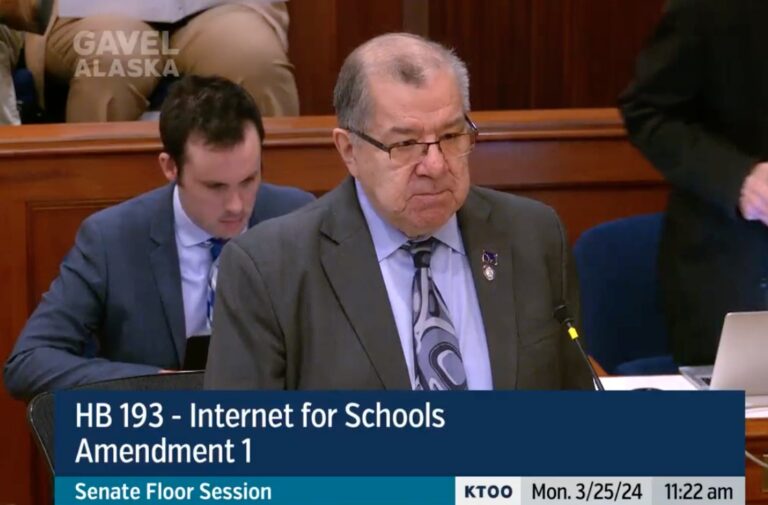
To ensure rural communities don’t miss a pending grant deadline from the federal government, the Alaska Senate rushed a bill through on Monday that increases state spending to rural school districts that buy old-school broadband service from companies like GCI. The next stop is the governor’s desk.
School districts will qualify for higher speed Internet with the state-federal program because the legislation increases reimbursements to buy 100 Mbps per second of speed from providers of fiber-optic internet services. The current program only reimburses for 25 Mbps. The state’s portion of the federal E-Rate program, is nearly $40 million.
The FCC’s E-Rate Program makes telecommunications and information services “more affordable for schools and libraries. With funding from the Universal Service Fund, E-Rate provides discounts for telecommunications, Internet access, and internal connections to eligible schools and libraries,” according to the FCC.
House Bill 193 scraped up the original wording of the failed Senate Bill 140 and repurposed it into a House standalone bill. SB 140 had become a vehicle for the National Education Association to shove massive amounts of education spending into the budget and the education industry tried to bully the spending through by saying rural internet was at risk. SB 140 was ultimately a hot mess that was vetoed by the governor because of the recklessness of the spending contained in it.
The core legislation in SB 140 — now in the House bill — is important to Sen. Lyman Hoffman of Bethel, who is a paid board member of Bethel Native Corporation, which has in the past gotten contracts for GCI to do the fiber optic work in the region; BNC is the company that is first in line to get the new contracts as well, which puts Hoffman in an ethical compromise, having voted for his own family’s self-interest. He did not recuse himself from voting on the legislation.
Hoffman was the sponsor of SB 140, which was the focus of legislative drama for most of a month. He also carried House Bill 193 in the Senate.
During the vote on Monday, the only senator voting no on final passage was Sen. Mike Shower of Wasilla, who questioned why the state is investing so heavily in fiber technology and is not making sure the program technology neutral.
“To use the terminology of a former president, ‘Let me be clear,’ I support where this is going. There’s no doubt we need the rural internet speeds so we have opportunity for people in rural Alaska. One hundred percent behind it,” Shower said.
He pointed out that the expansion of the grant program to 100 Mbps supports one chosen technology, “before we had other options that might be faster, cheaper, etc. And quite frankly, if you look at this from a kind of a strategic perspective or military perspective, you always want the backup to the backup. I’m not against looking at how we might have layered options, too,” with fiber optic cable and satellite internet redundancies.
“You might even have geosynchronous not just LEO,” Sen. Shower said. “There’s multiple things here that can work.”
Shower’s amendment to ensure technical technology neutrality failed, with only he and Sen. Shelley Hughes voting for it.
Why wouldn’t legislators want to add the technical neutrality amendment? That is the multi-million-dollar question.
In fact, many rural residents are now using Starlink satellite broadband to get the speeds they want, and it comes at a much cheaper price than what is charged by fiber providers.
But Hoffman ignored those alternatives and emphasized how much money would come from the federal government with passage of the bill. He said it was for the children. He also pointed out that the $40 million comes with a match that “if all the schools participate would benefit those communities to the tune of a little more than $350 million.”
The state and federal government, thus, will pay the broadband cost that can be as much as $60,000 a month for some village schools.
The $350 million that would come from HB 193 ($40 million from the state) would add to the approximate $300 million already coming from other federal government universal service funds program (E-rate for school, high-cost residential subsidies, rural health care subsidies etc.) That creates an artificial price floor that ultimately hurts Alaskans’ pocketbook.
This is often what happens when the government gets involved to make things better, rather than let the private sector compete.
It’s the Cobra effect — the economic parable of government’s unintended consequences. In India, when the government wanted to get rid of poisonous cobras, it paid a bounty for them. That incentivized people to breed cobras and then turn them in for money. Some of the cobras escaped and that led to an increase in cobras. The Cobra effect is an incentive that has an unintended and undesirable result opposite the intentions of its designers.
In the case of broadband subsidies, the Cobra effect is that by pouring money into the system, companies are incentive to set the price higher.
The technology battle is evidenced by companies like ASTAC, which provides service to Atqasuk, Nuiqsut, Point Hope, Utqiaġvik, Wainwright, Anaktuvuk Pass, Kaktovik, and Point Lay. ASTAC has been advertising promotions to buy back Starlink equipment if people switch to fiber optic service, which is dramatically higher in the long run than satellite. See the promotion at this link.
An example of how much internet costs in rural Alaska can be seen in this promotion from ASTAC.
“In partnership with Quintillion, ASTAC is now offering to buy back Starlink equipment as you switch to the amazing new plans! Bring us your old Starlink equipment, and we will apply a credit immediately to your account. Sign up today and get $500 INSTANTLY added to your account and clear out the equipment you no longer need,” ASTAC says in its promotion.
There are 23 schools already using space-based internet, said Sen. Shelley Hughes. The cost difference is extraordinary.
Last year, one school in the Lower Yukon School District was paying $44,000 a month for broadband through GCI Terra. This year, Microcom, connected with Starlink satellite service, came in with a bid. GCI lowered the cost from $44,000 to a $25,000 bid, hoping to beat out Microcom.
But Microcom came in with a $2,500 bid — one tenth of the cost of the next lowest bid, and 1/17th of what it cost the school the previous year with GCI.
“We’re all doing our taxes right now, and it’s good to remember that when we talk about federal dollars, those are coming out of out pockets as well. When we’re paying $400 million for internet serving 20,000 students, that’s $20,000 per child per year,” Sen. Hughes said. She pointed to a FCC report released last week that shows the cost of rural school internet in Alaska is an average of $203 per megabit per second, while in Utah, the cost is 29 cents per megabit per second.
As of Thursday, 16,984 ballots have been cast in the Anchorage municipal election, which ends April 2. That’s slightly more than had been received at the same time during the 2021 mayoral election.
On the ballot, Republican Mayor Dave Bronson is trying for a second term. Former Assembly chair Suzanne LaFrance, endorsed by Alaska Democrats, left office last year to mount a campaign against him. Also in the hunt is Chris Tuck, Democrat, and Bill Popp, unaligned.Several other lesser-known candidates are also on the ballot.
Anchorage residents have an opportunity to replace three liberal school board members. Another conservative member of the school board would allow conservative member Dave Donley to at least have a second on his motions, rather than have them completely ignored by the liberal majority running Anchorage schools.
Eagle River voters will be replacing Assemblyman Kevin Cross, who is leaving the Assembly early. The only candidate on the ballot is Mark Littlefield.
There are numerous bond propositions and road service area seats on the ballot.
Of the ballots received by the election office, 1,088 were mailed, 1,448 were dropped in the election drop boxes. All ballot envelopes (including military and overseas envelopes) must be postmarked on or before Election Day, or returned to a drop box or Anchorage vote center.
The voting centers opened up Monday, Seward’s Day, for in-person voting.
Anchorage vote center locations
City Hall All municipal ballots are available at 632 West 6th Avenue, Room # 105
Loussac Library
All municipal ballots are available. at 3600 Denali Street, First Floor
Eagle River Town Center
Only Chugiak-Eagle River ballots are available at 12001 Business Boulevard, Community Room #170 (same building as the library)
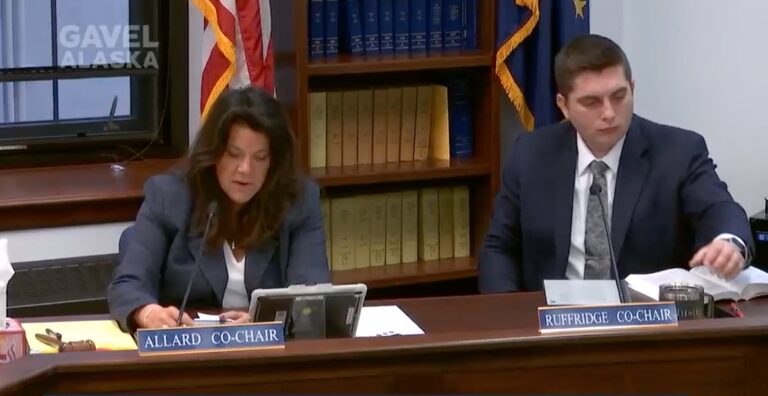
A bill that aims to protect Alaska’s girl athletes from being disenfranchised by transgender (boys who want to be accepted to compete in sports as girls) passed out of House Education Committee today.
Democrats Rebecca Himschoot, Andi Story, and CJ Mccormick voted against the bill, while Republicans Mike Prax, Tom McKay, Jamie Allard, and Justin Ruffridge voted in favor of it. However, when he signed the committee report, Ruffridge wrote “amend.”
The bill is sponsored by Rep. Allard of Eagle River and cosponsored by Rep. McKay of South Anchorage.
Before passing from committee, the room heard testimony from Alaskans representing both sides of the issue.
Josh Smith of Anchorage said, “House Bill 183, banning trans kids from sports, is a solution looking for a problem. There’s very real problems in the state of Alaska, this not being one of them. There’s no evidence that trans girls pose any sort of threat to girls sports or take anything from cis-gender kids. These faulty changes are discriminatory and undermine the validity of these kids. Can we take into consideration that indigenous people whose land we live on now that gender is not defined as many do now. The recognition of roles in society of communities and families is not binary and it was common to recognize beings outside of the binary.” Smith, who appears to be white, went on to talk about indigenous people not being binary.
Lynn Hallford, who called from Palmer, said, “I am a strong supporter of HB 183. It supports the fairness for girls in sports. There are biological differences between boys and girls. Everyone has heard about basketball and volleyball players that were hurt when males competed against girls. Everyone has seen girls lose medals and probably scholarship opportunities when boys are allowed to compete with them.”
The bill, which simply reiterates that federal Title 9, championed by the late Sen. Ted Stevens, is law in Alaska pertaining to fairness for girls in athletics. The trans community is attempting to expand Title 9’s protection to boys who wish to compete as girls. The bill will now go to the House Judiciary Committee.
Donald Trump may not be the richest person in America. He’s not even among the top 25 richest Americans. When a New York judge set a bond for him that was by far the largest in history — $464 million — even the New York State Appeals Court thought that was excessive.
The Court of Appeals ruled Monday that Trump can post $175 million to cover a civil fraud judgment that is under appeal. It’s still one of the largest bonds ever set in American history. That is 38% of the initial penalty from the Manhattan court.
Trump’s attorneys had argued that liquidating assets to come up with the full $464 million was “a practical impossibility” by today’s deadline set by Judge Arthur Engoron of Manhattan.
Trump says that the judicial system is corrupt and is planning to take Trump Tower, one of his signature New York properties.
Meanwhile, the judicial system, which conservatives believe is partisan, is making it difficult for Trump to campaign for president. On Monday, while Trump looked on in the courtroom, New York Judge Juan Merchan announced that Trump’s first criminal trial is set for April 15 in Manhattan. The date puts the trial right in the middle of the summer campaign season and will probably guarantee a verdict before November’s general election. The criminal matter relates to alleged hush money that Trump gave to a porn actress before the 2016 election.
Also on Monday, Trump’s media company, TruthSocial, which has merged with the shell company Digital World Acquisition Corp., filed with the Securities and Exchange Commission that it will start trading on Tuesday on the NASDAQ stock market. The new company is called Trump Media & Technology Group Corp. and will trade under the DJT stock ticker.
Although Trump is not the official presidential nominee of the Republican Party for until the Republican National Convention, July 15-18 in Milwaukee, Wisconsin, he is the presumptive nominee and has the backing of the RNC due to his winning of every primary and caucus to date, except for Washington, D.C. and Vermont. He has 1,686 delegates; he only needed 1,215 total to win the nomination officially.
Michael Steele, former chairman of the Republican National Committee and now a dedicated leftist, said the only reason Trump’s historic bond was reduced is because the court treated him differently: “Yet again, @realDonaldTrump gets special treatment with his own private system of justice. The NY Appeals Court has decided to give Trump more time to pay less money by reducing his bond from $454M to $175 and giving him 10 days to get the money. This makes absolutely no sense.”
Within the Eagle River, Chugiak neighborhoods — communities that make up Anchorage Assembly District 2 — a growing number of residents are working to detach from the Municipality of Anchorage and incorporate into a home rule borough, an initiative they call Eaglexit.
One of their core motivations is education reform and a new approach that allows parents to choose among competing charter schools.
Central to their vision is a shift toward a system consisting entirely of independent charter schools, none of which would observe boundaries. Eaglexit’s approach appears timely, as parents are removing their children from public schools at an ever-increasing pace, not only in response to poor academic outcomes but also in pursuit of curriculums better suited to their children.
According to Ric Smith, chairman of the Eagle Exit Education Committee, this proposed new municipality — the Chugach Regional Borough — establishes a charter school district within it that is pioneering, since it “prioritizes the holistic development and success of students, while also empowering educators and fostering community engagement.” Smith and others believe this approach represents the future of education, based as it is on a more targeted learning experience tied to the interests of each student, and on a parent’s ability to choose among schools.
At the heart of this concept is the idea of autonomy. Traditional schools are often viewed as top-down management structures that strip too much authority and control from parents, educators, and school staff. Under this new model, schools will be free to design programs based on broad principles contained in the borough’s educational standards. Each new charter school will have a decentralized governance structure where parents and school staff have more control through their own governing boards. Within this framework, each school will be free to specialize in areas such as STEM (Science, Technology, Engineering, and Mathematics) education, arts integration, language immersion, or vocational training.
Another benefit to parents is the injection of competition among schools. Schools with programs that don’t meet the needs of their students will lose students to better schools. This will force the failing schools to alter course, to quickly correct deficiencies that cause students to leave. This is perceived as the best way to address the two biggest reasons parents cite for removing their children from traditional schools — lack of appropriate curriculum and lack of ability to affect change. With competition among charter schools, unhappy parents will now have alternatives.
Parents will exercise a key role in the educational evolution of this new district when they select the school that aligns with their values, priorities, and educational philosophy. This partnership between parents, educators, and the community fosters a sense of ownership and investment in the success of the schools and students within the district.
As statistics emerge that compare the performance of charter schools to traditional schools, Alaskans are paying attention.
Gov. Mike Dunleavy recently cited a Harvard University study on charter schools when he stated, “Unbeknownst to a lot of folks, because this is the first study that’s ever been done that measures outputs through the NAEP scores — lo and behold, we’re tops in the nation! You would think you’d hear parade music and people dancing in the streets, but in some sectors, this has caused a problem because it doesn’t fit the narrative.”
According to the Alaska statewide test scores, charter schools are outperforming the traditional Anchorage School Distric public schools in math and reading. In Anchorage, which ranks among the highest in the nation in terms of spending per student, the charter school programs outperform traditional Anchorage public schools, both in higher student test scores as well as in lower spending per student.
These improved outcomes for our youth should be a cause for bi-partisan celebration.
Instead, every year the ASD and teachers’ unions promote the argument that they need more money to raise student test scores
Because of this growing disparity in outcomes, parents find it difficult to enroll their kids in charter cchools. Eagle Academy in Eagle River has a waiting list of over 140 students.
Given the waitlists, why doesn’t the Anchorage School District authorize more charter schools? One objection often cited is that charter schools remove resources from the traditional schools. However, Bob Griffin, of the Alaska State Board of Education and Early Development, exposed the fallacy of this argument when he stated:
“A final myth is that public charter schools rob resources from neighborhood public schools. This is not the case in Alaska, where per-student spending in charter schools is significantly lower than in traditional neighborhood schools. As more kids move to public charter programs, neighborhood schools are relieved of the burden of the variable cost of educating the kids who move, leaving more funding per student for the children who stay in their neighborhood schools.”
Not only do charter schools outperform public schools, but they do it for less money. By leveraging the self-interest of parents, charter schools attract volunteer time and expertise. Charter schools do not float bonds for maintenance, since they must live within a budget. Parents must find a way to deliver their children to school. Contrast this with the school district in Anchorage, which relies on bonds to pay for maintenance, and which receives $481 for busing charter school students even when they don’t actually transport them. ASD gets $1,108,705 to transport all 2,305 charter students; money the district then funnels to other uses.
During his 26-year career teaching at Birchwood ABC, Ric Smith witnessed firsthand how parents embraced a philosophy of high standards. Because parents cared and were involved, their kids brought that same enthusiasm with them to the classroom.
He emphasizes an equally important dynamic, which was that his school had a parent advisory board which helped guide the direction of the school, and the hiring of its staff, working to always ensure the continuity of the program. “These are things you don’t see in the traditional schools, and therein lies a big part of the difference between the two types of models,” he stated.
Eaglexit is still being formulated, and should it succeed, it will reflect the goals of the community. By engaging stakeholders in the charter development process, schools can identify local concerns and evolve in their solutions to educational challenges. This collaborative approach to education empowers schools to serve as agents of positive change within their communities, driving excellence in education.
Greg Sarber is on the board of Alaska Gold Communications Inc., parent company to Must Read Alaska.