Virginia Gov. Glenn Youngkin vetoed a bill requiring the state to rejoin a voter-registration consortium known as ERIC — the Electronic Registration Information Center. The multi-state compact to maintain voter rolls has seen nine states leave over the past two years, as Republican-led states lost confidence in the neutrality of the system, designed by partisan Democrats with initial funding from George Soros through the Pew Charitable Trusts.
The Virginia bill passed along party lines. Democrats control the Senate and House and wanted Virginia back in ERIC, which shares data from motor vehicle agencies and voter registries across its 25 remaining member states, which include Alaska. It’s unclear if they have the votes to override his veto.
Last year, the Alaska Division of Elections said it was evaluating its membership in the ERIC database system, but no decision to stay or leave was ever final.
Nine of 33 member states have dropped out of ERIC membership because of concerns about the organization’s partisan origins, current political biases, connections with leftist groups, and various data policies that appear to favor Democrats.
The nine states that pulled out of ERIC are all led by Republicans, including Virginia, West Virginia, Ohio, Iowa, Missouri, Louisiana, Texas, Alabama, and Mississippi.
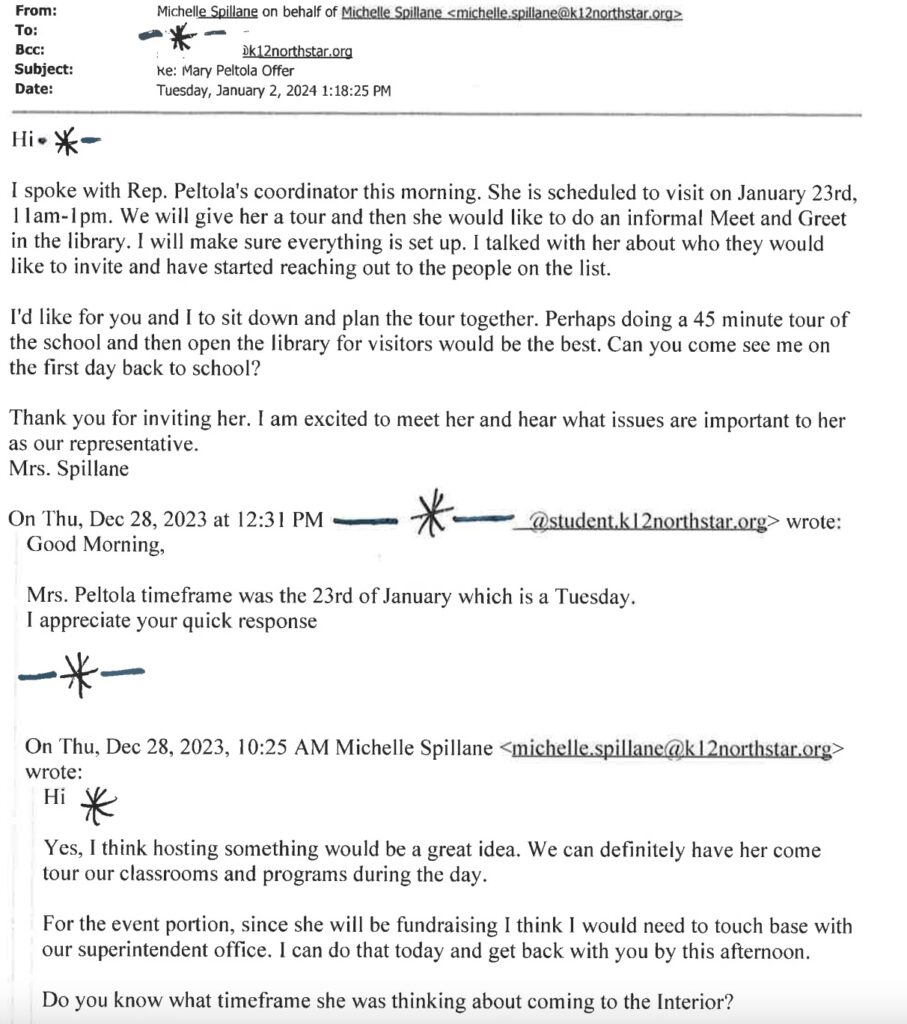
Documents obtained through a public records request show that Rep. Mary Peltola, in the capacity of a candidate and not as a U.S. representative, not only used North Pole High School for a campaign stop, but her campaign was trying to put together a fundraiser on campus while she was there, during school hours.
The fundraising portion of her event evidently fizzled, but the school administration actively helped her with the rest of her campaign stop as she was hitting various venues in the Fairbanks area.
It’s a serious offense, according to state law:
“Sec. 14.03.090. Partisan, sectarian, or denominational doctrines prohibited. Partisan, sectarian, or denominational doctrines may not be advocated in a public school during the hours the school is in session. A teacher or school board violating this section may not receive public money.”
In other words, schools that use their facilities during school hours to advocate for a candidate for partisan political office may not receive funding from the State of Alaska.
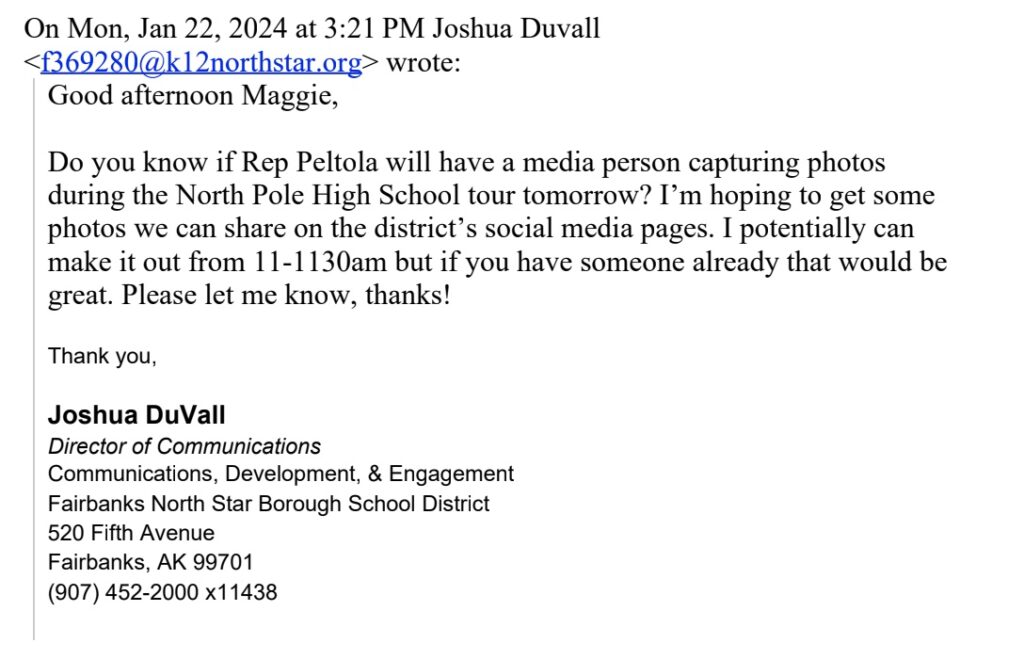
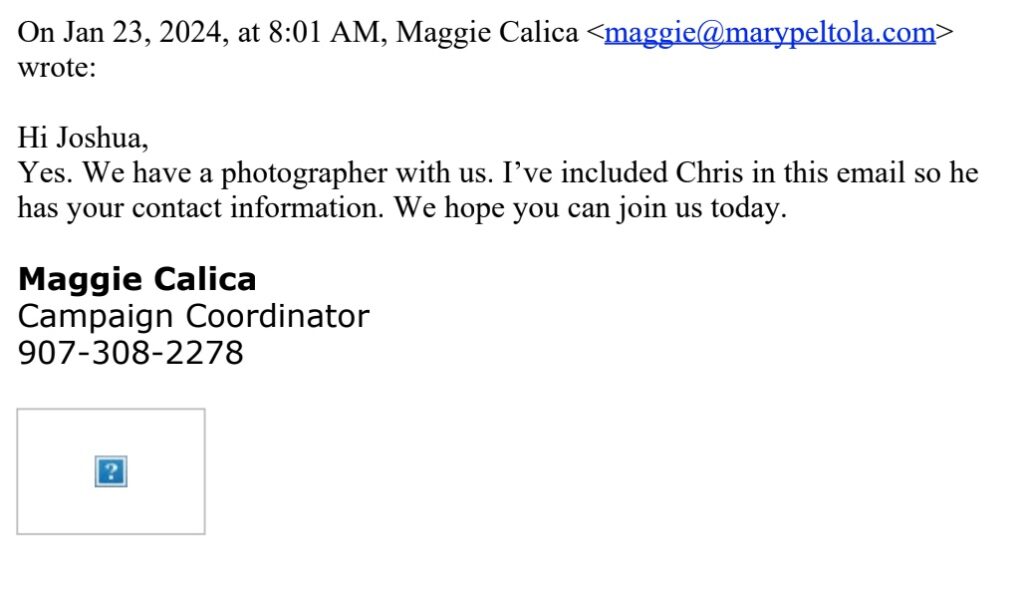
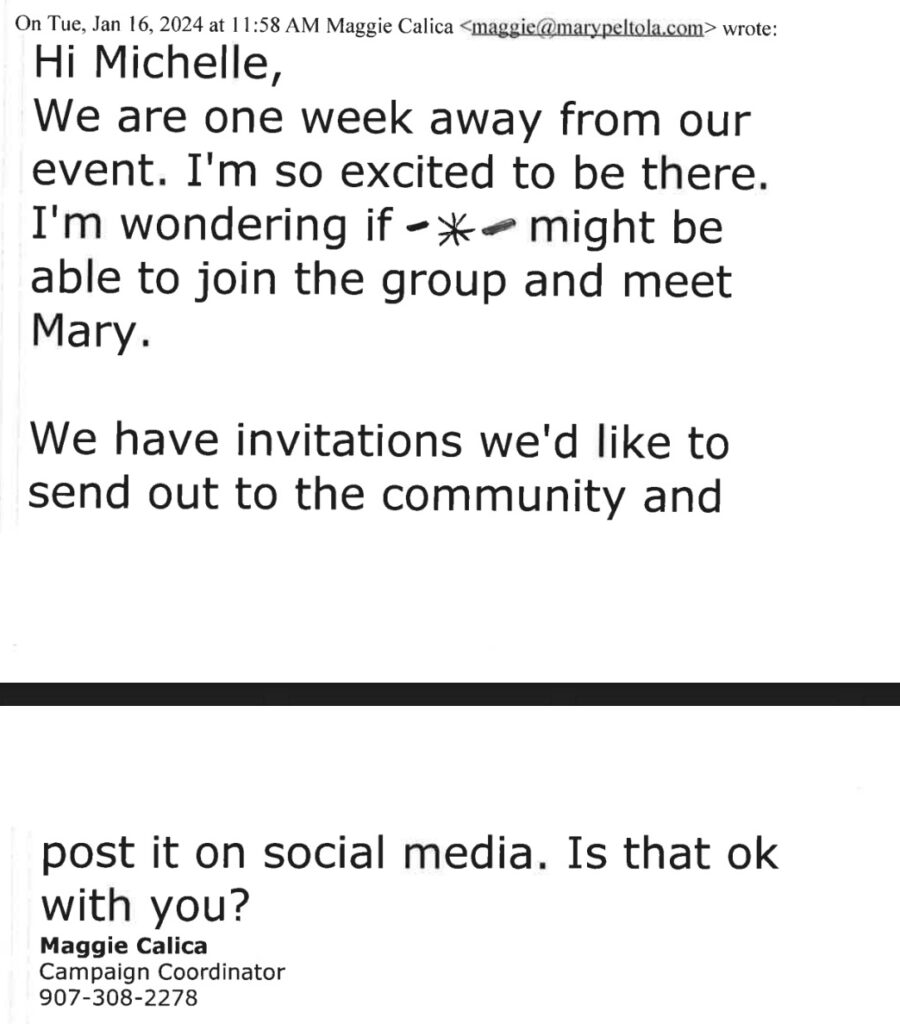
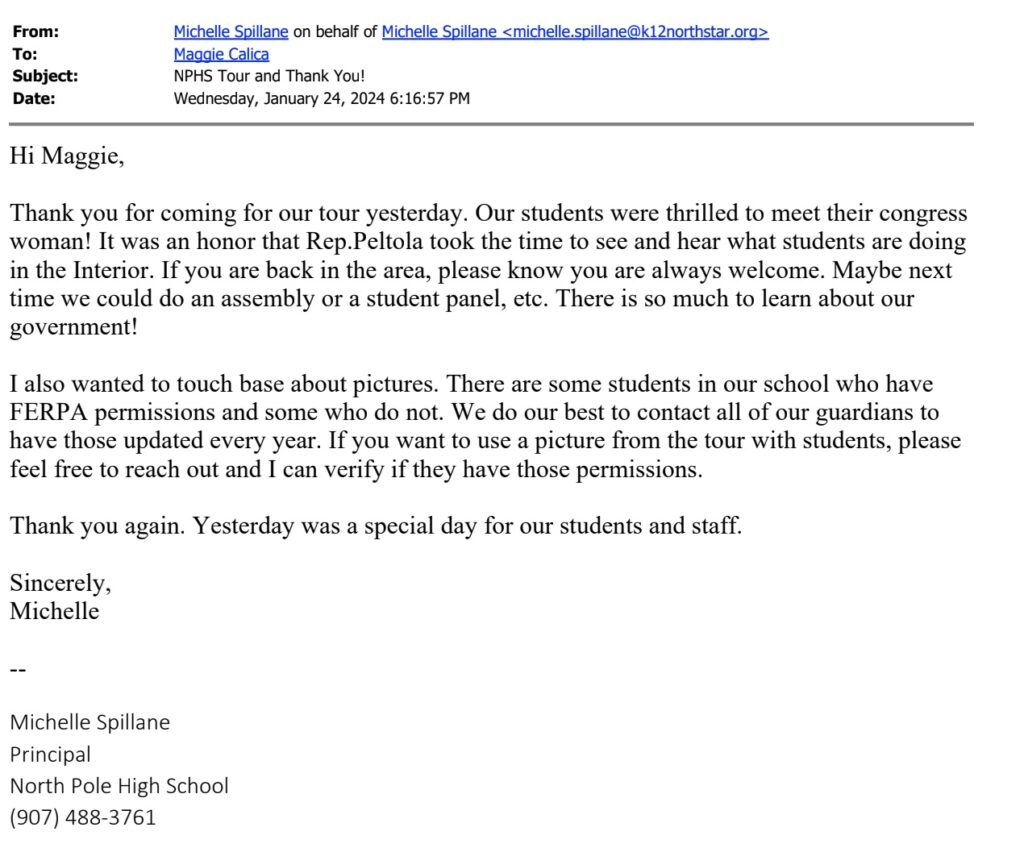
The trail of documents obtained by citizen activist Jay McDonald shows public employees in the school district continuously coordinating in advance with Peltola’s campaign staff, and eager to help get pictures and promote her campaign activity on the district’s social media pages. The back and forth emails make it clear the public employees knew they were coordinating with campaign staff.
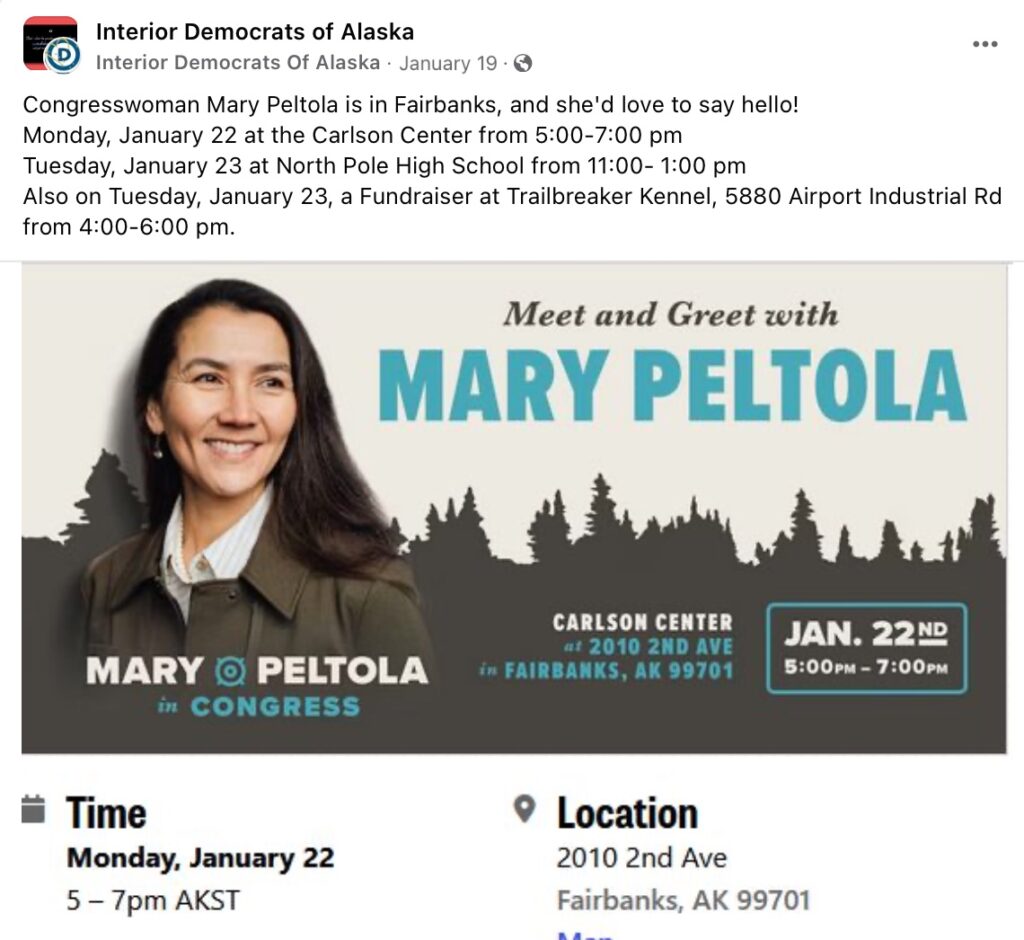
Peltola came through Fairbanks in January. On Jan. 18, she scheduled a campaign stop at North Pole High School for 11 am to 1 pm, while students were in school. Normally, campaigns could rent school space after hours, but it’s against the law to use public facilities during business hours for campaign events.
Along with her, Peltola had a gaggle of campaign staff, including Chris Whitschy, who was Sen. Bernie Sanders’ senior field film producer on the Bernie 2020 presidential campaign and the Friends of Bernie Sanders political committee, from March 2019-September 2021. Peltola also had with her Anton McPaland, her campaign manager who also serves as her chief of staff.
Even the principal of the high school got involved in helping the campaign event, by writing to campaign coordinator Maggie Calico multiple times to maximize publicity before and after the event.
Must Read Alaska wrote about the illegal activity in January, and immediately Peltola’s campaign staff removed all traces of the event on social media. That’s when Jay McDonald dug deeper to see just how much coordination with the school staff had occurred.
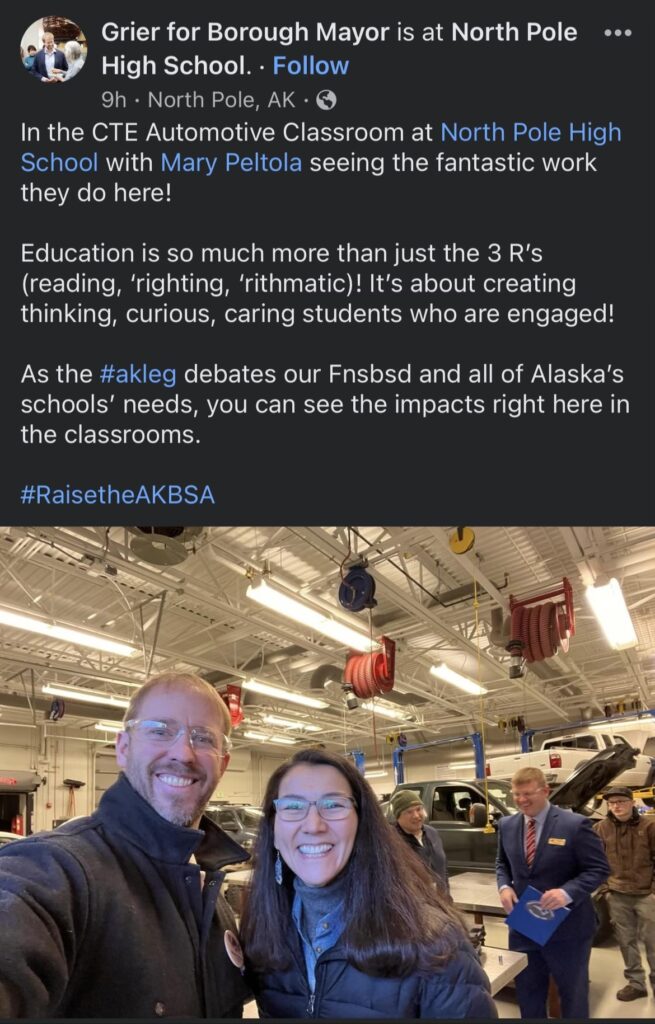
The Democrat member of Congress was accompanied by another Democrat candidate — Fairbanks North Star Borough mayoral candidate Grier Hopkins, who posted a photo to his campaign Facebook page of the two candidates, side by side, unabashedly campaigning during school hours.
Although it was not his campaign event, Hopkins was piggybacking on the representative and may have also been breaking the law, since he used the photo in his social media post.
The event was advertised for the school library, but the two politicians toured the school, popped into classrooms to talk to students and visited the automotive class, where Hopkins took the selfie.
In the narrative of that post on Facebook, Hopkins used the moment to promote more funding for schools from the Legislature and the governor:
“In the CTE Automotive Classroom at North Pole High School with Mary Peltola seeing the fantastic work they do here! Education is so much more than just the 3 R’s (reading, ‘righting, ‘rithmatic)! It’s about creating thinking, curious, caring students who are engaged! As the #akleg debates our Fnsbsd and all of Alaska’s schools’ needs, you can see the impacts right here in the classrooms. #RaisetheAKBSA — at North Pole High School.” he wrote.
Hopkins, who is running for a nonpartisan seat (mayor) has left his photo memorializing his campaign tour of the school with the candidate for Congress, but the school itself and the North Star Borough School District erased all evidence of the event on their Facebook pages.
It was fine for Democrats in Congress to interrupt President Joe Biden by chanting “Four More Years” repeatedly during the State of the Union on Thursday. In fact, it was welcomed by the president.
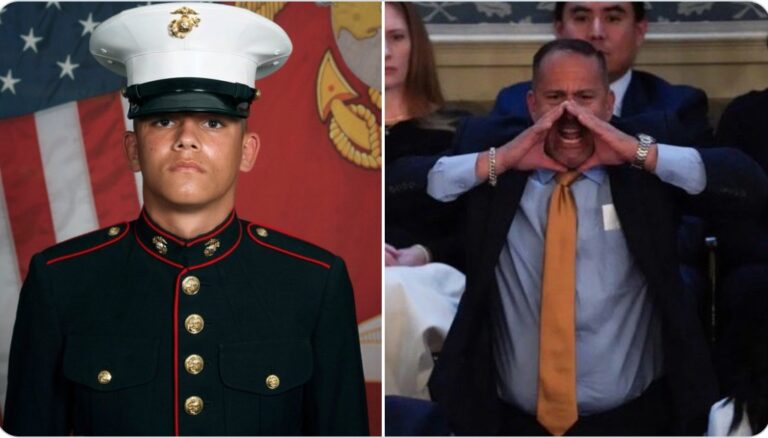
But it was not OK for the Steven Nikoui to stand up and yell at the president. He shouted “Abbey Gate” and “United States Marines,” after Biden said the phrase, “America is safer today than when I took office.” Nikoui just couldn’t take the lie and wanted to remind the hall of the site of the 2021 suicide bombing, when 13 US service members were killed during the Biden-ordered chaotic withdrawal.
Nikoui was a guest of Rep. Brian Mast. Florida Rep. Mike Waltz has offered to pay the possible $500 fine.
Nikoui’s son was Marine Lance Cpl. Kareem Nikoui, who died in the 2021 ISIS-K suicide bombing as Biden’s evacuation from Kabul, Afghanistan became a deadly military disaster.
Nikoui was removed from the House floor and taken away in handcuffs during what was described by many observers as Biden’s biggest campaign speech to date.
“The Sergeant at Arms is holding my State of the Union guest for yelling at [Biden] in protest because his son was killed in action at the Abbey Gate due to Biden’s incompetence,” Rep. Brian Mast said in a post on X.
“No one has been fired over the Afghanistan withdrawal that took the lives of 13 servicemembers. Biden refuses to ACKNOWLEDGE the lives of the 13 servicemembers. My guest, a Gold Star family member Steve Nikoui, had ENOUGH of Biden’s BS,” Mast wrote.
Nikoui posted bail and then attended a Gold Star family get-together with others who have lost military family members in war. was greeted with overwhelming support at the Dubliner Restaurant in Washington, D.C. Fellow Gold Star families rallied around Nikoui, and applauded his courage. Gold Star father Darin Hoover detailed Nikoui’s ordeal to the New York Post. “He was taken out in handcuffs,” Hoover told the New York Post. “And so we all sat there and waited and waited and waited — and gave him a hero’s welcome when he came in.”
Republicans have called for the charges to be dismissed.
After the speech, Mast was accosted by members of the radical group Code Pink, who demanded a cease fire in Gaza. Mast asked them if they knew “where we stand on terrorists? We stand on their throats,” he said, and walked away on his two prosthetic legs. During Operation Enduring Freedom in 2010, Mast lost both his legs while serving as a U.S. Army explosive ordnance disposal technician in Afghanistan. Watch the video of that exchange here:
The leftwing group called 907 Initiative has a side group 907 Action, which published a voters guide recently for leftists in Anchorage. Ballots will be mailed to voters on or around March 12, and must be in the mail by April 2.
The group is pouring money into the local elections to flip the mayor’s office back to Democrat control after suffering major setbacks during the last mayoral reign of Ethan Berkowitz, a Democrat.
The 907 Action website is pushing Suzanne LaFrance for mayor and endorses all the leftist incumbents on the Anchorage School Board, as well as pushing for yes vote on bond issues.
It’s impossible to tell who is funding the group, but its parent organization, 907 Initiative is a dark-money group that conceals its funding sources. The 907 Initiative poses as an educational group and is prohibited from campaigning, but it has been pounding on Mayor Dave Bronson for months.
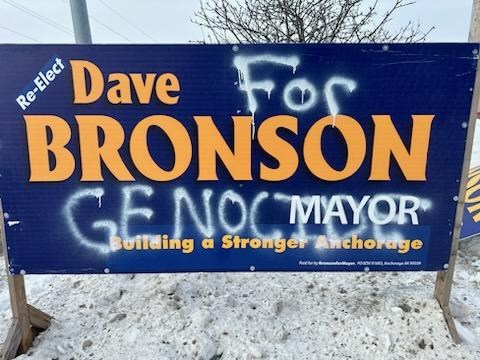
Meanwhile, leftists whose values align with the 907 Initiative/Action have defaced over 15 of Bronson’s campaign signs by scrawling the words such as “GENOCIDE” across them, as shown above.
On the 907 Action’s description of Mayor Dave Bronson, the group says, “Mayor Bronson’s first term was defined by scandal and incompetence. Under his leadership, long-time municipal employees fled, leading to high vacancy rates across city departments, including the Anchorage Police Department. The inability to clear the streets for two straight winters under his leadership led to record school closures and parents having to stay home from work. Mayor Bronson failed to implement a plan to address homelessness, leading to record outdoor deaths and large camps throughout the city’s green spaces. He also approved illegal contracts, and was accused of spying on employees and creating a sexualized work environment. We do not support the reelection of Mayor Dave Bronson.”
About Bill Popp, the group tries to not insult him: “Bill Popp led the Anchorage Economic Development Corporation for 16 years, before resigning to run for mayor. His long business background is a plus, but his absence of serving as an elected official is concerning. Anchorage residents need a leader with experience to get our city back on track. We do not support Bill Popp for mayor.”
The group is very hard against Chris Tuck: “Chris Tuck has a long history in Alaska politics, having served seven terms in the Alaska Legisature. Despite Tuck’s experience and accomplishments, he holds several concerning beliefs, including an anti-abortion stance. In 2020, he joined several other Democrats around the country in writing a letter asking the national Democratic Party to drop their support for abortion rights. Tuck also opposed Real ID on the belief that the IDs contain a GPS tracker, opposed the use of flouride in drinking water and claimed TSA scanners took naked pictures of people. Tuck’s tendency to believe misinformation is concerning. We do not support Chris Tuck for mayor.”
But the group glorifies Suzanne LaFrance, and calls her a nonpartisan, although she is the choice of the Alaska Democratic Party: “Suzanne LaFrance is running for mayor on a platform of returning competence to city government, focusing on public safety, trails, education, addressing homelessness, and affordable housing. LaFrance comes with the experience of serving as chair to the Anchorage Assembly and plans to deliver expected city services by staffing up city departments and instilling a professional, positive workplace culture. She ran on fighting for state and federal resources for the municipality and running a transparent city government. We support Suzanne LaFrance for mayor.”
There appears to be no such voter guide for conservatives in the Anchorage municipal election, which ends April 2.
The No Labels party, a third party launched last year to be somewhere between Democrat and Republican, met on Friday and sealed the decision to proceed with a presidential candidate.
That candidate won’t be Sen. Joe Manchin, who has decided not to pursue a run for president. Both former presidential candidate Nikki Haley and retiring Sen. Kyrsten Sinema of Arizona have ruled out third-party presidential campaigns.
Whoever it is will be has not been revealed but is to be announced around March 14. No Labels has ballot access in 16 states, including Alaska.
“Earlier today, I led a discussion with the 800 No Labels delegates from all 50 states,” said Mike Rawlings, No Labels convention chairman. “These citizen leaders have spent months discussing with one another the kind of leadership they want to see in the White House in 2024. These are some of the most civic minded, thoughtful, and patriotic Americans I have ever met. They take their responsibility seriously. Even though we met virtually, their emotion and desire to bring this divided nation back together came right through the screen. I wasn’t sure exactly where No Labels delegates would land today but they sent an unequivocal message: Keep going.”
The vote among the 800 delegates was nearly unanimous, Rawlings said.
“Now that No Labels has received the go ahead from our delegates, we’ll be accelerating our candidate outreach and announcing the process for how candidates will be selected for the Unity Ticket on Thursday, March 14.”
The Democrats and their liberal media surrogates are worried that the candidate most hurt by the liberal-leaning group will be President Joe Biden. With many of the top-tier candidates dropping out of contention, the party is on the hunt for someone with the “it” factor who can launch the group into orbit again.
In Alaska, the group is considered a limited political party, and its chair is one Darrell Brown Sr. of Palmer, who is a registered nonpartisan voter in Alaska with the Division of Elections, but has no evident political experience in the state.
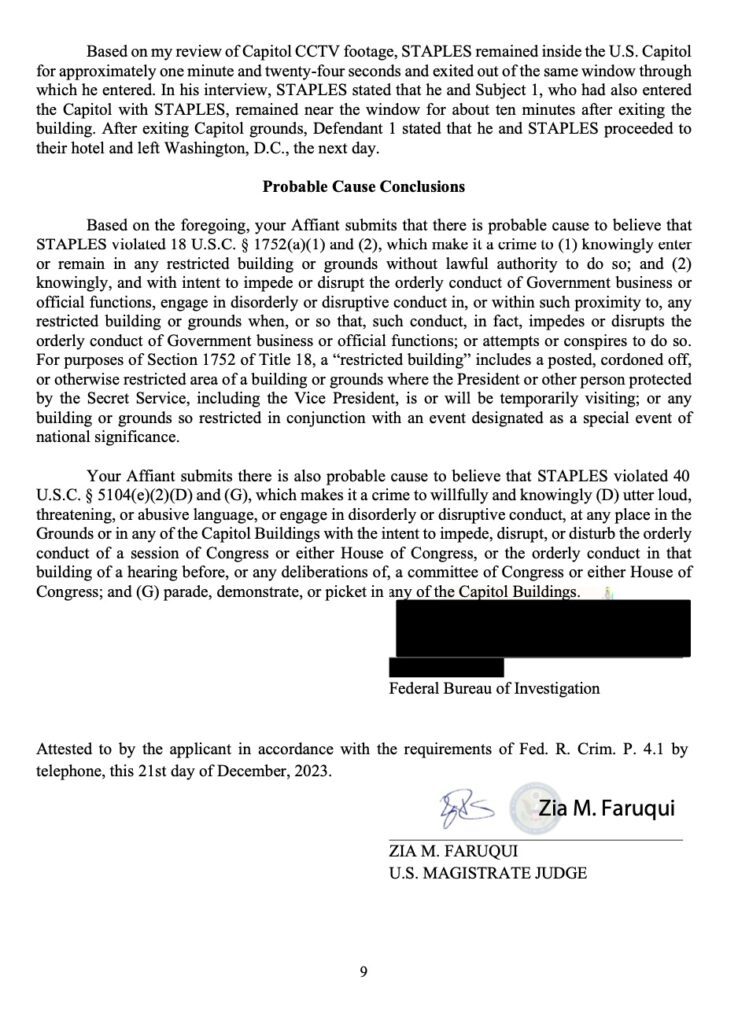
The criminal complaint against a man currently living in Girdwood, Alaska is an example of the Department of Justice’s efforts to round up and bring to justice anyone who entered the U.S. Capitol during the election protests of Jan. 6, 2021. Over 1,000 arrests have been made associated with the breach of the Capitol after a rally held by then-President Donald Trump.
The protest came as the U.S. Senate was preparing to certify the 2020 presidential election, which many to this day believe was riddled with fraud.
The complaint says that Eric Richard Staples, formerly a resident of Wyoming, broke federal laws:
18 U.S.C. § 1752(a)(1)- Knowingly Entering or Remaining in any Restricted Building or Grounds Without Lawful Authority 18 U.S.C. § 1752(a)(2) -Disorderly or disruptive conduct in a restricted building or grounds
40 U.S.C. § 5104(e)(2)(D) – Disorderly or Disruptive Conduct in a Capitol Building 40 U.S.C. § 5104(e)(2)(G) – Parading, Demonstrating, or Picketing in a Capitol Building
The complaint says:
“Beginning in January 2021, the FBI received a number of public tips regarding the possible involvement of Richard Eric Staples, Jr., (“STAPLES”) in the January 6th riot. On October 6, 2021, FBI Special Agent Michael A. Miedona interviewed one tipster who attended high school with STAPLES. The tipster indicated that STAPLES prefers to be called “Eric,” rather than “Richard.”
“The tipster reported that they had seen various Facebook posts concerning STAPLES’s travel to Washington, D.C., and his activities on January 6, 2021. These included posts to STAPLES’s own Facebook page and posts by an individual who has since been charged with criminal offenses arising out of his activities at the Capitol on January 6th (“Defendant 1”) in which STAPLES was tagged.2 The tipster provided screenshots of the posts.
“For example, the tipster provided a screenshot of a post by Staples on January 5, 2021, that he was ‘on [his] way to the snake pit of Washington DC.'”
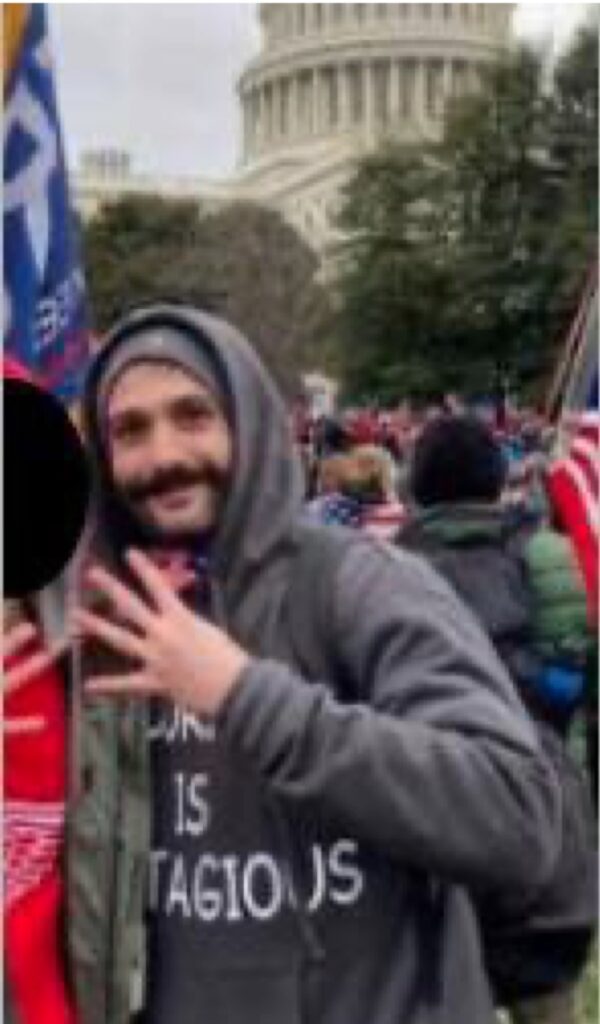
“The tipster also provided a post from Defendant 1 in which STAPLES was tagged. The tipster identified STAPLES in a picture within the post, which showed Defendant 1 and STAPLES standing together with the U.S. Capitol in the background. A reproduction of this image that has been cropped to show STAPLES is provided below.”
A man described as Eric Staples poses in front of the U.S. Capitol.
“The tipster also provided a post by STAPLES three hours after Defendant 1’s post, in which STAPLES stated ‘It is the peoples house, not Chinas.’”
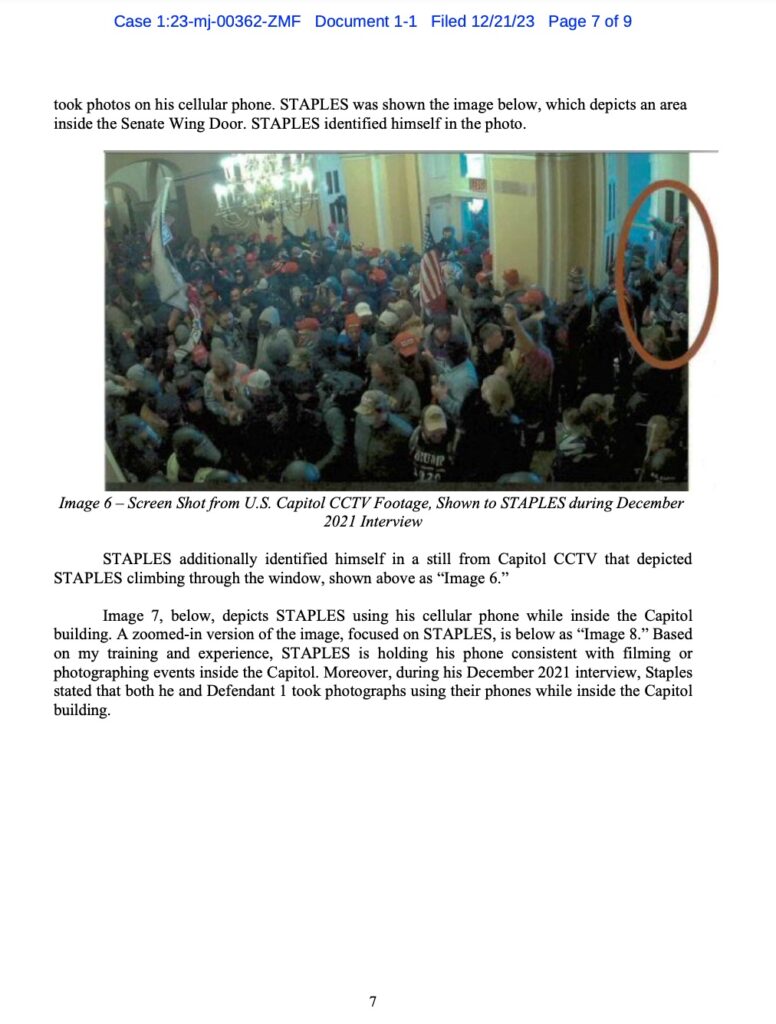
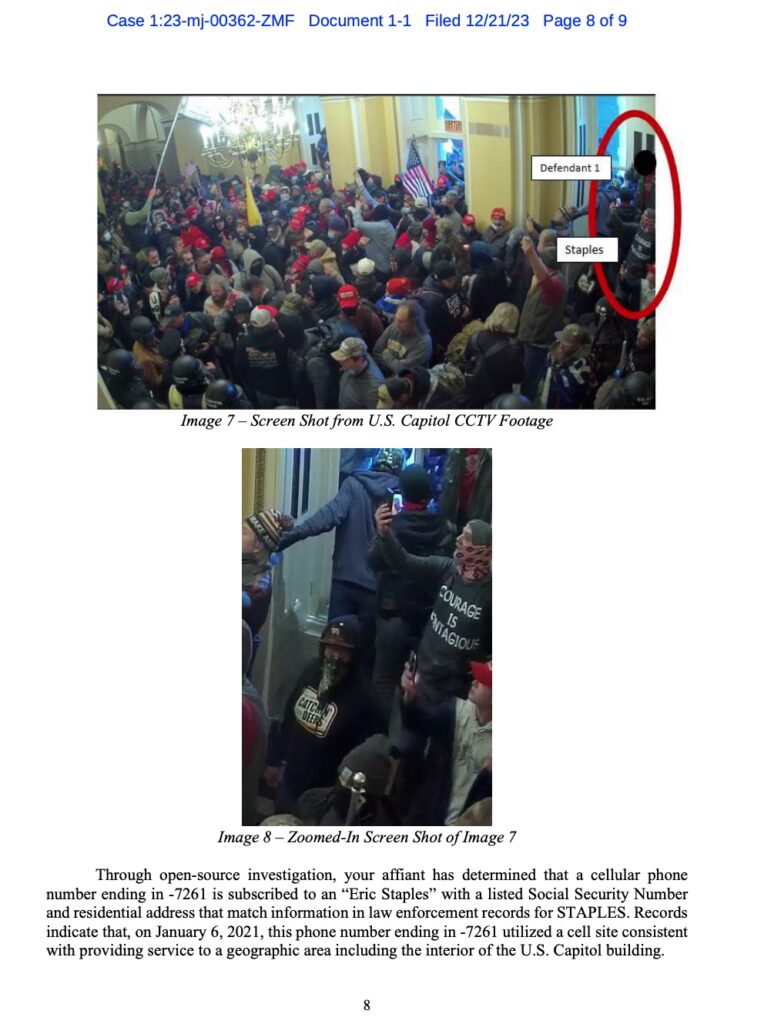
According to an image captured by Capitol’s closed-circuit TV, Staples entered the Capitol through a broken window, and only stayed a brief period of time before leaving. The time recorded by the camera was one minute and 24 seconds, just long enough to snap a few photos.
On Dec. 1 Staples was interviewed by federal investigators at the FBI’s Cheyenne, Wyoming office. Staples had an attorney with him, and admitted to entering the U.S. Capitol through a window. He said that in the photo where he was holding up four fingers, he was indicating “four more years” for President Trump.
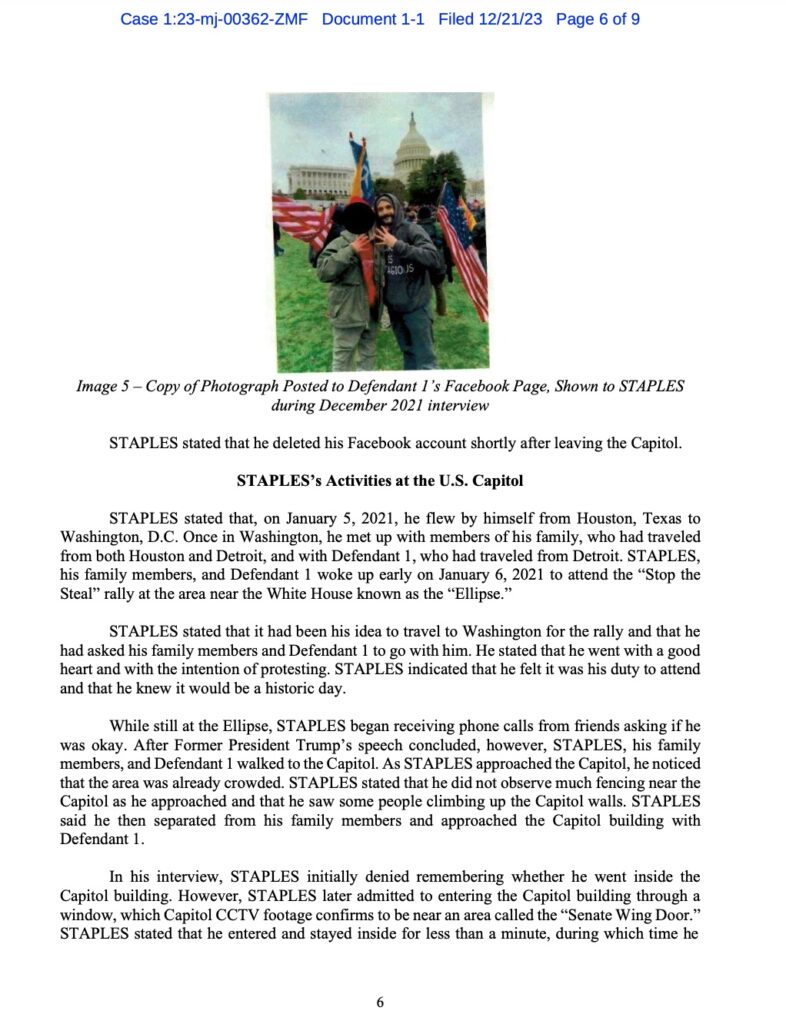
A slide show of the final four pages of the complaint is below:
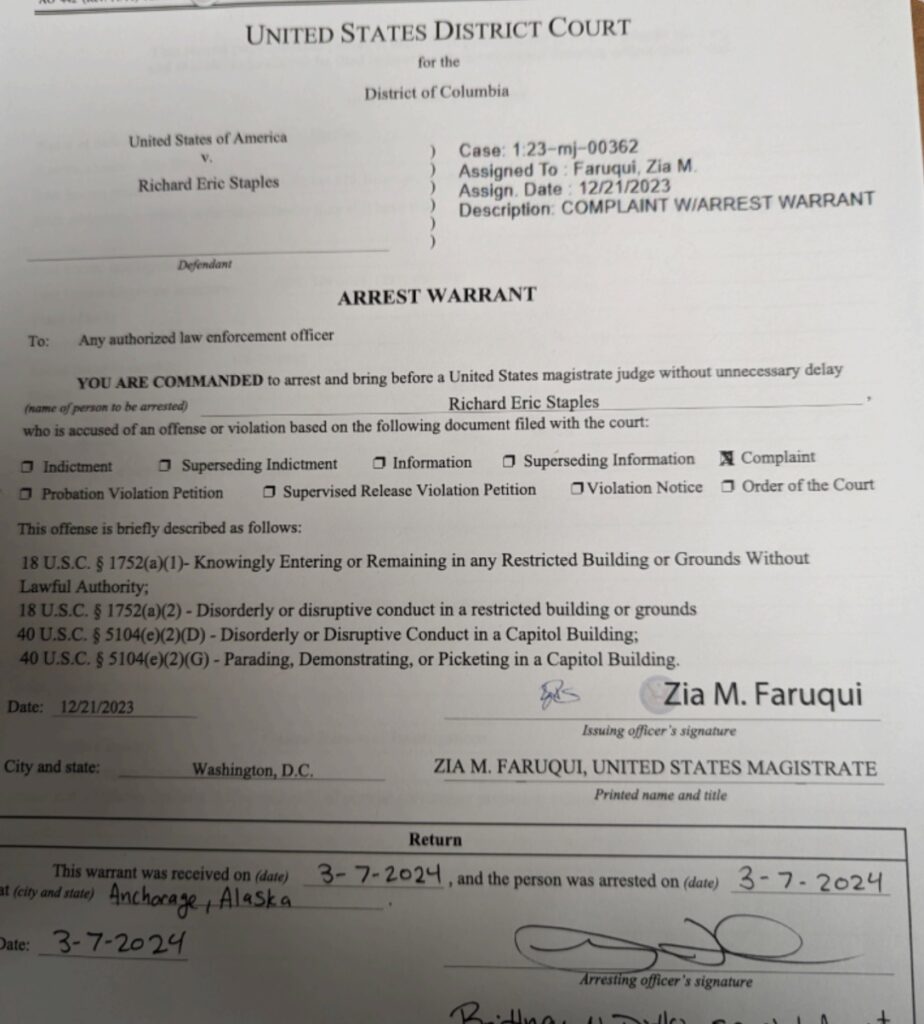
Staples, after Jan. 6, 2021, attempted to erase his social media history and he moved to Alaska, but he has known he was facing arrest since 2021, as he was interviewed by the FBI that year. The arrest came on Thursday.
The warrant for Staples shows what the Jan. 6 arrest warrants look like:
Aaron Mileur of Wasilla pleaded guilty in December of 2022 and received two years of probation. His is typical of plea agreement with Jan. 6 defendants:
A Florida man, Christian Manley, arrested for similar charges while in Anchorage, pleaded guilty on Dec. 7, 2022, and was sentenced to four years of prison, and three years of probation. All of his charges and photos of him are at this link.
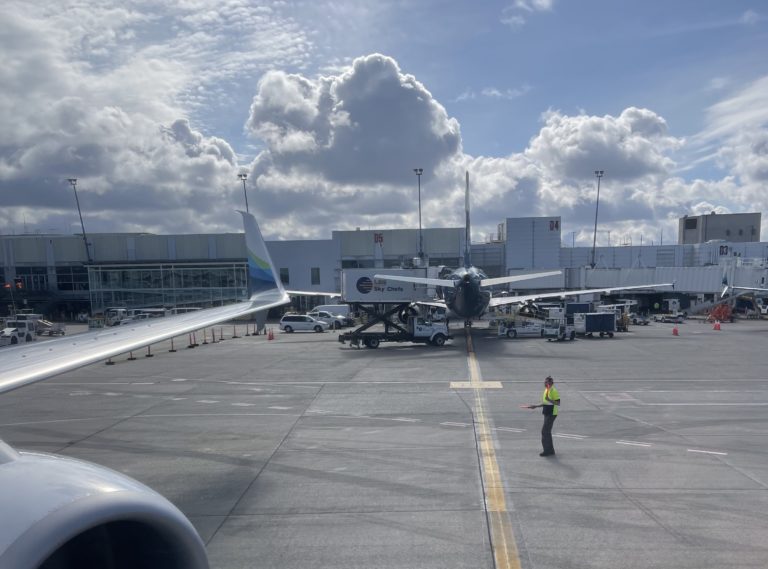
An Alaska Airlines Flight 1437 from Los Cabos, Mexico arrived at Portland International Airport on March 1 with what observers said was an unsealed cargo door, as confirmed by photos released by KOIN.
“It’s unclear how long the Boeing 737 door was open, but sources say passengers’ pets were inside and lived. It is not clear whether the circumstance could have put the flight at risk, but a source told KOIN 6 the flight did not require an emergency landing,” the report said. In the photo published by KOIN, the gap appears several inches wide.
“Upon landing at PDX on March 1, Alaska Airlines flight 1437 was discovered to have the forward cargo door unsealed. There was no indication to the crew that the door was unsealed during flight and all indications point to the door partially opening after landing. Our maintenance teams inspected the aircraft, replaced a spring in the door, tested the door and reentered it into service,” a statement from Alaska Airlines said, as reported by KOIN.
The company is suffering from the blowback occurring after a Boeing 737-9 MAX jet lost a door plug mid-flight in January, as it climbed out of Portland en route to Ontario, Calif. The U.S. National Transportation Safety Board found the bolts that hold the door plug in place were missing when the plane took off, a factory defect, not an Alaska Airlines oversight.
At least 62 passengers aboard that flight are suing the airline and Boeing for at least $1 billion. Another two lawsuits represent another 59 passengers and the damages in those lawsuits are not yet specified.
Alaska Airlines is the fifth-largest airline in North America, as measured by passengers carried, and is the main carrier for the majority of Alaska residents who fly.
The Alaska Supreme Court says that Alaska State Troopers can’t use high-powered surveillance equipment to conduct surveillance of property without cause.
The case involved John William McKelvey, who in 2012 had a marijuana growing operation north of Fairbanks. Based on a tip, Troopers flew over the property and took photos with a telephoto lens, which captured images of some unknown plants growing. With that, they got a search warrant and were able to validate their suspicions.
The court ruled on Friday that the Fourth Amendment of the U.S. Constitution and the Alaska Constitution have strong guarantees to the right of privacy and freedom from unreasonable searches.
“Do the police have to get a warrant before taking pictures of your yard with a zoom lens while flying in an airplane? The State argues that because small airplane travel is so common in Alaska, and because any passenger might peer into your yard and snap a picture of you, law enforcement officials may do the same. We disagree. The Alaska Constitution protects the right to be free of unreasonable searches. The fact that a random person might catch a glimpse of your yard while flying from one place to another does not make it reasonable or law enforcement officials to take to the skies and train high-powered optics on the private space right outside your home without a warrant. Unregulated aerial surveillance of the home with high-powered optics is the kind of police practice that is ‘inconsistent with the aims of a free and open society.’ The Alaska Constitution does not allow it,” the court wrote.
From now on, law enforcement aerial surveillance in Alaska must get a warrant prior to taking pictures of private property from the sky. The ruling is embedded here:
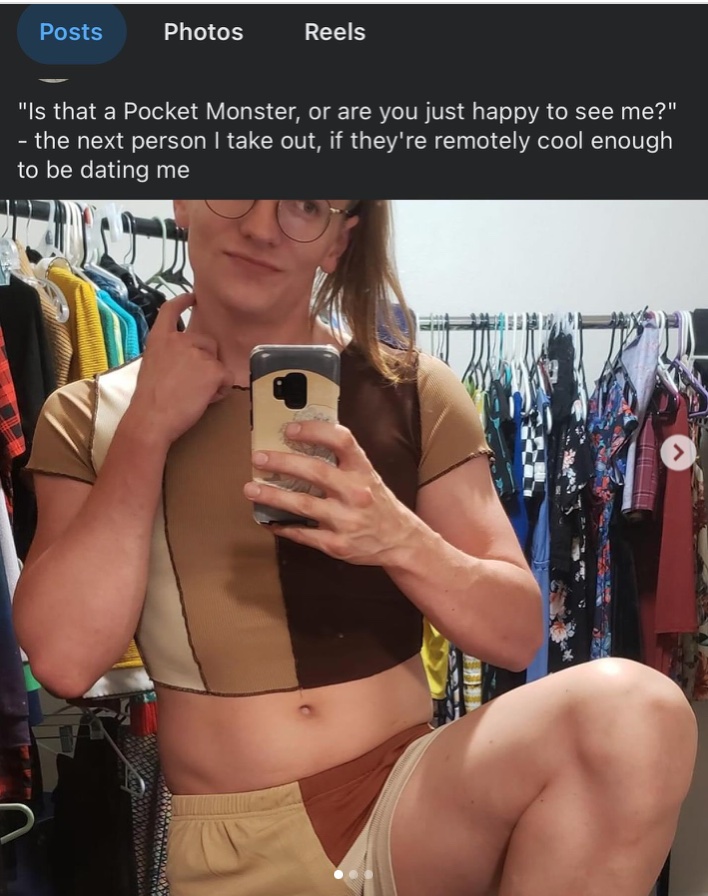
Social media users in Alaska have been reacting to the Must Read Alaska stories about the Dimond High School teacher in Anchorage who, according to the social media account @LibsofTiktok, seems to have a side activity as a porn content provider and has worn a tight dress to class that exhibits the shape of his genitals as he towers over students.
The liberal commentary on the crossdressing, non-binary, gender-confused, Pokemon-playing teacher with a bulge poking out of his dress during class is pure defense.
The thrust of the liberal reaction, shown below, is: “Pay teachers more so they don’t have do produce porn to make ends meet.”
Also, three Anchorage School Board seats are on that ballot with incumbents running who might be feeling the heat after the district has been exposed as coddling a cross-dresser. Those incumbents are Pat Higgins, Dora Wilson, and Carl Jacobs. Running against the liberal incumbents are conservatives Kay Schuster, Angela Frank, and Chelsea Pohland.
A survey of social media groups that have been discussing the story gives a glimpse into the angst the National Education Association union must be having over Dimond High teacher Fletch Fletcher, who is now on administrative leave while the school conducts an investigation. The teachers unions are pushing hard for an increase to the base student allocation from the State of Alaska to local districts like Anchorage. They want a massive increase in education funding and the Anchorage School Board refuses to make any meaningful cuts.
“Look at the source for this. It is Libs of TikTok, the same bigoted POS account that was quite significantly involved in New Benedict getting jumped in the bathroom and dying the next day, among other assorted trash. This is just another blatant attempt to bully and harm those who bigots dislike the open existence of.”
“Really the takeaway here should be that 1) we pay teachers sh** so that they have to do things like onlyfans to make money and 2) why is the student taking pics of a teacher at all? So long as it isn’t illegal, a teacher (or anyone for that matter) should be able to spend their free time however they want to.”
In other words, the teacher who put the poke in Pokemon is the victim of a student documenting the wardrobe failure.
OnlyFans typical content creator income is $150 a month, according to earthweb.com. OnlyFans deducts 20% of a content creator’s earnings. The average account only has 21 subscribers.
The commentators are saying that Fletcher has to do OnlyFans just to pay rent, all the while he has, according to his other social media accounts an extra-curricular night life.
“Sad we pay teachers so little they have to subsidize their income doing OF. But says more about the people seeking out their only fans to ‘blast them’ than it says about the teacher. The only issue I have is if they’re making the students uncomfortable with their clothing. Teachers should be modest in the classroom.”
“This is why I left teaching… so i wouldnt have to deal with the bull**** of you idiots bitching about me in the classroom. And that really sucks because i truly cared about your kids. Still do. But noooooooo because my gender doesnt match up to the sex I was assigned at birth all hell supposedly breaks lose. with no respect go f*** yourself if you think trans people are a problem in education! Not to mention left the state I love because of it.” [Editor’s note, foul language edited and the spelling is his, not ours.]
“Maybe if we paid teachers more they wouldn’t be selling pictures of their bodies for cheeseburger change.”
“What an adult does on their own tie (with other consenting adults) is non of my da** business and is sure is not yours. I highly doubt they are mixing the two occupations whatsoever. P.s. Might not need the OF if teachers were paid for appropriately but that is a whole nother topic.”
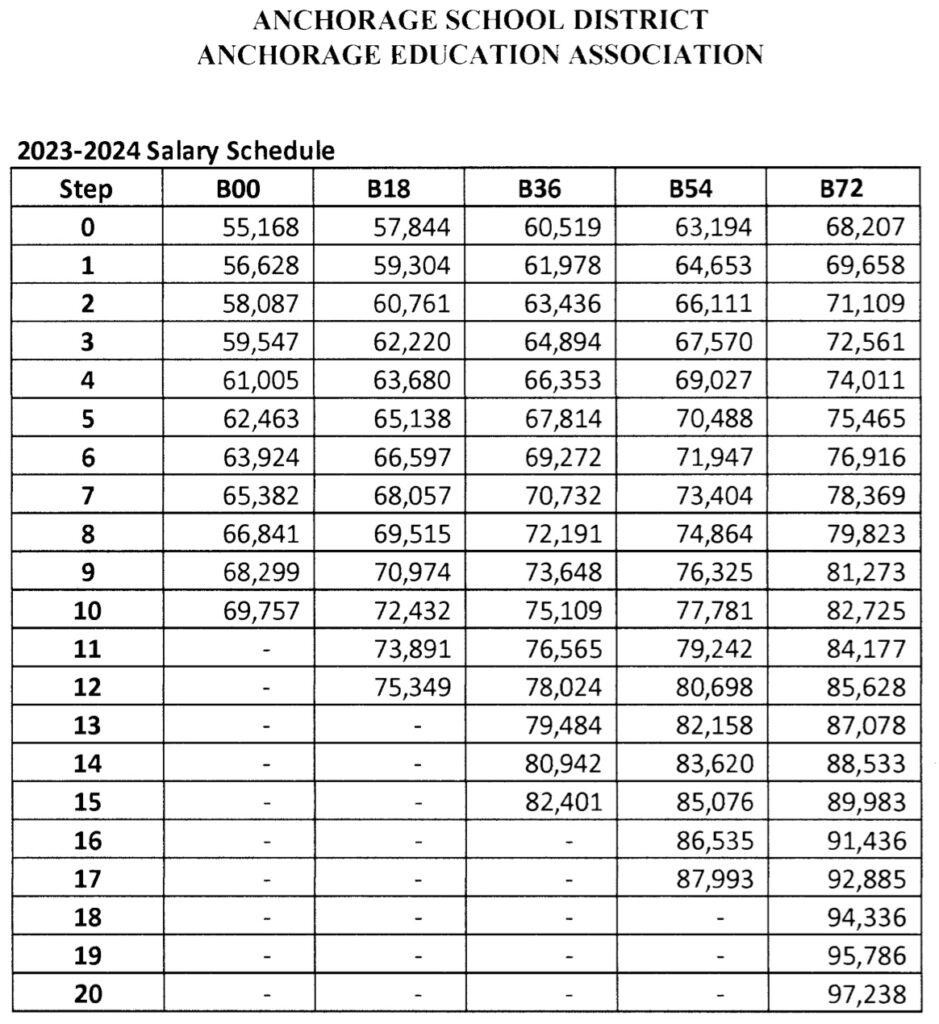
Anchorage teachers have a generous salary schedule for the 182 days per year they work, making on average more than $75,000 plus generous year-long benefits a year.
Many teachers pick up summer school, tutoring, tourism work, and other gigs to fill in their summer months with activity. Some become tour bus drivers, others work in stores and as coaches. This year’s salary schedule shows that at Step 4, a teacher can make as much as $75,000 a year.
Other commentators want to have the people who exposed Fletch Fletcher arrested:
“Libs of TikTok needs to be arrested. The constant doxxing has taken lives. Evil person.”
“While it might not be appropriate and the entire dress code thing is most likely hyperbolic and more snowflakes fear mongering, it’s LibsofTikTok…which means there is a 99% chance it’s made up, created by a stammering bigot c*nt who can’t read and is just angry this is the only grift she can milk with her dead a** personality.”
“Oh noooo!!! Think of the kids!! They’re being exposed to *diversity* we need to do better – would hate for them to grow up compassionate and understanding of peoples differences!”