As promised last month, Republican National Committeewoman Ronna McDaniel made March 8 her last day, after serving as party chair since 2017.
“I’m stepping aside today because I have long promised to put the nominee and their plans for the RNC first. Winning the White House back is just too important for me to do otherwise,” McDaniel said during an RNC spring training meeting on Friday. “President Trump deserves to have the team he wants in place at the RNC.”
Michael Whatley, chair of the North Carolina Republican Party and a Trump supporter, was elected as the new chair. Whatley is from conservative Gaston County, and said he promised to support Trump.
“We will work relentlessly in every state to ensure that it is easy to vote and hard to cheat. Over the next eight months, the RNC will work hand in glove with President Trump’s campaign to deliver on these core missions,” he said.
ABC described Whatley as an “ardent supporter of Trump’s baseless claims of voter fraud in the 2020 presidential election.”
Lara Trump, daughter-in-law to Donald Trump, was elected co-chair during the meeting held in Houston, Texas. She is taking over from Drew McKissick of South Carolina.
“We have one goal. The goal on Nov. 5 is to win and, as my father-in-law says, ‘bigly,'” she said, after being elected.
Before McDaniel stepped down, she said that Trump is now the party’s nominee.
“We recognize [Trump] today for the overwhelming success he has already achieved earning the support of over 90% of Republican delegates, and acknowledge that he is not only our presumptive nominee … that he will be the next President of the United States,” she said.
Cancellation. Threats. Fear. What do these things have in common? Put simply, they’re the time-tested and true intimidation tactics the Left uses to silence any voice that opposes it. Growing up, we’re encouraged to stand up to bullies, but what happens when fighting against the bullies gets you jeers rather than cheers? What do you do when the bullies issue death threats against you, or worse, your family?
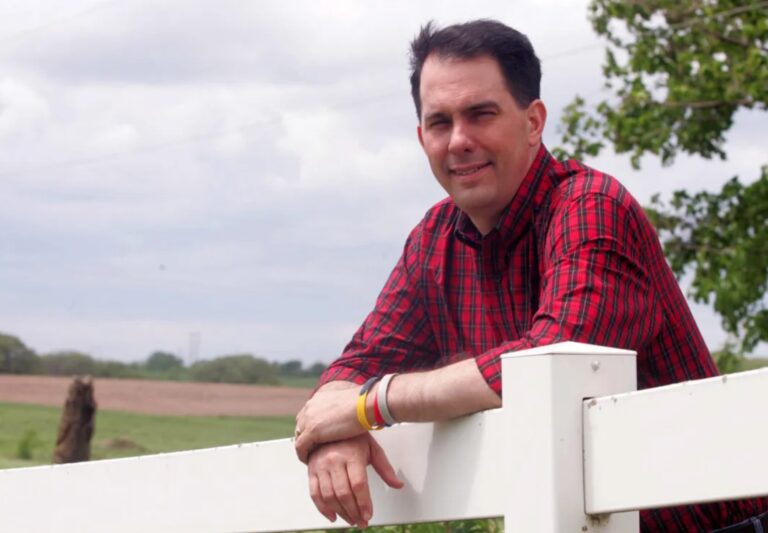
Former Wisconsin Gov. Scott Walker provides insight into this battle on a recent episode of the STAND podcast. Walker and his loved ones faced the intimidation of the Left every day of his governorship.
“We had death threats against me, against my family, my kids…”, he said. “There was one that said they were going to ‘gut my wife like a deer’.”
Walker, however, remained undeterred by the constant assaults against him: “It was all part of that intimidation process. We relied on our faith, family, and friends during those really trying times.”
His continued reliance on both his faith and those closest to him got him through his time as governor and preserved his notoriety as a man unfazed by the labels and scare tactics of the Left.
But Walker pointed out that not everyone need to run for political office to openly defy bullies.
“You don’t have Martin Luther King unless you have Rosa Parks … She had the tenacity in her own quiet way to move from the back of the bus to the front … That moment inspired millions of other people.”
We often forget that quiet acts of defiance and refusing to bend a knee to the cancellation mob is enough to inspire others to do the same, he said.
The Left’s intimidation tactics are still in play because it knows they work. The Left uses threats, intimidation, and even violence to scare its opposition into doing what it wants, but that all unravels when you stand firm.
Both Kelly Tshibaka and Walker come to the same conclusion from similar experiences: Bullies only win if people choose to be intimidated by them.
We can stop empowering those that try to silence us by keeping our voices strong, even if it comes at the cost of being canceled, mocked, humiliated, or losing friends, jobs or social standing. Or, perhaps more simply, by refusing to give up our proverbial “seat on the bus.”
It’s much easier to bully and cancel one, than it is to bully and cancel many, so the more people who stand with courage, the more successfully we can push back on the threats, intimidation, and cancel culture.
If you’d like to hear more about Gov. Scott Walker’s experience facing the Left, you won’t want to miss the newest episode of STAND. You can also view the episode on YouTube, Rumble, and your podcast streaming platform.
Kelly Tshibaka is the host of the podcast, TV, and radio show STAND, and the 2022 Alaska Republican candidate for U.S. Senate. She co-hosts the show with her husband, Niki Tshibaka.
I’ve been listening to my “pundits” lately and they haven’t disappointed in delivering “the news I can use”—depressing, yes; wrong, never; dour, always; accessible, 24/7. It’s awesome. At the heart of it is Tucker Carlson and I like his spin better than anyone else’s.
Carlson’s ability to get me bummed out faster than all others is without parallel. Whether it’s Brett Weinstein, Mike Benz, Vladimir Putin, and countless others, the topics paint a fairly sinister picture that “there’s trouble brewing on the horizon.” The question to this simple guy is: what to do with all this terrible information? Accept it, resist it, join it, what?
A quick drill down on my options: Accept it means to allow whatever to happen no matter the consequences. Resist it means to apply pressure in an opposing direction to inhibit forward movement of the thing one wants stopped, in other words, “fight”. Join it means–similar to acceptance but worse—to choose to go in the direction that Tucker would probably say is bad.
When confronted with “the news I can use” I do the above math and don’t like any of the alternative solutions. They all seem to present a lose-lose. There has been one approach lately, however, that has gained favor with me that is actually pretty simple when “the end of Democracy as I know it“ looms near.
Change the channel and listen to music.
Easy, quick and painless, and there’s no down side. Who’d a thunk it, the power of positive ignorance just might save us all from ourselves. Hell, I feel better already just thinking about it. Make your music selection count. So, turn off the news and go do something.
My something recently was to attend the Fur Rendezvous melodrama put on by the Alaska Sound Celebration. All deep thinkers and even simple guys like me need a reset from this complicated world. Great music, a great story, and fantastic acting was all it took to decompress from all my life stresses. Don’t tell anyone but I had a blast also.
Downtown Anchorage after a fair amount of snow isn’t one of the easiest of places to walk around in. Throw in Fur Rondy barricades, plastic fencing, red cones and you quickly discover that it’s hard to drive around in too. However, if you can power your way to 49th State Brewing on 3rd Avenue, you’re in for a treat. A Theater (the Chinese haven’t managed to tear this one down yet), music, and popcorn – lots and lots of popcorn; in your hair, in your clothes and in places where popcorn should never be.
I’m a dude that likes doing manly things. Attending the theater doesn’t exactly come to the forefront of my psyche when describing what makes me tick. For two hours last weekend, however, I laughed hard, threw popcorn at the “villain” and was stunned at how phenomenal the ladies were who performed in the choir that came with the production.
The only thing that would have pushed last Saturday night into a “perfect evening” would have been the inclusion of monster trucks or something. Suffice to say, I didn’t think about politics, war, the border, nothing – just the ballistics of popped popcorn, how to reach the stage with it, maybe get lucky and hit the villain, and how much fun I had. A big thanks to my wife and kid for making me go.
An even bigger thanks to the Rondy organizers for playing their part(s) putting stuff like this on. And of course, the cast and crew of the Alaska Sound Celebration, volunteers and everyone else involved; you hit a home run this year! Perhaps the best for last; thanks to Anchorage for making me believe that maybe our best days aren’t behind us as my pundits would make me believe.
Enough of this fluff, I’m ready for some more Tucker Carlson. Bring it!
Stan English, a multi-generational Alaskan, is on the board of Alaska Gold Communications, parent company of Must Read Alaska.
The Dimond High School teacher who became world-renown for wearing a tight dress that showed off his prodigious personal effects has been placed on leave.
“We want to provide an update about community concerns relating to a member of our staff. The employee has been placed on administrative leave pending the outcome of our investigation. We understand you have many questions. However, because this is a personnel matter, we cannot provide additional information at this time,” the Dimond High School principal wrote to parents in a new memo on Thursday.
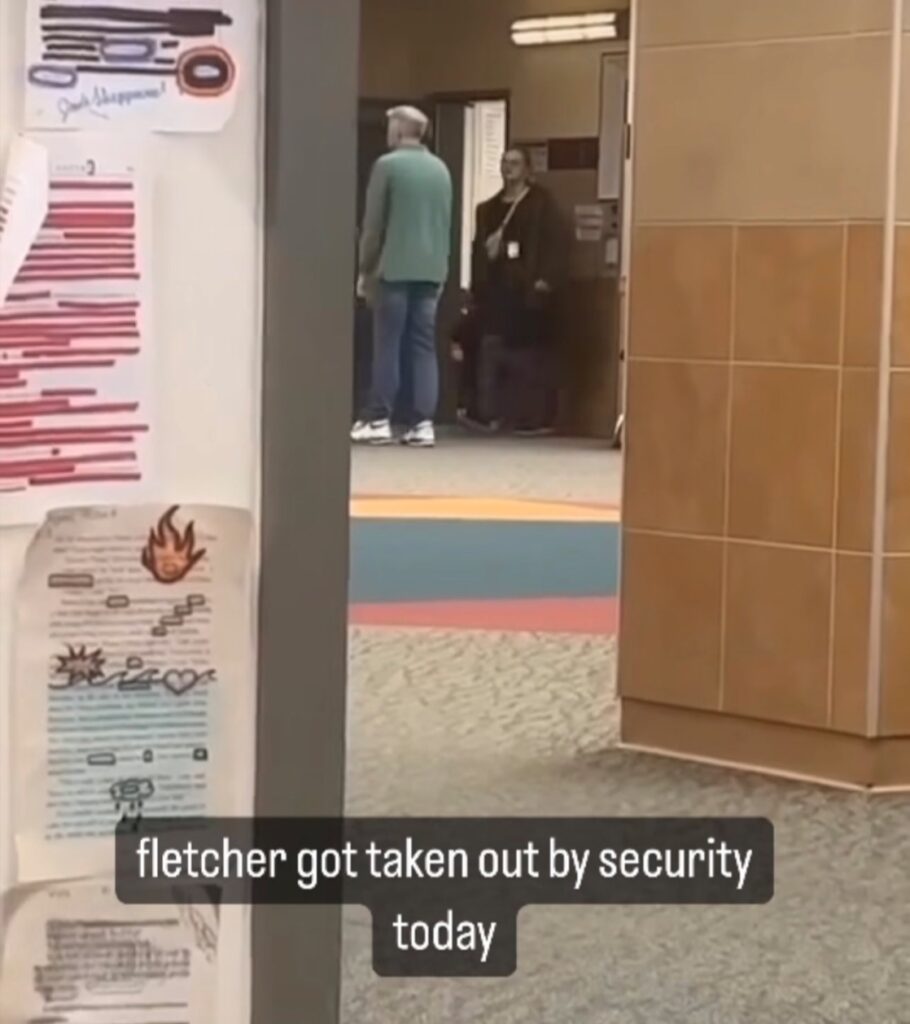
Social media post on @LibsofTikTok says Fletch Fletcher was taken out by security. This is unconfirmed.
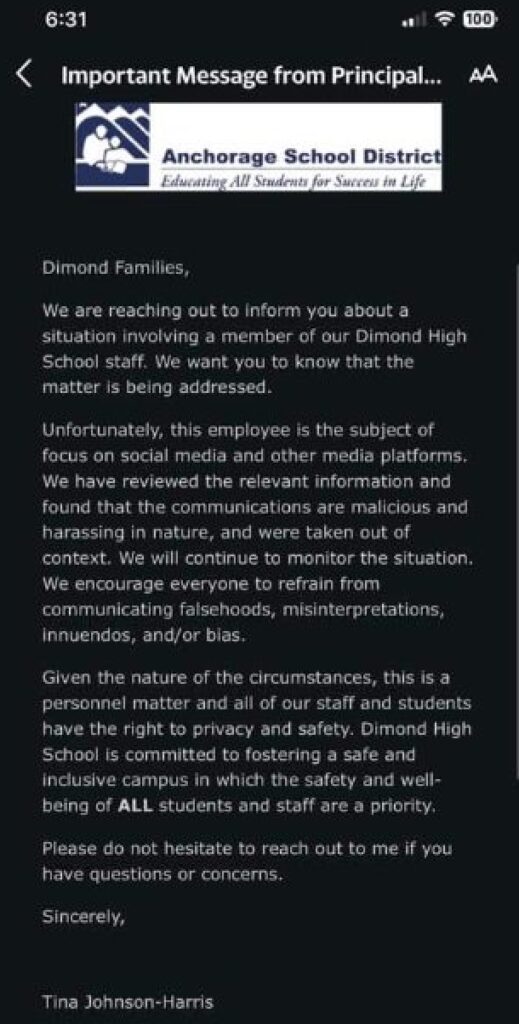
“Thank you for reaching out to me to voice your concerns. We take them seriously and will continue to foster a safe and inclusive campus while ensuring a stable learning environment. The safety and well-being of ALL students and staff are top priority. If you have questions or concerns, please contact my office directly to allow our staff to stay focused on educating our students,” said the memo by Principal Tina Johnson-Harris.
Language arts teacher Fletch Fletcher was the subject of a video that circulated on the X/Twitter account of @LibsofTikTok, in which his dress bulge was perilously close to the hand of a student he was supervising.
Since that video, several photos that have a person who looks like him have been circulating around the school district, and they show him in graphic sexual acts on a porn website.
The principal’s latest memo to parents is markedly different from her first one, which said the matter was private and that people were being mean, specifically that they were “malicious and harassing.”
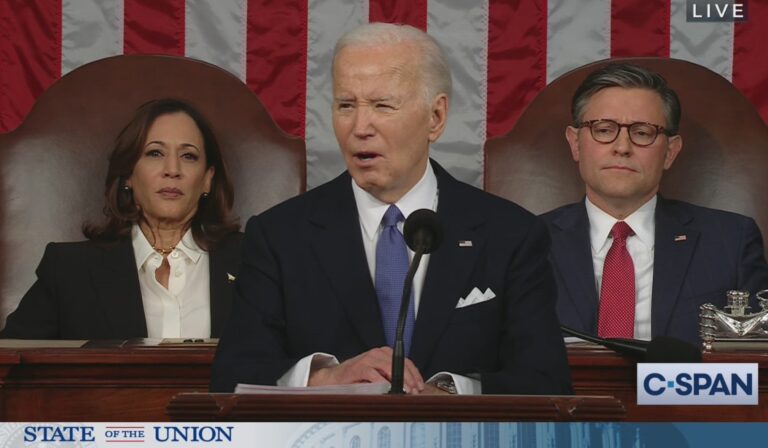
President Joe Biden delivered a combination speech on Thursday — campaign speech and state of the union speech.
“If I was smart I would go home now,” said Biden, 81, launching into what may be his possibly last State of the Union. Then he went into the Dark Biden mode, ripping into all who disagree with him, particularly Donald Trump.
He started out by comparing himself to Franklin D. Roosevelt taking on Hitler. He dumped on Trump numerous times. He took on the free market. He took on the food industry. He took on credit card companies. He took on the size of Snickers bars before he even talked about the border. But much of it was unintelligible.
“He’s speed shouting,” commented Tim Murtaugh, a political adviser. In fact, there are 77 exclamation points in the speech, as it was sent out.
“This #SOTU has attacked American families, the Supreme Court, American corporations that aren’t union, the unborn, Conservatives and more. Who has he championed? China and Russia,” said Rick Whitbeck, Alaska director of Power The Future.
Biden called for lower drug prices, higher salaries for teachers. He called for millionaires to pay their fair share of taxes, as he ignored his son’s scam against the federal Treasury.
Hunter Biden engaged in a four-year scheme in which he chose not to pay at least $1.4 million in self-assessed federal taxes he owed for tax years 2016 through 2019 and to evade the assessment of taxes for tax year 2018 when he filed false returns, the Department of Justice said in its indictment.
Biden badgered the Republicans in the room, mocked conservatives, threatened the entire Supreme Court, whose members sat silently staring at him, and was applauded by Democrats repeatedly, while Republicans sat stoically.
When Rep. Marjorie Taylor Greene of Georgia yelled at him to say the name of the woman murdered by an illegal alien, he responded, “Lincoln Riley,” mangling the name of the slain woman, which was Laken Riley. “Lincoln Riley” started trending on X/Twitter immediately.
Alaska Republican congressional candidate Nick Begich had an immediate reaction: “JoeBiden proved tonight once again: he cannot speak precisely, he cannot think clearly, he cannot lead rationally. He needs to be defeated in November. It’s time to put the people of America first. It’s time to make the bold decisions that will secure the future of our nation. It’s time to return @realDonaldTrump to the White House.”
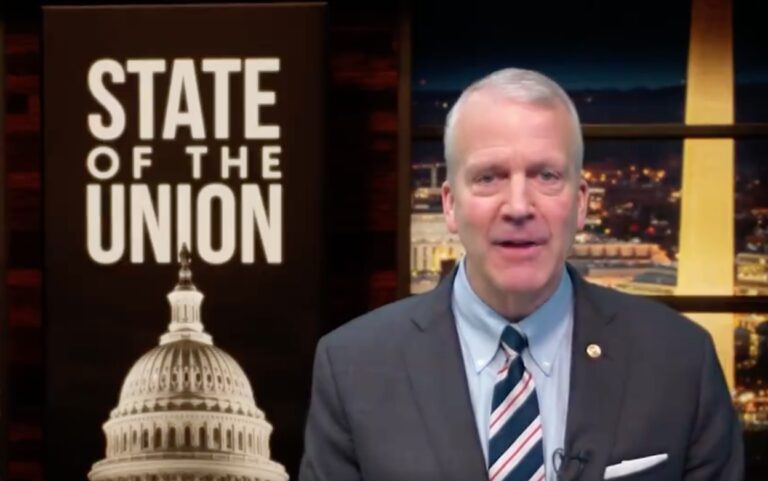
Sen. Dan Sullivan prepared remarks in advance of the speech:
A woman who refers to herself as an Alaska adult content creator for OnlyFans in some places and a “whore” in others has written to the Alaska House Labor and Commerce Committee to ask members to not pass House Bill 254, a proposed law to prevent the publishing or distribution or pornography to minors.
The bill will be heard in the Labor and Commerce Committee on Monday. That committee is chaired by Rep. Jesse Sumner and vice-chaired by Rep. Justin Ruffridge, both Republicans.
The issue comes at a time when a teacher at Dimond High School is alleged to be providing content to an OnlyFans site that shows him engaged in hard-core activities. The firestorm around teacher Fletch Fletcher started when the X/Twitter account known as @LibsofTikTok posted video and still shots of a person alleged to be the language arts teacher in one of Alaska’s largest high schools.
Mattie Yukon, who presents herself as an adult content producer, says in her letter to the Alaska Legislature that she uses her earnings from OnlyFans and Fansly to “support my subsistence lifestyle that was taught to me by my parents.”
She says if she lost this income, “I would replace it by traveling to engage in in person sex work in Fairbanks or Anchorage where serial killers like Brian Steven Smith target sex workers.”
In other words, if House Bill 254 passes, she might lose income, and so the bill hurts her bottom line.
“I only sell my content on OnlyFans and Fansly, which provide age verification services, but I have found my content being sold on various Discord servers and uploaded to tube sites. In some cases the people selling the adult content they stole from me impersonate me. It is almost impossible to get this content removed from Discord servers and police won’t even take reports about people stealing and reselling my content because they say they don’t know if the thief is located in their jurisdiction. I am confident that I could never be charged with the crime of distributing porn to minors, but the burden of proof is much lower in civil court,” she writes to the Legislature.
In other words, what happens to her content after she produces it is out of her control.
“I should not face civil liability for men stealing my content, and you should not allow Representative Vance to use the Legislature to join in men like Brian Steven Smith’s attacks on sex workers,” she says.
On her social media she says that “Once the Life Below Zero ppl came out to test shoot me but they had a morality clause against whores so I’m on OF instead.”
Also opposing the child protection bill is a group of Alaska sex workers, who wrote to the committee, and also used the name of the recently convicted serial killer to make their case:
“The Community United for Safety and Protection (CUSP) is a group of current and former sex workers, sex trafficking survivors, and allies working towards safety and protection for everybody in Alaska’s sex industries. We are outraged that the legislature has allowed Vance’s ongoing war on sex workers during the very public trial of Brian Steven Smith, a serial killer suspected of killing far more sex workers and Alaska Native women than the two he was recently convicted of,” they write.
“HB254 would create a civil liability for adult content creators if a minor accesses our materials. It is already a serious state and federal crime to send pornography to a minor, but the lower standard of evidence in civil courts risks this bill being used against sex workers who did not send content to a minor,” they write.
The sex workers group says that platforms do the age verification for them, “or if we sell independently we require an ID and matching face video. Once someone has accessed our adult content, we can not control whether that person shows it to a minor or resells it.”
These sex workers also raise the Mattie Yukon concern — that there are people who are using their content and posting on other servers without paying them, a theft of their intellectual content.
“There are men who buy our content and then pose as us on discord servers and sell it at a reduced price. “Why isn’t the Legislature doing anything to stop these men who steal and resell our content or the serial killers who target us? Why are you spending time on Vance’s ridiculous war on sex workers?”
The letter is signed by Terra Burns, Maxine Doogan, Amber Nickerson, and Kat McElroy.
The National Decency Coalition has a different perspective. In their letter supporting the legislation, they write:
“We support HB 254 by Representative Vance that requires online pornographers to comply with reasonable age-verification requirements. In just two years, eight states have passed this bill, and it has overcome each court challenge that it has faced in Louisiana, Utah, and Texas. When the bill first passed in Louisiana, a spokesperson from pornhub told CNN that since the Louisiana law went into effect, traffic from that state had fallen 80%. Today, pornhub has shut down service completely in Louisiana and each state that passes this law.
“Today, children generally have instant access to online pornography all the time. Even when a parent safeguards all devices in connection with their child, according to the Kaiser Family Foundation, 1 in 10 pornography sites still remain accessible. According to Pew Research, only 39% of parents actually use filtering/blocking software, which leaves 61% of children exposed. Additionally, it’s inevitable that a child will have a friend with an unprotected device, which is also a common form of exposure- peer to peer. This is a crisis, and it’s evidenced by 18 states in the U.S., since 2016, declaring pornography as creating a public health crisis or hazard in their state,” the group says.
In fact, it seems many children in Anchorage have been exposed to images from the OnlyFans account said to belong to the teacher at Dimond. Parents report to Must Read Alaska that their children have shown them the images that are believed to be of Fletcher.
“Like the online sale of alcohol, nicotine, and vaping, and online gambling, it’s time for online pornographers to bear the reasonable burden of ensuring children aren’t gaining access to harmful material. We support this proven effort to protect children from online pornography, and urge legislators in Alaska to vote in support,” the pro-decency group says in support.
Chalk it up to wardrobe failure: Fletch Fletcher, a language arts teacher at Dimond High School in Anchorage, made social media this week, with his name and physique featured in the “Libs of TikTok” channel on X/Twitter.
In a video apparently shot by a student, a teacher wearing a dress appears to have his hardened penis tenting out of the fabric, right at eye level where a student under his watch is working on a computer. The distance between the erection and the student’s hand is mere inches. That teacher is identified as Fletcher, although not verified by Must Read Alaska as such.
Meet Fletch Fletcher. A male teacher at @ASDschools who now identifies as nonbinary. He likes to wear tight dresses to school so his bulge sticks out. I’m told he also wears very tight pants and it makes the students extremely uncomfortable.
According to the Libs of TikTok account, Fletcher also wears tight pants that show his bulge and make students uncomfortable.
Students of Dimond High School who are familiar with the situation may contact Must Read Alaska in the comment section below and ask that their names be kept private if they have information that is pertinent to this report.
Alaska Sen. Dan Sullivan, speaking immediately after President Joe Biden’s fourth State of the Union address late Thursday night, called the speech partisan and divisive.
“It’s really hard to understand the president when he’s yelling, mumbling, and speaking real fast,” Sullivan said. Sullivan said it was a bad practice to yell at Congress if Biden wants a good relationship with the legislative branch. Watch Sullivan’s immediate reaction to the speech — completely unscripted — here:
Tonight was a missed opportunity for @POTUS to unite the country on pressing national security issues. Within minutes, his speech became one of the most partisan and divisive SOTU speeches I’ve ever heard in the Senate. pic.twitter.com/5ZpQ8lo56S
Before the State of the Union, Sullivan sent a video message: “56: That is the number of times this administration has chosen to side with Lower 48 extremists over Alaskans. Tonight, I hope President Biden announces a cease fire in his war against Alaskan working families. Unfortunately, that appears unlikely.”
Sullivan was right. Instead, Biden repeated his goal of cutting the country’s greenhouse gas emissions in half by 2030, heralding is as the “most significant action on climate ever in the history of the world.” It appears unlikely he can achieve that in six years.
Sen. Lisa Murkowski made brief official comments on the speech, calling it the most partisan political speech she had heard in years.
“He had lots of energy going on and I know that was part of the show, but I kind of felt it was a set up to be a campaign rally and I guess I’m enough of a traditionalist to not want to hear that level of politics injected into the State of the Union speech, so I was disappointed,” she told reporters.
Rep. Mary Peltola had no comment on the speech. Peltola, who wore a white kuspuk in solidarity with the Democrat women lawmakers in the House chambers who were dressed in their pro-abortion theme, pivoted from the spectacle of the incoherent president whom she endorses for reelection. On Friday morning she posted on X/Twitter a picture celebrating National Women’s Day through the lens of Native women.
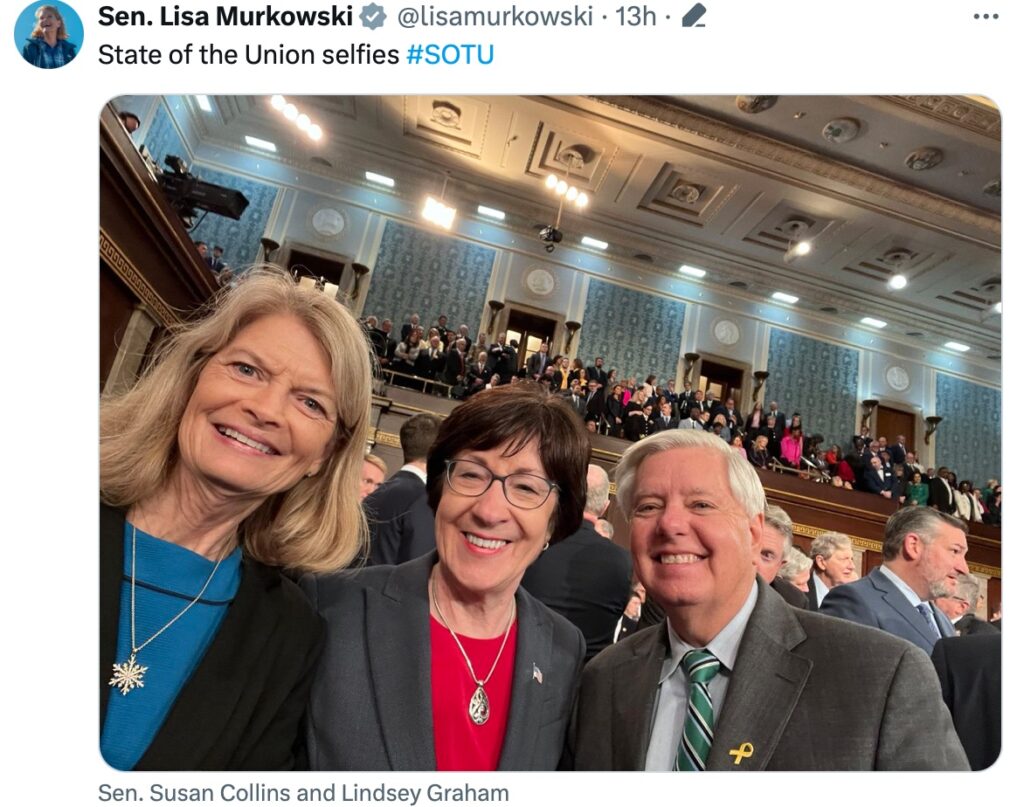
Murkowski posted a selfie with Sen. Susan Collins and Sen. Lindsey Graham.
Michael Hart of San Diego was arrested March 4 and charged with smuggling greenhouse gases into the United States from Mexico and selling them for profit. The U.S. District Attorney said this is a violation of regulations meant to curb the use of greenhouse gases and slow climate change. She said this was the first instance of such an arrest, but won’t be the last.
Hart, 58, violated the American Innovation and Manufacturing Act of 2020, which prohibits the importation of hydrofluorocarbons, commonly used as refrigerants, without specific permits allowances by the Environmental Protection Agency. He is accused of hiding the tanks of coolants under tools and a tarp in his truck and not declaring them at the border.
Hart posted the refrigerants for sale on OfferUp, Facebook Marketplace, and other sites, and sold them. In addition to greenhouse gases, the indictment alleges Hart imported HCFC 22, an ozone-depleting substance regulated under the Clean Air Act.
“This office is at the forefront of environmental prosecutions, and today is a significant milestone for our country,” said U.S. Attorney Tara McGrath in San Diego. “This is the first time the Department of Justice is prosecuting someone for illegally importing greenhouse gases, and it will not be the last. We are using every means possible to protect our planet from the harm caused by toxic pollutants, including bringing criminal charges.”
“The illegal smuggling of hydrofluorocarbons, a highly potent greenhouse gas, undermines international efforts to combat climate change under the Kigali Amendment to the Montreal Protocol,” said David M. Uhlmann, EPA Assistant Administrator for the Office of Enforcement and Compliance Assurance. “Anyone who seeks to profit from illegal actions that worsen climate change must be held accountable. This arrest highlights the significance of EPA’s climate enforcement initiative and our efforts to prevent refrigerants that are climate super pollutants from illegally entering the United States.”
Hart made his first appearance in federal court this week and pled not guilty. His next hearing is before U.S. District Judge Jeffrey T. Miller for motion hearing/trial setting on March 25, at 11 a.m.
The EPA, HFCs are potent greenhouse gases that cause climate change and are used in applications such as refrigeration, air-conditioning, building insulation, fire extinguishing systems, and aerosols.
“The use of HFCs has been rapidly increasing worldwide due to the global phaseout of ozone-depleting substances (ODS) and increased demand for refrigeration and air conditioning,” the government said.
The Montreal Protocol on Substances that Deplete the Ozone Layer is a treaty adopted in 1987 and ratified by virtually every country, the federal government said. The Montreal Protocol required the gradual phase out of ozone depleting substances, with different timetables for developed countries like the United States, and developing countries like Mexico.
In the United States, the Montreal Protocol was implemented in 1990 by an addition to the Clean Air Act, which covers Stratospheric Ozone Protection.
That addition identified HCFC 22 as a regulated ozone depleting substance. Before 2020, EPA regulations that governed ozone-depleting substances made it illegal for anyone to import a regulated ozone-depleting substance in an amount exceeding that individual’s consumption allowance, subject to certain exceptions. On January 1, 2020, consumption allowances for HCFC 22 were eliminated and it became illegal to import HCFC 22 for any purpose other than for use in a process resulting in their transformation or their destruction, the U.S. Attorney said.
The Kigali Amendment to the Montreal Protocol is another international agreement designed to phase down the production and consumption of greenhouse gases such as HFCs, which are commonly used alternatives to ozone-depleting substances and are already controlled under the Montreal Protocol.
The Kigali Amendment seeks to phase down the production and consumption of HFCs by 80 to 85 percent by 2047. The AIM Act authorized the EPA to phase down the production and consumption of HFCs in a stepwise manner. As part of the AIM Act, Congress added an additional list of regulated substances, which include HFC 32, HFC-125, HFC-134, HFC-134a, HFC 143 and HFC 143a. Refrigerants marketed as HFC 404a, 407a, 407c and 410a contain these regulated substances. The listed HFCs are some of the most commonly used HFCs and all are saturated, meaning they have only a single bond between their atoms and therefore have longer atmospheric lifetimes.
Beginning on January 1, 2022, EPA regulations prohibit any person from importing bulk regulated HFCs, except by expending, at the time of import, a consumption or application-specific allowance issued by the EPA. No person may sell or distribute, or offer for sale or distribution, any regulated HFC that was imported illegally.