Thursday, June 18, 2026
Home Blog Page 494

Chugach Electric Board sorts through what it would take to extend decision on Eklutna dam removal

19

Removing a major source of energy by dismantling the Eklutna Dam was the topic of both an open and a closed meeting of the Chugach Electric Association Board of Directors on Monday. The meeting had been abruptly called, poorly advertised, and the board went into executive session for at least a half an hour.

The board, which is the governing body for Anchorage’s electric coop, considered recent policy pronouncements by the Anchorage Assembly.

The Assembly majority, including the chairman of the Assembly Chris Constant, wants to remove the dam and restore salmon runs, but also wants to postpone the decision until there is a governor in place that might be more supportive of the idea. Although the Assembly has not stated that as their motive, Gov. Mike Dunleavy has the authority over the dam’s future, and the Anchorage Assembly is on opposite ends of the political spectrum.

Eklutna provides a major amount of electricity used in Anchorage and the Mat-Su Valley. It was constructed by the U.S. Bureau of Reclamation between 1951 and 1954 for less than $30 million and provides 177,438 megawatt hours energy, enough energy to power more than 24,600 residential homes for an entire year.

The project has proven durable and after the March 27, 1964 mega-earthquake, returned to partial operation within about 30 minutes.

Environmentalists want the dam removed because the river was once a minor salmon run. But even if the owners of the dam — Matanuska Electric Association, the Municipality of Anchorage, and Chugach Electric Association — removed the dam, it would only return the flow of the Eklutna River to what it was before the dam went up, and that means no fish, because there were no salmon swimming upstream before the dam went in. That’s because hydro projects downstream in prior years had already modified the river to the point where it was not a salmon run.

The Project was sold in 1991 to the Municipality of Anchorage, Chugach Electric Association, and Matanuska Electric Association. The municipality sold off its utility to Chugach and is now owner of 52% of it through the ML&P and Alaska Waste and Water Utility. When the sale of ML&P went through, the Municipality was supposed to designate a liaison for the Eklutna Dam, and didn’t. So the Muni is an owner but has no representation.

As part of the 1991 sale, the utilities entered into an agreement with the U.S. Fish & Wildlife Service to develop and propose to the governor a program to protect, mitigate damages to, and enhance fish and wildlife impacted by the development of the hydroelectric project. The governor appears to be under no obligation to agree with whatever the proposal might suggest. For this reason, the liberals on the Anchorage Assembly are working to get a delay, while they work on electing a Democrat governor in 2026.

Notes from the Chugach open meeting on Monday:

1. Chugach Electric Board’s legal counsel appears to disagree with the Anchorage Assembly on several issues.

2. Chugach Electric does want to establish year round flows and restore habitats.

3. Board Member Susanne Fleek-Green stated that all parties can agree to extend, as the Assembly has requested, because there is no specific rule that says all parties cannot agree to an extension. 

4. The 1991 agreement with USFWS will likely be enforced in federal courts.

5. Technically, Anchorage Municipality has no representative to come to the table and vote and agree on all alternatives because it is no longer an owner. 

6. CEA would like to make sure owners agree together.

7. There were 380 copy-and-pasted letters sent in favoring dam removal, with 275 of them from out of state.

8. The public may continue to provide comment on the proposal to remove the dam until Feb. 19 by writing [email protected].

Carmela Warfield announces she is a candidate for Alaska Republican Party chair

Carmela Warfield, currently an officer in the Alaska Republican Party as its Region 5 representative, has announced her intention to seek to lead the party when it elects a new chairperson at its statewide convention in Anchorage, April 19-21.

She already has the endorsement of the Mat-Su Republican Women’s Club, the Valley Republican Women of Alaska, the Anchorage Young Republicans, and Mat-Su Young Republicans, as well as many personal endorsements from around the state from those who will be attending the convention.

Warfield said, “In this critical time, we must strive to be, as President Reagan said, the shining city upon the hill. Our Party must be well-organized, professional, knowledgeable, and well-funded. Through our efforts, we will serve as an example to our communities and our fellow Republicans.”

Warfield has served in her Hillside Community Council in Anchorage and briefly filed a letter of intent to run for Anchorage Assembly in 2023, but withdrew.

Already announced for Alaska Republican Party chair is Nikki Rose and Mike Robbins, both of Anchorage.

The Alaska Republican Party has over 143,000 registered voters in what is is the largest political organization in the state.

Denali Brehmer gets 99 years for murder of Cynthia Hoffman at Thunderbird Falls

15

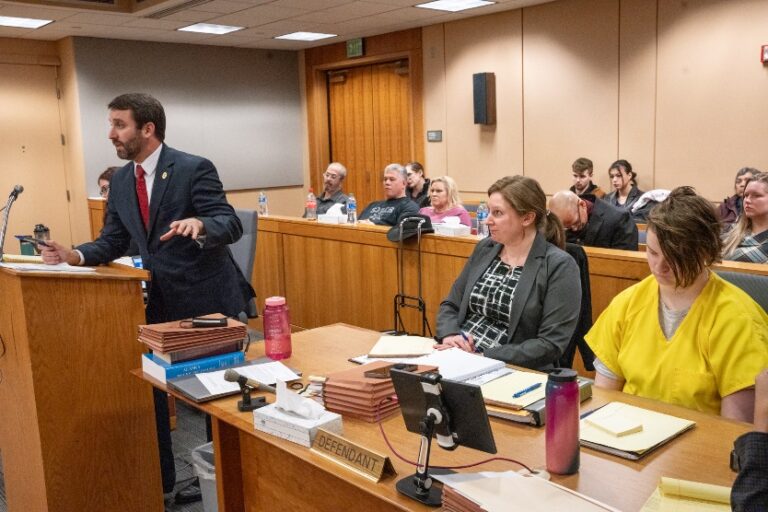
Denali Dakota Skye Brehmer, of Anchorage, now 24 years old, was sentenced by Anchorage Superior Court Judge Andrew Peterson for the murder of Cynthia Hoffman near Thunderbird Falls in Chugiak. The murder was committed on June 2, 2019.

Brehmer had pleaded guilty a year ago to one count of Murder in the First Degree.

Hoffman, who thought Brehmer was a friend, was lured by Brehmer and other friends to the banks of the Eklutna River and shot near Thunderbird Falls. Then, Brehmer and the accomplices dumped her body into the river. Investigators later learned that Darin Schilmiller had solicited the murder of Hoffman from Brehmer.

Schilmiller also solicited child pornography from Brehmer, conduct that led to additional federal charges.

Brehmer’s sentencing occurred over three days. The court was permitted to sentence Brehmer to a sentence of active imprisonment between 30 and 99 years.

The State requested a sentence of 99 years with none suspended and a “worst offender” finding.

Brehmer requested a sentence of 80 years with 20 years suspended.

“The Court should find that Miss Brehmer engaged in one of the most serious crimes that we have in Alaska,” said Anchorage Assistant District Attorney Patrick McKay. “She executed Cynthia Hoffman in a murder-for-hire plot. She conspired with numerous other individuals in and outside of Alaska, including juveniles, forever altering everybody’s life. She may not have pulled the trigger, but this never would have happened it if it weren’t for Denali Brehmer.”

The murder of Hoffman was a premeditated, and was a murder-for-hire, Peterson said, calling Brehmer’s conduct “cold, calculated, and carried out to a ‘T’.”

Judge Peterson said he found that Brehmer’s conduct was among the most serious first-degree murder cases and among the most serious contract killing cases. Judge Peterson described watching a video of Cynthia Hoffman’s last moments where she was observed duct taped on the ground at Thunderbird Falls “…one of the most difficult pieces of evidence I’ve had to watch in this position.”

Judge Peterson said Brehmer showed no remorse after the murder and, in fact, went on to engage in other criminal conduct.

Although Brehmer was a youthful offender and “youth matters,” Peterson said Brehmer clearly knew what she was doing and that this was not merely “youthful indiscretion.”

Brehmer was sentenced to 99 years with none suspended and was found to be a “worst offender.”

Darin Schilmiller, of Indiana, was sentenced to 99 years with none suspended for his role in the murder.

Caleb Leyland’s sentencing is scheduled for June 10, 2024, in front of Judge Peterson.

Kayden McIntosh’s case is pending trial. McIntosh is the one who is accused of actually pulling the trigger on the weapon. He has had several court dates over the years.

This case was investigated by the Anchorage Police Department’s homicide unit, the Federal Bureau of Investigation based out of Alaska and Indiana, and the Indiana State Police. Brehmer is in the custody of the Alaska Department of Corrections.

Rick Whitbeck: Thanks to fossil fuels, Anchorage averted a crisis this winter

By RICK WHITBECK | POWER THE FUTURE

A recent joint hearing of the House and Senate Resources committee I attended in Juneau laid bare the importance of natural gas to Southcentral Alaska residents and businesses.

The brutality of this winter has been a wake-up call for Southcentral Alaskans about the importance of reliable energy. When temperatures collapsed to the -20s in parts of Anchorage and -40s in parts of the Mat-Su, reliability was the difference between life and death other companies were looking for.

In a nutshell, natural gas saved the day in our moment of need. During the coldest week of winter, Cook Inlet Natural Gas Storage Alaska, a gas storage system managed by Enstar, started experiencing issues with a portion of its reservoir network, compromising its ability to supply a full complement of gas to utility customers throughout Southcentral Alaska.

Thanks to fossil fuels, a crisis was averted. Even as we used a record amount of natural gas on Jan. 31 — 268 million cubic feet, versus a typical January demand of 160 million cubic feet — our heat and power systems remained intact. Hilcorp, Alaska’s dominant natural gas producer, increased its production beyond its contracted volumes. Other Cook Inlet producers ran full throttle. This was the difference between heat and light in our homes instead of cold and darkness.

It should be a moment to celebrate. Traditional energy solutions worked, as they have in Southcentral Alaska since the Swanson River field was first developed in the 1950s.

Instead of a simple thank-you, lawmakers were more interested in scoring political points to advance their green agenda. Sen. Bill Wielechowski harangued Hilcorp over its profit margins rather than focusing on assisting producers to be able to drill gas. Rep. Donna Mears’ questioning of presenters took on a “petroleum is bad” tenor. It was language consistent with a state Democratic party platform considering a call for an end to all oil drilling and fracking.

The level of indignation toward the very companies capable of solving any supply shortages was astonishing. Rather than learn from the experience, the legislators were content to have avoided the bullet while acting as if nothing had happened and the threat had been permanently averted.

That’s not the way to govern. Turning away from reliable energy sources is no future.

Alaska is blessed with abundant natural resources. We have a century’s worth of coal reserves in Healy, nearly 150 years of Railbelt-wide demands of natural gas waiting to be brought down from the North Slope and nearly two trillion cubic feet of gas waiting to be produced in Cook Inlet.

Look at all the progress underway in our state from traditional sources of energy. Companies like Santos are hard at work extracting oil from the Pikka oil field. Ditto with ConocoPhillips Inc. and its Willow project on the North Slope. Hilcorp has revitalized the Prudhoe Bay area, and there are other companies looking to begin production in the coming years.

Another boom could be just around the corner. The issue isn’t a shortage of supply. It’s a lack of willpower to invest in projects and producers. Finding paths to get those supplies to market should be the priority for lawmakers the rest of this session. This mission most certainly should take priority over anti-market renewable portfolio standards.

Without reliable, affordable energy for Southcentral — and all of the Railbelt — people living on the margin from inflation and higher prices are at risk of falling off the financial cliff. Outmigration will explode, businesses will close, homelessness will increase, and social unrest won’t be out of the question.

Renewables are not the answer and won’t be anytime soon. In the recent cold snap, hydro, wind, and solar accounted for less than one-seventh of our power. If we are to survive another rough winter storm, our government officials should be calling for more of what works — Alaska natural gas — and not appeasing their green donors who reside in warm San Francisco and balmy Seattle who invest in failed wind and solar.

If we had listened to those pushing a not-ready-for-prime-time renewables “solution,” the result could have been widespread burst pipes in homes and businesses. The damage to the underlying infrastructure could have taken months or even years to fix. Even worse, under those conditions, widespread blackouts and even loss of life could have occurred. These are very real — and tragic — consequences if we don’t have heat and power available when we need it.

But we did because fossil fuels delivered. They are the good guys. Thankfully, they are in plentiful supply in our state. They deliver, they work, they power our everyday lives, and will for decades.

Rick Whitbeck is the Alaska state director for Power The Future, a national nonprofit organization that advocates for American energy jobs. Contact him at [email protected]and follow him on X (formerly Twitter) @PTFAlaska. This originally appeared in the Anchorage Daily News.

Arctic Man, the wildest, fastest race in Alaska, canceled in ’24 due to state bureaucratic slowdown

“Go fast or go home” is the motto of Arctic Man. This year, the race is staying home. The delays and jacked up costs from the Department of Natural Resources became so unreasonable for Arctic Man, a ski, snowboard, and snow machine race that has taken place for decades, that the race has been canceled this year, organizers said.

It’s been canceled before, due to weather and one year because of the Covid pandemic, but this time it was because by the time DNR came up with the promised five-year permit structure, the cost was a surprising $100,000 a year, and the organizers said they couldn’t do it — there was too little time left to raise the money.

DNR disputes that characterization. In a note, the agency said, “The first renewal option was exactly the same as previous permits (annual $6,480 multi-day commercial land use permit plus $4 fee for each registered event participant. In 2019 the total cost for permitting the 4-day event on State of Alaska land was $6,640). The second permit option could reach $10,000 annually based on the number of attendees ($1,440 multi-day commercial land use permit plus $4 visitor day use fees for each registered parking spot and each registered event participant).”

The race is a much-loved event for extreme sports enthusiasts all over the world. Skiers or snowboarders begin at 5,800 feet and dropping 1,700 feet to a canyon where they meet up with their snow machine partner-driver and catch a tow rope while on the go, pulling the skier 2.4 miles up hill at speeds of up to 86 mph. Then the skier drops over the side of a second mount and skis down 1,200 feet to the finish line.

When organizers couldn’t get DNR to act on their permit fast enough, they eventually went straight to Gov. Mike Dunleavy.

“He and his team were fantastic and they got it all straightened out,” said one of the organizers. But by then, it was too late. The organizers have to have everything coming together for the big gathering no later than December; the event is in April.

Thousands of people converge on the race area for the event each year. In 2022, there were 13,000 spectators, who camp and party for a few days in the Hoo-Doo Mountains at Summit Lake, near Paxson, which is about 3 or 4 hours south of Fairbanks down the Richardson Highway.

“The area the race is held is some the of the best snowmachine riding country in the world. The snowcapped peaks and beauty make this spring event one that you will treasure for a lifetime,” Arctic Man’s website states.

But all is not lost.

“We’ll resurrect it in 2025,” said Jeremy Wise, one of the event organizers. “But for this year, it’s shot.”

Watch this 2016 documentary of Australians as they tackle the world’s craziest race:

Alaska AG Treg Taylor and coalition side with Gov. Abbott on border security in Texas

By CASEY HARPER | THE CENTER SQUARE

A coalition of state attorneys general sent a letter Monday to Department of Homeland Security Secretary Alejandro Mayorkas backing Texas in its border battle with the Biden administration.

Texas Gov. Greg Abbott defied the Biden administration last week, making clear he would continue to put up concertina wire fencing at the southern border to help stop the flow of illegal immigration, which has soared since Biden took office.

The U.S. Supreme Court ruled on the issue last week, saying federal agents could continue to remove the concertina wire, but the ruling did not prohibit Texas from installing the border defenses. Abbott said after the ruling that the federal government had broken its pact with the states for not stopping what more than 50 Texas counties have declared an “invasion.”

That court case is the latest touchpoint for the ongoing immigration crisis and frustration of many border states and Republicans who argue Biden is willfully aiding millions of illegal immigrants get into the U.S.

“Since the Biden Administration has failed to do its job and secure the border, states like Texas have stepped up to protect their citizens,” the letter said. “A federal district court found that Texas’s border defense wires reduced illegal border crossings by more than two-thirds. Those barriers protect not just Texans from millions of illegal border crossings, but the rest of the nation.”

More than 10 million illegal immigrants have entered the U.S. since Biden took office, more than the population of about 40 U.S. states.

An impeachment effort is underway in the House for Mayorkas, the recipient of the letter, over similar concerns about the lack of border enforcement and Mayorkas policies.

The Biden administration has blamed Republicans, saying they have not passed the needed funding to secure the border. Republicans have pushed back, saying Biden’s changes to things like asylum policies have turned border agents into a processing and entry program instead of deterrence.

The Monday letter sided with Texas and said states “have an independent duty to defend against invasion.”

The letter was signed by attorneys general from Alabama, Alaska, Arkansas, Florida, Georgia, Idaho, Iowa, Indiana, Kansas, Kentucky, Louisiana, Mississippi, Missouri, Montana, Nebraska, New Hampshire, North Dakota, Oklahoma, Ohio, South Carolina, South Dakota, Tennessee, Utah, Virginia, West Virginia, and Wyoming. The leadership of the Arizona state legislature signed as well.

Earlier this month, Taylor joined forces with 26 other states to support Texas’s border defense efforts in a separate letter addressed to the Biden Administration. The letter, spearheaded by Iowa and Utah, highlights growing concerns about the ongoing border crisis and urges the federal government to take decisive action to secure the southern border.

Governor Mike Dunleavy expressed his support for Gov. Abbott’s efforts to address the border crisis, stating, “The lack of resolve by the federal government under the current administration is causing a catastrophe at the border that is impacting law-abiding Americans across our country. The current administration in Washington is failing its citizens and has completely abrogated its responsibility to secure our borders.”

Border Patrol agents, following the Biden Administration’s directives, have reportedly cut Texas’s border defense wires more than 20 times in just one month. In a shocking incident, a forklift was used to raise the wire, allowing over 300 individuals to enter the country. Due to the lack of proper vetting, it remains uncertain how many of these new arrivals are peaceful migrants seeking a better life and how many may be associated with criminal networks.

Assembly made jaywalking legal in October, and now may make ‘right-on-red’ in downtown Anchorage illegal

On Oct. 7, 2023, an Anchorage Assembly ordinance went into effect allowing jaywalkers the freedom to roam across streets whenever they deem it safe in the city, and not worry about pesky jaywalking fines. Walkers now rule the roads in Anchorage, and drivers need to be ever-aware of increasing dangers.

Sure enough, on Jan. 30, a pedestrian was hit while crossing C Street outside of a designated crosswalk. He died at the hospital.

Now, the Anchorage Assembly wants to make it illegal for drivers to turn right after stopping for a red light in downtown Anchorage. This new ordinance, offered by Assemblyman Daniel Volland, would make a different traffic law for the downtown business district than for other parts of the city, adding to the patchwork of changing traffic rules proffered by the Anchorage Assembly.

In almost all parts of America, drivers may stop and then turn right on red if there is not oncoming traffic, unless there is a specific signage prohibiting it. Even in Seattle, “no turn on red” is now the default law.

Exceptions to the “right on red” laws are New York City, which has a no-right-on-red law and in 2025, Washington, D.C. will join New York City and make it illegal to turn right on red.

But in all 50 states, the District of Columbia, Guam, and Puerto Rico, right turns on a red light have been legal since 1980, unless posted otherwise.

Alaska, too, is a right-on-red state: “Except when a traffic control device is in place prohibiting a turn on red or a steady RED AR- ROW signal indication is displayed, vehicular traffic facing a steady CIRCULAR RED signal indication is permitted to enter the intersection to turn right, or to turn left from a one-way street into a one-way street … ” the state law reads.

But the Anchorage ordinance being considered would designate the streets between 3rd and 9th Avenues, and L and Gambell Streets as a special district for no turning on a red light.

It comes at a time when some members of the Assembly also want to remove a portion of the Seward Highway that cuts through the Fairview neighborhood and is one of the major thoroughfares in Anchorage.

Volland, who moved to Anchorage from Seattle a few years ago, says that despite the improved safety standards in automobile design, pedestrian and cyclist fatalities have been on the rise nationwide. He and others who support this ordinance say all users have equal rights to the roadways.

The proposed ordinance, which will appear on Tuesday’s Anchorage Assembly regular agenda as a new item for a public hearing, is at this link. The Assembly meetings take place on the ground floor of the Loussac Library, at 36th and Denali Streets, starting at 5 pm and usually ending by 11 pm or before midnight.

Bizarre Biden video during Super Bowl stuns internet, causing a question: ‘Is it real?’

President Joe Biden avoided news reporters during the Super Bowl on Sunday, but he had a message for the American people: America’s producers of junk food are terrible, because they keep shrinking the quantities of chips in a bag and scoops of his favorite treat in a bin of ice cream.

People viewing the spectacle wondered if this was just another case of artificial intelligence. These days, one cannot be too sure.

But no — Must Read Alaska tracked it down to the White House official Twitter account. It’s real.

In the video, Biden is sitting in front of what appears to be the plush White House movie theater. The video producer may have well touched up the appearance of the aging president to take care of what his facelifts have not concealed.

But the entire production, which singles out the makers of Doritos, Oreos, Gatorade, Breyer’s Ice Cream and more, is all Bidenomics 2.0 — blaming companies for putting less product out during his watch, which has brought crushing inflation. Biden pitted Americans against the private sector.

“While you were Super Bowl shopping, did you notice smaller-than-usual products where the price stays the same? Folks are calling it Shrinkflation and it means companies are giving you less for every dollar you spend. I’m calling on the big consumer brands to put a stop to it,” the president says, reading from a screen in front of him but not seen by the camera.

The ad was broadcast at a time when Biden’s cognitive abilities have been questioned after a series of baffling incidents, including his confusing the names of the presidents of Mexico and Egypt during a rare press conference, in which the White House was attempting to allay concerns about Biden’s evident senility.

Anchorage man credited with saving a woman’s life in ’23 is accused of gunning down a man in ’24

6

Last year, Dylan Moss was a Good Samaritan who joined a team of strangers to help save a bicyclist’s life, after she had been run over by a vehicle and had the car’s tire sitting on her chest in an Airport Heights neighborhood. While some men helped lift the vehicle, Moss brought a vehicle jack to lift the car off the woman. The men worked quickly and the woman, who was a mother of a young child, lived through the ordeal, although she had severe injuries that required hospitalization.

Moss was a hero that day.

On Saturday, however, Moss was arrested for murder, after he allegedly shot and killed a man in the 7300 block of Huntsmen Circle, off of Foxridge Way near C Street in the early hours of the morning.

Police responded at about 2:30 a.m. Saturday to reports of a shooting; the man with gunshot wounds to his upper body died after being taken to the hospital by medics, and Moss, 24, was arrested and charged with second degree murder. It was Moss who had placed the call to 911 and Moss remained cooperative with police when they arrived, police said. Moss apparently knew the victim.

After he was taken to the Anchorage Police Department for questioning, Moss was charged with second-degree murder and fourth-degree misconduct involving a weapon. He was booked in the Anchorage Correctional Complex.

“The dynamics of the incident, to include the motive, are still under investigation,” police said in an update on the report.

Moss, now in custody, had been lauded for his heroic efforts last May. The Anchorage Assembly passed a resolution in July honoring him for his selfless actions.

Resolution No. AR 2023-201, was given to Moss during a July Assembly meeting, said, in part,

  1. WHEREAS, Dylan Moss, a mechanic at the nearby Chevron station, realized an accident occurred across the street and sprung to action; and
  1. WHEREAS, Moss recognized that specialty equipment would be needed to extract the pinned cyclist and grabbed a 2.5-ton floor jack from the station before sprinting to the scene of the accident with the heavy piece of equipment; and
  1. WHEREAS, Dylan expertly placed the jack under the rear of the vehicle and immediately worked to lift the car off the cyclist; and
  1. WHEREAS, Dylan’s quick response allowed the Anchorage Fire Department crews arriving at the scene to prioritize the injured cyclist rather than wait for extraction equipment to be brought out; and

WHEREAS, Moss worked in conjunction with Anchorage Fire Department crews to extract the pinned cyclist prior to the arrival of the ambulance; and

WHEREAS, the Anchorage Fire Department crews involved in the call stated that Dylan’s actions were nothing short of heroic and likely saved the cyclist’s life; and

 NOW, THEREFORE, the Anchorage Assembly recognizes and honors Dylan Moss for his heroic and lifesaving actions.

After receiving his accolades from the Assembly, Moss turned and pointed to the back of the Assembly chambers, where the other rescuers of the woman stood watching the ceremony, and he gave them credit for their efforts in the rescue.