The Biden Administration’s “Celebrating National Guard Families” art contest for children must not contain religious symbols this Easter. The contest is part of the White House Easter Egg Roll celebrations on Sunday.
“On behalf of First Lady Jill Biden, The Adjutants General of the National Guard are asking youth from National Guard families across the United States and all U.S. territories to submit artwork inspired by the theme “Celebrating our Military Families”. Children should depict on an egg template (see Art Submission form) a snapshot of their life – a favorite activity, scenery in your state, your military family, a day-in-your life, etc.”
On Friday, President Joe Biden announced that Sunday, March 31, is Transgender Day of Visibility. While religious themes or symbols cannot be submitted by children, there’s nothing saying they can’t submit art on transgender themes.
Sen. Lisa Murkowski has steered clear of endorsing fellow Republican Mayor Dave Bronson in the Anchorage election. Both Sen. Dan Sullivan and Gov. Mike Dunleavy have endorsed Bronson, as has former Mayor Dan Sullivan, also a Republican.
In fairness, Bronson didn’t endorse Murkowski for her reelection in 2022. But in 2024, Murkowski is once again on the record for endorsing Rep. Mary Peltola for House, and Nikki Haley for president, while saying twice on the record that she’s not certain about her future as a member of the Republican team.
On Saturday, Murkowski broadcast her love of mail-in elections by posting on social media that she was happy to be voting by mail in the Anchorage election, which ends Tuesday at 8 p.m. As of the close of business on Friday, 36,569 ballots had been logged in at the Anchorage Election Office.
Murkowski could have always voted from home through the long-established practice of absentee voting, and she probably did so before the liberal Anchorage Assembly moved the city voting into a mail-in ballot starting in 2018, with very few opportunities now for people to vote in person. The mail-in ballot ends up with a high number of spoiled ballots, when the signature verification process fails, as it has in Anchorage.
In 2022, one in every 100 ballots was rejected due to signature verification failures. Although the Anchorage election office sends a notification to the voter whose ballot has been rejected that they need to come in and “cure” their sick ballot, many people are out of town and don’t get the notice in time. It’s not clear how many ballots were cured in 2022
In 2021, 1,052 ballots were rejected due to signatures not matching. It’s unclear how many of those people were able to “cure” their ballots.
This year, voters can cure their ballots without ever going into the Election office. In one more step away from election security, voters can text “Anchorage” to the number 28683. They will get a text reply with a link to click that allows them to sign again from their phone. But the voters will also need to enter their State of Alaska voter ID number, affirm it was they who returned the ballot, sign the affidavit on their phone, take a photo of their official ID and hit the submit button.
This is what it’s all about: Jesus vs. the ultimate lockdown. From the Book of Matthew:
28 After the Sabbath, at dawn on the first day of the week, Mary Magdalene and the other Mary went to look at the tomb.
2 There was a violent earthquake, for an angel of the Lord came down from heaven and, going to the tomb, rolled back the stone and sat on it.3 His appearance was like lightning, and his clothes were white as snow.4 The guards were so afraid of him that they shook and became like dead men.
5 The angel said to the women, “Do not be afraid, for I know that you are looking for Jesus, who was crucified. 6 He is not here; he has risen, just as he said. Come and see the place where he lay. 7 Then go quickly and tell his disciples: ‘He has risen from the dead and is going ahead of you into Galilee. There you will see him.’ Now I have told you.”
8 So the women hurried away from the tomb, afraid yet filled with joy, and ran to tell his disciples. 9 Suddenly Jesus met them. “Greetings,” he said. They came to him, clasped his feet and worshiped him. 10 Then Jesus said to them, “Do not be afraid. Go and tell my brothers to go to Galilee; there they will see me.”
The Guards’ Report
11 While the women were on their way, some of the guards went into the city and reported to the chief priests everything that had happened.12 When the chief priests had met with the elders and devised a plan, they gave the soldiers a large sum of money, 13 telling them, “You are to say, ‘His disciples came during the night and stole him away while we were asleep.’ 14 If this report gets to the governor, we will satisfy him and keep you out of trouble.” 15 So the soldiers took the money and did as they were instructed. And this story has been widely circulated among the Jews to this very day.
The Great Commission
16 Then the eleven disciples went to Galilee, to the mountain where Jesus had told them to go. 17 When they saw him, they worshiped him; but some doubted. 18 Then Jesus came to them and said, “All authority in heaven and on earth has been given to me. 19 Therefore go and make disciples of all nations, baptizing them in the name of the Father and of the Son and of the Holy Spirit, 20 and teaching them to obey everything I have commanded you. And surely I am with you always, to the very end of the age.”
The Guards’ Report
11 While the women were on their way, some of the guards went into the city and reported to the chief priests everything that had happened.12 When the chief priests had met with the elders and devised a plan, they gave the soldiers a large sum of money, 13 telling them, “You are to say, ‘His disciples came during the night and stole him away while we were asleep.’ 14 If this report gets to the governor, we will satisfy him and keep you out of trouble.” 15 So the soldiers took the money and did as they were instructed. And this story has been widely circulated among the Jews to this very day.
The Great Commission
16 Then the eleven disciples went to Galilee, to the mountain where Jesus had told them to go. 17 When they saw him, they worshiped him; but some doubted. 18 Then Jesus came to them and said, “All authority in heaven and on earth has been given to me. 19 Therefore go and make disciples of all nations, baptizing them in the name of the Father and of the Son and of the Holy Spirit, 20 and teaching them to obey everything I have commanded you. And surely I am with you always, to the very end of the age.”
6 He is not here; he has risen, just as he said. Come and see the place where he lay.
President Joe Biden has declared Easter Sunday to be Transgender Day of Visibility. It is the most holy day of the Christian religious calendar, the day Jesus Christ came back from death.
The White House postedthe proclamation Friday, which is Good Friday on the Christian calendar, a solemn day marking the death of Jesus on the cross.
“I am proud that my Administration has stood for justice from the start, working to ensure that the LGBTQI+ community can live openly, in safety, with dignity and respect. I am proud to have appointed transgender leaders to my Administration and to have ended the ban on transgender Americans serving openly in our military. I am proud to have signed historic Executive Orders that strengthen civil rights protections in housing, employment, health care, education, the justice system, and more. I am proud to have signed the Respect for Marriage Act into law, ensuring that every American can marry the person they love,” the proclamation reads, in part.
He called on calling on “all Americans to join us in lifting up the lives and voices of transgender people throughout our Nation and to work toward eliminating violence and discrimination based on gender identity.”
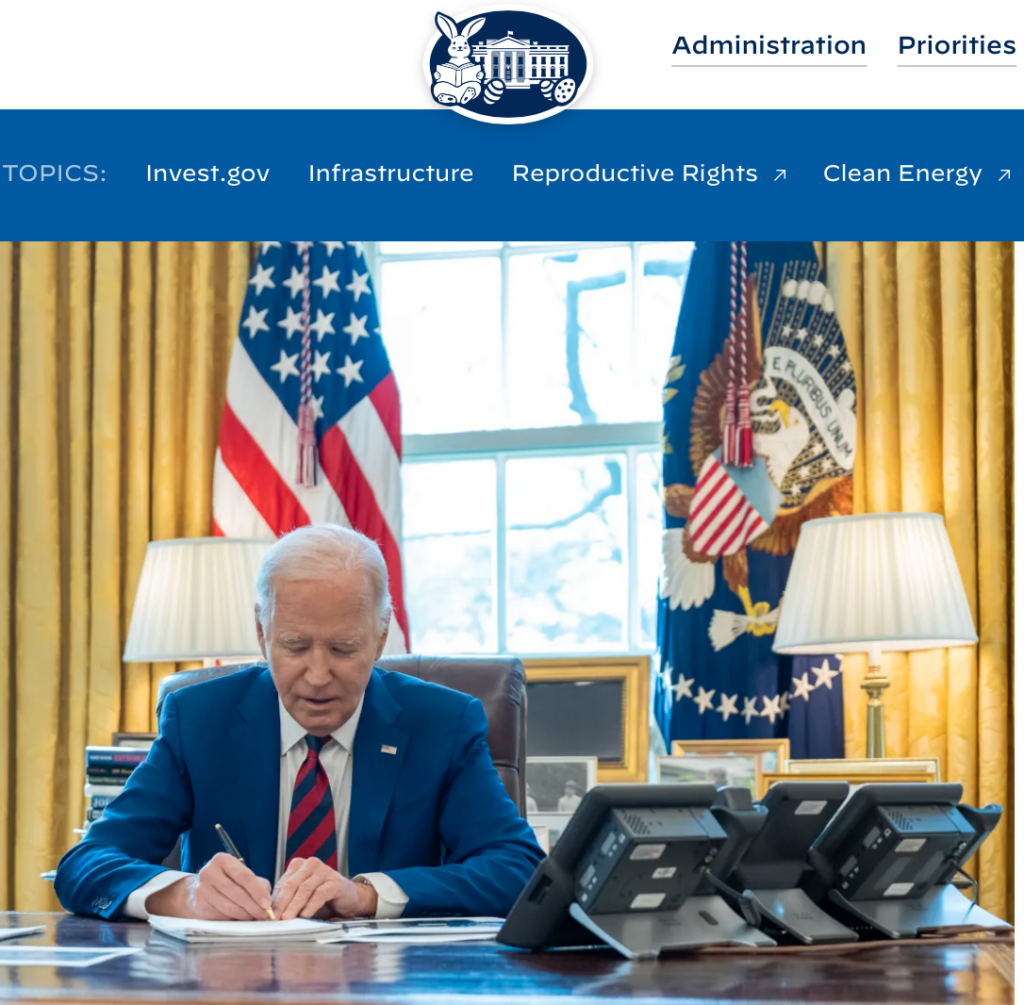
Biden will celebrate Easter Sunday with the White House Easter Egg Roll. As part of the White House Easter celebration, an Easter bunny appears in the official White House logo, as seen in the screenshot from the White House home page.
President Joe Biden at his desk. The White House is celebrating Easter by putting an Easter bunny in the official White House logo.
Transgender Day of Visibility, began in 2009 in Michigan with the Transgender Michigan program. It has spread and is also known as Transgender Day of Vengeance. It falls on March 31, and this year that is Easter Sunday.
Biden has made transgenderism a hallmark of his administration and is spending billions of taxpayer dollars to export transgender ideology to other countries. In his statement on Friday, he boasted about the many transgenders he has hired in his administration.
The Assistant Secretary of Health, Rachel Levine, is one of them. Levine spends most of his efforts pushing transgenderism throughout the entire federal bureaucracy.
Biden is also forcing taxpayers to pay for transgender surgeries for people in prison, according to a 2023 Federal Bureau of Prisons memo obtained by the Heritage Foundation’s Oversight Project.
In a memo discovered through a Freedom of Information Act request last fall, details were discovered of the “immediate implementation” for inmates to undergo invasive surgery to transition to mutilate their God-given genitals. “Healthcare providers should utilize a gender-affirming approach, including using the individual’s preferred name and pronouns during each clinical encounter,” the federal memo reads. “This also includes using non-gender specific terminology (ex. genital instead of penis/vagina or chest instead of breast) for anatomical body parts or asking if the patient has a preferred term to be used.”
Biden’s 2024 budget proposal requested billions of dollars to advance the transexual agenda around the world, allocating far more taxpayer dollars to that issue than dozens of other spending priorities, such as stopping fentanyl from being smuggled across the southern border.
Biden’s budget request for this transgender agenda has more than doubled in the last two years.
Voters in Anchorage are deciding whether to pass several bonds on the April 2 ballot. Notable among them is a $5 million “Portland Loo” bond that would buy public toilets from Portland that are souped-up versions of Porta-Potties, at a cost of $500,000 apiece, and place them around Anchorage where vagrants and drug abusers can have a place to relieve themselves or shoot up in loos that cost more than the average Anchorage house.
The plan came from the Anchorage Assembly liberal majority and was opposed by Mayor Dave Bronson. At a candidate forum on March 3, former Assemblywoman Suzanne LaFrance, who is running for mayor, said she is voting for the expensive potties. Mayor Bronson said he’ll vote against them.
The $5 million expenditure by taxpayers would be outside the existing tax cap and would also come with a $300,000 per year cost of operating and maintaining the Portland Loos, also outside the tax cap. The tax cap was placed by voters to prevent the Assembly from taxing them out of house and home. Voting in favor of the toilets adds ongoing costs to city operations in perpetuity.
Assemblyman Scott Myers, who represents Chugiak Eagle River says paying $500,000 apiece for toilets is more than people pay for the average price for a home in his district: $481,795.
“Eagle River homeowners already pay $8,500 a year on average already in property taxes, or $708 a month. If we’re adding outside the tax cap, this makes housing affordability even more an an issue. And it’s not just homeowners. The average residential lease is $3,000. So tenants are paying these taxes too,” he said.
“We need to work on responsible government spending,” Myers said. “We need to be good stewards.”
The leftist Assembly majority first proposed the bond for $12.5 million for 30 of the toilets, which in other cities have had short lifespans due to vandalism. Former Assemblywoman LaFrance is in favor of the project, but she killed the Anchorage homeless navigation center, which was a solution to the growing mental health and homeless crisis that has overtaken Alaska’s largest city.
Ballot Measure 8 and LaFrance are joined at the hip as a way to import Portland’s homeless industry to Anchorage for toilets that cost more than the average Anchorage home.
Analysis of the returns shows Bronson is within striking distance of winning on the first round of voting if conservatives turn out. Some 19,000 Anchorage conservatives who are registered Republicans have not yet voted, with four days to go until the election ends on April 2.
A horrific video circulating among youth in Anchorage of a student being beaten up by a group at Clark Middle School is the latest example of violence at the Anchorage campus, which has a reputation for student fights and brawls.
Clark Middle School, located in Mountain View, is in one of the most racially diverse campuses in Alaska; 93% of the student body is from a racial minority, predominantly Pacific Islander; 7% are white.
The victim in Tuesday’s assault was a white 14-year-old who was in the middle of gym class near the end of the school day.
The assailants, who appear to be mixed-Pacific Islanders, approached the girl with purpose in what looks like a planned, coordinated attack that involved punching, hair pulling, and when she was on the ground, she was kicked several times before a teacher intervened. It is unclear if this attack is a racially motivated hate crime.
The attackers were not part of the class that was in session in the gym but had been released early from their class and went to the gym, where the victim was still in class.
Must Read Alaska has learned that the girl was badly bruised on her head, face, arms, and ribs, and ended up in the hospital for x-rays and a CAT scan to be sure there were no internal injuries. The girl has spent the rest of the week on bedrest at home.
According to the parent interviewed by Must Read Alaska, the bullying of the girl has intensified since she transferred to Clark from Hanshew Middle School in January. The transfer was the result of the parent having been in a serious accident after her vehicle was t-boned and she was unable to get her child to Hanshew, whereas Clark is near where they live. As a new student, the girl entered the campus with no friends in the middle of the school year. Gangs of girls targeted her for harassment, leading her to sometimes hide in places around campus after she was told by students that attackers were looking for her to “jump” her. The harassment led to a full-on smack on the girl’s face in the weeks leading up to the group’s premeditated attack on Tuesday, videotaped by several students.
The mother of the victim said she reached out to the teachers on several occasions, and also asked to speak to the principal and guidance counselor, and finally was able to meet with them to express the danger that the escalating situation. But the response from teachers and the principal were inadequate to protect the girl. The mother said she was the one who called the police.
Watch the video here; be warned of the brutal nature of the attack and screaming:
The mother of the victim was actually outside the school during the attack, waiting to pick up her daughter at the end of the school day. She witnessed the attackers running from campus but was not aware at the time that they had just beat up her daughter.
The video is the type of activity often posted on social media, particularly on school fight channels on TikTok, Twitter and in groups on SnapChat.
Increasingly, students in schools across the country are recording these assaults for social media fame. There’s even a Clark Middle School fight channel on TikTok; others in Anchorage also have TikTok fight channels — Romig, Mears, and Wendler, for example.
This video has not yet emerged on social media. But others from Clark Middle School have in the past.
On Friday, Must Read Alaska asked the Anchorage School District for a statement on the assault and whether the assailants will be held accountable. The response from district headquarters was a request for the video, and an hour later the district wrote that there is an active police investigation and two students have been charged with assault. Several hours later on Friday — three days after the assault — the principal of Clark Middle School sent a note to parents with the same message.
Clark Middle School has a history of student violence. On April 18, 2023, the school was placed in lockdown after a group of teenagers got into a brawl. Ten Anchorage police officers responded to break up the fight that was now between both the student groups, and students and campus security officers. Some of the fighters were high school teenagers who were called in by friends for reinforcement.
The U.S. Department of Education is accusing the State of Alaska of mismanaging its Covid-19 relief funds by not allocating enough to our urban school districts.
Instantly, the leftist media jumped on the bandwagon to charge Commissioner Deena Bishop with misuse of these federal taxpayer dollars. The federal government wants the State to provide more and more funding to the urban school districts, and less to the rural districts.
This is micromanagement at its worst.
The Alaska Department of Education and Early Development was told by the federal agency that Alaska was not providing “equity” in its distribution of Covid relief funds, the American Rescue Plan. The Feds referred to this as “maintenance of equity.”
The American Rescue Plan for the first time ever required a “Maintenance of Equity” clause that said states could not reduce their per-pupil funding to low-income and high-needs school districts.
It seems as if “equity” has permeated the entire federal government, and it wants to now dictate how Alaska spends its money.
Per the DEED’s web page, “The ARP Act provides funding to help meet a wide range of needs arising from the COVID-19 pandemic, including reopening schools safely, sustaining their safe operation, and addressing students’ social, emotional, mental health, and academic needs resulting from the pandemic”.
Alaska responded to this concern on March 8, 2024, but the federal government was not satisfied with the answer. It stated that, “the State remains non-compliant for high-need and highest-poverty local educational agencies…”. (A local education agency is a local school district).
In its March 22, 2024 letter to the USDOE, Alaska said, “State funding was not cut during fiscal years 2019-2023. Instead, Alaska continued to apply and fund its base student allocation in accordance with existing state law…”.
In its response, DEED also stated that to solve the federal goernment’s concerns, it could ask for a supplemental appropriation from the legislature.
But the federal government was still not satisfied and wanted even to interfere with the legislative process of additional funding. It demanded that Alaska ask for a “supplemental appropriation to resolve the maintenance of equity compliance issues.”
And it demanded the governor ask for this appropriation now.
Then the DOE designated the State as a “high-risk grantee” for its Covid grants.
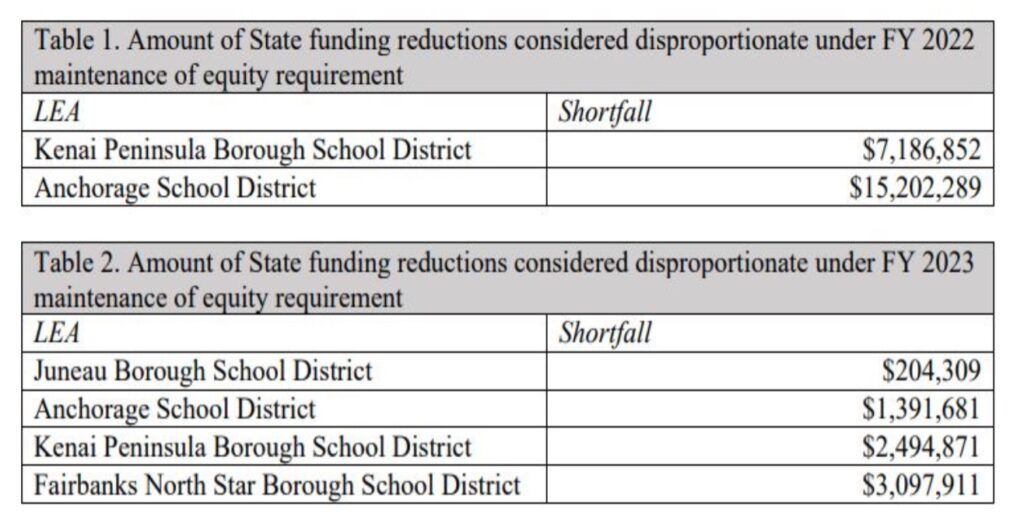
The DOE says that the State did not maintain providing the same level of funding equity during FY 2022 for one high need school district and one highest poverty school district.
Here are the school districts and the so-called fund shortages from the DOE letter:
Note that the MatSu School District, one of the five largest, is not mentioned in the federal listing. That may be because that district kept its schools open during the pandemic and gained many students.
This $29 million does not seem very significant when it comes to a statewide K-12 budget exceeding $2.7 billion.
Here are the American Rescue Plan funds that were doled out to the above school districts: Anchorage School District received more than $116.4 million; Kenai School District received more than $20.1 million; Juneau got more than $5.3 million; and the Fairbanks School District received more than $22.8 million.
The entire State of Alaska received $265,383,276 in ARP funds. Of these,$68.9 million — some 21% have still not been spent.
The DEED Commissioner Deena Bishop responded strongly to the DOE: “This is an incredibly surprising conclusion considering we funded our schools as we always have according to the equitable distribution formula as established in Alaska Statutes and also distributed any COVID funds based on the Title 1 Part A formula per federal guidance.”
Bishop continued, “Alaska has been applauded by several outside entities for the equity of our school funding formulas,including Rutgers University. To now come back and suggest that we need to give additional funding to some of our largest school districts, which takes the equitable distribution and upends it at the expense of our smaller, rural school districts, makes no rational sense. In short, the way ED is demanding Alaska distribute funds to comply with maintenance of equity requirements is inequitable for Alaska’s rural schools,” she said.
Does the federal government want to challenge Alaska’s education funding formula and dictate that as well?
This is just another indication of the control the federal government wants over a state’s K12 education.
In its final attack on Alaska, the Department of Education singles out the State saying, “Alaska is the only State that has not met, or presented a sufficient plan for meeting, these requirements.”
That would seem to be highly doubtful due to the many school districts’ budgets.
This adds nothing to the conversation and seems to attack our governor and the DEED.
What’s next? Will the federal government use its 4,000-mile screwdriver to take away school lunches from low-income kids?
It wasn’t that long ago that the Municipality of Anchorage was run not only by a radical Assembly, but by an even more radical mayor. Three years ago, we dodged that bullet when Chugiak Eagle River showed up to vote and steered the Municipality of Anchorage away from its trajectory of becoming another west coast San Francisco disaster.
But we are not out of the woods yet! This week we have another election to focus on, and it matters more than ever.
Chugiak Eagle River, we are 30,000 votes. That’s equal to all the ballots received by the Anchorage election office thus far. Our votes can help prevent the municipality from backsliding into the tyranny of the previous administration.
I’m proud to endorse Mayor Dave Bronson for a second term in office. When I was on the Assembly, I saw how the political operatives and the media worked to defeat our conservative values. They’ve done the same thing to Mayor Bronson.
You’ve likely seen the “incompetence has a price tag” smear campaign funded by the leftist 907 Initiative, but who has really cost the city more, Mayor Bronson or the Assembly?
Bronson’s 2024 budget proposal came in $12 million dollars under the tax cap, while the Assembly and Suzanne LaFrance continue to raise taxes by adjusting the property tax mil rate on your homes or accepting and implementing an alcohol tax that didn’t meet the voting threshold required by the city charter.
Maybe you are thinking, “What’s the point? Aren’t we going to bifurcate and create our own borough?” That plan, spearheaded by Eaglexit, may be necessary, especially if the Anchorage Assembly and the Anchorage School District continue down their path of destruction. But until then, too much is at stake for us to not take this election seriously.
Chugiak Eagle River needs the freedom to uphold the conservative values of our people. As a neighborhood, we take pride in the strength of our public safety. Families choose Chugiak Eagle River for our safer streets and better schools. We need a limited government that gets out of the way of the market while preserving our family values. We need fiscal responsibility that doesn’t overburden us with exorbitant taxes, we need sustainable revenues and dedicated infrastructure to grow our community.
A mayor like Suzanne LaFrance will punish our conservative district and inflict her progressive ideologies in tandem with the super majority on the Assembly. She voted in lock step with the 9-2 majority to increase spending and taxes, shut down Mayor Bronson’s sheltering plans, implemented plastic bag bans, inflicted Covid tyranny upon the city for years, recklessly spend millions of Covid Relief Funds on pet projects, funding her Assembly buddies and she voted to keep the public out of public testimony.
This is our opportunity to send a message to both the Anchorage Assembly and the Anchorage School Board that we want a more balanced approach. It’s our chance to stand up for the things we care about: our quality of life, effective education for our children, and safe neighborhoods.
Dave Bronson is the ideal mayoral candidate for our community. He prioritizes the Don Young Port of Alaska modernization project to bolster our economy, securing a record $270 million for its advancement. Despite assembly opposition, he’s made significant strides in addressing homelessness by facilitating affordable housing initiatives, Dave has also bolstered public safety with downtown foot patrols and the largest pay raise in history for Anchorage Police Officers. We need his fiscal responsibility and resilience to restrain a runaway assembly.
The Anchorage Assembly consistently obstructs Mayor Bronson’s efforts to advance our city. They halted progress on critical projects, such as the navigation center for the homeless, even interrupting construction midway. Additionally, their expansion of subpoena powers has turned voluntary citizen involvement in our local government into mandatory participation rather than a choice.
Moreover, their opposition to renaming the Port of Alaska after Don Young demonstrates their tendency to politicize every initiative by the mayor, hindering the city’s development. Through the opposition, Mayor Bronson continues to fight for Anchorage and is the only thing that stands in the way of single-party rule.
It is said the world is run by people who show up. It’s time for Chugiak Eagle River to show up and vote. Our community is a beacon for the rest of Anchorage. Whether we stay with Anchorage, or go our own way, our vote must count today.
Voting this weekend is good practice for our upcoming primary and general election season – and for our future vote on creating our own borough — so let’s dig out those ballots, vote like our lives depend on it, and let’s set a new standard for civic pride.
Join me on April 2 in voting for Dave Bronson for another three years of effective leadership!
Rep. Jamie Allard serves in the Alaska Legislature on behalf of Chugiak-Eagle River residents and is a U.S. Army veteran.
Gov. Mike Dunleavy added his name to the growing list of major endorsements for Anchorage Mayor Dave Bronson, the campaign announced on Friday. Earlier this week, former Mayor Dan Sullivan and U.S. Sen. Dan Sullivan joined the Bronson list of endorsers.
“Dave Bronson has been a key partner in driving Alaska’s economic prosperity,” Dunleavy said. “Together, we’ve streamlined city and state operations, creating a more efficient government that better serves our citizens. By working together, we have encouraged economic growth and investment in Anchorage. Dave’s leadership is crucial for our continued success. I endorse him for reelection and encourage Anchorage voters to return their ballots by April 2.”
“It is an honor to be endorsed by Gov. Dunleavy,” Mayor Dave Bronson. “We have worked well with the governor and his team over the last three years to ensure the State of Alaska and the Municipality of Anchorage operate as partners, delivering government services more efficiently and being responsive to citizens. I look forward to our continued collaboration and thank Governor Dunleavy for the endorsement.”
New to politics, Bronson ran for mayor in 2021, beating the campaign veteran Democrat Forrest Dunbar. Bronson had run for office only once before that race and had been a commercial pilot for his career, as well as a member of the U.S. Air Force. But with hardly any name recognition, he beat someone with a household name — Dunbar had run for Congress against U.S. Congressman Don Young, and had then run and twice won a seat on the Anchorage Assembly, where he championed all-things Democrat.
Dunbar, who blamed his loss on the intensity that people were feeling about the Covid pandemic, has endorsed Suzanne LaFrance for mayor. LaFrance championed lockdowns in Anchorage during Covid.
Anchorage voters must have their ballots returned by 8 p.m. on April 2.
In order to win outright, Bronson will need 45% of the vote. If he comes up short, the top two vote getters will be in a runoff, which will require another round of ballots to be mailed out to voters and another short-but-intense campaign, with ballots mailed May 6 and needing to be voted and returned by the May 14 runoff deadline.