Home Blog Page 476

Two tribes sue USDA over broadband grant awards

The Native Village of Unalakleet and Native Village of Elim have filed a lawsuit against the U.S. Department of Agriculture over a $70 million grant award that is part of the ReConnect “BEAD” Program, a massive $42.5 billion federal broadband “equity” program to bring high-speed internet to underserved areas in all 50 states, Washington D.C. and territories.

The tribes’ lawsuit says USDA gave away $70 million in funds meant to help connect them to the internet, and then declared the tribes “served” with internet, after not checking with the tribes to see if they were served.

The lawsuit says that the condition of awarding any funds to applicants for grants or loans under the ReConnect Program mandate that an applicant seeking funding to construct broadband service infrastructure over Tribal Lands must obtain a “Tribal Government Resolution of Consent from the Tribal Council of the Tribal Government with jurisdiction over the Tribal Lands at issue.” 

In the fourth round of the grant in the fiscal year 2023, the defendant RUS, which administers the grants, granted applications by Interior Telephone Company and Mukluk Telephone Company, in a total of $69,982,995, for a fiber-to-the-premises network. Evidently RUS consulted with Kawarek Inc., a community services organization that is not an authorized Native group in the consultation process outlined in the grant documents.

Despite obtaining $34,993,700 and $34,989,295, respectively, in Round Four of the Reconnect Program to construct broadband service infrastructure in the Nome Census Region of Alaska, Interior and Mukluk lack the ability to begin construction and have not implemented a backhaul plan, which is necessary for connecting subnetworks to the core broadband network, to serve the region, the lawsuit says.

“Even apart from the impropriety of the RUS awards, the lack of performance by Interior and Mukluk will prevent unserved Tribal communities such as Unalakleet and Elim from obtaining access to broadband service. Not only have Interior and Mukluk failed to serve Tribes like Unalakleet and Elim, they have prevented other ReConnect applicants from receiving funding in future rounds to do so after falsely declaring them ‘served’ without checking with the tribes,” as they were legally required to do.

The bottom line, the two tribes are not happy that the USDA apparently broke their own rules by allowing applicants to do work on their lands without their consent.

Once awards are made, the villages are marked as “served” and cannot apply for further funds.

Neither Interior nor Mukluk has yet begun any work on the projects described by their applications, the lawsuit says.

“Tribes including Unalakleet and Elim are injured by the lost benefit of the broadband infrastructure development funds intended for their benefit, and by being designated as ‘served’ when they are not,” the lawsuit continues.

In November, National Telecommunications and Information Administration issued a press release saying the BEAD program “will only succeed if every penny is wisely spent. This includes ensuring that subgrantees have the capacity not just to build and deploy high-speed Internet networks but to operate those networks for years to come, delivering Internet connectivity to areas that for too long have been left behind.”

The news release continued, “Being a good steward of taxpayer dollars also means encouraging robust participation from Internet service providers (ISPs) of all types and sizes. Inclusivity is key: where larger ISPs may have the resources to deploy quickly, smaller providers often have unique expertise in serving some of the hardest-to-reach communities in America. When providers compete for BEAD funding, states and territories can more efficiently spend their allocations and make the most of this historic investment.”

To that end, the NTIA released a programmatic waiver of the Letter of Credit requirement in the BEAD Notice of Funding Opportunity (NOFO).

Under the NOFO, prospective subgrantees must provide an irrevocable standby letter of credit to the Eligible Entity (i.e., the 50 states, five territories, and the District of Columbia) before entering into a subgrantee agreement. The amount of the letter of credit must be no less than 25% of the subaward amount.

“This requirement helps states and territories ensure that potential BEAD applicants have the financial capacity to deliver reliable, affordable high-speed Internet service,” the notice said.

Read the lawsuit at this link:

Mary Ann Pease: All options should be on the table for Southcentral and Interior energy crisis

By MARY ANN PEASE

Alaskans need all options on the table as we weigh each one’s ability to deliver results for Railbelt consumers, especially given the critical timelines we face regarding gas supply.

ENSTAR, the Railbelt Utility Group, BRG, Cornerstone and other engineering firms have pooled their expertise to study these options and will soon release their final draft. The options outlined in their first draft will not change and these solutions make it clear that private sector intervention or state subsidies are needed to fill a large gap in gas supply.   

BRG recently presented its study of gas supply options for Railbelt utilities to the Regulatory Commission of Alaska (RCA). An alarm bell sounded in April 2022, when Hilcorp stated that they were not going to contract for gas supplies beyond their current commitments.   

Option A: Drill in Cook Inlet

The best option for the State and Alaska is to drill in search of new gas reserves in the Cook Inlet. The reality is that Hilcorp is the predominant supplier in the Inlet and if they do not see the economics of the Cook Inlet gas market going forward, then who will? Other major producers don’t see immediate incentive to drill, otherwise they would be doing so here rather than drilling in more complicated jurisdictions.

Alaska must turn to the smaller independents in the Inlet, but what will it take to stimulate sizable production and bring it online within the next 10 years?  Maybe two off- shore platforms and drilling success at a price tag of $1.5+ Billion.  This is capital the independents likely don’t have.

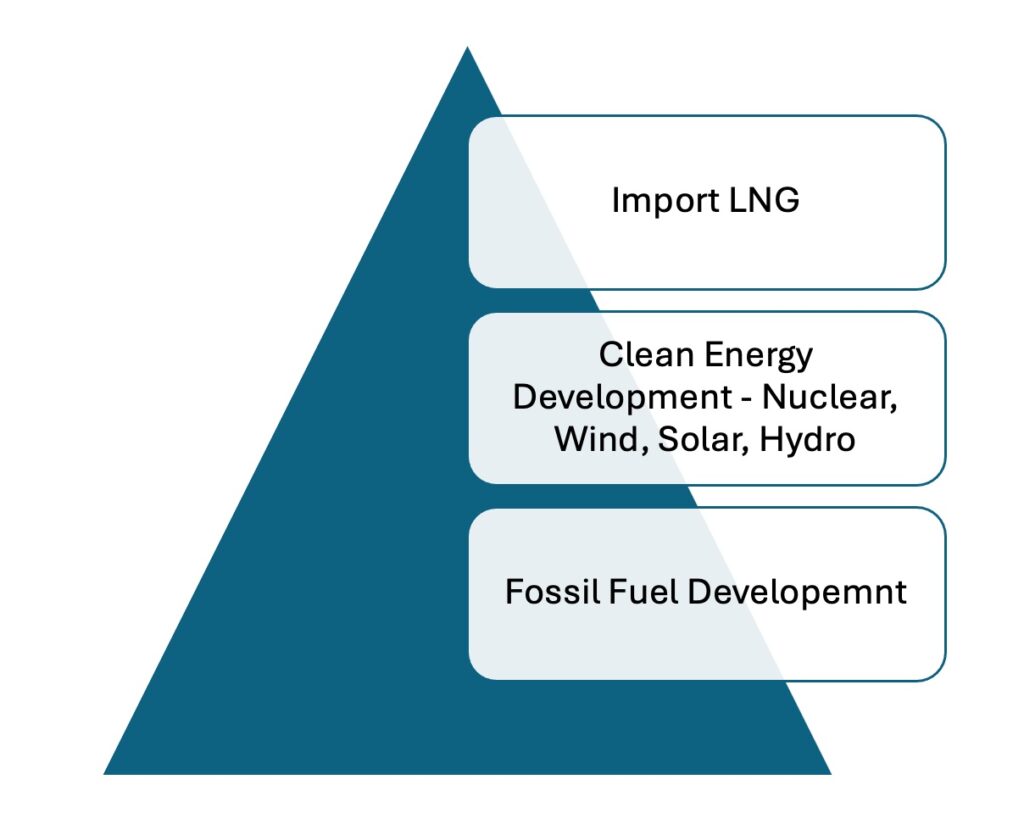
Option B: Import LNG

Using imported LNG makes total sense for Alaska’s Railbelt as a bridge solution until we have either a pipeline, new gas discoveries or other reliable alternative energy sources online.   LNG today from Fortis BC is about 1/3rd the cost of Cook Inlet gas.  Granted there are the transportation and storage components that will significantly increase the delivered cost of LNG for the Railbelt, but options for supply from Canada and elsewhere are available at fixed, long-term contracts.  

This import option is economically viable today until exploration and development in Cook Inlet produces ratable gas supply for the utilities. LNG can continue to keep the lights on and the homes warm in the near-term and can be used for peak winter demand in the future to avoid what could be a disaster for Alaskans if we have an extended cold snap like we just had with waning LNG supply. LNG can be that interim solution as we transition to more renewable clean energy solutions, when they are available at scale and an affordable pricing, without jeopardizing the quality of life and energy security we have come to expect in Southcentral.

The former Conoco Phillips LNG plant, now owned by Marathon/ Trans-Foreland Pipeline Company, LLC has filed with DOE and FERC a request to turn the facility into an import terminal. On August 16, 2022, the Federal Energy Regulatory Commission (FERC) approved a request from Trans-Foreland Pipeline Company LLC to extend the completion of its Alaska LNG import project to December 2025. 

FERC first approved Trans-Foreland’s request to build the plant in December 2020, and gave the company until December 2022 to place it into service. In July 2022, Trans-Foreland stated that uncertainty and volatility in the global LNG market had made it difficult to secure a suitable supply arrangement.

What we are witnessing here is delay and lack of urgency by Trans Foreland on a critical component to achieve gas supply security for Alaska. Expediting the re-positioning of the existing storage and marine facilities is the best solution.   As a publicly traded company, Marathon should focus on their shareholders and develop projects with the greatest benefit and return.  As Alaskans, we can ask them to open the facility for a “tolling arrangement,”. The state or the utilities need to make a suitable commercial arrangement that will get the gas coming into the state to supplement and shore up our energy requirements.

Globally, LNG has been a lifesaver. Imported LNG after the Fukushima incident in Japan replaced nuclear generation from shuttered plants, Similarly, when war in Ukraine cut off Europe’s gas supplies from Russia, LNG shipments from the global markets filled the gap. Now European countries and others have planned LNG into their energy mix, providing a bridge as they transition to clean energy, such as nuclear, solar and wind.

If we cannot use the existing Trans Foreland/Marathon facility, let’s move quickly to identify an alternate location and build onshore storage and re-gasification facilities with new cost competitive technologies. Floating storage and regas is another option, but there may be more difficult permitting and cost considerations.  It is evident after the weather in 2024 that  “we need to act now.”

Now is the time to take decisive action to secure our energy independence and security for Alaskans.  Imported LNG is the perfect bridge to a clean, secure, energy future and is the only near-term solution for Southcentral.

Mary Ann Pease is the owner of MAP Consulting LLC, an energy consulting firm specializing in Alaska, Arctic, Pacific Northwest and international energy markets.

Protection of girls in sports scrimmaged in House, as Democrats fight for boys’ right to beat girl athletes

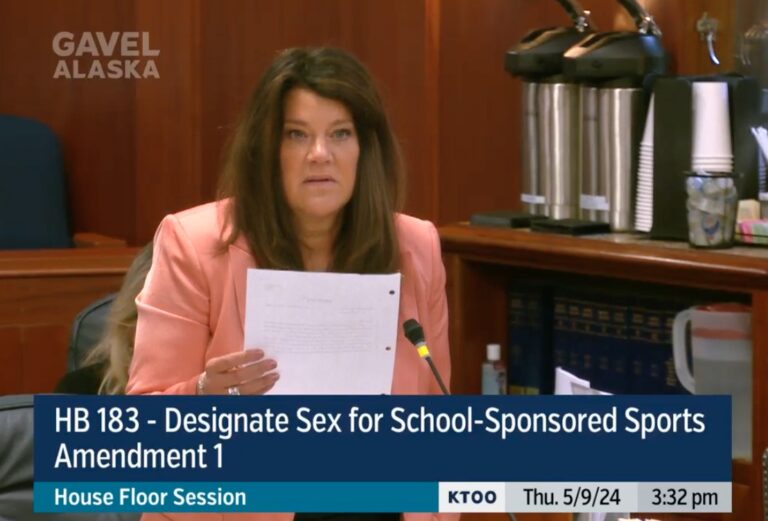
House Bill 183, which clarifies protections for girls sports in Alaska schools ran into trouble with House Democrats and even some Republicans on Thursday. Evidently, supporting Title IX in its intended form, which is protection for girl athletes, is such a touchy subject that House members didn’t want to vote on it. It was tabled.

Rep. Alyse Galvin argued that her own child had changed his or her gender and even had his/her birth certificate changed, and so she felt her child was attacked by the provision that girls shouldn’t be forced to compete against boys in sports.

Rep. Zack Fields said it was just too much work to try to figure out who is a boy and who is a girl, and the schools are already too underfunded already.

Rep. Rebecca Himschoot asserted that students would have to undress for a formal inspection of their genitals.

Rep. Sara Hannan said there’s no real way to know what some baby’s sex is without a complicated hormone test, which isn’t done.

Rep. Andrew Gray went on at length about transgenders and argued that intersex people would not be protected (they are said to comprise 0.018% of all people, according to the National Institutes of Health.)

Rep. Gray offered an amendment that stated that transgender people have constitutional rights and all protections of other citizens, but he all-but admitted that his amendment was a way to invalidate the underlying legislation. His amendment was a poison pill to give the Alaska Supreme Court permission to decide that boys competing as girls is a constitutional right.

It failed to pass, as Republican representatives recognized it as a poison pill.

Rep. Andy Josephson then put in the “chess” amendment, which makes it clear that the bill would not apply to transgenders playing in girls’ chess tournaments. Apparently there were going to be such nonsensical amendments as his from then on. Perhaps a checkers amendment, and then a dominos one.

It was at that point when, as expected, Rep. Bryce Edgmon moved that the bill be tabled until May 11. The House went into an extended at-ease and the majority Republicans left the chambers to caucus.

Screenshot

The bill, House Bill 183, sponsored by Rep. Jamie Allard of Eagle River, had over 100 amendments in the queue for it. So strong was the urge of the Democrats to give transgenders more rights than girls in Alaska in athletic competitions, they filibustered the bill.

Troubles widen for Permanent Fund board, as executive session was breached

After a spicy meeting of the Alaska Permanent Fund Board of Trustees, the board went into executive session to try to determine just who had leaked internal board emails about Trustee Ellie Rubenstein and allegations that she has been bullying and threatening the fund’s staff into doing business aligned with the interests of David Rubenstein’s Carlyle Group, a powerful private equity company.

The executive session was to be about security and how to ensure that no more leaks occurred to the public. Some on the board seem especially concerned that the Alaska Landmine political blog released some of the internal emails in a mind-blowing expose of the workings of Alaska’s sovereign wealth fund.

But then, security was again a problem. A member of the public was able to access the “secure” virtual meeting through simply clicking on a feature that allowed him to join, and he took dozens of pages of notes and gave them to the Alaska Landmine.

It appears the Permanent Fund meeting manager didn’t “close the door” to the virtual meeting and now everything that was said has been noted in detail.

The Alaska Permanent Fund Corporation acknowledged this in a notice on its website today:

“The Alaska Permanent Fund Corporation (APFC) was alerted to the fact that the Board of Trustees’ executive session held during the May 8, 2024, Special Meeting was accessed by members of the public. APFC is concurrently assessing and conducting a forensic analysis of the comprised session,” the Permanent Fund wrote. It appears the fund intended to mean “compromised session.”

Jeff Landfield, of the Alaska Landmine, said he is reviewing the notes and is likely to have more to tell about the widening scandal at the Permanent Fund.

Must Read Alaska’s report about the public meeting that took place in advance of the executive session is below. It explains how the board of trustees is suffering from a schism surrounding the behavior of trustee Ellie Rubenstein toward the professional staff:

Testy trustees: Permanent Board directors show signs of strained relationships over Rubenstein revelations

Wednesday’s Alaska Permanent Fund Board of Trustees meeting to discuss leaks of emails to the Alaska Landmine website devolved into chippy, barely concealed hostilities between two apparent factions: There are those trustees who seem upset with board behavior that has embarrassed the fund, and those upset with word about board behavior getting out to the public.

In one camp, it appears that trustees Ellie Rubenstein, Adam Crum, and Jason Brune are a posse, wanting to find the leaker and punish him or her. In the other camp, it appears board Chairman Ethan Schutt and former board Chairman Craig Richards are aligned in wanting to address the concerns that some have about Rubenstein meddling in the investment business of the Fund. Commissioner of Transportation Ryan Anderson appears to be Switzerland in this dustup, which has exposed trustee Rubenstein’s oversized and possible inappropriate role in the corporation’s operations.

The emails that were released into the wild show that Rubenstein, who has been on the board for two years and is now vice chair, was making Chief Investment Officer Marcus Frampton and others on staff uncomfortable with the pressure she was putting on them to create investment relationships with people and entities that have ties to her father, David Rubenstein, the founder of the Carlyle Group private equity corporation and one of the most powerful men on Wall Street.

Rubenstein is also the daughter of Alice Rogoff, former owner of the Alaska Dispatch (now again called the Anchorage Daily News) before running the organization into financial ruins.

Rubenstein has said she broke no ethical rules as a board member. In a statement last week, she defended her actions as above reproach.

“Serving on the Board of Trustees for the Alaska Permanent Fund Corporation is a great honor. This position has allowed me to serve my home state by bringing private sector investment expertise and perspectives to the Permanent Fund Corporation. Introducing and connecting Permanent Fund Staff to investment firms so that they can explore opportunities is an appropriate and valuable role and is common practice among state pension boards, endowments, and sovereign wealth funds. In this role, I have always followed the Permanent Fund Board’s ethics rules and disclosure requirements, and I was unaware of these concerns about my service on the Board. That someone leaked internal messages containing confidential information to the media is disturbing; it is a breach of policy and trust, and it distracts from the important work the Permanent Fund Trustees and Staff are doing for the State of Alaska.”

But during Wednesday’s meeting, held virtually, Rubenstein was quiet during the public session, even though the meeting was called because of her alleged behavior.

While she didn’t say anything, Crum and Brune pushed back against Richards and seemed interested in going after the person or persons who leaked the emails that raised the concerns about board interference in investment decisions.

Trustee Richards said he observed a growing trend of direct communication between trustees and staff over the past two years, including “indirect threats” that “increased in volume to a point that staff is obviously feeling uncomfortable, and that’s been communicated, yet the behavior still occurred.”

In other words, the behavior has going on long enough that it has been brought up as a concern before, but continued.

Trustees having direct communication with staff, outside the chain of organization command is still happening, Richards said, “at a level we’ve never seen before and I think that that, again, is having some negative consequences in the sense that it’s making some of the managers feel a little undermined.”

Some people in the corporation staff have even felt that their jobs were being threatened by board members, Richards said.

Brune punched back that those were “pretty broad allegations” and challenged Richards to expand on his inference. Richards said he didn’t want to point fingers and Brune replied that he was indeed pointing fingers.

“We really have four issues before us: We have the specific, ethical allegations against trustee Rubenstein, which I presume will ultimately be handled through the state’s ethics process. We’ve got, in my mind, some of the broader behavior of this board that has resulted in an atmosphere at the Permanent Fund, where we’re seeing the need of employees to do your standard cover-yourself behavior. That, in turn, has led to some leaks that seem to be what other people are more concerned about. In my mind, the key thing is, I’m less concerned about leaks than I am about fixing the behavior that caused the leaks,” Richards said.

“From my mind, the right way to go forward with this thing is after we get the information we have is to go through and do a positive, constructive way of looking at our own governance documents for the board and our staff that includes better and clear expectations around trustee behavior as well as plugging whatever might have been the source of some leaks. To me, as a stepping stone to getting to governance reform, that’s fine. But it’s ultimately governance reform that’s going to be necessary to solve the core, underlying problem here,” Richards said.

The board went into executive session for two hours and when it came back out into public session, Chair Schutt said there had been no breach of the IT system at the Fund by anyone from the outside, and that the board would continue to look at how emails flow, how trustees interact with staff, and the information trustees provide to staff about investment opportunities.

After the meeting, the board put out a statement, that read in part:

“The Board of Trustees of the Alaska Permanent Fund Corporation (APFC) held a special meeting to assess its information technology systems and potential solutions to strengthen APFC’s records process and document management systems.

“The meeting was held virtually on May 8, 2024. At the beginning of the meeting, the Board amended the agenda to allow for public comment. The public is welcome to submit additional comments to [email protected].

“The Board discussed and clarified executive session parameters, then voted to enter an executive session in accordance with Alaska’s Open Meeting Act to “discuss the security of APFC’s records systems and document management procedures for confidential information.”

“During the executive session, the trustees were informed that APFC’s information technology staff promptly performed a cybersecurity vulnerability analysis and intrusion detection protocol, and it was concluded that no external breach had occurred, thus giving reassurance to the Trustees as well as the Fund’s investors and the public that our IT and security systems are in place and working as designed.

“In addition, during the meeting, Chair Ethan Schutt confirmed that he, Executive Director Deven Mitchell, and other APFC senior staff, including APFC’s General Counsel, were informed in late January of the issues of perceived inappropriate communication between trustees and staff that has been the subject of recent media stories. Upon initial review, it was deemed that the existing governance process was followed, and no follow-up action had been taken or was deemed necessary at the time.

“The Board of Trustees is committed to reviewing its governance processes to ensure full and transparent disclosure of potential conflicts and ensure there are viable and secure channels for employee concerns to be raised and addressed. Reviewing and, if necessary, updating these processes will help build better staff–trustee relationships going forward, so APFC can continue to be a high-functioning, high-trust organization on which Alaskans and investors can rely. Trustees also committed to updating internal procedures to ensure confidence in its information technology data retention and external information sharing procedures.

“Our primary focus remains on the work that our Board and Staff do to manage and invest the Alaska Permanent Fund,” said Deven Mitchell, the Executive Director and Chief Executive Officer of the Alaska Permanent Fund Corporation. “We are committed to improving protocols that are currently in place to uphold our dedication to the integrity of the Corporation and Fund.”

“APFC’s mission is to deliver outstanding returns for the benefit of all Alaskans. We are dedicated to providing income and stability for current and future generations,” the statement said.

The next meeting of the Board of Trustees will be the quarterly meeting on May 29-30, in Utqiagvik and via WebEx. 

Invasion by design? Peltola votes for illegal immigrants to be counted toward reapportionment, Electoral College

Rep. Mary Peltola, Alaska’s only voice in the U.S. House, has voted against a bill that makes it clear that redistricting (also known as reapportionment) must be done by using the U.S. Census count of actual citizens, and not by counting the 20 million illegal immigrants that have criminally moved across the border and are living in the United States unlawfully.

Over 7 million illegal immigrant have come to the United States in the three and a half years of the Biden Administration, and the Administration is shipping them to states like Florida, playing a long game to flip the state blue.

“One of the lesser acknowledged, but equally alarming, side effects of this administration’s failure to secure the southern border is the illegal immigrant population’s influence in America’s electoral process,” said Rep. Chuck Edwards, of North Carolina, speaking in favor of his Equal Representation Act, H. R. 7109.

The act passed along party lines, with all Democrats, including Peltola, voting against it.

Edwards spoke on the House floor about the need to protect America’s democracy and electoral integrity by making sure that only American citizens are counted when apportioning congressional seats and. The apportionment process also affects the Electoral College votes assigned to each state.

“Our democracy depends on accurate representation and electoral integrity. Voting is a coveted privilege held by American citizens, and elected representatives are responsible for serving the interests of the voters in their district,” Edwards said.

“But even if not a single illegal alien casts a vote, the mere presence of illegal immigrants in the U.S. is having a profound impact on the outcome of elections, skewing the representation of Americans,” he said.

Rep Andy Biggs of Arizona pointed out that that the U.S. Constitution mandates that a census be carried out every 10 years, where everyone who is present in the United States, regardless of their citizenship and immigration status, is counted. But the Constitution does not specify whether noncitizens or illegal aliens must be counted for the purpose of apportioning House seats.

In 2016, President Donald Trump added a citizenship question back to the 2020 census via executive order. The citizenship question that had been asked on every census since 1820, until it was removed in 1960, because the effect of illegal immigration was negligible at the time.

“But there’s no doubt today, that the effect of illegal immigration is significant. I won’t waste my time making that case – we all know it. It’s a top concern of about 70% of all Americans, Edwards said. “Though commonsense dictates that only citizens should be counted for apportionment purposes, illegal aliens have nonetheless recently been counted toward the final tallies that determine how many House seats each state is allocated and the number of electoral votes it will wield in presidential elections.

Since the illegal alien population is not evenly distributed throughout the nation, some states are losing representation in Congress to illegal aliens in other states.

“A 2019 study by the Center for Immigration Studies estimates illegal immigrants and non-citizens who have not naturalized and do not have the right to vote impact the distribution of 26 House seats,” Edwards said.

House seats and Electoral College votes will added to areas with the most illegals unless Senate passes the bill.

Newsweek jumped to defend Democrats in its fact-checking of the characterization being made of their pro-illegal-immigration vote, by saying that including illegals has been policy since the late 1700s. However, the Newsweek fact-checking was rated poorly by readers, who understand that illegal immigration is not what it was in earlier eras, and is now being used by Democrats to alter the actual political landscape of America.

Statista.com shows the number of illegal immigrants in each state in 2019, before the massive surge of over 7 million illegals during the Biden Administration. Based on the Statista baseline of 2019, there would be now about 20 million illegal aliens in the United States:

Source: Statista.com

Not so fast: Senate Finance strips out Giessel-Wielechowski tax on S corporations

Once considered a champion of Alaska’s oil-based economy, Sen. Cathy Giessel, a south Anchorage Republican, has done a 180-degree pivot, and now is voting against energy companies, which are the driving force for jobs and prosperity in Alaska.

Giessel’s vote in Senate Natural Resources Committee on Friday to tax Hilcorp surprised many who once knew her as a conservative.

But on Wednesday, her Hilcorp tax was foiled.

Senate Finance Committee brought forward a new version of House Bill 50 — the governor’s carbon storage bill — stripping out the S corporation tax that had been inserted into the bill by Sen. Bill Wielechowski and Committee Co-Chair Giessel.

The amended bill, with the controversial “Amendment d.49,” had left the Resources Committee on a vote of 4-3, with Giessel the only Republican to vote for enacting a new tax in Alaska.

Even Sen. Matt Claman, a Democrat, voted against it because of the implication it would have on thousands of businesses, both large and small, in Alaska. The language in the amendment was so vague it could capture other S corporations in the industry.

Other provisions had been crammed into HB 50 included HB 394 (gas storage), HB 256 (seismic data release) and HB 388 ( reserve-based lending). All were taken out in Finance and the bill is back to being just legislation that allows the state to engage in carbon storage as the only topic.

In addition to Giessel’s vote, Senators Forrest Dunbar, Scott Kawasaki, and Wielechowski voted in favor of taxing S corporations.

Voting against the tax amendment were Senators James Kaufman, Claman, and Committee Co-Chair Click Bishop.

Gov. Mike Dunleavy may not need to veto his own bill, now that the hostile tax amendment has been removed, although the bill must still pass the Senate.

It’s not a secret that the Giessel and Wielechowski are working on a plan to make Giessel the Senate president next year, while Dunbar is working on a plan to run for governor in 2026, according to those inside the Capitol.

Gas storage, seismic data, and reserve-based lending are expected to be considered separately on their own merits. They should advance as they involve policies with bipartisan support.

Win Gruening: Juneau Assembly ignores voters, ramps up spending and taxes

By WIN GRUENING

Capital City citizens and businesses have endured double-digit increases in property taxes over the last several years, yet the Juneau Assembly is doubling down on a spending spree and raising taxes.

Does the Assembly care about the public they serve?

City officials assert that the budget is “balanced,” and that revenues and expenditures are not projected to be materially different from the prior year.

But that ignores the substantial changes within recurring revenues and expenses as well as one-time expenditures that can be funded out of reserves. So, while the city may, in fact, end up with a “balanced budget,” it’s not because revenues actually equal expenses, it’s because the city can choose to use its cash reserves (or, in some cases, use debt) to finance their deficit spending.

This has serious implications for taxpayers who ultimately are responsible for paying off bonded indebtedness or replenishing city reserves via sales and property taxes levied by the city. 

Over the years, the city has developed a bad habit of over-collecting property taxes and underestimating sales tax receipts. The resulting excessive reserves have allowed the Assembly to finance all sorts of projects and activities that would never pass muster with voters.

The Assembly’s on-going obsession with building an arts and culture center connected to an expanded Centennial Hall is a perfect example. The “Capital Civic Center” (CCC) continues to receive millions of dollars despite the fact the arts center component was soundly rejected by voters in 2019.

Nevertheless, in December 2021, the Assembly appropriated $2 million toward engineering and design of the project and then passed a resolution in March 2022 allocating up to $10 million in funding from cruise passenger fees. In 2023, another $5 million was added making the total amount appropriated or committed for the project since inception $19 million, all without the approval of the voters who will be taxed to operate and maintain it.

This year the Assembly is considering giving the project a $4 million “advance” on their passenger fee commitment. Some view this as “free money” since it comes from cruise passengers. But other uses that it displaces should be a higher priority. Electrification of the city cruise docks, for example, will be short-changed if $10 million is squirreled away for the Capital Civic Center.

The Assembly’s CCC priority is astonishing given that it lacks electoral support, any justified return-on-investment, and is beyond the financial scope for Juneau’s population. Especially when Tlingit & Haida Central Council recently announced plans to build a large event center that “can be a gathering place for major events like Celebration, the Gold Medal Basketball Tournament and Native Youth Olympics.”

The 2021 $2 million design study was supposed to nail down the CCC cost, but no one seems curious why no answers are forthcoming.

Voters also rejected a $35 million bond issue for a new city hall in Juneau but $16 million in prior appropriations remain buried in city accounts that aren’t being used to reduce the budget. Why not? 

But that’s not all.

Other projects totaling $14 million are also being considered for community grants by the Assembly in the FY25 budget. A partial list of these projects raises questions about how they will reduce Juneau’s cost of living or expand the economy. 

  • $4 million – Land purchase for Association of Education for Young Children (AEYC)
  • $2 million – Homeless/Low Income housing for Gastineau Human Services
  • $2 million – Homeless/Low Income housing for Juneau Community Foundation
  • $500K – Operational support for AEYC – Parents as Teachers Program
  • $500K – STEAM/Fab Lab for Sealaska Heritage Foundation
  • $500K+ – Studies/Research for JEDC and Travel Juneau
  • $218K – Operational support to Juneau Arts and Humanities Council

Some projects may be worthwhile but with all the available vacant buildings, it’s fair to ask why we need any new buildings. Some requests have no detailed plans for completion or for self-support and will likely return year after year for more money. That isn’t an effective use of the Community Grant process.

The Juneau Assembly seems incapable of saying no. Instead, they have announced a $2 million increase in property taxes to help fund their largesse.

Will they ever draw the line and when will voters decide enough is enough?

After retiring as the senior vice president in charge of business banking for Key Bank in Alaska, Win Gruening became a regular opinion page columnist for the Juneau Empire. He was born and raised in Juneau and graduated from the U.S. Air Force Academy in 1970. He is involved in various local and statewide organizations.

Harold Hollis: Don’t be fooled by the incumbents on the ballot in Chugach Electric Association’s election

By HAROLD HOLLIS

It is election time of year for all Chugach Electric Association members to elect directors to represent you on the Chugach Electric Association Board. You should have received an email confirming your email address and information on voting. Voting is easy and only takes a few minutes online.

Two board seats are open this election. Voting in the annual election began on April 17 and ends May 17. Two candidates will be elected to four-year terms on the Chugach Board of Directors. The four candidates, two of which are incumbents, are running this year.

The two incumbents, Sam Cason and Mark Wiggin, who are endorsed by the dark money supported Alaska Center (for the Environment) and Renewable Energy Alaska Project (REAP), are running an extensive media campaign promising support for lower rates, energy security and renewable energy. Who doesn’t want these things?

But campaign promises and smooth talk is cheap. Let’s look at the recent voting record of these two and see if their actions match their rhetoric.

– The two incumbents have voted solidly in line with the Alaska Center and REAP directors whose sole priority is intermittent and unsustainable wind and solar power. Their votes allow the renewable coalition to control the Chugach board.
– They voted to increase your electric rates on average 5.8% with further increases to come.
– They voted to increase their own Board compensation over 150%.
– They voted to approve a resolution supporting a Renewable Portfolio Standard (RPS) with unreasonable goals that will increase Chugach’s costs and incur financial penalties that will ultimately increase your electric rates even more.
– They have voiced support for NVE’s proposal for removal the Eklutna dam which would eliminate Chugach’s lowest cost power generation. So much for support of reliable renewable energy.
– And, moreover, they have taken no significant action to ensure Chugach has a long-term gas supply to keep your lights on! Their focus has been on importing LNG at a cost of two to four times what Chugach currently pays for natural gas.

Don’t be fooled. Every one of these actions taken by these two directors will increase your electric rates and jeopardize our energy security. Does this sound like directors that have your best interests in mind? If not, I encourage you to vote for Dan Rogers and Todd Lindley. Dan and Todd strongly support all sources of energy and power, including renewables where they make sense.

They are solid professionals with engineering and management experience who will bring sound business decisions and unbiased rational problem solving to the Chugach Board.
You can read their bios at this link and this one.

This is a very important election. Chugach needs a board that makes rational decisions for the long term benefit of its members, you and me.

Dan Rogers and Todd Lindley will bring unbiased fresh new ideas and will explore all reasonable and practical solutions to Chugach’s energy challenges now.

Harold L. Hollis, PE is a past Chugach Electric Association board director, and is a business owner and professional engineer.