Monday, August 10, 2026
Home Blog Page 475

Alaska author book release: ‘Pride and Privilege’

By LEIGH SLOAN | BRAVE NATION

In the world of politics, most of our conversations are framed around right or left, conservative or liberal dichotomies. However, what is deemed right and left, conservative or liberal at any given point in history is a moving target.

More important are the underlying philosophies that drive our tribal identities. Just as dangerous philosophies such as eugenics rose to the foreground surrounding the time of World War II, newly cloaked but equally dangerous philosophies are threatening to hold a death grip on our nation and world.

In our day, the thing few are talking about is modern versus postmodern thought, or those who believe in objective and universal truth vs those who oppose the concept altogether. How in the world can we even have effective conversations with those who don’t even accept the concept of truth itself? 

While it can seem impossible, I have discovered some keys for making transformative conversations and reform more likely. Putting on our “boxing gloves” in this volatile time is sometimes necessary, but it’s helpful from time to time to take a healthy pause from the fray and examine the big picture. Knee-jerk reactions created from sustained levels of frustration are not always effective at creating and sustaining necessary reform. Neither is it effective to pretend nothing is wrong or constantly pine for “the good old days.” 

In my brand new book “Pride and Privilege: expand your influence in cultural chaos,” I help you frame your world, to understand the philosophies that threaten our future while arming you with useful strategies to unravel these deceptions while bringing clarity to yourself and those around you with effective language contextualized to our present day. 

This book has already been giving people all around the world hope that they were made for such a time as this and that they can truly effect change. In place of the confusion we are being inundated with, we can be armed to co-create our future in more effective and innovative ways. This book will challenge you to consider real ways you can expand your influence even in the midst of chaos as you bring order from the rubble and hope from the ashes. 

There is no clearly defined blueprint for where we are heading, but my hope is that this book will inspire you to begin to steward your particular sphere of influence with more courage and wisdom than ever before. 

“Pride and Privilege” is now available on amazon.com. On March 24, over 100 people gathered for the in person launch. We now invite you to the upcoming online zoom launch on Thursday, April 4 at 4 p.m. Alaska time. Invite a friend near or far to hop on with you at www.bravenation.online

There will be free giveaways and you’ll be able to hear from other powerful cultural architects who are making a difference where they are. In the following weeks, we will be offering an online book study so you can really start applying these principles to your daily life. Get your book on Amazon and join us on Thursday!

Leigh Sloan is author and trainer at www.bravenation.online.
Win Gruening: Tax revolt over property assessments

By WIN GRUENING

While we all have different ideas on how our tax money should be spent, it’s important to put aside those differences to ensure that property tax assessments are fair, transparent, and justifiable.

Recently, broad agreement on this issue resulted in draft legislation now under consideration. Two bills, SB242 and HB347, each titled “an act relating to assessment of property, boards of equalization, and certification of assessors”, are winding their way through the Alaska State Legislature.

Initially introduced in the Senate under the sponsorship of Sen. Jesse Kiehl and later in the House by Rep. Julie Columbe, the bills have gained bi-partisan co-sponsors and several hearings. Public testimony has been universally in favor of passage.

The impetus for this legislation came about largely through the publication of a white paper on property tax assessments titled “Restoring Public Trust” authored by Haines resident, Brenda Josephson, and Juneau property owner, Greg Adler, representing Goldstein Improvement Company. 

The dust-up over property tax assessments came to the forefront when a group of nearly 600 Haines residents signed a petition requesting their Borough Assembly fire their property tax assessor, Michael Dahle. He was hired by Haines in December 2022 after previously serving as the Deputy Assessor for the City and Borough of Juneau (CBJ). The basis for the petitioners’ complaint was excessive and unequal city-wide tax assessments that failed to comply with state statute in calculating a “full and true value.”

Some property owners experienced assessed value increases of 50%-100% or higher.

Haines taxpayers contended that Mr. Dahle, who was not a licensed appraiser or certified assessor, instituted his own hybrid assessment system that relied heavily on cost replacement values without adequate adjustments for market conditions or functional obsolescence. When taxpayers questioned his methodology and attempted to appeal, they were often stonewalled or, in some cases, threatened with and subjected to even higher retaliatory increases in their assessments.

Under current law, assessors are not required to explain their findings in reaching “true and full value.” They are not obligated to physically survey a subject property or attempt to reach a settlement with its owner before a formal appeal. Furthermore, even if the property owner provides an arms-length sales agreement or fee appraisal, the assessor can disregard it and exclude it as evidence. Appeals heard by a local Board of Equalization (BOE) often defer to the assessor’s opinion.

The draft legislation attempts to correct this through the following provisions:

  • Requires assessors be certified by Alaska Association of Assessing Officers or supervised by a certified assessor
  • Prevents property assessments from being raised out-of-cycle during an appeal 
  • Composition of the BOE would default to an appointed board rather than elected officials
  • Requires the municipality to adopt formal assessment standards
  • Fee appraisals provided by appellants not accepted as full and true value would require the BOE to justify their findings

The hiring of Mr. Dahle should have raised a red flag since he was involved in a similar controversy in Juneau while employed there. During Dahle’s tenure, Juneau property owners experienced similar increases in property assessed values that resulted in hundreds of appeals heard by the Juneau BOE. 

Very few of those appeals were resolved in favor of the appellant and many dropped their appeals when told their assessment could increase. After some litigation, Juneau city officials agreed to pass an ordinance revising and clarifying appeal procedures. However, these revisions incorporate few of the changes contemplated in the state legislation and still leave Juneau property owners open to potential mistreatment.

Haines officials fired Dahle when they realized the seriousness and scope of the complaints leveled by petitioners.  To date, neither CBJ nor the Alaska Municipal League have publicly supported the legislation.

Even though most testifiers were from Juneau and Haines, this is a statewide issue as callers from Anchorage, Kenai, Homer, and Seward shared similar stories of unjustifiable assessment increases.

Needing to boost revenue, municipalities across the state levying property taxes are incentivized to maintain the highest assessed values possible. It’s possible for municipalities with millage rate caps to circumvent them by artificially raising their assessments while keeping their millage rates low.

While not a comprehensive “fix”, the guardrails contained in these bills, when followed by taxing authorities, will help ensure that the burden of proof in reaching a “full and true value” will be more equally shared by the property taxpayer and local government.

After retiring as the senior vice president in charge of business banking for Key Bank in Alaska, Win Gruening became a regular opinion page columnist for the Juneau Empire. He was born and raised in Juneau and graduated from the U.S. Air Force Academy in 1970. He is involved in various local and statewide organizations.

Former Rep. Liz Snyder fined $3,673 for slipping campaign cash to husband as a ‘thank you’

Former Rep. Liz Snyder, a Democrat instructor at the University of Alaska Anchorage who represented a portion of East Anchorage (then District 27) for barely one term, was given a $3,673 fine for giving her husband some money left over from her campaign as a “thank you” gift after the campaign was over.

What did she thank Sam Snyder for? Volunteering.

“Ms. Snyder violated campaign laws by (1) giving a prohibited thank you gift of campaign funds to her spouse who volunteered for the campaign, (2) failing to report the work that her spouse did as a debt to the campaign, and (3) not timely disbursing campaign funds after the campaign,” the commission ruled on March 11. “The Commission concludes that Ms. Snyder violated AS 15.13. l l 2(b) by giving her spouse a ‘personal benefit’ in the form of $2,000 thank you gift and AS 15.13.116 by failing to timely disburse or forfeit leftover campaign funds. The Commission dismisses the allegation that Ms. Snyder failed to report campaign expenditures when incurred for her spouse’s work; the campaign did not promise or agree to pay him in advance and reported the post-campaign gift. For the two violations, the Commission orders Ms. Snyder to pay civil penalties of $3,673.16-the amount of the prohibited gift and the contributions that were not timely disbursed.”

Snyder lost to Rep. Lance Pruitt in 2018 and won against him in 2020. This fine is for her 2018 campaign.

During her campaign, she enlisted her husband to be her campaign treasurer. After the campaign ended, Sam Snyder then set up his own company to provide campaign reporting for other liberal groups.

“The amount of the gift reasonably covered the hours that Mr. Snyder worked on the campaign. Although Mr. Snyder’s exact number of hours and the rate that he would have received as a paid treasurer is unclear, he estimated that he worked about five to seven hours per week over the seven months that his wife was running for office,” the final order from APOC said.

McDonald said he had brought it to Alaska Public Offices Commission several months earlier, and APOC contacted Snyder about the violation but would not file a complaint itself against her. McDonald filed the complaint himself a year and a half later, but it was not finally closed until last month.

Snyder’s financial finagling became an issue in 2020. She took the whole summer off in 2020 from her University of Alaska Anchorage, charging the university for her time, calling it a sabbatical and being paid by the state while she campaigned. Later, she kept her university job even while serving as a legislator, against state statute that prohibits state employees from simultaneously serving as legislators.

After serving for a year and a half, Liz Snyder lost interest in the work and the couple quickly and quietly sold their home in Anchorage and moved back to Florida, where she had come from originally. Her husband Sam is now listed as teaching journalism at the University of Florida.


Who wants to be a millionaire? Mary Peltola’s campaign cash machine is churning the dough

Rep. Mary Peltola’s campaign leaked the news to Axios’ newsroom first: She has $2.5 million in available cash for her reelection campaign. The campaign numbers won’t be revealed officially until around April 15, but she sent them to the Outside news organization as a scoop.

Peltola’s last report, covering the fourth quarter for 2023, showed she had pulled in $2.9 million, had spent $1.8 million, and had $1.77 million cash on hand.

By comparison, in 2020, Congressman Don Young raised $1.9 million in total for his reelection campaign. But in this quarter alone, Axios reports, Peltola has $2.5 million to spend. She has raised at least $4.6 million for her campaign since she ran for Congress in 2022, the year Don Young died.

This is possibly the most any House candidate has ever raised for Alaska’s at-large congressional seat in one quarter. It’s a seat many Democrat campaign groups believe is at risk, since Alaska is still a Republican state, having a Republican governor and two Republican senators.

“Campaigning in Alaska isn’t easy, and in this tough race, every dollar counts,” Peltola told Axios, which was founded by former staffers from the Politico news organization.

Two Republicans, Nick Begich and Nancy Dahlstrom, are also running for Congress. Their fundraising totals have not yet been released, but if they aren’t splitting the vote, they’re surely splitting the fundraising potential for Republicans. They have each raised around $200,000 in prior quarters. The FEC numbers are released later this month, but it appears that even combined, the Republican side has a fraction of what Peltola has been able to raise.

Peltola, who has endorsed President Joe Biden, is running in a presidential election year in which Donald Trump is likely to be the winner of the popular vote in Alaska. Biden is deeply unpopular in the 49th state, and Peltola’s popularity has also slipped , as her voting record shows a pattern of clinging to the left wing of her party, in support of Rep. Hakeem Jeffries for House Speaker and siding with Rep. Nancy Pelosi over 90% of the time, while voting with her party 88% of the time.

In fact, Peltola owes much of her campaign fundraising success to her fellow Democrats, who have chipped in with large amounts from their own political action committees to keep her in office after November. This becomes a political IOU to the Democrats in the next congressional calendar.

Political analysts have noted that Peltola’s burn rate on her campaign cash has been high. She has spent a lot of money to acquire national donors, and she has spent money on revising her image, with a new brand identity on her website and marketing materials.

And the Anchorage winners are …

Early results from the Anchorage municipal election indicate that Mayor Dave Bronson is in a comfortable position, but not leading in his reelection for mayor. The Anchorage Election Office counted 44,427 ballots and posted results late in the evening on April, with more mail-in ballots to be counted and posted in the coming days. So far, the turnout is 18.91% but many more votes are expected.

There are 237,360​ registered voters in Anchorage A mayoral candidate must have 45% of ballots cast to avoid going into a runoff. It appears there will be a runoff between Suzanne LaFrance and Dave Bronson for mayor.

Mayor’s race

Suzanne LaFrance: 16,121 for 36.29%

Dave Bronson: 15,559 for 35%

Bill Popp: 7,630 for 17.17%

Chris Tuck: 3,490 for 7.86%

Jenny DiGrappa: 916

Nick Danger: 220

Phil Isley: 198

Dustin Darden: 148

Breck Craig: 92

Darin Colby: 63

Eagle River has a new Assembly member, as Mark Littlefield was unopposed in the exercise of replacing resigning member Kevin Cross.

Mark Littlefield: 4,838

School Board:

School Board – Seat E

Pat Higgins, incumbent: 22,290

Kay Schuster: 17,636

School Board – Seat F

Angela Frank: 14,004

Dora Wilson, incumbent: 23,987

School Board – Seat G

Chelsea Pohland: 16,744

Carl Jacobs, incumbent: 22,721

Proposition 1: Capital improvements, Anchorage School bonds. Yes – 23,007; No – 21,305

Proposition 2: Amending charter, requiring confirmation of chief medical officer by Assembly. Yes – 24,641; No – 19,443

Proposition 3: Roads, drainage bonds. Yes – 28,792; No – 15,533

Proposition 4: Parks and Recreation capital improvement bonds. Yes – 25,702; No – 18,529

Proposition 5: Police service area bonds. Yes – 26,071; No – 18,026

Proposition 6: Transit capital improvement bonds. Yes – 26,784; No – 17,430

Proposition 7: Cemetery capital improvement bonds. Yes – 19,609; No – 24,445 FAILS

Proposition 8: Portland Loo bonds. Yes – 17,186; No – 27,086 FAILS

Proposition 9: Chugach State Park access service bonds. Yes – 24,919; No – 19,332

Kendall & Co. sue Division of Elections and lieutenant governor over validation of ranked-choice voting recall petitions

60

Attorney Scott Kendall, representing three Alaskan plaintiffs, has filed a legal challenge against the petition to recall the 2020 Ballot Measure 2, which made jungle primaries and ranked-choice general elections the novel voting method in Alaska state elections.

Kendall, who also represents the group that brought Ballot Measure 2 to Alaska — Alaskans for Better Elections — argues that the sponsors of the recall petition “intentionally conducted their signature petition drive illegally, thereby disqualifying thousands of signatures.”

The lawsuit names Division of Elections Director Carol Beecher and Lt. Gov. Nancy Dahlstrom.

Kendall, in his 37-page complaint, says “The Sponsors and their paid contractor specifically instructed their petition circulators to leave 22AKHE signature petition booklets unattended, with various people and at various places of business, all outside the presence of the individual circulators. These individual circulators followed these instructions and later retrieved many petitions to falsely certify them and the signatures they contained.”

Alaska Statute says signatures in a petition booklet must be personally witnessed by a circulator, and that signatures must be made only in the presence of the one individual circulator who certifies the booklet.

There are numerous other complaints made by the group, including that when the sponsors filed their full petition with the Division on Jan. 12, dozens of the individual signature petition booklets were not properly notarized as required by law.

“Alaska Statute 15.45.130 prohibits Defendants from counting petition booklets lacking a valid notarization or self-certification,” the group says in its complaint.

Additional charges are that numerous circulators acting on behalf of 22AKHE unlawfully allowed multiple individuals to circulate a single booklet and/or abandon signature petition booklets for unmonitored signature collection.

“When the illegally-collected signatures are removed from the Division’s calculation as required by law, 22AKHE no longer has a sufficient number of signatures to qualify for the ballot and must be voided,” Kendall wrote on behalf of the plaintiffs.

The lawsuit advises the court that as time goes on, the litigants will probably add additional challenges to individual signatures in what is now known as the “22AKHE petition” booklets. This could prevent the matter from appearing on the ballot this year, if it is not resolved in favor of the Alaskans for Honest Elections group that organized the recall effort.

The complainants are Elizabeth Medicine Crow, Amber Lee, and Kevin McGee, all political operatives on the Democrat side of the political aisle. Crow was the longtime president of the First Alaskans Institute. Lee is a deputy treasurer on the Suzanne LaFrance for Mayor campaign team. McGee is the former president of the local NAACP.

Northrim, rooted in Alaska, focused on Alaskans

Northrim Bank has been rooted in Alaska since inception in 1990 – and we have been focused on serving Alaskans and strengthening our state ever since. We have extended our footprint into more communities across the state while maintaining a strong commitment to supporting local initiatives and fostering community development. In just over 33 years, the Bank has grown from one location in Anchorage to 20 branches from Nome to Ketchikan, including our newest location, the Homer Financial Center. 

A key element of the Bank’s mission has been an understanding of the unique needs of Alaskan communities. Northrim strategically identified areas where financial services were lacking and made efforts to establish a presence there. This approach has not only enabled the Bank to reach new markets but has also provided essential banking services to residents who previously had limited access.

Another important aspect of Northrim’s success has been to empower employees to work closely with their customers to ensure their banking needs are being met by truly understanding the uniqueness of each customer. Demonstrating our commitment to local businesses, the Bank was recognized by the Small Business Administration in 2023 as the Alaska 504 Third Party Lender of the Year for the third consecutive year. 

Furthermore, core lending saw an increase of 11 percent in 2023 and deposits saw nearly a nine percent growth in 2023. Northrim’s wholly-owned subsidiary, Residential Mortgage, which was the largest provider of home loans in Alaska in 2023, has also contributed to the Bank’s growth. 

The Bank actively engages in various philanthropic activities and initiatives aimed at uplifting Alaskan communities. Through partnerships with local nonprofits, educational institutions, and other organizations, Northrim contributes to initiatives focused on support for low-income individuals and families, housing, community and economic development, higher education, financial literacy and overall wellness. In 2023, Northrim and our employees donated over $1.2 million to support local non-profits. 

Our commitment to community support is exemplified through our financial contributions, volunteer efforts, and employee engagement programs. Northrim encourages our employees to volunteer their time and skills to support local initiatives, further strengthening our ties with the communities we serve. In 2023, Northrim Bank employees volunteered over 2,700 hours in their local communities.

As a critical issue in our state, Northrim supports affordable housing through our participation in low-income housing tax credit projects. Notable 2023 projects included providing construction and/or long-term financing for housing projects in Wasilla, Anchorage and Valdez. 

Northrim Bank is invested in Alaska. By identifying opportunities to connect with underserved regions and prioritizing community support, we have positioned ourselves as a trusted financial partner and a catalyst for positive change within the state. As the Bank continues to grow and evolve, we remain dedicated to serving the needs of Alaskan communities. We invite you to join us at our community summits in Nome, Soldotna, Homer, Anchorage and Fairbanks this Spring where we share knowledge and resources to help local businesses achieve their goals. More information can be found at Northrim.com.

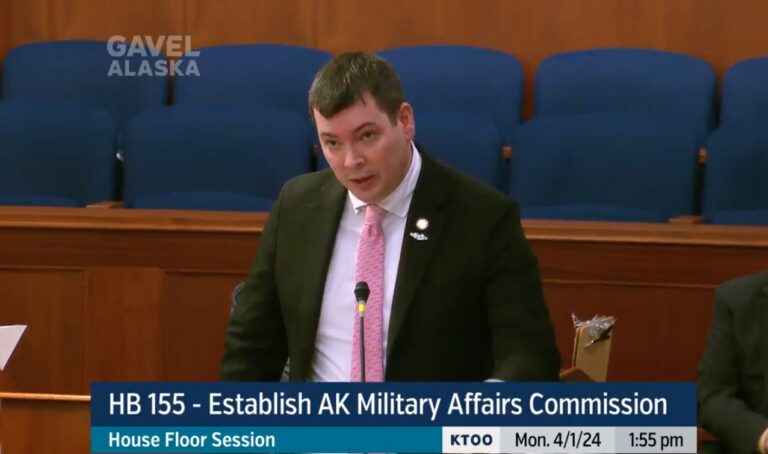
House bill establishing Alaska Military Affairs Commission passes unanimously

One thing that both sides of the political aisle agree on in the Alaska House of Representatives is that the military is important to Alaska. A bill establishing an Alaska Military Affairs Commission, with prime sponsor Rep. Will Stapp of Fairbanks, passed the House on a unanimous vote of 37-0. Three members were absent: Rep. Maxine Dilbert of Fairbanks, Rep. Daniel Ortiz of Ketchikan and Rep Andi Story of Juneau, all members of the Democrat-led minority caucus.

House Bill 155 establishes the commission in the Office of the Governor and sets staggered three-year terms for the nine voting members. The commission is intended to provide advice, counsel, and recommendations on military issues and economic and industrial development related to military issues to the governor, state agencies, the Alaska Legislature, communities, and the state’s congressional delegation.

The AMAC will work to expand and grow the current presence of the armed forces in the state, including new bases, expanded missions, and increased training, the sponsoring documentation says. Members would include the lieutenant governor, who would serve as chair of the commission, the adjutant general of the Department of Military and Veterans’ Affairs or designee, the commissioner of Commerce Community and Economic Development or designee, three members of are mayors or their designees from communities with military presence, and two public members with military experience or expertise, and one public member with statewide business or economic development experience. The public members would be appointed by the governor.

There will be no pay for service, but the governor’s office may pay per diem to members on meeting days.

Alaska has more than 67,000 veterans representing four generations across five major conflicts. There are 21,407 active military members in the state with over 29,400 military dependents.

Rep. Jamie Allard said the commission will help the State of Alaska do a better job of reaching out to veterans, particularly female veterans, who are often ignored.

The bill has cosponsors Representatives Frank Tomaszewski, Julie Coulombe, Alyse Galvin, Cliff Groh, Dan Saddler, Mike Cronk, Stanley Wright, Kevin McCabe, and Andy Josephson, and Allard.

HB 155 is in the Senate for consideration.

Chinese illegals swarm border in record numbers since Biden sworn in as president

By BETH BLANKLEY | THE CENTER SQUARE

The number of Chinese nationals illegally entering the U.S. – primarily single, military age men – has skyrocketed under the Biden administration.

Of the more than 140,000 Chinese who’ve illegally entered the country since fiscal 2021, one recently was apprehended at a Marine Corps base at the southwest border.

El Centro Sector Chief Patrol Agent Gregory Bovino reported that Border Patrol agents “responded to a call from the Marine Corp Base about a Chinese national who entered the base without authorization, ignoring orders to leave.”

The Marine Corps Air Station in Yuma, Arizona, is not far from the El Centro Sector, which lies directly west of the CBP Yuma Sector. The El Centro Sector spans 71 linear miles along the border with Mexico in primarily desert and mountainous terrain. To its east is the Yuma Sector, which covers all of Nevada, a southeastern section of California and the western part of Arizona.

The MCAS Yuma is where all Marine Corps tactical aviation units train, and is home to multiple squadrons, including fighter, air combat, and aviation weapons and tactics squadrons. A Naval Air Facility Base is located in El Centro, California, 15 minutes from the Mexico border and is a key training location for pilots.

The Chinese national was “confirmed to be in the country illegally,” Bovino said and “his purpose and intent behind his actions are still being investigated.”

Of the record number of Chinese nationals illegally entering the U.S. along the southwest border, the majority are entering California; at the northern border, the majority are entering in New York, according to U.S. Customs and Border Protection data.

Since fiscal 2021 through February 2024, 140,839 Chinese nationals illegally entered the U.S. nationwide, excluding those who evaded capture.

In fiscal 2021, 23,471 Chinese nationals illegally entered the U.S. nationwide. This number increased to 27,756 in fiscal 2022 and to 53,700 in 2023.

Current numbers are on track to exceed previous fiscal years, with 36,912 having been apprehended through February 2024. The greatest number to illegally enter in a single month was 8,518 in December 2023.

From fiscal 2021 through February 2024, nearly 50,000 illegally entered through the southwest border. Nearly half that number, over 24,000, illegally entered at the northern border over the same time period.

Of those illegally entering from Mexico, the majority are being apprehended in California, totaling a record more than 35,000, according to CBP data. In fiscal 2021, 263 Chinese were apprehended. By February 2024, fiscal year to date, 22,098 have been apprehended.

The second greatest number have been apprehended in Texas of over 26,000 over the same time period, according to the data.

Of those illegally entering from Canada, the majority are being apprehended in New York, over 10,400 during the same time period.

In every state and sector, nearly all being apprehended are single adults. The majority of the single adults are military age men, officials told The Center Square.