Sunday, June 14, 2026
Home Blog Page 474

Peltola and Biden propose taxing middle class to expand Social Security

Before President Joe Biden’s angry and loud State of the Union address on Thursday, Alaska Rep. Mary Peltola put out a brief statement saying that rich people don’t pay enough in Social Security. She wants them to pay even more than they already do.

Peltola is going after the pipeline workers, the pipe fitters, plumbers, and fishermen of Alaska, not just the super-wealthy, although she’s going after them too, including the CEOs of Native Corporations. She wants working, wage-earning Alaskans taxed to the max.

“Did you know that high earners only pay social security tax on the first $168,600 they make in a year? If millionaires paid into Social Security at the same rate as the rest of us, we could afford to protect and expand benefits for everyone. It’s time to #ScrapTheCap,” Peltola wrote on X/Twitter on Feb. 29.

These were talking points passed around by the Biden Administration and parroted by Democrats on Capitol Hill to prime the pump in the class warfare theater of the nation’s center of policy and power. Sure enough, in his speech on March 7, Biden said that millionaires should pay more Social Security tax.

But there’s a problem with that, according to Reason magazine writer Eric Boehm. “Raising the payroll tax cap could generate up to $1 trillion over 10 years, but Social Security faces a $2.8 trillion deficit.”

What’s more, it’s not millionaires who would be hurt, but anyone making more than the cap of $168,600 a year — less than 17% of what another person who makes $1 million a year makes. The two different income earners are in different categories altogether. In fact, millionaires often make much of their money through investments, not necessarily wages.

Peltola herself makes more than $174,000 a year and House of Representative staff members are capped at $199,000 per year, also not in the millionaire category, considering the cost of living in Washington, D.C.

Reason Magazine’s writer acknowledges the $168,600 cap is arbitrary. “In trying to draw a contrast between his own plans and what he claimed Republicans are aiming to do, Biden claimed that ‘working people who built this country pay more into Social Security than millionaires and billionaires do. It’s not fair.'”

To be fair, it was not just working people who built the country, but risk-taking investors, business owners, and job creators. Also others, from soldiers to scientists.

Biden said he plans to “protect and strengthen Social Security and make the wealthy pay their fair share.”

“Though he did not spell it all out in Thursday night’s speech, those two comments seem to be pointed toward the same aspect of how Social Security is funded. Under current law, the payroll tax that funds Social Security is capped so that, for this year, only the first $168,600 in earnings are subject to it,” Boehm wrote. That cap went into effect in 2024.

To be fair, $168,600 in New Mexico is not the same as $168,600 in New York City. But eliminating the cap is the Democrats’ idea to stop the bleeding for Social Security, or as Peltola would have it, expand Social Security to more people.

The Social Security growing deficit is set to create a major insolvency problem in nine years, which could mean a 23% benefit cut. Peltola and Biden want a massive tax that would not guarantee the insolvency would be fixed, because, as Peltola puts it, she wants to expand benefits.

There’s no doubt that raising the cap would generate more revenue that could be used to help keep Social Security afloat, Boehm explained in his article. “The Congressional Budget Office estimates that applying payroll taxes to higher income levels could raise $1 trillion in revenues over a 10-year period (though the amount of revenue would depend on how the cap was altered, and whether benefits increased as well).” It’s just not enough to close the $2.8 trillion gap.

Here’s where it gets tricky: Taxing people who are clearly not millionaires is a penalty on hard-working Americans to transfer their wealth to both retirees and the expanding federal definition of disabled people.

“A significant portion of that tax increase would fall on people making less than $400,000 annually—remember, the cap is currently set around $168,000—a cohort that Biden promised again in Thursday’s speech would not face tax increases,” Boehm wrote. Thus, anyone making $400,000 would pay a Social Security tax on the next $231,000, or at least $17,700 more in taxes, or nearly $36,000 more if self-employed. The Peltola-Biden Plan is especially hard on small business owners.

The announcement of the increase of the cap came in October when the Social Security Administration announced that the maximum earnings subject to Social Security tax would increase from $160,200 to $168,600 in 2024 — an increase of $8,400. It wasn’t the only change. Due to the cost of living going up, Social Security recipients received a 3.2% cost-of-living increase for 2024. For most recipients, it means less than $100 a month more than last year.

Peltola and other Democrats started their coordinated #ScraptheCap campaign in lockstep in the days leading up to the State of the Union. It went like a virus through the Democrats on Capitol Hill and she was just another vector among many.

Sen. Bernie Sanders, a socialist from Vermont, parroted the same phrase: “At a time of massive income and wealth inequality, we have a radical idea that maybe the people on top should start paying their fair share of taxes … #ScrapTheCap,” he said.

Rep. Pramila Jayapal, the socialist sympathizer from Seattle, also used the phrase the same day that Peltola did:

“Did you know that Saturday is when millionaires stop paying into Social Security for the year thanks to arbitrary caps? That’s not right — they need to contribute all year, just like the rest of us. It’s time to #ScrapTheCap and make the ultra-rich pay their fair share,” she said.

So did Rep. Mark Pocan of Wisconsin: “Millionaires will stop paying into Social Security for the year on Saturday, while the rest of us continue to pay into the system with each and every paycheck. It’s time to #ScrapTheCap to ensure the ultra-wealthy pay their fair share!”

The list goes on and on, with representatives and senators from the Left using almost the exact same phrasing in the days and week before Biden’s speech.

At the Manhattan Institute, senior fellow Brian Riedl has written about the myths surrounding these fixes:

“Eliminating the tax cap would either raise benefits as well (reducing the proposals’ savings), or—if the accompanying benefits are canceled—turn Social Security into a true welfare program by delinking contributions and benefits,” Riedl wrote in The Dispatch in “Ten Myths Sabotaging Social Security Reform.”

As a former Senate budget staffer, he has studied the problem for years: “Moreover, eliminating the cap would not bring permanent solvency or avert the need for benefit changes….The system would return to deficits by 2029. Lawmakers would still need to reform benefit levels and the eligibility age.”

The contribution salary cap has been around since the beginning of the program. When Joe Biden was born, only the first $3,000 a person made was taxed by the Social Security Administration. By the time Peltola was born, that had gone up to $10,800. It kept rising with inflation. In 2016, it was $118,000. By the time Biden took office, it had risen to $137,700. Now, people are taxed all the way up to the first $168,600, and Democrats want it all now — Social Security tax on every penny earned.

Read Boehm’s entire analysis at Reason about why the Peltola-Biden plan to tax upper-income earners even more will not work to reduce the Social Security funding gap.

Alaska Senate bill would take bite out of tiny-print newspaper ad revenue; publishers fight back

17

A bill to be heard on the Senate floor on Monday would modernize public notice regulations and eliminate the requirement that some public notices for the sale, appropriation, or removal of water will not need to be published in newspapers. They can be published online at the state’s public notice website.

For decades, budget hawks have said that the “legal notices” in newspapers are costly and unnecessary, since everything else in the world, including the Legislature itself, has migrated online. Newspapers are increasingly just another online source of information, but no longer dominate the news landscape like they did even 25 years ago. For example, the Juneau Empire now only prints two editions a week. While it once printed 9,000 copies six days a week, it’s down to 1,595 print copies on Wednesdays and 1,802 on Saturdays.

The Anchorage Daily News is down to printing five days a week. It’s protective of its print circulation numbers but during the bankruptcy proceedings of 2017, it was down to about 28,000, and likely is half that in 2024. It says to advertisers that its circulation is 57,000 daily, but that’s due to its digital edition and reach, and it does not break out the closely guarded numbers.

Senate Bill 68, recognizing that most newspapers have most of their readers online anyway, calls for publishing the notices in the Alaska Online Public Notice System, by mail, and by “other means as deemed necessary.”

There would be no cost to the state for the change, says the Division of Mining, Land and Water. In fact, there even might be substantial savings.

The executive director of the Fairbanks Daily News-Miner opposes the change. Virginia Farmier wrote that many in the Fairbanks area do not have access to the internet. “The bill will do a disservice to our community and the state as a whole,” she said in her letter of opposition. “The public has relied on community newspapers to keep them informed and to publish public notices. If the state government publishes their own notices, where’s the transparency in that? I took an informal poll of people in Fairbanks asking if they knew the state had an ‘online public notices’ website and they did not.”

Ryan Binkley, publisher of the Anchorage Daily News, wrote, “The current law, which requires notices to be published in newspapers of general circulation, ensures that the public is informed and has the opportunity to provide feedback and input on matters that affect their communities. Newspapers (and their websites, which include all the notices published) have a vastly wider reach and are more accessible to Alaskans who may not have access to the internet or are not frequent users of government websites. This change would disenfranchise these individuals and limit their ability to participate in the decision-making process.”

The Alaska State Chamber of Commerce supports the bill: “For a number of years, the Chamber has had a position that supports the automation for processing of titles, liens, notary signatures, and other paper-based processes to improve access, delivery turnarounds and lower cost of operations. SB68 streamlines an antiquated process and provides for a common-sense efficiency as it relates public notice for water rights.”

The bill would update, but not substantively change, any other requirements for notice by the commissioner to determine the rights of persons holding existing appropriations, removal, or sale of beneficial water use rights, the bill sponsor says.

“Eliminating the newspaper notice requirement would prevent delays in the water permitting process and save the applicants a significant amount of money required for newspaper notice. The changes would utilize the state’s existing online public notice system, which is available to most Alaskans at no cost. All public notices posted on the online public notice system are permanently retained for future reference by interested parties, whereas newspaper notices are much more difficult to retrieve. Utilizing the online public notice system ensures that each Alaska resident has equal access to public notices rather than just newspaper subscribers or residents of an affected area. Further, elimination of coordinating newspaper publications reduces the permit processing timeframe,” the sponsor statement says.

SB 68 says that the public can use the subscriptions feature on the Alaska Online Public Notice System website (https://aws.state.ak.us/OnlinePublicNotices/) to either register for all notifications through the system, or to tailor what notifications from which departments they wish to receive.

“The Department of Natural Resources is eager to educate the public on the benefits of using the online notice system; SB 68 enables notice to be delivered to Alaskans through the power of the Internet,” the statement says.

Other states are dropping the newspaper option for public notices.

Last year, Florida Gob. Ron DeSantis signed the first law in the nation, which took effect Jan. 1, allowing local governments to post exclusively on either government websites or in free newspapers or other publications that have been cut out of the lucrative business of publishing public notices.

This year has seen more legislatures moving away from newspapers. There are bills in both Indiana and Iowa that provide government websites as an alternative to newsprint, which is a dying medium.

The newspaper industry is fighting the trend, trying to claw back the revenues that are supporting smaller and smaller publications, staffed by leftwing operatives. The Public Notice Resource Center is a website operated by American Court and Commercial Newspapers, Inc. to help newspapers stop the bleeding off of taxpayer dollars from their enterprises. PNRC even created a suite of ads  that newspapers can use to promote how interesting and essential these legal ads can be.

And PNRC advises publishers to make sure their reporting staff does not disparage legal ads.

“Pay close attention to reporting on public notice issues and you may begin to observe that some papers have adopted certain rhetorical habits that tend to undermine the goal of preserving newspaper notice. They’re mostly innocent mistakes made by people who are unaware that what they’re doing may be counterproductive. But it’s fair to say that if those habits could be eliminated it might enhance the policy environment for maintaining newspaper notice,” PNRC wrote this month.

“It would also help if reporters stopped referring to them as ‘those tiny ads in the back of the paper,’ a description we see in newspaper stories so often it practically qualifies as a cliche. They’re only tiny and in the back of the paper if your paper insists on making them that way. Try taking a different approach by presenting notices in a manner that brings attention to them — the way this publisher did and the way many other publishers try to do with other types of advertising.”

PNRC also reports that at least one newspaper has sued its state government for pulling the ads.

“A newspaper based in Delaware County, N.Y. sued county officials in December, claiming they unlawfully canceled its public notice contract in retaliation for unfavorable news coverage. The Reporter, a weekly newspaper based in the county seat of Delhi, also alleges the county violated the First and Fourteenth Amendments by ordering its employees to refer all questions from the paper to the county attorney’s office,” the website reports.

The bill will be in its third reading on the Senate floor on Monday. It’s main sponsor, Sen. Cathy Giessel, had her name removed from the bill and made the sponsor the entire Senate Natural Resources Committee. Information about the bill is at this link.

By the numbers: Just how many voters are on Alaska’s voting rolls today?

After the Division of Elections conducted its annual clean-up of Alaska’s voter rolls at the end of February, there are 587,277 voters in Alaska. Before the Feb. 29 data purge, 590,778 voters were on the rolls at the Division of Elections.

It’s a process the state division goes through every year after it sends out two required notices to voters who haven’t voted for four years or who have not contacted the division.

Purging means the voters go into inactive status and do not appear on any voter rolls in coming elections. Later, the voters are completely removed if they don’t make themselves known.

If a voter is in an inactive purge status, they can cast a questioned ballot which is reviewed by the questioned board and their ballot is counted to fullest extent possible based on the residence address/house district assignment they provided on the questioned envelope and the address/house direct assignment we have in the voter registration system. They then are put back into an active status. 

In the most recent report 141,240 registered Alaska voters are Republicans, at 24%; 74,769, or 12.73%, are Democrat; Undeclared (those who won’t say) total 258,489, 44%; and Nonpartisans are 82,489, 14%.

It’s an imperfect process, but the division is following state and federal laws that err on the side of not mistakenly removing a legitimate voter. Still, it leaves tens of thousands of names on the list, when mathematically, it doesn’t compute with the number of adults in Alaska.

The U.S. Census says there are an estimated 733,406 residents of Alaska. Of those, 24% (176,017) are under the age of 18, thus ineligible to vote. That leaves a voting age population of about 557,000, if you rule out the ineligible sex felons and noncitizens. (If you have been convicted of a crime involving moral turpitude or are on probation or parole for the same crime, you are not eligible to vote until the Department of Corrections gives you an unconditional discharge.)

In November of 2022, turnout was 267,047.

Last year during the annual list maintenance process, the Division of Election purged 15,916 voters from the rolls; the purged numbers vary year to year, as the division tries to keep the list up to date, something that is required by state and federal laws that also limit how quickly the division can remove voters from the list.

The division conducts the main list maintenance process from December through February and at other times throughout the year. It is a process required by state and federal laws, which limit the division’s ability to remove voters from the voter list.

Having too many on the rolls is partly due to people applying for Permanent Fund dividends, who are automatically registered to vote unless they opt out, and the ease of registering to vote when they get a driver’s license, the division says. Alaska voters passed a ballot initiative that automatically registers people to vote when they apply and are qualified for a dividend.

“If someone becomes registered but does not vote and does not contact the division, it can take at least eight years and the return of undeliverable mail to remove them from the voter list. Alaska’s list maintenance law requires more steps to remove a voter than the federal list maintenance law, the National Voter Registration Act,” the division says.

Also, military members may register to vote and vote in Alaska elections even if they are stationed overseas and do not plan to return to Alaska. As long as they don’t register or vote in another state, they can be Alaska voters; many do maintain that residency in order to receive and Alaska Permanent Fund dividend.

Gov. Youngkin vetoes bill that would have forced Virginia back into ERIC voter registration system

Virginia Gov. Glenn Youngkin vetoed a bill requiring the state to rejoin a voter-registration consortium known as ERIC — the Electronic Registration Information Center. The multi-state compact to maintain voter rolls has seen nine states leave over the past two years, as Republican-led states lost confidence in the neutrality of the system, designed by partisan Democrats with initial funding from George Soros through the Pew Charitable Trusts.

The Virginia bill passed along party lines. Democrats control the Senate and House and wanted Virginia back in ERIC, which shares data from motor vehicle agencies and voter registries across its 25 remaining member states, which include Alaska. It’s unclear if they have the votes to override his veto.

Last year, the Alaska Division of Elections said it was evaluating its membership in the ERIC database system, but no decision to stay or leave was ever final.

Nine of 33 member states have dropped out of ERIC membership because of concerns about the organization’s partisan origins, current political biases, connections with leftist groups, and various data policies that appear to favor Democrats.

The nine states that pulled out of ERIC are all led by Republicans, including Virginia, West Virginia, Ohio, Iowa, Missouri, Louisiana, Texas, Alabama, and Mississippi.

Document drop: Peltola abused state law during North Pole campaign stop at school, and illegally coordinated election activity with school staff

Documents obtained through a public records request show that Rep. Mary Peltola, in the capacity of a candidate and not as a U.S. representative, not only used North Pole High School for a campaign stop, but her campaign was trying to put together a fundraiser on campus while she was there, during school hours.

The fundraising portion of her event evidently fizzled, but the school administration actively helped her with the rest of her campaign stop as she was hitting various venues in the Fairbanks area.

It’s a serious offense, according to state law:

“Sec. 14.03.090. Partisan, sectarian, or denominational doctrines prohibited.
Partisan, sectarian, or denominational doctrines may not be advocated in a public school during the hours the school is in session. A teacher or school board violating this section may not receive public money.”

In other words, schools that use their facilities during school hours to advocate for a candidate for partisan political office may not receive funding from the State of Alaska.

The trail of documents obtained by citizen activist Jay McDonald shows public employees in the school district continuously coordinating in advance with Peltola’s campaign staff, and eager to help get pictures and promote her campaign activity on the district’s social media pages. The back and forth emails make it clear the public employees knew they were coordinating with campaign staff.

Peltola came through Fairbanks in January. On Jan. 18, she scheduled a campaign stop at North Pole High School for 11 am to 1 pm, while students were in school. Normally, campaigns could rent school space after hours, but it’s against the law to use public facilities during business hours for campaign events.

Along with her, Peltola had a gaggle of campaign staff, including Chris Whitschy, who was Sen. Bernie Sanders’ senior field film producer on the Bernie 2020 presidential campaign and the Friends of Bernie Sanders political committee, from March 2019-September 2021. Peltola also had with her Anton McPaland, her campaign manager who also serves as her chief of staff.

Even the principal of the high school got involved in helping the campaign event, by writing to campaign coordinator Maggie Calico multiple times to maximize publicity before and after the event.

Must Read Alaska wrote about the illegal activity in January, and immediately Peltola’s campaign staff removed all traces of the event on social media. That’s when Jay McDonald dug deeper to see just how much coordination with the school staff had occurred.

The Democrat member of Congress was accompanied by another Democrat candidate — Fairbanks North Star Borough mayoral candidate Grier Hopkins, who posted a photo to his campaign Facebook page of the two candidates, side by side, unabashedly campaigning during school hours.

Although it was not his campaign event, Hopkins was piggybacking on the representative and may have also been breaking the law, since he used the photo in his social media post.

The event was advertised for the school library, but the two politicians toured the school, popped into classrooms to talk to students and visited the automotive class, where Hopkins took the selfie.

In the narrative of that post on Facebook, Hopkins used the moment to promote more funding for schools from the Legislature and the governor:

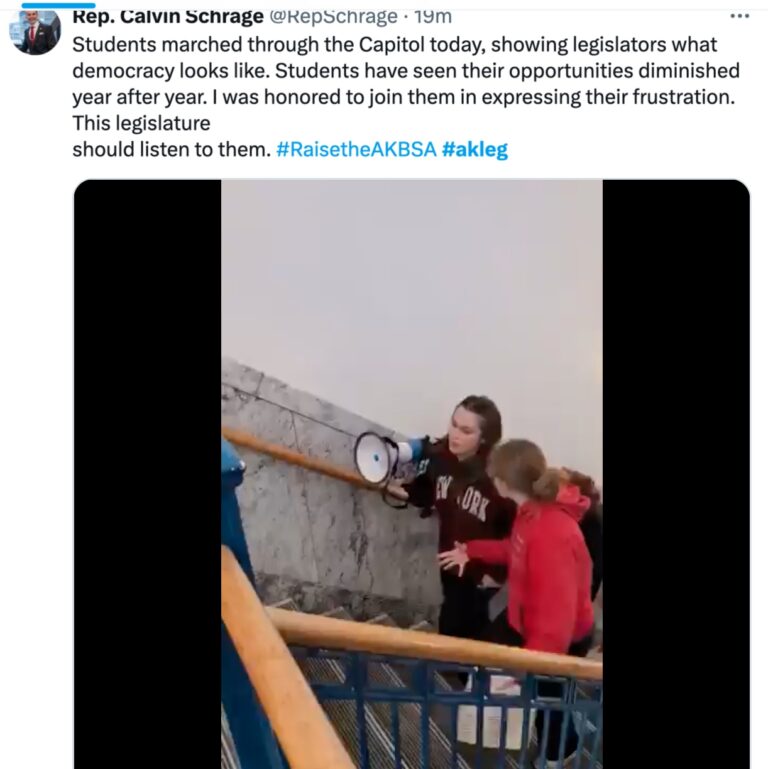
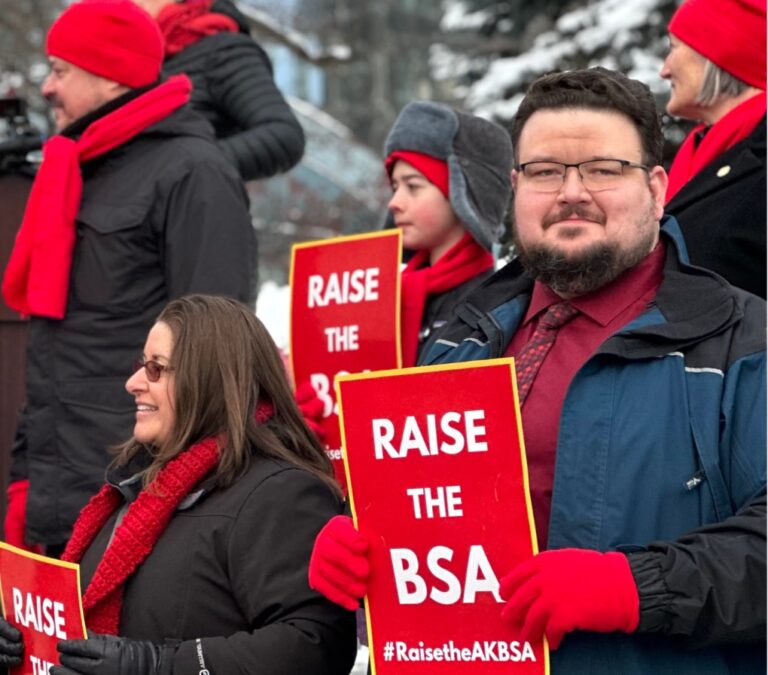
“In the CTE Automotive Classroom at North Pole High School with Mary Peltola seeing the fantastic work they do here! Education is so much more than just the 3 R’s (reading, ‘righting, ‘rithmatic)! It’s about creating thinking, curious, caring students who are engaged! As the #akleg debates our Fnsbsd and all of Alaska’s schools’ needs, you can see the impacts right here in the classrooms.  #RaisetheAKBSA — at North Pole High School.” he wrote.

Hopkins, who is running for a nonpartisan seat (mayor) has left his photo memorializing his campaign tour of the school with the candidate for Congress, but the school itself and the North Star Borough School District erased all evidence of the event on their Facebook pages.

Republicans: Drop the charges against Gold Star father who yelled ‘United States Marines!’ at Biden

It was fine for Democrats in Congress to interrupt President Joe Biden by chanting “Four More Years” repeatedly during the State of the Union on Thursday. In fact, it was welcomed by the president.

But it was not OK for the Steven Nikoui to stand up and yell at the president. He shouted “Abbey Gate” and “United States Marines,” after Biden said the phrase, “America is safer today than when I took office.” Nikoui just couldn’t take the lie and wanted to remind the hall of the site of the 2021 suicide bombing, when 13 US service members were killed during the Biden-ordered chaotic withdrawal.

Nikoui was a guest of Rep. Brian Mast. Florida Rep. Mike Waltz has offered to pay the possible $500 fine.

Nikoui’s son was Marine Lance Cpl. Kareem Nikoui, who died in the 2021 ISIS-K suicide bombing as Biden’s evacuation from Kabul, Afghanistan became a deadly military disaster.

Nikoui was removed from the House floor and taken away in handcuffs during what was described by many observers as Biden’s biggest campaign speech to date.

“The Sergeant at Arms is holding my State of the Union guest for yelling at [Biden] in protest because his son was killed in action at the Abbey Gate due to Biden’s incompetence,” Rep. Brian Mast said in a post on X.

“No one has been fired over the Afghanistan withdrawal that took the lives of 13 servicemembers. Biden refuses to  ACKNOWLEDGE the lives of the 13 servicemembers. My guest, a Gold Star family member Steve Nikoui, had ENOUGH of Biden’s BS,” Mast wrote.

Nikoui posted bail and then attended a Gold Star family get-together with others who have lost military family members in war. was greeted with overwhelming support at the Dubliner Restaurant in Washington, D.C. Fellow Gold Star families rallied around Nikoui, and applauded his courage. Gold Star father Darin Hoover detailed Nikoui’s ordeal to the New York Post. “He was taken out in handcuffs,” Hoover told the New York Post. “And so we all sat there and waited and waited and waited — and gave him a hero’s welcome when he came in.”

Republicans have called for the charges to be dismissed.

After the speech, Mast was accosted by members of the radical group Code Pink, who demanded a cease fire in Gaza. Mast asked them if they knew “where we stand on terrorists? We stand on their throats,” he said, and walked away on his two prosthetic legs. During Operation Enduring Freedom in 2010, Mast lost both his legs while serving as a U.S. Army explosive ordnance disposal technician in Afghanistan. Watch the video of that exchange here:

Leftist group weaponizes against Mayor Bronson; mayor’s campaign signs defaced across town

The leftwing group called 907 Initiative has a side group 907 Action, which published a voters guide recently for leftists in Anchorage. Ballots will be mailed to voters on or around March 12, and must be in the mail by April 2.

The group is pouring money into the local elections to flip the mayor’s office back to Democrat control after suffering major setbacks during the last mayoral reign of Ethan Berkowitz, a Democrat.

Conservatives can use the “progressive voters guide: to figure out what the liberals want for Anchorage, and can vote the opposite way.

The 907 Action website is pushing Suzanne LaFrance for mayor and endorses all the leftist incumbents on the Anchorage School Board, as well as pushing for yes vote on bond issues.

It’s impossible to tell who is funding the group, but its parent organization, 907 Initiative is a dark-money group that conceals its funding sources. The 907 Initiative poses as an educational group and is prohibited from campaigning, but it has been pounding on Mayor Dave Bronson for months.

Meanwhile, leftists whose values align with the 907 Initiative/Action have defaced over 15 of Bronson’s campaign signs by scrawling the words such as “GENOCIDE” across them, as shown above.

On the 907 Action’s description of Mayor Dave Bronson, the group says, “Mayor Bronson’s first term was defined by scandal and incompetence. Under his leadership, long-time municipal employees fled, leading to high vacancy rates across city departments, including the Anchorage Police Department. The inability to clear the streets for two straight winters under his leadership led to record school closures and parents having to stay home from work. Mayor Bronson failed to implement a plan to address homelessness, leading to record outdoor deaths and large camps throughout the city’s green spaces. He also approved illegal contracts, and was accused of spying on employees and creating a sexualized work environment. We do not support the reelection of Mayor Dave Bronson.”

About Bill Popp, the group tries to not insult him: “Bill Popp led the Anchorage Economic Development Corporation for 16 years, before resigning to run for mayor. His long business background is a plus, but his absence of serving as an elected official is concerning. Anchorage residents need a leader with experience to get our city back on track. We do not support Bill Popp for mayor.”

The group is very hard against Chris Tuck: “Chris Tuck has a long history in Alaska politics, having served seven terms in the Alaska Legisature. Despite Tuck’s experience and accomplishments, he holds several concerning beliefs, including an anti-abortion stance. In 2020, he joined several other Democrats around the country in writing a letter asking the national Democratic Party to drop their support for abortion rights. Tuck also opposed Real ID on the belief that the IDs contain a GPS tracker, opposed the use of flouride in drinking water and claimed TSA scanners took naked pictures of people. Tuck’s tendency to believe misinformation is concerning. We do not support Chris Tuck for mayor.”

But the group glorifies Suzanne LaFrance, and calls her a nonpartisan, although she is the choice of the Alaska Democratic Party: “Suzanne LaFrance is running for mayor on a platform of returning competence to city government, focusing on public safety, trails, education, addressing homelessness, and affordable housing. LaFrance comes with the experience of serving as chair to the Anchorage Assembly and plans to deliver expected city services by staffing up city departments and instilling a professional, positive workplace culture. She ran on fighting for state and federal resources for the municipality and running a transparent city government. We support Suzanne LaFrance for mayor.”

There appears to be no such voter guide for conservatives in the Anchorage municipal election, which ends April 2.

Official information about the election can be found at this link.

‘No Labels’ party to proceed on presidential campaign with candidate … But who?

The No Labels party, a third party launched last year to be somewhere between Democrat and Republican, met on Friday and sealed the decision to proceed with a presidential candidate.

That candidate won’t be Sen. Joe Manchin, who has decided not to pursue a run for president. Both former presidential candidate Nikki Haley and retiring Sen. Kyrsten Sinema of Arizona have ruled out third-party presidential campaigns.

Whoever it is will be has not been revealed but is to be announced around March 14. No Labels has ballot access in 16 states, including Alaska.

“Earlier today, I led a discussion with the 800 No Labels delegates from all 50 states,” said Mike Rawlings, No Labels convention chairman. “These citizen leaders have spent months discussing with one another the kind of leadership they want to see in the White House in 2024. These are some of the most civic minded, thoughtful, and patriotic Americans I have ever met. They take their responsibility seriously. Even though we met virtually, their emotion and desire to bring this divided nation back together came right through the screen. I wasn’t sure exactly where No Labels delegates would land today but they sent an unequivocal message: Keep going.”

The vote among the 800 delegates was nearly unanimous, Rawlings said.

“Now that No Labels has received the go ahead from our delegates, we’ll be accelerating our candidate outreach and announcing the process for how candidates will be selected for the Unity Ticket on Thursday, March 14.”

The Democrats and their liberal media surrogates are worried that the candidate most hurt by the liberal-leaning group will be President Joe Biden. With many of the top-tier candidates dropping out of contention, the party is on the hunt for someone with the “it” factor who can launch the group into orbit again.

In Alaska, the group is considered a limited political party, and its chair is one Darrell Brown Sr. of Palmer, who is a registered nonpartisan voter in Alaska with the Division of Elections, but has no evident political experience in the state.

The case of Eric R. Staples: Read what typical charges look like against Jan. 6 election protesters

The criminal complaint against a man currently living in Girdwood, Alaska is an example of the Department of Justice’s efforts to round up and bring to justice anyone who entered the U.S. Capitol during the election protests of Jan. 6, 2021. Over 1,000 arrests have been made associated with the breach of the Capitol after a rally held by then-President Donald Trump.

The protest came as the U.S. Senate was preparing to certify the 2020 presidential election, which many to this day believe was riddled with fraud.

The complaint says that Eric Richard Staples, formerly a resident of Wyoming, broke federal laws:

18 U.S.C. § 1752(a)(1)- Knowingly Entering or Remaining in any Restricted Building or Grounds Without Lawful Authority
18 U.S.C. § 1752(a)(2) -Disorderly or disruptive conduct in a restricted building or grounds

40 U.S.C. § 5104(e)(2)(D) – Disorderly or Disruptive Conduct in a Capitol Building
40 U.S.C. § 5104(e)(2)(G) – Parading, Demonstrating, or Picketing in a Capitol Building

The complaint says:

“Beginning in January 2021, the FBI received a number of public tips regarding the possible involvement of Richard Eric Staples, Jr., (“STAPLES”) in the January 6th riot. On October 6, 2021, FBI Special Agent Michael A. Miedona interviewed one tipster who attended high school with STAPLES. The tipster indicated that STAPLES prefers to be called “Eric,” rather than “Richard.”

“The tipster reported that they had seen various Facebook posts concerning STAPLES’s travel to Washington, D.C., and his activities on January 6, 2021. These included posts to STAPLES’s own Facebook page and posts by an individual who has since been charged with criminal offenses arising out of his activities at the Capitol on January 6th (“Defendant 1”) in which STAPLES was tagged.2 The tipster provided screenshots of the posts.

“For example, the tipster provided a screenshot of a post by Staples on January 5, 2021, that he was ‘on [his] way to the snake pit of Washington DC.'”

“The tipster also provided a post from Defendant 1 in which STAPLES was tagged. The tipster identified STAPLES in a picture within the post, which showed Defendant 1 and STAPLES standing together with the U.S. Capitol in the background. A reproduction of this image that has been cropped to show STAPLES is provided below.”

A man described as Eric Staples poses in front of the U.S. Capitol.

“The tipster also provided a post by STAPLES three hours after Defendant 1’s post, in which STAPLES stated ‘It is the peoples house, not Chinas.’”

According to an image captured by Capitol’s closed-circuit TV, Staples entered the Capitol through a broken window, and only stayed a brief period of time before leaving. The time recorded by the camera was one minute and 24 seconds, just long enough to snap a few photos.

On Dec. 1 Staples was interviewed by federal investigators at the FBI’s Cheyenne, Wyoming office. Staples had an attorney with him, and admitted to entering the U.S. Capitol through a window. He said that in the photo where he was holding up four fingers, he was indicating “four more years” for President Trump.

A slide show of the final four pages of the complaint is below:

Staples, after Jan. 6, 2021, attempted to erase his social media history and he moved to Alaska, but he has known he was facing arrest since 2021, as he was interviewed by the FBI that year. The arrest came on Thursday.

The warrant for Staples shows what the Jan. 6 arrest warrants look like:

Aaron Mileur of Wasilla pleaded guilty in December of 2022 and received two years of probation. His is typical of plea agreement with Jan. 6 defendants:

A Florida man, Christian Manley, arrested for similar charges while in Anchorage, pleaded guilty on Dec. 7, 2022, and was sentenced to four years of prison, and three years of probation. All of his charges and photos of him are at this link.