After eight months of investigation, the U.S. Supreme Court still doesn’t know who on its staff leaked a draft copy of the historic Dobbs v. Jackson Women’s Health Org. decision, which untangled the nearly 50-year-old abortion law known as Roe v. Wade, and sent the abortion question back to the states, so states can make their own laws regarding the legality of abortion.
The investigation “has to date been unable to identify a person responsible by a preponderance of the evidence.” The report says investigators conducted 126 formal interviews of nearly 100 employees, and all denied leaking the opinion to the media.
The investigation also found no credible reason to believe the court’s computers were hacked.
The justices went on, in an introduction to the report, to say that the Covid-19 pandemic remote work policies led to a situation where it would have been too easy for someone to get access to a document and leak it to the media. An independent legal review of the investigation recommended the court tighten up access to hard copies of sensitive documents and to limit email distribution of them to avoid further leaks.
The May 2, 2022 leak is considered to be the worst confidentiality breach in Supreme Court history and has shaken the faith in the institution. Politico, a publication read by politicos, published the draft opinion on May 2. The following day, Chief Justice John Roberts ordered an investigation by the court’s marshal, Gail Curley.
The justice’s issued a statement on Thursday calling the leak a form of misguided protest, and “a grave assault on the judicial process.” The justices called it a “betrayal of trust.”
Curley’s report, attached below, details what actions the investigation took, and concludes that the culprit remains unknown. The justices say no further investigation is warranted:
The leak of the Dobbs decision is thought to be the reason pro-abortion advocates attacked more than 100 crisis pregnancy clinics in recent months, attacks that started right after the publication by Politico.
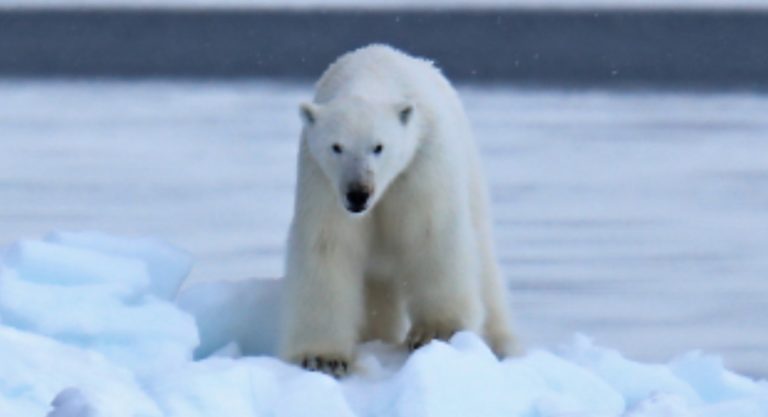
On Wednesday, an Alaska State Trooper and a representative from the Alaska Department of Fish and Game were able to land in Wales, Alaska to investigate the polar bear attack that left a young mother and her child dead on Tuesday, in what was described by Must Read Alaska sources as an extremely gory scene in an attack that went on for some time near the entrance to the school in that remote village.
The bear had chased other residents in the village during a blinding ground storm, and then came upon Summer Myomick, 24, and her son, Clyde Ongtowasruk, age 1, as the two were walking from the school to the clinic. Myomick was from St. Michael, 232 miles away, but split her time between the two communities.
The mauling took place near the Kingikmiut School front door. The bear had also tried to enter the school at one point and the principal slammed the door shut before the bear could get in, had all the blinds shut in the building, and kept everyone away from windows. People inside the school were not able to save the two mauling victims because the bear was an immediate threat and there were no adequate weapons inside the school.
After the mauling, the polar bear was shot and killed by a Wales resident who had a large-caliber firearm and took the bear down while it was consuming its prey, Must Read Alaska has learned.
Troopers and Alaska Department of Fish and Game were able to get to Wales after weather improved. The runway lights were out in Wales, limiting the ability of pilots to get into the village, due to the approximately five hours of actual daylight this week in that village, which is the farthest-west community on the North American continent. Wales is located on the Seward Peninsula and facing Little Diomede Island, 26.5 miles to the west.
The remains of the young mother and child were sent to the medical examiner. Fish and Game is assisting the U.S. Fish and Wildlife Service, as polar bears are federally managed as a marine mammal. Officials took samples from the bear for a necropsy, which may determine if the bear was hungry, rabid, injured, or was just an aggressive predator.
At this time of year, most polar bears are out on the sea ice hunting seals. There is no lack of sea ice off of Wales at this time of year, but many liberal news outlets are suggesting that the bear attack is a result of climate change. This attack is the first reported in Alaska for over three decades. The last attack was in Point Lay, in 1990, when a 28-year-old man was killed while walking in the village, which is 300 miles north of Wales.
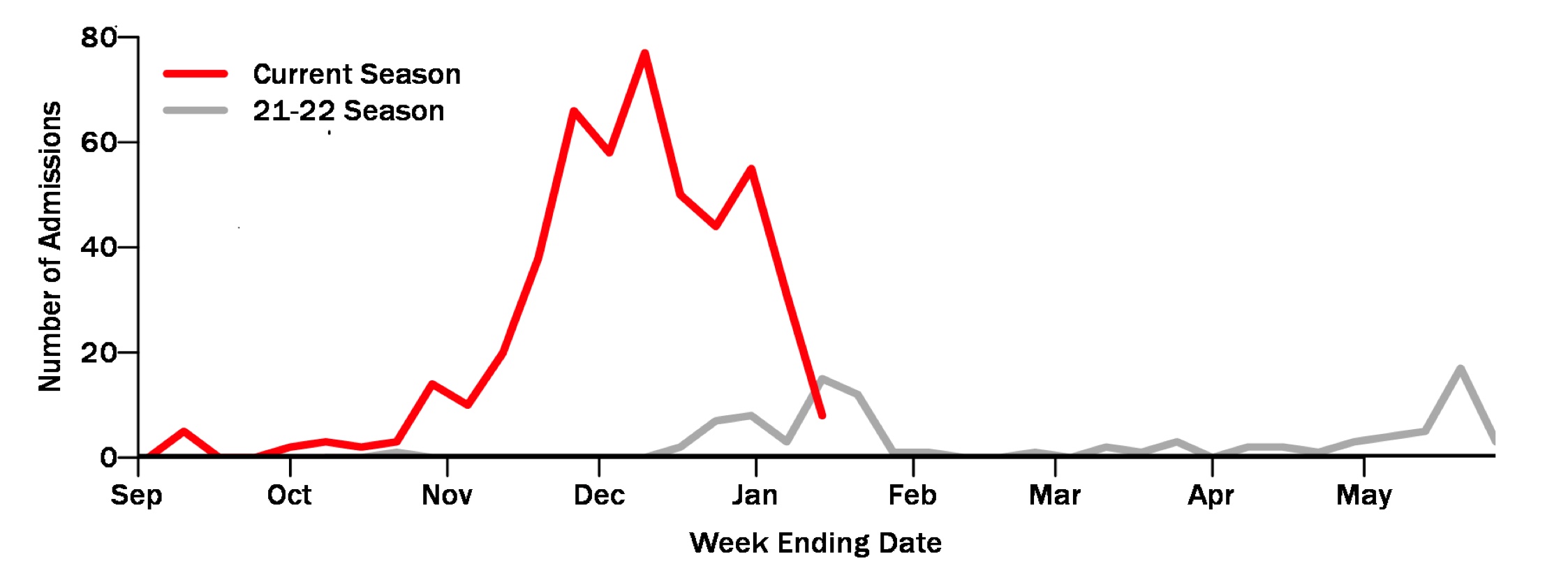
The Alaska Department of Health data dashboard shows an 8% drop in influenza vaccinations administered to Alaskans this flu season compared with the 2021-2022’s flu season.
The data shows a consistently lower number of vaccinations throughout the timeline measured, starting in August. To date, 151,600 Alaskans have been vaccinated, down from 154,600 last flu season. This, in spite of a robust public health campaign encouraging everyone to get the flu vaccination this year, and warnings in the fall about the harsh flu season expected.
Juneau has the highest number of overall residents vaccinated for the seasonal flu, at 32%, followed by the rest of Southeast at 29%. The lowest vaccinated borough in Alaska is the Matanuska Susitna Borough, at 14%, followed by Kenai at 17%, the Northwest Arctic at 17%, and Fairbanks North Star Borough at 18%.
Roughly 24% of Anchorage residents are vaccinated for flu.
Alaskans are not getting flu vaccinations at the rate they got them in the 2021-2022 flu season.
As for ethnic breakdown, Alaska Natives and Asian ethnicities were the most likely to get the flu vaccine, and Blacks and Pacific Islanders were least likely, according to the Department of health data. Whites fell into the middle of the chart.
While still not “all in” for the flu vaccine, older Alaskans are getting vaccinated the most this season, according to the data. In Juneau, 52% of those 65 or older are vaccinated, followed by the seniors of Anchorage, at 51%.
Mat-Su’s seniors are at the bottom of the flu vaccine chart at 36%.
A call to the Alaska Department of Health for an explanation for the drop in flu vaccine acceptance went unanswered.
The 2021-2022 flu season was relatively mild, possibly due to more people avoiding social situations that could expose them to the also-concerning Covid-19 virus. But with this change in social behavior, some Alaskans may have gauged their risk of catching the flu to be reduced. Others may believe that if they lived through Covid they can live through a bout with the seasonal flu.
This year, there’s been a dramatic spike in people being admitted to the hospital for flu, compared with the 21-22 season.
There’s also the government trust factor: Some Americans feel they have been misled by the same health agencies and pharmaceutical companies that people previously felt had told them the truth on other important topics. The discovery that politics entered medicine and science may have shaken Americans’ confidence in medical advice.
In 2021, 29% of U.S. adults said they have a great deal of confidence in medical scientists to act in the best interests of the public, down from 40% who were surveyed the previous year, according to a poll conducted by Pew Research.
“Similarly, the share with a great deal of confidence in scientists to act in the public’s best interests is down by 10 percentage points (from 39% to 29%),” the group reported. “The new findings represent a shift in the recent trajectory of attitudes toward medical scientists and scientists. Public confidence in both groups had increased shortly after the start of the coronavirus outbreak, according to an April 2020 survey. Current ratings of medical scientists and scientists have now fallen below where they were in January 2019, before the emergence of the coronavirus.”
Gallup released a polllast summer with similar results, showing a growing mistrust by Americans in their basic institutions.
The release of the Twitter Files by Elon Musk revealed over recent weeks isn’t reversing that suspicion. Those files demonstrate how government pressured social media companies to suppress certain information about Covid and vaccinations.
Indeed, the official narrative on the Covid vaccines changed through time, with Americans told by their government that the vaccine would absolutely protect them from getting Covid. Later, the government promise was that people would at least get a less severe case of Covid if they got the vaccine and kept up with seasonal booster shots. Throughout the Covid vaccination rollout, Americans were promised the vaccine is safe and effective, although it is still considered an experimental treatment and adverse reactions are concerning.
The journal Clinical Advisorreported in October that fewer than half of all adults planned to get the flu vaccine this season:
“Although more than two-thirds of US adults believe that annual influenza (flu) vaccination is the best protection against infection, 41% said they are unsure or do not plan to get an influenza vaccine during the 2022-2023 season, according to results from a national survey by the National Foundation for Infectious Diseases (NFID). The key reason cited was the belief that flu vaccines do not work well, infectious disease experts said at a news conference,”
The Centers for Disease Control and Prevention has reported that during the 2021-2022 flu season, 51% of Americans 6 months and older received a flu vaccine, similar to coverage during the 2020-2021 season. But this flu season, 49% of surveyed Americans said they plan to get vaccinated against flu, according to the NFID findings. That is a 4% drop nationally.
Alaskans appear to be anchoring the more reluctant end of the spectrum, with an 8% drop in Alaskans going in for what used to be an annual flu shot.
More information about Alaska flu and the seasonal data is at this link.
The division of the human family into its two distinct branches, liberals and conservatives, occurred some 20,000 years ago. Until then all humans coexisted as members of small bands of nomadic hunter/gatherers. A thousand generations ago, in the pivotal event of societal evolution, beer was invented. This epochal innovation was both the foundation of modern civilization and the occasion of the great bifurcation of humanity into its two distinct subgroups.
Once beer was discovered, our prehistoric forebears decided it was time to settle down. Making beer required grain, and securing a steady supply of it ordained the invention of agriculture.
After that was accomplished, ancient man quickly, and unfairly, consigned actual cultivation to women.
Men couldn’t just run off, willy-nilly, however. Neither the glass bottle nor the aluminum can had yet been invented, so it was necessary to stick pretty close to home, and the brewery.
This left our male ancestors with a lot of time on their hands, and led to the division, which persists to this day, of the species.
Some men tried to conserve remnants of the old way of life (hence the term “conservative”) by spending their days in the open field in the dangerous pursuit of big game animals. At night they would roast their prey at a big barbecue, and afterwards sat around the fire drinking beer and telling off-color jokes.
Other, more timid, souls stayed closer to home. They are responsible for the domestication of cats and the invention of group therapy. Mostly, they sat around worrying about how life wasn’t fair and concocting elaborate schemes to “liberate” themselves from inequity (thus their designation as “liberals”). In the evening they gathered around their fire, nibbling on fruit and nuts, sharing their innermost feelings.
Today some liberals try to pretend they’re really sort of conservative, and sometimes succeed in confusing people. The following are a few tips to use in distinguishing the two types.
By definition liberals believe in big government and high taxes. Life is unfair and the government is there to do something about it. Most people are too stupid to spend untaxed income wisely, and high taxes allow liberals in government to do a better job of it.
Conservatives don’t like government, and, aside from the military, wish it would just go away. They hate taxes, regulations, speed limits, and small cars.
Typical conservatives are former California Gov. Arnold Schwarzenegger, the late President Ronald Reagan, and, up there with the Big Man in the Sky, the incomparable John Wayne.
Typical liberals are Dustin Hoffman, Shirley McLaine, and Pee Wee Herman.
All conservatives drink beer. American beer.
Some liberals like imported beer, but most prefer white wine or foreign water from a bottle.
Liberals like to drive Volvos and Saabs because they’re made (or used to be made) in socialist Sweden. They like to eat weird food because it’s un-American.
Your basic conservative vehicle, especially in Alaska, is the Chevy Suburban. It’s big, it’s American, it’s four-wheel drive, and it sucks up the gas. Conservatives eat beef, which they (surprise!) like to barbecue.
Big game hunters are conservative. Interior decorators are liberal.
Liberals invented the designated hitter rule in baseball because it wasn’t “fair” to make the poor pitcher take his turn at bat.
Conservatives, inspired by a remark of the legendary Pittsburgh Steeler linebacker Jack Lambert, believe quarterbacks should be required to wear skirts, so they can more easily be distinguished from real football players.
James Brown and Ray Charles were conservatives. Michael Jackson and Milli Vanilli were liberals.
Most social workers, personal injury lawyers, journalists, and group therapists are liberals. Most ranchers, loggers, professional soldiers, and steeplejacks are conservatives.
Liberal jurors distrust the prosecutors and police. Conservatives figure the defendant must be guilty or he wouldn’t be on trial.
Most conservatives not only believe in the death penalty, they would cheerfully implement it, personally, if called upon to do so.
Liberals think capital punishment is a barbaric relic, and unfair to boot.
Liberals believe Europeans are, generally speaking, far more enlightened than Americans. Conservatives think they’re basically decadent, as evidenced by their complete absence in the NFL. (Place kickers don’t count).
Typical conservative movies are “Raising Arizona”, “Patton”, and “Conan the Barbarian”.
Typical liberal movies are “Prince of Tides”, “Last Tango in Paris”, and “The Big Chill”.
The quintessential liberal is the handicapper, the person who decides how much extra weight to saddle the faster horses with in order to make the race “fair”.
The American cowboy, of course, is your basic, full bore conservative. The following story, part of this writer’s family folklore, demonstrates why:
A hundred years ago an Englishman in South Dakota was trying to find the owner of a huge cattle ranch. He rode up to one of the ranch hands and asked, “Excuse me, but could you tell me where to find your Master?” To which the cowboy replied, “That sumbitch hasn’t been born.”
Fritz Pettyjohn served in the Alaska Legislature from 1982-1986 and now blogs at ReaganProject.com.
Olympia – Washington State Democrats are filing bills to take away several types of guns from state residents, and make them harder to buy, and are even going so far as to allow all cities and counties in the state to have their own gun laws that supersede state law. Democrats in the House and Senate have the backing of Democrat Gov. Jay Inslee, who has made gun control a major priority of his administration as he considers his next reelection campaign.
Bills filed in the Washington Legislature so far this year include:
House Bill 1240, a bill filed at the request of the governor, would bans the sale of “new “assault weapons” in the state, making such sales a gross misdemeanor. Over 65 guns are known to be targeted by this legislation.
Washington does not specifically define and regulate a general class of weapons designated as assault weapons, but the state has restrictions on weapons classified as semiautomatic assault rifles. State law defines a semiautomatic assault rifle as any rifle which utilizes a portion of the energy of a firing cartridge to extract the fired cartridge case and chamber the next round, and which requires a separate pull of the trigger to fire each cartridge, but this definition excludes antique firearms, any firearm that has been made permanently inoperable, and any firearm that is manually operated by bolt, pump, lever, or slide action.
House Bill 1143 tightens gun permit laws and sets forth a requirement for gun safety training as a prerequisite for buying some guns:
Prohibits a dealer from transferring a firearm to a purchaser or transferee unless the person has a valid permit to purchase firearms, and establishes requirements for the application, issuance, and revocation of permits to purchase firearms.
Provides that a dealer may not transfer any firearm to a purchaser or transferee until: completion of a background check indicating the person is eligible to possess firearms; and 10 days have elapsed since the dealer requested the background check.
Requires a firearms transfer application and recordkeeping requirements for all firearm transfers.
Updates firearm transfer and background check processes, including updates to conform to the implementation of a state firearms background check program.
Amends numerous other provisions of law to incorporate permits to purchase firearms consistent with requirements relating to concealed pistol licenses.
House Bill 1144 also creates mandatory training that would need to be renewed every five years for the purchase of some guns.
House Bill 1178 gives cities and counties authority to enact gun control if state legislation fails. It repeals the statute that preempts local jurisdictions from adopting laws relating to firearms. Critics say this would turn the state into a jigsaw puzzle of gun laws with every city and county having different laws.
In the Senate, SB 5078 would remove immunity for firearms manufacturers for any harm caused by their products. “If enacted into law, it could lead to the entire firearms manufacturing industry being sued out of existence,” said Gun Owners of America, in its summary.
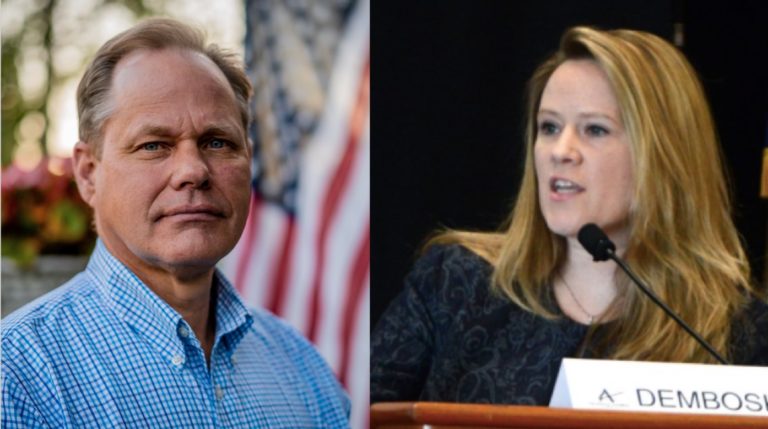
The Anchorage Assembly will go into executive session on Thursday to discuss what actions it may take after a letter from the attorney of former Municipal Manager Amy Demboski arrived in all 12 of the Assembly in-boxes last week, making a wide range of actionable accusations against Mayor Dave Bronson and members of his administration.
The meeting will take place at the Assembly Chambers in the Loussac Library, at 36th Avenue and Denali Street.
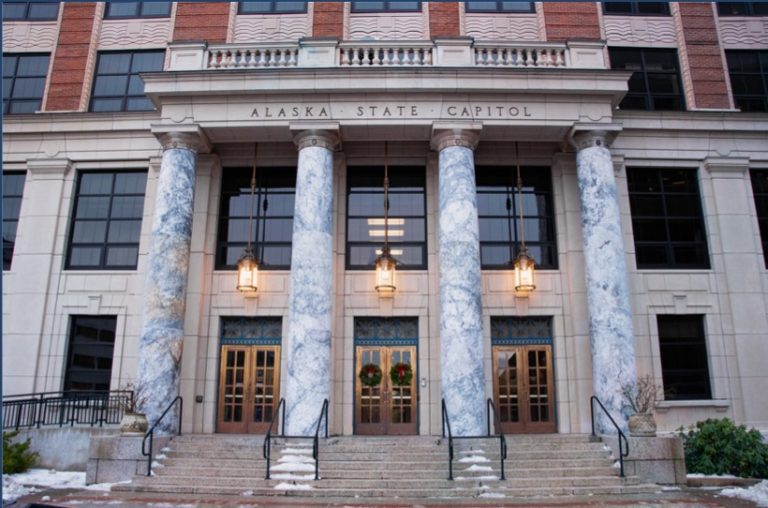
The executive session will follow immediately after the Assembly interviews candidates for the temporary Assembly seat representing Chugiak-Eagle River. That seat was vacated on Jan. 17, when former Assemblywoman Jamie Allard was sworn in as a member of the Alaska House of Representatives. The agenda for the 4 pm meeting and swearing in of the interim Assembly member is here.
At 5 pm is when the Assembly will go into a secret meeting andask for legal advice from the Assembly attorney on actions the Assembly may take against Bronson. It is likely that impeachment will be discussed, as the Assembly granted itself the authority to impeach the mayor at meeting last year. The accusations against the mayor are contained in this letter:
The Assembly’s work session will start the afternoon, when it will interview the Eagle River candidates, and then will go into a formal meeting to vote on their choice to serve until April 25, when the results of the April 4 election should be known.
The Alaska House majority, led by Republican Speaker Cathy Tilton of Wasilla, will assign House members to committees on Thursday when the Committee on Committees meets at 2:30 pm to make the final assignments, which will be done in public, rather than behind closed doors. The meeting will be televised on Gavel Alaska.
It appears that Rep. Craig Johnson may be chair of Rules, and Rep. Dan Saddler may be Republican majority leader. Both are returning to the House after several years away and both have been in leadership positions in the House.
Other Rules Committee members: Johnson, Tilton, Allard, Sumner.
On Finance, it appears Reps. DeLena Johnson, Will Stapp, Frank Tomaszewski, Mike Cronk, Julie Coulombe, Bryce Edgmon, and Neal Foster will be assigned the coveted seats, with Johnson, Foster, and Edgmon as co-chairs. The minority will appoint four seats.
Must Read Alaska has learned that Reps. Josiah Patkotak and George Rauscher will be co-whips for the majority.
Rep. Ben Carpenter will be chairing Ways and Means and Legislative Budget and Audit. Also appointed to Ways and Means is Rep. Jamie Allard.
Rep. Laddie Shaw will chair Military and Veterans Affairs. Other members are Carpenter and Wright.
Rep. C.J. McCormick of Bethel will chair Tribal Affairs Committee. Other members are Allard and Vance.
McCormick will chair Community and Regional Affairs. Other members on Community and Regional Affairs are Reps. Tom McKay and Josiah Patkotak.
Reps. Jamie Allard and Justin Ruffridge will co-chair the Education Committee. Other members are Prax, McCormick, and Sumner.
Rep. Stanley Wright will chair the State Affairs Committee. Other members are Shaw, Carpenter, and Vance.
Rep. Tom McKay will chair Natural Resources Committee. Other member are Rauscher, Saddler, McCabe, Patkotak, and Wright.
Rep. Sarah Vance will chair Judiciary. Other members are Allard, Carpenter, and Craig Johnson.
Rep. Kevin McCabe will chair Transportation. Other members are Vance, McKay, and Craig Johnson.
Rep. Mike Prax chairs Health and Social Services. Other members are Ruffridge, McCormick, and Sumner.
Rep. George Rauscher will chair the Energy Committee. Other members are McKay and Patkotak.
Rep. Sarah Vance will chair Fisheries. Other members are McCabe and McCormick.
Rep. Jesse Sumner has Labor and Commerce. Other members are Saddler and Wright.
Rep. Kevin McCabe will be vice chair of Legislative Council.
Rep. Laddie Shaw will be co-chair of Joint Armed Services Committee, with Saddler, Rauscher, and Prax.
Rep. Jamie Allard and Rep. DeLena Johnson are appointed to the Ethics Committee.
Must Read Alaska does not have the complete list assignments. Check back — this story will be updated.
In other legislative happenings, Rep. Cal Schrage took the lead of the House Democrat minority, issuing a press release on behalf of the group, which published a press release earlier today with his quote:
“We look forward to working with fellow legislators on our priorities, including meaningful additions to the Base Student Allocation to ensure all of Alaska’s students have access to quality education, bolstering recruitment and retention of Alaska’s workers, investing in critical infrastructure, and charting a long-term fiscal plan that will set Alaska on a course for prosperity. We are committed to working together with other members of the House, the Senate, and all Alaskans to accomplish these goals.”
[The following contains very basic information regarding security clearances and classified information, all of which is open source material. Those of you who worked (or work) in the cleared world will find it rudimentary. That’s because it is intended for folks who have not been in that world but keep hearing about it on the news.]
Classified information has been in the news again, most recently regarding the discovery of classified documents in President Biden’s think tank closet and his garage. The story is, on so many angles, as fascinating as it is unbelievable. Well, it should be unbelievable that such things happen at the highest levels of government, but the past couple decades have taught us otherwise. A quick recap, shall we?
March 2005 – Sandy Berger, former National Security Advisor to President Bill Clinton, pled guilty to removing classified documents from the National Archives and cutting them up.
July 2016 – then FBI Director James Comey announced that 113 emails from Hillary Clinton’s personal email account contained classified information.
August 2022 – a raid at former President Trump’s Mar-a-Lago residence turned up 103 classified documents. A search in December 2022 revealed two more classified documents in a storage facility with which the former president was affiliated.
January 2023 – 10 classified documents were found at President Biden’s former office at the Penn Biden Center for Diplomacy and Global Engagement, and six more pages were then discovered in the garage of the president’s private home.
These instances are alarming, especially considering that no prison sentences have resulted. These people held positions of trust at the very highest levels of our government. Sandy Berger was the only one to ‘fess up, for which he was fined $50,000, spent two years on probation, performed 100 hours of community service, and had his security clearance suspended for three years.
The arrogance or ignorance, or perhaps a combination of the two, of those involved is particularly galling … but not quite as galling as listening to reporters botch the nomenclature of classified documents and security clearance levels.
Granted, most reporters haven’t worked in jobs where they accessed classified documents but somebody in their newsrooms had to have spent time in the military or worked for a government contractor. And to be fair, it doesn’t just happen in news circles. Movies and television do a pretty fair job of butchering the nomenclature.
So let’s set the basic groundwork, if for no reason other than allowing this writer to get it out of his system:
There are three levels of security clearances in the national security realm, in order from lowest to highest: Confidential, Secret, and Top Secret.
Now, there are also Sensitive Compartmented Information accesses, and Department of Energy L and Q clearances, but going into that will just muddy the waters, so let’s save that for another time. For now, we will stick with Confidential, Secret, and Top Secret.
The three levels are defined by the nature of damage to national security that unauthorized disclosure could cause, and the definitions are quite basic.
The unauthorized disclosure of Confidential information could reasonably be expected to cause damage to the national security; for Secret information the phrase is serious damage; and for Top Secret, the wording is exceptionally grave damage.
All of which brings to mind that courtroom scene in “A Few Good Men” when Tom Cruise’s character asks Colonel Jessup (Jack Nicholson) if he felt Private Santiago’s life was in grave danger, to which Jessup replied, “Is there another kind?” (That was the best courtroom drama in American cinema.)
When you hear a reporter say the information was “top security” or “a confidential clearance at the highest level,” or if you hear a movie character announce that they have a “security clearance above top secret,” you will know better, and you can rightfully yell at the television set or movie screen.
Tim Barto is a retired personnel security investigator for the Defense Counterintelligence & Security Agency, and held the highest security clearance (but not above Top Secret) while serving with Naval Intelligence.
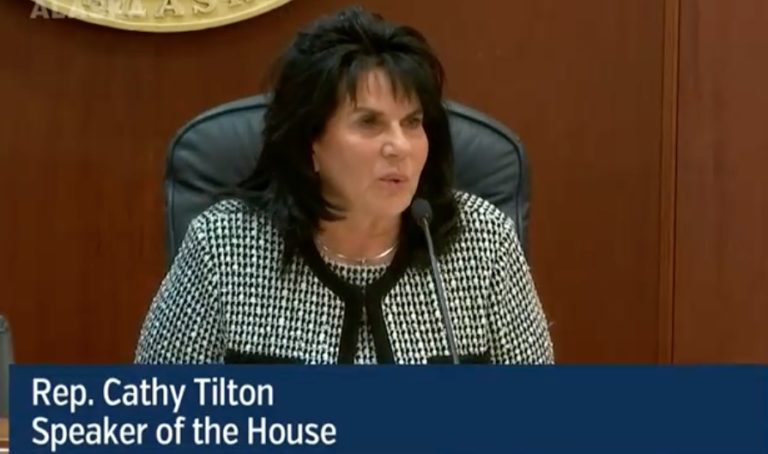
Wasilla Republican Rep. Cathy Tilton has been elected Speaker of the House. It appears to be the 19 Republicans and most of the rural Bush caucus will be in the Republican-led caucus, but it’s unclear who is going to be included the caucus.
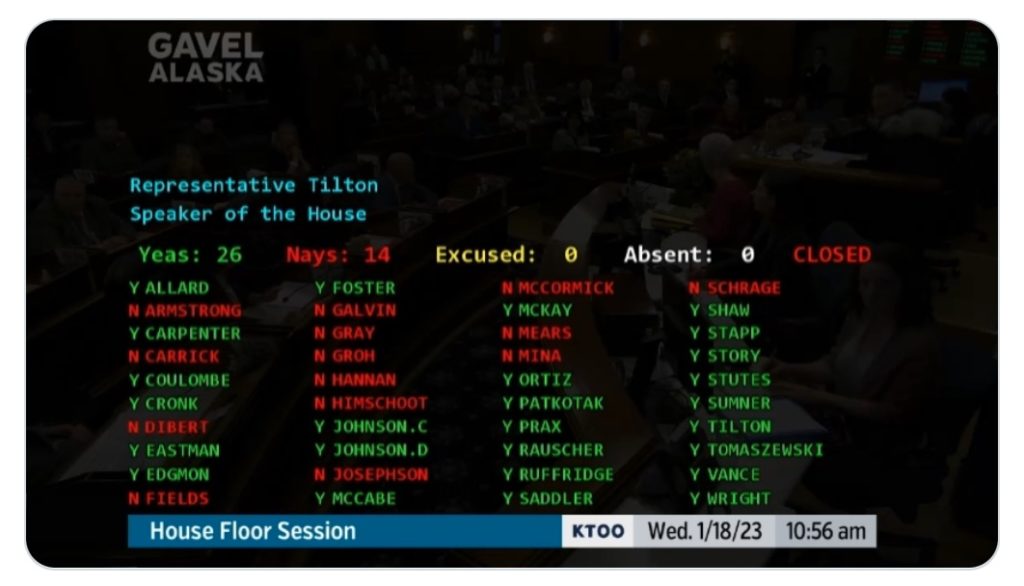
The vote was 26-14 on Wednesday morning, with all Republicans and some no-party members voting for Tilton.
Anchorage Rep. Cal Schrage, a no-party member, and Rep. Rebecca Himshoot, a no-party member but liberal from Sitka, voted against her, while Rep. Daniel Ortiz of Ketchikan voted for Tilton, along with Josiah Patkotak of Utqiagvik. Both Ortiz and Patkotak are not aligned with a party.
Also voting for Tilton was former Speaker Louise Stutes, a Republican and Rep. Bryce Edgmon, who is considered a Democrat, although has no party.
Four others were nominated: Former Speaker Stutes, Nikiski’s Ben Carpenter, Soldotna’s Justin Ruffridge, and Dillingham’s Edgmon. Edgmon and Carpenter declined their nominations. Ruffridge, a Republican of Soldotna who made a play for the job of Speaker Pro Tem, was nominated by hard-left Zack Fields of Anchorage, who appeared to want to drive home the knife and cause chaos in the Republican caucus by aligning Ruffridge with the Democrats.
Northway-Tok’s Mike Cronk made the motion for Tilton, and she was the only nominee voted on.
“I am honored to be selected as the Speaker of the House,” Tilton said. “I am excited to start working with all the members of the House to ensure the people of Alaska are represented. I am humbled by the faith my colleagues have in me and will embrace this leadership role with humility and greatly appreciate the opportunity to lead the House of Representatives.”
The Alaska House Republican Caucus pledges to lead this body with efficiency and civility so that the people of Alaska are once again confident in the leadership, she said.
The House gaveled out so that Tilton and others can now figure out who is in and out of the majority caucus. Then, the Committee on Committees can start making assignments.
Tilton has represented Wasilla and until recently a portion of Chugiak-Peters Creek in the Anchorage Borough since 2015. She was a legislative aide before she ran for office.