Monday, August 17, 2026
Home Blog Page 558

Alex Gimarc: Thinking past the sale on the big plan for decarbonization of Alaska’s energy

By ALEX GIMARC

“Thinking past the sale” is a powerful persuasion technique that moves your attention from whether or not something ought to be done to all the wonderfulness that will happen once you do it. 

The most common and infamous example comes from the used car sales field, where the sales critter pushes hard the wonderful new world of sex, booze (or drugs) and rock and roll that will open to you once you sign on the dotted line.

The important point here is to ensure that you spend very little time considering whether to make the purchase and almost all time and effort on how Life Will Be Good after you bring your new play toy home.

With that in mind, the Alaska Center for Energy and Power out of UAF in Fairbanks is working a project named the Railbelt Decarbonization Study. The presenters gave a briefing / Q&A session Sept. 26 at the Westmark in Fairbanks. The video is available below.

The project kicked off May 2022 and is scheduled to be completed June 2024. It is being funded by the Office of Naval Research and State of Alaska FY23 Economic Development Capital Funding.

The goal is to identify several pathways to a completely decarbonized Alaska energy system and to see if it is in anyway affordable. Happily, the scenarios include Big Hydro (Watana) and nuclear (Gen IV nukes). Wind, solar, tidal, biomass, and in-stream generation are all part of the work. I expect them to conclude that it is possible to get from here to there. But at what cost?

“Thinking past the sale,” is what the Alaska Center for Energy and Power is doing, telling us how Alaska can construct a pathway from where we are today to a carbon-free future in 27 years (2050). This is their job, and someone needs to be doing that sort of analysis.

But the most critical question is not how to do it, but why should Alaska decarbonize its energy use? And if we choose to travel that pathway, what will it cost and how will our lives and the lives of our children and future generations change?  

As I have previously written, energy use here in Alaska is divided roughly into three equal buckets, electricity (90% natural gas in the Railbelt), heating (natural gas and propane), and vehicular fuel (gasoline, diesel, AvGas). 

Think of this mix as three legs on a stool. If one leg goes away, you can still remain relatively upright with the other two intact. If the electricity goes away, which it does from time to time, you can keep from freezing in the dark with heating and still retain mobility with your vehicle.

The decarbonization crowd would take us ultimately to a single legged pogo stick relying on electricity for everything. For me, something less than a positive lifestyle choice.  

At a more basic level, why should Alaska adopt decarbonization? What are we hoping to change? While the climatistas will spend a lot of energy arm waving and chair throwing about manmade global warming due to CO2 emissions, precisely what impact does a state with 732,000 people have on the global climate?  Is it even measurable? 

I would submit the answer is really close to zero / none. And if we are having no measurable impact, why are we even considering this future?

Choosing a decarbonization pathway before even agreeing that we have a problem is a fool’s errand, thinking past the sale.

This will be a difficult discussion, as we have a political party supported by half our population that already adopted decarbonization as a matter of faith.  They are in the process of installing it in their party platform.  As they control the Senate majority, expect some legislation to make this so to start percolating through the process in January.

Make no mistake, Democrats are interested in decarbonization, which means decarbonization is interested in you. It is their latest faith-based climate prescription, completely ignoring the unpleasant experience of Europe, California and Texas traveling that path over the last few decades. And if we’ve seen nothing else out of Democrats recently, they aren’t a bit bashful of cramming their shiny new solution down the uncooperative throats of a skeptical public the instant they have a one-vote majority in any legislative body.

This is coming. Be ready for it. 

Alex Gimarc lives in Anchorage since retiring from the military in 1997. His interests include science and technology, environment, energy, economics, military affairs, fishing and disabilities policies. His weekly column “Interesting Items” is a summary of news stories with substantive Alaska-themed topics. He was a small business owner and Information Technology professional.

U.S. vetoes United Nations resolution demanding permanent cease fire in Israel-Hamas war

The United States on Friday vetoed a resolution by the United Nations Security Council that demanded Israel stop its defense against Hamas, and create what the council imagined would be a permanent cease-fire.

The resolution needed nine votes in favor and no vetoes from any of the five permanent members, which include the United States, Russia, China, France, and Great Britain.

Thirteen members of the council, including Japan and permanent member France, approved the resolution, offered by United Arab Emirates and which had 98 sponsor nations as signatories; Great Britain abstained.

The U.S. has agreed with Israel’s position that unless Hamas is dismantled, there will never be an end to the conflict, which started when Hamas terrorists made a surprise attack on Israel on Oct. 7, killing 1,200 Israelis. The Israeli military response has been overwhelming and there is clearly a humanitarian crisis in Gaza among the civilian population, as food and fuel is running low and as much of Gaza has been razed.

The resolution not only demanded an immediate humanitarian ceasefire, and the immediate and unconditional release of hostages, it did not condemn the terror attacks perpetrated by Hamas.

It was the third time the U.S. has vetoed the security council’s call for an immediate cease fire. The vote came after United Nations Secretary-General Antonio Guterres sent a letter to the Security Council warning that the Gaza war has the possibility of becoming a global threat and calling for a vote.

Censorship 101: Details on how social media and the Department of Homeland Security locked arms to suppress free speech in 2020’s election cycle

By BEN WEINGARTEN

During the 2020 election, the Department of Homeland Security’s Cybersecurity and Infrastructure Agency (CISA) partnered with the Election Integrity Partnership (EIP), a consortium of groups led by the Stanford Internet Observatory, to track and counter what they considered mis- and dis-information.

EIP surveilled hundreds of millions of social media posts and collected from the cooperating government and non-governmental entities that it calls its “stakeholders” potential violations of social media platforms’ policies concerning election speech.

It coordinated its efforts primarily through a digital “ticketing” system. There, one of its as many as 120 analysts or an external partner could highlight a piece of offending social media content, or narrative consisting of many offending posts, by creating a “ticket,” and share it with other relevant participants by “tagging” them. Tagged participants could then communicate with each other, in something of a group chat, about the veracity of the flagged content, concerns about its spread, and what actions they might take to combat it.

For social media companies this meant removing the content outright, reducing its spread, or “informing” users about dubious posts by slapping corrective or contextualizing labels on them.

During the 2020 election cycle, EIP generated a total of 639 tickets, covering some 4,784 unique URLs – representing content shared millions of times – disproportionately related to the “delegitimization” of election results. Major platforms including Twitter, Google, and Facebook responded to tickets in which they were tagged at rates of 75% or higher. The platforms “labeled, removed, or soft blocked” 35% of the URLs shared via EIP.

RealClearInvestigations has obtained data associated with nearly 400 EIP tickets, data produced for the House Homeland Security Committee in connection with its oversight efforts. The tickets come in the form of a series of spreadsheets. Each row represents one ticket. The Stanford group provided no key for the spreadsheets. Much of the information is redacted.

Here are just a few examples of the tickets EIP produced:

Ticket EIP-482 (created October 27, 2020) was originated by the CISA’s Elections Infrastructure Information Sharing & Analysis Center (EI-ISAC). It concerns a tweet from then-President Trump indicating “most” states permit one to change one’s original vote after engaging in early voting, which EIP categorized as potential “Procedural Interference.”

The analysts point to fact-checks from, among other sources, Buzzfeed and ABC News challenging the president’s claim. Following two redacted comments on the ticket, an unnamed commenter writes, “Twitter received and is reviewing.” A subsequent comment reads: “We heard back from Twitter through CISA with this response: Our team concluded that the Tweet was not in violation of our Civic Integrity Policy.”

CISA-produced documentation shows the sub-agency’s chief counter-MDM (mis-, dis-, and malinformation) officer, Brian Scully, had also reported the tweet to Twitter, which responded to him directly about it. Therefore, EIP and its stakeholder, an executive agency, both forwarded the chief executive’s speech to a social media platform for potential censorship.

Ticket EIP-257 (Sept. 29), originated by the EI-ISAC, concerns a social media post from an unnamed user, alleging an absentee ballot had been delivered by mail to his dead father. An EIP stakeholder “flagged the post to Facebook for removal and the link is no longer active which means it has either been taken down or made private to the individual’s Facebook.” A subsequent comment notes that “We also received confirmation from Facebook (by way of CISA) that Facebook took action on this case,” again showing EIP and CISA seemingly working as force multipliers in content moderation.

Ticket EIP-301 (Oct. 2), originated by the EI-ISAC, concerns a “tweet regarding voting machines.” An elected official reported that the since-deleted and unavailable tweet “is false. Voting machines work the vast majority of the time. Old machines do have issues, but to phrase it like [this] vastly overstates the scope of the problem.” CISA inquired as to whether Twitter took the tweet down. It did.

Ticket EIP-954 (Nov. 8), the origins of which are not discernible, concerns social media posts sharing an article from The Federalist, where I am a senior contributor, titled “America Won’t Trust Elections Until The Voter Fraud Is Investigated.” According to the ticket, the article “Misconstrues Disinformation as Evidence.” One tagged post comes from Federalist Editor-in-Chief Mollie Hemingway. A stakeholder writes to Facebook and Twitter in connection with the ticket that “this seems to be the greatest hits from the past 3 days wrapped up in one article. The article links to several of the gateway pundit links which have received action since Tuesday.” Twitter indicates it was reviewing the tweet, though it appears not to have taken action on it. RCI asked Hemingway for comment on the flagging of her tweet and publication’s work. She replied:

“This unconscionable censorship of The Federalist and its reporters is sadly unsurprising. The censorship-industrial complex in this country clearly views free speech as its enemy and will do anything to shut it down, including spreading lies and using intimidation to coerce private companies to censor factual, legal speech on behalf of the regime.”

Hemingway concluded with a warning: “The censorship-industrial complex better buckle up, because the days of conservatives taking this lying down are over.”

This article was adapted from a RealClearInvestigations article published Nov. 6.

Rick Whitbeck: Alaska Democrats’ party platform going against all fossil fuel?

By RICK WHITBECK | POWER THE FUTURE

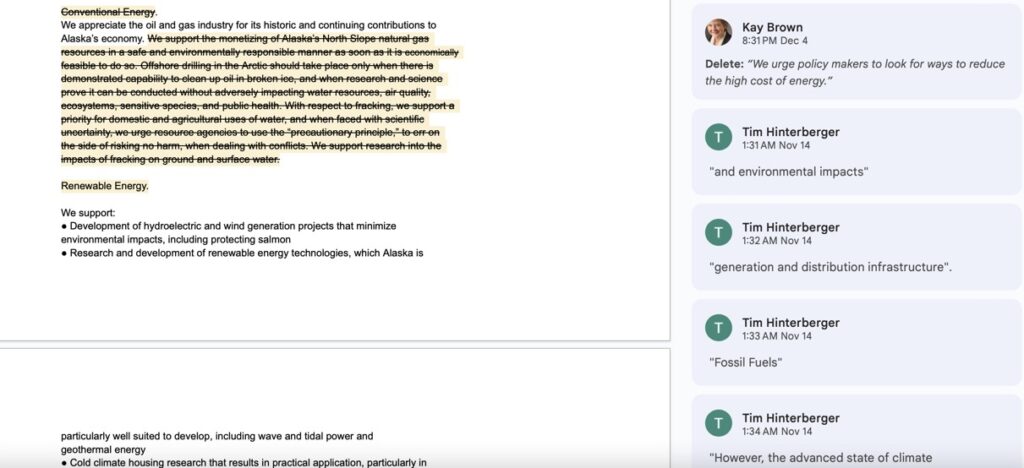
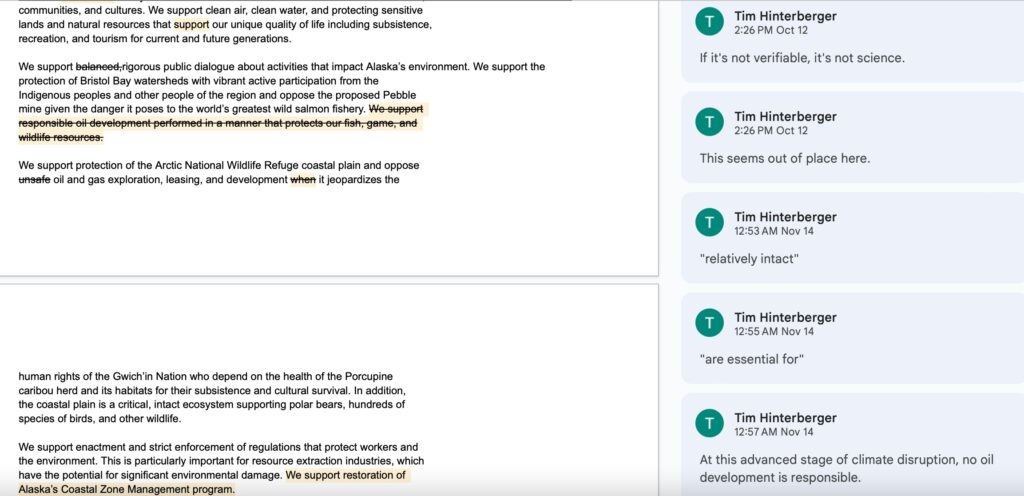
As first reported by Suzanne Downing in Must Read Alaska, the Alaska Democratic Party is saying the quiet part out loud in their fight against traditional energy, and considering making their platform fossil fuel-free.

Changes to both Republican and Democratic state platforms are considered and ratified at biannual conventions of party activists, but proposed changes are tossed around throughout the time in-between. 

Over the past few weeks, the Democrats’ Climate Caucus, a standing committee comprised of eco warriors on their State Central Committee, have been editing their party platform.

The changes are shocking.

The picture above is a screenshot of just some of those proposed changes, including a complete deletion of the plank dealing with oil and gas development.  Tim Hinterberger, a professor at the University of Alaska, Anchorage and a well-known anti-development activist, sums up his thoughts in a comment, shown below: “At this advanced stage of climate disruption, no oil development is responsible.”

Will the rest of the Democrats support the radical changes to the platform? We’ll stay on top of things between now and their 2024 convention. This document, when completed, will be the litmus test they vet candidates for public office against. If they insist on looking to eliminate the industry that pays for nearly 25% of all private-sector employees and over 40% of state government, it will be interesting to see how their preferred candidates react.

Rick Whitbeck is Alaska state director for Power the Future.

School board won’t consider motion to let parents know about their own children’s gender pronoun preference, or alternate names

Should teachers and administrators of Anchorage Public Schools let parents know if their children are using alternative names or alternative pronouns for themselves at school?

Anchorage School Board member Dave Donley thinks parents have a right to know, and that there should be a rule to prevent schools from grooming children without their parents’ knowledge. Other school board members, however, believe some secrets should be kept from parents.

Member Andy Holleman, speaking during a committee meeting on Thursday, said teachers need latitude and should not be required to notify parents. If parents want to know, they can simply ask, he said.

But even then, the school district’s administrative guidelines currently advise teachers and staff that notifying parents of secondary students is not required. School employees have latitude to decide if sharing such information would put the child in danger, and if they decide there is a risk, they can keep it between themselves and the student.

Donley could get no board second for his motion to protect parents and children, and keep guardians from being cut out of gender discussions taking place in the schoolhouse; without a second, the proposal is essentially dead on arrival.

The Anchorage School District’s transgender policy is at this link.

No National Anthem: Anchorage school board tables motion to play Star Spangled Banner

During a committee meeting held on Pearl Harbor Day (Dec. 7), Anchorage School Board member Dave Donley moved to have the public schools play the National Anthem over the intercom on Pearl Harbor Day, Veterans Day, and on Sept. 11, if schools are in regular session on those dates.

Donley could not get any support for the motion from his fellow board members, however. The motion was tabled and referred to the school superintendent’s office to study until March.

Peltola votes to transfer billions of dollars of student debt to taxpayers

Rep. Mary Peltola voted against House Joint Resolution 88, which passed 210 to 189, disallowing the Biden Administration to once again, through a regulatory loophole, force taxpayers to pay back the loans of college tuition borrowers.

A regulation by the Department of Education was the latest student debt transfer to working class Americans. It would not actually forgive or cancel a penny of student debt, but instead transfer it to people who did not take out the loan. The wealth transfer amounts to $4.8 billion in loans taken out by college students.

“President Biden is once again asking hard-working taxpayers to foot the bill for the loans of well-off graduates. This is not only unfair, it is wrong. Borrowers should be responsible for paying off their debts,” said Speaker Mike Johnson.

After the U.S. Supreme Court ruled in June that the Biden Administration’s $400 billion college student loan forgiveness program was unconstitutional, Biden went about it another way, and canceled debt for some college graduates, particularly those in government jobs.

Student loans that were borrowed from the taxpayers had been put on “pause” for three years, starting during the Covid pandemic, when college and the job market was disrupted by regulatory shutdowns.

Impeach, indict, rinse, repeat: Joe and Hunter Biden’s very bad day

Both President Biden and his son Hunter were in trouble again on Thursday. One faces formalized impeachment hearings, and the other faces multiple felony indictments involving drugs, guns, women of the night, and now tax evasion amounting to $1.4 million.

Hunter Biden was charged on Thursday with tax evasion crimes and filing false tax return in California. In all, there are three felony and six misdemeanor charges for tax crimes occurring between 2016 and 2019. This is his second round of indictments.

In September, the Justice Department charged him with lying about his drug use when he purchased a handgun in October of 2018, which was during a time when he admittedly was addicted to crack cocaine. The indictment was filed in a federal court in Delaware.

“Hunter Biden engaged in a four-year scheme in which he chose not to pay at least $1.4 million in self-assessed federal taxes he owed for tax years 2016 through 2019 and to evade the assessment of taxes for tax year 2018 when he filed false returns,” said the statement released by prosecutor David Weiss. “Between 2016 and October 15, 2020, the Defendant spent this money on drugs, escorts and girlfriends, luxury hotels and rental properties, exotic cars, clothing, and other items of a personal nature. In short, everything but his taxes.” 

If convicted on all of the new charges, Hunter could face up to 17 years in prison.

As for the president, House Republicans have released a resolution that would authorize their impeachment inquiry into President Joe Biden. The vote on the resolution is expected to take place next week after going before the House Rules Committee on Tuesday. The last day of business for the House in this calendar year is Thursday. That leaves just one day — Wednesday — for a possible vote in a House that has a very thin Republican majority.

The resolution to formalize the impeachment process that has been going on in three committees would give the committee chairs the ability to enforce subpoenas that the Biden Administration has been ignoring. Multiple impeachment resolutions have been filed this year that allege that in his former role as vice president, President Biden abused the power the office through enabling bribery and other high crimes and misdemeanors by allowing his son Hunter Biden to influence the domestic policy of a foreign nation and accept benefits from foreign nationals in exchange for favors.