Monday, August 17, 2026
Home Blog Page 557

He’s back: Alex Jones reinstated on X

Liberals on X/Twitter may be grabbing their preferred pronouns and heading for the exits at X in even greater numbers, now that Elon Musk has reinstated Alex Jones, the wildly unpredictable owner of the Infowars website.

Jones, when told of the news, said he had been banned for so long, he wasn’t even sure how to get back on X. The previous owner team of X/Twitter, under Jack Dorsey, permanently banned Jones in 2018, calling him a right-wing conspiracy theorist and accusing him of “abusive behavior.”

Back then, Twitter said Jones posted a video violating Twitter’s policy against โ€œabusive behavior.โ€ The video showed Jones berating CNN journalist Oliver Darcy for several minutes in between two congressional hearings on social media and its bias against conservative users. Dorsey had testified at both hearings.

Here is the 2018 video that was the final straw for “old” Twitter, which prompted the banishment of Jones:

Dorsey punished not only Jones, but said he would take action against any account that was even potentially associated with Jones or Infowars.

At the time that Twitter banned Jones, he had some 900,000 followers; Infowars had about 430,000.ย Today, even though his account had been frozen for five years, Jones has 946.9K followers. Last week, Musk ran a survey asking X users if they wanted Jones reinstated and approximately 70% of those who responded were in favor. By Sunday morning,ย Musk posted on his account, โ€œThe people have spoken and so it shall be.โ€

Jones declared bankruptcy recently after a court ordered that he must pay $1.1 billion in defamation damages stemming from his claims about the 2012 Sandy Hook elementary school shooting. A bankruptcy judge has since said he will have to pay that personally, and that his bankruptcy declaration won’t protect him. Courts in both Connecticut and Texas ruled that Jones intentionally defamed relatives of the children killed in the shooting when he accused them of being actors in a hoax.

The following video is classic Alex Jones, posted just before he was banned by Dorsey in 2018, where he rants about the globalist agenda. In it, he talks about how the federal government was conspiring with the media, which in 2023 is the subject of congressional hearings. It is the also type of discourse that had mainstream media calling Jones a conspiracy theorist:

Musk’s X platform has taken financial hits for providing a free speech rodeo, complete with skilled riders, political steer wrestlers, bucking broncos, cheering sections, rodeo queens, and commentary clowns, all provided as news and entertainment that has few sideboards. And X is also used by those who only follow nonpolitical accounts, such as sports, arts, books, and science. Many X users are not using the platform for debate, but for cooking tips and weather reports.

Musk has chosen to push back against the threats of advertisers against the platform, including the likes of Disney and Walmart, which have pulled their ads from X and moved their promotion money to Chinese-owned TikTok and to the Meta universe, which owns Facebook and Instagram. Musk responded to that threat by telling any advertiser who wanted to try to blackmail him with ad dollars to “Go f*ck yourself.”

One year ago, just after Musk took over majority ownership, X had 368 million monthly users. As of October, 2023, X has approximatelyย 556 millionย active monthly users, and receives 6.14 billion visits per month.

But liberals, including PBS/NPR, have been fleeing the platform for a smattering of alternatives, such as Threads, owned by leftwing propagandist Mark Zuckerberg, and Blue Sky, which looks very much like X, which is majority owned by Jack Dorsey. Mainstream media outlets have been publishing a slew of news stories about alternatives to X in an attempt to drain users from the X platform. Mastodon, started by a Russian-born programmer, is favored by liberal U.S. journalists.

Meet Anthony Pitcher, new school board member appointed in Mat-Su Borough School District

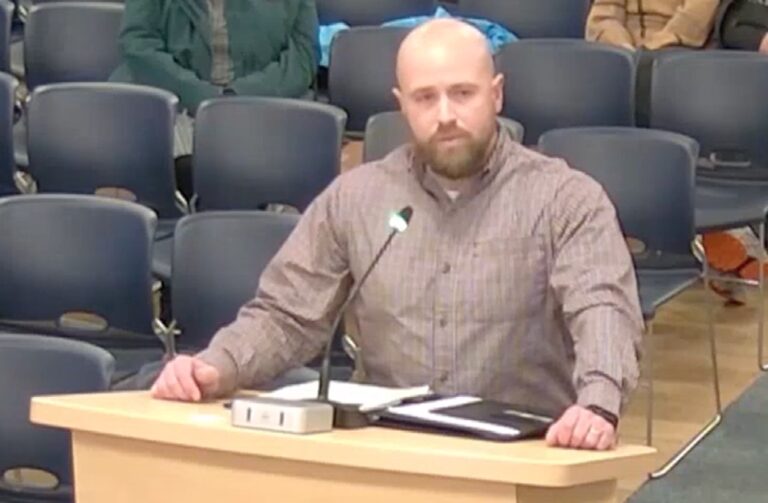
Filling out the remaining term of departing member Jacob Butcher, the Matanuska-Susitna Borough School District Board appointed Anthony Pitcher, a conservative and father of nine.

Pitcher has lived in Alaska for 21 years, having moved north to work on a dairy farm, and later getting involved in electrical work, he told the board during his introductory remarks. He has children who have graduated from high school, some who attend charter school, one who home schools, and two who are not yet school age. He has been a volunteer with Boy Scouts and in his church youth programs.

โ€œI was raised by a very patriotic father who instilled in me that education is very important, not just for career paths, but also for history,โ€ Pitcher said to the board, adding, “if we donโ€™t learn from history, then we are destined to go through some hard times.โ€

Pitcher attended Pasco High School in Eastern Washington and has been an electrician for over 20 years. Since 2007, he has run Pitcher Electric.

The school board held a special meeting to hear from each of the applicants for the seat, which will come up for reelection in November of 2025. After the vote was taken and Pitcher was chosen, Superintendent Randy Trani swore in the newest member and a regularly scheduled meeting began to take up normal business.

The board has retained its conservative character with the choice of Pitcher to replace Butcher in the District 5 vacancy. During the most recent election, conservative candidates prevailed. The board has one member considered liberal: Ted Swanson.

Boy, 14, wins girls’ division in regional Irish dance competition, heads to nationals

A boy who says he is a girl won an Irish dance competition for girl dancers under 14 in Dallas last weekend.

According toย The Daily Signal, the boy will represent girls under 14 on the world stage at the Irish Dancing World Championships after placing first in the 2023 Southern Region Oireachtas competitions.

The Daily Signal reported that the male dancer, which the publication would not name due to his age, competed as a male earlier this year. The boy โ€œplaced 11th in the world in the Coimisiรบn Le Rincรญ Gaelacha (CLRG) World Championships in April 2023.โ€

In a competition in March, the boy competed as a boy and won a trophy.

The boy who has now won in the girls’ division was first place in a regional dance competition in March — in the boys’ category. Now he wins as a girl. Photo credit: Facebook page of Carolina State Championships and Feis and Walsh Kelley School Feis.

Many of the youth who compete as Irish dancers practice more than 12 hours a week.

โ€œOh, my gosh. Itโ€™s going to make me cry,โ€ said one mother, whose daughter danced in the same competition as the trans-identifying boy in the Dallas, Texas, event, according to The Daily Signal, who interviewed her. โ€œI never thought I was going to have to deal with this. And my heart breaks for my daughter and the other girls that are having to deal with this. They are too young to have to deal with topics that are going on in society, that are adult topics, that they donโ€™t quite comprehend yet. They just look at it as unfair. And itโ€™s really hard to explain to them whatโ€™s going on and why they have to accept it. Thatโ€™s what societyโ€™s making them do. As a mom, I want to be an advocate for my daughter. But at the same time, I have to protect my family.โ€

Read the complete story at The Daily Signal.

One dead, one injured in small plane crash

0

Kurt Joseph St. Jean of Homer, owner of a Piper Super Cub that crashed near Mile 154.5 of the Sterling Highway on Friday, was found deceased by Alaska State Troopers responding to the scene after a report of the crash at about 1:12 pm. An adult female passenger was extricated from the plane, which was lodged in a tree, and transported to a nearby hospital, in critical condition. The aircraft number is N1880P.

The National Transportation Safety Board has taken over the investigation into the crash, which was north of Anchor Point.

John Morris: Why Alaska healthcare community sued the state’s insurance division over 80th percentile rule

By JOHN MORRIS

A broad coalition including physicians, chiropractors, physical therapists, podiatrists and more — representing the vast majority of healthcare providers in Alaska — recently brought suit to stop the repeal of the longstanding consumer protection known as the 80th Percentile Rule. As a member of that coalition, and a concerned Alaskan, let me explain to Must Read Alaska readers why:

After months of attempting to communicate in good faith with the Alaska Division of Insurance about the dangers of repealing the 80th Percentile Rule without a workable replacement, our coalition reluctantly took legal action to protect the countless Alaska families, workers and patients who will be impacted by this misguided repeal. If the repeal is allowed to stand, the elimination of this rule will severely jeopardize Alaskansโ€™ ability to receive healthcare here at home, will return us to the days before the ruleโ€™s implementation in 2004 when Alaskans were saddled with surprise medical bills on top of their already high insurance premiums, and will result in little if any of the promised cost savings. 

Every Alaskan, regardless of their politics or background, should care about this lawsuit because repeal of the 80th Percentile Rule all but guarantees an Alaska where it will be even harder to find a doctor, where wait times will dramatically increase, and where patients will have to pay even more out of their own pocket for healthcare. 

Critics of the 80th Percentile Rule, led by Seattle-based insurance companies, have lobbied heavily to repeal this rule. Collectively, theyโ€™ve spent thousands of dollars spreading misleading messages such as Alaskaโ€™s doctors are getting paid too much, eliminating this rule is common sense and will lower healthcare costs, this is an outdated and unnecessary government regulation that raises costs and makes doctors more money.   

But when you stop and review the facts there is so much more to this story. For example, if Alaskaโ€™s healthcare providers are being paid so much, why does Alaska face the most significantย healthcare worker shortage of any stateย in the nation according to recent studies? One reason is that Alaskaโ€™s โ€œcompetitiveโ€ salaries are no longer competitive; theyโ€™re being matched or surpassed by Lower 48 states hoping to recruit and retain medical professionals. But letโ€™s use data, not anecdote.ย ย 

According toย Beckerโ€™sย andย Weatherby Healthcare, two reputable organizations that track physician compensation,ย ย Alaska doesnโ€™t make the top 5 states for highest physician pay and, if you factor in the cost of living, we donโ€™t even make the top 10. More than that, doctors in Alaska are getting paid less each year while insurance premiums have skyrocketed. Thatโ€™s right, we are paying more each year for insurance but those same insurance companies are paying less each year per service. There are exceptions to this, but they are a small minority.ย 

How do we know this? We did the work. We surveyed a broad spectrum of healthcare practices in Alaska and asked them to share how much insurance has paid them for a given service over the years. We thenย graphed those payment trends, together with how insurance premiums have risen, and got a striking picture. Again, despite each of us paying more in insurance every year insurers are, with few exceptions, paying less for the same care each year. Insurance pays less while premiums skyrocket.

If the Alaska Division of Insurance (DOI) knows that medical providers are receiving smaller reimbursements each year, why would they still push the repeal of the 80th Percentile Rule, which contains critical consumer protections and safeguards against insurance companies completely controlling the Alaska healthcare market?

We canโ€™t speak for the DOI but the DOIโ€™s Director, Lori Wing-Heier, told us that she based her decision making on data provided to her by an out of state company called FairHealth.  FairHealth collects claims information and other data from insurers and then, for a fee, provides aggregated data on healthcare costs to various consumers across the country.  Curious, we hired FairHealth too and paid them to give us the same data on how much insurance in Alaska has paid for a given service over the years โ€“ how much to deliver a baby or do a heart surgery, how much for a chiropractic treatment, and so on. 

One of the first things we noticed about the FairHealth data was that it listed values for payments and charges for procedures that have never taken place – such as dozens of prices and payments for heart surgeries in Kodiak, Juneau, Fairbanks, and Ketchikan. In case youโ€™re wondering, there are no heart surgeries in Kodiak, Juneau, Fairbanks, or Ketchikan. When we asked FairHealth about this they reported that they use mathematical methods to derive data when they donโ€™t have any to report. In other words, they make it up. So we asked them for another spreadsheet of data, with only real (not derived) data in it. That spreadsheet was much, much smaller and wouldnโ€™t have justified the DOIโ€™s position.

The DOI and Premera say repealing this rule will result in lower health insurance costs โ€“ often citing an outdated and incomplete study that blames the 80thย Percentile Rule for up to 24% of Alaskaโ€™s health care cost increases. But now that the rule has been repealed, we get a glimpse as to what the insurance companies and the Division of Insurance really think the 80thย Percentile Rule is โ€œworthโ€. The answer – not much. Despite the ruleโ€™s repeal insurance premiums are once again on the rise next year, just as they did last year, by about 17%, sometimes more. They are rising so much that they areย making headlines. Premera now says the repeal of the 80thย Percentile Rule will only amount to a savings of 2.5-4% (depending on who they speak to), despite previous claims that it would result in significant cost savings to policyholders.

While healthcare professionals and the 80thย Percentile Rule are often blamed for the rising costs of healthcare in Alaska the real reasons for rising costs are sometimes simpler, if not a bit more inconvenient. Before each year starts insurance companies have to receive approval from the DOI for how much they can charge for premiums the following year. Itโ€™s called rate review. There are two insurers currently on the individual marketplace, Moda and Premera. Premera holds a virtual monopoly in Alaska but Moda is a big company too, doing over a billion dollars a year in revenue across all the states they operate in. For the year 2023, according to publicly available documents, Moda asked the DOI to only raise their prices 3.97%. Itโ€™s safe to assume that Moda would like to grow their business in Alaska, taking some customers from Premera, and having lower prices is a great way to do that. But that lower price request was not approved, and instead the DOI required Moda to raise their rates further by 12.1%. Thatโ€™s 8% more than originally requested, hundreds of dollars per person more than what they asked for.ย In 2024 a similar story. Moda asked to raise prices 10.52% but instead was approved for 15.72%. For those interested, detailed information can be found atย https://ratereview.healthcare.gov, including insight on what Premeraโ€™s prices have done in the same period.ย 

In conclusion, despite insurance companies charging Alaskans more and providers being paid less for the same work, Alaska continues to grapple with massiveย shortages in healthcare workers. This shortage, which disproportionately affects vulnerable populations, such as seniors and veterans, continues to make receiving quality and timely medical care in Alaska a significant challenge. The Alaska DOI chose to use โ€˜derivedโ€™ data rather than real, locally sourced and timely data on insurance payments. The DOI decision-making has resulted in higher insurance costs by requiring Moda to charge more than their initial marketplace request โ€“ aligning their prices more closely with Premera’s rates. And lastly, all reforms and replacements proposed by the healthcare coalition to preserve the many consumer protections and safeguards found in the 80thย Percentile Rule have been rejected by the DOI.

Repealing the 80th Percentile Rule without a replacement will turn back the clock on the significant progress Alaska has made in expanding our healthcare system over the last 20 years and will hand complete control over to out-of-state insurance companies. We encourage you to look beyond slogans and bumper stickers and think about whether you want your insurance company to choose who provides your healthcare, what it will cost you out of pocket if you disagree with their choice, and whether there will be a provider available for you to see at all.  Please join us in working to make Alaska an even better, healthier place to live. 

Five Reasons Repealing the 80th Percentile Rule Is Bad for Alaska:

  • Fewer Consumer Protections: The 80th Percentile Rule provided Alaska patients with protections against predatory billing practices and surprise medical billing. Its repeal means fewer safeguards for policyholders, exposing them to greater risks without the safety net provided by the regulation. For example, recently several Providence based groups gave termination notices to Premera. With the 80th Percentile Rule these patients would be protected from big bills and could still see their regular doctor, no matter how the Providence and Premera fight plays out. Without it, theyโ€™re on their own. 
  • Shift in Power Away from Patients and Doctors: With the 80th Percentile Rule gone, access to reliable medical care in Alaska will be significantly impacted. Thatโ€™s because the 80th Percentile Rule prevents insurance companies from completely controlling Alaskaโ€™s healthcare system. Without the 80th Percentile Rule, insurance companies have all the bargaining power, deciding which doctors you see, when and where youโ€™ll see them, and arbitrarily deciding how much theyโ€™ll pay. Providers will be forced out-of-network by insurers who see no reason to contract with them and seek to narrow their networks.
  • Premiums Are on the Rise: Despite, big out of state insurance companies insisting that the repeal of the 80th Percentile Rule would result in lower rates, premiums for Alaskans are set to skyrocket in 2024 โ€“โ€“ with one insurer raising rates by 17.8%.
  • Decreased Access Competition: Without Alaska’s 80th Percentile Rule, insurance companies have ZERO incentive to negotiate with your doctor. The result โ€“ they get to pick the winners and losers in our healthcare system; shrinking our healthcare market, reducing access, and driving specialists out of Alaska. For vulnerable populations like seniors, veterans, and rural residents, this would be catastrophic and would result in less access to care at home. Providers will be forced to limit or stop seeing non-privately insured payers all together as their fees will be drastically cut by insurers.
  • Insurance Companies Continue to Reimburse Alaska Doctors Less, While Increasing Patient Premiums: Despite claiming doctors and medical providers are the primary driver of rising health insurance premiums, out-of-state insurance companies reimburse Alaska doctors less and less each year. How are local doctors the problem if 1) Alaska faces on the most significant healthcare worker shortage of any state in the nation and 2) insurance companies are paying providers less but charging you more?

For more information, please visit our website at www.reliablemedicalaccess.org.

John Morris is an Anchorage-based board-certified pediatric anesthesiologist and chair of the Coalition for Reliable Medical Access.


After fourth RNC-sponsored debate, national party is done hosting them before first caucus, primary

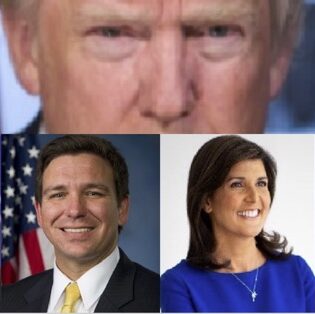
The Republican National Committee will not play a role in further 2024 GOP primary debates, the RNC said Friday. The party has held four debates, and has winnowed down the candidates to five for the fourth debate, which took place on Wednesday. But with frontrunner Donald Trump skipping all the debates, the viewership has been declining.

4.1 million viewers watched the fourth Republican presidential debate, including 1.6 million on NewsNation and 2.5 million on the CW Network, according to Nielsen, a ratings service. It was a 47% drop in viewership from the third debate, Nov. 8. It was, however, a record night for NewsNation.

The first debate in August drew 12.8 million viewers.

There still may be debates, but they would need to be sponsored by another group and time is of the essence. The Republican Party of Iowa holds presidential caucuses on Jan. 15 and the New Hampshire primary is Jan. 23.

Coast Guard retrieves downed helicopter from Southeast Island

3

The U.S. Coast Guard on Friday recovered the downed MH-60ย Jayhawk helicopter that crashed on Read Island on Nov. 13ย during a rescue mission, in which the crew was responding to a boat taking on water in stormy seas.

The four aircrew members involved in the crash were medevaced to Seattle during the initial rescue effort, and have since been released from Harborview Medical Center.

Efforts to retrieve the aircraft included the Coast Guard, the U.S. Armyโ€™s Downed Aircraft Recovery Team, Forest Service, National Weather Service, Alaska Department of Environmental Conservation, Petersburg Fire & Rescue, and independent contractors.

โ€œWe are grateful our four crewmembers were released from Harborview Medical Center and are on the road to recovery,โ€ said Coast Guard Capt. Brian McLaughlin, head of the Crisis Action Team, who led recovery efforts. โ€œWe are also incredibly thankful to the many people and organizations who helped us recover the aircraft. Getting the helicopter to where our investigators can better examine the wreckage is the next step in the ongoing investigation.โ€

The Coast Guard also disestablished the security zone around the crash site, which has been in effect since the incident occurred. The investigation into the crash is still ongoing.

Michael Tavoliero: Is it time to move to partisan municipal elections?

By MICHAEL TAVOLIERO

One of the more difficult topics to capture the public’s interest in is how certain political taboos originated. I’m writing about nonpartisan municipal elections in the United States, and how and why they developed.

This topic is like the debate in the Sean Connery movie, “The Name of The Rose.” Set in the early 14thย Century, Franciscan William of Baskerville, played by Connery, and his Benedictine novice travel to a monastery in northern Italy to participate in a major ecclesiastical debate at the time: Did Jesus and the Disciples own their own clothes?ย 

A 21stย Century reply might be, โ€œWho cares?โ€

But here’s today’s question: Has our current nonpartisan municipal elections become a conduit for creating a country with a national debt headed to $50 trillion, the worse outcomes in public education, and the most corrupt redistribution of our tax dollars in the history of the world?ย 

How did this all begin?

It started toward the end of the 19thย Century and the beginning of the 20thย Century. The reason for nonpartisanship in municipal elections was to promote focus on community-specific issues, rather than national party politics. The thought was, if you were an โ€œRโ€ or a โ€œD,โ€ you were more likely to be concerned with national party politics than wanting to fix potholes or fight local crime.

In the turn of the 20thย Century, nonpartisan elections were marketed as a way to develop strong local governance without the domination of city politics promoted by the urban-centric party machines. This was a progressive model for utopian political equity.

As a result, nonpartisan municipal elections were brought firmly about by the Progressives’ insistence that most of the late 19thย and early 20th Century cities faced issues of corruption by the very political machines that controlled local government, through favoritism and crooked patronage.

This brought us the current era of the industrialization of municipal entities: Large urban centers controlled by small groups of people managing the redistribution of local tax dollars, which subsequently control the states in which these cities reside. Today, examples abound with New York, Philadelphia, Minneapolis, Seattle, Portland, San Francisco, and Los Angeles.

In the early 1900s, there was a mix of trust and skepticism in local government, just like there is now. The Progressive Era (late 19th to early 20th century) saw efforts to address issues such as corruption, inequality, and the influence of powerful interests by offering remedies such as nonpartisan local elections. More government regulations were marketed to the public to fix this, and the voters bought it.

The remedy brought with it several changes to how local government was managed in America. It helped to create the advent of professional municipal management. Unfortunately, there is little evidence that professional municipal management has done anything favorable to municipal efficiencies and effectiveness. Such management has evolved with the focus on employment security for municipal employees, rather than municipal services to the public.ย 

In part, this presented a foothold for local identity to be managed by small groups of councils or assemblies in huge populations rather than small more efficient local governance models managed by active public involvement. 

Nonpartisan elections left voters with the inability to discover candidate political ideologies at a glance of a letter after each candidateโ€™s name. That opened the door to large, non-party organizations promoting candidates loyal to their organizations. It reduced civic engagement as respective political parties did not have the seat at the table of the discussion of local challenges and ideas. This further fostered voter disillusionment, resulting in inhibited competition, choice, and apathy.ย 

It is critical at this point of our discussion to note that local government, then and now, controls the most useful tool for political change: public education. What have non-partisan municipal elections done for American education?

The advent of nonpartisan municipal elections brought promises of improved efficiencies and professionalism to local government. These promises promoted the American values of localism, which addressed the unique needs of the respective communities. The result of these promises underdelivered meaningful features and benefits to local communities and instead created an hegemony in power and control.

The Municipality of Anchorage is one example that showcases hegemony.

Have nonpartisan municipal elections improved our American model? Many would still argue against the changing the status quo, but with over 125 years of experience, perhaps we might now want to consider the alternative: Partisan municipal elections.

Michael Tavoliero is a senior contributor at Must Read Alaska.

Bethel police chief resigns after a year and four months, citing ‘internal and external interference’

Leonard “Pete” Hicks, police chief of Bethel, joined the force on Sept. 12, 2022. Dec. 31, 2023 will be his last day.

Hicks submitted his resignation to the Bethel Human Resources department on Wednesday. In it, he said that he felt there was not much more he could do: โ€œBoth internal and external interference and challenges have hindered my ability to enforce and maintain discipline within the department.โ€

From Trussville, Ala. last year to Bethel, Alaska, Hicks has a 20+-year law enforcement background and is a military veteran. He has a bachelor’s degree in homeland security, law enforcement, firefighting, and related protective services. He is a graduate of the FBI National Academy.

Hicks had served as lieutenant and chief investigator in the Criminal Investigations Division for the Moody Police Department in Moody, Ala. When he accepted the offer to lead the Bethel Police Department, the position had been vacant for several months year after the resignation of Police Chief Richard Simmons, a 25-year law enforcement officer who had moved from Fort Worth, Texas but lasted less than two years in Bethel.

Hicks was offered $130,786 and a $10,000 relocation budget when he accepted the job. His predecessor, Chief Simmons, was offered a $140,000 starting salary.

The job has not been posted at the City of Bethel’s website as of Saturday, Dec. 9. Lt. Jesse Poole served as interim chief between Simmons and Hicks, and will serve in that role again until a new chief is hired, which may take several months.

โ€œIโ€™ve enjoyed the community,โ€ Hicks told a KYUK reporter. โ€œI like the community. But I feel like Iโ€™ve reached a point where thereโ€™s just not much more I can do, and it will just probably be in everybodyโ€™s best interest at this point just to move on and let somebody else try.โ€

Bethel, located on theย Kuskokwim River aboutย 40 miles from the Bering Sea and 400 air miles from Anchorage, isย a commercial hub and port for the entire Yukon-Kuskokwim Delta area of Alaska, and serves as a tribal hub. Bethel, with a population of about 6,300, is comprised of 83.3% Alaska Native (mainly Yupik).

During the Covid-19 panic of 2020 and 2021, city officials mandated that all municipal employees get Covid vaccines. About half of the police force refused. Chief Simmons, who left shortly after that forced vaccine dispute, has described Bethel as โ€œone of the most violent communities in the nation.

His claim is backed up by a report from 247Wall Street, which said in 2020 that violent crime rate in Bethel ranks as the highest of the 12 cities in Alaska that are home to at least 5,000 people for which the FBI has data.