Home Blog Page 522

Electric car in winter? Pro tip: Keep your parka close

Tow truck operators in Alaska might have a word of advice for those driving electric cars in Alaska’s wintertime: Don’t put your winter gear in the front luggage compartment, also known as a “frunk.” You could freeze to death.

Scott Hockema, owner of Scott’s Towing & Hauling in Soldotna, came across a Tesla full of young adults shivering in the late night cold, wearing only their t-shirts. Their Tesla was inoperable along the shoulder near Kasilof, on the Kenai Peninsula, and, in frigid nighttime temperatures, they could not get the frunk to open. The insurance company told them they’d send a truck in the morning. So they called Scott’s Towing, one of the few tow truck operators who work nights in the area.

Hockema was able to get the passengers warm, and then lifted and hauled the car to a charging station in Soldotna. But there, the group found that the car was so dead that when they plugged in the 4-foot charging cord, the vehicle wouldn’t charge.

That’s when the towing challenge went from slightly out-of-the-ordinary to pro. The vehicle had been towed so many times the towing hook was broken. It was hard to get close with the tow truck. And a tow operator just can’t jack up an electric car from anywhere.

“You have to use a jump box on two small wires in the bumper to open the hood to jump to the 12-volt battery to get the big batteries to start charging. But the electric actuators were not working, so the hood wouldn’t open.” The actuators were frozen.

The Tesla was inoperable until the owner could get a technician from Anchorage to get the hood open and jump the 12-volt battery.

Hockema said that the incident was a reminder that electric cars’ batteries are not only drained by cold weather, but also by the amount of weight in the car — in this case four people and luggage, which can make battery life unpredictable. Having to heat the cabin of the vehicle also drains the battery. He pointed out that electric vehicles don’t come with spare tires, as manufacturers try to keep costs down. And since most everything can be run off of an app on a smart phone, you don’t want your phone battery to die as you wait by the side of the road in the middle of an Alaska winter. This group of Alaskans, who were heading to Anchorage over the pass with a winter advisory calling for 8-12” of snow, were actually lucky they broke down in Kasilof.

With more automobile owners turning to electric cars in Alaska, Hockema noted that tow operators are having to come up with new ways to “McGyver” them out of the ditch and on a flatbed for towing; electric cars cannot be towed without a flatbed.

Hockema said he’s not trying to bash EV owners, but wants them to be aware of what to expect in the harsh Alaska winters.


Where does Sen. Lyman Hoffman really live — Bethel or Anchorage? Quinhagak voter wants to know the truth

On any given weekend all year long, Sen. Lyman Hoffman can be seen filling up his cart at the Dimond Blvd Costco in Anchorage. He is known to spend most of his time in Anchorage, even though he represents Senate District S, the Bethel-to-Adak area. That is something that has irked fur trapper Willie Keppel of Quinhagak. Keppel has lived in rural Alaska for over 40 years and is often heard on KRUP radio out of Dillingham, and KEDI radio out of Bethel during the morning talk show hosted by Stevie Ray.

Keppel wants to start a recall petition to get rid of the Hoffman reign in Western Alaska. However, he has a challenge on his hands: Senate Seat S is huge, with a coastline that stretches from the Yukon River to the tip of the Aleutian island and back to the western part of Cook Inlet. And Keppel lives in a remote town of 776 people south of Bethel.

“Lyman Hoffman has been misrepresenting his residency for years. The Division of Elections didn’t do due diligence when we requested he be removed from the ballot in 2022,” Keppel said. But with a new Division of Elections direction, Keppel is hoping he can get access to his cell phone location records, credit card spending location, and Alaska Airlines mileage records.

The letter that Keppel received from the Division of Elections in 2022:

Keppel says that the U.S. Census uses “intent” as a qualifying factor.

“We’re calling malarkey,” Keppel said. He pointed out that for Anchorage homeless people, the Census rules that their residence is “where they lay their heads, most commonly.”

Hoffman, Keppel has reminded radio listeners often, lays his head on a pillow in a home on Snowline Drive on the Anchorage hillside. He also has a place in Bethel. He says Hoffman only uses his Bethel house as a fish camp.

“Lyman never shows up until the king salmon shows up in June,” Keppel said.

“We’re intent on having the final say in Senate S, as the Legislature refuses to tighten up the rules and force legislators to live in their district, and worse yet, the Division of Elections has fully embraced the ‘if you lie, we sure ain’t checking’ policy for incumbents,” Keppel said.

“You would never get away with living in Sand Lake and running for a seat out in the Valley,” Keppel said.

Keppel, if he goes ahead with his recall efforts, would need 744 signatures from the district.

“So if you are living in-between the Yukon River and the tip of the Aleutian Islands, are a registered voter of Senate District S, we’re asking interested parties to DM me if you would like to be part of a recall Lyman Hoffman committee. Or, email me at [email protected]. The corruption has to end,” Keppel said on social media.

U.S. government funnels taxpayer funds to an organization filled with Hamas terrorists

11

By ADAM ANDRZEJEWSKI | REALCLEARWIRE

Topline: The U.S. government has given $1.2 billion to the United Nations Relief and Works Agency since April 2021, according to a report from OpenTheBooks.com.

UNRWA exists to provide humanitarian support for Palestinian refugees. But 10% of the agency’s employees are believed to have connections to the terrorist group Hamas, according to a recent Wall Street Journal report.

At least 12 employees were directly involved in the Oct. 7 attacks against Israel, including one teacher who allegedly kept a hostage in his attic for 50 days.

Key facts: U.S. taxpayers have spent over $8 billion to help Palestinian refugees since 1950, OpenTheBooks found.

The U.S. has provided almost one-third of UNRWA’s total funding, more than any other country. President Barack Obama’s administration spent more than any other president, with annual payments reaching nearly $400 million.

Former President Donald Trump cut all aid to UNRWA for the first time in 71 years because of concerns it could support Hamas and the Palestinian Liberation Organization, which used funds to support the families of dead terrorists.

President Joe Biden restarted U.S. support in 2021 and spent over $300 million each year. Biden said at the time that providing balanced support to both Israel and Palestine was the best way to work toward a two-state solution.

But concerns were expressed as early as 2014 that UNRWA was “effectively a branch of Hamas.”

Even after Oct. 7, the Biden administration sent another $121 million in Palestinian aid to UNRWA. Funding did not stop until this January.

A Biden-backed bill moving through Congress would redirect UNRWA funding toward other humanitarian groups in Gaza.

Critical quote: Ethan Mayer-Rich of the Arab Center Washington D.C. opposed the U.S.’s recent decision to pause UNRWA funding.

“We’re seeing a pretty quick departure from what used to be a split down party lines,” he said. “It’s reckless, and ultimately I think history is going to see [the U.S.] as being completely complicit in what is unquestionably an incredibly tragic and dire situation.”

Supporting quote: Rep. Darrell Issa (R-CA) wants the U.S. to permanently end UNRWA funding, not just temporarily pause it.

“Weapons have been found in UNRWA schools. Hamas tunnels have been found adjacent to UNRWA facilities. Hamas has stolen $1 million in UNRWA supplies since October 7, while UNRWA facilities may have been used to hold hostages,” Issa said in a letter obtained by the New York Post. “UNRWA has also faced longstanding criticism over its educational programing which indoctrinates Palestinian youth in antisemitism and terror.”

Summary: Concerns have long existed that the $1.2 billion the U.S. sent to UNRWA since 2021 could be used to fund terrorist activities. Tragically, those concerns appear to have been borne out.

The #WasteOfTheDay is a project of forensic auditors at OpenTheBooks.com

This article was originally published by RealClearInvestigations and made available via RealClearWire.

Larry Behrens: The Pocketing Podestas influenced Biden’s LNG embargo. Congress must investigate.

By LARRY BEHRENS | POWER THE FUTURE

Ever since 2016, talk to a liberal and there’s a good chance that they will blame “Russia” for something.

Election interference, inflation, record-high gas prices, the list goes on and on. Since taking office, Joe Biden continues to take this deflection to a new level. As a gallon of gas soared past $5 in the summer of 2022 it was all Russia’s fault. And who can forget the ill-fated #PutinsPriceHike campaign as Team Biden tried to dodge criticism for skyrocketing inflation.

Yet according to recent revelations, there may be more to Biden’s “America Last” energy policy than meets the eye, and again, Russia enters the picture.

According to a bombshell report from the Washington Free Beacon, the decision to halt American liquified natural gas (LNG) exports was pushed by Biden’s new Climate Czar John Podesta, who recently took over for John Kerry.

As a well-known climate warrior, it makes sense Podesta would be pushing for policies against American energy interests. Yet at the same time, Podesta’s brother, Tony, one of DC’s most well-connected mega lobbyists, has financial connections to foreign LNG companies, including one with links to a Russian oligarch.

It is concerning to see the Podesta family standing to profit from a policy priority of the White House who employs another Podesta. Foreign companies, including Russia, are clear beneficiaries Biden’s LNG attack. It should be raising questions about potential conflicts of interest and profit motives at the White House.

Even more troubling is the fact that this decision plays right into the hands of Vladimir Putin, the same dictator that Biden and his allies have been quick to blame for our country’s woes. By halting American LNG exports, Biden is handing Putin a wider energy market, allowing him to continue raking in billions while American energy workers suffer, and our families pay higher prices.

As even the left-leaning Washington Post editorial board put it, “Biden’s LNG decision is a win for political symbolism, not the climate.”

For the record, this is not the first time the Podestas were caught in ethical compromising situation. In 2019, Tony Podesta was investigated by the Southern District of New York for potential violations of foreign lobbying rules. Back in 2021, the same Podesta brother pocketed a cool $1 million by lobbying Biden in favor of Chinese telecommunications. Instead of tapping the brakes on this questionable influence, Joe Biden picked John Podesta to replace John Kerry and then put him in charge of the largest green slush fund in American history.

At a time when the country is still facing too-high gas prices and inflation, it is unacceptable for the Biden administration to prioritize the interests of foreign companies, and his radical green supporters over those of American workers and consumers. It is imperative that Congress launch an investigation into these suspicious ties to uncover the truth behind Biden’s energy policy and determine whether there is any real Russian collusion at play.

The House of Representatives deserves credit for investigating other elements of Biden’s green grift, including an electric vehicle battery deal that Ford reached with a Chinese company. It seems there is no end to the amount of our money Team Biden is willing to spend for more…green.

It is time for Biden to put America first and prioritize the needs of the American people over the profits of foreign entities.

It is time for Congress to step up and ensure that our energy policies are in the best interests of the country, not those of foreign oligarchs. The time for action is now. Let us demand the truth and hold our leaders accountable for their actions. Congress must investigate because America deserves nothing less.

Larry Behrens is the Communications Director for Power The Future. He has appeared on Fox News, OANN and NewsMax speaking in defense of American energy workers. He is the author of the book “Sabotage: How Joe Biden Surrendered American Energy Independence.” This column was originally published by RealClearEnergy and made available via RealClearWire.

FAA orders Boeing to fix 737 MAX anti-ice system

Although the likelihood may be remote, the chance is not zero that the Boeing 737 MAX engine anti-ice system could cause engine damage.

That was enough to cause the Federal Aviation Administration to order a fix.

The problem also presents on the 787 Dreamliner, with anti-ice system having caused “relatively minor” damage to an engine in more than one instance. The FAA says it requires fix for a new 737 MAX design problem. The problem was discovered by Boeing in the MAX’s engine anti-ice system, prompting the company to drop its request from a certain exemption from safety regulations.

The design flaw is not considered an immediate flight risk by the FAA, but the agency has issued two directives to Boeing to fix the problem and inspect, and then redesign the configuration for a permanent fix.

This is a separate issue from the door-plug bolts that were found to be missing from the 737-9 MAX that lost its plug mid-flight in January.

Boeing company representatives met with the FAA last week to go over the system-wide quality-control concerns.

“Boeing must commit to real and profound improvements,” Administrator Whitaker said following the meeting with Boeing Chief Executive Officer and President Dave Calhoun and his senior safety team. “Making foundational change will require a sustained effort from Boeing’s leadership, and we are going to hold them accountable every step of the way, with mutually understood milestones and expectations.”   

Administrator Whitaker told Boeing he expects the company to provide the FAA with a comprehensive action plan within 90 days that will incorporate the forthcoming results of the FAA production-line audit and the latest findings from the expert review panel report, which was required by the Aircraft Certification, Safety, and Accountability Act of 2020.

That expert panel noted “a disconnect between Boeing’s senior management and other members of the organization on safety culture. Interviewees, including ODA Unit Members (UM) also questioned whether Boeing’s safety reporting systems would function in a way that ensures open communication and non-retaliation.”

“Boeing must take a fresh look at every aspect of their quality-control process and ensure that safety is the company’s guiding principle,” Whitaker said.   

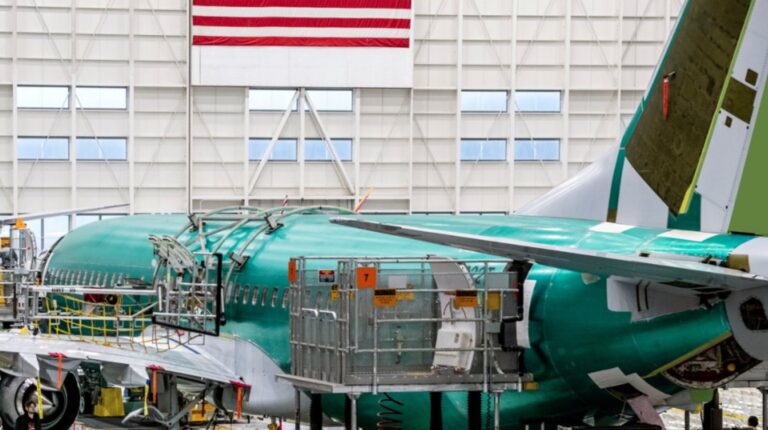
On Feb. 12, Whitaker was on the Boeing factory floor in Renton, Wash. to observe the 737 production line and hear directly from Boeing engineers, mechanics, and others about quality control processes. Whitaker also went to the Alaska Airlines headquarters to discuss the port-side mid-cabin door plug that blew out of Alaska Airlines Flight 1282 on Jan. 5 while in flight.  

The FAA has halted production expansion of the Boeing 737 MAX, is exploring the use of a third party to oversee Boeing, and will wrap up its enhanced oversight audit of Boeing’s production and manufacturing quality systems in the coming weeks. An investigation into Boeing’s alleged noncompliance is also underway, the FAA said.

Linda Boyle: CDC implies ‘curve’ is flattened, while experts admit new guidance follows social norms

By LINDA BOYLE

Has the curve finally been flattened? Not exactly. After four years of warning Americans to stay away from work and public places, and gradually decreasing the isolation time from 12 days to 10 days, then to five days if you tested positive for Covid, the Centers for Disease Control and Prevention changed its guidelines last week.

Now, the CDC says, you should stay home until free of fever without taking medication for 24 hours. However, the CDC says you still need to take more precautions for the following five days, ensuring you have improved ventilation, get that good old mask out of storage and mask up, and limit contact with others.  

The CDC has decided to use the same standards for Covid as it recommends for all other respiratory viral illnesses to include RSV and flu viruses.  

“Covid-19 is still an important public health threat, but it is not the emergency that it once was,” said Dr. Brendan Jackson, who leads the respiratory virus response for the CDC’s National Center for Immunization and Respiratory Disease, on Friday. And its health impacts increasingly resemble those of other [respiratory viral] illnesses, including influenza and RSV.” 

This change in policy is the first revision of coronavirus guidelines since 2021. And these changed guidelines are for us regular folks, not for hospitals or nursing homes. Those facilities still have their own rules.

Why the change? Was there a ton of research data to explain this shift in policy? Or was it just another SWAG (scientific wild a** guess)?  

The CDC quoted some statistics to justify the change. CDC Director Dr. Mandy Cohen said that by now, most of the U.S. population has some type of immunity to Covid.

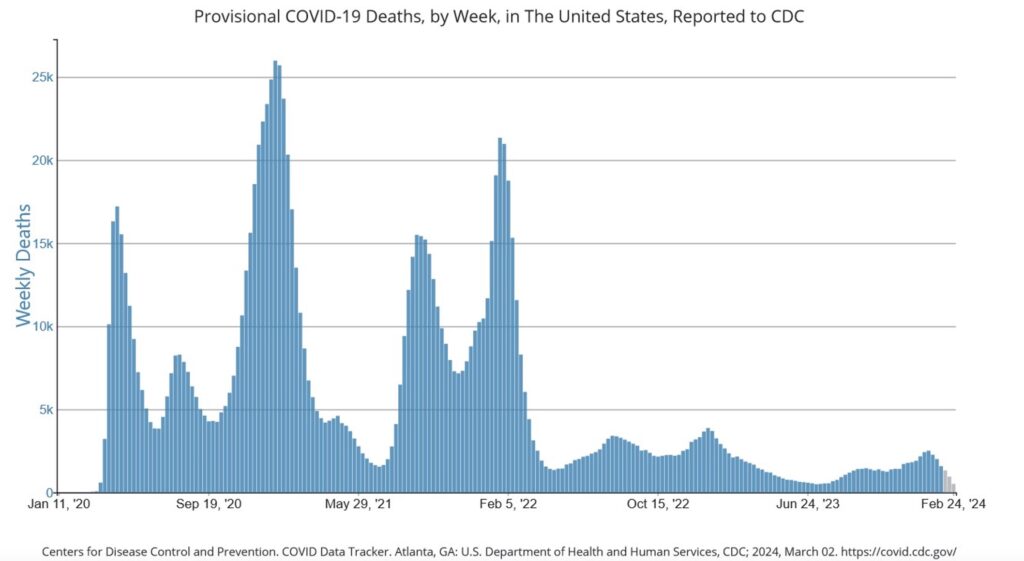
In 2021, there were more than 2.5 million hospitalizations for Covid-19. In 2023 that number dropped 60% to 900,000.

In 2021, there were 450,00 deaths attributed to Covid-19. In 2023 that number dropped 83% to about 75,000 deaths.

Covid was the third leading cause of deaths in the U.S. in both 2022 and 2021. In 2023, Covid dropped to number 10 as a leading cause of death.

Covid deaths have plunged. A Covid-19 death is defined as one where the disease is listed on the death certificate as an underlying or contributing cause of death.


That is eye-opening data. Yet, some of the top doctors also made some interesting comments.  

Dr. Marcis Plescia, Chief Medical Officer of the Association of State and Territorial Health Officers, said his board members felt it was time to make the change, aligning Covid with other respiratory illnesses.  

“It’s in step of where we need to be going and where our society is going anyway,” she said.

Dr. Anand Parekh, Chief Medical Advisor for the Bipartisan Policy Center, also stated the change was needed because “most members of the public likely aren’t following the previous isolation guidelines anyway.” 

In other words, the CDC made the change because people weren’t following the guidance. Americans were tired of the restrictions.  

Or perhaps it simply was because Oregon and California had recently made the same changes. The dominos were falling.

Jeff Childers observed in Coffee and Covid, “Why now? It’s election season.” 

This type of commentary would have him banned from social media just a few years ago. Covid has morphed from a “civilization-destroying virus” that justified massive lockdowns that destroyed the economy, to something treated like the flu.  It’s a good time to announce victory.  

True to form, however, the CDC reminds you to still take Covid vaccinations. It wants you to know the disease is still scary. They still have a huge inventory of “vaccines” to get into people’s arms.  

Over 65 years old? You now need those jabs every four months, CDC says, even though research has proven those antibodies are still there years later. There is a large inventory of vaccines still on the government’s shelf!

It’s no wonder 25% of Americans don’t trust the CDC.

The trust deficit is because the CDC continues to pick and choose the talking points it wants you to believe. When it changes guidance, it goes back to its original talking points to keep some Americans very afraid: “Treat it like the flu but it is still dangerous, and you need those jabs.”  

Sure, the virus has morphed. But it did so long time ago. Other countries loosened these restrictions back in 2022.  

It is just a good time now to make that announcement.

Linda Boyle, RN, MSN, DM, was formerly the chief nurse for the 3rd Medical Group, JBER, and was the interim director of the Alaska VA. Most recently, she served as Director for Central Alabama VA Healthcare System. She is the director of the Alaska Covid Alliance.

Bob Griffin: Anchorage schools need to right-size facilities to put the resources into classrooms

By BOB GRIFFIN

The Anchorage School District could solve much of its chronic budget problems by right-sizing its facilities – especially in excess elementary school floorspace.

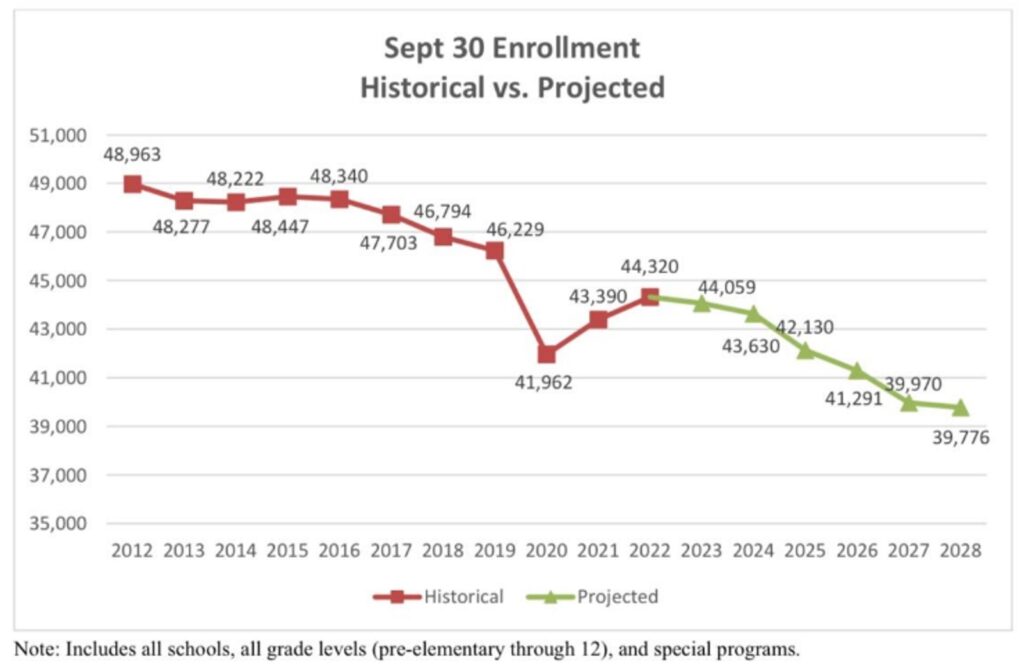
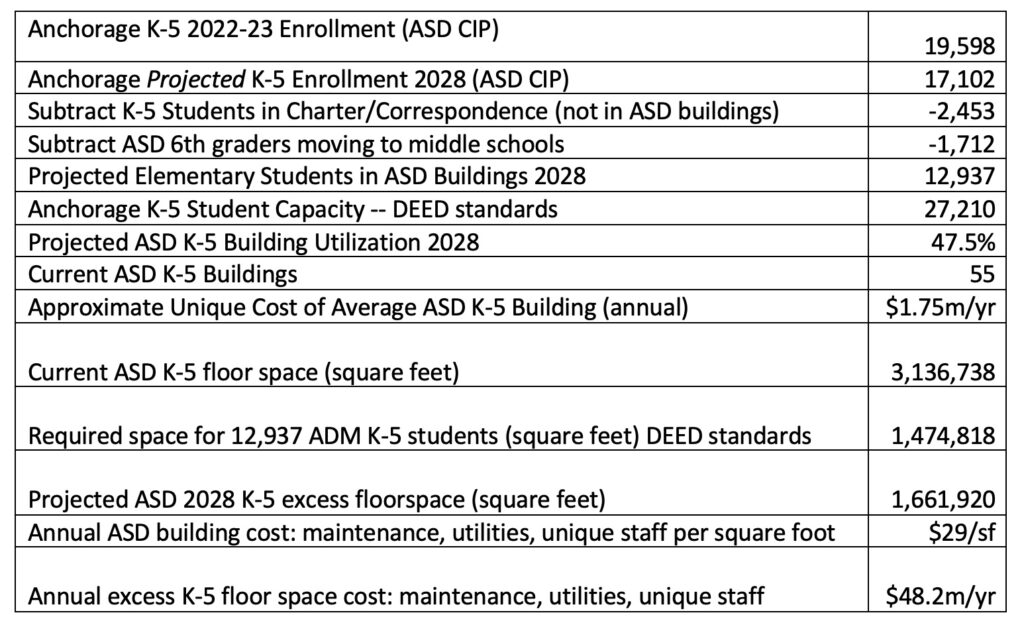
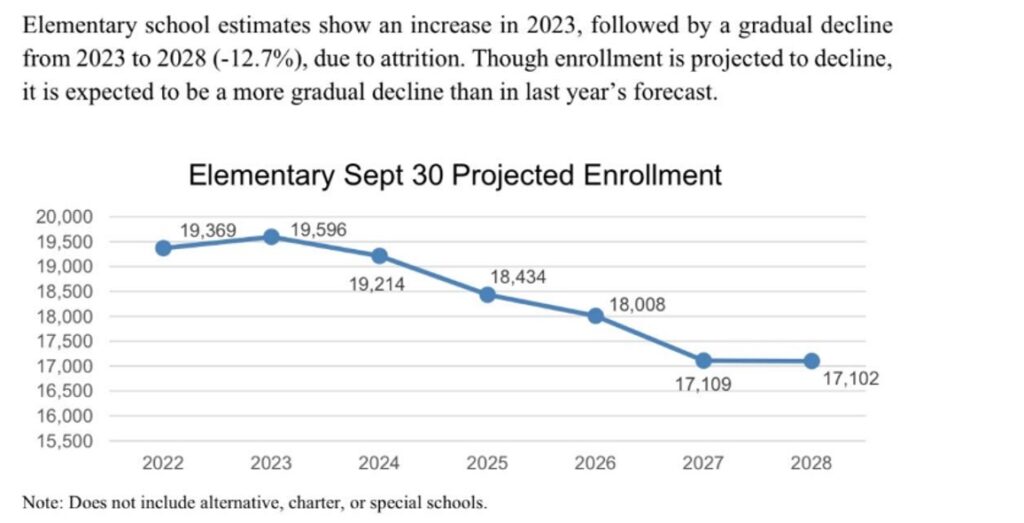
Over the next few years, ASD will have fewer than 13,000 elementary students in ASD buildings, with capacity to accommodate more than 27,000. 

The Anchorage School District currently has capacity for 27,210 elementary school students according to  Department of Education elementary school space requirements. The 2023-24 projected ASD elementary school enrollment was 19,958 students. That number is projected to decline to 17,102 by 2028.   

The 2028 projection does not account for over 1,700 sixth graders who will no longer be in elementary schools with the new 6-8 middle school model in Anchorage. It also doesn’t account for the more than 2,400 ASD K-5 students in charter and correspondence programs who don’t use ASD facilities.

That puts student projections in ASD brick and mortar K-5 schools at 12,937 students –or lower, if more parents choose charter or correspondence programs over the next few years.    

Many may consider that excess space a nice luxury. Great! Kids have more elbow room. But that luxury comes at a steep financial burden that robs resources from our kid’s classrooms. 

The average ASD elementary school costs about $250,000/year to heat and light. The salaries for non-classroom teachers (principals, office staff, janitors, etc.) that are unique to each elementary school, averages about $550,000/year. Though the biggest cost of keeping excess floor space open is the long-term maintenance expense. 

The current guidance recommends we invest 2% per year of the current replacement value of our schools to account for long-term maintenance like roof and boiler replacements and other needed future upgrades. Based on our most recent ASD construction projects, our current cost to replace a school is roughly $800/square foot.

Using the average of 60,000 square feet for an Anchorage elementary school, that results in around $960,000/year for long-term maintenance planning. With all those costs considered, Anchorage needs a little over $1.7 million eachyear to operate the average elementary school (teachers not included) or $29 per square foot per year to keep excess elementary schools open.

Keeping-up on long-term maintenance is not something we do very well in Anchorage. The current ASD deferred maintenance list is around $1 billion dollars (yes, with a “B”). Despite a fairly good record of passing maintenance bonds, that list has increased by around $80 million/year over the last several years.

Repurposing some excess floorspace to accommodate the acute needs of our very successful public charter schools is a pretty common-sense solution to some of this real estate glut. Eagle Academy Charter School in Eagle River is just one example. They are arguably one of the highest performing schools in the state of Alaska – operating out of a 50-year-old roller rink, with nearby underutilized campuses.  

ASD currently operates a little over 3.1 million square feet of elementary floorspace while state standards require a little less than 1.5 million for the 2028 projected brick-and-mortar student population. That means we are likely squandering up $48 million per year on elementary school buildings we don’t need (we haven’t addressed middle and high school underutilization). Those squandered resources are not available for other needs — like paying up to 400 teacher salaries.

Bob Griffin is on the board of Alaska Policy Forum and serves on the Alaska Board of Education and Early Development, but writes this in his own capacity. 

Bob Griffin is on the board of Alaska Policy Forum and serves on the Alaska Board of Education and Early Development, but writes this in his own capacity.

Oregon Legislature votes to re-criminalize hard drugs

14

Oregon is learning the hard way with anything-goes policies for street drugs. Both the Oregon House and Senate voted this week to undo some of the more troubling aspects of the state’s liberal drug law, Measure 110, which voters approved in 2020 to decriminalize possession of small amounts of hardcore street drugs.

House Bill 4002 restores misdemeanor penalties for drug possession and allows cities and counties to divert users into treatment programs or face up to six months in jail. The bill had bipartisan support and was the result of months of legislative work. Most provisions in the law will take effect immediately because of the bill’s emergency clause.

In January, the city of Portland declared a state of emergency over fentanyl usage in downtown Portland.

Democrat Gov. Tina Kotek has not said whether she will sign the bill. She said changes to the underlying citizen initiative “would have to pass the balancing test of concrete, measurable improved outcomes for individuals who are struggling with addiction and accountability.”

Oregon drug users are dying in record numbers, according to official data. In 2019 there were 280 unintentional opioid overdose deaths, and by the end of 2022, the number had exploded to 956. Numbers are not yet compiled for 2023, but are expected to increase from the 628 known deaths; the number of opioid overdose visits to Oregon emergency departments in 2023 are higher than previous years, according to the Oregon Health Authority.

In Alaska, 633 overdose deaths involving opioids were recorded between 2018 and 2022 (about 127 per year). Then in 2021, that number jumped to 198, and in 2022. Overall overdose deaths in Alaska reached 255 in 2021, and 247 in 2022.

Pro-Hamas flag flies in face of Iditarod mushers, spectators in Anchorage

The festivities of the Last Great Race have started in downtown Anchorage on Saturday morning, with the posting of the American flag and the ceremonial start of 38 mushers heading down 4th Avenue.

As the color guard posted the American flag at the starting line, a man with a big Palestinian flag stood behind the speakers’ podium and indicating support for Hamas terrorists and opposition to Israel’s defense of its country. The flag remained waving at the announcers’ podium throughout the first hour of the ceremonial start, prominently placed to appear in most photos and televised broadcasts. Then the flag bearer moved down the street with his flag to be seen from a better vantage.

Sen. Lisa Murkowski and husband Vern Martell at the start of the 52nd running of the Iditarod Sled Dog Race on March 2, 2024 in Anchorage, Alaska. A Palestinian flag can be seen behind the senator.

In attendance at the starting line for Iditarod 52 were politicians Sen. Lisa Murkowski, Mayor Dave Bronson and Lt. Gov. Nancy Dahlstrom.

The weather is brisk, with clear skies and temperatures at about 3 degrees, with the wind snapping the flags on 4th Ave.

You can watch the ceremonial start at this link: