
First published in the author’s personal Substack, November 6, 2026.
On October 23, Department of Natural Resources Commissioner John Crowther signed a proposed decision to convert the two conditional right-of-way leases for the Alaska LNG project into full leases under AS 38.35.100(a). The leases are ADL 421296 for the Point Thomson Transmission Line and ADL 421297 for the 807-mile mainline running from the North Slope to Nikiski. The request came on October 2 from 8 Star Alaska LLC, acting on behalf of the Alaska Gasline Development Corporation. DNR posted notice of the request on October 5, and written comment on the proposed decision closes at 5 p.m. on Wednesday, November 25, the day before Thanksgiving. Public hearings are set for November 23 online and November 24 in Anchorage.
Many Alaskans have heard enough about Glenfarne and the gasline to last them a while, and this could easily be mistaken for one more chapter in that story. It deserves a closer look for a narrower reason. A conditional lease reserves a corridor across state land but conveys no property rights. A converted lease would, in DNR’s own words, “vest AGDC with real property interests across state-owned lands associated with the Project.” When the state issued these leases in 2021, it wrote seven conditions into them that had to be met before that could happen. Reading the 2026 decision side by side with the leases themselves, and with DNR’s own 2021 analysis, raises questions that should be answered before the decision becomes final.

What the 2021 leases required
In January 2021, then Commissioner Corri Feige found that AGDC had the capacity to meet the standards of the Right-of-Way Leasing Act, “but additional technical expertise and project funding must be secured before AGDC is fit, willing, and able to perform under the application.” Rather than deny the applications, she offered conditional leases under AS 38.35.100(b), which give an applicant up to ten years to qualify. The 2021 leases run until 2031.
Section 2(a) of the Mainline lease sets out the order of events in plain terms: “To convert this AS 38.35.100(b) conditional lease into an AS 38.35.100(a) lease, the Lessee shall comply with the following conditions. Upon compliance with these conditions the Commissioner shall initiate the statutorily required process to convert.” The seven conditions cover financial capability, technical capability, existing uses along the route, plans for the use of timber, water and construction materials, a project management schedule, a fully executed Highway Use Agreement with the Department of Transportation, and a fully executed contaminated sites agreement among AGDC, DNR and the Department of Environmental Conservation.
DNR’s 2021 analysis described how conversion would work. To convert, “the lessee must prove that they can completely satisfy the requirements of AS 38.35.” It went on: “Once these conditions are met, the lessee may apply to DNR for a lease conversion in the form of a lease amendment.” On the financial question, DNR wrote that AGDC would qualify “upon securing sufficient project funding with appropriate binding commitments and structure,” after which the department would determine “if adequate funding is available to design, construct, and operate the project.” That was the standard the state set for itself when it issued these leases.
What DNR accepted in 2026
The 2026 decision agrees on page 10 that the leases “require AGDC to meet seven specific conditions before the leases may be converted.” One page earlier, it says that conversion “does not eliminate the seven conditions” as requirements at later stages, and that it “only confirms that a method has been identified to address them.” On page 17, it concludes that “the conditions for conversion have been met.” Those three statements are hard to reconcile, and the condition-by-condition analysis shows why.
The Highway Use Agreement and the contaminated sites agreement are the clearest examples, because each turns on a single word in the lease: executed. The lease calls for a “fully executed Highway Use Agreement.” The decision reports that “AGDC has submitted a draft Highway Use Agreement” and that the final agreement will be submitted “once completed.” The lease calls for a fully executed contaminated sites agreement among three parties. What the record contains is a letter from AGDC agreeing to comply with a 2018 DEC technical memorandum, and DNR “finds this condition met for lease conversion.” A draft and a one-party letter are what the state accepted for two agreements the lease required to be executed.
On technical capability, the lease asks for “Preliminary Design Documents.” The decision states that AGDC’s current Design Basis “is not a full preliminary design package,” but finds it “sufficient for this stage of the lease to proceed to conversion.” The 2021 analysis expected preliminary design to reach DNR after the federal permit was issued but before front-end engineering and design began, so that DNR’s concerns could be addressed early. Petroleum News reported in June that the pipeline FEED work performed by Worley concluded in December 2025. Whether DNR received and reviewed preliminary design before that work went forward is a fair question for the record.
On financial capability, DNR relied on a confidential Department of Revenue analysis, an overview of Glenfarne’s energy assets, and what the decision itself calls “publicly issued press releases as indicative evidence of anticipated commercial arrangements.” The decision describes the letters of intent from Asian buyers as “non-binding” and 8 Star’s capitalization of more than $50 billion as “planned.” It also counts AGDC’s statutory authority to borrow and issue bonds as financial capability. The lease asked for “binding agreements from new project owners or investors” and for evidence of the ability to indemnify the State. Glenfarne’s binding agreements with AGDC fund development work up to a final investment decision, and the decision’s financial section does not address indemnification.
DNR is candid that it is applying the standard differently than in the past. The decision says the fit, willing and able test “historically has been applied to private operators expected to construct and run a pipeline entirely by themselves,” and that for AGDC “the standard must reflect its statutory purpose.” Under that reading, AGDC is able because it has “the legal authority and institutional capacity to assemble the financial, technical, and commercial resources needed to advance the project,” and it demonstrated that ability by bringing in Glenfarne. That may be a defensible policy view. It is also a different test from the one DNR described in 2021, and the 2026 decision does not explain why the earlier standard no longer applies.
Where DNR has a fair argument
Some of DNR’s positions have solid footing in the lease. The existing uses condition asks only for letters of intent for the Little Troublesome Creek Campground and the Mainline Material Offloading Facility, and it expressly defers final mitigation design to the Notice to Proceed stage. The stipulation on scheduling contemplates a general schedule before a final investment decision and a detailed one after. Conversion does not authorize construction, which still requires separate Notices to Proceed, and Section 13 of the lease bars any construction notice until AGDC delivers an unconditional performance guaranty. AGDC also submitted a conversion package in 2024, so the paperwork did not appear overnight. DNR has the legal authority to convert these leases. The open question is whether the record supports doing it now, on these terms.
Funding, cost and buyers five years later
In 2021 the state said project funding had to be secured. Five years later there is still no final investment decision. South Korea has said Alaska LNG must still pass commercial and legal reviews before it decides whether to invest, and that no investment amount has been agreed. Taiwan has confirmed its interest, but its commitment remains under negotiation and is not binding. Glenfarne has said it needs binding sales contracts for most of the plant’s capacity before it can line up financing, and as of the latest reporting it has none.
The cost picture is no clearer. Glenfarne presented a range of $44.5 billion to $54.5 billion to Senate Finance on June 3. The low end of that range is close to the $45 billion figure the project has carried since at least 2016, and only the pipeline portion has reached an advanced engineering estimate. The gas treatment plant and the LNG terminal, which account for most of the cost, remain at an early estimating stage. Senator Bert Stedman has said a realistic figure with contingencies is $62 billion to $65 billion. A Department of Revenue economist told Senate Finance the long-cited $46 billion estimate could rise by as much as 100 percent. On June 10, Governor Dunleavy told a Council on Foreign Relations audience the project would cost “upwards of 65, $70 billion.” His office later said he misspoke. Whichever number proves closest, no one, including the governor, has offered a figure that the current funding commitments are shown to cover, and that was the condition the state set in 2021.
Who holds the lease
The leases themselves remain with AGDC. The decision states that both “remain in one hundred percent ownership and control of AGDC,” and the lease forbids any transfer without a written finding by the Commissioner. The project that would use the corridor is a different matter. Glenfarne owns 75 percent of 8 Star Alaska, the project company, and manages it, while AGDC holds the remaining 25 percent. DNR found AGDC able largely on the strength of 8 Star’s financing structure and Glenfarne’s experience, but no fit, willing and able finding has been made about either one. Glenfarne’s own filing says project debt will be secured by the project’s assets and contracts. How lenders would take security in a corridor held by AGDC, and whether any agreement between AGDC and Glenfarne already addresses the leases, are questions the record does not answer.
What the public is not allowed to see
State law requires DNR to keep an applicant’s financial information confidential when the applicant asks, under AS 38.05.035(a)(8)(D), and the applicant asked. The result is that the financial basis for converting these leases rests on a Department of Revenue analysis no member of the public can read. DOR published its project economics during the HB 381 debate earlier this year, including its cost and financing assumptions. During that same debate, legislators who wanted to see Glenfarne’s numbers had to sign nondisclosure agreements first, at AGDC’s discretion. The Legislature recognized the problem. Both HB 381 and Senator Cathy Giessel’s SB 275 included provisions to open that process up, including a rule that confidentiality agreements could not hide terms that put the state on the hook. The same kind of information now underpins a finding that conveys property rights in public land.
There is a second gap. When DNR proposed the conditional leases in 2021, it published the full draft leases alongside the decision, so the public could read exactly what the state would grant. The 2026 notice is titled “Conversion & Amendment of Conditional Leases,” and the decision says the leases will be amended “according to the findings described above.” As of this writing, no draft of the amended leases has been released. Alaskans are being asked to comment on an amendment they have not been shown.
Why this decision should wait
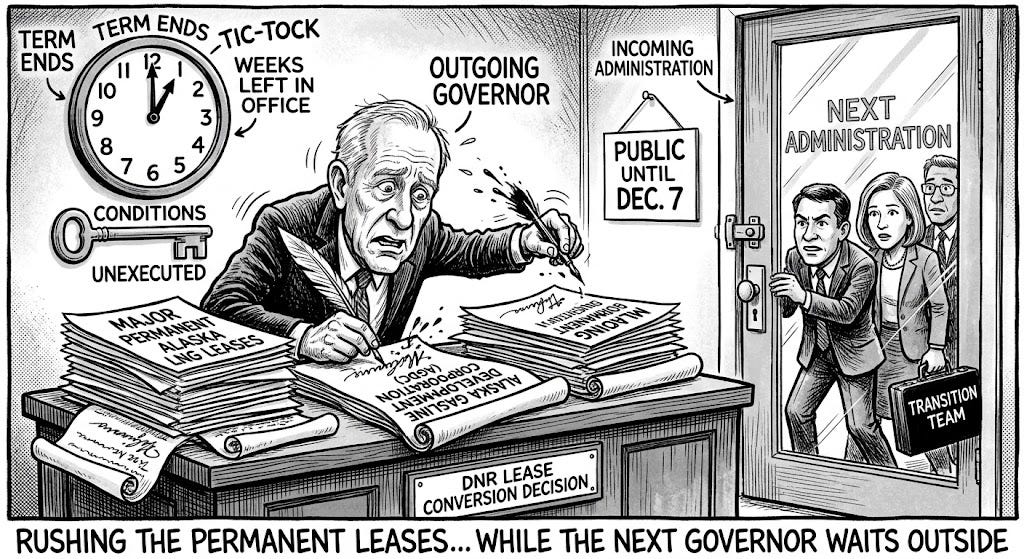
The final weeks of any administration are usually treated as a caretaker period. The outgoing team keeps government running, finishes what deadlines require, and leaves major decisions with lasting consequences to the people voters just elected. That is not a legal rule in Alaska, and Commissioner Crowther has full authority to act until his term ends. It is a long-standing norm that both parties have relied on during transitions, and it fits this decision closely.
No deadline forces the decision, since the leases run to 2031. The decision is hard to undo, because a conditional lease can be revoked while a converted lease carries a vested property interest, and AS 38.35.200(c) sharply limits court review of right-of-way decisions for AGDC projects. And the next administration will be responsible for everything that follows, from Notices to Proceed to any future request to transfer the leases. The new governor takes office on the first Monday in December, which this year falls on December 7, less than two weeks after comments close.
Waiting would not threaten the project. Every candidate for governor this year said they support building a gas pipeline, and whoever takes office will inherit this one. A few weeks would give a new commissioner, a new governor and a new Legislature the chance to review the record, publish the amended lease text, and decide whether drafts and letters satisfy conditions the state wrote in 2021. Whatever one thinks of the gasline, a decision this permanent belongs with the team that will have to stand behind it.
How to comment
Written comments are due by 5 p.m. on Wednesday, November 25, 2026. Specific comments carry the most weight, particularly ones that cite a lease section or a page of the decision and ask a question DNR must answer. Two reasonable requests do not depend on any view of the project: ask DNR to hold the final decision until the incoming administration takes office, and ask it to publish the proposed amended lease text and reopen comment so the public can review it.
Email: [email protected]
Mail: Department of Natural Resources, Division of Oil and Gas, State Pipeline Coordinator’s Section, 550 West 7th Avenue, Suite 1100, Anchorage, AK 99501
Phone: (907) 269-8800
Virtual hearing: Monday, November 23, 6 to 8 p.m. Connection details at dog.dnr.alaska.gov/home/newsroom
In-person hearing: Tuesday, November 24, 11 a.m. to 1 p.m., AHFC Headquarters, 4300 Boniface Parkway, Anchorage
The proposed decision and the public notice are posted on the same DNR newsroom page.
Questions worth asking
The record leaves several questions open, and the comment period is the place to put them to DNR.
- Why convert now, when the leases run until 2031?
- What does “fully executed” mean in Section 2(a) if a draft qualifies?
- In 2021 DNR said financial capability required “sufficient project funding with appropriate binding commitments and structure.” Which binding funding commitments does the 2026 record contain?
- Why has the public not been shown the text of the amended leases?
- Should the commissioner and governor who will oversee this project for the next four years be the ones to make this call?


