
From Brooklyn to the Flight Line: A Marine’s Unplanned Journey
I was not headed anywhere in particular.
Growing up in Brooklyn in a working-class Italian household, I was a reasonably smart kid. Calculus and physics in high school, but college was not a realistic option financially. Honestly, I could not picture myself there anyway. My father was second-generation American, his family having come over from Sant’Angelo dei Lombardi, Italy around 1900. He had served in the Navy during World War Two. His position on adulthood was straightforward: when you turn 18, you are out. No ambiguity, no negotiation. By the time my high school years split between Brooklyn and Cape Coral, Florida, my horizon had narrowed to renting jet skis on the Gulf Coast. That was the plan, such as it was.
Then one day I walked into a Marine Corps recruiter’s office.
I did not choose the Marines out of some deep knowledge of their history or traditions. I chose them because they had the reputation of being the hardest to get through. I was seventeen, cocky, from Brooklyn, and I wanted to know if I could do it. That was the entire calculation. I signed a Delayed Entry Program contract and shipped to Parris Island, South Carolina a few weeks after graduation.

Boot camp answered my question. Yes, I could do it.
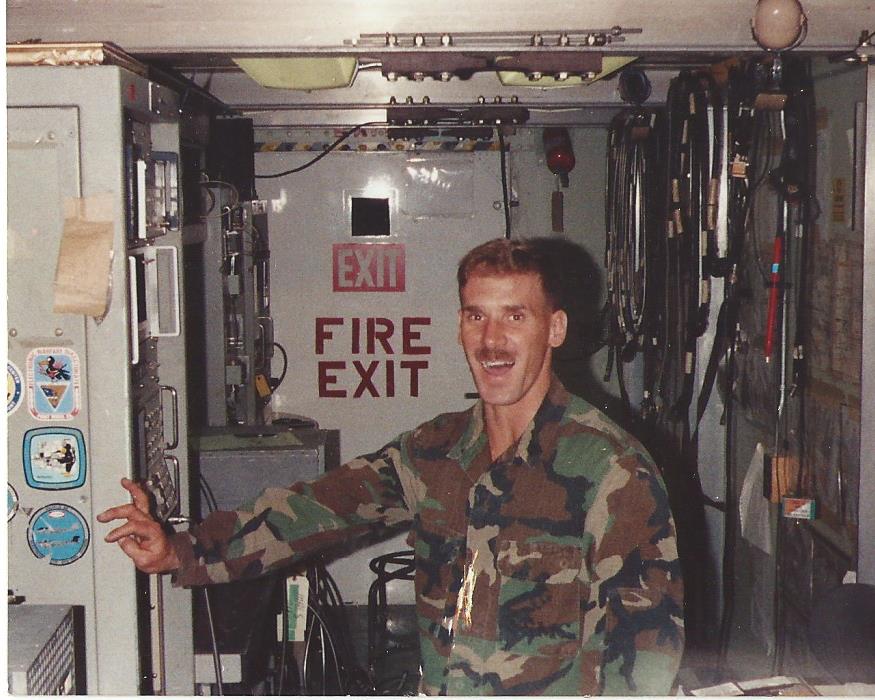
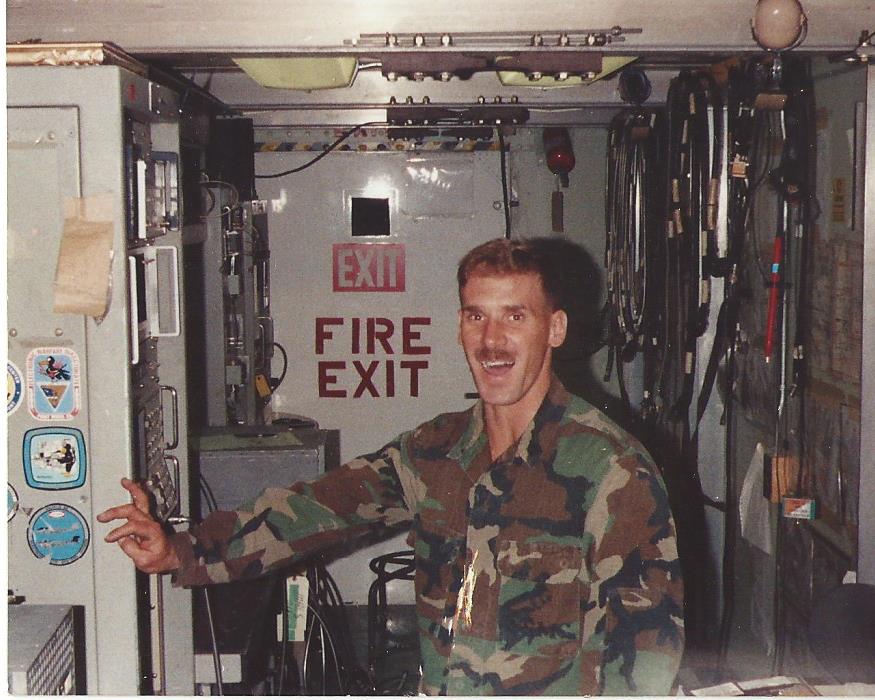
What happened next, I did not expect. I had enlisted on an open contract with no guaranteed job and no guaranteed school. The Marine Corps ran me through their classification process and apparently saw something in the math aptitude scores, because I was sent to NAS Memphis in Millington, TN for aviation electronics training. Basic electricity and electronics. Avionics fundamentals. Advanced avionics. Then specialty training on Electronic Warfare systems, the radar warning receivers and jamming systems carried on Marine Corps aircraft.
I had found my element. The technical curriculum absorbed me completely. What might have been a grind for others was genuinely interesting work. Circuit analysis, signal theory, fault isolation on sophisticated avionics, it connected to something that had apparently always been there, waiting for the right framework.
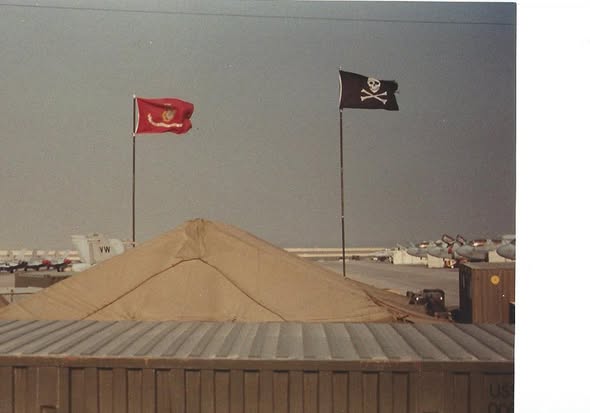
My first duty station was Military Corp Air Station (MCAS) Iwakuni, Japan, with H&MS-12. I extended my one-year tour to two. From there, MCAS El Toro, California, attached to VMA(AW)-242, the Bats, as intermediate-level Electronic Warfare support, making two deployments back to Iwakuni with the squadron. When Desert Storm began, I deployed to Kuwait and Bahrain with a combat replacement company, then joined H&MS-11 in Bahrain before returning to El Toro in late 1991. In 1988 I had been selected for AVIC7, the most advanced electronics course the Navy ran, eight months of graduate-level circuit analysis with an E5 prerequisite. Twelve years total. I separated as a Sergeant in August 1992 during the post-Cold War drawdown.
The greatest challenge of my service was not a single moment. It was the sustained discipline of performing precise, consequential technical work on deployed aircraft, often in austere conditions, where the margin for error was effectively zero. You learn quickly that competence is not optional and that the standard exists for a reason. That lesson does not leave you.
What the Marine Corps gave me, beyond the technical training, was a framework for approaching complex problems methodically. Gather data, characterize the problem, isolate the fault, resolve it, move on. That framework transferred directly into everything that followed: maintaining public safety radio systems for Motorola, troubleshooting citywide RF interference as a performance engineer at Nextel, designing cellular networks at VoiceStream, and ultimately building optical and network infrastructure to remote Alaskan villages, communities that had no meaningful telecommunications before fiber arrived.
The through line from Parris Island to the Alaskan bush is, in retrospect, completely coherent. A structured technical discipline applied to progressively larger and more complex systems, in environments where self-sufficiency and sound judgment matter more than organizational support.
I did not plan any of it. A Brooklyn kid with no particular direction walked into a recruiter’s office on a whim and the institution saw potential he had not yet seen in himself.
To young Americans aged 18 to 25: Pay attention to where the future is actually going, not where it appears comfortable today.
The technical fields, mathematics, engineering, computer science, electronics, are where civilization’s infrastructure will be designed, built, and operated for the next several generations. Artificial intelligence and automation are not distant concepts. They are already absorbing manual and routine labor at an accelerating rate. My own field, network and optical engineering, will increasingly be automated at the implementation level. What will not be automated, for a long time, is the capacity to design the systems, understand their failures, and operate at the level of genuine technical depth.
The Marine Corps spotted that capacity in me through a standardized test when I was seventeen and I had no framework to recognize it myself. You may have it too. The question is whether you will develop it before the window closes.
Math and science are not obstacles. They are the doors.
Find out which ones open for you.
More in Series
Want to Submit Your Story?
We hope to keep this series going all the way to Veterans Day! If you are a veteran or active duty service member, please consider sharing your military story and/or encourage friends and family to submit their stories! We will be publishing submissions in the order they are received, every Monday at 9am.
A recent op-ed by Army veteran Paul A. Bauer inspired this series. Bauer writes: “The problem is not gratitude itself. The problem is shallow gratitude. Many veterans do not need strangers to perform respect with a slogan. They often prefer real curiosity, human recognition, and informed conversation.”
We invite veterans and active-duty service members to send us articles sharing your story. You can use the questions below as inspiration. You do not have to respond to all the questions, and you are not limited to them. Please include the branch you served in and how many years you served.
Guiding Questions
What did/ do you do in the military?
How long did you serve?
Did anyone else in your family serve?
Why did you choose the service branch that you did?
What was the greatest challenge you faced during your service and how did you overcome it?
What was the most significant lesson you learned during your service?
If you could say one thing to young Americans aged 18-25, what would you say?
Requirements
Please follow these requirements for your submission:
- Word limit: 1,000 words
- Must be written in first person
- Must be published with original author’s legal name (no pennames/ ghostwriting)
- No foul language
- All direct quotes and data points must be cited (a link to source is sufficient)
- Have fun! Be creative!
Submit your story to [email protected].
Must Read Alaska says thank you to all our amazing veterans!



