Monday, October 19, 2026
Home Blog Page 1000

Shocking: Reading scores in Anchorage dropped between fall and winter of 2021

By DAVID BOYLE

Anchorage School District leaders presented an update on reading proficiency in grades K-2.  The results are disappointing and unsettling. In summary, reading proficiency from the fall to winter of 2021 dropped in every demographic.

This is not good news for parents, students and Anchorage School District staff.  Most of the board members were silent when this information was presented on Jan. 18.  Anchorage Board Member Dave Donley asked about a 2019 report regarding the correlation between the new curriculum and reading progress. The district had no relevant response.

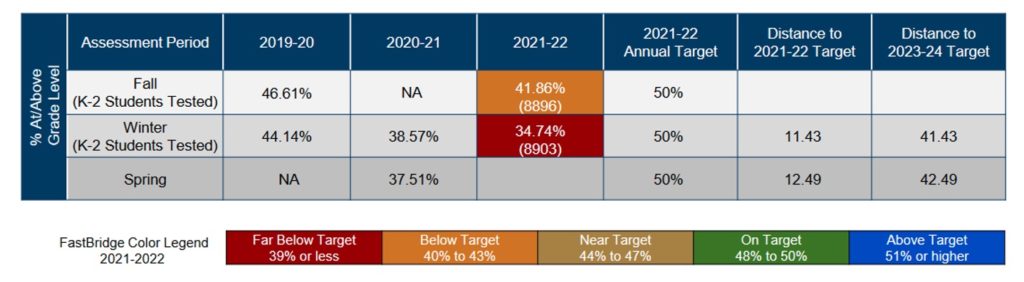
Most schools in Anchorage underperformed.  Here is a summary of the K-2 students at or above grade level showing the decrease in achievement from fall to winter:

The scores for all the K-2 grades decreased from nearly 42% above the benchmark to about 35% above the benchmark from fall to winter, a dramatic fall of about 20% of all K-2 students from the benchmark.  

Clearly, something is broken.

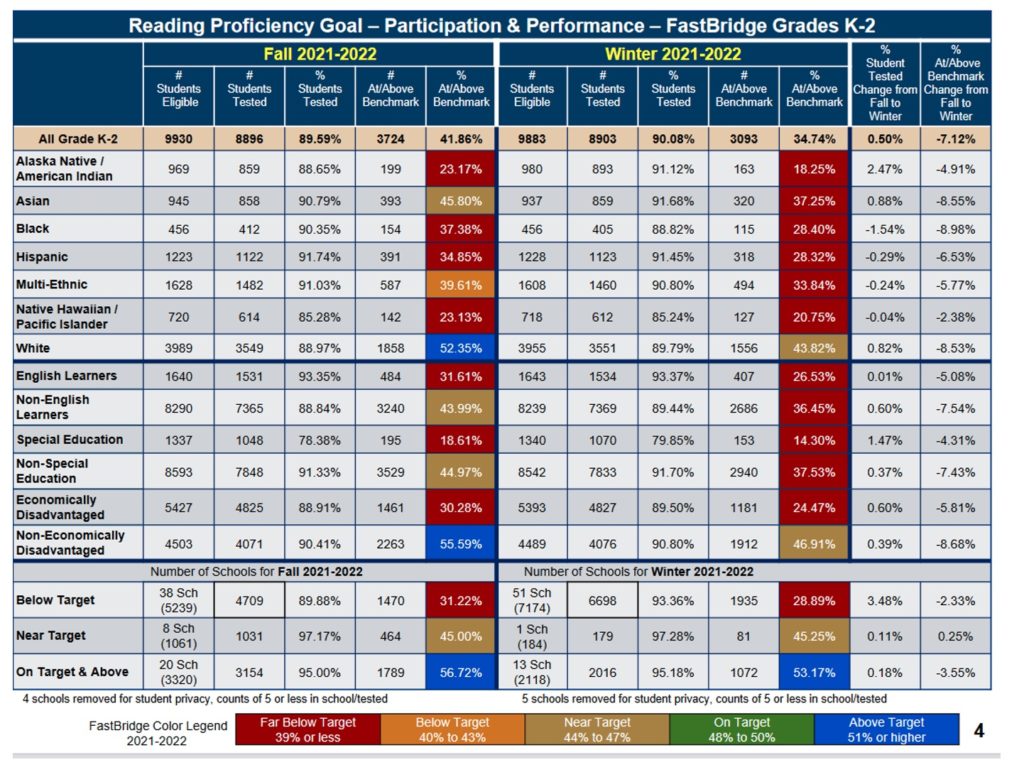
Only the white/non-Hispanic and the lottery schools (charter and alternative) performed above targeted goal. Here is the chart broken down by every demographic:

Note that even the white and wealthy children dropped in achievement from fall to winter.  

Anchorage and Alaska has provided adequate funding, according to Superintendent Deena Bishop, yet our children are failing in reading. It’s important to note that children were back in the classroom when these data were collected.  

Is the curriculum not working? Are the teachers ineffective in teaching reading to K-2? Are the face masks impeding the learning process? 

Superintendent Bishop stated that the lottery schools did well because they are probably upper socio-economic class. Lottery schools are attractive to parents who want to send their children to a school not within their designated area. They are hard to get into and the applications must be made annually and are not guaranteed year to year.

Bishop said, “It isn’t that our kids haven’t learned the longer they are with us. It’s that they’re trying to catch up but the goalposts keep moving for them. It doesn’t mean there is not growth, it’s just not the expected growth.”

The chart above would seem to contradict the fact that “kids haven’t learned the longer they are with us.” Board Member Carl Jacobs questioned if the assessments were too ambitious and implied that he wants to lower the standards so the students would look more proficient. 

Lowering the goalposts will not improve reading proficiency. But that will make it appear there are improvements.

School Board Member Kelly Lessens probed deeper by asking about the cause of the drop in reading, or the “elephant in the room.”  

Bishop said that there were several factors. She named them: consistent (or lack of consistent) instruction, staffing shortages, behavioral issues, Covid, and the earthquake. Thus, student learning took a backseat.  All these barriers were the “elephant in the room.”

Note that the earthquake occurred several years ago (2018) and the K-2 students were not in the classroom then. Why isn’t there not consistent instruction? 

Twenty schools were above target and 38 schools were below target in the fall. That dropped to 13 schools above target and 51 schools below target in the winter.  

Bishop said, “Wealth probably has the most to do with that, or socio-economic status.”

But all children decreased in proficiency, regardless of socio-economic status.

The district should drill down to the classroom level and determine what teachers are the most effective in teaching reading. Take those best practices and implement them in all classrooms.

The per-student cost in the ASD is more than $19,000, according to its audited report. Money is not the solution.  Pre-K is not the solution if the district cannot teach K-2 children to read at grade level.  

David Boyle is former executive director of the Alaska Policy Forum and is Must Read Alaska’s education writer.

Last day to file for Anchorage elected office

The final day to file for an elected position in Anchorage is Friday, Jan. 28, at 5 pm. While some people have filed a letter of intent with the Alaska Public Office Commission, as of the close of business on Thursday, the following people have officially filed with the Anchorage Municipal Clerk:

Anchorage Assembly

District 2 – Seat A – Eagle River/Chugiak

     Cross, Kevin​ – Filed 01/21/2022

District 3 – Seat D – West Anchorage

     Perez-Verdia, Kameron​ – Filed 01/24/2022

     Williams, Nial Sherwood​ – Filed 01/14/2022

     Vazquez, Liz​ – Filed 01/27/2022

District 4 – Seat F – Midtown Anchorage

     Zaletel, Meg​ – Filed 01/26/2022

     Henslee, Kathy – Filed 01/18/2022

District 5 – Seat H – East Anchorage

     Taylor, Stephanie – Filed 01/14/2022

     Dunbar, Forrest – Filed 01/18/2022

     Hall, Christopher​ – Filed 01/19/2022

District 6 – Seat J – South Anchorage

     Colbry, Darin – Filed 01/24/2022​​​

     Weddleton, John​ – Filed 01/25/2022

     Sulte, Randy – Filed 01/20/2022

School Board

School Board Seat A

     Murray, Cliff – Filed 01/20/2022

     Bellamy, ​Margo – Filed 01/19/2022 

     Cox, Mark Anthony – Filed 01/24/2022

School Board Seat B

     Murray, Cliff – Filed 01/14/2022 – ​Withdrawn 01/20/2022

     Lessens, Kelly – Filed 01/14/2022

     Baldwin, Benjamin R. – Filed 01/18/2022

     Darden, Dustin​ – Filed 01/27/2022

     Ries, Rachel – Filed 01/18/2022

Service Area Board of Supervisors 

Bear Valley LRSA – Seat B

Birchtree/Elmore LRSA – Seat C

     Lees, Adam​ – Filed 01/26/2022

Chugiak Fire Service Area – Seat C

     Stoltze, Bill – Filed 01/24/2022

Girdwood Valley Service Area – Seat C

     Wade, Guy​ – Filed 01/18/2022

Glen Alps Service Area – Seat C

Glen Alps Service Area – Seat D

     Marks, Roger​ – Filed 01/19/2022

Homestead LRSA – Seat A

     Parret, David​ – Filed 01/20/2022

Lakehill LRSA – Seat A

Mt. Park Estates LRSA – Seat C

     Redlinger, Bob – Filed 01/21/2022

Mt. Park/Robin Hill RRSA – Seat E

     Leary, Collin – Filed 01/20/2022

Paradise Valley South LRSA – Seat A

Rabbit Creek View/Heights LRSA – Seat C

     Pexton, Scott R. – Filed 01/27/2022

Raven Woods/Bubbling Brook LRSA – Seat C

Rockhill LRSA – Seat C

Section 6/Campbell Airstrip Road LRSA – Seat D

     Brown, Lonnie – Filed 01/25/2022

Section 6/Campbell Airstrip Road LRSA – Seat E

     Trueblood, Ted B.​ – Filed 01/18/2022

Sequoia Estates LRSA – Seat C

     Valantas, Robert A.​ – Filed 01/19/2022

Sequoia Estates LRSA – Seat D

     Mikko, Dagmar​ – Filed 01/19/2022

Skyranch Estates LRSA – Seat C 

     Wallow, Brian​ – Filed 01/27/2022

South Goldenview RRSA – Seat D

South Goldenview RRSA – Seat E

SRW Homeowners’ LRSA – Seat B

Talus West LRSA – Seat C

     Jorgensen, Lawrence – Filed 01/25/2022

Totem LRSA – Seat A

     Jensen, David​ – Filed 01/14/2022

Upper Grover LRSA – Seat C

     Dwiggins, Leon – Filed 01/14/2022

Upper O’Malley LRSA – Seat C

Upper O’Malley LRSA – Seat D

Valli Vue Estates LRSA – Seat C

     Strand, Paul​ – Filed 01/20/2022

Villages Scenic Parkway LRSA – Seat B​

Legislative committee to spend $100,000 to investigate why Permanent Fund Corp president was removed by board

The Legislative Budget and Audit Committee emerged from an executive session on Thursday to vote to approve spending $100,000 on a legal team and inquiry into the firing of Angela Rodell, former executive director of the Alaska Permanent Fund Corp.

Last week, the committee called the chair of the board of Alaska’s sovereign wealth fund before the committee. Craig Richards, however, was careful to not answer the committee’s specific questions, although many of those questions may have been answered in the public release of Rodell’s annual performance review.

The committee’s chair, Sen. Natasha von Imhof, was given subpoena power by the committee to force people to appear before the committee to answer questions.

The motions appear to be the first time in Alaska legislative history that the Legislature will get into the day-to-day business of the corporation, which is run as a separate entity owned by the State of Alaska. Breaking through the firewall that has separated the corporation from politics may be a bridge that, once crossed, forever changes the way the Permanent Fund Corporation is managed.

“We will provide a list of people that we would like the firm to contact and depending on what that person says when they initially answer the phone or email or whatnot, if they agree then the firm will proceed,” said von Imhof. “And if they say ‘I don’t want to agree’ then we will discuss.”

It’s especially meaningful that the investigation is being done in an election year, with von Imhof being talked about as a potential candidate for governor.

Legislature rejects salary commission’s recommendation on legislators’ per diem and salary

On Day 10 of the 2022 legislative session, the Alaska House of Representatives voted unanimously to oppose a plan by the State Officers Compensation Commission, which would have restructured pay for legislators, commissioners and the governor and lieutenant governor. The Senate had already voted to reject the commission’s salary and per diem schedule.

The bill is expected to head to Gov. Mike Dunleavy’s desk late Thursday or Friday; he has 15 days — subtracting Sundays — to sign it, veto it, or allow it to go into law without his signature.

With an unanimous House and Senate, it’s unlikely Dunleavy will want to get into a veto fight so early in the session, when it’s clear the Legislature has the votes to override a veto.

The State Officers Compensation Commission earlier this month voted to cut the per-diem allowances for legislators from $307 a day to $100, and at the same time raise salaries from $50,400 to $64,000 a year.

The way the math would have worked is that for the legislators claiming the most per diem, the commission was giving them a haircut of about $11,000 per year.

The commission’s proposal would have gone into effect next January if the Legislature had not taken action.

11 senators call for investigation of collusion by teachers union, Biden’s DOJ and DOE, against parents opposed to Critical Race Theory

The Biden administration and the nation’s largest teachers’ union appeared to have colluded to target parents who questioned radical school policies, according to two Republican senators, who have called for an investigation.

“It also looks like they attempted to pressure social media companies to censor parents’ social media profiles as well. Senator Marco Rubio and I are calling for Inspector General investigations at both the U.S. Department of Education and the U.S. Department of Justice into this matter. We need answers,” said Sen. Cynthia Lummis of Wyoming.

Lummis, Rubio and nine other senators sent a letter to the Inspector General of the U.S. Department of Education, describing the collusion and calling for an investigation.

As they described it, on Oct. 8, 2021, the nation’s largest teacher’s union, the National Education Association, sent a letter to social media companies such as Facebook requesting that they remove “propaganda” and “disinformation” posted by parents who were protesting school policies regarding Covid-19 and Critical Race Theory.

“There is reason to suspect the NEA worked with Biden Administration officials to write this letter after email evidence revealed that the Secretary of the U.S. Department of Education colluded with the National School Board Association (NSBA) to produce a letter sent to President Biden a few days earlier, on September 29, 2021,” Lummis and Rubio wrote.

Parents Defending Education, a grassroots organization advocating for non-political education and the prevention of indoctrination in the classroom, obtained NSBA internal emails through the Freedom of Information Act. The documents show that in September the NSBA coordinated directly with Secretary of Education Miguel Cardona in writing a letter that equated parents‘ concerns about Covid-I9 regulations, school curriculum, and other policies, as “terrorism.” The NSBA almost immediately requested the Biden the Administration use federal law enforcement agencies to address “threats“ and “acts of intimidation“ by parents against school staff and boards.

“The issue first garnered national attention when Attorney General Merrick Garland issued a memo on October 4. 202l, directing the Federal Bureau of Investigation to go after these parents. After receiving significant pushback from many state school boards, the NSBA issued a public apology on October 22, 2021. At least I9 states have since withdrawn their membership from this organization after the release of the troubling statements,” the senators wrote.

“While we remain concerned that parents whom are peacefully protesting continue to be threatened by the failure of the Attorney General to rescind his memo, we are equally disturbed that the NSBA and NEA used taxpayer dollars -collected as dues from member schools – to carry out politically motivated attacks against concerned parents at the direction of the Biden Administration. These actions must be investigated, as threatening and intimidating concerned parents should never be tolerated,” the senators wrote. “Parents deserve to know the complete truth on this matter. Just because someone disagrees with you does not give you the right to silence them. These fundamental and constitutional freedoms must be upheld by every American and every organization.”

The signers on the letter were from Sen. Cynthia Lummis-Wyoming, Marco Rubio-Florida, Roger Wicker-Mississippi, Joni Ernst-Iowa, Mike Braun-Indiana, Steve Daines-Montana, Roger Marshall-Kansas, John Barrasso-Wyoming, James Inhofe-Oklahoma, Cynthia Hyder-Smith-Mississippi, and James Lankford-Oklahoma.

Who’s who: Legislative staff list updated

7

As it does each year, the Legislative Affairs Agency has updated the staff contact list for legislators for the 2022 session. Today is the 10th day of the 2022 legislative session and most of the staff are now onboarded, with just a few openings, such as House Minority Press Office, unfilled. Today is Day 10 of the legislative session.

Alaska North Slope crude tops $90 a barrel, and Alaskans wonder if they can now have their Permanent Fund dividends

For the first time since the price crash of 2014, oil from Alaska’s North Slope is selling for more than $90 a barrel. Today’s posted price is $90.51.

While commodities fluctuate with supply and demand cycles, the trend has been upward for a few years. Alaska oil hit a low point of about $30 a barrel in 2016, and had climbed to $55.56 in January of 2021.

The State’s fall forecast for the 2023 budget, which is the spending plan that starts in July, had a prediction of $71 a barrel.

In the January, 2022 Short-Term Energy Outlook published by the U.S. Energy Information Administration, predicted crude oil prices will sag later in the year, although they show no sign of doing so.

“We forecast that the price of Brent will average $75/b in 2022 and $68/b in 2023,” the agency wrote on Jan. 12.

The predicted decline in prices will be driven by a shift from global inventory declines last year to inventory increases in 2022 and 2023.

The Alaska Legislature is keeping an eye on the price of oil, as it crafts the budget for the coming year and looks to balance the desire from special interests for higher spending on state projects and programs, with the looming requirement that the Constitutional Budget Reserve must be restored. The Legislature has been “borrowing” from that fund for several years, and is required by statute to pay it back.

Statute also requires a Permanent Fund dividend, to be paid by a lawful formula. There will also be pressure from Alaskans for the Legislature to return to the lawful formula and pay the Permanent Fund dividend in full this year.

The public may see the State of Alaska reaping all the benefit from the higher oil prices, while families watch their incomes being eroded in real time and not getting help from lawmakers to pay for heating oil and gas for their vehicles.

The Alaska Legislature also has to confront something it hasn’t done in a decade: How to handle having more money coming in than going out. When the money wasn’t there, legislators were able to lean on the argument that there is a structural deficit with a Permanent Fund dividend of any size, and therefore the lawful dividend was unsustainable.

Now, with a surplus of money, pro-dividend Alaskans wonder if they are getting the shaft, while the Legislature protects its profits during what will likely be an “up year” for oil prices.

Even with the high price of oil, income tax bills are being considered this year by Democrats, including Senate Bill 154.

Biden will make race and gender identity a top priority as he replaces Justice Breyer; Kamala Harris to advise him on the pick

President Joe BIden said today that he will choose a black woman to replace Justice Stephen Breyer on the Supreme Court, when Breyer retires this summer.

News of Breyer’s upcoming retirement was leaked to mainstream media on Wednesday, and made official by the White House on Thursday, when the president released Breyer’s letter of resignation.

Biden said today that Vice President Kamala Harris will advise him on the correct black woman to name to the Supreme Court. Two women now serving on the court are of Russian-Jewish and Puerto Rican heritage, although both Justice Elena Kagan and Sonia Sotomayor are American-born.

Breyer has served on the court for 28 years and is now 83 years old. In an unusual move, he joined the president today in the official announcement of his retirement.

Biden said he will make his selection to replace Breyer by the end of February. It will be Biden’s first pick to the court, which had become more conservative during the Trump Administration.

The president’s choice must be confirmed by the Senate, which is now run by Democrats at a 50-50 split with Republicans. Harris has the tie-breaking vote to confirm executive and judicial appointments, which require a simple majority.

Alexander Dolitsky: U.S. and Russia relations, and the role of Ukraine

By ALEXANDER DOLITSKY

Who was responsible for post-war tensions between the U.S. and the U.S.S.R.? Were they primarily a result of the Soviets’ mistrust of a perceived intent on the part of the Allies to establish a “New World Order” and act as policeman of the world?

The United States’ influence in Asia, Europe and North Africa at the end of the World War II was superior to that of any other nation. The U.S. government’s interest in creating a military coalition (i.e., NATO in 1949) and in establishing military bases in strategic locations all over the world obviously attracted Joseph Stalin’s attention.

Did President Harry Truman misunderstand Stalin’s psychological behavior at the end of the war? At the Potsdam conference in July and August of 1945, Truman informed Stalin of the U.S.’s intention to use nuclear weapons against Japan. In Truman’s view, he was just sharing this essential information with his closest war ally, but Stalin apparently interpreted this message as a potential threat to the Soviet state. Could termination of the Lend-Lease program to the U.S.S.R. and other countries in September 1945, and Truman’s approval of the Marshall Plan to assist Western Europe in 1947, have exacerbated Stalin’s fears regarding U.S. post-war military expansion?

Or were post-war tensions a result of Soviet communist expansionist ideology, a stated component of the Marxist–Leninist agenda? Questions surrounding the causes of post-war tensions between the U.S. and U.S.S.R. are complex and must be studied objectively if we hope to elucidate the confrontational patterns between military powers in the past in order to avoid the resurgence of similar patterns in the future.

The history of Soviet­–American relations has been quite short and somewhat intense. Evidently, President Franklin D. Roosevelt approved recognition of the Soviet Union in 1933, not out of any good will or political vision of peaceful cooperation with the Soviets, but for entirely pragmatic economic reasons. The Soviet Industrialization Plan required huge economic investments from the West, and in that Great Depression year of 1933, American manufacturers needed business wherever they could find it. In fact, in the 1930s, more than 200,000 unemployed Americans wrote to the Soviet Embassy in Washington, D.C., asking for work, and some of them were actually hired and emigrated from the U.S. to work in the Soviet Union. 

The Soviet government, in turn, hoped diplomatic ties would open doors for greater access to American bank loans and Western technology; and for greater export of socialist ideology at a time when membership in the U.S. Communist Party was growing.

The post-war history of Soviet–American relations, seen from an American perspective, can be summarized as a series of Cold War cycles. The first cycle (1945–55) might be called the Truman–Stalin duel. This period coincided with the division of Germany and Europe, the Marshall Plan, the creation of NATO, the Warsaw Treaty, and the Korean War. 

The second cycle (1956–73) featured Khrushchev’s nuclear threat, the expansion of socialist ideology into developing countries, the development of Soviet space technology as demonstrated by Sputnik, and the Soviet–Egyptian arms deal. 

The third cycle (1974–86) began with the self-destruction of an American president, Richard Nixon, via Watergate, and the Soviet invasion of Afghanistan in 1979. The United States then imposed a trade embargo and otherwise tried to isolate the U.S.S.R. In the early 1980s, President Ronald Reagan and his administration challenged the Soviet government by enlarging the U.S. nuclear and conventional military arsenal. Attempts by the Soviets to compete with the military production of the United States eventually devastated the Soviet economy and severely impacted its physical environment and natural resources.

In spite of all of the mutual animosity of the Cold War, the United States and the Soviet Union never engaged in direct military action, fighting, at worst, by proxy. In fact, both American and Soviet leaders did a fairly good job of preventing a “hot war” between these two great nations, thereby preserving mankind for subsequent global challenges.

Recently, diplomatic and military tensions between NATO and Russia over the situation in Ukraine escalated to a new and dangerous level, potentially leading to possible military conflicts around the globe and a revival of the Cold War. Below are selected key points from a recent article (“An Existential Threat to Europe’s Security Architecture,” in ForeignPolicy.com) by Russia’s ambassador to the United States Anatoly Antonov, explaining Russia’s position regarding NATO’s expansion in Europe.

We have witnessed five waves of NATO expansion since the dissolution of the Soviet Union. At various events at NATO headquarters in Brussels since 2005, Russian representatives have been told that the main threat to the alliance comes from the south—where Iran is located. To our simple question “Then why are you moving east toward Russia’s borders?” we have never received any clear answer.

Now NATO’s agenda is focused on drawing Ukraine and Georgia into its membership. With the “crawling” of the alliance into Ukraine’s territory, the threat to Russia’s security is increasing sharply, as missile systems with minimum flight time to our country and other destabilizing weapons can be deployed there.

In other words, U.S. policy toward our country looks like what is known as “compressing a spring.” Either it breaks or hits back. What should we do in such circumstances? Disregard them? Remove our troops deep into Russia, beyond the Urals?

The situation is extremely dangerous. No one should doubt our determination to defend our security. Everything has its limits. If our partners keep constructing military-strategic realities imperiling the existence of our country, we will be forced to create similar vulnerabilities for them. We have come to the point when we have no room to retreat. Military exploration of Ukraine by NATO member states is an existential threat for Russia.

Urgent action is needed. The principle of equal and indivisible security must be restored. This means that no single state has the right to strengthen its security at the expense of others. With political will, this can be achieved through the development of serious long-term and legally binding security guarantees.

We want to be confident in the future, and for this we need commitments from the United States and other NATO countries not to further expand the alliance and not to deploy weapons systems that pose a threat to Russia on the territories of neighboring countries, both members and nonmembers of NATO.

European security is now at a crossroads. The way in which events will develop further depends on the readiness of our Western colleagues for substantive dialogue, not delaying tactics and obfuscation. As Russian President Vladimir Putin said, we are not demanding any special exclusive terms for ourselves. The Russian initiative to conclude legally binding agreements on security guarantees is aimed at ensuring equal and reliable security for all. 

In order to secure peaceful U.S.–Russia relationship, lessons must be learned from the patterns of the past. Historically, the Alaska–Siberia Lend–Lease Air Route during World War II (1942–1945) demonstrated the need for a dynamic rather than static approach toward foreign neighbors whose political and economic systems differ from ours.

The program demonstrated that two nations could compromise in their views and set aside conflicting cultural values and economic principles sufficient to achieve a common and mutually beneficial goal. A dynamic approach to dealing with potentially antagonistic neighbors, therefore, may help the United States government and United States citizens achieve favorable results in their exploration of new avenues for cultural, political, commercial, and military cooperation and exchanges with Russia and other former Soviet republics.

Alexander B. Dolitsky was born and raised in Kiev in the former Soviet Union. He received an M.A. in history from Kiev Pedagogical Institute, Ukraine, in 1976; an M.A. in anthropology and archaeology from Brown University in 1983; and was enroled in the Ph.D. program in Anthropology at Bryn Mawr College from 1983 to 1985, where he was also a lecturer in the Russian Center. In the U.S.S.R., he was a social studies teacher for three years, and an archaeologist for five years for the Ukranian Academy of Sciences. In 1978, he settled in the United States. Dolitsky visited Alaska for the first time in 1981, while conducting field research for graduate school at Brown. He lived first in Sitka in 1985 and then settled in Juneau in 1986. From 1985 to 1987, he was a U.S. Forest Service archaeologist and social scientist. He was an Adjunct Assistant Professor of Russian Studies at the University of Alaska Southeast from 1985 to 1999; Social Studies Instructor at the Alyeska Central School, Alaska Department of Education from 1988 to 2006; and has been the Director of the Alaska-Siberia Research Center (see www.aksrc.homestead.com) from 1990 to present. He has conducted about 30 field studies in various areas of the former Soviet Union (including Siberia), Central Asia, South America, Eastern Europe and the United States (including Alaska). Dolitsky has been a lecturer on the World Discoverer, Spirit of Oceanus, andClipper Odyssey vessels in the Arctic and sub-Arctic regions. He was the Project Manager for the WWII Alaska-Siberia Lend Lease Memorial, which was erected in Fairbanks in 2006. He has published extensively in the fields of anthropology, history, archaeology, and ethnography. His more recent publications include Fairy Tales and Myths of the Bering Strait Chukchi, Ancient Tales of Kamchatka; Tales and Legends of the Yupik Eskimos of Siberia; Old Russia in Modern America: Russian Old Believers in Alaska; Allies in Wartime: The Alaska-Siberia Airway During WWII; Spirit of the Siberian Tiger: Folktales of the Russian Far East; Living Wisdom of the Far North: Tales and Legends from Chukotka and Alaska; Pipeline to Russia; The Alaska-Siberia Air Route in WWII; and Old Russia in Modern America: Living Traditions of the Russian Old Believers; Ancient Tales of Chukotka, and Ancient Tales of Kamchatka.

A few of Dolitsky’s past MRAK columns:

Read: Neo-Marxism and utopian Socialism in America

Read: Old believers preserving faith in the New World

Read: Duke Ellington and the effects of Cold War in Soviet Union on intellectual curiosity

Read: United we stand, divided we fall with race, ethnicity in America

Read: For American schools to succeed, they need this ingredient

Read: Nationalism in America, Alaska, around the world

Read: The case of the ‘delicious salad’

Read: White privilege is a troubling perspective

Read: Beware of activists who manipulate history for their own agenda

Read: Alaska Day remembrance of Russian transfer

Read: American leftism is true picture of true hypocrisy

Read: History does not repeat itself

Read: The only Ford Mustang in Kiev

Read: What is greed? Depends on the generation

Read: Worldwide migration of Old Believes in Alaska

Read Traditions of Old Believers in Alaska