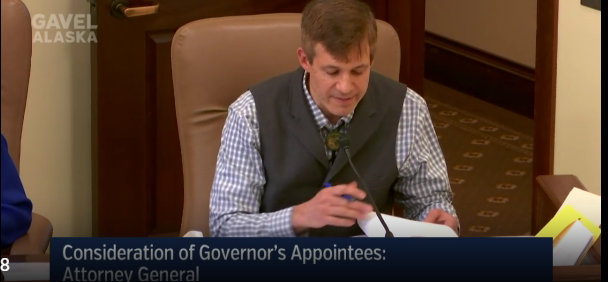
On Thursday, April 30, Attorney General Stephen Cox appeared before the Senate State Affairs Committee for questions before confirmation by the Legislature. AG Cox was appointed by Governor Dunleavy to fill the vacant role left by Candidate for Governor Treg Taylor. Alaska law requires the Legislature to either confirm or decline the Governor’s appointments by a majority vote before the end of the regular session (AK Stat § 39.05.080). The Legislature is scheduled to vote on Stephen Cox’s confirmation this Thursday, May 7, 2026.
Senate State Affairs includes Senators Scott Kawasaki (D-Fairbanks), Bill Wielechowski (D-Anchorage), Jesse Bjorkman (R-Nikisiki), and Elvi Gray-Jackson (D-Anchorage), and Cathy Tilton (R-Wasilla).
Election Data and Voter Information Controversy
While many important topics and concerns were addressed during the hearing, the senators spent a bulk of the time on a controversy related to the disclosure of confidential election and voter information to the U.S. Department of Justice. Senators Kawasaki and Wielechoswki drove the conversation.
Senator Kawasaki questioned Cox about the decision he made to comply with a request by the Department of Justice for state election and voter data. In August 2025, the Department of Justice requested election material and voter data information from all the states. At first, Alaska gave DOJ only the publicly available information. DOJ responded that this was insufficient and threatened to sue. Alaska provided the requested information in December 2025, which was after Cox assumed his position as Attorney General.
Cox responded that he allowed the information to be given to the federal government based on two lines of reasoning: 1) existing state statute allows for a lawful disclosure of confidential information and 2) the State has a precedent of cooperation with federal agencies.
Senator Kawasaki incorrectly claimed that only two states, Alaska and Texas, complied with the DOJ’s request. 13 states complied, but Alaska and Texas were the only states who provided the information and signed a “Confidential Memorandum of Understanding,” detailing the DOJ’s request and purposes for the request.
Readers can review the Memorandum here:
Senator Wielechowski stated that the Lieutenant Governor’s Office was “advised by the attorney general’s office to not provide that information. When you became Attorney General, that advice changed. Did you change that opinion, or did you did you advise them after they were previously advised? And after our legislative attorneys advised that this was illegal and that they shouldn’t provide that information, did you change the opinion?”
Cox replied: “Through the chair, Senator, I don’t know if that’s exactly how the law department advised the lieutenant governor before I was attorney general. I do think the law department advised the lieutenant governor: ‘Let’s try to provide just the public information.’ I do not think the law department ever advised the lieutenant governor that it was illegal to provide that information. And I do believe that the law department would back me up; that there is a statute that authorizes that disclosure. That is the position of the law department.”
Senator Kawasaki then asked Cox if he would make the same decision now knowing that 30 some states went to Court and the Courts are ruling in their favor. Kawasaki incorrectly stated that the Courts said it is “a violation of law” for states to give the DOJ the confidential information.
Cox replied: “No court has said that it was a violation of the law for the state to provide that information. What the courts have said, in litigation, is that the federal government does not have the authority under the statutes that they have cited in their lawsuits to compel the states to cooperate.” Cox stated that he would make the same decision again.
Senator Kawasaki mentioned the Alaska State Constitution’s right to privacy clause, which Kawasaki indicates should have caused Cox to pause before complying with the DOJ’s request.
Cox answered, “I concede, I am learning about the right to privacy… But I will also say that the right to privacy under the Alaska Constitution calls for the legislature to implement the right to privacy. There is a statute on the books, and there has been no challenge to that statute under the right to privacy, and the law department’s position is that that statute is a valid statute.” The statute Cox refers to is AK Stat § 15.07.195, which allows the disclosure of confidential voter information to federal government agencies to be used for lawful purposes.
Senator Wielechowski declared he “wants to point out the revisionist history that is going on here.” Wielechowski then shared the same timeline as covered previously in the session: DOJ sends request, Alaska initially refused, DOJ threatens litigation, Cox becomes AG, Alaska complies with DOJ request. There is no record of anyone presenting a different timeline during the session.
Later in the session, Senator Jesse Bjorkman circled back to the election and voter data disclosure, stating the matter hangs on the phrase “for lawful purposes” in State statute. Cox agrees that this is the pertinent phrase, and says the lawful purposes are described in the Memorandum of Understanding, signed by the State of Alaska and the Department of Justice.
Complete Hearing
Readers can listen to the full hearing here: