
By Michael Tavoliero
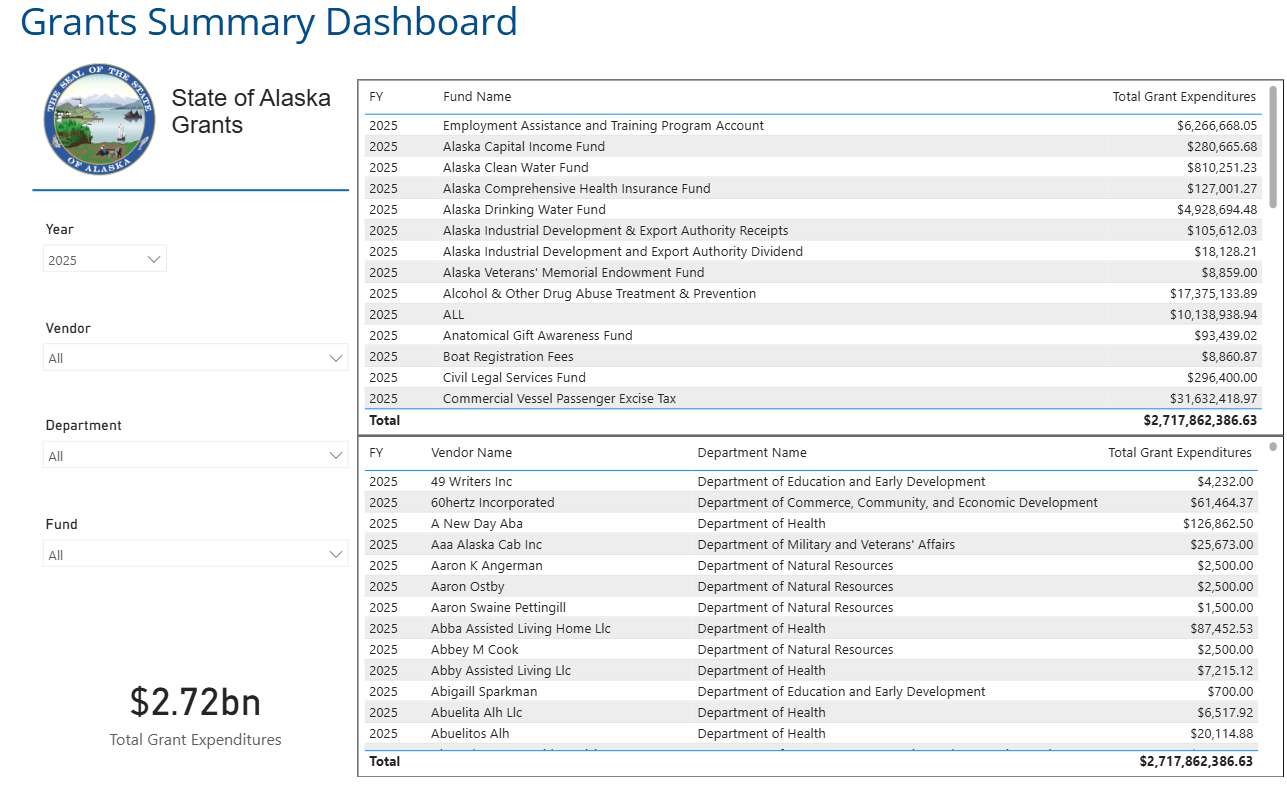
Every state has mechanisms for collecting, allocating, and redistributing public money. In Alaska, the State’s Grants Summary Dashboard offers a partial view of that process, showing how funds move from government agencies to nonprofits, quasi-public entities, contractors, and other grant-funded recipients.
The dashboard reveals more than grants; it reveals a governing structure. Public funds flow through agencies, programs, boards, commissions, legislative priorities, federal pass-throughs, and favored policy channels, creating a public-private funding network dependent on continued government support.
In population terms, Alaska’s 2025 grant system is equivalent to California operating a $145 billion grant network, Texas operating a $117 billion network, or Florida operating an $87 billion network.
In Alaska, that dependence has become political. Recurring public funds align nongovernmental organizations with the agencies, officials, and policy structures that sustain them, while their methods may perpetuate the problems they claim to solve. In turn, they reinforce the existing order by supporting the policies, narratives, and institutional priorities that keep the money flowing.
The result may not always be direct fraud, waste, or abuse, but it can become institutionalized self-protection: a closed loop where government funds outside actors, those actors validate government priorities, and their networks later shape elections, policy debates, donor activity, testimony, endorsements, or ballot campaigns that protect the same officials and programs that fund them. Over time, public dollars can sustain the very organizations that help preserve the governing class distributing those dollars.
In Alaska, this matters because the state is unusually dependent on public revenue, federal transfers, resource income, and administrative discretion. When grants fund social services, advocacy networks, consultants, education, housing, public health, tribal partnerships, nonprofits, or community development, the public should expect clear answers: who received the money, what was delivered, who benefited, what outcomes were achieved, and whether the spending produced measurable public value.
A serious review of Alaska’s grant system should therefore ask several basic questions:
Who received the money?
What agency awarded it?
Was the grant state-funded, federally funded, or a federal pass-through?
Was the award competitive or discretionary?
What statutory authority supported it?
What measurable public purpose did it serve?
What outcomes were promised?
Were those outcomes independently verified?
Did the recipient engage in lobbying, advocacy, ballot activity, litigation, or political messaging?
Did the grant strengthen public services, or did it strengthen a permanent political funding network?
The issue is not whether every grant is improper. The issue is that the current grant environment is increasingly revealing high levels of impropriety, self-serving objectives, weak oversight, political favoritism, and institutional behavior that appears designed less to solve public problems than to preserve funding streams, protect favored networks, and expand bureaucratic influence.
Has Alaska allowed public money to create a self-protecting ecosystem of funded intermediaries whose continued existence depends more on political alignment than measurable results? Do these political alignments perpetuate the same governing class, bureaucratic structures, and failed service-delivery models that continue to consume public resources without producing proportional public benefit?
Transparency must mean more than showing where the money went. In 2025, Alaska’s $2.72 billion in grants represented a substantial share of state fiscal activity; 17.4% of all state revenue, 22.3% of the FY2025 operating budget, and 43.2% of projected unrestricted general fund revenue. A dashboard may disclose recipients, but accountability requires proving public value.
Should Alaska require grant-by-grant review of purpose, performance, duplication, overhead, political activity, and measurable outcomes so public funds serve citizens and not a permanent intermediary class dependent on the existing power structure?
In a healthy republic, public money should serve authorized public purposes, not manufacture consent, reward alignment, or shield agencies from reform. Alaska’s grant data is only the starting point; citizens deserve a full accounting of whether those funds produced measurable results or merely sustained the machinery of political control.
That accounting should begin with one principle: public money belongs to the people. Alaska from 2019 through 2025 averaged over $2.60 billion in grants for a total of $18.2 billion. Every grant dollar must be traceable from appropriation to award, expenditure, and measurable result. If a grant cannot be tied to a lawful purpose, defined service, measurable outcome, and transparent public benefit, citizens have the right to question why it exists.
Alaska should treat its grant system as a matter of fiscal sovereignty. The state cannot justify reduced Permanent Fund Dividends, higher local taxes, rising fees, or declining services while billions move through fragmented grant networks with limited accountability. True fiscal discipline requires examining the hidden architecture that converts public money into institutional power.
This review should cover every major grant-like funding stream: state grants, federal pass-throughs, legislative grants, sole-source awards, recurring nonprofit funding, public corporation transfers, university-administered grants, tribal and municipal subgrants, and contracts that operate like grants. It should also identify duplicate funding, excessive administrative overhead, overlapping purposes, and whether publicly funded organizations use their taxpayer-supported capacity to influence policy in ways that protect their own funding.
A proper reform agenda would not abolish legitimate grants; it would separate public service from political dependency. Essential functions should be protected. But grants that sustain advocacy networks, duplicate services, produce vague results, expand administration, or recycle public money into political influence should face immediate review, reduction, or termination.
The standard should be straightforward: if a grant serves the public, it should withstand public scrutiny. If it cannot withstand scrutiny, it should not be funded.



