Saturday was a slow day for early and absentee voting, with only 609 new absentees returned, and 1,098 people voting early.
A sampling of high-voting districts:
District 3 North Juneau-Haines-Skagway: 1,290 early and absentee votes in so far.
District 4 Downtown Juneau: 1,111 early and absentee ballots in.
District 6 Seldovia-Homer-Kasilof: 1,354 early and absentee votes cast.
District 9 South Anchorage (old 28): 1,524 ballots received so far. D-9 is typically the highest turnout in the state. While the lines may have changed, the record is intact.
51,876 absentee ballots have been requested, possibly the highest number ever other than 2020 (Covid year, which was an outlier). The deadline for requesting an absentee ballot was Oct. 29.
Historically, voters may want to reflect on Murkowski’s actions and not the words of her current or earlier campaign rhetoric. Let’s review her history of what she said, and then what she did, leading up to her vote to not repeal Obamacare, the Affordable Care Act.
During the 2010 U.S. Senate race, Sen. Lisa Murkowski declared publicly to Republican voters that she would support the winner of the Republican Primary. After she was defeated in the primary, she instead maliciously attacked the winner of the Republican primary through an unprecedented write-in campaign.
Up until the 2022 elections, this campaign supported by some Alaska Republican Party leadership was one of the most distasteful and egregious campaigns in Alaska history.
ARP leadership’s decision to support Murkowski has led to the deterioration of the Alaska primary election process. It also is having dire consequences for Alaska, for the nation, and for the Alaska Republican Party, especially with the Murkowski-supported Ballot Measure 2.
Ranked choice voting (Ballot Measure 2), supported by Murkowski, was a blatant deception to fool Alaska voters into thinking their vote was limiting or stopping the flow of outside “dark money” and its influences upon Alaska.
Instead, it opened the door to “dark money” influence and eliminated the previous primary voting system in Alaska.
With the election of Donald J. Trump as President, Alaskans and America saw the door open for the limiting of federal control over America’s health care system, America’s banking and mortgage system, and a change in America’s judicial system. Alaska saw a potential advent of development and pro-growth policies never before seen since the pipeline era.
Regarding America’s health care system, the Affordable Care Act has proven to be a financial and administrative train wreck to Alaska and the nation, increasing health care costs, reducing health care quality, and expanding the federal bureaucracy’s power and control over one of the largest sectors of the US economy.
With the Trump presidency, for the first time since March 23, 2010 (the date Obamacare was signed into law), we all saw the potential for reducing health care costs and returning decision making back to the states and their political subdivisions.
In Murkowski’s Sept. 30, 2014, op-ed, she states, “The key reason I opposed the health care law when it was proposed and jammed through Congress? Not politics; just simple math. The basic economics of being a high-cost rural state with limited providers has resulted in the costly outcomes we are seeing today.”
She went on to cite, in Alaska, Premera Blue Cross insurance rates will increase between 35 and 40 percent and MODA’s rates would increase 22 to 28.8%. With this she reminded her readers that the Alaska Division of Insurance “also announced that even with these cost increases, the health insurers were still going to be losing millions of dollars.”.
In her Dec. 3, 2015 press release, titled, “Murkowski on Senate Floor: “For Whom is the Affordable Care Act Affordable?”, subtitled, “Senator Details Harmful Effects of ACA on Alaskans, Announces Support for Repeal Bill”, Murkowski stated: “Senator Murkowski has long been an opponent of the Affordable Care Act, recognizing from day one that the one-size-fits-all bill would never work in a rural, sparsely populated state such as Alaska.”
Murkowski ran in her 2016 election and received support from the Republican Party and from Republican voters in her 2016 election by campaigning to repeal Obamacare.
It is noteworthy to ask that of the reported 70 attempts Congress voted to repeal Obamacare, how many times had Murkowski surreptitiously voted to repeal it with the clear knowledge that Obama would veto any bill repealing any part of Obamacare sent to his desk?
At the 2016 Alaska U.S. Senate debate, Murkowski stated, “I voted against Obamacare, largely because it puts government in control of choosing what care is covered. Access, as we know it, is a critical issue here in this state. The ACA (Affordable Care Act, Obamacare), quite honestly, is collapsing because of federal mandate and lack of flexibility. What states need is more flexibility, more choice, not less.”
In 2017, when the vote to repeal Obamacare did finally come before the Republican-controlled Congress and knowing that Trump would sign the repeal the moment it hit his desk, Murkowski betrayed the voters who elected her, the Republicans who supported her election, and the Alaska Republican Party by siding with Democrats against her Republican colleagues and against the principles of the Alaska Republican Party, by voting with the Democrats against the Senate vote to repeal Obamacare.
Her single vote doomed any chance of repealing Obamacare.
Murkowski’s July 28, 2017, press release stated, “I voted no on the healthcare proposal last night because both sides must do better on process and substance. The Affordable Care Act remains a flawed law that I am committed to reforming with a structure that works better for all Americans. But to do that, the Senate must fully devote itself to an effort to improve the healthcare system in this country, reduce costs, increase access, and deliver the quality of care that our families want and deserve.”
Thus because of Alaska’s senior Senator’s single vote, Murkowski kept Alaska and American under the tyranny of federally controlled centralized health care, the capricious costs of which are inestimable to financial and health care solvency.
Murkowski is a fair-weather politician who changes her tune the moment the political winds change. It is time to fire her. On November 8, 2022, reject Lisa Murkowski.
Michael Tavoliero is a realtor in Eagle River, is active in the Alaska Republican Party and chaired Eaglexit.
The Must Read Alaska comment section is a gritty, entertaining, and wild-west forum for discussing issues of the day, and it is growing in popularity. You don’t have to be a Jack-London-level writer to comment here at Must Read Alaska. But there are a few things that can help everyone have a great reading experience.
Recently, the story about the attack on Paul Pelosi at his home in San Francisco has had 165 reader comments approved in just four days (as of this writing), with about five sent to the trash for the sin of being tedious or trashy. There are a few more waiting to be posted on that story, so I expect the conversation about the Paul Pelosi hammer attack will continue for days to come.
It’s terrific to see so many new visitors in the comment section of stories in recent months. Over 95% of comments are accepted for posting. Every comment is skimmed by a human — me — and most get the OK for posting, typos and all, because “skimmed” is the operative word. Sometimes they get skimmed after a long, long day, and I accidentally let a truly offensive comment go through. I apologize for that. A few comments go in the trash when they are not contributing to a healthy dialogue, or when they are too clumsy with their thumbs, thus having too many glaring errors. In the history of Must Read Alaska, 855 comments went to the trash, and nearly 200,000 have been approved.
What I’d like to see: I’d like to see the name-calling kept to a low roar or not at all. Also, when you spell a political leader’s or candidate’s name, please refrain from spelling it “Dumbleavy” or “Sleeza” or “Peltolosi.” Please spell people’s names with proper spelling, regardless of how much you don’t like them. Same goes for when you are responding to other commenters in the comment section — don’t butcher their handles on purpose to demean them. It’s the little things that make a difference in my workload and sometimes when I see those intentional misspellings, I just put that comment in the trash.
Also, it helps the forum become more enjoyable — and makes my life a lot easier — when people give their sentences one last read before sending in. I have no copy editor here at Must Read Alaska, and plenty of typos of my own to chase down. There are not nearly enough hours in the day to fix punctuation and spelling of 500-600 comments that arrive daily.
I ask for your patience. With all the great feedback from readers, I get to them as quickly as I can. Sometimes as much as five hours will go by without me being able to get to the comment “pending” bucket and get it cleared. Those five hours will be when I take time for family or am writing stories … or am stuck on a plane that doesn’t have working wi-fi.
Approval of comments is an imperfect and subjective process, but mostly it’s just a very fast process once I get to the task, which is several times a day.
Must Read Alaska got its start because the Anchorage Daily News was not publishing the comments from conservatives. Thus, this has become the home of conservative commentary, which comes in all varieties.
Mostly, I just want to say thank you to everyone who posts their comments at Must Read Alaska. I really do love hearing from readers, even the critics who fly under those clever secret identities. Keep the comments civil, and keep them coming. Thank you to all readers of Must Read Alaska.
A Bremerton, Washington high school football coach who lost his job in 2015 for praying on the field, will be reinstated in his same position no later than March 15, 2023, according to a Western District of Washington judge.
In June the U.S. Supreme Court ruled in a 6-3 vote in Joseph Kennedy’s favor, saying his public prayer was protected by the U.S. Constitution. Kennedy has a habit of kneeling and praying at the 50-yard line after games, and often some of his players join him on the field.
“But it’s not just a victory for one coach. The Court struck down a bad precedent, Lemon v. Kurtzman, and set a new one. For five decades, Lemon was a thorn in the side of religious freedom. The legal test it established caused many school officials to suppress any religious observances, leading them to violate the rights of teachers and students,” wrote the First Liberty Institute, which took on the case.
“Because of the Kennedy victory, that’s no longer the case. The Court makes clear that government cannot censor private expression simply because it is religious. This will have a nationwide impact on public-school teachers, employees and coaches, who can now freely live out their faith in public,” the legal nonprofit group wrote.
The details are not final, but Judge Robert S. Lasnik announced Kennedy must be reinstated to his previous position as assistant coach of the Bremerton High School football team. The proposals for the wording of the final order for the case are due by Nov. 8.
“Bremerton School District shall not interfere with or prohibit Kennedy from offering a prayer consistent with the U.S. Supreme Court’s opinion,” the attorneys wrote in the filing.
First Liberty Institute has also been awarded legal fees to be paid by the Bremerton School District.
This summer, some Alaskans may have met Kennedy, as he came Alaska with Franklin Graham and former Vice President Mike Pence to greet and pray with veterans at Samaritan’s Lodge on Lake Clark, where Samaritan’s Purse has a retreat program for military veterans and their spouses.
The State of Alaska filed a petition last week asking the U.S. Supreme Court to review a Ninth Circuit Court decision that upheld a Department of Interior action that oversteps state laws that pertain to the method and means of hunting on federal refuges.
“The Ninth Circuit brushed over the cooperative nature of ANILCA (Alaska National Interest Lands Conservation Act) and invited the federal management agencies to preempt state law at their will,” the brief states, in reference to the case of In Safari Club International v. Haaland.
Beginning in 2015, the U.S. Department of Interior issued three regulations preventing brown bear baiting, overriding state-authorized hunting on park preserves and national wildlife refuges.
The State of Alaska and Safari Club International sued. After the lawsuit was filed, Congress invalidated the broadest regulation—the one banning brown bear baiting, among other methods of hunting, statewide in all national wildlife refuges in Alaska.
Contrary to Congress’s action, the Department of Interior continues to ban this method of hunting in the Kenai National Wildlife Refuge.
The lawsuit is about Alaska’s traditional authority, which was granted at statehood, to manage the methods and means of hunting throughout Alaska.
The petition asserts that, through ANILCA, “Congress did not divest Alaska of its traditional authority. Congress preserved it.” The Ninth Circuit ruling undermines ANILCA, and gives authority to federal agencies to override state law and ignore the will of Alaskans.
“Congress did not intend for federal agencies to have unlimited authority over how we access our wildlife,” said Gov. Mike Dunleavy. “We will continue to fight to ensure that Alaskans manage how we use our own resources.”
“Soon after statehood, Alaska implemented a comprehensive management program to ensure we could responsibly manage our resources based on sustained yield principles in a manner that incorporates public interests. Today, the federal government is trying to circumvent our hard-fought statehood rights to manage our resources and replace it with theirs, including a new claim that they have a property right to our fish and game resources. This is federal overreach, unchecked by the Ninth Circuit Court,” said Alaska Department of Fish and Game Commissioner Doug Vincent-Lang.
“We have State biologists managing wildlife populations at all times,” said Alaska Attorney General Treg Taylor. “We manage our wildlife resources responsibly to guarantee future Alaskans can enjoy harvests as well. These Federal regulations wrongfully obstruct Alaska’s right to do so.”
Sarah Palin, running for Congress against three others on Nov. 8, told Steve Bannon on the War Room podcast that she wasn’t working with her campaign consultants, that they’d given her “crappy advice,” and that she is managing her own campaign now. She is not raising money, she said, but instead going into the general election on the strength of her reputation.
Fundraising mills have cost Palin’s campaign tens of thousands of dollars. Conservative Connector charges her for lists of possible donors; those lists are used to send out email and text message fundraising notes.
Campaign insiders say that Palin’s campaign manager and longtime ally Kris Perry has pulled away from the campaign. Jerry Ward, who is a volunteer and not paid campaign staff, is still with her and shows up alongside her at events, which are few and far between. In Alaska, Palin is using Optima Public Relations, and it’s unclear what she meant by getting “crappy advice” from them or if the company is still with Palin; her campaign’s last disbursement to Optima, for $9,144, was on Oct. 19. After debts are paid, Palin had just $75,000 in cash on hand as of Oct. 19.
“Ya gotta wonder if they’re really in it for the right reasons ’cause sometimes they give really crappy advice and effort,” she told Bannon, commenting on her hired campaign consultants. “So, I’m doing a lot of this myself. I’m not going to ask people for donations, though, which ticks off those in my campaign, you know, and other campaigns, because they look at this as a business and they get a cut of funds raised.”
It’s not the kind of thing a candidate who is in a winning stance would typically say. The admission that she was doing her campaign on her own now was surprising, but the cost of hiring campaign consultants has been expensive, siphoning off much of the money that Palin has raised.
Her total receipts for her campaign have been $1.7 million as of Oct. 19, but her campaign costs have consumed almost all of it before the final few days, when funds would be most needed. At least half of the funds Palin has raised appear to have gone to the fundraising mill that she contracted with, leaving her with little to work with.
Palin is running against Mary Peltola, the Democrat, Nick Begich, the Republican, and Chris Bye, the Libertarian. Pelota is the current incumbent, having won the seat to fill out the remainder of the late Congressman Don Young’s term.
In a call with supporters in Ketchikan, Republican Senate candidate Kelly Tshibaka also noted that Palin had pulled back from her campaign, wasn’t spending much time in state, and didn’t seem to be putting in the effort.
On the Bannon podcast, Palin blamed the Republican establishment in the state, and complained she was not invited to a get-out-the-vote rally at Anchorage Baptist Temple. She also blamed Mitch McConnell, Senate Minority Leader for pouring money into Sen. Lisa Murkowski’s race and remarked that Murkowski is supporting the Democrat in the race, Mary Peltola.
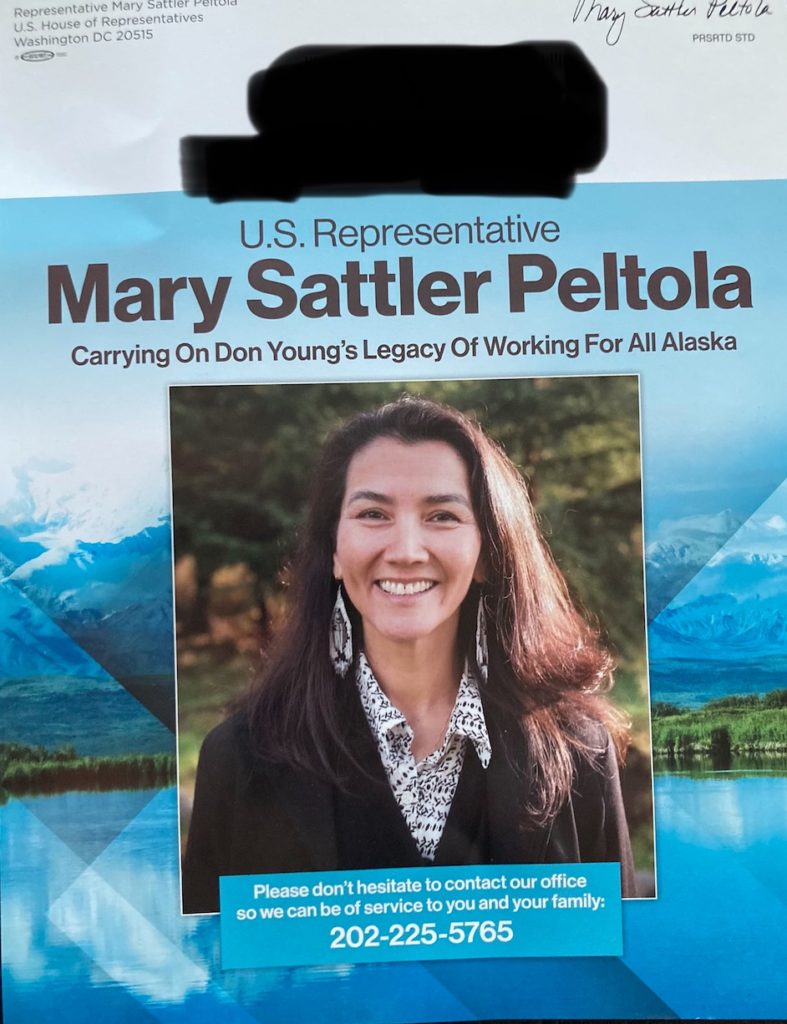
Congresswoman Mary Peltola, with a D rating from the NRA and increasing criticism from Alaska gun owners, has edited her views on the Second Amendment of the Constitution.
Before this week, she said the Second Amendment, Americans’ right to own firearms, was intended for hunting. She said there needs to be stricter gun laws. She advocated for guns to be locked in safes at home.
In her latest ad, Peltola says the Second Amendment is “To defend ourselves and our food from wild animals.”
Alaskans own more guns than just about any population on the planet. Former Congressman Don Young was on the board of the NRA.
But now, Alaska’s only representative in Congress believes the constitutional protections for gun owners were designed for subsistence hunters like her family. Not for self defense, and not as the nation’s founders had intended — to protect the new federation of United States against outside enemies and invasion.
Peltola also says she will “stand up for the Second Amendment — whether it’s hunting, self-defense, or recreation — because Alaska just wouldn’t be Alaska without guns.” That’s a new spin for her, as she has seen the resistance growing to her anti-freedom stances.
Peltola pivoted in just a few short weeks from her earlier statements about guns being for hunters, and is painting over her record of pushing gun control legislation. In a public forum earlier this year, Peltola said that 18 year olds should not be able to purchase guns, and she supports universal registration.
In June, she was on the record with Alaska Public Media saying she supports “common sense gun legislation” that would be brought forward by a bipartisan committee. President Joe Biden is eager for such legislation and uses the exact wording “common sense legislation.” His federal approach includes forcing all gun owners to own gun safesand to keep guns locked away.
On Twitter in May, Peltola wrote: “We cannot continue doing things the way they’ve always been done. It’s killing us.”
Peltola is a Democrat running against Republican Nick Begich and Sarah Palin, as well as Libertarian Chris Bye. She won the temporary seat for Congress in August, after Republican voters refused to rank other Republicans on the ballot, thus handing the victory to Peltola.
Alaska is a conservative-leaning state, where President Donald Trump won by 53 percent in 2020. But Democrats are pouring tens of millions of dollars into the effort to convince Alaskans to vote for Peltola, in spite of her anti-constitution view.
U.S. Health and Human Services’ transgender policies toward children are under scrutiny, the latest federal agency to face Congressional questions over how taxpayer dollars may be pushing the issue and even funding surgeries.
U.S. Rep. Nancy Mace, R-S.C., ranking member on the Subcommittee on Civil Rights & Civil Liberties, sent a letter to Health and Human Services Secretary Xavier Becerra raising concerns about the agency’s work to “promote life altering changes to young children.”
“I write to conduct oversight of the federal government’s use of taxpayer funds to promote radical gender ideology and the medical transition of children using pharmaceutical or surgical interventions,” the letter said. “The Biden Administration appears to be encouraging any child, who does not conform to perceptions of masculine or feminine stereotypes, to alter his or her body through potentially irreversible medical or surgical intervention. Instead of funding these life-altering drugs and procedures, our government should be promoting policies to protect vulnerable children – who cannot consent.”
HHS is the latest but not the only federal agency to come under scrutiny for its transgender policies toward children. As The Center Square previously reported, The U.S. State Department’s Diversity, Equity, Inclusion, and Accessibility (DEIA) Strategic Plan also came under Congressional scrutiny for including taxpayer-funded “gender transition care” for employees as well as their children.
Mace said that other western nations have raised concerns about the transgender drugs and surgeries, but that the Biden administration has gone all in.
The letter explicitly requests information to what extent taxpayer dollars are being used to fund these drugs and surgeries.
“HHS, under the guise of ‘gender affirming care,’ now promotes medical interventions such as drugs designed to block puberty, opposite-sex hormones to transition children – both of which do not have FDA approval for use in children’s gender care – and even surgical interventions to remove or alter the gender specific anatomy,” the letter said. “HHS also falsely promotes some of these interventions as ‘reversible’ or ‘partially reversible’ despite potential, serious long-term physical and mental health risks, complications, and regret. The American medical institutions simply do not have enough data to understand outcomes. Children who suffer from mental health conditions are least likely to engage in sound decision making which is where parental control should intervene.
“It is imperative that the American people understand HHS’s role and the use of federal taxpayer money to promote a radical gender ideology that is harming children in our country,” the letter adds.
Casey Harper is a Senior Reporter for the Washington, D.C. Bureau. He previously worked for The Daily Caller, The Hill, and Sinclair Broadcast Group. A graduate of Hillsdale College, Casey’s work has also appeared in Fox News, Fox Business, and USA Today.
Alaskans have been asking for justice from our judicial system for a long time. Too many Alaskans see the law applied to protect those with money and power but not those without.
The simple truth is that Alaskans need a greater say in selecting judges to break the cycle of injustice in our communities. Improving our judiciary can only happen with a constitutional amendment that reforms Article 4, Section 8 of our State Constitution that empowers four Alaskans on the Judicial Council to choose a list of lawyers the governor must choose a judicial appointment from.
The issue of justice reform unites Alaskans from rural villages and urban centers alike. It also energizes out-of-state interests determined to protect the status quo, which is why there is so much dark money being spent on a “no” vote on a constitutional convention this year.
Alaskans have the authority to demand a constitutional amendment, but Alaskans only have the power to secure one through a constitutional convention.
Here’s why: A constitutional amendment is passed with a simple majority vote during a constitutional convention. The Legislature can also pass constitutional amendments but requires a two-thirds majority vote to do so. This super-majority vote is an impossible hurdle to overcome given the historic makeup of our legislature.
The drafters of our state constitution foresaw times like this when they included the provision for the people to decide once a decade whether to call a constitutional convention or not. The purpose of the convention is to bypass a dysfunctional legislature and enable Alaskans to create their own constitutional amendments.
For decades justice in our villages has been elusive for too many Native Alaskans. For decades Alaska businesses have been asking for an effective spending limit. For decades Alaskans have been asking for the Legislature to be relocated from Juneau, including a successful ballot initiative. For decades the Permanent Fund dividend program worked for Alaskans, but now it has been ruled unconstitutional by the judiciary and ignored by the Legislature. For decades our government has ignored Alaskans’ pleas for action and these important issues have continually been allowed to divide us.
If Alaskans want to stop being divided, ordinary Alaskans need to say “yes” to a constitutional convention and start working together to solve our problems.
A false choice is presented between no constitutional convention and instead, successfully solving our problems under the status quo. History proves that our government will not act to correct itself. The question isn’t can things get worse with a constitutional convention. Things have been worse for too long! The question is can things get better without a constitutional convention? Do you trust your government to correct itself?
The necessity of a constitutional convention is a matter of how serious we are about the rule of law. If we want justice, Alaskans must have the courage to exercise the constitutional authority the state’s framers included in our state constitution by voting “yes” for a Constitutional Convention.
If justice can’t be secured in a constitutional convention, we can’t preserve it in the Legislature.
The question isn’t “Will it get worse?” The question is “Will it get any better if we don’t?”
Ben Carpenter is a state representative for Seward, Moose Pass, Cooper Landing, Sterling, Funny River, Salamatof and Nikiski.