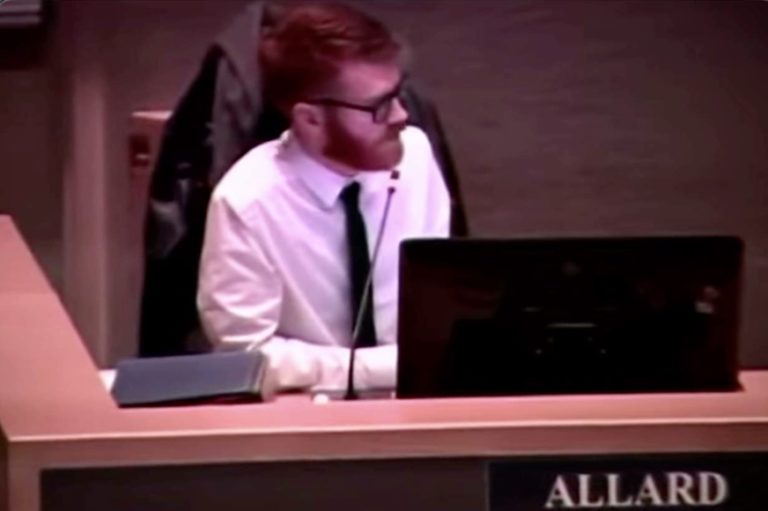
It was a moment of rare unanimity on the Anchorage Assembly: By a 12-0 vote, the Assembly repealed minimum parking mandates, meaning that new construction in much of Anchorage will not have to provide a specific number of parking places.
The ordinance was sponsored by conservative Kevin Cross, and liberals Daniel Volland and Forrest Dunbar.
The trend is being repeated across the country, as a way to encourage businesses to build, and reduce the large parking lots needed under the old requirements. Even Mayor Dave Bronson approved of the move. The ope is that reducing required parking lots spaces will be an economic stimulus and improve the quality of life.
“There is broad consensus … found around the issue of wanting to support housing in Anchorage to address the housing shortage,” Volland said in the work session before last week’s vote. “I think that we have an Assembly committed to doing that.”
“This is going to be a gradual process as people take advantage of it,” Assemblyman Cross said. More people will be encouraged to revitalize older buildings without being penalized by having to provide a specific — and often excessive — amount of parking.
In much of Anchorage, there is a parking glut, a result of outdated ordinances requiring what appears to be unnecessary parking spaces for new construction. It’s true in multi-family and commercial properties, with one in four city-mandated parking spaces sitting empty, even at peak periods.
The Foundation for Economic Education notes that the trend to eliminate parking requirements is happening all over the country, including San Francisco; Lexington, Ken.; and St. Paul, Minn., which have made parking reforms like Anchorage just did. Sand Point, Idaho, a much smaller community, has also eliminated the requirements for a minimum number of parking places back in 2009.
“Parking minimums are a type of urban regulation that require developers to provide a predetermined number of parking spaces for a certain number of residential units or a given developed square footage. These mandates centralize decision making and impose uniformity, rather than leaving parking decisions to developers or property owners who are likely to understand the needs of residents and appreciate how these needs vary across geography and over time,” the foundation explains in this story.
“As such, parking mandates are a great example of an urban regulation that reduces efficiency and unnecessarily increases costs. Parking mandates also compel vehicle‐centric transit in what is—or would otherwise be—urban areas. Because land is expensive, especially in urban and development constrained areas, the costs of parking mandates can be substantial,” the story explains.
“For instance, one paper found that the construction cost of a parking space ranged from $17,000 (aboveground, in Phoenix) to $48,000 (underground, in Honolulu). But even these estimates underestimate the true cost of a parking space by ignoring the cost of land for above ground parking as well as the opportunity cost related to foregone, higher utility development, both above and below ground: in places where parking is required, office, retail, or residential space could be developed instead. For example, in suburban Seattle, parking minimums were estimated to reduce the number of residences in buildings by 13 percent,” FEE reports.
But for Anchorage, the passage of what appears to be very a Libertarian ordinance by a unanimous vote by a legislative boy that leans big-government is a notable achievement in itself.
Readers have been led to believe the Anchorage School District was preparing to close schools due to major budget shortfalls. Instead, two out of the six of the proposed schools are being “repurposed” by the Anchorage School District as pre-kindergarten academies, even though it has no data to prove the effectiveness of such programs.
When questioned about the “proof of concept” on how these pre-k academies will operate, the administration stated it will just develop the concept once it has the program in place.
Most programs have an approved proof of concept prior to being implemented. However, the administration doesn’t seem to think it needs one.
At the Nov. 15 work session, school board member Kelly Lessens asked the vital questions regarding the success of the current pre-k program. She wants data that show the effectiveness of the current program.
“If we want more preschool funding, I am interested in finding a proof of concept. Are our investments positively impacting our students?” Lessens asked.
Only board member Dave Donley showed an interest by seconding the request for information. Other board members remained quiet.
Superintendent Jharrett Bryantt responded to Lessens’ question by stating, “Are you seeking data on ASD pre-k programs?”
Lessens answered yes,
“I would anticipate that it would be slightly difficult to produce, and it would be difficult to discern a causal relationship for a number of reasons,” Bryantt said.
Bryantt noted the district has no data on its pre-k program. He did not explain why it would be “slightly difficult to produce.”
Bryantt also did not explain his reasoning as to why it “would be difficult to discern a causal relationship for a number of reasons.”
Bryantt did offer to provide national research on the effectiveness of pre-k programs. However, member Lessens was more interested specifically in the effectiveness of the ASD pre-k program.
She responded that national data are fine, but she wanted to know what philosophy is dictating the Anchorage pre-k programs. There was no response from the district regarding its program philosophy.
Lessens asked if the pre-k program translates into kids who are more ready for kindergarten and asked if they are succeeding in kindergarten. She was interested in the education outcomes and the value added.
Lessens wanted data to show the Alaska Legislature before the session starts, so the district can get more funding. Member Bellamy said it would take a long time to get the pre-k data.
There is national research available that shows pre-k has little to no impact on student achievement.
The Vanderbilt Study, which consisted of 3,000 low-income pre-k students, showed that at the end of kindergarten the kids who had not gone to the program caught up with the kids who had gone through pre-k.
More importantly, at the end of third grade, the kids who did not go to pre-k were doing better on state tests and had fewer suspensions than the pre-k kids.
Alabama has had the highest quality pre-k system for the last 13 years, according to the National Institute for Early Education Research.
Unfortunately, that investment in high quality has not seemed to pay off in NAEP scores. Over the last 13 years Alabama has fallen from 47th to 50th in low-income NAEP 4th grade reading scores. Alaska is the only state that scores lower.
Can the Anchorage School District expect any better than Alabama?
The correct question is: “Will these pre-k 3- and 4-year-old children be able to read better than other children?”
Regardless, the Anchorage School District will go forward with growing its pre-k program. The goal here seems to be grow the program to get more State funding due to the decreased population of children entering schools in Anchorage
The ASD graph below shows that decline:
One can see the quandary the district is in. It wants to maintain its current budget, but the declining birth rate means it will have fewer k-12 students and less funding in the future.
The administration’s solution is to grow unproven pre-k programs and ask the Legislature to fund them. The Legislature needs to have accurate data before it makes a decision.
Member Kelly Lessens should be applauded for her pointed questions. The district needs to respond with data, a proof of concept, and a concept of operations.
Otherwise, it may be saving its funding without helping children to achieve their potential. Any decision should be focused on the children, not the institution.
David Boyle is an education writer for Must Read Alaska.
Several groups argue the Respect for Marriage Act (ROMA) currently before the U.S. Senate is unconstitutional, and if enacted, will eventually be struck down by the U.S. Supreme Court.
The bill, HR 8404, was introduced in the House by U.S. Rep. Jerry Nadler, D-NY, on July 18 and passed by a vote of 267-157 the next day. The U.S. Senate took it up on Nov. 14.
It would provide “statutory authority for same-sex and interracial marriages” and repeal several provisions of the 1996 Defense of Marriage Act (DOMA). The 1996 law received bipartisan support including from then U.S. Sen. Joe Biden and U.S. Rep. Chuck Schumer, D-NY, and from Democratic President Bill Clinton, who signed it.
When a constitutional amendment was proposed to ban same-sex marriage in 2006, Sen. Biden told Meet the Press’ Tim Russert, “I can’t believe the American people can’t see through this. We already have a law, the Defense of Marriage Act … where I voted and others … that marriage is between a man and a woman and states must respect that. … Why do we need a constitutional amendment? Marriage is between a man and a woman.”
Sixteen years later, President Biden now supports replacing DOMA provisions, which “define, for purposes of federal law, marriage as between a man and a woman and spouse as a person of the opposite sex,” with ROMA provisions “that recognize any marriage that is valid under state law,” according to the bill summary.
The summary also notes that the Supreme Court ruled three marriage-related laws as unconstitutional: DOMA (U.S. v. Windsor, 2013) and state laws banning same-sex marriage (Obergefell v. Hodges, 2015) and interracial marriage (Loving v. Virginia 1967).
The bill would also allow “the Department of Justice to bring a civil action and establishes a private right of action for violations,” its summary states.
When filing a cloture motion on a substitute amendment on Nov. 17, now Senate Majority Leader Schumer said the Senate would vote on ROMA when it returned on Monday after Thanksgiving. He said, “Let me be clear,” passing it “is not a matter of if but only when.” He also thanked his colleagues from both sides of the aisle “who led this bill.”
Twelve Republicans voted with Democrats to allow it to move forward, eliminating a filibuster threat: Sens. Roy Blunt, Richard Burr, Shelley Capito, Susan Collins, Cynthia Lummis, Rob Portman, Mitt Romney, Dan Sullivan, Thom Tillis, Joni Ernst, Lisa Murkowski, and Todd Young.
After their vote, Biden said, “Love is love, and Americans should have the right to marry the person they love,” adding their vote made “the United States one step closer to protecting that right in law.”
Schumer also said he had “zero doubt” the bill “will soon be law of the land.”
But multiple groups disagree, arguing it’s unconstitutional for the same reasons the Supreme Court struck down DOMA. Because the court already ruled Congress doesn’t have the constitutional authority to define marriage under Article 1 of the U.S. Constitution, and because ROMA is nearly identical to DOMA, they argue it will also likely be struck down.
In a letter to Congress, the nonprofit religious freedom organization Liberty Counsel argues the court ruled in Windsor, “DOMA, because of its reach and extent, departs from this history and tradition of reliance on state law to define marriage.” It also ruled, “[b]y history and tradition the definition and regulation of marriage . . . has been treated as being within the authority and realm of the separate States.”
Liberty Counsel Founder and Chairman Mat Staver, said, “The Constitution cannot be said to prohibit the exercise of power to define marriage in one manner yet authorize the opposite definition of that same unconstitutional exercise of power. If Windsor noted that Congress lacked authority in this realm, then it necessarily lacks the power here.”
While a bipartisan amendment was introduced claiming to protect religious liberty, Sen. Mike Lee, R-Utah, argues it really doesn’t.
“Religious Americans will be subject to potentially ruinous litigation, while the tax-exempt status of certain charitable organizations, educational institutions, and non-profits will be threatened. My amendment would have shored up these vulnerabilities,” he said.
Heritage Foundation President Kevin Roberts said, “Conservatives are deeply disappointed by the betrayal of Senate Republicans to protect Americans’ religious freedom and won’t soon forget the votes of the 12 Republican senators who cast aside an essential right in a bill that will weaponize the federal government against believers of nearly every major religion.”
Gregory Baylor, senior counsel with Alliance for Defending Freedom, also said the law is “unnecessary and could have a disastrous effect on religious freedom. While proponents of the bill claim that it simply codifies the 2015 Obergefell decision, in reality it is an intentional attack on the religious freedom of millions of Americans with sincerely held beliefs about marriage.”
It also “threatens religious freedom and the institution of marriage” by codifying a “false definition of marriage in the American legal fabric,” ADF argues. It also “opens the door to federal recognition of polygamous relationships, jeopardizes the tax-exempt status of nonprofits that exercise their belief that marriage is the union of one man and one woman, and endangers faith-based social-service organizations by threatening litigation and liability risk if they follow their views on marriage when working with the government.”
Although incoming Alaska Senate President Gary Stevens is a nominal Republican, the Senate committees are dominated by Democrat Party chairs.
In addition to two Democrats co-chairing the Senate Finance Committee, along with one Republican, seven committees will be chaired by Democrats and four committees will be chaired by Republicans. In one of the committees — Natural Resources — it’s a co-chair award to two Republicans, and all that Sen.-elect James Kaufman was able to get was a vice chair of a committee.
The Alaska Democratic Party was thrilled. On social media, they wrote: “We did it! After making gains, Democrats have flipped the Senate from full Republican control to a moderate bipartisan Coalition.”
Alaska Democratic Party reaction to new organization in Alaska Senate. Alaska Republican Party has made no comment.
The prize committee chair assignments are, as of publication:
Finance: Sen. Bert Stedman-R, and Sen. Lyman Hoffman-D and Sen. Donny Olson-D.
Rules: Sen Bill Wielechowski-D
Legislative Council: Sen. Elvi Gray-Jackson-D
Health and Social Services: Sen. David Wilson-R, vice chair Sen.-elect James Kaufman
Judiciary: Sen.-elect Matt Claman-D
Resources: Sens. Click Bishop-R and Sen.-elect Cathy Giessel-R
State Affairs: Sen. Scott Kawasaki-D
Community and Regional Affairs: Sen.-elect Forrest Dunbar-D
Labor and Commerce: Sen.-elect Jesse Bjorkman-R
Transportation: Sen. Bill Wielechowski-D
Education: Sen.-elect Loki Tobin, D
Sen. Bishop will also serve as majority whip.
The Senate majority has 9 Democrats and 8 Republicans, with the eight Republicans turning their back on three Republicans — Sens. Shelley Hughes, Mike Shower, and Robb Myers — and renouncing an 11-member majority in order to form up a majority made up of mostly Democrats.
The richest person in the world — the man who just bought Twitter — says he’ll back Florida Gov. Ron DeSantis for president in 2024, should DeSantis choose to run. Elon Musk, who was once a supporter of President Obama and even voted for Biden, said on Twitter that he can’t support President Biden this time around. He made his remark about supporting DeSantis in a response to a question from a Twitter account.
“As a reminder, I was a significant supporter of the Obama-Biden presidency and (reluctantly) voted for Biden over Trump,” Musk wrote on his Twitter feed Friday. “But freedom of speech is the bedrock of a strong democracy and must take precedence. My preference for the 2024 presidency is someone sensible and centrist. I had hoped that would the case for the Biden administration, but have been disappointed so far.”
Musk added, “But Twitter as a platform must be fair to all.”
Former President Donald Trump announced earlier this month that he will run for president in 2024, to mixed reviews from conservatives.
DeSantis has not yet announced, but his campaign for governor was successful this month, and he goes into his second term with the support of 59.4% of voters, with former Gov. Charlie Crist only getting 40%. The near landslide came after DeSantis has been at the conservative forefront of the culture wars on issues such woke-ism, transgender indoctrination in schools, education, abortion, free markets, and Covid policy.
Alaska Sen. Dan Sullivan, one of 12 senators who voted for moving the “Respect for Marriage Act” to the Senate floor for a final vote, supports two amendments to the act that have been filed by Utah Sen. Mike Lee and Oklahoma Sen. James Lankford. The amendments would strengthen religious liberty protections in the act, which creates a federal designation for same-sex marriage and does not provide strong protections as it repeals the Defense of Marriage Act.
The Respect for Marriage Act states: No person acting under color of State law may deny–‘‘(1) full faith and credit to any public act, record, or judicial proceeding of any other State pertaining to a marriage between 2 individuals, on the basis of the sex, race, ethnicity, or national origin of those individuals; or a right or claim arising from such a marriage on the basis that such marriage would not be recognized under the law of that State on the basis of the sex, race, ethnicity, or national origin of those individuals.”
“Make no mistake, there’s no stopping this bill from final passage,” said Senate Majority Leader, Chuck Schumer, a New York Democrat, earlier this month on the Senate floor.
Color of law may be interpreted to mean that any person, such as judge, legislator, notary public, or minister, who is performing wedding ceremonies, may not withhold their services from same-sex couples, even if by doing so the ceremony would violate the officiant’s religious or moral beliefs. The bill may also be interpreted to mean that the government can strip a business, such as a restaurant, lodge, or wedding venue, photographer, or cake baker, of its business or other licenses if it chooses to not provide services to same-sex weddings.
The law further states, “For the purposes of any Federal law, rule, or regulation in which marital status is a factor, an individual shall be considered married if that individual’s marriage is valid in the State where the marriage was entered into or, in the case of a marriage entered into outside any State, if the marriage is valid in the place where entered into and the marriage could have been entered into in a State.”
This part of the bill strips away states’ rights from the matters of marriage and makes it entirely a federally regulated contract, which would have consequences for family businesses all over America.
Sen. Lee has called on the 12 Republican senators who voted to advance the Respect for Marriage Act to adopt protections for Americans who believe marriage is between one man and one woman.
“The undersigned ask that you oppose cloture [closing or ending debate] on the Respect for Marriage Act unless the Lee amendment is added to the bill,” Lee and 20 other Republican lawmakers, wrote to the 12 Republicans, including both Sullivan and Sen. Lisa Murkowski of Alaska, who voted to move the Democrats’ act forward. “The free exercise of religion is absolutely essential to the health of our Republic. We must have the courage to protect it.”
The proposed Lee amendment would prevent the federal government from discriminating against anyone who holds a religious belief or moral conviction that marriage is a union between one man and one woman, or is a union between two individuals.
Sullivan told religious leaders in Alaska last week that he would support the Lee and Lankforc amendments, and a source said he also told others in Alaska during meetings that he would support the amendments.
In a letter sent to the 12 Republicans who voted for the legislation, Lee wrote that his amendmentwould “ensure that federal bureaucrats do not take discriminatory actions against individuals, organizations, nonprofits, and other entities based on their sincerely held religious beliefs or moral convictions about marriage by prohibiting the denial or revocation of tax exempt status, licenses, contracts, benefits, etc.”
The Lee amendment ensures Americans have the right to their faith and deepest convictions.
The 12 Republican lawmakers who voted for advancing the Respect for Marriage Actare Sens. Sullivan, Roy Blunt of Missouri, Richard Burr of North Carolina, Shelley Capito of West Virginia, Susan Collins of Maine, Cynthia Lummis of Wyoming, Rob Portman of Ohio, Mitt Romney of Utah, Thom Tillis of North Carolina, Joni Ernst of Iowa, Lisa Murkowski of Alaska, and Todd Young of Indiana.
Read more about this development at The Daily Signal, which first reported this story.
The Senate Democrat majority announced its formation today as a result of decisions of eight Republicans who allowed nine Democrats to dominate the majority, rather than forming a majority of 11 Republicans. Some 65% of Alaska voters chose Republicans during the most recent election, but the Senate majority has now been handed to a Democrat majority.
The majority has 17 members, which the presumed Senate President Gary Stevens, a Republican from Kodiak, called “a healthy majority.”
The Majority’s membership includes Senator Click Bishop (R-Fairbanks), Senator-elect Jesse Bjorkman (R-Nikiski), Senator-elect Matt Claman (D-Anchorage), Senator-elect Forrest Dunbar (D-Anchorage), Senator-elect Cathy Giessel (R-Anchorage), Senator Elvi Gray-Jackson (D-Anchorage), Senator Lyman Hoffman (D-Bethel), Senator-elect James Kaufman (R-Anchorage), Senator Scott Kawasaki (D-Fairbanks), Senator Jesse Kiehl(D-Juneau), Senator-elect Kelly Merrick (R-Eagle River), Senator Donny Olson (D-Golovin), Senator Bert Stedman (R-Sitka), Senator Gary Stevens (R-Kodiak), Senator-elect Löki Tobin (D-Anchorage), Senator Bill Wielechowski (D-Anchorage), and Senator David Wilson (R-Wasilla).
Wielechowski will be Senate Rules Chair, Giessel will be Senate Majority Leader, Bishop will be Majority Whip, and Gray-Jackson will be Legislative Council Chair.
All but three people in the Senate are included in the caucus. The three excluded from the caucus are all Republicans — two from the Valley and one from Fairbanks: Sen. Shelley Hughes, Sen. Mike Shower, and Sen. Robb Myers.
There will be and unusual aspect in the Senate Finance Committee this year: Three co-chairs, including Sen. Stedman for operating budget, Sen. Hoffman for the capital budget, and Sen. Olson, who will will handle bills coming through committee.
It appears to be a binding caucus with all members expected to vote in favor of the budget when it comes to the floor, Sen. Stevens said.
There was no commitment on the Permanent Fund dividend, and Stevens indicated there is not agreement on that item. Sen.-elect Cathy Giessel said that education needs more funding than it has now and “all of that has to be weighed out.” This is an indication that the budget will balloon for education at the expense of dividends.
Giessel said that “all members of this caucus are responding to what we heard from Alaskans. We heard door to door and in elections that Alaskans are looking for people in Legislature who will work together to get things done, to get important things done.”
When asked why they favored joining the Democrats for a majority rather than plan offered by the three excluded Republicans, Stevens said it was a recognition of “the reality of the last four years, we have not been able to give several of our senators support on budget. We had to go around them and get the budget passed.”
As for whether the Senate would overturn ranked choice voting, Sen. Stevens said he was “loathe to overturn it,” since it was the will of the people and has “led to more moderation in the Senate.”
Giessel agreed, said that 92% of the people had been instructed on how to use the people, and 60% of the people said they felt that the races were more competitive with ranked choice voting.
Meanwhile, the Senate minority announced its three members: The new Republican Senate Minority consists of the current Senate Majority Leader, Senator Shelley Hughes; the current State Affairs Chair, Senator Mike Shower; and the current Transportation Chair, Senator Robb Myers. It is one of the smallest minorities in Alaska Senate history.
“The new Minority looks forward to and is proud to stand with the overwhelming majority of voters across Alaska who demonstrated on their ballots their desire for the Senate to take a right-of-center pathway,” the three wrote in a press release this afternoon.
The three senators in the new Minority had previously proposed to all of their Republican colleagues a pathway for what would be a functional and successful majority to respect the 65% of Alaskan voters who had voted for Republicans to represent them in the State Senate.
“The proposal included a clear route to passing a responsible budget without draconian cuts along with policy priority options that were positive for Alaska and around which caucus members could coalesce. The inclusion of several Democrats was also part of this proposal,” the press release said.
Sen. Shelley Hughes began discussions over the summer with the now Republican members of the Majority about policy priorities as a unifying bond. In the days following the Nov. 8 election, on behalf of the now Republican Senate Minority, Hughes reached out by phone, text, and email to her Republican colleagues to offer a solution to ensure a Republican majority would meet its constitutional duty to pass a budget. This approach was offered as an ethical alternative to the “binding caucus rule” adopted by the bipartisan coalition.
With a binding caucus rule, before the session begins, members pledge to vote yes on the budget sight unseen; if a member fails to vote for the budget, punishment in the past has included the loss of chairmanships, committee assignments, staff, staff pay, district resources, and office space.
“Unfortunately, in response to the reasonable proposal offered, only one Republican colleague (who is now a member of the Democrat-weighted Majority) contacted Hughes at the last minute to convey they were not interested in the proposal nor willing to come to the table to dialogue,” the press release stated.
“It’s very disconcerting that my fellow Republicans in the Senate were not even willing to have a conversation about joining together for the betterment of Alaska, but more troubling than that is my colleagues defied the voters and have let Alaskans down. When 65% of Alaskans send a majority of Republicans to represent them in the Senate in Juneau, they are voting for a right-of-center Majority. Alaskans are concerned about high inflation, gas, and energy prices; Biden’s anti-resource development policies which are harmful to our state; and leftist policies that hurt families and children. Alaskans’ votes for state Senate clearly indicated Alaskans preferred policies based on conservative principles that will open up new opportunities and promote a strong economy, strong communities, and strong families. Despite being in the Minority, I want my district and Alaskans to know I will aim for these goals in the Senate in my work on Alaskans’ behalf to the best of my ability, as well as in my work with the House and with our governor,” Hughes said.
Following the Senate Majority’s announcement, Senator Robb Myers of Fairbanks and North Pole said, “I had hoped to join a majority focused on fixing our long-standing fiscal problems and moving the state forward. Unfortunately, the new coalition is bound by terms counterproductive to what I ran on and seems to be focused on maintaining the status quo. Nonetheless, I am focused on being as productive as possible for my district and the state under the new arrangement.”
Sen. Mike Shower said, “It’s disappointing a majority of Republicans rejected discussing the formation of a Republican controlled Senate among the 11 of us. We presented a common-sense path forward: 1.) separate the PFD into its own bill to prevent legislators from having to commit political self-destruction voting against it year after year and 2.) agree to some version of a spending cap limit to ensure controlled growth of the operating budget. We made two basic requests to ensure Republican senators were not put in untenable positions on hot button issues in their very diverse districts. Instead, our colleagues appear willing to throw away a clear Republican majority for a Democrat-dominated Senate: 9 Democrats joining 8 Republicans. Their arrangement is hard to justify considering roughly two-thirds of first place votes in the Senate races went to Republicans.”
Shower said he would continue to work with the Republican governor and Republican- dominated House to advance important priorities for Alaska.
“I will continue to do so wherever possible within the Senate with anyone willing to advance smart policy like the bipartisan fiscal working group’s recommendations presented last year. I will work on the repeal of ranked choice voting, continue election and judicial reform efforts, and will never give up on a balanced budget comprehensive fiscal plan Alaska desperately needs. There are many ways to solve problems. I’ll do whatever I can and whatever we must do to move Alaska forward,” he said.
Hughes wrapped up remarks for the group: “We want Alaskans to know that our Minority organization may be small, but we will be mighty. We understand that voters have been betrayed and a very substantial majority of you cast your votes against watered-down principles, left-leaning policies and for a right-of-center majority. We will stand up and fight for Alaskans every chance we get. We will also work to find consensus with the Bipartisan Coalition wherever and whenever we can to advance items that will lead to a better future for Alaska. In the end, we will be true to Alaskans and to our districts.”
The Senate Democrats’ press secretary says the new Senate majority will hold a press availability to announce its organization for the coming legislative season. It’s a signal that a bipartisan majority has formed.
The timing of the news announced by Noah Hanson, the Democrats’ press secretary, is what’s called a “Friday night news dump,” which is when controversial news is released in the hopes that few will notice.
Democrats are controlling the message for the new Senate majority in the Alaska Legislature.
The press conference will be held at the Anchorage Legislative Information Office, 1500 W. Benson Blvd, Anchorage at 5:30 pm. Access to the public is limited.
The new Senate Majority will be comprised of Sen. Gary Stevens as president, Sen. Bert Stedman and Sen. Lyman Hoffman as Finance co-chairs, and possibly Sen. Bill Wielechowski as Rules chair, Must Read Alaska has learned.
Republicans have more seats in the Senate but the notification coming from the Senate Democrats’ press office is a signal that the Democrats are in charge and will be running the news conference.
Kenai Senator-elect Jesse Bjorkman is part of the organization, as is Republican James Kaufman of Anchorage, and David Wilson of Wasilla.
Republicans Sens. Shelley Hughes, Rob Myers, and Mike Shower have been isolated and not invited to the majority. But it’s clear most Democrats will be part of it, while Hughes, who has served as Senate Majority Leader, is not part of the majority.
In the 2022 state legislative races, Democrats and small-Permanent Fund dividend Republicans were winners for the Alaska State Senate. Republicans lost two seats and Democrats gained two, giving them nine seats to the 11 seats held by Republicans. Republican senators are actively forming a bipartisan coalition majority, similar to the bipartisan caucus that ruled during the days of the Bipartisan Working Group of the 27th Legislature, which had six Republicans and 10 Democrats. They are cutting out the most conservative senators, Sens. Shelley Hughes, Mike Shower, and Rob Myers, all Republicans. They are, at this writing, considering giving Sen. Bill Wielechowski, a Democrat, chairmanship of the Rules Committee, where he can kill or move legislation. Former Sen. Cathy Giessel, a Republican who opposed Gov. Mike Dunleavy while she was Senate president, and who supported abortion-promoter Bill Walker for governor, returns to the Senate as part of this bipartisan caucus.
In the House, Republicans won 21 seats, which makes for a strained majority, with some legislators not wanting to include the most compromising and the least compromising legislators in the caucus. Announcements about the majority are expected soon and may include no-party members.
The winners who won by the biggest margin were those with no opponents or opponents who didn’t campaign. Here’s the list of landslide victories (over 69%):
Senate– Candidates who won with over 60% of the vote
Jesse Kiehl, Senate Seat B: 95.82%, (no opponent)
Shelley Hughes, Seat M: 75.82%
Bert Stedman, Senate Seat A: 68.79%
Loki Tobin, Seat I 66.41%
Rob Myers, Seat Q: 62.59%
Lyman Hoffman, Seat S: 64.74%
House District– Candidates who won with over 60% of the vote
Josiah Patkotak, House District 40: 97.92%, (no opponent)
Mike Prax, House District 33: 97.51%, (no opponent)
Bryce Edgmon, House District 37: 96.52%, (no opponent)
Ben Carpenter, District 8: 96.60%, (no opponent)
Andi Story, House District 3: 95.45%, (no opponent)
C.J. McCormick, House District 38: 85.09%, (no opponent)