The Anchorage Daily News held a company wide meeting Tuesday to announce it will be reducing print from 6 days a week to just Sunday and Wednesday, effective June 2.
The company is said to be expecting at least a 20% loss in circulation from the change in addition to the steady 16-19% loss it currently is experiencing each year.
A source told Must Read Alaska that the Sunday print run was just 6,400 copies, while in the 1990s, the Sunday edition was over 100,000 copies.
There will be layoffs and further restructuring in the coming months as a result of the changes, MRAK has learned.
The newspaper was purchased by millionaire Alice Rogoff in 2014. She changed the name to the Alaska Dispatch, the name of an upstart online news organization she had purchased from journalists Amanda Coyne and Tony Hopfinger. Rogoff ran the entire enterprise into the red and finally had to liquidate it as a bankruptcy reorganization.
The Binkley Company, headed by former state Sen. John Binkley, purchased the print and online Alaska Dispatch out of bankruptcy in 2017 and returned it to its former name, the Anchorage Daily News. Rogoff had paid over $30 million for the newspaper, while the Binkley Company purchased it from the bankruptcy proceedings for $1 million. Ryan Binkley, son of John Binkley, became president and CEO and Andy Pennington became the publisher.
The pattern is part of the decline of newspapers across the country. The Juneau Empire reduced its print edition to twice weekly a year ago, as did the Peninsula Clarion. Both are now being printed out of state. The ADN contracted its printing out to the Frontiersman when it changed hands to the Binkleys. It was once a daily newspaper, but has recently reduced print editions to five days a week.
Just last month, the ADN was lobbying the Legislature to preserve the paid public notices in order to slow the decline. Senate Bill 68, recognizing that most newspapers have most of their readers online anyway, calls for publishing the notices in the Alaska Online Public Notice System, by mail, and by “other means as deemed necessary.”
The newspaper has always had a liberal bent, but has become hard-left starting with the transfer to Rogoff in 2017.
The ink was hardly dry on the Juneau School District FY 2025 budget passed last month before a local group filedpetitionsto recall the school board president, Deedie Sorensen, and vice president, Emil Mackey.
Petition supporters have 60 days under state statute to secure enough signatures to force a recall vote.
The petitions chronicle a litany of grievances stemming from the recall supporters’ inability to convince the board to keep both high schools open in the face of declining student counts and significant budget deficits.
The audacity and unsupported accusations of the petitions are eye-opening. Rob Palmer, Juneau’s City Attorney, ruled that, of the15 separate charges (seven for Sorenson, and eight for Mackey),13 were legally insufficient and were thrown out.
The sole remaining charge for each is identical: “Failure to understand the FY24 budget and accounting errors resulting in $7.9M deficit and taxpayer loan from CBJ.” Ironically, the FY24 budget is unrelated to JSD school closures and was crafted and recommended by previous Superintendent Bridget Weiss and unanimously approved by the board in 2023.
Palmer’s legal opinionnotes that “regarding [legal] sufficiency, it does not matter if the petition’s statement contains untrue or mischaracterized facts. It does not matter if the petition’s statement omits facts…”.
Although the board voted 5-2 to approve the school consolidation plan and unanimously to approve both the 2024 and 2025 budgets, the recall group targets only two board members for recall. This alone is reason for potential signers to reject the petition. It’s clear the group’s effort isn’t about better schools but, rather, about shifting blame.
For years, previous school administrators and school board leadership overlooked their own demographic projections and budgeted for unrealistic student populations.
Several past board members and school officials won’t have to answer questions about why the school district is in this predicament.
Bridget Weiss, JSD’s superintendent for five years, left in 2023. In a 2018 Juneau Empire article, Weiss stated she was “more optimistic for the future, saying that if Juneau’s economy can provide jobs and be attractive to young families, enrollment could turn around” even though evidence pointed to the opposite occurring.
Brian Holst, currently director of the Juneau Economic Development Council, served nine years on the board and five as president, leaving in November 2023. Paul Kelly served three years on the school board, two of those years in a leadership role, departing in 2021 to run successfully for the Juneau Assembly last year.
They all left the party before the tough decisions had to be made. The current school board was left to clean up the mess.
Deedie Sorensen and Emil Mackey had the courage to speak up, no longer allowing the board to ignore Juneau’s student population decline that is primarily responsible for the district’s deteriorating financial condition. Sorensen and Mackey consistently and rationally advocated for a budget that prioritized people and programs over buildings, and, in doing so, convinced a majority of the board to do the same.
Yet the petitioners blame those two board members for necessary school closings caused by a financial debacle that has been brewing for years.
That is some kind of twisted logic.
What the petitioners and their supporters won’t tell you is that the school district has been living on borrowed time. Maintaining the status quo or taking half-measures isn’t an option. The board’s own demographic projections envision losing another 1,200 students over the next ten years.
Within a short time, an elementary school (or two) will likely need to be closed. In two years, the district must begin repaying the $4.1 million loan included in the financial rescue package approved by the CBJ Assembly. With Juneau’s dwindling student population, the district’s structural deficit won’t be cured without more cuts and closures, even if the Legislature passes increased education funding for school districts.
But petition boosters don’t want you to know that. They want you to shoot the messengers.
Before starting a war, maybe the people behind this recall effort will have the courage to look in the mirror and, like Pogo, realize that “we have met the enemy, and he is us.”
After retiring as the senior vice president in charge of business banking for Key Bank in Alaska, Win Gruening became a regular opinion page columnist for the Juneau Empire. He was born and raised in Juneau and graduated from the U.S. Air Force Academy in 1970. He is involved in various local and statewide organizations.
Progressives are using legal loopholes and the power of the federal government to maximize Democrat votes in the 2024 election at taxpayers’ expense, RealClearInvestigations has found.
The methods include voter registration and mobilization campaigns by ostensibly nonpartisan charities that target Democrats using demographic data as proxies, and the Biden administration’s unprecedented demand that every federal agency “consider ways to expand citizens’ opportunities to register to vote and to obtain information about, and participate in, the electoral process.”
A dizzying array of overwhelmingly “democracy-focused” entities with ties to the Democratic Party operating as charities and funded with hundreds of millions of dollars from major liberal “dark money” vehicles are engaged in a sprawling campaign to register the voters, deliver them the ballots, and figuratively and sometimes literally harvest the votes necessary to defeat Donald Trump.
These efforts, now buttressed by the federal government, amplify and extend what Time magazine described as a “well-funded cabal of powerful people ranging across industries and ideologies,” who had worked behind the scenes in 2020 “to influence perceptions, change rules and laws, steer media coverage and control the flow of information” to defeat Trump and other Republicans. The “shadow campaigners,” Time declared, “were not rigging the election; they were fortifying it.”
Heading into 2024, “there is not a ‘shadow’ campaign,” said Mike Howell, executive director of the Heritage Foundation’s Oversight Project. “There is an overt assault on President Trump and those who wish to vote for him occurring at every level of government and with the support of all major institutions.”
By contrast, Republican Party stalwarts lament that no comparable effort exists on their side. The GOP’s turnout and messaging efforts seek to thread a difficult needle by encouraging early and absentee voting and ballot-harvesting – pandemic-era measures that Trump and supporters blame for his 2020 electoral defeat – while the party simultaneously fights the mainly blue-state laws that made the practices possible. The party’s position is further complicated by its standard-bearer’s warnings of a rigged election bigger than in 2020, which some speculate could turn off moderate swing voters.
The IRSpermits tax-exempt nonprofit groups to engage in voter registration and get-out-the-vote drives so long as they do not “refer to any candidate or political party” nor conduct their activities “in a biased manner that favors (or opposes) one or more candidates prohibited.”
These entities have become magnets for funds not only from wealthy donors, who can contribute without traditional campaign finance limits – and get a tax break to boot – but also abundantly endowed private foundations that are prohibited from engaging in partisan activities.
In recent years, dozens of progressive-oriented 501(c)(3)s, now pulling in upwards of $500 million annually, have engaged in purportedly neutral efforts to impact elections, according to Hayden Ludwig, director of Policy Research at the election integrity-focused advocacy group, Restoration of America.
In practice, critics like Ludwig argue, left-leaning charities flout the law by registering and mobilizing demographics that tend to vote disproportionately Democratic behind a veil of non-partisan democracy promotion.
During the 2020 election, for example, the Voter Participation Center solicited millions of ballot applications in swing states – many of them prefilled for respondents. This nonprofit, like its peers, is clear that it isn’t targeting just any voters, but what it and progressive activists have dubbed a “New American Majority” of “young people, people of color and unmarried women.”
Tom Lopach, a longtime Democratic Party operative and the center’s president and CEO, told RCI in a statement: “We do the work that state election officials typically do not do – seeking out underrepresented voting-eligible Americans Tom Lopach … This is difficult but necessary work that brings democracy to eligible Americans’ doorsteps.”
In 2020, Facebook founder Mark Zuckerberg and his wife Priscilla Chan showed how supposedly neutral efforts can have a partisan impact when they funneled some $400 million through two progressive–led but purportedly nonpartisan nonprofits into election offices across the country.
That money disproportionately wentto jurisdictions that Joe Biden won in the pivotal battleground states that delivered his victory, often flowing to left-leaning nonprofits to whom election offices outsourced the administration of sometimes critical functions.
In April 2022, a primary conduit of these so-called “Zuckerbucks,” the Center for Tech and Civic Life, announced the launch of a successor to the 2020 effort – the U.S. Alliance for Election Excellence, a five-year $80 million program “to envision, support, and celebrate excellence in U.S. election administration.”
“The left has assembled an impressive ‘election-industrial’ complex of non-profit organizations that is constantly working towards goals like ‘promoting participation’ targeting ‘underrepresented minorities,’” said Jason Snead, executive director of the conservative Honest Elections Project. Such terms, Snead says, “are code for identifying and mobilizing liberal voters.”
Election experts view such activities as potentially decisive.
“‘Nonpartisan’ and ‘charitable’ voter registration and get-out-the-vote groups” are the Democratic Party’s “electioneering super-weapon[s],” said Parker Thayer, an analyst with the conservative-oriented Capital Research Center in Washington, D.C.
Born of a plan “commissioned by [Hillary] Clinton campaign chairman John Podesta, funded by the Democratic Party’s biggest donors, and coordinated with cut-throat Democratic consultants,” Thayer writes in an extensive analysis of the group’s efforts, “the Everybody Votes campaign [has] used the guise of civic-minded charity to selectively register millions of ‘non-white’ swing-state voters in the hopes of getting out the Democratic vote.”
It does so by funding and training over 50 community groups to register voters to close“the voter registration gap in communities of color,” which it attributes to “modern forms of Jim Crow laws,” such as voter ID requirements, the group’s executive director, Nellie Sires, said in a January 2024 interview.
From 2016-2021, the Everybody Votes Campaign, doing business as three entities, collected over $190 million from major Democratic Party donors, unions, and environmental activists. Some of the largest donors include the League of Conservation Voters Education Fund; the New Venture and Hopewell Funds, managed by for-profit consulting firm Arabella Advisors; and the George Soros-funded Foundation to Promote Open Society – all 501(c)(3) public charities or private foundations forbidden from supporting “voter education or registration activities with evidence of bias.”
The Everybody Votes Campaign distributed the funds to a slew of left-leaning state-based voter registration organizations largely in eight pivotal states from 2016 to 2019 – Arizona, Colorado, Florida, Georgia, Ohio, North Carolina, Virginia, and Nevada – and then to Pennsylvania, Michigan, and Wisconsin in 2021.
According to Thayer’s analysis, the Everybody Votes Campaign’s voter registration push “would have provided Democrats more votes than the total margins of victory in Arizona, Georgia, Nevada, and Pennsylvania,” securing Joe Biden’s victory in the 2020 election.
‘4 to 10 Times More Cost-Effective’
One notable backer of the Everybody Votes Campaign is Mind the Gap, a “Moneyball-style” Silicon Valley Democratic Super PAC founded by Stanford law professor Barbara Fried, and connected to the political activities of her convicted crypto-fraudster son, Sam Bankman-Fried.
The analytics-focused outfit prepared a confidential strategy memo leaked in advance of the 2020 election, noting that “501(c)(3) voter registration focused on underrepresented groups in the electorate” would be the “single most effective tactic for ensuring Democratic victories” – “4 to 10 times more cost-effective” on after-tax basis at “garnering additional Democratic votes” relative to alternatives like “broadcast media and digital buys.”
Mind the Gap recommended that donors contribute to three organizations: the Voter Participation Center and its sister organization, the Center for Voter Information for mail-based registration efforts, and Everybody Votes for site-based registration efforts.
The largest grant recipient, receiving $24 million during the 2016-21 period, was State Voices, which describes itself as a “nonpartisan network of 25 state-based coalitions … that collectively partner with over 1,200 organizations” consisting of “advocates, organizers, and activists … work[ing] together to fight for a healthy democracy and political power for Black, Indigenous, Latinx, Asian American and Pacific Islander (AAPI), and all people of color (BIPOC).”
Another top recipient, raking in over $10 million, was the Voter Participation Center.
According to the Capital Research Center, the Everybody Votes Campaign would collect and spend over $50 million in connection with the 2022 midterm elections – the most recent period for which financials are available. All told, since its founding in 2015, the Campaign says, its network has registered 5.1 million voters, of whom 76% are people of color; 56% are women; and 47% are under the age of 35.
Last November, the news outlet Puck reported on a secret memo circulated by Mind the Gap regarding its plans for 2024. “Our strategy early in the 2024 presidential race will be to massively scale high-performing voter registration and mobilization programs,” the memo read. The PAC again specifically directed donors to the Everybody Votes Campaign, which did not respond to requests for comment.
Lopach, who has worked in Democratic Party politics his entire career, bristled at RCI’s questions regarding critics’ claims of a partisan bent to its work. “The presumptions baked into the questions … emailed to us are inaccurate and reveal the reporter’s own biases,” he responded, while emphasizing the organization’s targeting of “underrepresented voting-eligible Americans.”
Thayer has dubbed Everybody Votes the “largest and most corrupt ‘charitable’ voter registration drive in American history.”
Of such organizations’ claims of nonpartisanship, Howell told RCI: “If they were truly interested in an informed participatory constitutional Republic, they would have an even-handed approach to registering voters.”
“Call me when they show up to a NASCAR race, Daughters of the American Revolution event, or a gun show,” Howell added. “Then we can pretend for a minute that these are beyond just facial efforts to appear somewhat neutral.”
Challenges for GOP
But NASCAR races have not been hubs for GOP-led voter registration efforts either. Restoration of America’s Ludwig estimates that the right may spend as little as 1% of what the left spends on voter registration efforts.
A recent memofrom the Sentinel Action Fund, a super PAC that aims to elect conservatives, noted that in the 2022 election cycle, while $8.9 billion was spent on federal elections, there were zero large independent expenditure organizations on the right focused on get-out-the-vote efforts or “ballot chasing.”
Republican Partyvehicles and conservative outfits like grassroots-oriented Turning Point Action, a 501(c)(4), are engaged in such efforts in the 2024 cycle, but the scale and sophistication of their political counterparts’ efforts would appear unrivaled at this point.
Election experts attribute this gap to several factors beyond the GOP’s focus on other tactics to win elections, or ineffectiveness. They note that Democratic voters tend to be more concentrated in urban areas and college campuses, making it easier to run efficient registration drives. As regards early and absentee voting and ballot harvesting, it is not clear if these efforts will substantially grow the pool of Republican voters versus merely enabling the party to “bank” votes earlier.
With respect to the use of 501(c)(3)s to conduct such activities, Ludwig said some conservatives may still be fearful of running afoul of the IRS – through exploiting tax laws to pursue efforts perceived to be partisan effectively on the taxpayers’ dime – in the wake of its targeting of Tea Party groups for extreme scrutiny during the Obama years.
‘Bidenbucks’: ‘Zuckerbucks’ on Steroids
Since the 2020 election, Democrats have opened a second apparent electioneering front that Republicans could not match even if they wanted to: The rise of so-called “Bidenbucks,” which uses the “unlimited funding, resources, and reach” of the federal government and agency offices located nationwide,” to turn out favored voters, according to Stewart Whitson, legal director of the conservative Foundation for Government Accountability.
In March 2021, President Biden introduced Executive Order 14019. The directive on “promoting access to voting” orders every federal agency, more than 600 in all, to register and mobilize voters – particularly “people of color” and others the White House says face “challenges to exercise their fundamental right to vote.” It further directs the agencies to collaborate with ostensibly nonpartisan nonprofits in pursuit of its goals.
As RCI has previously reported, EO 14019 appears to have been designed by left-leaning think tank Demos and implemented in consultation and sometimes coordination with a slew of progressive, labor, and identity-focused groups with the goal of generating up to 3.5 million new or updated voter registrations annually.
The ACLU and Democrats have reportedly helped execute the order. RCI additionally found that at least two recipients of grants under the Everybody Votes Campaign, the NAACP and UnidosUS – formerly the National Council of Raza – were also listed on an email as participants in a July 2021 listening session on the executive order convened by the White House and agency officials.
Whitson, whose organization unearthed that email in its fight to expose details about the order, emphasized that “[U]nlike 2020 wherein the shadow campaign was conducted by private citizens seeking to influence government election operations from the outside, the threat we face in 2024 is being launched from within the government itself.”
Facing both congressional scrutiny and litigation, the administration has closely guarded the strategic plans agencies were to develop to carry out the order, how they are implementing them, to what end, and with whom.
Perfunctory press releases, reports from groups supportive of the order, and documents slowly ferreted out via FOIA requests and litigation, however, demonstrate that relevant agencies have sought to drive voter registration via public housing authorities, child nutrition programs, and voluntary tax preparation clinics.
In August 2023, U.S. Citizenship and Immigration Services issued updated guidance calling for the agency to register voters at naturalization ceremonies.
More recently, the Department of Education did the same, blessing the use of federal work-study funds to pay students for “supporting broad-based get-out-the-vote activities, voter registration,” and other activities. Scott Walter, president of the Capital Research Center, recently told the Epoch Times that the Department had previously threatened schools “that you better be registering students or you could lose your federal funds.”
When asked by RCI to respond to Walter’s claim, the Department of Education would not. Over two dozen Pennsylvania state legislators challenged the order via a lawsuit in January. Citing alleged unlawful attempts by several agencies to register Keystone state voters, the lawmakers asserted: “By engaging in a targeted voter registration effort of this magnitude, focused specifically on these agencies and the groups of potential voters they interact with, leveraging the resources and reach of the federal government, this effort appears to be a taxpayer-funded get-out-the-vote effort designed to benefit the current President’s political party.”
Echoing this view, Whitson’s Foundation for Government Accountability submitted an amicus brief noting that “all of the federal agencies FGA has identified as taking active steps to carry out EO 14019 have one thing in common: They provide government welfare benefits and other services to groups of voters the vast majority of which have historically voted Democrat.”
The plaintiffs alleged the executive order violated both Pennsylvania law limiting voter registration efforts to non-federal actors, and constitutional provisions reserving election laws to the states. On March 26, a district court dismissed the case, claiming the plaintiffs lacked standing. Whitson told RCI that others would likely lodge similar lawsuits, building on the Pennsylvania legislators’ case in the wake of the dismissal. Days later, The Federalist reported that the plaintiffs intended to appeal their case to the U.S. Supreme Court. A White House spokesperson did not reply to RCI’s inquiries regarding the executive order.
Opposition and Circumvention
Republicans have had more success opposing the use of Zuckerbucks and other private monies used to finance public elections. More than two dozen states would move to ban or restrict such grants in response to the activities observed during the 2020 election.
Most recently, Wisconsin, where some of the most controversial Zuckerbucks-related efforts took place, was added to that list when, on April 2, voters approved a constitutional amendment barring the private funding of elections.
Despite this crackdown and the feds seemingly stepping into the breach, efforts to privately finance election administration persist. The U.S. Alliance for Election Excellence bills itselfas an initiative to bolster “woefully unsupported” election offices to “revitalize American democracy.”
The organization says it services jurisdictions – 11 listed on its website, ranging across states from Arizona to California and Wisconsin – with “training, mentorship, and resources.” Alliance officials did not respond to RCI’s inquiry about whether it would be terminating the relationship with the city of Madison, Wisconsin., in light of the passage of the recent ballot measure that would seem to have barred it. Nor did it respond to RCI’s other inquiries in connection with this article.
Most of these partnerships were initiated with jurisdictions in states that have not banned Zuckerbucks, though it has sought to circumvent such prohibitions in Georgia and Utah. The stated goal of the Alliance for Election Excellence is to support voters via measures like assisting participating centers in “redesigning” forms to make them more intuitive and purchasing infrastructure “to improve election security and accessibility.”
Alliance launch partners include entities such as:
The Center for Civic Design, which works with election offices “using research, design, accessibility, and plain language to remove barriers in the voter journey and invite participation in democracy;”
The Elections Group, to “implement new programs or improve processes for voters and stakeholders”; and
The Center for Secure and Modern Elections to “modernize the voting system, making elections more efficient and secure.”
Critics argue this seemingly more modest effort is, in reality, an ambitious Zuckerbucks rebrand.
Snead’s Honest Elections Project published a report in April 2023, based in part on documents received from FOIA requests, indicating “that the Alliance is a reinvention of CTCL’s scheme to use private funding to strongarm election policy nationwide.”
Among other takeaways, it found that:
The Alliance offers services that touch every aspect of election administration, ranging from “legal” and “political” consultation to public relations, guidance, and assistance with recruitment and training.
The Alliance is gathering detailed information on the inner workings of participating election offices and developing “improvement plans” to reshape the way they operate.
The report shows that many of the alliance’s launch partners, starting with the Center for Tech and Civic Life and the Center for Civic Design, are funded by major Democrat-tied, so-called “dark money” groups such as the Democracy Fund and Arabella Advisors’ New Venture Fund and Hopewell Fund.
The Democracy Fund is led by Democrat tech billionaire Pierre Omidyar, which has granted some $275 million to like-minded organizations from publications like Mother Jones and ProPublica to the Voter Registration Project since its founding.
The District of Columbia recently closed a criminal investigation into Arabella, whose fund network reportedlyspent nearly $1.2 billion in 2020 alone, after probing it over allegations its funds were pursuing political ends in violation of their tax-exempt statuses. The Center for Secure and Modern Elections, the Honest Elections Project says, pushes “left-wing priorities like automatic voter registration” and is run by the New Venture Fund. The Elections Group’s CEO and co-founder, Jennifer Morrell, previously served as a consultant at the Democracy Fund.
The Capital Research Center’s Walter uses a football analogy to explain why he sees these efforts as untoward. He told RCI: “Election offices are the refs in elections; the parties are teams trying to score. You’d be puzzled if you heard Super Bowl refs say they’re trying to boost points scored. You’d be outraged if you learned those refs had received money and training from people who previously worked for one team’s offensive coaching staff. That’s what left-wing political operatives, using left-wing money, are doing, and it’s clearly unfair.”
Non-Trump Lawfare
Democrat-aligned groups continue to engage in litigation, like that brought by chief election lawyer Marc Elias, aimed at loosening election laws to their benefit. Snead told RCI, “There are more than 70 active lawsuits right now targeting voter ID laws, anti-ballot harvesting laws, signature verification, drop box regulations, and more.”
After securing victory in a lawsuit requiring signature verification for mail voting in Pennsylvania, the RNC touted its engagement as well in 81 election integrity cases this cycle. Swing-state Wisconsin is another major battleground for such efforts.
There, Elias’ legal team has challenged witness signature requirements and bans on election clerks filling address information on mail-in ballots. It and others are also working to overturn a state Supreme Court decision finding drop boxes illegal. The Badger State’s now liberal-majority Supreme Court announced in March it would take up the case.
Cutting against these efforts are not only the state’s citizen-approved Zuckerbucks ban, but another Badger-passed April 2 ballot measure amending the state’s constitution to prohibit those other than “an election official designated by law” from carrying out election-related tasks.
Watchdogs like Howell are concerned that left-leaning electioneers and lawfare forces collectively are pursuing an “election ‘dis-integrity’ strategy … to greatly expand the universe of ballots while limiting any ability to ensure that they are fairly cast and counted.”
“It’s a basic recipe for fraud.”
Elias says those seeking to combat such efforts are engaged in “voter suppression and election subversion.”
Democrats also have the federal government working on their side on the litigation front – and in ways extending beyond the veritable lawfare barrage the Biden Justice Department has leveled at Donald Trump.
Speaking in Selma, Ala., on the 59th anniversary of Bloody Sunday, the 1965 police assault on civil rights marchers, Attorney General Merrick Garland declared that “the right to vote is still under attack.”
Garland vowed the Department of Justice was punching back, including “challenging efforts by states and jurisdictions to implement discriminatory, burdensome, and unnecessary restrictions on access to the ballot, including those related to mail-in voting, the use of drop boxes, and voter ID requirements.”
This article was originally published by RealClearInvestigations and made available via RealClearWire.
In Gastonia, North Carolina, Planet Fitness’ “judgment free zone” had another breakdown in judgment when a man disrobed and walked into the women’s locker room buck naked, claiming he identified as a woman. He was arrested and booked.
The latest incident puts the awkward spotlight on Planet Fitness again.
In Fairbanks, Alaska an actual woman in the women’s locker room in March told a man to leave, took photographic evidence that he had invaded the women’s locker room, and showed it to the staff, asking for help to get the man out of the women’s changing area, where there was a young girl.
Patricia Silva soon found her own membership cancelled by the gym company because she violated Planet Fitness’ rules by taking the man’s picture. The man returned later and was photographed by another woman patron using the women’s locker room again.
In Gastonia, however, Christopher Allan Miller’s arrest on a felony charge came after a woman at the local Planet Fitness called 911 to report a naked man in the women’s locker room, reported WSOC-TV.
“It’s a man but he says he identifies as a woman, and he won’t leave the restroom,” the woman told the police dispatcher. “But he is just walking around showing us his — and he won’t leave.”
“And what’s he wearing?” the dispatcher asked.
“Nothing, literally nothing,” the caller responded.
“OK, so he is completely naked?” the dispatcher asked.
“He is completely naked,” the caller said.
“And is that man still there?” the dispatcher said.
“Yeah, he is still in the bathroom,” the caller said. “It’s a man but he says he identifies as a woman, and he won’t leave the restroom. But he is just walking around showing us his — and he won’t leave.”
Miller was arrested and booked on charges of indecent exposure to a minor.
“Without talking to Miller, there’s no way for Channel 9 to know whether Miller truly is transgender,” the station generously reported, but added that there was “no indication that Miller self-reported before this incident.”
That opens up a legal question about the meaning of self-reported gender identity and whether Miller will prevail in court.
Planet Fitness’ policy is that members may to use locker rooms based on their self-reported gender identity.
“A spokesperson for Planet Fitness told Channel 9 its employees took immediate action to ensure the safety of members and officials are working with law enforcement,” according to the report.
The enforcement of protected spaces for women appears to be all over the map — literally — for Planet Fitness.
In September, a 15-year-old girl was inside the women’s locker room of Planet Fitness in Monroe, Ga., when a naked male allegedly exposed himself to her, according to the Monroe Police Department. Jakorbie Dixon of Conyers, Ga., was then arrested on “multiple warrants for public indecency by exposing himself in the female locker room,” the police department said at the time.
But at the Fairbanks Planet Fitness franchise, women bear the brunt of the invasion of men into women’s locker rooms.
Silva told Must Read Alaska, “The event that occurred on March 11, one month ago at Planet Fitness in Fairbanks, Alaska, coincides with this situation that took place in North Carolina recently. Planet Fitness is allowing pedophiles off the streets to self-identify to gain access to the women’s locker rooms across the country and throughout the world where there’s a Planet Fitness.”
Silva said people need to step up and stand for decency.
“It is imperative that you as a citizen let your voices be heard now to stop this tyranny before our women’s and children’s lives are further endangered by this deranged cult,” Silva said. “Let me make myself clear: Not every transgender would make a decision to invade women’s space in the locker rooms. But those who do choose to go into a women’s public, private space are more than likely to be a sex offender or a pedophiliac.”
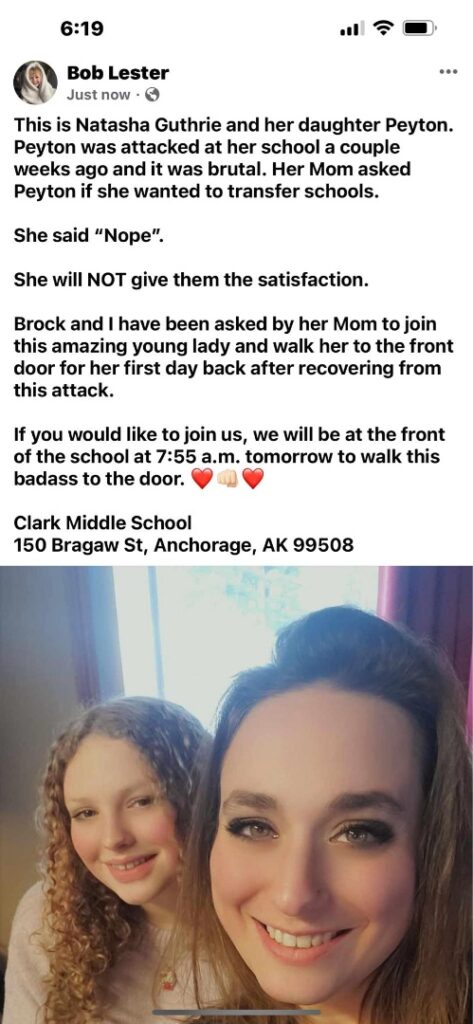
The mother of a girl who was beaten by a mob at Clark Middle School went before the Anchorage School Board on Tuesday to testify on behalf of all children and youth in Anchorage schools who have been bullied and beaten.
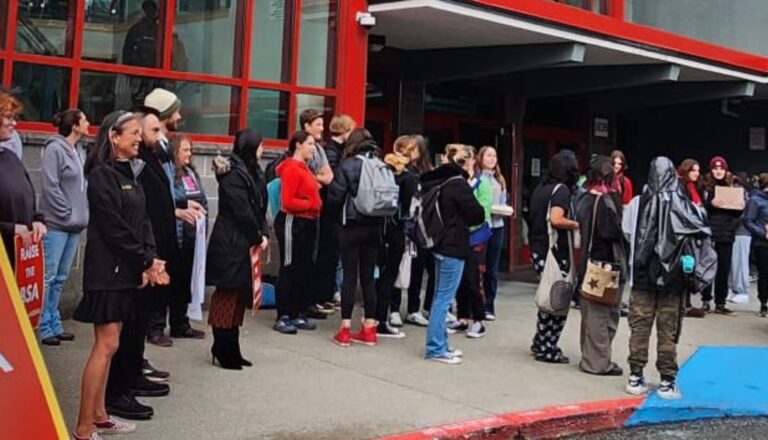
Now, a local KWHL radio host is organizing concerned community members to walk her back to school on Thursday morning as a show of community support, and to provide the family with emotional support as the girl returns to the violent campus.
Natasha Guthrie told the school board that on March 26 her daughter was beaten and kicked over 41 times in the Clark Middle School gymnasium, while other students videotaped the beating and offered no assistance.
“Four teachers were present in the gym at the time of this assault, which took 42 seconds from start to finish for anyone to intervene,” Guthrie told the board.
She also described three incidences that took place at Clark Middle School in 2023, two of which happened within 24 hours of each other resulting in the arrest of four juveniles on April 18, and four more on April 19, when the school was placed into lockdown mode due to uncontrolled violence.
After her daughter transferred to Clark in January of 2024, “I attempted 13 times to schedule a meeting with school officials between January 25 and February 16 regarding bullying and harassment along with racial slurs that had been targeted toward my daughter. On Jan. 24, my daughter contacted me after she had been threatened that 10 Polynesian girls were going to jump her,” Guthrie said.
“On Jan. 32, I spoke to Mr. Kelkis. I advised him that these girls were harassing my daughter and taking photos of her in class. On Feb 2, I got a call from my sister that my daughter had been slapped in the head,” Guthrie said. Another time, the girl was slapped in the face. The school official told the mother it was accidental.
The harassment accelerated until the incident on March 26, when a group of girls entered the gym with the apparent purpose of targeting her daughter for a beating that has been preceded by racist name-calling.
Guthrie had reported the harassment, bullying, and threats to Anchorage Police on Feb 3, and again in March. The school did not report the beating to the police.
Earlier in March, Guthrie’s daughter was suspended for protecting herself after she was shoved into the fight by another student; that incident was caught on videotape and it’s clear she was shoved into a fight.
Guthrie also appeared on the Bob and Brock radio show on KWHL FMto describe the beatings and harassment. Lester has invited the community to join him in helping to walk Peyton to the school door on Thursday, which will be her first day back at school since the March 26 beating; she has been recovering at home. Community members who wish to support the Guthries can meet at 7:55 am in front of the school, at 150 Bragaw Street.
Gov. Mike Dunleavy declared a state disaster emergency for the Kivalina fire that destroyed two community buildings and damaged electrical and communication lines in Kivalina. The disaster declaration helps fund emergency response efforts and activates the state’s Public Assistance and Individual Assistance Disaster Recovery Programs.
Kivalina is anInupiat community in House District 40. It is located between the Chukchi Sea and Kivalina River at the tip of an 8-mile barrier reef. Subsistence, including whaling, is a major portion of the local economy and the village is the only one in the region where people hunt bowhead whale. On April 9, Kivalina’s Bingo Hall caught fire. Despite committed local firefighting efforts, the fire spread to a nearby community building and threatened the community’s power plant. The temperatures in Kivalina were a high of 35 and a low of 5 fahrenheit.
While the fire destroyed the Bingo Hall and damaged the community building, local fire response saved the power plant and other structures. Damage to Alaska Village Electric Cooperative power distribution systems resulted in a community wide power outage with over 250 persons sheltering at the school overnight on backup power generation. Severe weather complicated response efforts by the City of Kivalina and the Northwest Arctic Borough.
The Northwest Arctic Borough, Red Dog Mine, Alaska Village Electrical Cooperative, State Fire Marshal, State Emergency Operation Center, along with other agencies, are in communication with the community and engaged in supporting response and recovery. Power was restored on Wednesday to all but 15 homes immediately near the fire area.
“I stand behind the village of Kivalina as we coordinate the response to the damage experienced from the recent fire and the impacts on their power system,” said Rep. Thomas Baker. “My office coordinated with the Governor’s office in requesting a Disaster Declaration, and I am thankful to the administration for the speed with which this was approved. I will be coordinating with state, city, and Tribal organizations to facilitate the recovery and rebuilding efforts of the lost and damaged infrastructure.”
Dunleavy’s declaration comes in response to the City of Kivalina and the Northwest Arctic Borough’s declaration of disaster requesting state assistance.
The disaster declaration activates the state’s disaster Public Assistance, Individual Assistance, and Temporary Housing programs. The Public Assistance program reimburses communities and jurisdictions for emergency response costs, emergency protective measures, and can fund repair of critical infrastructure damaged by the declared disaster event.
The state’s Individual Assistance programs provides grants to individuals and families to help repair damaged housing, meet critical needs, and to provide temporary housing.
Former House Rep. Liz Snyder, who lived in Alaska for a few years, won elected office and served one term and now runs a bodega in Florida, got a lucky break from the Alaska Public Offices Commission.
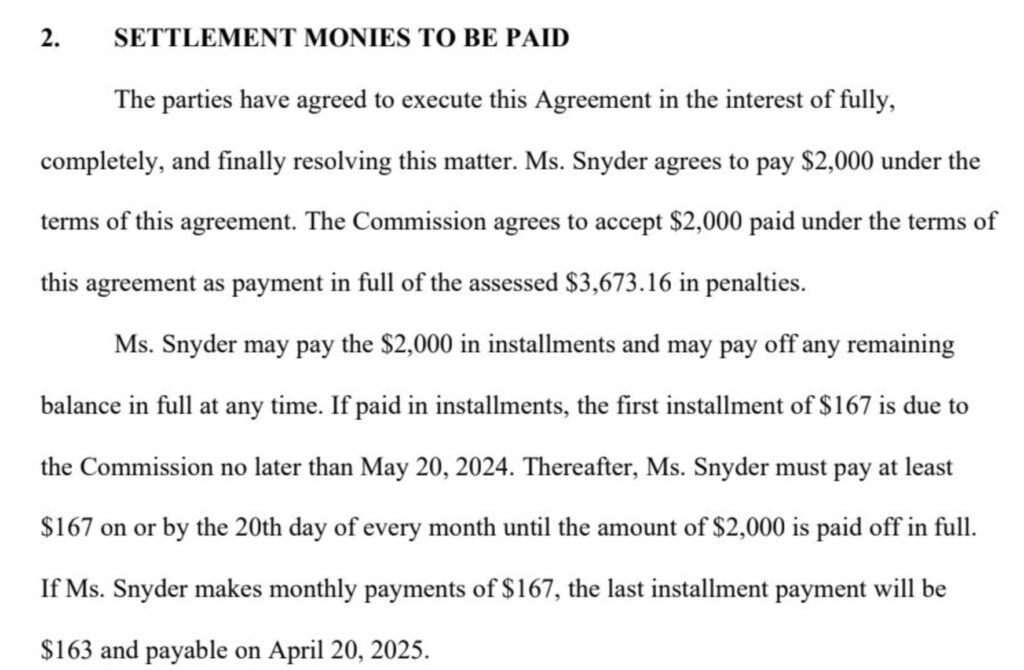
The Democrat had been fined $3,673 for giving her husband an illegal “thank you” gift at the end of her 2018 campaign.
But then the commission turned around an reduced her fine by 40%. She will only have to pay $2,000, and she can pay it off in monthly installments of $167 a month starting in May of 2024, until the reduced fine is paid in full.
The commission did not reduce the fine it levied against Rep. Lance Pruitt, who Snyder ran against in 2018 and 2020. He was fined $20,000 and was required to pay the full amount as a penalty for what the commission said was sloppy reporting. Snyder’s offense, however, revealed a different offense — essentially using campaign funds for household expenses after the campaign was over.
It’s not just Alaska students skipping class, egged on by union representatives of the education industry. A record number of students are skipping school, propelling chronic absenteeism to a national crisis, according to an analysis of public-school attendance data.
The analysis comes as public school districts nationwide are laying off teachers, citing high inflationary costs, budget deficits, and spending decisions related to federal COVID-era funding, which is running out after schools received windfalls in federal subsidies for three years.
Chronic absenteeism – the percentage of students who missed at least 10% of a school year – surged from 15% of students in 2018 to 28% in 2022, according to an American Enterprise Institute analysis, “Long COVID for Public Schools: Chronic Absenteeism Before and After the Pandemic.”
The analysis relies on AEI’s “Return to Learn Tracker Chronic Absenteeism Data Collection,” which it claims is “the most comprehensive and current data collection on pandemic and post-pandemic chronic absenteeism.” The tracker was created by Nat Malkus, senior fellow and deputy director of AEI’s Education Policy Studies, who is also the author of the report. Malksus collected weekly data on the remote-learning status of 8,600 school districts that collectively educated 89% of public-school students. Not all states reported data by the time of the report’s 2024 publication.
During the 2021–2022 school year, 28% of students were chronically absent, an increase of roughly 89% over pre-pandemic rates, his analysis found.
Although chronic absenteeism fell in 33 of 39 states reporting data since 2022, his analysis found that it remained 75% higher in 2023 than “the pre-pandemic baseline.”
“Chronic absenteeism increased for all district types, but rates were highest in districts with low achievement and higher poverty, affecting over one in three students,” Malkus says.
Current chronic absenteeism is “the most pressing post-pandemic problem in public schools,” Malksus argues, and is anticipated to “severely hamper” any improvements to COVID-era learning losses. Extended school closures, preventing in-person instruction, and remote learning programs caused historic and decades of learning losses for grade school students, The Center Square has reported.
“Unfortunately, nearly four years after the start of the pandemic, chronic absenteeism rates indicate that the ‘Return to Learn’ name is still apt,” Malkus said. “Even though nearly every school returned to in-person instruction over two years ago, many students have not fully returned to school in earnest.”
A New York Times analysis of the data found that “The trends suggest that something fundamental has shifted in American childhood and the culture of school, in ways that may be long lasting. What was once a deeply ingrained habit – wake up, catch the bus, report to class – is now something far more tenuous.”
The Times report points to parental relationships disintegrating with school boards as one reason for chronic absenteeism.
“The habit of daily attendance – and many families’ trust – was severed when schools shuttered in spring 2020,” the Times states. “Even after schools reopened, things hardly snapped back to normal.”
Several reports have pointed to parents pulling their children out of public school nationwide ,citing destructive lockdown policies, including mask mandates, as well as other problems leading to learning losses. Others have pointed to the FBI being weaponized against parents for raising issues with school boards, leading to congressional investigations.
As expected, former liberal candidate for mayor Bill Popp has endorsed Suzanne LaFrance for mayor.
Lining up with the radical Assembly, Popp chose one-party rule as his roadmap for Anchorage, instead of the incumbent Mayor Dave Bronson, who is tied with LaFrance as the two head into a runoff election for May 14. Neither achieved 45% in the March-April election.
The election that ended April 2 won’t be certified until April 23. Popp came in a distant third place. It is expected that if LaFrance wins, he will return to his city job. He left his job as CEO of the taxpayer-funded Anchorage Economic Development Corporation last summer to run for mayor, but in endorsements such as this, a quid-pro-quo promise is almost certainly in the works for Popp to return to another high-level, taxpayer-funded job at City Hall. When Popp left AEDC, the board of directors appointed Jenna Wright to be CEO.
“I believe Suzanne shares my perspectives on solutions to the key issues facing our city and as Mayor I believe she will assure our government will effectively address the issues our city faces today while setting in motion long-term strategies to revitalize Anchorage and set our city back on a path to success and vitality,” Popp said. He held his press conference in front of City Hall at 1 p.m. Wednesday.