Sunday, June 14, 2026
Home Blog Page 468

Supreme Court Justice Kentanji Brown Jackson suggests government has a ‘duty’ to censor Americans in some circumstances

“My biggest concern is that your view has the First Amendment hamstringing the government in significant ways in the most important time periods,” Supreme Court Justice Kentanji Brown Jackson told Louisiana Solicitor General Benjamin Aguiñaga on Monday during Aguiñaga’s presentation defending citizens in the state of Louisiana and Missouri.

Louisiana and Missouri attorneys [and solicitor] general challenged the federal government over how it censored conservative speech and coordinated with social media companies to silence critics during the 2020 election and the Covid-19 pandemic.

The states won in the Fifth Circuit Court of Appeals in Western Louisiana last fall. Appeals Court Judge Terry Doughty, chief judge of the U.S. District Court for the Western District of Louisiana, said the government-directed censorship witnessed was “the most massive attack against free speech in United States’ history” in his 155-page memorandum ruling issued last year.

The appeals court ruled that the Biden Administration had appeared to violate the First Amendment when it worked to persuade social media platforms to remove what the government said was misleading or false content about the Covid-19 pandemic.

The lower court judges wrote that the White House and the Office of the Surgeon General had coerced “platforms to make their moderation decisions by way of intimidating messages and threats of adverse consequences” and “significantly encouraged the platforms’ decisions by commandeering their decision-making processes.”

The Biden Administration appealed the ruling to the Supreme Court and the Supreme Court calendared the case for this session.

During Monday’s oral arguments for Murthy v. Missouri, aka Biden v. Missouri, Justice Brown Jackson had concerns about limiting the government’s role in censoring Americans through its coordination with social media companies like X/Twitter and Meta/Facebook/Instagram because “some might say that the government actually has a duty to take steps to protect the citizens of this country” in ways that are more draconian than just posting the government’s point of view.

“You seem to be suggesting that that duty cannot manifest itself in the government encouraging or even pressuring platforms to take down harmful information,” Jackson said. “So can you help me because I’m really worried about that. Because you’ve got the First Amendment operating in an environment of threatening circumstances, from the government’s perspective, and you’re saying that the government can’t interact with the source of those problems.”

Aguiñaga answered that he was not asking for a restriction on interactions between the government and social media companies, but he said there are constitutional limits to what the government can do in the way of bullying or threatening.

“Our position is not that the government can interact with the platforms there. They can and they should in certain circumstances like that, that present such dangerous issues for society and especially young people,” Aguiñaga said. “But the way they do that has to be in compliance with the First Amendment and I think that means they can give them all the true information that the platform needs and ask to amplify that.”

Despite the abuse of power by the Biden Administration, even more-conservative Justice Amy Coney Barrett raised a concern about how a ban on the cooperation of social media companies with government requests could be too sweeping. It may be the case gets remanded to the Fifth Circuit for further consideration of sideboards on the government, to keep it from being a director of online content and a censor of Americans’ points of view.

Brown Jackson was nominated to the Supreme Court by President Joe Biden and confirmed by the Senate in 2022; she is the first black woman and the first former federal public defender to serve on the Supreme Court. Her confirmation vote in the Senate was 53-47, with three Republicans joining all 50 Democrats in voting yes. Those Republicans were Sens. Lisa Murkowski of Alaska, Susan Collins of Maine, and Mitt Romney of Utah.

Recipe for revenge: Anchorage city managers handled pe*is-shaped cookie complaints correctly, Ombudsman says in final report

33

Once upon a time last year, a high-level manager brought penis-shaped cookies to the mayor’s office at the Anchorage Municipality. It was a tawdry treat that turned into a workplace tit-for-tat that turned into a political maelstrom that became fodder for the mainstream media.

Several current and former city employees contacted the Anchorage Ombudsman, who works for the mayor-maligning Anchorage Assembly, alleging that the Human Resources Department/Labor Relations had failed to investigate the complaints the employees had filed with them regarding the alleged inappropriate behavior of the department director, including distribution of the penis-shaped cookies at City Hall.

The manager, Purchasing Director Rachelle Alger, was also accused of being mean.

“Multiple current and former MOA employees contacted the Ombudsman alleging inappropriate behavior by an MOA department director. The individuals alleged that the director had ‘yelled, cursed, and screamed at them’ and stated that the director’s behavior was ‘aggressive, intimidating, and disruptive’. The employees alleged that the director had bullied and harassed them, “including distributing penis shaped cookies in City Hall.”

Ombudsman Darrell Hess has determined in his report to the Assembly that allegations that the Human Resources Department/Labor Relations failed to properly investigate employee complaints about inappropriate behavior are not supported by the evidence.

The complainants told Hess the director had created a hostile and toxic work environment. The Ombudsman first ascertained that the employees had not yet filed complaints with the Human Resources Department, but had brought their complaints to him first. He referred them to Human Resources to start the process. Some of the employees did filed complaints with HR, while others did not, stating to the Ombudsman that they thought it would be a waste of time, as it was rumored that the mayor had a ”no fire list” and that the director was on the list.

Several employees who filed with Human Resources/Labor Relations later contacted the Ombudsman, alleging that HR/LR had not taken their complaints seriously and had not investigated them.

Ombudsman Hess opened an investigation into that allegation. In the process, he reviewed emails, notes, and files in Human Resources/Labor Relations and found documentation that the department had, indeed, taken the matter seriously and acted on it.

“The Ombudsman’s Office also reviewed multiple other documents related to whether HR investigated the employee complaints regarding the alleged behavior of the director. The documents reviewed by the Ombudsman’s Office and their interviews with current and former MOA employees, demonstrated that LR had taken the employee complaints seriously and that they had investigated all the employee complaints that had been filed with them regarding the alleged inappropriate behavior of the director, including the alleged distribution of penis shaped cookies at City Hall,” Hess wrote.

His report to the Anchorage Assembly is in the Tuesday meeting packet for the meeting, which begins at 5 p.m. at the Loussac Library on the ground floor. The full report can be viewed here:

Anchorage Assembly considers bad dogs off leash, and ‘no right on red’ in downtown district

The Anchorage Assembly on Tuesday evening will take up various ordinances aimed at curbing the behavior of citizens and their pets.

One proposed amended ordinance would tighten the leash law as it pertains to dogs on an electronic collar, controlled by a remote mechanism held by the dog’s owner. The Assembly will also consider the meaning of “control by command,” by which a dog is well-trained to follow voice commands. The move is part of a process started with the Animal Control Advisory Board to address the complaints about aggressive dogs that are not on leashes in city parks and on trails.

“A controlled animal off-leash will return to its custodian at the time it has been called. The animal will not run after wildlife. The animal will not approach people. The animal will not run up to other animals,” the ordinance has been amended to say.

An “(e-collar) means the animal is trained to respond to a mild shock, vibration, or sound upon receiving a signal from a remote transmitter. A controlled animal must be within eyesight and within range of the e-collar. A controlled animal using an e- collar will return to its custodian at the time it has been called. A controlled animal will not run after wildlife. The animal will not approach people. The animal will not run up to other animals.”

“Activities NOT allowed under control by command include but are not limited to hiking, walking, biking, and skiing,” the ordinance says. “Control of an animal by e-collar is allowed if the collar is worn by the animal properly and the collar and remote controller are functional throughout the duration of its use. The animal must be within eyesight and within range of the e-collar. No more than three animals per custodian. A leash per animal must be in possession of the custodian. An animal on an e-collar must conduct itself in a manner that does not impact the general public.”

The proposed ordinance language is at this link.

The Assembly will also continue considering an ordinance that would make certain blocks in downtown Anchorage the only place in the state where drivers may not turn right on a red light, even if there is no competing traffic. Assemblyman Daniel Volland, formerly of Seattle, is the ordinance sponsor and believes it will create more safety for pedestrians and cyclists. The streets would be “all streets and portions of streets within the area described as follows: all that area bounded on the south by Ninth Avenue, on the north by Third Avenue, on the west by L Street and on the east by Gambell Street.”

That ordinance language can be viewed at this link.

The Assembly will vote on new regulations for short-term rentals in Anchorage, aimed at getting control over people who convert part of their homes into vacation rentals. And it will hear a proposed ordinance that amends Anchorage Municipal Code Section 15.20.020 prohibiting homeless camps within 10 blocks of any licensed homeless shelter, and prohibiting homeless camps with more than 50 people and other provisions relating to camping and vehicle homeless camping.

The Anchorage Assembly meets at 5 p.m. on March 19 in the theater of the Loussac Library, which is on the corner of 36th Ave. and Denali Street. The meeting typically goes until 11:30 p.m. The entire agenda is here.

Too hot to handle? Mat-Su Borough Assembly to consider forming library review committee

Obscene books in the children’s and young adults’ sections of libraries is an ongoing debate among library patrons, liberal librarians, and conservative taxpaying citizens across America.

Earlier this year, Matanuska-Susitna Borough Manager Mike Brown suspended the existing Library Challenged Materials Policy process until further review, after community meetings on certain books became loud and contentious.

Now, the Assembly will consider creating a library materials review committee, modeled after the one created by the Mat-Su Borough School District. That school district policy is not without controversy, and has drawn a lawsuit from the Northern Justice Project and the ACLU for pulling books off the shelf in order to be reviewed by someone other than the school librarian.

The purpose of the proposed committee is to allow library staff to focus on providing services, while incorporating community into the review process, and provide libraries with a better understanding of the attitudes and opinions held by the community, the draft ordinance says.

The citizens advisory committee would serve in an advisory capacity only and would not act as a policy-making or decision-making body, according to the ordinance under consideration.

The suspension of the library book policy by borough Manager Mike Brown came after a Jan. 18 meeting, in which people requested that two books, “Red Hood” by Elana K. Arnold and “Identical” by Ellen Hopkins, both of which contain sexual material, be pulled from the young adult fiction section. A borough committee ruled at the time that the books should remain. These two books have been controversial across the country.

“Identical” is described by the publisher Simon & Schuster as having two protagonists who are identical twins: “Raeanne is the aggressive twin, the one who is sexually promiscuous—giving sex in return for drugs; she craves sexual attention from anyone, including her father. Kaeleigh is the quiet one, the one most like her mother, and the victim of her father’s sexual advances.”

“Red Hood” is a fantasy novel about sexual abuse and has sexually explicit passages graphically describing rape.

“The meetings have devolved into a shouting match and name-calling that is not producing a positive outcome for our community,” Brown wrote in his suspension of the library review policy. “I acknowledge the value of having a process for patrons to challenge material, but until such time as we can come up with a different approach, there is no value in continuing to put materials through the current process.”

The Mat-Su Borough Assembly meeting begins at 6 p.m. in the Assembly Chambers, 350 East Dahlia Ave., Palmer.

Legislature fails to override governor on education mega-bill

The Alaska Legislature, in a joint session on Monday voted 39-20, but it was one vote short of what was needed to override Gov. Mike Dunleavy’s veto of an education bill, Senate Bill 140, that started out as an internet bill for rural Alaska, but turned into the dream of the National Education Association Alaska — another quarter billion dollars for school districts without any strings attached.

Gov. Dunleavy issued a statement within minutes: “I want to thank the legislature for their hard work and commitment to implementing new education reforms that put Alaska families first. Let it be clear to school boards and associations: education funding will be prioritized and available – I support solutions that move us forward.”

The vote came after about two hours of legislators from both sides of the aisle talking about the shortcomings of Alaska school districts, as well as the need for funding, and how that funding gets distributed. It turns out, a $680-per-student increase is not distributed equally through all districts. North Slope gets more, while Southeast Alaska rural districts get less.

The education industry and unions fought hard for the funding bill, and has been swarming the Alaska Capitol since the beginning of session, putting pressure on legislators, who were flooded with requests to increase funding for schools as part of a formula called the base student allocation, which is the floor for funding of public education.

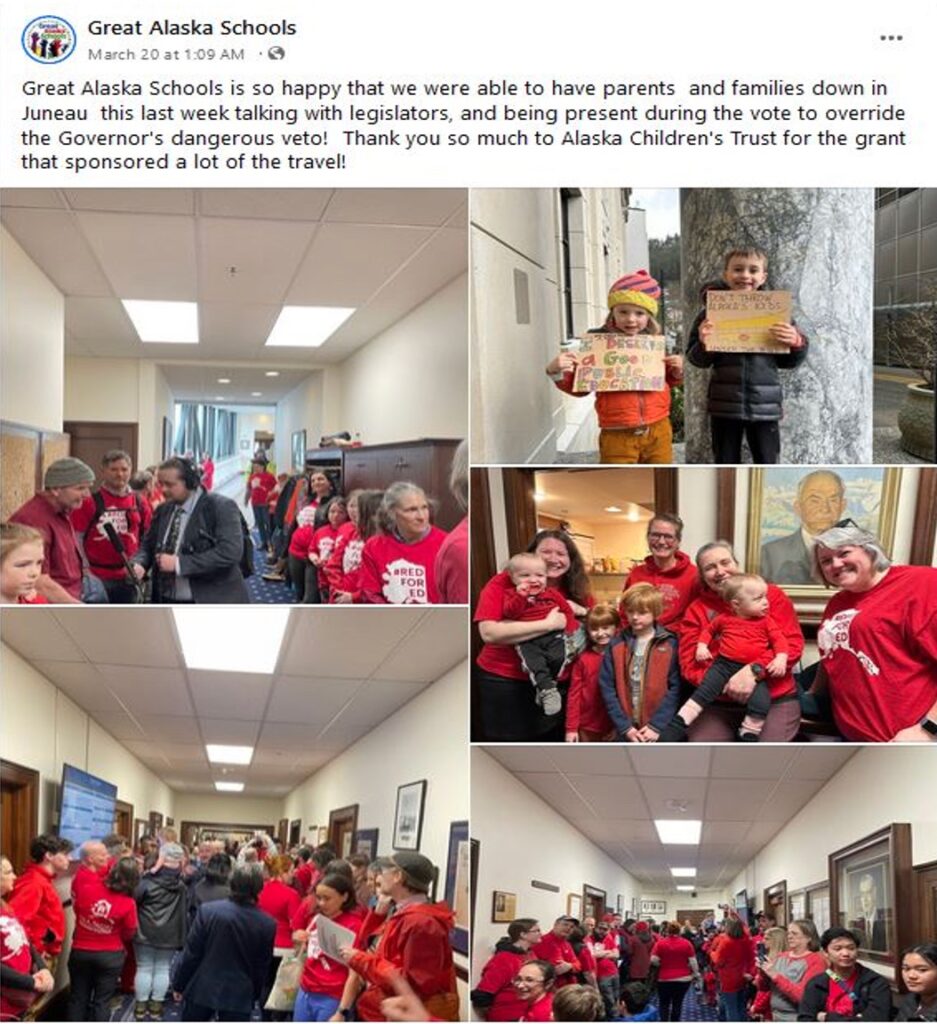
In fact, the hallway leading up to the House Chambers was lined with both adults and children being used as props by the education lobby, as human sentinels watching legislators filed in to deliberate and vote.

Several legislators rose to speak for and against the veto override.

Rep. Tom McKay, a Republican of Anchorage, was the first, reminding everyone that he had already introduced an alternative to Senate Bill 140 — House Bill 392 — which would also increase the base student allocation by $680, as SB 140 would have, but would restore some of the items the governor wants, such as support for charter schools. While public schools in Alaska are at the bottom nationwide for student achievement, Alaska charter schools are at the top, he added.

Rep. Dan Saddler, another Republican, went next, and also reminded people that even if there was an override, the governor could still veto the $680 after the session ends, when he is handed the final proposed budget. He still has a line-item veto.

“It might appear that voting yes, that it guarantees it,” he said. “But that’s not accurate. It’s not that simple.”

Sen. Lyman Hoffman, whose family stands to gain financially from the original broadband section of the bill that would enrich his Bethel Native Corporation when it gets the multi-million-dollar contract to expand broadband for his district, rose to support overriding the governor; he is a paid officer of Bethel Native Corporation and has a conflict of interest, which he did not declare.

Sen. Mike Shower of Wasilla pointed out that Alaska would be spending millions of dollars to lay cable when satellite internet has made it all but obsolete in rural Alaska. He also pointed out that the $680 BSA increase would likely never be seen by teachers and that the governor’s incentive pay for teachers, which would go directly to them, had already been stripped out of the bill at the request of the education industry union lobbyists.

Sen. Rob Myer pointed out that 25 years ago, when he was in school, the Alaska schools were about in the middle of the pack, and that with the funding formula put in place, the quality of schools has just gone downhill and is now at the bottom of the barrel nationally.

Myer said that truancy and absenteeism is a huge problem in Alaska, and is one reason students are doing so poorly. “I don’t know how more money is going to address absenteeism,” he said. He said Alaska needs to put money in places that are succeeding, he said. But unfortunately those pieces got stripped out of this bill and it’s not where it needs to be, he said.

“I want to continue the conversation to talk about outcomes, if we’re not talking about outcomes for our kids then this conversation is meaningless,” Myer said.

Rep. Ben Carpenter said that districts losing out on funding is a red herring. “This is not an appropriations issue. This is a policy bill. This says we favor spending more money as a solution to our problems.”

He reiterated that SB 140 was a policy bill originally to address internet in rural schools and that “it got co-opted with a BSA increase,” he said.

Sen. Shelley Hughes of Mat-Su gave passionate closing remarks, saying education is her highest priority, but “I am no to prioritizing a system, over kids and teachers. My no vote is to go back to the drawing board.”

She added, “I encourage reporters to report that we all care about our kids.”

Murkowski hires Garrett Boyle as chief of staff

U.S. Sen. Lisa Murkowski announced Monday that Garrett Boyle is returning to her Washington, D.C. office to become chief of staff. He will replace the departing Chief of Staff Kaleb Froehlich.

“I am very pleased to announce Garrett Boyle as my new Chief of Staff, and welcome him back to my team” said Murkowski. “His strong background in rural development and policy issues on both the federal and state side make him uniquely qualified to serve in this new role. Having previously served in my office as both Legislative Director and Deputy Chief of Staff, I have no doubt that he will hit the ground running.”

Boyle received his bachelor’s degree from Seattle University and is a graduate of Tulane University School of Law. He was raised in small towns throughout Alaska, including Ouzinkie, Unalakleet, and Seward. He previously served in Murkowski’s office beginning as a legislative assistant, then as legislative director, and deputy chief of staff. He left the office in 2021 to serve as the federal co-chair of the Denali Commission.

Stock plunges after Planet Fitness cancels membership of Fairbanks woman who objected to man in women’s locker room

Patricia Silva of Fairbanks documented an adult male using the women’s dressing room at Planet Fitness in Alaska last week, and sent her proof to Libs of TikTok, a social media account that shows how radical some liberals are.

Silva’s video and photographic evidence was seen by Libs of TikTok’s 2.9 million followers on X/Twitter, and it didn’t take long for Planet Fitness to cancel her membership, because she had violated the rule.

What rule? The rule that says you can’t take pictures of other members in the locker rooms.

There is no rule, evidently, for men whipping out their “members” while in the women’s locker rooms, however. Planet Fitness says it is a “judgment free zone.”

In this instance, there was a young girl also in the dressing room, wrapped in a towel, while a man shaved at the sink.

The incident has led to a call for a boycott of Planet Fitness and a drop in the company’s stock price on Monday.

Silva isn’t the only female customer to take on the fitness company. In September, a 15-year-old girl was inside the women’s locker room of Planet Fitness in Monroe, Ga., when a naked male allegedly exposed himself to her, according to the Monroe Police Department. Jakorbie Dixon of Conyers, Ga., was arrested on “multiple warrants for public indecency by exposing himself in the female locker room,” the police department said.

Planet Fitness has a policy about such things:

The policy says staff should “work with members and employees to address this discomfort [sharing facilities with transgender members] and to foster a climate of understanding consistent with the Judgment Free character of Planet Fitness.’

The statement says, ‘Planet Fitness staff shall strive to address transgender members with names, titles, pronouns, and other terms consistent with their self-reported gender identity, if reasonably known to the Planet Fitness staff” and that “a transgender woman shall be referred to by her preferred name and female pronouns” and a “transgender man shall be referred to by his preferred name and male pronouns.’

The statement says the company “reserves the right to terminate a person’s membership immediately for any violation of this policy.”

Meanwhile, a man accused of exposing himself in February to a teenage girl in an Anchorage fitness center is still being sought by Anchorage police.

Win Gruening: Juneau Assembly holds firm on Telephone Hill redevelopment

By WIN GRUENING

In a rare moment of near unanimity during a special Juneau Assembly meeting last month, members voted to move forward to develop Telephone Hill.  

Several Assembly members spoke passionately in favor of transforming the property with an eye towards providing as many additional housing units as possible (while still observing reasonable aesthetic guidelines). 

Almost four years after the city applied to acquire Telephone Hill from the State of Alaska and one year after assuming ownership of the property, it appears that a plan is finally emerging.

The Assembly deserves credit for recognizing that the economic significance of the property far outweighs any historic preservation value.

The Telephone Hill property covers approximately 4.2 acres in the center of downtown Juneau.  It is envisioned as a mixed-use downtown hub incorporating green/public gathering space, multi-family housing, or even some commercial use. The available developable property is currently occupied by four single family homes, two duplexes, and a small five-unit apartment building, most with renters on month-to-month leases.

Understandably, the tenants, faced with the prospect of vacating their residences, have made emotional pleas to the Assembly to consider a no-development option. But legally and practically, this is almost impossible.  The city should not be in the business of renting tax-exempt homes to private individuals when Juneau property taxpayers are burdened with ever increasing taxes on the homes and businesses they own. 

Legally, if sold, the city must offer the properties at fair market value to the highest bidder. However, a recent condition report commissioned by the city and prepared by structural engineers detailed numerous structural issues and/or code violations on all the units, even citing unsafe conditions on the Martin-Johnston House which was deemed “hazardous and should not be occupied.” All properties in their current condition were found to be “ not economically feasible for CBJ to own or rent….”

No bank would finance a purchase without these deficiencies being resolved and there is no hold harmless agreement that could be drafted that would protect the city from liability if the properties were sold as-is.

The plan that was approved by the Assembly was Option C which was abbreviated to “Mid-Rise Apartments (100-200 units)”. This option also secured the highest number of votes (555) in a survey which accounted for  29.79% of the responses. Although votes were split relatively evenly among other alternatives, most Assembly members concluded that addressing the housing shortage in Juneau was the highest priority in selecting an option.

There was some discussion about how much involvement city staff should have in formulating possible building configurations and sizes.  This is where caution should be exercised.  Setting restrictive guidelines would be a mistake.

The way to determine the best and highest use for the parcel is to invite experienced professional developers to create the best plan that corresponds with existing market conditions. It’s all well and good to demand a project with 100 – 200 units in a certain configuration, but that may not be technically or financially feasible. Additionally, parking requirements may need to be negotiated to allow some type of partial exemption.

Elected officials and city bureaucrats lack the professional judgment of experienced local developers and should not mandate designs that may not be viable.

It is encouraging that our Assembly seems to connect the dots between housing and economic growth (at least on this project) since growth directly impacts demographic trends.

Let’s hope that our city leaders take a similar view on other projects. 

The possibility of a Coast Guard icebreaker being homeported in Juneau could help. However, that is still somewhat speculative. It would mean a welcome influx of 190 crew and support personnel. They could bring as many as 400 dependents, half of whom might attend our schools. But we are slated to lose almost 1,200 students over the next 10 years so it won’t stop our population decline by itself.

Projects that stimulate economic growth like the Huna Totem dock project, a regional Career Technical Education Center, better transportation options, and streamlining the budget to reduce taxes will be necessary to lower our cost of living and reverse continuing demographic decline.

That’s where the Juneau Assembly should be concentrating its efforts now.

After retiring as the senior vice president in charge of business banking for Key Bank in Alaska, Win Gruening became a regular opinion page columnist for the Juneau Empire. He was born and raised in Juneau and graduated from the U.S. Air Force Academy in 1970. He is involved in various local and statewide organizations.

Michelle Traxler: An aborted baby named John Anthony is why I support defining life in HB 107

By MICHELLE TRAXLER

I have the following stories to tell, as these personal experiences touch on several facets of the abortion debate. It’s not just my experience that I’m representing here. It’s the experience of tens of thousands of other women who were in distress, and made a horrible decision to end the life of their baby before they could be born. My son was one of these people who was never born. 

At 17, I was pregnant for a second time. I already had a daughter by the same drug-addict boyfriend I was in the process of leaving. I reasoned that I couldn’t take care of two little ones by myself, and I couldn’t. 

Considering giving the child up for adoption didn’t go well. Being honest, I was deeply upset about the damage that had been done to my body from being pregnant and giving birth. I didn’t want to go through it again so soon. 

Also heavily weighing on my mind, was the thought of my child being abused, as I had been abused. I had seen and experienced evil in this world. It broke my heart to think of someone hurting my child, and for me to not know about it to save him. 

I reasoned that both myself, and this child, would be better off if I got rid of him before he could be born. I was sad, troubled and lost, but resolved to my decision. 

Back in 1987, you couldn’t go in early and have an abortion. There was a risk of having  a “missed abortion.” There were no pills to take. 

I set off to go to a distant city, where I would be asleep for the procedure. On the way there, my boyfriend was stopped for speeding. We missed the appointment. 

The clock was ticking and I was still resolved. Another appointment was made to a different clinic. By then, I was 13 weeks pregnant. 

Shortly after entering the clinic, I was directed to the counselor’s office. I was very mature, composed and matter of fact. I laid out my argument to allow me to proceed, without dropping a tear. I convinced her that I knew what I was doing, and was fine with it. 

On my way from her office to the waiting room, I ran into a girl I knew. Her appointment was ahead of mine. We didn’t say much to each other, but I thought of how sad it was that her, and her boyfriend, were killing their baby, yet I mostly blocked feeling that way about my own.

I did await my turn in dread. I remember being on the table with IV medicine dripping into me that was about to knock me out. I stared at the vacuum machine and the tool the doctor was about to insert into me. He looked up at me as I looked at him in terror, as I thought he was going to insert the suction tool before I was asleep. 

As I slept, the 13-week-old little boy I was carrying was literally torn apart as it was sucked out of my womb. To ensure nothing was left behind to cause an infection, his little body parts were reassembled in another room. He was then, maybe, incinerated. He was a person.

I woke up in a recovery room, at the end of a row of other women. After I dressed and was leaving, I looked over at all of them. 

The first woman was a 30-something year old. She was sitting up and smiling. The others were teenagers like me. One was crying loudly and profusely. Another was just huddled with her blankets hiding her. Another just stared off into space. 

It was literally like an abortion factory. I waited and waited outside the clinic, but still in the building, for my boyfriend to come pick me up. That was awful. 

When he finally got there, he was mad that they told him wrong about when to be back  to pick me up. He went on a rant. I felt embarrassed, and just wanted to leave so bad. He insisted on saying something, and told me that he, “didn’t believe in abortion.”

My heart sank when he said that. Fine time to tell me, after the fact. He left, after telling off the woman at the desk. I left him and the state three months later.

Years later, someone close to me had a miscarriage. She came out of the bathroom with her hands cupped and trembling, holding something. 

What she was holding was maybe two inches long. It looked liked a big piece of bubble gum in a V shape, with a spine developing down the middle. 

It certainly didn’t look like a baby or have a heart beat, but it was still, undeniably, the body of a human baby. Science would have identified it as such. 

One day, my daughter contacted me in great distress. She was given the RU486 (mifepristone), a two-part abortion pill, by a bad doctor in Anchorage. (She’s not practicing medicine here anymore.) She had already taken the first pill.

I didn’t even know she was pregnant. She had two days to think about what she did. We were both in unbearable anguish.  I did research on it. At the time, she had no choice but to take the second pill. She did and went to work. 

I got a phone call from her, as she sat on the toilet at the gas station she worked at. She told me it was finished. My grandchild was about to be flushed down the toilet.

I asked my daughter a few years later what she thought about abortion. She said, “It’s bullshit.” I said, “What do you mean?” She said, “If you’re pregnant with a baby, you should have a baby.” Amen. 

Someone else I know, was expecting their first born. At seven months gestation she couldn’t breathe, and was diagnosed with preeclampsia. She had the choice of either giving the baby a chance at life in the NICU at Providence, or abort him. NICU it was!

This mother told me that she never realized she could love someone so much. It turns my stomach to think that child could have been destroyed along with the other medical waste, had his mother not wanted him. 

The issue of unwanted pregnancies, for whatever the reason, has always existed and always will. It’s a very complex situation to be in. There’s no easy solution, but there are solutions that don’t involve murdering a baby. 

If you don’t want one, don’t make one. But don’t make one, then kill it. Get sterilized, temporarily or permanently, by whatever means you choose. Your body, your choice on this one.

These babies are our future. The birth rate here in Alaska has actually gone down, thanks in part to abortion. It’s a low-key form of genocide that people actually demand. 

We are living, human beings from the time we are conceived and attach in our mother’s womb to grow. That should be a most sacred and safe place, for us as humans to begin our life here on Earth. 

I have thought about that over the years, and how I betrayed my own child in such a horrific way. It pierces my soul. My only consolation is that Christ died for that sin too, and I’m forgiven for it. When I die and leave this world, I’ll see my baby. 

There are tens of thousands of other women, whose pain and shame prevent them from speaking the truth about this evil, we have for too long allowed in our society. 

In honor and remembrance of my son, whom I have named John Anthony, and my lost grandchild, I have written this.  

They were real people that should at least be granted the dignity of being referred to as such, after having suffered the indignity of being aborted. 

HB107, sponsored by Rep. Kevin McCabe, will define human life, just as we have statute defining death. Both God and science agree that life begins at conception. Without politics involved, that conclusion was once the accepted norm, that it should be today.  

There are other states trying to pass similar legislation. Babies in this state have been legally murdered, up until birth, for over 50 years. Tens of thousands of babies, dead. That should bother you. 

Please overwhelm Rep. McCabe, in letters of support for this critically important piece of legislation. He needs to hear from you, even if you just simply say that you support HB107. If you may be so bold, say that, along with the name of a baby that was lost. That may help some of you.  

HB107, will officially recognize that the unborn are living, human beings…individual people. They should be respected, and have the same right to have their life protected, as if they were born.

Michelle Traxler is a resident of the Matanuska-Susitna Borough.