The Alaska Railroad, a State-owned corporation, has given all employees a mandate to be fully vaccinated by Dec. 8, or be terminated. Many workers are contemplating striking, sources say.
The Alaska Railroad required vaccination for all new employees hired after Sept. 15. The workforce is said to be 50 percent vaccinated, current employees told Must Read Alaska.
According to CEO Bill O’Leary, this notification will trigger union bargaining.
The letter to employees from O’Leary to Alaska Railroad employees:
From the start of the pandemic, ARRC has put a priority on maintaining a safe and healthy workplace. We’ve encouraged employees to follow guidance from public health experts regarding vaccination, but we haven’t mandated vaccination as some companies have done. Our employees have diverse and often deeply held views on this topic, and we respect those differences.
We are proud that we have stayed operational throughout the pandemic. We’ve kept trains moving and our business strong, while limiting workplace spread. Our people rose to the challenge, and we are thankful to each and every one of you. We appreciate all you do to serve our customers and communities.
Now the situation has changed. On Sept. 9th President Biden issued an Executive Order on Ensuring Adequate COVID Safety Protocols for Federal Contractors. The EO requires all employees associated with a federal contract to be vaccinated against COVID-19 in order to safeguard the health of employees and their families, customers and visitors, and the community at large.
Over the last six weeks, we’ve carefully reviewed additional EO guidelines and our interactions with federal agencies to determine if the Alaska Railroad is affected. We are. As a federal contractor, ARRC must meet this standard.
Bottom line: All Railroaders must be fully vaccinated by Dec. 8, 2021. Time is short, because full vaccination is achieved several weeks after receiving the vaccine shot(s).
We understand that for some employees this news will require a difficult decision. We don’t want anyone to leave the company because of this new mandate; yet, we do not have a choice. To disregard the EO could cause substantial legal, regulatory and financial harm to our organization, and ultimately, to our workforce.
Supervisors: Please share this notification with all employees immediately. Please print and post this notice on bulletin boards in break rooms and common areas. Please continue to share this information during your job / safety / staff meetings to ensure everyone is aware.
Meeting the Requirement
All employees must be fully vaccinated no later than Wednesday, Dec. 8, 2021.
Reference the following schedule to meet the full vaccination requirement, based on vaccine type:
Vaccine Type
1st shot no later than
2nd shot no later than
Fully vaccinated no later than
Moderna
10/27/2021
11/24/2021
12/8/2021
Pfizer
11/3/2021
11/24/2021
12/8/2021
Johnson & Johnson
11/24/2021
N/A
12/8/2021
· Employees may use paid administrative leave to get each dose. Be sure to coordinate with your supervisor to schedule time off to vaccinate by the date(s) noted above.
· Employees may use paid administrative leave to recover from any adverse reaction to the vaccine.
· If you have been vaccinated but have not yet provided proof of vaccination to Human Resources, please do so immediately. Scan or take a photo of your vaccination card, and email it to [email protected].
Who is Included?
All employees, including those working remotely, must meet the requirement.
· Represented Employees: We have notified union leadership as this triggers a union’s right to bargain regarding the effects of this requirement. Effects bargaining does not eliminate the vaccination requirement or alter the Dec. 8 deadline.
What if I don’t get vaccinated?
Exemptions. Employees can request an accommodation for a sincerely held religious belief or medical disability. To request an exemption, contact Human Resources as soon as possible, and no later than Nov. 24, 2021. Exemption requests involve an interactive process to determine if an accommodation can be granted without: A) causing undue hardship to ARRC; or B) posing a direct health-and-safety threat to others. If granted, accommodation may mean additional protocols that include, but are not limited to:
· weekly COVID-19 testing
· continued masking and social distancing even after the requirement is lifted for others
· inability to attend in-person events
· unpaid leaves of absence
Non-compliance: ARRC Employees who are not fully vaccinated on or before Dec. 8, 2021, and who do not have an approved exemption or who are not engaged in the process to seek an exemption, will no longer meet the requirements to continue employment with ARRC.
About the Vaccines
To better understand how the COVID-19 vaccines work to protect you, review this CDC Information.
Hundreds of millions of people around the globe have been vaccinated with one of the three available vaccines. The vaccines have been proven safe and effective against severe illness, hospitalization and death from COVID-19.
Find a vaccination provider or event near you here.
Finally, whether you support the mandate or have concerns about vaccination, let’s continue rising to the challenge by showing each other the mutual respect we all deserve.
Many of my friends during my upbringing in the former Soviet Union were students from various academic institutes, striving for knowledge, wisdom, academic curiosity and freedom of intellectual expression. We constantly challenged each other during our passionate discussions about new discoveries in science and creations in literature, art, music and other spheres of academic endeavors.
Many topics of our discussions — especially related to creative writing and dissident literature — were forbidden and harshly punishable by Soviet authorities. Indeed, we all realized the danger of our involvement in these freedom–spirited activities. But a desire for a democratic liberty and truth was stronger than fear and cowardliness.
Across the socialist countries in the Eastern Block, samizdat (Russian for self-publishing) was a form of forbidden literary activity in which individuals reproduced uncensored and underground publications and passed the documents from one liberal–minded reader to another. The practice of manual reproduction was done via typewriters because printing devices required official registration and permission to access. This grassroots practice to evade official Soviet censorship was dangerous and came with threats of harsh punishment, including expulsion from the universities, loss of employment and even imprisonment.
All Soviet–manufactured typewriters and printing devices were officially registered by the government. Their typographic samples were collected right at the factory and stored in the government directory for further identification, when needed.
Because every typewriter has unique micro features, which are as distinct as human fingerprints, it allowed KGB investigators to easily identify the device that was used to type the text in question and, subsequently, apprehend its user. However, the typewriters that were smuggled into the Soviet Union by rebel Soviet citizens from abroad, mostly in the nearby socialist countries (e.g., German-made Erica), skipped the sample collection procedure which made it significantly more difficult for KGB agents to trace the devices.
The smuggled typewriters typed Cyrillic text via Latin characters. To prevent capture by the authorities, the forbidden texts were often bound and concealed within ideologically approved books (e.g., Maxim Gorky, Leo Tolstoy, Alexander Pushkin, etc.).
In the Russian samizdat (self-publishing) process, writers or typists commonly typed four to eight carbon copies of uncensored and underground material at once. It was then widely multiplied, retyped and distributed among intellectuals, political activists, rebel youth and trusted friends. In absence of a typewriter, several copies were made by hand using carbon paper—a very laborious process.
Mikhail Bulgakov(1891–1940) was a Russian writer, playwright, and physician in the first half of the 20th century. His father was a professor of theology and a prominent Russian Orthodox essayist, thinker, and translator of religious texts. His mother was a teacher, and his grandparents were clergymen of the Russian Orthodox Church. Thus, Bulgakov’s writing and ideological beliefs reflected his upbringing and orthodox Judeo-Christian faith and moral values. His most renown literary work is The Master and Margarita, presumably the best masterpiece of the Soviet time (1918–1991).
Samizdat copies of Bulgakov’s satirical novel were passed around among trusted and liberal–minded friends. His novel describes a visit by the devil to the officially atheistic Soviet Union; it combines supernatural elements with a satirical dark comedy and Judeo-Christian moral values.
Unfortunately, his novel was never published during his lifetime. The publication of his work, in a censored and abridged state, happened 26 years after Bulgakov’s death. Although the censorship had removed some 60 typed pages (about 15,000 to 20,000 words), nearly 150,000 copies were sold out in a few hours in the former Soviet Union.
However, prior to its official (censored) publication in 1966–67, the complete version of the book was self–published by samizdat and secretly passed along from one avid and courageous reader to another. In fear of getting caught, rebellious readers would read it in one day (often in one night) and hurriedly rid themselves of the forbidden literature. I did not have a chance to read a samizdat version due to my secondary school age and lack of access to the source, samizdat, at that time.
Officially, the novel saw publication in its entirety (uncensored and published in full) in 1973, 33 years after Bulgakov’s death. Eventually, it was translated into many languages. In fact, my cousin Janet from Canada revealed to me, in the course of our private correspondence, that she had a chance to read Bulgakov’s uncensored novel in English in 1974. I read the uncensored Russian version several years later in the Soviet Union.
Boris Pasternak (1890–1960) was one of Russia’s foremost poets and literary translators of Goethe, Schiller, Calderón de la Barca and Shakespeare. But his novel, Doctor Zhivago, had a very unfortunate fate. The manuscript was first approved by the government publishing house, but sometime later, because of the anti-revolutionary sentiments in the book, the Soviet government reversed its decision. Fortunately, Pasternak had sent a copy of his novel to an Italian publisher who published the book in 1957; and later it was translated and widely published in many languages.
Pasternak won the Nobel Prize for Literature in 1958 for his novel, but under pressure from the Soviet government and in fear for his family and friends, he declined the prize. In 1989, however, his descendants were able to accept it posthumously.
In fact, Pasternak’s Doctor Zhivago remained unpublished in the U.S.S.R. until 1987–88, because of its implicit criticism of the Soviet socialist system and brutality of the October 1917 Socialist Revolution in Russia. I did not have a chance to read the Russian version because I left the Soviet Union in March of 1977, before the novel was published.
Interestingly, in 1977, in Vienna, Austria, three days after my departure from the U.S.S.R. as a political refugee, I happened to watch the film Doctor Zhivago, with English subtitles. It was an inspiring and eye-opening event. There I was, my third day in the West, and I had no fear of watching a classic film based on the banned book from my former country—the authoritarian socialist U.S.S.R.
Aleksandr Solzhenitsyn (1918–2008) was a Russian writer, historian and Nobel Prize Winner for Literature in 1970.He was a notorious critic of the Soviet socialist regime. The writer was accused of spreading anti-Soviet propaganda during World War II. As a result, he was imprisoned from 1945 to 1956 in the Gulag, the Soviet Union’s system of forced labor camps.
After Solzhenitsyn’s return from the Gulag, he began writing memories and accounts of the camps, including The Gulag Archipelago, his most renown anti-socialist regime novel. For a while, his stories and books, such as One Day in the Life of Ivan Denisovich, published in 1962, were studied in Soviet universities. But after the government leadership changed with the deposal of Nikita Khrushchev in October 1964, his works were no longer welcome. Eventually, he was expelled from the Union of Writers and was unable to receive the Noble Prize for Literature awarded to him in 1970.Soon after, in 1973, Solzhenitsyn was expelled from the Soviet Union along with all his works.
After deportation, he lived in Europe for several years, finally settling permanently in the United States in 1975. He visited Alaska the same year in search of permanent residency and a home state. Solzhenitsyn described his trip to Sitka as a “day of quiet spiritual joy and of simple physical rest.” He also visited several other communities in Alaska, including Juneau, where he was hosted by my close friend, the late Bill Ruddy.
I have presented several examples of how a Soviet authoritarian regime treated literary and human rights giants. Indeed, socialist governments believe that fear and rigid discipline of its members is the foundation of any social order. It uses this governing tactic, along with rigid censorship and control of natural, financial and material resources, to indoctrinate social and educational systems with notions of collective representation, collective consciousness, collective responsibility and collective justice. This effectively suppresses individual integrity, identity, freedom, liberty and factual truth.
Indeed, freedom of speech is the core of American individual and constitutional rights. As my good friend stated in our private correspondence, “If you do not have free speech, how do you know who the jerks are?”
Now, my fellow Americans, Is Soviet–style censorship rearing its head in America? Are there any parallels between the Soviet socialist regime and today’s America? Do any of these governing patterns appear familiar today?
If your answers are YES, then I, and many others, left the authoritarian socialist regime in the Soviet Union at great personal expense for the authoritarian socialist regime in America!
Alexander B. Dolitsky was born and raised in Kiev in the former Soviet Union. He received an M.A. in history from Kiev Pedagogical Institute, Ukraine, in 1976; an M.A. in anthropology and archaeology from Brown University in 1983; and was enroled in the Ph.D. program in Anthropology at Bryn Mawr College from 1983 to 1985, where he was also a lecturer in the Russian Center. In the U.S.S.R., he was a social studies teacher for three years, and an archaeologist for five years for the Ukranian Academy of Sciences. In 1978, he settled in the United States. Dolitsky visited Alaska for the first time in 1981, while conducting field research for graduate school at Brown. He lived first in Sitka in 1985 and then settled in Juneau in 1986. From 1985 to 1987, he was a U.S. Forest Service archaeologist and social scientist. He was an Adjunct Assistant Professor of Russian Studies at the University of Alaska Southeast from 1985 to 1999; Social Studies Instructor at the Alyeska Central School, Alaska Department of Education from 1988 to 2006; and has been the Director of the Alaska-Siberia Research Center (see www.aksrc.homestead.com) from 1990 to present. He has conducted about 30 field studies in various areas of the former Soviet Union (including Siberia), Central Asia, South America, Eastern Europe and the United States (including Alaska). Dolitsky has been a lecturer on the World Discoverer, Spirit of Oceanus, andClipper Odyssey vessels in the Arctic and sub-Arctic regions. He was the Project Manager for the WWII Alaska-Siberia Lend Lease Memorial, which was erected in Fairbanks in 2006. He has published extensively in the fields of anthropology, history, archaeology, and ethnography. His more recent publications include Fairy Tales and Myths of the Bering Strait Chukchi, Ancient Tales of Kamchatka; Tales and Legends of the Yupik Eskimos of Siberia; Old Russia in Modern America: Russian Old Believers in Alaska; Allies in Wartime: The Alaska-Siberia Airway During WWII; Spirit of the Siberian Tiger: Folktales of the Russian Far East; Living Wisdom of the Far North: Tales and Legends from Chukotka and Alaska; Pipeline to Russia; The Alaska-Siberia Air Route in WWII; and Old Russia in Modern America: Living Traditions of the Russian Old Believers; Ancient Tales of Chukotka, and Ancient Tales of Kamchatka.
Libby Bakalar, the city attorney for Bethel, appeared to have posted on social media a graphic of Sen. Lora Reinbold’s head on a vibrator. That post is now no longer visible, but remnants of it remain in screenshots shared on the Internet.
She was commenting on Reinbold’s method for breaking up chest congestion associated with Covid-19.
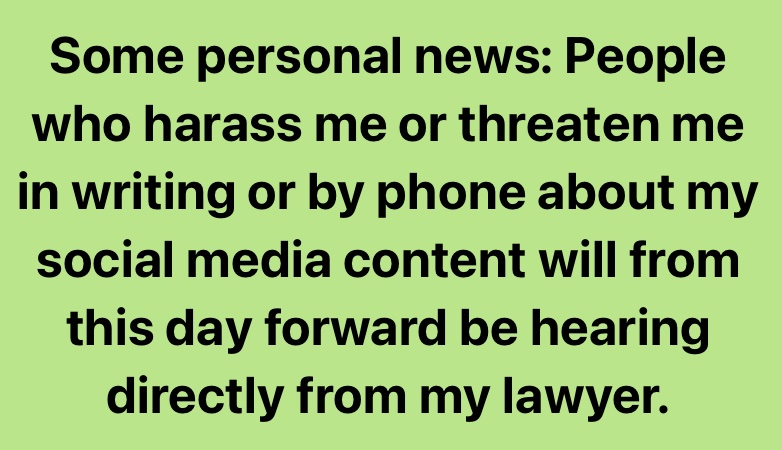
Bakalar, whose trademark on social media is audaciousness, also posted a warning that she will sue anyone who harasses her by writing to her or calling her regarding her social media posts.
She is a former assistant attorney general who was released by the Dunleavy Administration who is suing the Administration because of wrongful termination. She is represented by the ACLU.
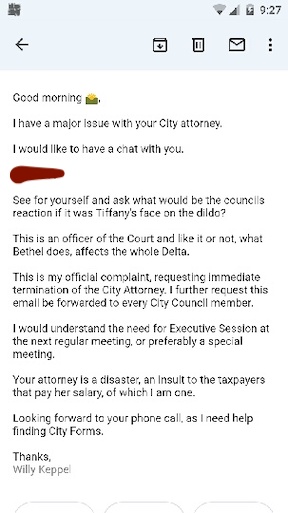
Willy Keppel, a Quinhagaklresident who often comments on political issues, took issue with the post. He asked the City Council of Bethel if it would also be acceptable to put Rep. Tiffany Zulkosky’s head on a vibrator, or it that was just ok for Republican lawmakers.
“This is an officer of the Court and like it or note, what Bethel does, affects the whole Delta,” he said, calling for her immediate dismissal.
As for Reinbold, she has aid on social media she is now better after fighting Covid-19.
The Alaska Democrats have been flirting with the idea for months, but with special session after special session of the Legislature, they haven’t been able to launch Alaska State Sen. Elvi Gray-Jackson of Anchorage as their candidate for U.S. Senate. The fourth special session of the year is still under way, even though few are paying attention to no-show legislators.
Over the course of the summer, Gray-Jackson has changed up her edgy, spiked hair style to something more … senatorial. The Alaska Democratic Party has been putting out social media surveys to lay the groundwork for her, trying to build her statewide name recognition.
Before and after the senatorial makeover.
In the latest edition of the Alaska Democrats’ official newsletter, the party makes it clear that she is their preferred candidate.
“Wonder who’s running as a Democrat for Senate and U.S. Representative? We get that question a lot, and we know it’s tough to be patient. But know that we’re working behind the scenes fitting Democrats into the best seats, waiting for redistricting maps to be finalized, and doing all the prep work behind the scenes to run successful races. But if you want to encourage things along, here’s something you can do,” the newsletter says.
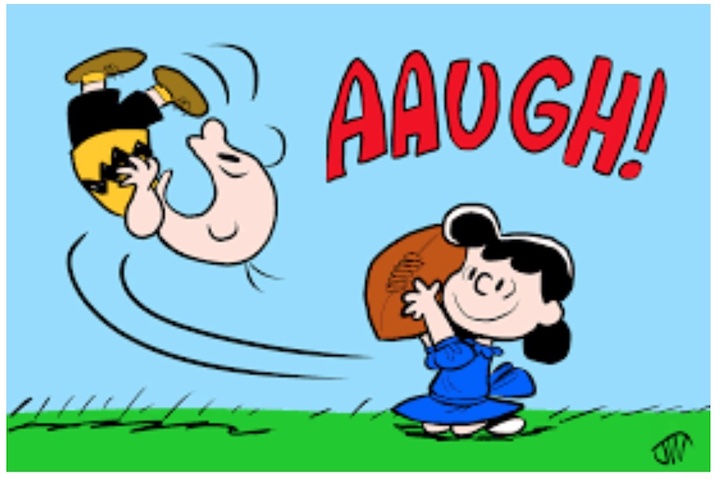
“First – does the thought of having State Sen. Elvi Gray-Jackson representing Alaska in the U.S. Senate excite you? We have reasons to believe with the right candidate, this is a winnable race for Democrats, FINALLY! Just think of it… A Senator who doesn’t bob and weave, no tiptoeing around positions, no more equivocating and backtracking, no being ‘concerned’ and then doing the wrong thing. No more being Charlie Brown while our Senator is Lucy with the football,” the party writes, describing their disillusionment with Sen. Lisa Murkowski.
The party used an old Charlie Brown cartoon to illustrate their feelings about Murkowski, who is too conservative for the party leadership:
“Elvi is solid. She’s decisive. She says what she means and means what she says. She believes in people, and that they deserve a leader not someone who licks their finger after every question to see which way the wind is blowing. She’s a rock, she’s whip smart, and she works really hard. AND, she’s thinking about running for U.S. Senate,” the Alaska Democratic Party posits. The party has been messaging for months that it is done with Murkowski, a candidate many Democrats have supported over the past two decades, due to her pro-choice position on abortion, and other stances.
This up-and-coming Senate candidate is the same Gray-Jackson who has authored legislation that some view as anti-police and anti-public safety.
She also authored legislation this year to make Juneteenth made into another official legal holiday for State of Alaska workers, shutting down government for a day and paying state workers to play. This summer Congress passed similar legislation that allows federal workersto take Juneteenth off.
Some of the legislation Gray-Jackson has authored that has not passed this year is SB 1, use of force by peace officers; SB 2, relating to how police de-escalate situations; SB 3, mandating officers must give warning before shooting a firearm; SB 4, use of force and ban of shooting from a moving police vehicle; and SB 5, the Juneteenth holiday for state workers.
Gray-Jackson represents the Anchorage midtown, Spenard, and U-Med District in the Alaska State Senate; she ran for former Sen. Berta Gardner’s seat when Gardner retired. She also anchors the far left of the Alaska Democratic Party in a state that voted for Donald Trump for president by 53 percent.
It’s unclear what Gray-Jackson will be able to do in the way of campaigning, since that is prohibited for legislators while they are in session. Will she resign in order to run for U.S. Senate?
Gray-Jackson has a long career in politics. Before joining the Alaska Senate, she was on the Anchorage Assembly for several terms, and she was an Assembly aide before that.
A Republican candidate, Kelly Tshibaka, has won the Alaska Republican Party endorsement and is already campaigning hard. She will appear on the brand-new open primary ballot on Aug. 16, 2022. Sen. Lisa Murkowski has not yet declared her candidacy, although she, like all members of Congress, keep their campaign accounts alive at the Federal Election Commission, and she has continued to raise millions of dollars.
The general election is a ranked-choice voting scenario with the top four winners from the August primary on the ballot Nov. 8, 2022.
U.S. Senator Dan Sullivan sent a letter to President Joe Biden last week, taking the Administration to task over the Covid-19 vaccine mandates that he has ordered for 80 million or more Americans.
Sullivan, along with Tommy Tuberville (R-Ala.), Mike Braun (R-Ind.), Cynthia Lummis (R-Wyo.), Deb Fischer (R-Neb.), Steve Daines (R-Mont.), Roger Wicker (R-Miss.), John Barrasso (R-Wyo.), Mike Lee (R-Utah), and Marsha Blackburn (R-Tenn.) wrote that the threats against workers by the president lack precedent and legal and constitutional authority. The executive order imperiling the jobs of millions of workers and economy of America.
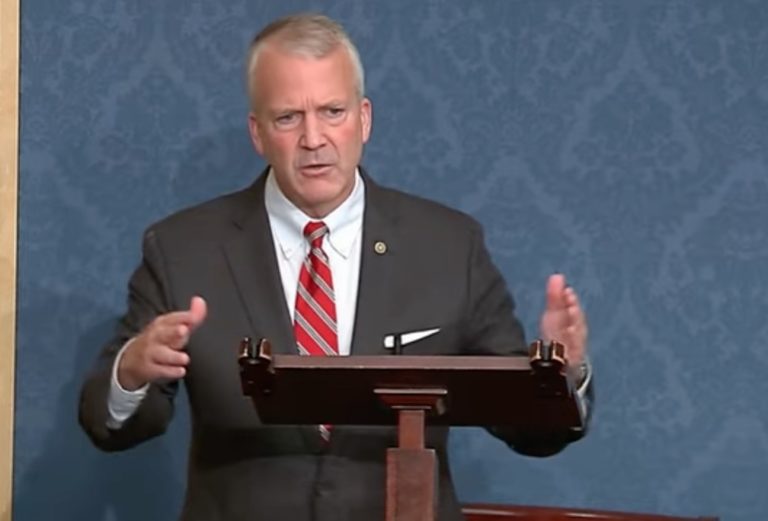
Sen. Sullivan also spoke on the Senate floor in opposition to the administration’s vaccine mandates and imploring employers to not fire their workers until inevitable litigation is heard.
Sullivan said he has heard a lot about the issue of Covid-19 vaccines when he travels across Alaska.
“This goes to constitutional authority and it goes to what I believe it means to believe an American,” he said.
“In essence what he has said in this executive order … is that employers need to have all their employees vaccinated by a certain date, or they’re gonna be fired,” Sullivan said. “That’s the president of the United States saying he has that power to force employers to make their employees decide between a vaccination or putting food on the table for their families. Vaccination or you’re fired,” Sullivan said on the Senate floor.
“This is unprecedented. Never before has a president claimed the authority to actually to this.” he said. “Private employers who have some connection to the federal government or otherwise, tell your employees get vaccinate or you’re fired — I don’t even think it’s the close call as to whether the president has the constitutional authority to do this.”
He said it shows contempt for hard-working Americans, typical of leftists, he added.
Sullivan said that the president’s order would have millions of American fired on Dec. 8, just before the holidays.
The senators’ letter also said:
“Firing hardworking Americans who choose not to get vaccinated not only undermines the significant work Congress and the Trump Administration did to save millions of jobs, it also exacerbates the workforce shortages employers are already facing. The disappointing economic data released by your own Administration outlines the serious nature of this issue. The demand for workers is strong, but there are simply not enough workers to fill positions. Forcing employers to terminate loyal employees who are willing to work when businesses are facing significant challenges in hiring—and after Congress has invested trillions to save their jobs—is nonsensical.
“Your actions have put businesses and hardworking Americans in an unnecessary bind. Both your Executive Order and the OSHA rule disregard public input and instead use coercion to force implementation of the vaccine mandate. In particular, Executive Order 14402 side steps the public rulemaking process required under the Administrative Procedures Act in favor of using agency guidance. Similarly, OSHA is releasing an Emergency Temporary Standard, which bypasses the public process. Both mandates are an extreme abuse of power, and those who are most negatively impacted have not even been afforded an opportunity to provide comment.
“Beyond sidestepping public input, the mandate on contractors does not include an option for testing in lieu of a vaccine, making it particularly onerous and discriminatory. Instead, businesses who receive federal contracts will be required to submit to an even higher standard than OSHA is expected to require for other private sector employers. In addition, neither mandate considers natural immunity.
“We all want to put this pandemic behind us for the benefit of our health, our families, and our economy, but we cannot lose sight of the massive, negative impacts that your mandates will have on hardworking Americans and their families. We urge you to change course for the sake of hardworking Americans and their families.“
The International Brotherhood of Electrical Workers Local 1547 says it’s aware that some employers are going to demand its members be vaccinated for Covid-19, because of anticipated rules from the Biden Administration, which are not yet fully published.
“Simply put, we will continue to insist that employers bargain with us regarding rules that affect you, our members,” the union wrote in a press release. “We are prepared to utilize all legal methods to bargain over the impact of such orders. We have been and will continue to distribute Request to Bargain letters to employers that are impacted by these regulations.”
A petition was circulated in Anchorage this week titled “Local 1547 Members for Medical Freedom,” and directed at IBEW Local 1547 leadership.
“The petition referenced the anticipated OSHA regulation for a vaccine mandate for employers of over 100+ employees. This OSHA regulation has not been released yet. The petition also references the perceived actions of five other IBEW locals and their alleged ‘stand against a vaccine mandate,” the union said.
The local unions in the five other jurisdictions have filed unfair labor practice charges with the National Labor Relations Board.
“This is a legal process by which the Local union requests to bargain after employers in their state implemented changes to terms and conditions of employment without bargaining with the union. If this happens here in Alaska. IBEW Local 1547 will do the same.” the union said.
“We have not and will not approach an employer asking them to adopt a vaccine mandate. However, when an employer approaches us with a vaccine mandate, we will continue to insist that they bargain over the policy. Our bargaining options are more limited when the employer is acting pursuant to a customer requirement or a federal law. But even in those cases, we have and will continue to demand that the employer bargain with us over the policy and will seek to limit the impact on employees to the greatest degree possible,” the union said.
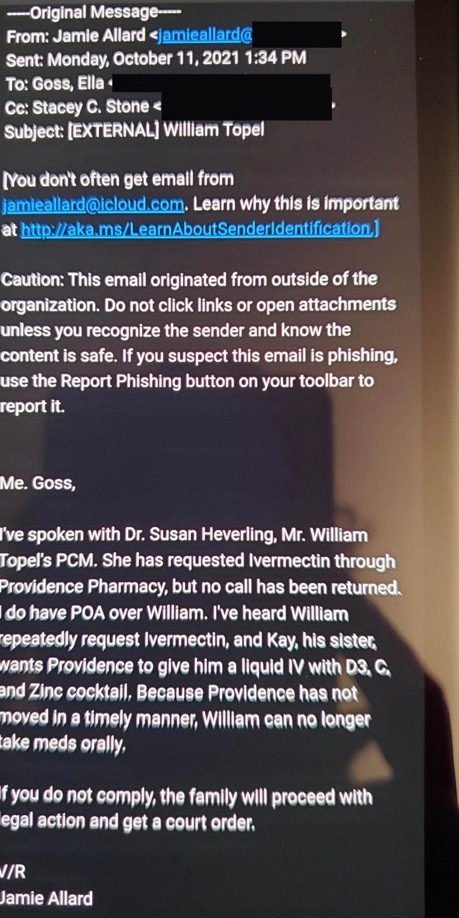
Medical information about a patient under the care of Providence Alaska Medical Center was released to an Anchorage blogger, with the apparent intention of damaging the reputation of the patient’s legal medical power of attorney.
That medical power of attorney was Anchorage Assemblywoman Jamie Allard, who was trying to help conservative activist Bill Topel, who was then in grave condition due to Covid-19. Topel died two days later on Oct. 13.
Allard, in a note to Ella Goss, the CEO of Providence on Oct. 11 pictured above, said that Topel wanted to try Ivermectin and an infusion of vitamins and minerals.
Allard said his condition was too fragile at that point for him to take the medicine orally, and she was asking for his right to try the infusion method.
That note to Goss contained medical details about a patient. When Goss leaked it to the blogger, she violated that patient’s rights under the HIPAA law, which protects patients’ medical information.
Providence had weaponized personal medical information about one of its patients in order to stop what it perceived as harassment from Topel’s friends and to push back on the strong advocacy by Allard.
HIPAA, the Health Insurance Portability and Accountability Act of 1996, is a federal law that prohibits sensitive patient health information from being disclosed without the patient’s consent or knowledge.
The blog, armed with that letter from Allard to Goss, wrote the story about how Allard had relayed to Goss that Topel’s family would take legal action if the hospital didn’t respond. The story characterized Allard as threatening a lawsuit, and that characterization was repeated in a national blog, The Daily Beast, which headlined its story, “GOP Pol Waged Insane Battle to Treat Dying COVID Patient With Ivermectin.”
Only three people had that email — Allard, attorney Stacey Stone, and Providence CEO Goss. Only Goss had the motive to send it to a hostile blog, but that may have been done through an intermediary. Stone ultimately was not Allard’s attorney on this matter; her attorney is Mario Bird.
From appearances, the act falls into a criminal category.
“The minimum fine for willful violations of HIPAA Rules is $50,000. The maximum criminal penalty for a HIPAA violation by an individual is $250,000. Restitution may also need to be paid to the victims. In addition to the financial penalty, a jail term is likely for a criminal violation of HIPAA Rules,” according to the HIPAAJournal.com.
“Civil penalties for HIPAA violations start at $100 per violation by any individual who violates HIPAA Rules. The fine can rise to $25,000 if there have been multiple violations of the same type. These penalties are applied when the individual was aware that HIPAA Rules were being violated or should have been aware had due diligence been exercised. If there was no willful neglect of HIPAA Rules and the violation was corrected within 30 days from when the employee knew that HIPAA Rules had been violated, civil penalties will not apply,” the journal explains.
“Criminal violations that occur as a result of negligence can result in a prison term of up to 1 year. Obtaining protected health information under false pretenses carries a maximum prison term of 5 years. Knowingly violating HIPAA Rules with malicious intent or for personal gain can result in a prison term of up to 10 years in jail. There is also a mandatory two-year jail term for aggravated identity theft,” according to the journal.
The National School Board Association’s board of directors has apologized for a letter it sentto President Joe Biden on Sept. 29, which called for immediate federal law enforcement action against unruly parents who attend school board meetings and protest the policies being passed.
The apology is meant to calm a growing movement by local and state school boards to disconnect from the national organization, which has pushed many of the radical theories that parents increasingly are concerned about, such as Critical Race Theory. In the letter, the NSBA said school boards were under “immediate threat” by parents that required the Department of Justice to deal with the “growing number of threats of violence and acts of intimidation occurring across the nation.”
The letter referred to “acts of malice, violence, and threats against public school officials” and “…the classification of these heinous actions could be the equivalent to a form of domestic terrorism and hate crimes,” read the letter. The NSBA asked the Biden Administration to “examine appropriate enforceable actions” including the Patriot Act, which is used to track down terrorists.
The governing board of the Pennsylvania School Boards Association left NSBA after the letter; and soon it became clear the NSBA was facing a mass exodus from its conservative members.
“To be clear, the safety of school board members, other public school officials and educators, and students is our top priority, and there remains important work to be done on the issue. However, there was no justification for some of the language included in the letter. We should have a better process in place to allow for consultation on a communication of this significance. We apologize also for the strain and stress this situation has caused you and your organization,” the board wrote in its Oct. 22 apology to members.
Across the country, parents have objected to things like the rise of the use of Critical Race Theory in classrooms. CRT is a belief system that categorizes white people as inherently racist, and it is a theory promoted by NSBA. Other parents have objected to the masking of their children day after day in school or other Covid-19 related policies.
U.S. Attorney General Merrick Garland had responded to the Sept. 29 letter with his own threat against parents and community members who take part in the public process. On Oct. 4 he said he had ordered the FBI to investigate “a disturbing spike in harassment, intimidation, and threats of violence against school administrators, board members, teachers, and staff.”
In Anchorage, the only conservative on the Anchorage School Board proposed a resolution last Tuesday that condemned the National School Board Association for apparently coordinating with the White House and Department of Justice to send federal investigators to intimidate, or arrest angry parents.
Anchorage School Board member Dave Donley didn’t seek to go so far as some school boards around the country, which have left the national organization.
He only wanted the Anchorage School Board to make a statement that said it honors parents’ input, condemns the NSBA characterization of parents and the suggested use of force by federal agents, and does not believe using the FBI as a tool against local protesters is appropriate. He believes local school boards can provide their own security at their meetings.
Donley’s resolution to condemn the actions of the national school board group was buried in a committee by Anchorage School Board Chair Margo Bellamy.
It’s mid-October and I should be watching postseason baseball, and I would be if Major League Baseball had not aligned itself with protesters and All-Star Game boycotts, and ruined my 50-year obsession.
But I still have wonderful memories of the early 1970s, a time just before I discovered girls, when innocence ruled my life and baseball was about base hits, batting averages, and double plays. In those days, many big league ballplayers still worked odd jobs during the Winter months, and baseball cards were ten cents a pack and came with a stick of pink bubble gum that was full of sugar and so hard it sometimes cracked our sugar-laden teeth when we bit into it.
At 10 years old in 1972, I — as a good, red-blooded American boy — followed baseball religiously. Only two years prior, my big brother, Rick, taught me how to read box scores and The Standings, and I was astonished to learn that big league ballplayers actually got paid real money to play the game.
The September 1970 edition of Sport magazine had Johnny Bench on the cover, asking if he would be baseball’s first $200,000 player. For perspective: the minimum Major League salary in 2021 is $570,000, and the average salary is over $4 million.
But enough about the money part of the game. It’s the romance of it all that takes me back – back to Oct. 18, 1972.
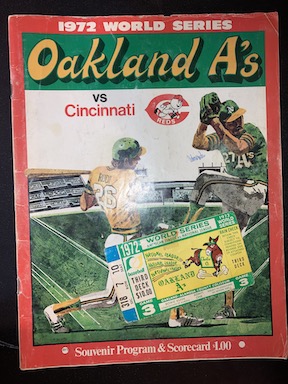
My Ol’ Man had an accounts receivables business in San Jose, California, the heart of what is now Silicon Valley. As a business investment, he purchased two World Series tickets for each of the three home games in Oakland, as the A’s – that “other team” across the bay from San Francisco – had won the American League championship. The tickets were in the third deck, but they were smack dab behind home plate, and they made pretty nice perks for his business clients.
My Dad was going to take my brother Rick to Game Three, the first game in Oakland after the first two games were played in the National League city . . . which happened to be Cincinnati.
Yep, my beloved Reds won the National League championship that year behind the leadership of Johnny Bench, who’d won his second MVP award in two years. There are few things in the world I would have gladly given to attend that game, including various limbs, organs, and appendages.
But I was only 10. Rick was 17 and a senior in high school. The tickets for the other two games would be used for business clients. I would have to be content with telling my friends that my Dad and brother went to the World Series. All in all, pretty good bragging rights, but it wasn’t an invitation to the big dance.
On Oct. 17, Rick and Dad drove up to Oakland to watch Game Three in person, and I would scan the TV screen to see if I could spot them in the crowd. Unfortunately, it rained that day, rained so hard that the game was postponed. Rick and Dad would have to drive back up to Oakland the next night to see the re-scheduled game.
There I was, sitting in my fifth grade classroom on Oct. 18 when my teacher received a message that I was to go to the office. My face flushed and my innards turned to ice as I scanned my memory banks for something I’d done that would get me sent to the office. Having been pretty well behaved of late, I was unable to come up with anything, so I was fully prepared to mount a defense of false incrimination against whatever crime I was being accused of.
As I walked into the office, I saw my Dad standing there. Oh, no, they called in the Ol’ Man. This was serious.
Sensing my dread, the school secretary smiled at me as my Dad was saying goodbye to the Principal. What was going on? A sense of confusion overcame my sense of dread.
Dad turned towards me. “How would you like to go to the World Series, Tim?” he asked.
My mouth opened but I had trouble finding my voice. Was that a serious question? “Really? Where’s Rick?” I finally managed to ask.
“He has a varsity basketball game tonight, so he can’t go the game,” Dad said with a smile. He had my tattered PROPERTY OF CINCINNATI REDS T-shirt, my red satin jacket with the white C on the chest, and my plastic Reds batting helmet with him. This was real. “Come one, we gotta’ get going. Game starts at five and traffic will be horrible.”
As we left the office, the always stoic secretary smiled for a second time in two minutes, the first such smiles any student at John Muir Elementary School had ever witnessed.
I was going to the World Series. With my Dad. To see my favorite team.
Inside the car, my Dad handed me a ticket, an actual World Series ticket: Section 318, Row 7, Seat 10. Price? Ten bucks. I taped it to my wall when I got home, and I have it to this day.
Game Three is best known for MVP Bench taking a called third strike after the A’s catcher initially called for a pitchout, but what I remembered most was watching Tony Perez rounding third with what would be the only run of the game, and slipping on the rain-soaked grass.
He got up and made it home, but that scenario a recurrent nightmare for many of us who follow the game: falling down while headed towards home and struggling to get up and make it to the plate. But Tony did make it home and the Reds won, salvaging the Series after losing the first two games in Cincy.
Dad is 93 years old now and his mind is wandering. Two months ago I visited him and Mom in California. Memories come and go with him, and he often asks what day it is or how it’s going in the Marines (I honorably discharged in 1990), but when I mentioned baseball and going to the World Series with him, he perked up, smiled, nodded, and remembered.
And that, my friends, is part of the reason that baseball is so dear to me. It’s full of great memories and bonding, and no matter what MLB does I will always have that part of the game.
Tim Barto is Vice President of Alaska Policy Forum, President of the Chugiak-Eagle River Chinooks Boosters, and late at night often recalls the greatest day of a ten-year-old boy’s life.