Yesterday, June 10, 2026, the House Finance Committee moved House Bill 381 version T As Amended out of committee and on to the House floor. If the House passes the bill, it will move on to the Senate for review, possible amendment, and voting before being returned to the House. HB 381 provides a revised tax structure for the Alaska LNG project and related revenue allocations.
HB 381 enables municipalities to “partially or totally exempt from taxation or provide an alternate tax rate for all or some property related to a natural gas project for a designated period.” Municipalities may also negotiate for an equity interest in lieu of property tax. Rather than the State deciding to unilaterally forego property taxes and institute an alternative volumetric tax (AVT) such as suggested in Senate Bill 2001, the House bill allows municipalities to decide the tax structure that works best for them.

According to a presentation by the Department of Revenue (DOR), the “bill is a tax decrease, the magnitude of which depends on municipal decisions, increasing uncertainty.” Although the bill does not provide absolute certainty regarding the tax structure, it does promote local government, placing the tax structuring power firmly in the hands of municipalities.
To be eligible for a potential property tax exemption and AVT, owners of property related to the gasline must commit to the following: 1) deposit $40 million into a designated community impact fund and reimburse impacted municipalities for the impacts of pipeline construction, 2) negotiate a project labor agreement for construction of the gas pipeline, and 3) construct a Fairbanks spur line.
In addition to municipal tax decisions, the State will institute an AVT of $0.15 per 1,000 cubic feet of throughput in place of state property taxes levied on property related to the gasline project. The State would then distribute 100% of the AVT revenue to municipalities, half of which would be distributed in proportion to the miles of pipe laid in those municipalities and the other half on a per-capita basis. The State would retain the unorganized borough’s portion of the revenue, an estimated 31% of the AVT revenue for the pipeline component and zero for other project components.
HB 381 also repeals the Affordable Energy Fund and enables the Legislature to appropriate 20% of certain royalty gas revenue remaining after payment to the Alaska Permanent Fund to the Renewable Energy Grant Fund (established by AS 42.45.045(m)).
The bill potentially creates a new fund, but it would need voter approval: the Alaska Education Fund. The establishment of the Alaska Education Fund would be through a constitutional amendment and therefore requires voter approval. If Alaskans approve the fund, the Alaska Education Fund would receive all remaining state revenue associated with a North Slope natural gas project after payments to the Permanent Fund, to municipalities and communities under the AVT, and to the Renewable Energy Grant Fund.
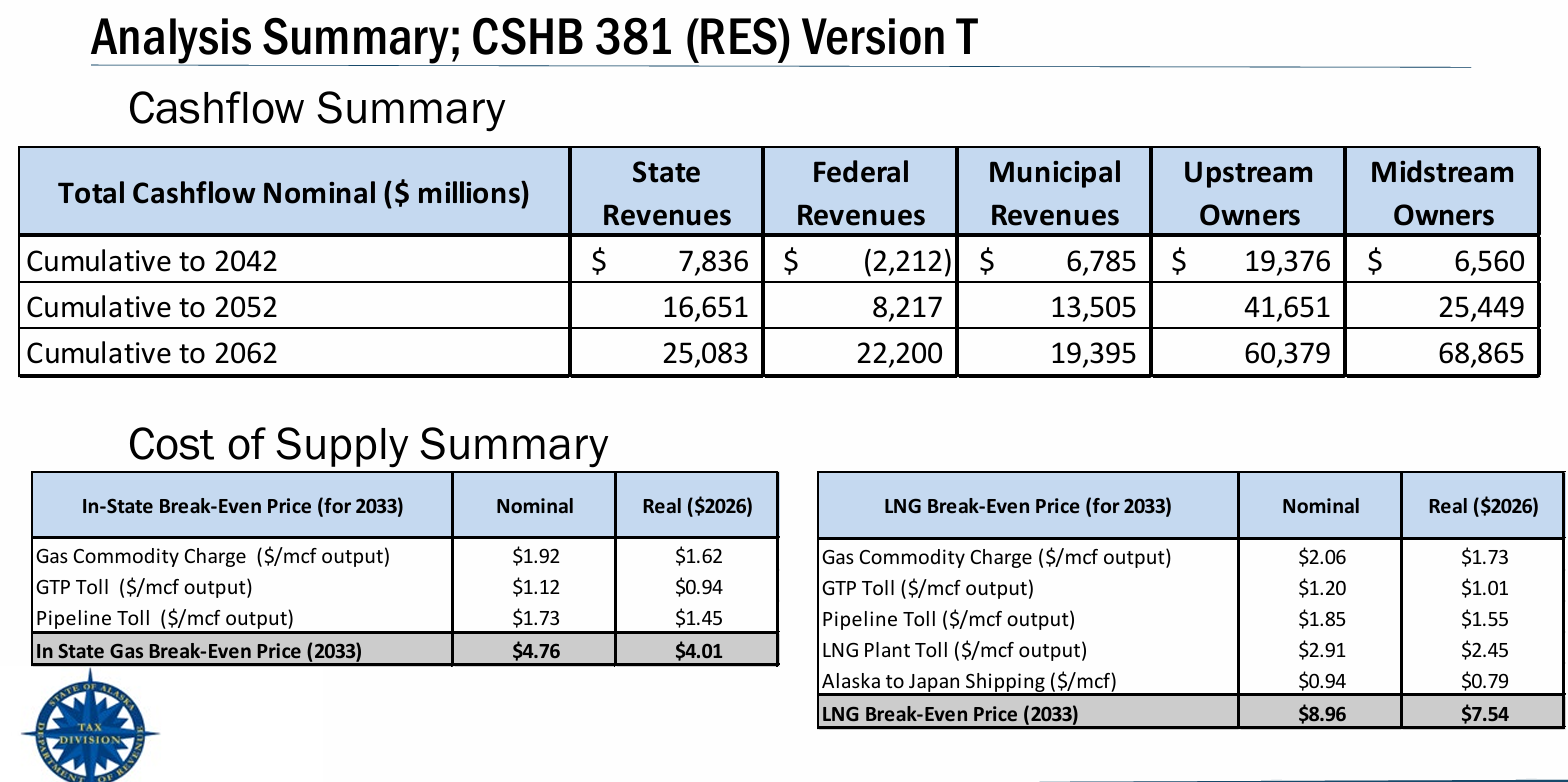
The analysis provided by Acting Tax Director Brandon Spanos and DOR Chief Economist Dan Stickel estimates state and municipal revenues under current tax law, under HB 381 as introduced, and under the version of HB 381 that passed out of committee. HB 381 as introduced decreased both state and municipal revenues to the same degree as SB 280 as introduced. The version passed out of committee (version T) reduces state revenue, but not as much as the original draft of the bill. Conversely, version T increases rather than decreases municipal revenues.
Here is the math put simply:
| State Revenues | Revenue increase with HB 381 as introduced ($) | Revenue increase with HB 381 as passed out of committee ($) |
| 2042 | -2.6 billion | -2.3 billion |
| 2052 | -4.9 billion | -4.2 billion |
| 2062 | -7.2 billion | -4.6 billion |
| Municipal Revenues | ||
| 2042 | -5 billion | 0.5 billion |
| 2052 | -9.2 billion | 1.6 billion |
| 2062 | -13.3 billion | 2.1 billion |
Spanos and Stickel concluded that the bill as passed onto the House floor “would not materially decrease the cost of gas or make the project more attractive to investors,” but it provides “significant benefits for communities.”
With HB 381 version T, the House shows Alaskans a willingness to decrease the State’s own revenues rather than optimizing State revenue as seen in the Senate’s actions with SB 280 during the regular session. Furthermore, the House prioritizes municipal revenues and local government power.
However, the bill also shows the House’s prioritization of renewable energy projects above education funding. The Alaska Education Fund, which requires voter approval, would only receive whatever is left after appropriations to municipalities, the Permanent Fund, and the Renewable Energy Grant Fund. The appropriating of 20% of certain royalty revenues from the gasline project to the Renewable Energy Grant Fund would not require voter approval.
The House Finance Committee includes 5 Republicans, 4 Democrats, and 2 non-affiliated representatives, and the resulting bill passed out of committee reflects a mixture of those political persuasions.
In summary, the bill reflects the conservative priority of local governance mixed with the progressive priority of pursuing renewable energy projects. The bill does not significantly burden investors, but it also does not significantly enhance the project’s attractiveness to investors. If the bill passes, Alaskans will need to consider whether or not the State ought to maintain an Alaska Education Fund, funded by leftover revenue from the gasline project.