Sunday, June 14, 2026
Home Blog Page 772

Alaska House appears at impasse for organizing, as 20-20 split looks like it did three years ago

A memo from the Alaska House Coalition makes it clear that Rep. Louise Stutes, now the Alaska House Speaker, will stay with the bipartisan, Democrat-dominated caucus.

So will Reps. Bryce Edgmon and Neal Foster, both of Western Alaska.

“Our coalition has proven its unwavering support for essential services, protecting our Permanent Fund and savings accounts, and providing sustainable dividends,” said Stutes, a Republican of Kodiak. “Alaskans expect us to be ready to work in January and to get the job done on time. We look forward to working across the aisle with our colleagues in the House and Senate, as well as with the administration on bi-partisan solutions to make that happen.”

“From school closures to record outmigration and a declining economy, the challenges facing our state are monumental, ” said Rep. Bryce Edgmon, who switched a few years ago from Democrat to being without a party. “That’s why I’m proud to stand with a coalition who will work hard to put partisan differences aside on behalf of the best interests of Alaskans across the state.”

Rep. Neal Foster, a Nome Democrat, said, “I’m committed to working with my colleagues in the Alaska House Coalition to ensure these priorities are realized this next session.” He was speaking about public safety, and power cost equalization for rural Alaska communities.

That means there is a nearly impossible path for Republicans in the House to form a majority, which would take 21. Indeed, there are 21 elected Republicans, but Stutes is one of them, and Rep. David Eastman of Wasilla is the other. Eastman cannot be seated as a legislator until a judge decides that he is not a threat to democracy. He has been accused of violating the “disloyalty clause” of the Alaska Constitution due to his membership in a patriot group that was associated with the Jan. 6, 2021 disruption at the U.S. Capitol. His case will be heard this month in the Palmer courthouse.

The  Democrats have 13 seats and no-party candidates have six, including Bryce Edgmon, Dillingham; Daniel Ortiz, Ketchikan; Cal Schrage, Anchorage; Josiah Patkotak, Utqiagvik; Alyse Galvin, Anchorage; and Rebecca Himschoot, Sitka.

All of the no-party candidates are likely to join the Democrats, giving the House coalition 19 members. With Rep. Stutes, that makes 20, creating a 20-20 split with Republicans, a similar situation that happened in 2019. Then, it took the House until mid-February to get a majority coalition, and in doing so, Republicans who stuck with their party were sidelined into minority status. The majority was 21 to 18, with Edgmon as speaker.

There may be Republicans willing to go over to the Democrat-controlled bipartisan coalition, and some have already signaled they are willing to hear an offer. But the bipartisan coalition won’t need but a couple of them, and thus will pick the most malleable, least drama-prone Republicans to woo with choice assignments.

The Senate, although it has a majority of elected Republicans, organized as a Democrat-led majority, with Sen. Gary Stevens, a Kodiak Republican, as Senate President. The Senate majority has all but three senators in it — Sens. Shelley Hughes, Mike Shower, and Robb Myers were left out in the cold, too small of a group to even have acknowledged minority status.

The statement released by the Alaska House Coalition on Monday was the first official statement from the group on any topic since mid-September.

Anchorage Assembly joins school district with proposed taxes to provide child care to fill up empty schools

By DAVID BOYLE

The Anchorage Assembly is about to tax marijuana users and property owners to pay for childcare and pre-K. It has teamed up with the Anchorage School District to levy the taxes for an unproven pre-kindergarten initiative.

Assembly members Suzanne LaFrance and Kameron Perez-Verdia are sponsoring AO 2022-17(S), which they want to be on the April, 2023 ballot.  They cannot do this on their own—they need taxpayers to vote to approve/disapprove a change to the charter so they can push their social agenda.    

Does this push for “free” early education help our children?  Are there data to back this up?  These two Assembly members cite little research to support their position.  

Alabama has had the best pre-kindergarten system for 13 years, according to National Institute for Early Education Research.

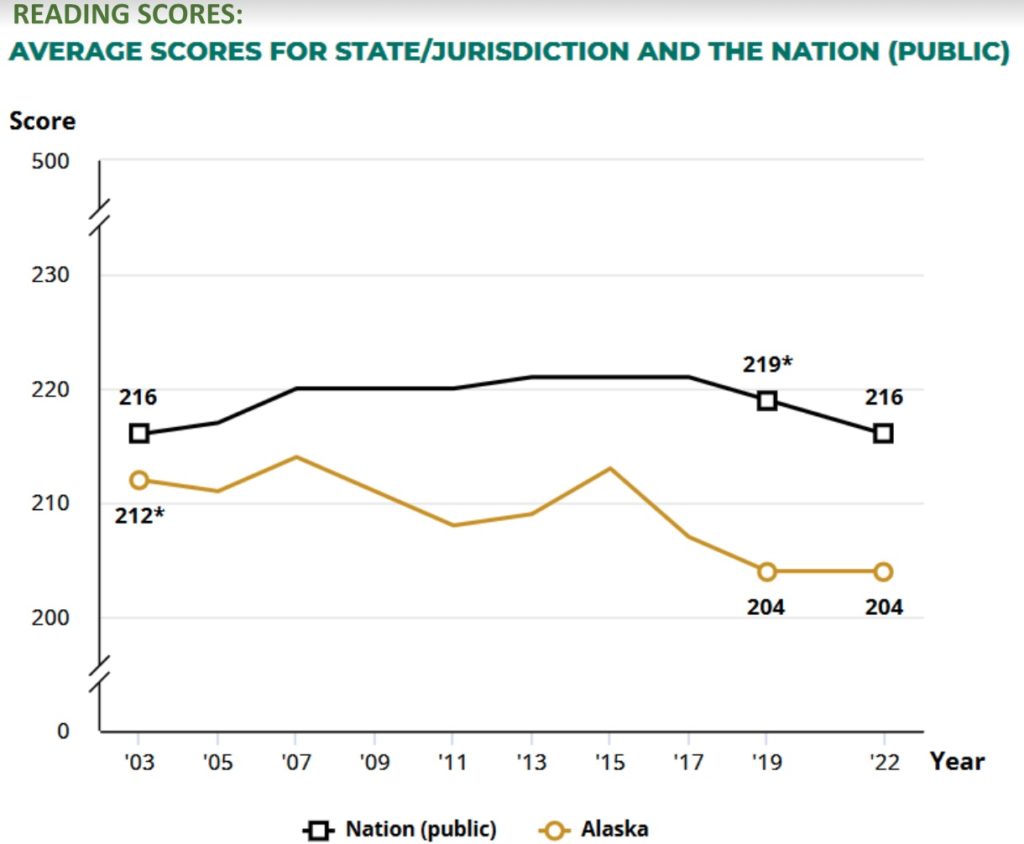
Unfortunately, that investment in high quality has not seemed to pay off in NAEP scores. Over the last 13 years, Alabama has fallen from 47th to 50th in low-income NAEP 4th grade reading scores. Alaska is the only state that scores lower.

They also mention the current economic “crisis” that the Assembly caused by closing businesses and shuttering daycare centers.

They cite the current struggle that families have in feeding their kids and paying bills, not acknowledging this is due to the Assembly shutting down so many businesses for almost two years during the Covid-19 fiasco.

And are families suffering because the federal government has pumped tons of money into the economy, causing rampant inflation?   

The Anchorage Assembly is about to push this daycare and pre-k despite the lack of proof that children would be more ready for kindergarten. 

The Assembly wants to tax marijuana users and property taxpayers for this childcare and pre-K, following Rahm Emmanuel’s quote, “Never let a crisis go to waste.”

The two Assembly members stated they have support from “members across the political spectrum.” However, no mention was made of who they are. The support comes from a coalition of the marijuana industry, educators, non-profits, and businesses.  

The marijuana industry supports this charter change because it is gifted by a freeze on its retail tax of 5% for 5 years.  And the charter change also lowers the maximum tax to 10%.

Here’s the kicker. The marijuana tax will be removed from under the tax cap.  It will be replaced by an increase in property taxes. By removing this marijuana tax from the tax cap, they can raise your property taxes without busting the tax cap.  

But wait — there’s more!  The charter amendment also states that funds from the alcohol tax will also be used to fund this program.

But no worry.  Per the charter amendment, “It will cost less than a latte once a month for a year…”.  

Taxpayers can testify on AO 2022-17(S) on Tuesday, Dec. 6 at the Anchorage Assembly meeting, which starts at 5 pm.  A link to the charter amendment is here.

It’s your money and your latte.

David Boyle is the education writer for Must Read Alaska.

Dunleavy sworn in for second term, Dahlstrom makes history as first Republican woman lieutenant governor

On a snowy December day, Gov. Mike Dunleavy and Lt. Gov. Nancy Dahlstrom were sworn into a four-year term by Judge Paul Roetman of Kotzebue. They each took turns standing before the crowd of about 150 gathered at the Alaska Airlines Center on the campus of the University of Alaska Anchorage and recited their oaths of office. Another 70 watched the ceremony on YouTube.

Roetman had just left the Alaska Judicial Council meeting, where he was being interviewed for the position of Alaska Supreme Court justice, and after swearing in the governor and lieutenant governor privately, in order to meet the constitutionally set noon deadline, swore them in ceremonially at the public ceremony.

Then, Dahlstrom and Dunelavy each gave brief remarks, thanking the people in the room who performed, organized, and who serve Alaskans in various capacities.

Dunleavy spent over 90 seconds thanking his wife Rose and his daughters for their steadfast support. “I couldn’t do this job without her,” he said, adding that Rose is strong, supportive and relaxed, even when times get difficult. He gave her a bouquet of flowers and noted that they recently celebrated their 35th wedding anniversary.

Dunleavy mentioned that there had been fires, earthquakes, a pandemic, and at times his commissioners probably wondered “what’s next, locusts?” He thanked his staff and the 22,000 workers of the State of Alaska. He said he hoped to have a grandchild to bounce on his knee someday, and that he would be able to look at that child and know he had left the state in great shape for future Alaskans.

The attendance was dwarfed by the size of the venue, but spotted in the crowd were very few legislators, including Rep. Cathy Tilton, Rep. Kevin McCabe, Sen. Mike Shower, Sen. Gary Stevens, Anchorage Mayor Dave and Deb Bronson, Alaska Energy Authority Executive Director Curtis Thayer, Alaska Republican Party Chair Ann Brown and National Committeewoman Cynthia Henry. Nick Begich, who ran for Congress in this election cycle, was in attendance.

Not in attendance was Lt. Gov. Kevin Meyer, who is finishing out a 29-year career of public service and who was thanked by Gov. Dunleavy for his service to Alaska.

For Gov. Dunleavy, it was his second swearing-in. His first, four years ago, took place in Kotzebue at the high school gymnasium. It was scheduled to take place in Noorvik, Rose Dunleavy’s hometown, but the planes couldn’t fly due to fog, and so the swearing in was an impromptu event, and a party was held in Noorvik.

Doctor-assisted suicide becomes government-suggested suicide in Canada, as Trudeau’s death culture expands

Canada’s Veterans Affairs office offered to assist a veteran in committing suicide after she asked to have a wheelchair lift installed in her home, the woman told the House of Commons Veterans Affairs Committee last week.

Christine Gauthier, a retired corporal and competitor representing Canada at the 2016 Paralympics in Rio de Janiero, testified to lawmakers that a VA official had offered in writing to provide her with an assisted suicide kit, which contains medication for someone to end their own lives. Gauthier had been fighting for a wheelchair lift for her home for five years.

“I have a letter saying that if you’re so desperate, madam, we can offer you MAID, medical assistance in dying,” Gauthier said in a hearing before the House of Commons veterans affairs committee, as reported by the CBC.

The case officer remains unnamed but reportedly made similar offers to at least three other veterans, Canadian news outlets reported over the weekend.

The head of a wounded warrior group that supports Canadian veterans says he was horrified to hear of the incident, but it’s not an isolated story. In August, officials confirmed to CBC News that they issued an apology to a veteran who called for counseling, only to get a recommendation by the counselor that he could get assistance with dying. 

As many as five Canadian military veterans seeking help for post traumatic stress disorder were offered option of MAID by at least one Veterans Affairs Canada caseworker, and the matter is now in the hands of the Royal Canadian Mounted Police for investigation; the caseworker known to have offered the suicide program is on leave.

MAID is the acronym in Canada for medical assistance in dying. Earlier this year, the practice was legally expanded to be available to those with mental illness; it has been available to terminally ill people since 2016, after in 2015 the Canada Supreme Court ruled in Carter v. Canada that parts of the Criminal Code would need to change to satisfy the Canadian Charter of Rights and Freedoms. The parts that prohibited medical assistance in dying would no longer be valid. The Supreme Court gave the government until June 6, 2016, to create a new law. Read about the history of the MAID laws at the official Canadian government website.

In 2017, researchers in Canada said that doctor-assisted suicide could reduce annual health-care costs by as much as $136.8 billion, according to a report in the Canadian Medial Association Journal.

The savings would far exceed the estimated cost of the MAID program, which was then estimated to be up to $14.8 million a year.

“The take-away point is that there may be some upfront costs associated with offering medical assisted dying to Canadians, but there may also be a reduction in spending elsewhere in the system and therefore offering medical assistance in dying to Canadians will not cost the health care system anything extra,” said Aaron Trachtenberg, an author of the report and a resident in internal medicine at the University of Calgary.

The use of medically assisted suicide keeps expanding in Canada, where health care is socialized, difficult to access, and costly to the public. MAID deaths now comprise nearly 5% of all deaths in Quebec and British Columbia, while in 2020, the doctor-assisted suicides were only 2.5% of all deaths.

It gets worse: Canadian fashion retailer Simons began promoting the Canadian euthanasia program with an ad that focused on the beauty of self-deletion.

The video ad, “All is Beauty,” featured a woman who opted for the program in advance of ending her life. After she starred in the ad, she killed herself, according to her plan. The ad is being criticized for glamorizing suicide and indeed makes it look like a very lovely choice.

A still shot from the ad “All is Beauty” by the Simons fashion retailer in Canada. The ad has been replaced with a Christmas-themed ad for the holidays.

The euthanasia program is now is being recommended by some doctors for disabled babies up to one year of age.

Dr. Louis Roy, of the Collège des médecins du Québec, or Quebec College of Physicians, told the House of Commons’ Special Joint Committee on Medical Assistance in Dying on Oct. 7 that it’s an appropriate alternative for infants who have “severe malformations” and “grave and severe symptoms” and whose “prospect of survival is null, so to speak.”

Krista Carr, executive vice-president of Inclusion Canada, a disability rights group, said infants cannot give consent and doctors’ predictions are “far too often based on discriminatory assumptions about life with a disability.” She called the killing of babies “murder.”

Craig Campbell: Republican Party change comes through action

By CRAIG CAMPBELL | ALASKA REPUBLICAN PARTY NATIONAL COMMITTEEMAN

This past Saturday the Alaska Republican Party State Central Committee met for our regular quarterly meeting.  This was the first meeting since the November elections that provided an opportunity to review what worked and what didn’t work in this first-ever, ranked-choice voting process.  

There’s been a lot of social media frenzy about the actions taken by the State Central Committee on Saturday, mostly by people reacting with emotional rhetoric who have not been actively engaged with the party this past year.  So let me provide some background and information on the basis for the SCC vote to sunset the Alaska Republican Party censures of Sen. Lisa Murkowski and state Sen.-elect Kelly Merrick.    

Sen. Murkowski and then-Rep. Merrick were censured for their actions that were either not in accordance with the ARP Platform (Murkowski), or for joining an Alaska State House bipartisan coalition after having pledged not to do so to her district leadership during the election cycle of 2020 (Merrick).  

Despite those censure actions, both individuals won their respective election in 2022.  

It was concluded by a majority of the SCC members on Saturday that the censures were ineffective. While the censure actions may have sent a message that the ARP disapproved of Murkowski’s and Merrick’s actions, the censures did not change votes. In fact, in the case of Sen.-elect Merrick, the ARP censure action may have actually contributed to her victory. Therefore, the SCC members decided to sunset the censures and place a moratorium on any further censure actions until after the April 2024 Alaska Republican Party State Convention, when all delegates for the ARP will gather in Anchorage and can consider how our party should support, or not support, Republicans in the 2024 election. 

While some have characterized this action as “Admitting defeat,” it could more accurately be characterized as recognizing that the censure tactic did not work. Since it didn’t, it’s time for the party to develop a different strategy to encourage Republicans to support the party platform and form Republican majorities when Alaskans elect a numerical majority of Republicans to the state House and Senate. 

This leads me to the leadership issue. Many social comments blame the Alaska Republican Party for the failure of this past election. While nothing is ever perfect, the Alaska Republican Party worked hard during this election cycle to get Republicans elected. This included withholding support for Republican candidates who had been censured. We had the largest get-out-the-vote program ever conducted by the party in Alaska: we used rapid response media blasts when Republican opponents made dishonest statements about our candidates, we had active phone banking, we gave monetary support to candidates, we conducted an effective poll watching program, we had an election day hub monitoring the election, and we were active vote count observers. We wanted to ensure election integrity in 2022.

I hear some Republicans say they are leaving the Alaska Republican Party because leadership “caved” to the moderates. That is factually wrong. Let me explain party leadership. It starts at the local level. Alaska Republican Party leadership consists of those Republicans elected by Republicans in each of our 40 districts statewide, plus each district gets a bonus vote when that district has a Republican House representative. All in all, the State Central Committee has upwards of 90 members, all elected in local districts by those registered Republicans who participate in the district conventions. 

The Alaska Republican Party chair, vice chair, national committeewoman, finance chair, treasurer, secretary, and national committeeman are also active members of the State Central Committee. Therefore, actions taken by the SCC are based on a vote by the majority of members who come from the 40 different districts.  Alaska Republican Party leadership did not “cave,” rather it conducted a vote of SCC members, which determined the outcome.  

To those who disagree with the SCC actions this past Saturday, I put out a challenge: 

  • Get active with the Alaska Republican Party; 
  • Attend your district meetings; 
  • Get elected district leader or bonus vote; 
  • Attend the quarterly State Central Committee meetings and the state convention; 
  • Nominate and support the people you feel would best lead the Alaska Republican Party; and 
  • Make your voice heard through action.  

Sniping on social media is not the way to change the Alaska Republican Party.  It’s your party, you can lead it in a conservative, moderate, or any other manner as the majority of the State Central Committee members determine. Instead of quitting, get involved. 

Craig Campbell, former lieutenant governor of Alaska, is the Alaska Republican Party’s national committeeman and serves on the Republican National Committee.

Religious liberty at Supreme Court: Can a designer be forced to design a same-sex wedding website?

The U.S. Supreme Court will on Monday hear a free speech case from Colorado testing the question of whether the government can force someone to affirm same-sex marriage as they go about their daily vocation.

Colorado graphic artist and web designer Lorie Smith challenged Colorado’s anti-discrimination law, which the state uses to force businesses to affirm same-sex marriage.

The law has already been used to attack wedding cake baker Jack Phillips, who refuses to bake wedding cakes for same-sex couples or to celebrate “transitioning” of transgenders with special cakes.

Smith says that she is also finding her free-speech curtailed because she wants to start designing wedding websites, but fears the government will force her to create them for same-sex couples, which is not consistent with her faith.

The Supreme Court already ruled once in the case of Phillips, but it was a narrow ruling, leaving Phillips the subject of additional attacks from LGBTQ activists.

Smith and Phillips both are arguing that they are using their creative talents to express their Christian beliefs and they should not be forced to work on projects that violate those beliefs.

“Jack [Phillips] was targeted by the law for declining to create a custom cake celebrating an event that went against his religious convictions. The Colorado Civil Rights Commission tried to punish Jack because of his Christian faith. While the commissioners allowed three other cake artists to decline cakes expressing messages that offended their secular beliefs, they denied this same freedom to Jack. Some members of the commission even made hostile statements against Jack, calling his religious-liberty defense “a despicable piece of rhetoric” and compared that defense to ones used to justify the Holocaust and American slavery,” Alliance Defending Freedom wrote. ADL has defended Phillips all the way to the Supreme Court.

The Supreme Court, in its ruling in favor of Phillips, condemned Colorado’s “clear and impermissible hostility toward [Phillips’] sincere religious beliefs” in a 7-2 decision in 2018.

But because the free-exercise-of-religion violation was clear, the court didn’t address whether Phillips’ free speech rights were violated. That left Phillips subject to harassing legal attacks, and he is now facing a new, nuanced legal battle.

It is the same law that threatens Smith: “The State reads its law as even banning Lorie from explaining on her business’s own website what designs she can create consistent with her religious beliefs. But she should be free and empowered to live out her calling. If we want entrepreneurs like Lorie to pursue their dreams, the government must respect their freedom,” ADL writes.

The U.S. Court of Appeals for the 10th Circuit issued a ruling that says the state can indeed compel Lorie to express messages that contradict her religious beliefs. The U.S. Supreme Court agreed earlier this year to hear her appeal. The case is 303 Creative v. Elenis, and it is set to be heard by the Supreme Court on Monday, Dec. 5.

In June, numerous groups representing artists, publishers, broadcasters, scholars, and 20 states submitted friend-of-the-court briefs to the Supreme Court asking it to rule in Smith’s favor. Read the Americans for Prosperity Foundation’s brief at this link.

Learn more about the case at Alliance Defending Freedom.

It’s unclear what the recent congressional passage of the Respect for Marriage Act means for people like Jack Phillips and Lorie Smith. They are both fighting Colorado laws that curtail their free speech, but even if they win they might find themselves subjected to federal lawsuits as a result of the new legislation that demands equal treatment for gay marriage.

“Unfortunately, we are aware of case after case where individuals, charities, small businesses, religious schools, and religious institutions are being hauled into courts to defend themselves for living out their faith. These people are not committing hate crimes against their neighbors. No, they’re not abusing peers for their personal choices either. No, they’re being hauled into courts across this country for serving the poor, the needy, and the refugee in compliance with their sincerely-held religious beliefs,” warned Sen. Mike Lee of Utah, who advocated against passage of the Respect for Marriage Act.

Alliance Defending Freedom was the group that defended the Downtown Hope Center in Anchorage, which provides shelter space for women, but turned away a man who was wearing a dress and calling himself a woman. The man and the Anchorage Equal Rights Commission sued the faith-based center for violating the public accommodation ordinance based on alleged gender identity discrimination, but eventually the commission settled with the nonprofit group.

A senior official of the U.S. Justice Department has called Alliance Defending Freedom a hate group.

Alaska Judicial Council holds public hearing on Supreme Court vacancy, applicants

The Alaska Judicial Council will hold a public hearing on Monday, Dec. 5, at 12:30 pm to take public comments on the applicants for an Alaska Supreme Court judicial vacancy.

Members of the public can participate in person at the Boney Courthouse, Supreme Court Courtroom, 303 K Street, Anchorage, or by calling 1-833-928-4610, meeting ID 844 6481 1777

The council is meeting Monday and Tuesday to interview, discuss, and nominate the most qualified applicants for the vacancy due to the forthcoming retirement of Chief Justice Daniel E. Winfree. The position is for justice, while the next chief justice is selected by other members of the Supreme Court for a three-year position.

The council usually recommends two or more names to the governor, who picks one. The governor has very little choice in the matter and often is only given two names by the council, which by design in the Alaska Constitution is dominated by the Alaska Bar Association.

Candidates to be interviewed on Monday include:

  • Jude Pate
  • Paul Roetman
  • Aimee Oravec
  • Dani Crosby
  • Margaret Paton Walsh

Anchorage municipal election season starts with candidates filing with state APOC, and later with city clerk

Brian Flynn, pictured above, has registered to run for the Anchorage Assembly for West Anchorage (District 3) in the April 2023 municipal election. He’ll run for the seat being vacated by Assemblywoman Austin Quinn-Davidson, who will not run for re-election. Anna Brawley, hand-picked by Quinn-Davidson as her successor, will also run for that seat.

Flynn presently serves the Municipality on the Heritage Land Bank Commission, the Zoning Board of Examiners and Appeals, and the Budget Advisory Committee and is the Treasurer for the Bayshore/Klatt Community Council. He is a realtor. His website is flynnforanchorage.com

There are two seats up for election in East Anchorage — one is the Pete Petersen seat; he is term-limited. The other is the seat held by Forrest Dunbar, who won his election to the Alaska Senate last month.

Others are filing their letters of intent with the Alaska Public Offices Commission, including:

  • Irene Boll, School Board
  • Christopher Constant, current Assemblyman, for Assembly, representing downtown; his term expires 2023
  • Karen Bronga, did not report seat; she is a teacher in Anchorage School District.
  • Dave Donley, current School Board member, for reelection
  • Andy Holleman, current School Board member, for reelection
  • Zachary Johnson, Assembly, South Anchorage, the seat now held by Suzanne LaFrance, who has not filed
  • Dayton Ikaika Keliikipi Jr, Assembly, East Anchorage seat
  • George Martinez, Assembly, East Anchorage seat
  • Cliff Murray, School Board
  • Scott Myers, Assembly, for Eagle River seat, being vacated by Rep.-elect Jamie Allard
  • Rachel Ries, Assembly, South Anchorage seat, now held by Suzanne LaFrance. Her website is www.riesforalaska.com
  • Felix Rivera, current Assemblyman, for Assembly midtown

The next regular Anchorage Municipal election ends Tuesday, April 4, 2023. Formal filing with the Anchorage Municipal Clerk opens opens on Friday, Jan. 13, 2023, at 8 a.m. and closes on Friday, Jan. 27, 2023, at 5 p.m. All candidates must also file with the Alaska Public Offices Commission, which regulates campaign finances.

For information on filing for office, including candidate filing packets, visit the municipality’s candidate information webpage here

Appeals Court upholds Air Force personnel against Biden Covid-19 vaccine mandate

9

The U.S. Sixth Circuit Court of Appeals in Ohio unanimously upheld a class-wide injunction protecting unvaccinated U.S. Air Force personnel from being disciplined over their refusal to obey the Department of Defense’s COVID-19 vaccine mandate.

For now at least, the ruling protects 10,000 — or one out of every 50 — service members from punishment for refusing the Covid-19 vaccine on religious grounds. The case will surely be appealed by the Biden administration to the U.S. Supreme Court.

From January through April, roughly 3,400 troops have been discharged for refusal, service personnel officials told lawmakers this Spring. The Air Force had kicked out more than 830 airmen and guardians who refused vaccination as of July 11, according to Air Force Times.

In October, the Air Force began to allow many of those airmen to resume flying.

“The Department of the Air Force has ordered all of its over 500,000 service members to get vaccinated against COVID-19. Some 10,000 members with a wide array of duties have requested religious exemptions from this mandate. The Air Force has granted only about 135 of these requests and only to those already planning to leave the service. Yet it has granted thousands of other exemptions for medical reasons (such as a pregnancy or allergy) or administrative reasons (such as a looming retirement). The 18 Plaintiffs who filed this suit allege that the vaccine mandate substantially burdens their religious exercise in violation of the First Amendment and the Religious Freedom Restoration Act of 1993 (RFRA). Finding that these claims would likely succeed, the district court granted a preliminary injunction that barred the Air Force from disciplining the Plaintiffs for failing to take a vaccine. But its injunction did not interfere with the Air Force’s operational decisions over the Plaintiffs’ duties. The court then certified a class of thousands of similar service members and extended this injunction to the class,” the judges wrote in their ruling.

The lead author of the ruling was U.S. Circuit Judge Eric Murphy, a Donald Trump appointee.

Murphy stated, “”The Air Force cannot rely on its general readiness or health concerns to refuse specific exemptions. In the abstract, the Air Force may well have a compelling interest in requiring its 501,000 members to get vaccinated. It has also largely achieved this general interest, as evidenced by its ability to vaccinate over 97% of its force.”

Murphy wrote that the claims were justiciable because the service members established standing by the nearly nonexistent exemptions granted by the Air Force and intentions by 10,000 to refuse the vaccine.

“The basic facts are undisputed. The Air Force has denied all religious-exemption requests unless a service member has agreed to leave within a certain time, and it has granted far more medical and administrative exemptions. Either the Air Force can justify these policies or it cannot. But the plaintiffs have pointed to specific questions that matter for the class’s claims and that decisionmaker can resolve in ‘one stroke,'” Murphy wrote.

Murphy also said the Air Force is working at cross-purposes in its challenges to both the individual and class-action claims.

“We are asked to deny that common questions exist for purposes of certifying a class but to accept that common answers exist for purposes of rejecting all 18 plaintiffs’ claims on their merits. We decline this inconsistent invitation,” Murphy wrote.

Read the 56-page ruling at this court link.

In October, the Federal Air Surgeon determined that FAA medical certificate holders may not act as pilot in command, or in any other capacity as a required flight crew member, for 48 hours after each dose of the Pfizer-BioNTech, Moderna, Novavax, and Johnson & Johnson vaccines.

Some pilots are reluctant to get the Covid-19 vaccine because of the possibility of side effects such a blood clots.

“The Federal Air Surgeon made this determination after evaluation of available medical information about these COVID-19 vaccines and potential side effects. As a result of this determination and consistent with 14 CFR § 61.53(a), each person subject to part 67 who receives the vaccine must wait 48 hours after each dose before acting as pilot in command or as a required flightcrew member.,” according to the FAA, in one of the first official recognitions that there may be problems with some of the vaccines for those who fly.

The mainstream media has disputed that Air Force pilots have been resigning due to the mandates. Read the Reuters story here.

Read the FAA warning here.