By Marcus Moore
Originally published in “Rants from Alaska,” the author’s personal Substack, on August 6, 2026, edited by Must Read Alaska.
What the H- E- double hockey sticks did they serve at that AEDC Economic Outlook Luncheon last week?
The way they spun Anchorage’s “slow growth” story was next-level gaslighting, and now that I have gone through the report line by line, I can prove it.
They stood up there talking about optimism and shifting sectors while the city bleeds people, schools collapse, and the one BIG UPSIDE they are pinning down as the whole forecast of Anchorage’s future is not even based on real money yet.
The facts are a population still sliding from the 2013 peak; net out-migration, year after year, for over a decade; and a 7,500-student freefall from Anchorage School District, which gets treated like an afterthought. That is not analysis. That is stagecraft for the people who wrote the check for the room.

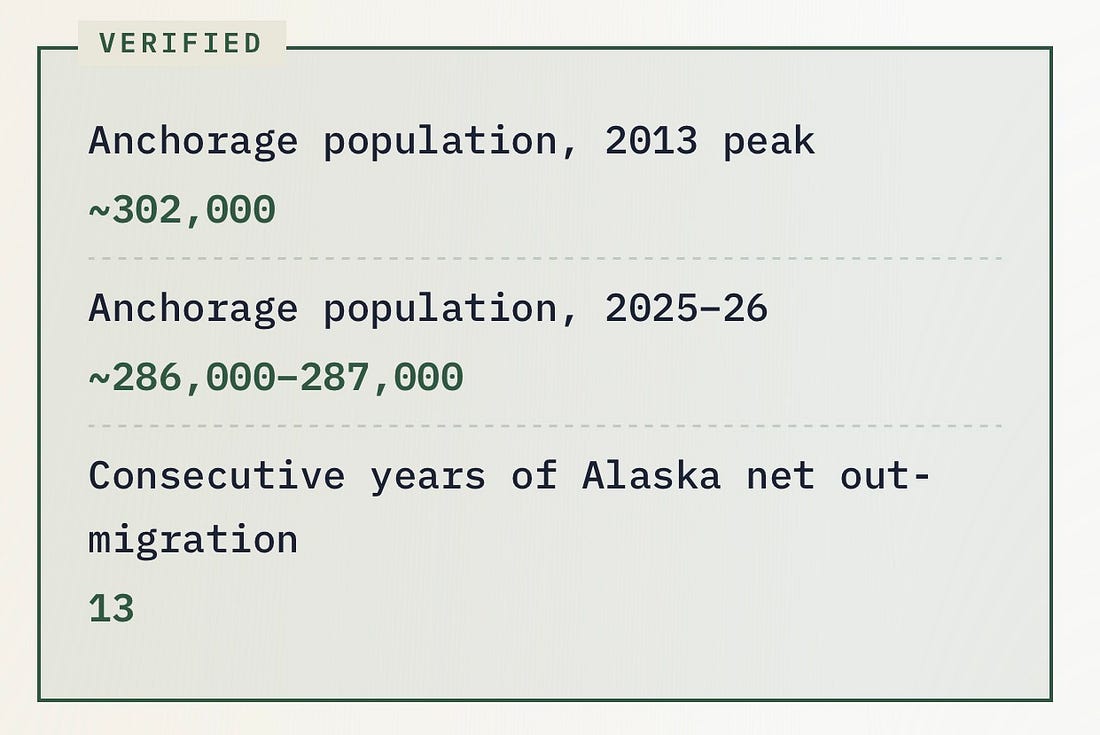
Anchorage peaked at roughly 302,000 people in 2013. It is now sitting around 286,000–287,000. Alaska just logged its 13th consecutive year of negative net migration statewide, the longest losing streak since 1945. This is not a bad quarter. It is a structural bleed that predates COVID, predates the oil bust, predates every excuse in the deck.

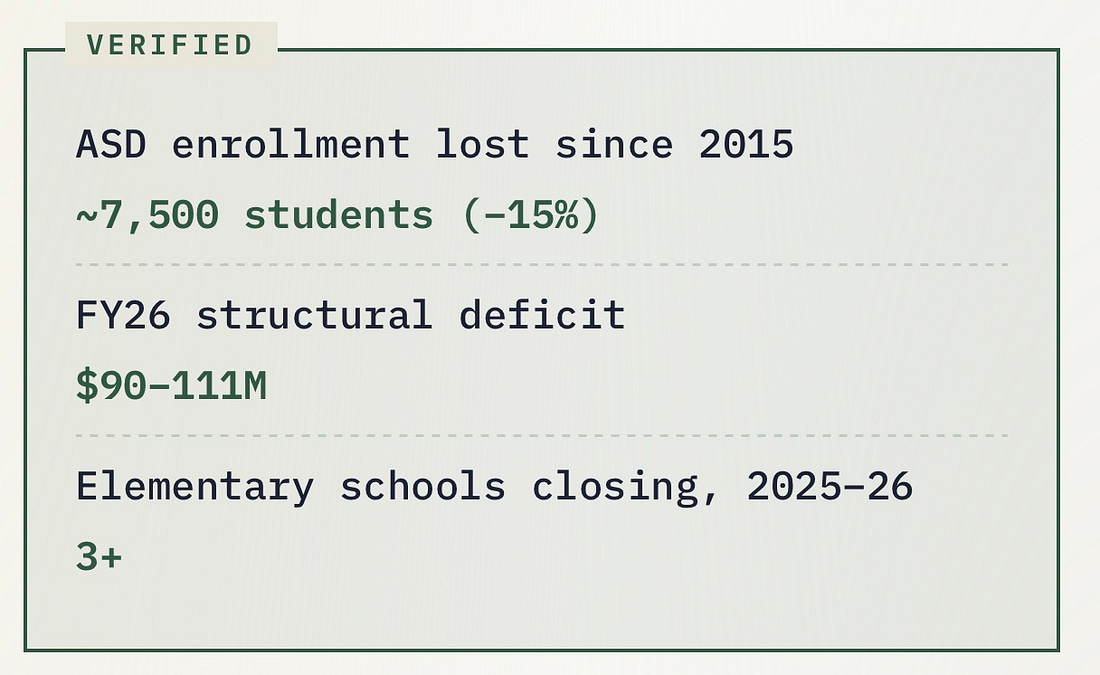
But sure… Let’s keep blaming housing costs and perceptions that it is what it is (taking Alaska cost of living) while the actual family-retention of our Alaska residence is in free fall. The Anchorage School District has lost about 7,500 students since 2015, a 15% collapse. It’s staring down a $90–111 million structural deficit and closing elementary schools in 2026. Don’t get me started on the number of families that have pulled their kids out to homeschool because of how bad our school system performs.
The AEDC report mentions ASD once, in passing, as a line item under local-government job losses. Kind of an important topic if we were talking about the economic future of Anchorage, Alaska, but what do I know?
You don’t lose 15% of a school district’s kids to “perception.” You lose them because families left.

Public safety? They reduce it to homelessness and downtown conditions. Cute. Survey feelings are fine as watered down commentary, but when you will not put the hard numbers on the slide, it starts looking like deliberate soft-focus AKA gaslighting theater. Anchorage’s violent crime rate is still running 1.5–3x the national average, and property crime kept climbing from 2021–2025 while the rest of the country cooled off. That is not a vibe. That is a statistic they had access to and chose not to print.

And here is the crown jewel of the presentation: $2 billion in near-term military construction, called, “the single largest identifiable upside catalyst,” with half the three-year forecast quietly built on top of it.
Reality check: it is a budget request only Sen. Sullivan can ask. He has been fighting for a $6.9 billion total authorization with “$2 billion sought up front.” As of summer 2026, it is still moving through appropriations using alternative contracting authorities because traditional MILCON is too slow to hit the timeline they need. Treating a contested request as locked-in cash is not forecasting. It is projection inflation with a press release attached. Please prove me wrong!


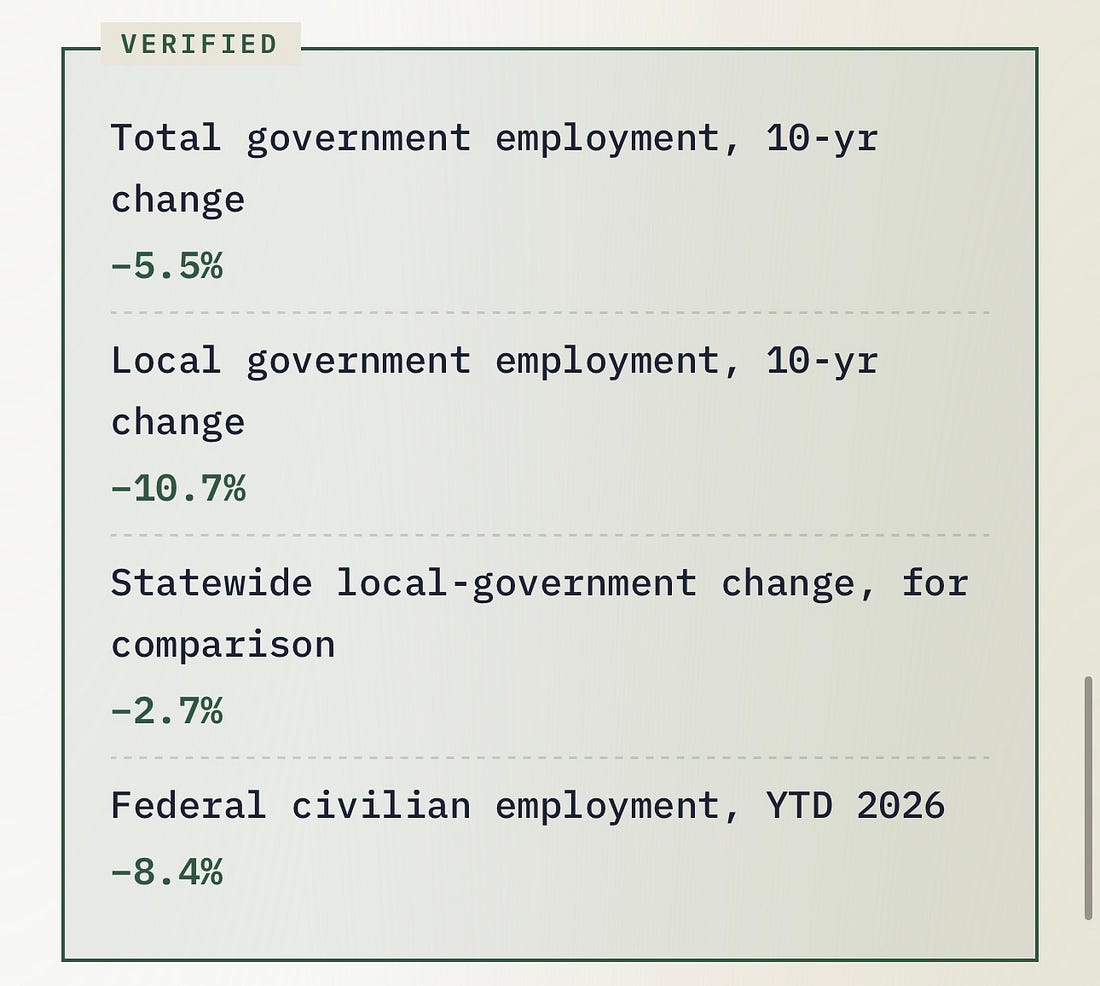
Now here is the part that should embarrass anyone still pushing a “protected tax-funded sector crowding out the private base” story. The report’s own numbers torch it. Government employment in Anchorage fell harder than the state average over the last decade. Local government is down over 10%— more than four times the statewide local-government decline. Federal civilian jobs are cratering right now, down 8.4% year-to-date through mid-2026, with June alone off nearly 13%.
The public sector is not bloating. It has been shrinking faster than the state, at every level, for a decade. What is actually happening is eroding service capacity, which means fewer teachers, tighter police resources relative to need, and a school system hemorrhaging kids. That is a different diagnosis than government eating the private economy, but it lands in the same place. People are voting with their U-Hauls either way. If you want to shrink government spending for the shrinking private sector, the solution is not more taxes, it is cutting spending and the government workforce. That is just common sense!
But we aren’t, so you see us hemorrhaging people. That is not sustainable.

Energy is the cherry on top. Cook Inlet’s managed man-made decline is not a distant risk in a footnote anymore. Matanuska Electric just slammed through a 29.4% Cost of Power Adjustment, Chugach’s rate case landed a 4.3% increase with utility executives warning of 12–24% more once LNG imports kick in, and officials are publicly using the word urgent about supply this winter. The cost-of-living index in the report is already on the floor— not a pretty snapshot of where our future is headed.
And the Port of Alaska modernization they wave around as a growth catalyst? It is partly funded by a freight surcharge hike to roughly $4.80 per ton on a port that handles 90% of the state’s inbound freight. Infrastructure investment financed by making almost everything that arrives in this state more expensive is a hell of a growth strategy to put on a hero slide. Or am I the only one see this as a major problem?
The core trends in the report are real. Population decline is real. Cost pressure is real. The military opportunity is real— if it actually gets funded.

The selective gaslighting framing, the under-weighting of the school crisis, the soft-pedaling of crime stats, and the treatment of a budget request as a done deal— that is not analysis for the people who live here. That is a pitch deck for the stakeholders or— let’s just say it— the gatekeepers who need the room to feel good enough to keep writing checks.
Somebody needs to ask the next panelist what was in the catering. Because the gap between the slides and the streets is getting ridiculous.
Sources
U.S. Census Bureau / FRED (ANCPOP) · Alaska Dept. of Labor & Workforce Development, 2025 population estimate · Alaska Beacon · Anchorage School District budget filings, reported via ADN / Alaska’s News Source, 2026 · APD crime data via Alaska’s News Source, Oct. 2025 · FBI UCR-derived indices (CrimeGrade, HomeSnacks, City-Data) · Sen. Dan Sullivan, Senate Armed Services Committee remarks, reported via Alaska’s News Source / The War Zone, Apr.–Jun. 2026 · Regulatory Commission of Alaska rate order, reported via AARP Alaska · Matanuska Electric Association COPA filing, reported via Mat-Su Sentinel, 2026 · ADN / Alaska Public Media, Port of Alaska Modernization Program funding reporting, 2026 · AEDC Anchorage Economic Trends Report, Aug. 2026.