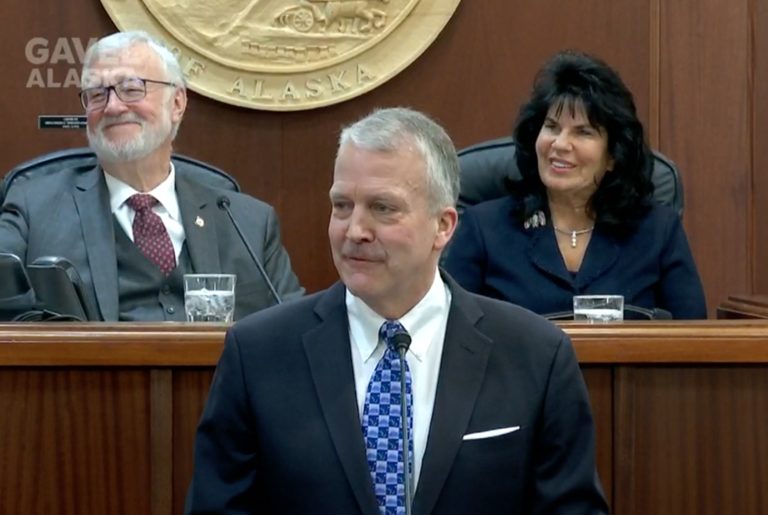
In themes familiar to Alaskans, U.S. Sen. Dan Sullivan on Tuesday spoke in Alaska’s Capitol to a joint session of the Alaska House and Senate, calling on Alaskans to help him fight to keep the promise of Alaska alive, and to lean into the purpose of our state for the greater good of all of America.
He challenged legislators and all Alaskans to rise to the call of citizenship in a Republic, and to engage in the arena, hearkening back to the words of President Teddy Roosevelt in his famous “Man in the Arena” speech.
Sullivan was positive about Alaska’s potential and pivotal place in national security.
He was not so bullish on the Biden Administration, saying he felt no need to be present at President Joe Biden’s State of the Union address on Tuesday evening in Washington, D.C., when he could be with Alaskans.
“I wouldn’t want to be anywhere else in world than right here, right now with the people who really matter,” he said.
He also criticized President Biden for issuing 44 executive orders relating to Alaska — more than any other state, in the two years since he took office. Sullivan described the Biden Administration’s “war on Alaska,” as running counter to Sullivan’s top priorities for Alaska: Revitalizing Alaska’s economy and growing jobs for Alaskans, and providing security to the United States in a time of rising global tensions.
“No other state has gotten this kind of unwarranted attention,” Sullivan said of Biden’s executive orders, adding that even Democrats senators are stunned when they find out how much Alaska has been targeted by the Biden Administration.
Sullivan described the Willow and Pikka oil projects on the North Slope and National Petroleum Reserve-Alaska as on the cusp of bringing a renaissance in jobs and activity to the state, not to mention over 200,000 barrels per day of oil into the Trans Alaska Pipeline System and billions of dollars in revenues to local, state, and federal coffers. If only the Biden Administration won’t spike the projects.
He praised the activation of the Army’s 11th Airborne Division, first formed in 1943, and now activated in Alaska as of 2022. He described how he has nearly nailed down a new icebreaker that will be home-ported in Juneau soon, bringing a crew of 200 and hundreds of related jobs, while also finally having an icebreaker located in the state.
Sullivan said that while America has two icebreakers, one of them is broken, which leaves just one operational. Russia, on the other hand, has 54 icebreakers, many of them with nuclear capabilities. Even Singapore has more icebreakers than the United States, he added, with a note of exasperation, considering it is one degree north of the Equator. But change he has pushed for is on the horizon, with icebreakers now being built at shipyards in America.
He warned of the rise of authoritarian governments around the world, such as in Russia and China, and how important Alaska is to protecting the nation during an era of global power dynamics he predicted will continue well into the future.
When asked during a brief question and answer period following his speech, Sullivan praised the military personnel stationed in Alaska for tracking the Chinese spy balloon that went across Alaska last week. He said that data about the aircraft was transmitted to the Department of Defense, where decisions were made to allow the spying device to continue on its path across America. Sullivan said he thought it should have been shot down earlier in its journey, rather than later. He also indicated that he needed to be careful about what he said publicly about the incident, and said that others speaking on the record have probably overshared knowledge that is or could be classified.
In addition to the usual Alaska topics of energy, mining, fishing, and tourism, Sullivan talked about the problems of addiction, domestic violence, and the mental health crisis, particularly as it impacts many young people, who are hooked on social media and are becoming depressed and suicidal.
But he ended on a positive note — where he started — by reminding lawmakers that Alaska is like no other place on earth, and that the people of the state are not too divided to be able to work together to move the state ahead. Alaskans share with each other and pull together during tough times, and have a unique generosity of spirit. He once again called for Alaskans to dig deep to create a place where a sense of purpose is preserved, and where the spirit of community is interwoven with endless possibilities.
America is not fully America without Alaska, Sullivan concluded, and Alaska has a strong purpose and a place in America.
Last week, Alaska’s Rep. Mary Peltola voted against the “Show Up Act,” a bill that passed the House 221-206, which would roll back the federal rules relating to telework to what they were before the Covid pandemic, when the federal government let many workers clock in from home. The idea of the bill is to get the federal workforce back into a regular working environment and make government more accountable.
Democrats voted against the bill that requires agencies to reinstate the telework policies that were in place on Dec. 31, 2019. According to the legislation, agencies may not implement expanded telework policies unless the Office of Personnel Management certifies that such policies, among other requirements, will have a positive effect on the agency’s mission and operational costs, says the summary from HR 139.
On Tuesday, Peltola was a no-show at her Transportation and Infrastructure Committee hearing, which had testimony from the high-ranking officials of the Federal Aviation Administration, an agency that is up for reauthorization. Top Transportation Department and FAA officials and airline industry experts, including representatives from the Airline Pilots Association, National Transportation Safety Board, National Business Aviation Association testified on aviation safety.
Alaska is the state that is arguably the most dependent on aviation and has the top cargo hub in America, the Ted Stevens Anchorage International Airport and Peltola issued a press release in January, celebrating her influential role as a member of the Transportation and Infrastructure Committee. Read Peltola’s press release at this link.
Also on Tuesday, Peltola was a no-show again in her Natural Resources Committee, where the committee met as a committee of the whole to consider the Authorization and Oversight Plan for the 118th Congress.
Peltola was also a no-show for the House vote today on HR 97, which would remove the Centers for Disease Control and Prevention’s Covid-19 vaccine requirement for non-citizens entering the United States. That measure passed 217-208, with Democrats voting against the resolution, which must also pass the Senate. The resolution also disapproves of the actions of the DC Council in allowing non-citizens to vote in the District of Columbia.
Last week, Peltola walked out of the Natural Resources Committee’s first meeting, after she said that there was too much partisan bickering. A debate about whether the House rules meant that firearms are or are not allowed in committee had ensued for about 15 minutes when Peltola walked out of the meeting, which had been going on for two hours. The meeting was an organizational meeting for the committee to establish rules and procedures. She later told reporters that the bickering was just too much for her.
Two weeks ago, Peltola was a no-show on a House floor vote on the protection of the Strategic Petroleum Reserve because, she later explained to reporters, she needed to use the restroom.
The late Congressman Don Young was criticized for occasionally using colorful language. But Rep. Mary Peltola is no slouch. She got in line with the AFL-CIO union in a recent retweet of a message that was openly hostile to all nonunion workers: “Good morning, Saturday morning, to everyone except union busters & scabs,” the message said.
Peltola may not know that the origin of the word “scab” means any worker who is not part of a union. In union parlance, scabs are the lowest form of life on earth — even lower than company managers. The word “scab” is used to intimidate people who are not part of unions or who want to work in spite of a strike called by a union.
Peltola has invited Labor boss Joey Merrick as her guest at the State of the Union speech by President Joe Biden on Tuesday, Must Read Alaska has learned. Merrick, business manager for Laborers Local 341, is the husband of state Sen. Kelly Merrick of Eagle River. It is unclear if Merrick has accepted the invitation.
President Biden will address a Joint Session of Congress at the United States Capitol on Tuesday, Feb. 7, 2023 at 9 pm Eastern, 5 pm Alaska Time. It is considered an important event that will mark the launch of his 2024 bid for reelection.
Peltola’s comments on scabs comes on the heels of her verbal support for striking bus workers in the Mat-Su Borough. She called for an immediate resolution to the dispute, writing, “Striking is never an easy decision for workers — particularly educational professionals. The Teamsters Local 959 voted nearly unanimously to begin striking for better pay and safer working conditions. I’m sure they didn’t make this decision lightly. Let’s get them a good deal ASAP so they can get back to serving the Mat-Su community. When workers organize, they win!”
The Department of Justice on Friday unsealed a January indictment charging two Anchorage women with conspiracy, fraud, aggravated identity theft, and money laundering for perpetrating a lengthy scheme to steal identities and defraud elderly victims and Habitat for Humanity, a charitable organization that builds houses for low-income people.
According to court documents, Valerie Calip and Jennifer Haydu defrauded banks and individuals in Alaska, obtaining at least $150,000 through their illegal scheme.
The pair stole mail, checkbooks, and identity documents from victims and used the information to create false identification documents. They signed up for credit cards and bank accounts under the victims’ names and intercepted their mail, using the fake ID to access their bank accounts. Calip and Haydu also used cash transfer apps to conceal the source of the stolen funds by transferring money to third-party accounts.
Calip and Haydu are accused of stealing more than 200 identity documents and thousands of dollars from victims, including over $100,000 from an elderly victim with dementia and thousands from a Habitat for Humanity bank account.
Calip is a repeat customer of the criminal justice system. In 2019, she was indicted by a grand jury for robbery, theft, and vehicle theft in relation to an armed robbery that occurred on Oct. 26, 2018 at Mile 71 of the Tok Cutoff Highway. Calip and her accomplice at the time, Wesley Sanford, approached a couple at their home and asked for assistance. Then, the bandits held the two victims at gunpoint and rifled through the residence, stealing firearms, cash, and other items. They tied the victims up and fled in a stolen truck.
Calip has numerous other prior charges, including forgery of legal documents. She is housed at Hiland Mountain Correctional Center.
Haydu is also a known criminal. She was arrested in Ketchikan in 2017 for importing methamphetamine and heroin to Alaska from Seattle. She has court records relating to shoplifting, violating conditions of release, falsifying evidence, and other crimes. Haydu comes from the Southeast community of Craig, where she has offered services as an accounting professional. Haydu is also at Hiland Mountain Correctional Center.
If convicted, each defendant faces a maximum penalty of 30 years in prison on the most serious indictment counts and a mandatory sentence of two years in prison for each count of aggravated identity theft. A federal district court judge will determine any sentence after considering the U.S. Sentencing Guidelines and other statutory factors.
The United States Postal Inspection Service is investigating this case and has received assistance from the Anchorage Police Department.
Assistant U.S. Attorney Ryan Tansey for the District of Alaska is prosecuting the case. Anyone who believes they may be a victim of this scheme and entitled to restitution may contact the United States Attorney’s Office at 907-271-3661.
With parents and guardians now driving children to school in the Mat-Su, the Mat-Su Borough School Board is looking for ways to help. Gift cards for gas may be the answer.
Bus drivers who are members of Teamsters Local 959 went on strike a week ago Tuesday over a contract negotiation impasse with Durham Student Services, the company that has the bus contract with the school district. Even if the strike ends before the school board meets, the board may decide to issue gas gift cards to parents to help out families.
The matter of gas gift cards came up at a joint meeting of the school board and the borough Assembly on Monday, and some consideration was given to calling for an emergency school board meeting. But in the end, the board, through consultations with its lawyer, determined there is no actual emergency, as defined by borough law, and that the matter can wait a week and be taken up on the regular school board agenda.
The details about how the gas gift cards would be issued still need to be worked out, sources said.
The dispute itself doesn’t involve the school district but is between bus drivers and their employer, Durham. Mat-Su School District is the second-largest in the state.
Mayor Dave Bronson has named Raylene Griffith as the acting director of the Human Resources Department, as the mayor accepted the resignation of Anchorage H.R. Director Niki Tshibaka today.
Tshibaka was named Director of Human Resources on July 1, 2021. He previously served the state of Alaska as deputy commissioner of the Department of Education.
Griffith has worked for the Municipality since 2013 in a variety of roles in the Human Resources Department and is currently the Labor Relations director.
Tshibaka has become ensnared in a number of problems in the Bronson Administration, and is the current focal point for the Anchorage Assembly’s war against the mayor, and after it became clear that former Health Director Joe Gerace had manufactured his education. The blame was placed on Tshibaka’s department, although the vetting of new employees in the Bronson Administration followed the same procedure the city had done for years.
The Assembly held an hours’ long executive session, closed to the public, over the Gerace matter late last month.
Niki Tshibaka is married to Kelly Tshibaka, who ran against Sen. Lisa Murkowski in 2022, and came in second in the field of four on the November ballot. Niki Tshibaka has a Harvard Law degree and has been involved in Christian ministry and church leadership.
Tshibaka is the latest highly placed person to resign or be fired from the Bronson administration. Municipal Manager Amy Demboski was fired by the mayor, and Deputy Chief of Staff Brice Wilbanks resigned. Also resigning was Acting City Attorney Blair Christensen, whose last day is Feb. 8.
More than one in three of the 535 senators and representatives in the U.S. Congress showed up to the new session with FTX baggage, having received campaign support from one of the senior executives of the fraud-ridden crypto giant.
CoinDesk identified 196 members of the new Congress who took cash from Sam Bankman-Fried or other senior executives at FTX, a crypto exchange that filed for bankruptcy in Delaware in November after CoinDesk revealed unusually close ties between FTX and Alameda Research, an affiliated hedge fund.
The names in Congress range from the heights of both chambers, including new Speaker of the House Kevin McCarthy (R-Calif.) and Senate Majority Leader Chuck Schumer (D-N.Y.), down to a list of recipients new to high-level politics. The list includes Alaska Sen. Lisa Murkowski.
After the lawmakers received the money, it became clear – according to the work of journalists, the criminal charges and admissions of guilt from FTX insiders – that the funds sprang from this colossal financial swindle. CoinDesk reached out to all 196 lawmakers to ask what they would do with the money.
Most of the politicians who responded said they handed it over to charities to remove the taint of contributions from executives such as former FTX CEO Bankman-Fried, whose federal fraud charges also include an accusation that he violated campaign-finance laws. Others have revealed they had conversations with the U.S. Department of Justice about setting aside the money until it can be dropped into a fund to compensate FTX victims.
“Making a payment or donation to a third party (including a charity) in the amount of any payment received from a FTX contributor does not prevent the FTX debtors from seeking recovery,” FTX warned in a December statement. The company is now controlled by CEO John Ray III, whose primary job is to recover money for the company’s fleeced creditors, though it isn’t yet clear whether political donations – nominally made directly from the individual’s personal accounts – will be subject to clawbacks.
Murkowski said she donated the money from her campaign account to a charity that is associated with her family.
The Alaska Democratic Party was also a major recipient of FTX-related donations, but does not appear in this CoinDesk research.
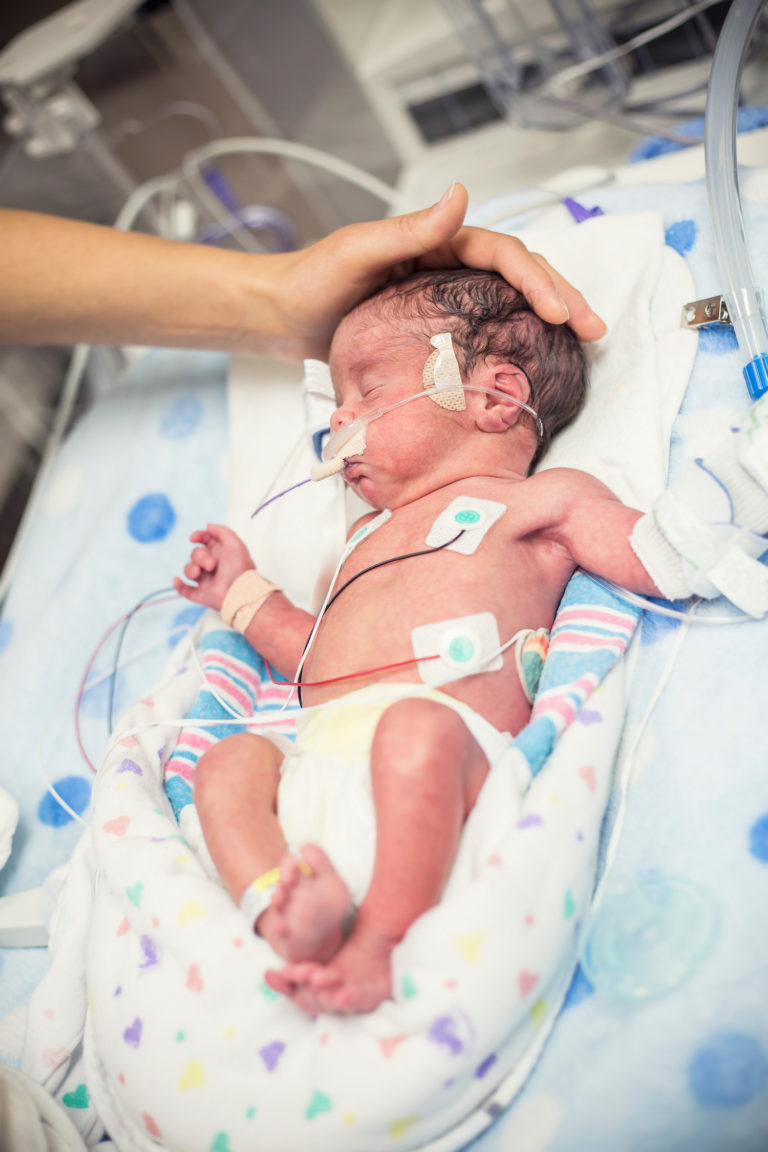
Senators James Lankford of Oklahoma and John Thune of South Dakota introduced introduced a bill on Monday that would require medical facilities and providers to treat infants who survive abortions as legal persons entitled to legal protections, including providing the babies with the same level of care that would be provided to other infants.
A similar measure passed the House in January on a vote of 220 to 210, with Alaska Democrat Rep. Mary Peltola joining other Democrats in voting agains the measure. Only two Democrats voted in favor of the House bill, and all Republicans voted in favor of it.
Little information is publicly available about how many babies survive abortions. The Centers for Disease Control reported that eight states that actually tracked the data showed that between 2003 and 2014, at least 143 babies were born alive after an attempted abortion. The number of actual babies born alive during the procedure is thought to be exponentially higher nationally.
The Senate bill, like the House version, says that any health care practitioner present at the time the child is born alive during an abortion: “shall (A) exercise the same degree of professional skill, care, and diligence to preserve the life and health of the child as a reasonably diligent and conscientious health care practitioner would render to any other child born alive at the same gestational age; and (B) following the exercise of skill, care, and diligence required under subparagraph (A), ensure that the child born alive is immediately transported and admitted to a hospital.”
The Born-Alive Abortion Survivors Protection Act is also similar to legislation filed in 2019, introduced by Sens. Ben Sasse and Pat Toomey. That bill failed 53 to 44. It needed 60 votes to pass. Sen. Lisa Murkowski skipped the vote on that bill. The new bill is unlikely to reach the floor, due to the Democrat-controlled Senate. If for some reason it passed, President Joe Biden has vowed to veto it.
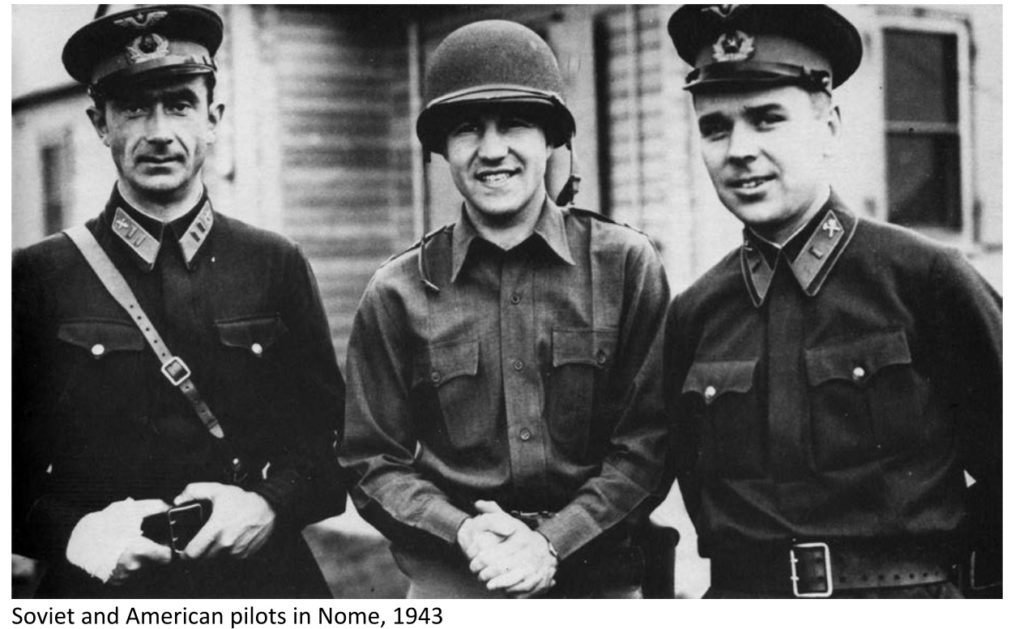
Part III: The first Soviet envoys arrive in Nome in 1942; eventually up to 600 were stationed in Alaska
On Aug. 26, 1942, the first Soviet envoys, Colonel Piskunov and Colonel Alexey A. Anisimov, members of the Soviet Purchasing Commission, arrived in Nome.
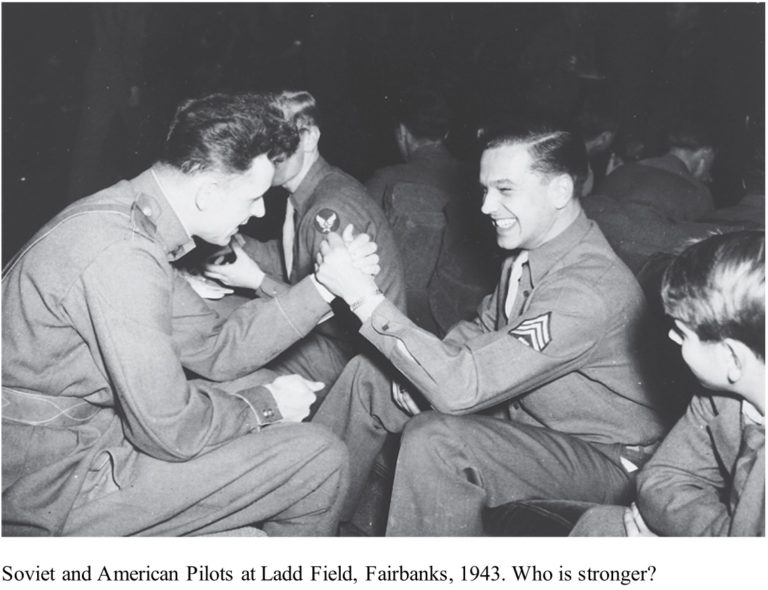
On Sept. 3, 1942, the first Soviet aircraft arrived in Alaska, bringing more mission members to set up permanent command stations at Ladd Army Airfield, in Fairbanks, and at Nome. By the summer of 1943, many Soviets had been stationed at Fairbanks, Nome, and Galena; at the height of the program anywhere from 150 to 600 Soviet pilots and other personnel resided at Ladd Army Airfield alone.
Bill Schoeppe, an airplane mechanic and a technical representative for North American Aviation (the manufacturer of the B-25 bomber), was stationed at Ladd Army Airfield, and then in Nome, from 1942 to 1945. According to his recollection, Soviet servicemen were stationed only in Alaska.
“No big thing, but it should be known there were no Russian service men stationed at any of our bases in Great Falls, Edmonton, Whitehorse and Yukon. While on assignment with North American Aviation, I traveled many times to our air bases in Canada and Alaska and never met or never heard of Russian personnel along the ferry route.“
Soviets assigned to work on American soil were ideologically drilled to maintain loyalty to their motherland. Separate facilities were built in Fairbanks and Nome for Soviet officers and other staff, and the Soviet government preferred to use its own interpreters and office personnel—predominantly women in uniform who had passed security clearance procedures in the Soviet Union before coming to the United States. “I never saw any female Russian transport pilots [in Alaska],” wrote Bill Schoeppe, “and I flew many hours in Russian [-crewed] B-25s from Fairbanks to Nome.” In fact, at the time, women pilots in the USSR were allowed to fly in combat. Many distinguished themselves and earned the country’s highest medal for combat valor: Hero of the Soviet Union.
Although the Soviet airmen who were sent to Alaska to pick up the Lend-Lease aircraft were guests in Alaska, and in the Soviet Union the Alaskan mission was regarded as a “rest from combat,” they tended to remain aloof from U.S. personnel. On those occasions when Soviets would socialize with Americans, they sometimes expressed their ideological views, but reluctantly and with great caution. For the most part, the Soviets and Americans were cordial toward one another. Some became close acquaintances during and after the war, leaving a lasting mark of good memories and affection for one another.
As Bill Schoeppe wrote:
“Whenever there was a gang of pilots in town waiting for airplanes, they roamed the streets of Fairbanks, some buying women’s silk stockings and underwear. Most unusual was their use of perfume! Some rough-bearded guys in britches and fine leather boots, wearing heavy perfume while partying, which we did every now and again. All men, only lots of drinks and smoking, and all these guys loaded with perfume! Some said it was because they had no antiperspirant! We’ll never forget that high consumption of liquor. All Alaskans and U.S. military personnel drank excessive quantities of alcohol, but the Red Army men beat us by far. Without fail, the Russians laid on the greatest variety and quantity. Each party table in mess halls, most seating 4 to 6 men, contained lots of spiced food and at least 5 to 6 quarts of liquor.
“The Russian hosts always kept the liquor flowing, so the big restaurant-size glasses were seldom empty. “Down the Hatch” was the constant order as toasts were proposed to Stalin and Roosevelt! These parties usually ended in 2 to 3 hours. We were always amazed how the Russians could put away so much more liquor than Americans.
“A few times we were entertained by some fine male dancing: wild whirling and jumping, the Gypsy dances were outstanding. Remember especially the pace the musician kept—until they had to step out because they were exhausted!“
Schoeppe also recalled his occasional meetings with the Soviet Captain Mikhail Gubin, an engineer of the Nome permanent garrison, when both were stationed in Nome. Evidently, Bill Schoeppe did not know at that time that Captain Gubin was a Soviet intelligence officer.
“Captain Gubin: engineer-officer in Nome, very friendly, nice fellow; he and his wife and two children lived off base in a small house near the city’s center. I lived in a hotel with 3 other factory representatives, and I spent several nice Sundays in the Gubins’ home for dinner and drinks. Remember one Sunday so well, friendly conversation with many husky drinks; he spoke good English and we spent many hours talking politics and comparing our forms of governments. Stalin, of course, was a big hero, always a toast for Stalin and Roosevelt!
“The captain’s wife didn’t speak much English but she kept apologizing for the poor furnishings, dishes, and silver.
“On Sunday, I remember so well, following several drinks we came to the table and large bowls of soup were served, and I assumed that was it! But then the main course was served―a huge beef tongue and vegetables, and dark bread! This is a rich meat, and everyone had to be served seconds. I did not think I would be able to stand up!
“I’ve often thought how rough those times were for the captain’s wife―unable to speak English, with two young kids in a small house, no running water and no sewer system, going from house to house with horse drawn sled in the winter.“
Despite occasional friendly meetings between Soviet and American personnel, Soviet insistence that the planes be in perfect condition before being flown to Siberia caused constant delays and some antagonism between the two commands. Bill Schoeppe also noticed the appearance of many FBI agents, particularly when Soviet top brass were visiting. He recalled:
“So many things happened in those times and sabotage was blamed too often. For example, the P-39 and P-63 pursuit planes were powered with V-12 liquid-cooled Allison engines; so much trouble was encountered, especially during extremely cold weather. These engines had to be warmed at a very high idle; if not, the spark plugs would foul badly. When the temperature is minus 40–50º … there are many problems. Each engine has 24 spark plugs. 24 x 30 = 720 plugs to be changed, and it causes lots of trouble. Usually these plugs would be sand blasted and checked, but for a time the Russians thought they were sabotaged and demanded all replacement plugs be factory new …
“I recall one comical incident: a P-39 had been grounded in Edmonton; the V-12 engine was mounted behind the pilot, and a big carburetor mounted on top―between banks and cylinders. One of the mechanics placed a silk cloth over the carburetor to prevent parts falling into the engine. When repairs were complete, someone put the cowl-cover over the engine and forgot to remove the silk-cover. When the pilot reported low power on arrival to Fairbanks, he joked, “Sabotage again!”
Tragically, many aircraft operated by both Soviet and American pilots crashed, mainly by because of weather conditions, but also due to poor maintenance, overloading, lack of fuel, and pilot error—sometimes traceable to over-consumption of hard liquor by Soviet pilots the day before a long and dangerous journey. As Bill Schoeppe recalled, the winter of 1942–43 was extremely cold in Alaska. In order to prevent mechanical failure, planes had to be winterized—in very difficult working conditions—before they could be flown out.
“We had no idea of the number of aircraft that were lost along the ferry route from Edmonton to Whitehorse and Fairbanks due to heavy smoke from forest and muskeg fires, which went wild during the war. Zero visibility was common day after day. Our radio aids to navigation were very poor or nonexistent; this, with low-time, inexperienced pilots, made a tough combination. It was found that many airplanes hadended up 180 degrees off course and out of fuel, so a system of flying in ever-widening circles by rescue planes was initiated, and is still used today in wilderness areas.“
Between September 1942 and September 1945, 133 planes were lost in North America, and 44 in Siberia, along the Northwest and ALSIB air routes, due to severe weather conditions, mechanical problems, and pilot error—a total of 2.22 percent of the 7,983 planes that were delivered to the Soviets from Great Falls.
In his memoirs, Victor Glazkov, a Soviet radio operator on Li-2 and C-47 aircraft who worked along the ALSIB route from 1942 to 1945, writes:
“There could have been fewer plane crashes if our [Soviet] ferry pilots had followed strict flight manual rules and instructions in flying Lend-Lease aircraft. If they had more thoroughly studied the technical characteristics of the American planes which, in fact, were very reliable and of good quality, and had properly used them, fewer lives would have been lost. The severe weather conditions of the northern latitudes also contributed to accidents, especially during the fall and winter period… The practice of consuming alcohol before and after flights by some [Soviet] ferry pilots led to fatigue on the ALSIB route and caused many accidents and deadly losses of the planes.“
Alexander B. Dolitsky was born and raised in Kiev in the former Soviet Union. He received an M.A. in history from Kiev Pedagogical Institute, Ukraine, in 1976; an M.A. in anthropology and archaeology from Brown University in 1983; and was enroled in the Ph.D. program in Anthropology at Bryn Mawr College from 1983 to 1985, where he was also a lecturer in the Russian Center. In the U.S.S.R., he was a social studies teacher for three years, and an archaeologist for five years for the Ukranian Academy of Sciences. In 1978, he settled in the United States. Dolitsky visited Alaska for the first time in 1981, while conducting field research for graduate school at Brown. He lived first in Sitka in 1985 and then settled in Juneau in 1986. From 1985 to 1987, he was a U.S. Forest Service archaeologist and social scientist. He was an Adjunct Assistant Professor of Russian Studies at the University of Alaska Southeast from 1985 to 1999; Social Studies Instructor at the Alyeska Central School, Alaska Department of Education from 1988 to 2006; and has been the Director of the Alaska-Siberia Research Center (see www.aksrc.homestead.com) from 1990 to present. He has conducted about 30 field studies in various areas of the former Soviet Union (including Siberia), Central Asia, South America, Eastern Europe and the United States (including Alaska). Dolitsky has been a lecturer on the World Discoverer, Spirit of Oceanus, andClipper Odyssey vessels in the Arctic and sub-Arctic regions. He was the Project Manager for the WWII Alaska-Siberia Lend Lease Memorial, which was erected in Fairbanks in 2006. He has published extensively in the fields of anthropology, history, archaeology, and ethnography. His more recent publications include Fairy Tales and Myths of the Bering Strait Chukchi, Ancient Tales of Kamchatka; Tales and Legends of the Yupik Eskimos of Siberia; Old Russia in Modern America: Russian Old Believers in Alaska; Allies in Wartime: The Alaska-Siberia Airway During WWII; Spirit of the Siberian Tiger: Folktales of the Russian Far East; Living Wisdom of the Far North: Tales and Legends from Chukotka and Alaska; Pipeline to Russia; The Alaska-Siberia Air Route in WWII; and Old Russia in Modern America: Living Traditions of the Russian Old Believers; Ancient Tales of Chukotka, and Ancient Tales of Kamchatka.