Sunday, June 14, 2026
Home Blog Page 774

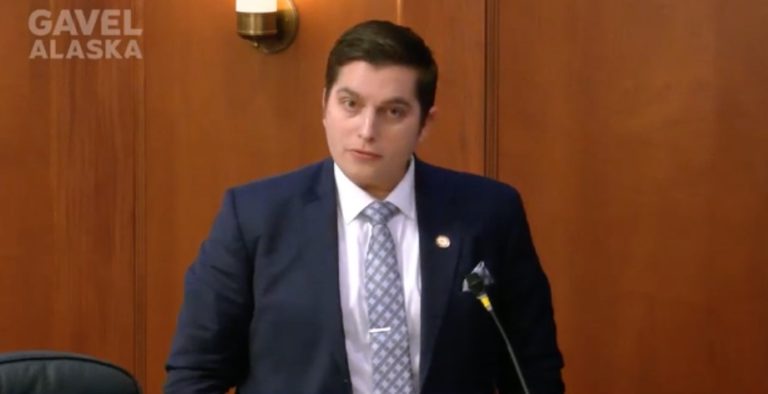
Biden’s nuke official who advised Anchorage on ‘Don’t Say Straight’ counseling ban gave kink-spanking seminar last week, even after being charged with luggage theft

Sam Brinton, who secretly consulted to members of the Anchorage Assembly as they drafted their 2020 “Don’t Say Straight” ordinance banning counselors from helping teens troubled by sexual confusion, did not let the felony charge against him stop him from delivering at the gay “Leather Getaway” conference last week.

View the agenda for the conference here. Warning: Not for children. And remember, the internet remembers what you click on.

Presenting under the pseudonym “NuclearNerd,” Brinton delivered a seminar called “Spanking: From Calculus To Chemistry.” It was under the heading of SM, for sado-masochism. There were other categories with seminars on things like “Fisting with a Passion,” and “Fisting Fundamentals,” an activity evidently popular with gay men.

The Energy Department now refuses to tell reporters whether Brinton, who holds a “Q” level top-secret clearance pertaining to national security, continues to be paid after being charged with felony theft of a Vera Bradley brand suitcase with women’s clothing, valued at $2,325.

That theft happened in at the Minneapolis St. Paul International Airport in September, and Brinton has confessed to stealing the suitcase. Security cameras show that he tore the luggage tag off the bag before wheeling it away quickly as though it was his own. Security cameras also show him using the bag for various travel after the theft. Brinton’s next court date is Dec. 19.

Two years earlier, when former Anchorage Mayor Ethan Berkowitz had locked the city down due to the Covid pandemic, the Anchorage Assembly’s gay caucus got busy and passed an ordinance that bans counselors from engaging in what is called “conversion therapy,” which is aimed at helping people with sexual dysphoria or sexual impulse problems. The Assembly passed the ordinance while prohibiting the public from attending Assembly meetings.

During that lockdown period, some Assembly members also set up a fake email account belonging to fictitious “Tom Sconce,” so that they could illegally communicate with each other about the controversial ordinance. To this day, the Assembly has refused the public access to those emails and that fake email account, despite numerous requests. They have claimed attorney-client privilege, even though they had no contract with Brinton’s group, the Trevor Project and its attorney.

Brinton advised the Anchorage Assembly and other jurisdictions on the conversion therapy ban topic before he was hired by the Biden administration. His group, the Trevor Project, also grooms teens to adopt the sexual choices it promotes through its secretive online counseling program, which advises teens to avoid parental oversight.

Sen. John Barrasso, the senior Republican on the Senate Energy Committee, wants Energy Secretary Jennifer Granholm to fire Brinton.

“Sam Brinton is on leave from DOE, and Dr. Kim Petry is performing the duties of Deputy Assistant Secretary of Spent Fuel and Waste Disposition,” a DOE spokesperson told Fox News Digital this week.

The State of Minnesota complaint against Brinton includes that his gender is “UNKNOWN”:

Brinton appears to be using his federal position to continue to build his own personal brand as an advocate for the highly sexualized, gender-fluid lifestyle for which he advocates.

In the world of fetish sex, he is also known as a pup handler, who role plays with other men who pretend to be dogs. He is featured in this Metro Weekly story on the world of “pup play,” a subset of leather and bondage sex play. His role in the Biden administration has given him worldwide notoriety as a representative of the government both at home and abroad.

Uh-oh: Artificial intelligence can now write a complex essay on an obscure academic topic in 10 seconds

A new “chatbot” created by artificial intelligence company OpenAI Inc. is roaring onto the internet scene after being in stealth mode, as robot intelligence has grown more sophisticated behind the scenes for years.

OpenAI released ChatGPT, a bot that converses easily with humans via artificial intelligence. The bot can help humans write computer code, write essays and poems, and strategize.

Here’s an example of an academic essay that ChatGPT produced within 10 seconds of being asked:

It’s not just high school composition teachers that should worry. The rise of artificial intelligence has grave possibilities for humanity, and may be as dangerous as nuclear war, some futurists are warning. The bots are so sophisticated that what humans interact with on social media may or may no longer be a real human.

The website, thispersondoesnotexist.com shows just how far the deception can go. Every time a user refreshes the page a new face is shown, completely made up by artificial intelligence but appearing 100% human and believable.

A chatbot can now create a persona, access Twitter or Facebook, and start convincing people that a political candidate or ballot measure is good, bad, or even criminal. The voters would never know they are being interacted with by a programmed bot.

A chatbot can now go into a Facebook group, (think Juneau Community Collective, Bethel, Spenard, or Save Anchorage) and create dozens of online personas. Then the chat bot could start conversations, and persuade people to behave in a certain way or believe something is going to happen.

Facebook has also recently unveiled an online AI bot called CICERO, which has reached “human-level performance” in the board game called Diplomacy. This is a game built on human interactions, rather than moves and maneuvers as you would find in chess or checkers. The bots learned about human behavior by playing against thousands of humans and learning the complexities of how humans approach the game, in which the goal is to take over the world.

The bots learned about ways that humans use strategy or act impetuously. They learned about when humans get fatigued and how that affects their decisions. At this point, the CICERO bot is winning all the time, and continues to learn about humans by playing the game with those who probably don’t realize they are training a chatbot.

What is OpenAI? It’s a research lab founded by Elon Musk and Sam Altman, among others, in 2015. The group collectively pledged $1 billion to the project. Musk has resigned from the board in 2018, citing “a potential future conflict (of interest)” with Tesla AI, which he was developing for self-driving cars. He remained a donor, and in 2019, OpenAI received a $1 billion investment from Microsoft, which is now the company’s official preferred vendor.

Scientists such as Stephen Hawking have expressed concern that if AI gains the ability to re-design itself at an ever-increasing rate, “an unstoppable “intelligence explosion” could lead to human extinction.”

Even Musk says that AI is humanity’s “biggest existential threat.”

The rise of these technologies points to the need in Congress and in the White House for people who understand how complex these artificial intelligence matters are.

For now, Alaska is represented by “Fish, Family, Freedom” Congresswoman Mary Peltola, who does not express the capacity to understand the threats posed by AI, nor the interest in resolving the ethical, moral, and legal issues. Whether Sen. Lisa Murkowski or Sen. Dan Sullivan have the capacity — or the courage — to take on this growing threat is yet to be seen.

Which group of registered Alaska voters didn’t show up in 2022? A look at the participation drop-off by party

The general election had a noticeable drop in voter participation in Alaska in 2022, but the drop-off in voter interest wasn’t the same in all groups of registered voters.

Just 266,573 of Alaska’s 601,795 registered voters cast ballots, a 44.30% turnout. That means 26% fewer voters participated than in 2020, and 6% fewer voters participated than in 2018, the last midterm general election.

We compare the 2022 to the 2018 election because they are midterm elections and were not interfered with by Covid policies across the country. The breakdown by party shows that Democrats and Republicans in Alaska dropped out of voting this year at different rates.

Republicans: About 3,200 fewer Republicans voted in 2022 than in 2018, or a 2.2% drop-off.

Democrats: About 3,200 fewer Democrats voted in 2022 than in 2018, a 4.1% drop-off. (Democrats represent only about 12.5% of the total voter file).

Nonpartisans: About 4,500 fewer nonpartisan voters showed up at the polls, compared to 2018, with the largest percent drop-off percentage at 5.4%

Undeclareds: Undeclared voters are the largest group of registered voters and although 6,900 fewer of them voted than in 2018, it represents a drop-off of 2.6%. Undeclareds include many people who were automatically registered to vote when they applied for their Permanent Fund dividend.

The number of registered voters in Alaska as of Nov. 3 divides into these main groups (with several other minor parties with small memberships):

  • Undeclared: 266,085
  • Nonpartisan: 83,576
  • Republican: 144,542
  • Democrat: 77,137
  • Alaskan Independence Party: 19,277
  • Libertarian: 7,009

Bethel police release video images of pot robber

Bethel Police Department has released images from a in-store video camera that show the armed robber of the AlaskaBud cannabis store in Bethel, which may give Bethel residents a clue as to the suspect’s identity.

The suspect is wearing a “Res Alaska” jacket. Res Alaska is a renewable energy company out of Fairbanks. The suspect also has on a “AK” beanie style hat. The suspect has a distinct gait, police said, possibly due to a limp. The duffle bag he carried has a camouflage pattern on it.

Update: Police say the man is left-handed. Only 10% of the population is left-handed.

In the original press release, police speculated that the jerky movements of the man made it appear he may have been intoxicated.

The store was hit on Monday night by a lone gunman with an M-16-style firearm, who fired several shots. One shot ricocheted off the floor and hit the counter, after which two employees at the counter fled, as the man shot at them several times, but missed. One of the shots went through the wall and hit a third employee hiding behind the wall.

The robber fled the store in an unknown direction on a snow machine.

The Bethel Police Department is looking for help from the community in establishing the identity of the suspect. Those with any information may call: 907-543-3781.

Alexander Dolitsky: Conversation with a progressive activist on the matter of gender identity

By ALEXANDER DOLITSKY

Rebecca, a young American in her late 20s, seemed restless; she anxiously wandered around the room in all directions of the compass. Then, she asked me, “Alexander, do you believe in death?” 

I was somewhat astounded by the question but answered cautiously and without hesitation, “Yes, I do.” 

“Everlasting?” she followed up. 

“Of course, everlasting. Why do you ask such a trivial question? Eventually, we all will biologically vanish, forever,” I responded.

“Well, do you ever think about your legacy?” she continued.

 “Not on a daily basis; but, yes, I do from time-to-time,” I answered.

“Please don’t be offended; take my question in the friendly spirit with which it is intended. I’d like to propose two versions of your hypothetical obituary and ask which one you’d prefer. Is that OK?” she asked sheepishly, looking straight to my eyes. 

“Okay, shoot,” I smiled and answered with an expression of friendliness.

“Thanks. Here is the first version: “Alexander D. was born and raised in such-and-such place, he was educated in such-and-such institutions, he was accomplished in many areas of his life, including achievements in many academic fields. In death, he preceded his ideologically progressive, far-left child who, as an adult, considered themselves to be non-binary and requested to be referred to as ‘they/them.’ This was an identity and ideology that Alexander D. reluctantly accepted.”

Certainly, Rebecca’s first hypothetical version of my legacy/obituary got my attention. “And what is the second version?” I asked, with obvious curiosity.

“The second version is this: “Alexander D. was born and raised in a such-and-such place, he was educated in such-and-such institutions, he was accomplished in many areas of his life, including achievements in many academic fields. In death, he preceded his ideologically progressive, far-left child who, as an adult, considered themselves to be non-binary and requested to be referred to as ‘they/them.’ This was an identity and ideology that Alexander D. sadly rejected.”

I was puzzled by Rebecca’s questions and the direction she was headed. 

“So, what version of your hypothetical legacy/obituary would appeal to you?” Rebecca asked with a smirky smile. 

I looked directly into Rebecca’s smirky eyes, which were radiating signals of distorted compliments, and replied, “Rebecca, I understand your implication of and reference to my child’s decision to begin using plural pronoun “them/they” in reference to themself. You know that this has been a difficult transition for our family. 

“Keep in mind, Rebecca, that social anthropologists define kinship terminology systems as a set of words (e.g., mother, father, sister, brother, aunt, etc.) used in various languages ​​and cultures to describe or label specific relationships between relatives. Societies in different parts of the world use more or less the same terminological patterns of kinship. Indeed, kinship terminology is fundamental for the preservation of the nuclear family.” 

Rebecca objected with an accusatory voice, “But this traditional kinship terminology, both nouns and pronouns, does not adequately describe some peoples’ gender identity.  They are not masculine or feminine; they are something in between. It is a science, you know.” 

“Rebecca, don’t confuse the word science with the practice of scientific inquiries. Science is not a subject like math, physics, astronomy, anthropology, and so on. Science is a method and methodology. It’s a procedure, a process used by scientists for the scientific inquiries of the natural world. Scientists ask logical questions, propose  logical hypotheses, testproposed hypotheses, collect and analyze data, prove or disprove proposed and tested hypotheses, derive to logical conclusions, and, finally, propose explanations based on the evidence derived from their research,”  I said.

“Alexander, it is a proven fact that peoples’ gender identity may evolve and change in the course of their life. A child may be born as a girl (feminine) and gradually evolve into a boy (masculine). My 3-year old niece is convinced that she is a boy. She always yells to my aunt: ‘Mom, mom, I am a boy,’” Rebecca argued. 

“Rebecca,” I countered, “an innocent 3-year old child dressed as an elephant during a Halloween or his/her birthday party will also innocently believe in being an elephant. Don’t you think so?

“More importantly, Rebecca, it is a proven biological fact that peoples’ hormones—the chemical substances that act like messenger molecules in the body—will definitely change in the course of their life. This is evidenced by the changes people experience in metabolism, appetite, growth and development, mood, stress, and body temperatures as they age. 

“Additionally, it is an undeniable biological fact that peoples’ chromosomes (masculine or feminine) will not change in the course of their life. The X and Y chromosomes, also known as the sex chromosomes, determine the biological sex of an individual. Females inherit an X chromosome from the father for a XX genotype, while males inherit a Y chromosome from the father for a XY genotype (mothers only pass on X chromosomes).”

“Well, fine,” Rebecca reacted angrily. “So, what version of your hypothetical legacy would appeal to you, the first or the second?” she asked abruptly.

“Each of us has ownership of our life, identity, and ideologies. We can choose to vehemently disagree with the gender identity decisions that our friends and loved ones make,” I said. “Yet, it’s important to recognize that in spite of genetics or our personal ideologies, each person has the freedom to determine the course of their life and the decisions made there-in. 

“Our freedom, however, can be used for good or ill. Ultimately, we are given freedom that we might freely choose the good—not like robots, but like humans. That is really the only purpose of free will—to choose the good. When it is misused to choose that which is hurtful or harmful or delusional, then it is misappropriated.

“We must certainly make every effort to love and respect every human as children of God, but without fostering or enabling a harmful fantasy that ultimately changes the course of their life.

“My life and my identity belong only to me, and to nobody else. I cannot and will not compromise my life, my beliefs, faith, ideology and factual truth. So, in regard to your question, and from the Judeo-Christian values and perspectives, my legacy ought to be the second version that: 

“Alexander D. was born and raised in a such-and-such place, he was educated in such-and-such institutions, he was accomplished in many areas of his life, including achievements in many academic fields. In death, he preceded his ideologically progressive, far-left child who, as an adult, considered themselves to be non-binary and requested to be referred to as ‘they/them.’ This was an identity and ideology that Alexander D. sadly rejected.”

Alexander B. Dolitsky was born and raised in Kiev in the former Soviet Union. He received an M.A. in history from Kiev Pedagogical Institute, Ukraine, in 1976; an M.A. in anthropology and archaeology from Brown University in 1983; and was enroled in the Ph.D. program in Anthropology at Bryn Mawr College from 1983 to 1985, where he was also a lecturer in the Russian Center. In the U.S.S.R., he was a social studies teacher for three years, and an archaeologist for five years for the Ukranian Academy of Sciences. In 1978, he settled in the United States. Dolitsky visited Alaska for the first time in 1981, while conducting field research for graduate school at Brown. He lived first in Sitka in 1985 and then settled in Juneau in 1986. From 1985 to 1987, he was a U.S. Forest Service archaeologist and social scientist. He was an Adjunct Assistant Professor of Russian Studies at the University of Alaska Southeast from 1985 to 1999; Social Studies Instructor at the Alyeska Central School, Alaska Department of Education from 1988 to 2006; and has been the Director of the Alaska-Siberia Research Center (see www.aksrc.homestead.com) from 1990 to present. He has conducted about 30 field studies in various areas of the former Soviet Union (including Siberia), Central Asia, South America, Eastern Europe and the United States (including Alaska). Dolitsky has been a lecturer on the World Discoverer, Spirit of Oceanus, andClipper Odyssey vessels in the Arctic and sub-Arctic regions. He was the Project Manager for the WWII Alaska-Siberia Lend Lease Memorial, which was erected in Fairbanks in 2006. He has published extensively in the fields of anthropology, history, archaeology, and ethnography. His more recent publications include Fairy Tales and Myths of the Bering Strait Chukchi, Ancient Tales of Kamchatka; Tales and Legends of the Yupik Eskimos of Siberia; Old Russia in Modern America: Russian Old Believers in Alaska; Allies in Wartime: The Alaska-Siberia Airway During WWII; Spirit of the Siberian Tiger: Folktales of the Russian Far East; Living Wisdom of the Far North: Tales and Legends from Chukotka and Alaska; Pipeline to Russia; The Alaska-Siberia Air Route in WWII; and Old Russia in Modern America: Living Traditions of the Russian Old Believers; Ancient Tales of Chukotka, and Ancient Tales of Kamchatka.

Read: Neo-Marxism and utopian Socialism in America

Read: Old believers preserving faith in the New World

Read: Duke Ellington and the effects of Cold War in Soviet Union on intellectual curiosity

Read: United we stand, divided we fall with race, ethnicity in America

Read: For American schools to succeed, they need this ingredient

Read: Nationalism in America, Alaska, around the world

Read: The case of the ‘delicious salad’

Read: White privilege is a troubling perspective

Art Chance: The barbarians have been inside the gates before in Alaska, and they’re back

By ART CHANCE

In August of 1974, I put Atlanta’s violence and racial strife in my rearview mirrors and struck out “North to the Future” with wife, 3 year-old daughter, dog, a Toyota Landcruiser, some camping gear, and something of a stash of cash.

We were astoundingly naïve about Alaska; we had a couple of National Geographic books and a copy of “The Milepost.”  We made a leisurely diagonal trip across the country to Seattle. From there, we drove to Watson Lake and connected there to the Alcan, still dirt in those days except for about 40 miles around Whitehorse. Somewhere along the way we heard that President Nixon had resigned (Aug. 8, 1974); we still had enough college in us to think it was a good thing. 

It was late August getting into September and it was raining and snowing from time to time. I spent a lot more time in four-wheel-drive mode than I would today but we made it to pavement at the border uneventfully. It cost $20 to get some of the mud off at the quarter car wash in Tok. In those days a vehicle that had come over the Alcan was never clean again.

We spent our first night in Alaska at The Big Timber across from Merrill Field, which had a better reputation than it later acquired, and we had our first meal at Peggy’s Café. 

We looked around the next day and the line from The New Yorker about how “the people who built Anchorage, Alaska should never be allowed to build anything again” ran through my head. Anchorage was a scruffy place in 1974.

It became apparent that we had to either give away our beautiful Norwegian Elkhound or give away our kid in order to get a place to live. Housing was cruel in Anchorage. The dog went.

Like everybody else, I wanted a pipeline job, but it wasn’t yet spinning up very much in late 1974 and you had to have a very low union seniority date, which I didn’t have, or know somebody, and I didn’t. I didn’t yet know that $500 in the right hand would get you a dispatch.  I wasn’t dumb enough to sit around union halls polishing pine; I’d long ago learned that when you needed a job, take the first one you can get.   

I’d learned to walk in a retail store so I went to work at Stallone’s, then in University Center mall. I’d been selling high-dollar fashion to the pimps, prostitutes, gangsters and professional athletes in Atlanta, so University Center was a piece of cake. My few months with Stallone’s was a very good Alaska 101 course; you saw everyone from every social status and walk of life there. I quickly learned how different Anchorage was from rigidly class-conscious Atlanta. That tattered brown outfit that old guy is wearing is a Filson that costs as much as the most expensive suit on your rack.

I had a problem; Stallone’s paid well and I was a good commission salesman, but I needed benefits. My daughter needed surgery and I needed good health insurance. That meant the union or public employee or better yet, union public employee kind of health insurance.

I started paying “dobie dues” to the Laborers’ Union looking for a State, Municipality of Anchorage or school district job. The first dispatch was to a graveyard shift custodian position at Dimond High School. It was 40 hours at a good wage, overtime, leave, holidays, and full-ride health insurance after 30 days and no pre-existing conditions restrictions. Hell, yes, I’d sweep and mop floors for that.

After I’d stayed around long enough, I began to dabble in union politics. It didn’t take long to become a shop steward, then executive board member, then vice president. I ultimately wound up with a seat on the Central Labor Council, the District Council of Laborers, head of the Central Labor Council’s Committee on Political Education, their PAC, and more. 

Don’t let the fancy-sounding titles fool you; I served at the pleasure and was mostly just a high-status briefcase toter. My daughter’s medical issues were resolved and I had gotten far enough up the ladder to get myself in serious trouble and not nearly far enough to get myself out of it. It was time to arm myself with the “courage of my connections” and move on.

Along the way I’d had considerable involvement in political action. Blue collar organized labor in those days wanted nothing to do with white collar public employee labor. The long-established trade unions represented most of the blue and gray collar unionized employees and the white collar unionized employees were represented by their independent employee associations; they didn’t want to condescend to being unions.

The trade union leadership was generally conservative. All were Democrats and most were the Democrat version of Catholic and at least went to Mass on Christmas and Easter. The AFL-CIO of the 1970s was mostly anti-communist. Social justice wasn’t a part of the vocabulary. They were social conservatives and really only cared about the wages, hours and conditions of their members; their mantra was Sam Gomper’s: “More.”  

I was younger and much further left than most of the people whose briefcases I toted. Even back then it took several semesters of Life 101 to get over going to college.

The Democrat Party of those days was going through a schism. The old “New Deal” coalition of FDR’s time had broken in the streets of Chicago in 1968 when the Students for a Democratic Society and Abbie Hoffman and Jerry Rubin’s “Yippies” had clashed with Mayor Richard Daley’s cops during the Democrat Convention.  “Four Dead in Ohio” at Kent State University pretty much put an end to Democrat unity for the better part of a generation.

Here in Alaska we’d had little of the civil rights and anti-war conflict, but the Great Society programs had brought us a flock of fresh-faced college graduates as Volunteers in Service to America (VISTA) and others working for all the “community action” programs created by The Great Society.   

The majority of the Democrat politicians of the 1970s came to Alaska as a VISTA volunteer or as an employee of one of the community action programs. The hot ticket seems to have been to come to Alaska as a VISTA volunteer, marry an Alaska girl who was either Native or who had good Democrat bona fides, and pursue your rocket to stardom. If you don’t believe me go check out the bios of most of the Democrat office-holders of the day.

That cadre of Great Society emigres and some local talent created “The Ad Hoc Democratic Coalition” in the early 1970s. They were what the media and political scientists styled “The New Left.” Few of them knew it, but they were mostly Trotskyite communists. Many of them still had the marks on the pocket of their Levis from the copy of Mao’s “Little Red Book” that they’d carried through college. 

I knew a lot of them and had even spent time sitting cross-legged on the floor smoking dope and planning the revolution with them.

They took over the Alaska Democrat Party and in 1974 defeated the Democrat nominee, the legendary Gov. Bill Egan, by supporting a Bush Republican, Sen. Jay Hammond. Gov. Hammond may have been a Republican, as that was understood in Alaska in those days, but his administration was mostly Ad Hoc Democrats and just this side of openly communist.

Today’s Alaska was formed during their time in power. They controlled the Legislature in the middle 1970s and many maintained power into the 1980s. Rep. Hugh Malone, House speaker who many consider the father of the Permanent Fund, wasn’t a “Ad Hoc’er,” but he worked with them and the Permanent Fund and the dividend are products of their time in power.   

The 1970s and 1980s were a time of great growth in the size and power of state government and most of the laws and regulations that direct it are products of that era. The best indicator that the government was controlled by a bunch of hippies is the statute from the 1970s that prohibits the State from imposing a dress code.

To my point: We’ve been here before, and we’re here again. The barbarians are inside the gate. I’ve railed in these pages for years about the false flag Republicans, and even going back to the 1990s and the Gingrich Revolution and candidates who flew an R as a flag of convenience.

Think about it folks; the thing that most motivates you politically is the dividend. The whole Permanent Fund and dividend scheme is from a time when state government was run by a bunch of communists. They’re back; think about what you’re going to do.

Art Chance is a retired Director of Labor Relations for the State of Alaska, formerly of Juneau and now living in Anchorage. He is the author of the book, “Red on Blue, Establishing a Republican Governance,” available at Amazon.

Art Chance: Palin is finishing what she started, as every Democrat’s favorite Republican

Art Chance: The 1609 Project and the indentured servitude of immigrants

Sen. David Wilson censured by District 27 Republicans, asked to resign from Democrat-run caucus

District 27 Republicans in Wasilla voted to censure Sen. David Wilson for leaving the Republican caucus and joining a caucus in which Democrats hold the majority, when there is a majority of Republicans voted into seats in the Senate.

The district issued a stern resolution in which it said Wilson betrayed the voters of District N, and asked Wilson to resign from the Democrat-led caucus. The district has also asked Wilson to return funds the $4,000 donated to him by the Alaska Republican Party for his campaign if he doesn’t quit the Democrat caucus.

If he doesn’t resign from the Democrat-controlled caucus, the members want Wilson to resign by Friday at 5 pm.

Wilson is out of step with the other two senators from his district, Sen. Shelley Hughes and Sen. Mike Shower. The Democrat-led group put him in as the chair of the Senate Health and Social Services Committee.

Strike averse: Murkowski votes ‘aye,’ Sullivan votes ‘no’ on resolution to prevent rail strike; it passes Senate 80-15

U.S. Sen. Lisa Murkowski today voted in favor of H.J. Res.100, to codify the tentative agreement brokered by the Biden administration between railroad carriers, union representatives, and officials in the Biden administration.

Its imposition will prevent a railway strike that would have cost the U.S. economy an estimated $2 billion per day, disrupted supply chains, harmed public health, and negatively impacted consumers and businesses—including in Alaska. H.J. Res.100 passed by a vote of 80-15-1.

Sen. Dan Sullivan and several other conservative senators, such as Sen. Mike Lee of Utah and Sen. James Lankford of Oklahoma, voted no. Sen. Rand Paul voted present.

The agreement provides for a range of new benefits, agreement provides for a 24 percent wage increase by 2024 with a 14.1 percent increase effective immediately and five $1,000 annual lump sum payments, resulting in $11,000 in immediate payments to employees; a 15 percent cap on health insurance premiums; an additional day of paid personal leave; three days of scheduled leave for medical exams and procedures; up to five weeks of paid vacation each year; and 14 paid holidays.

Provisions that are currently in effect and which will remain in place under the new contract, include providing either 26 weeks of paid sick leave at 60 percent wage replacement or 52 weeks of paid sick leave at 70 percent wage replacement, depending on the union, after four days of unpaid sick leave. The Agreement was ratified by eight of the 12 railway unions, while four unions voted no in an effort to include additional paid sick days in a final agreement.

“While it is unfortunate that Congress had to intervene in this matter, a rail strike would have had severe economic and public health consequences that could have harmed families and businesses just as we move into the holiday season,” Murkowski said. “Those consequences would have been felt in Alaska, as goods that are moved across the country by rail and then shipped to our state would have been stranded along the way. While the Tentative Agreement provides important benefits, including better wages, lower health care costs and more days off, I have great empathy for the rail workers and their efforts to negotiate paid sick leave. Ultimately, however, I recognize it is not Congress’ role to intervene in the details of labor negotiations. Doing so would set a bad precedent for other industries who are also negotiating contracts.”

In the House, Congresswoman Mary Peltola voted against the bill earlier this week because it did not give the unions enough. However, the resolution passed with an overwhelming majority.

On average, according to National Railway Labor Conference, a Class I rail employee covered in the current bargaining round makes about $130,000 in total annual compensation, and got 38% in raises between 2009 and 2019.

Election certified without drama

The Division of Elections and the State Review Board finished up their review of all election results and signed the certificate on Wednesday, which closes out the Nov. 8 general election for 2022. None of the results changed, although in one race in Anchorage, the margin between first and second place candidates may end up with a recount.

Rep. Tom McKay, House District 15, South Anchorage, leads Democrat Denny Wells by seven votes, up from the four-vote lead he had before the Election Review Board competed its work. Wells may ask for a recount within five days and is likely to do so by Monday.

In the case of Rep. David Eastman, whose qualifications to serve as a legislator have been challenged by partisan actors in his Wasilla district, a judge has ruled he cannot be certified until a court case against him is resolved involving his membership in the Oath Keepers, a paramilitary group that is patriotic in its mission. Although the results have been certified, it’s not the same as having the certificate filed. The court date for the election challenge is Dec. 12, but the matter may make it all the way to the U.S. Supreme Court because it is a First Amendment case that could have federal ramifications.

In the case of Rep.-elect Jennifer Armstrong of Anchorage, a lawsuit has been filed against her residency eligibility, because she indicated on social media that she had not moved to Alaska and to the West Anchorage district in the required timeframe for filing for office. Armstrong, a Democrat, is what Alaska Democrats normally refer to as a carpetbagger, but she will defend her eligibility to be in office by saying that she indeed moved to Alaska in time to file and that the challenge to her residency has come too late.