Jenny Di Grappa, a liberal who filed to run against Felix Rivera in District 4 for the Anchorage Assembly, pulled out of the race this week. Although she missed the withdrawal deadline, the Anchorage Municipal Clerk has crossed her name off the list, and she won’t appear on the April 4 ballot, and won’t take votes away from Rivera.
Remaining in the race is liberal standard-bearer Rivera, who drives for DoorDash and is trying for his third and final term on the Assembly, and conservative Travis Szanto, a builder and principle of Skyworks LLC, who is known for his innovative treehouses.
Di Grappa withdrew on Feb. 1. By leaving the race, she strengthens Rivera, who has served on the Assembly since 2017, after having been a member of the staff of former Mayor Ethan Berkowitz.
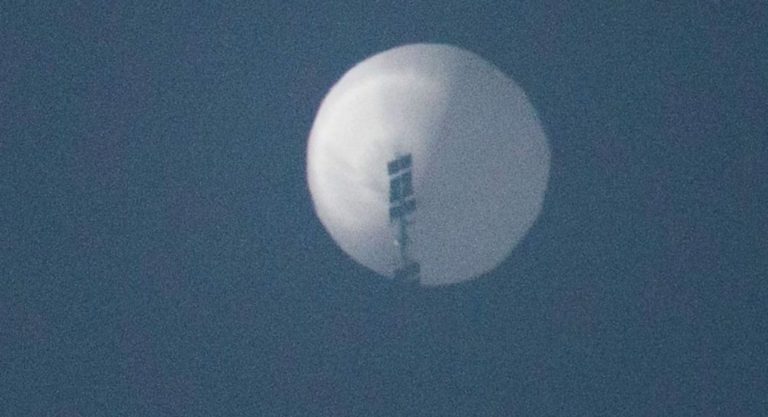
As of noon Friday, the maneuverable Chinese surveillance balloon that was over Montana yesterday, was at an altitude of about 60,000 feet and floating over the center of the continental United States in an easterly direction, the Department of Defense said. It poses no risk to commercial aviation, military assets or people on the ground, said the Pentagon.
The balloon is the size of about three school buses. It crossed Alaska over the Aleutian Chain and entered airspace over the mainland of Alaska between Nome and Kotzebue, and then traveled through Canada to Montana. Officials say it has been over Kansas City, Missouri and continues heading east, which would take it close to the nation’s capital and main population centers.
The North American Aerospace Defense Command is continuing to monitor and leaders are reviewing options, said Air Force Brig. Gen. Pat Ryder, who held a media briefing on Friday.
“The balloon has violated U.S. airspace and international law, which is unacceptable,” he said, adding that the U.S. has communicated that to Chinese leaders at multiple levels.
The balloon is carrying surveillance gear as well as a payload, Ryder said. He didn’t reveal what the payload is.
A reason not to shoot it down at this point, he said, is that besides not posing a threat to people or aircraft, the resulting debris from a strike of this large balloon could be harmful to people on the ground and result in property damage.
The balloon most likely will continue floating over the U.S. for the next few days and updates will be provided as needed, he said.
“Once the balloon was detected, we acted immediately to protect against the collection of sensitive information,” he added, a statement that has been challenged by critics who said the Defense Department didn’t reveal the whereabouts of the balloon until it reached Montana. Bloomberg News reported that the White House kept spy balloon’s presence secret for fear of derailing the trip to China by Sec. of State Antony Blinken. But then, local media in Billings, Montana published a picture of it.
An apparent explosion over Billings, Montana, seen in a video posted by a private citizen and widely circulated on the internet, may be a fake. There is no indication that the Department of Defense has shot down the balloon.
Montana Gov. Greg Gianforte, who was not informed about the balloon over Montana buy the Pentagon until it was already in Montana airspace, issued a statement:
“I received an informational briefing yesterday on the situation involving a suspected Chinese spy balloon flying over Montana. From the spy balloon to the Chinese Communist Party spying on Americans through TikTok to CCP-linked companies buying American farmland, I’m deeply troubled by the constant stream of alarming developments for our national security.”
Gianforte said, “If it was up to Montanans, this thing would have been taken out of the sky the moment it entered our sovereign airspace.”
Al Jazeera’s Kimberly Halkett, reporting from D.C., said that the balloon was first spotted by bystanders in the state of Montana.
“It was spotted by people on the ground who were wondering what was in the sky. That is how the US government first learned about this, incredibly,” Halkett said. “It was then that the US government started tracking it.”
Secretary of State Antony Blinken called it “a clear violation of U.S. sovereignty and international law…An irresponsible act.” He canceled his trip to China after the photo and news leaked out about the spy balloon.
The Chinese government says it is just a research airship that deviated from its course.
“The airship is from China. It is a civilian airship used for research, mainly meteorological, purposes. Affected by the Westerlies and with limited self-steering capability, the airship deviated far from its planned course. The Chinese side regrets the unintended entry of the airship into US airspace due to force majeure. The Chinese side will continue communicating with the US side and properly handle this unexpected situation caused by force majeure,” the People’s Republic of China said in a press release on its website.
On Friday evening, the Pentagon confirmed that a second Chinese spy balloon was “transiting Latin America.”
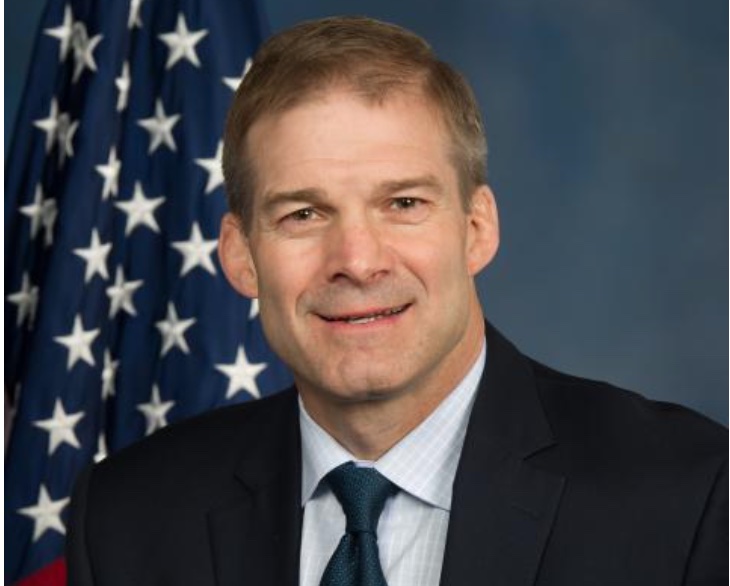
House Judiciary Committee Chairman Rep. Jim Jordan, representing Ohio’s 4th District, sent a warning shot over the bow of the Biden Administration on Friday, subpoenaing top officials to hand over documents to the committee relating to investigations of Americans who merely protest their local school board policies.
Subpoenas were sent to Attorney General Merrick Garland, FBI Director Christopher Wray, Education Secretary Miguel Cardona, and others.
According to the subpoenas, the officials are “commanded” to produce documents to the Judiciary Committee by March 1. The subpoena comes as Jordan sent four letters to various officials Friday, calling for information and interviews the committee has been requesting, in a final warning shot before he sent the subpoena their way.
The subpoenas relate to a memo sent by Attorney General Garland, describing a “spike in harassment, intimidation and threats of violence” against school boards.
It’s a mission that Jordan has been on for months, after it was discovered that the National School Board Association was directing the actions of the White House, in order to criminalize parents who become school activists. In November, Jordan wrote to FBI Director Wray, saying that if the documents didn’t get turned over, there would likely be a subpoena during the 118th Congress, as control changed over to the Republicans.
“Over the past twenty-one months, we have made several requests for information and documents concerning the Biden Administration’s misuse of federal criminal and counterterrorism resources to target concerned parents at school board meetings. We reiterated and itemized these requests in our recent letter of October 17, 2022, which is enclosed for your convenience. To date, you have ignored these requests. Please be aware that if our requests remain outstanding at the beginning of the 118th Congress, the Committee may be forced to resort to compulsory process to obtain the material we require,” Jordan wrote in November.
In January, the Biden Administration told Jordan he would have to resubmit all of his requests for documents, now that he was going to be in the Republican majority in January. The Feb. 3 subpoena is the answer to the White House’s digging in of its heels.
In 2021, citing an increase in what it called harassment, intimidation, and threats of violence against school board members, teachers and workers in public schools, Attorney General Garland directed the FBI and U.S. Attorneys’ Offices to begin meeting with federal, state, Tribal, territorial and local law enforcement leaders to discuss strategies for addressing what it saw as a trend that may require the heavy hand of federal authorities.
“Threats against public servants are not only illegal, they run counter to our nation’s core values,” wrote Garland. “Those who dedicate their time and energy to ensuring that our children receive a proper education in a safe environment deserve to be able to do their work without fear for their safety.”
The White House and the National School Board Association were, that year, coordinating with federal officials to criminalize parents who have started to pay attention to what their local school boards are promulgating with critical race theory and gender ideology.
A report to the House Judiciary committee last year said that the FBI was artificially inflating statistics about domestic violent extremism in the nation.
“Whistleblowers have described how FBI leadership is pressuring line agents to reclassify cases as domestic violent extremism even if the matter does not meet the criteria. They also explained how the FBI is misrepresenting the scale of domestic violent extremism nationwide by categorizing January 6th-related investigations as organic cases stemming from local field offices, instead of all related to one single incident. In both ways, the FBI is fueling the Biden Administration’s narrative that domestic violent extremism is the biggest threat to our nation,” the report said.
“The FBI is abusing its counterterrorism authorities to investigate parents who spoke at school board meetings. Whistleblowers disclosed how, shortly after the National School Boards Association urged President Biden to use the Patriot Act against American parents, the FBI Counterterrorism Division set up a special “threat tag” to track school board-related cases. Whistleblowers provided evidence of how the FBI opened investigations into one mom for allegedly telling a local school board ‘we are coming for you’ and a dad simply because he ‘rails against the government’ and ‘has a lot of guns,'” the report said.
Editor’s note: Must Read Alaska is noting here a unique weather event that almost took down a commercial flight leaving Juneau 30 years ago on Jan. 29, 1993. But for the quick thinking of the pilot, dozens of lives would have been lost in a horizontal tornado that occurred upon takeoff and nearly flipped the aircraft. This story first appeared in the Alaska Airlines employee newsletter in 1994. The incident and the solution arrived at ‘on the fly’ became instrumental to training pilots about what to do in such a circumstance).
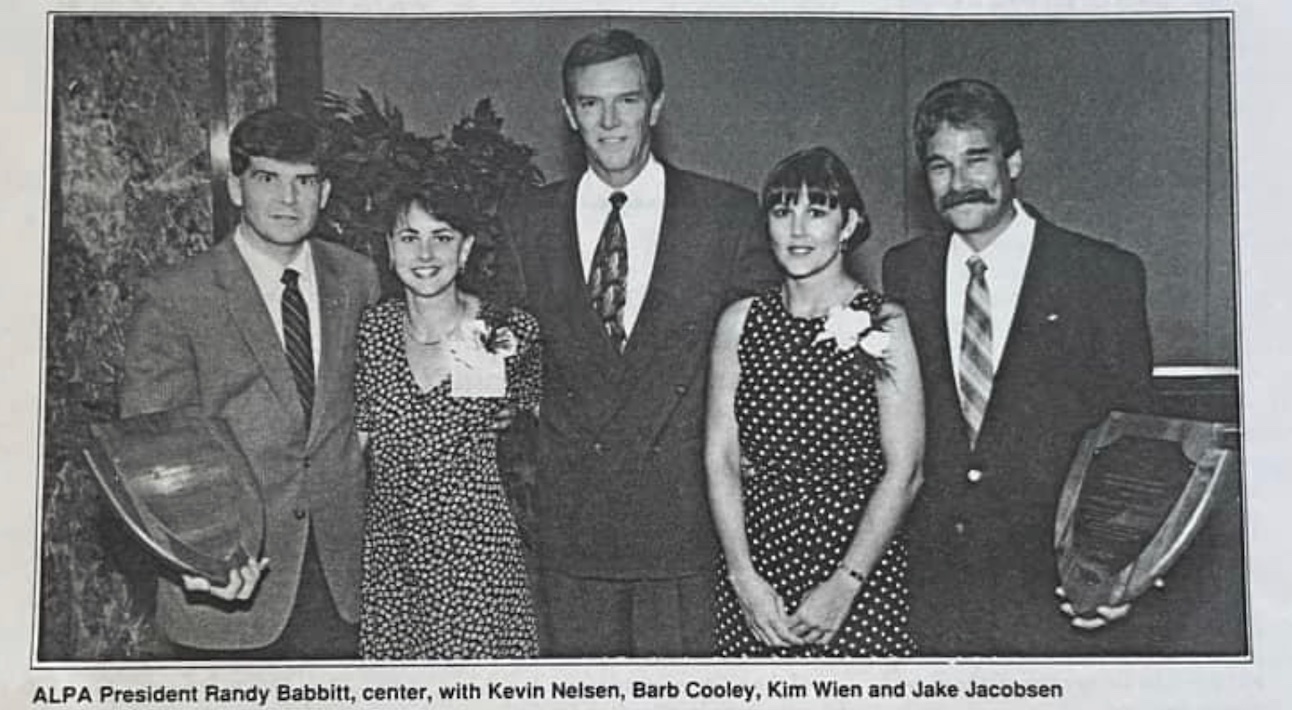
In 20 years as a pilot, Captain James “Jake” Jacobsen had racked up more than 15,000 hours of flight time, but when he looked back over his career, his most vivid memory was of 15 seconds over Juneau on the night of January 29, 1993.
He and First Officer Kevin Nelsen were later honored with the Air Line Pilots Association Superior Airmanship Award for their flying skills that night.
The incident began about 6:30 pm. The sky was dark. A light rain was falling. Winds were from 120 degrees at 30 knots — not the best flyng conditions by any means, but not unusual for Southeast Alaska either.
Two previous jet departures reported moderate turbulence on the climb out.
Jacobsen and Nelson took off toward the east on a flight to Seattle with two pallets of freight and 31 passengers. Flight attendants Kim Wien (Merrill Wien’s daughter) and Barb Cooley were securely strapped in their jumpseats.
Low mountains around the airport required the B737-200 to make a 180-degree right turn shortly after takeoff. About halfway through the turn the right wing of the jet suddenly dipped down toward the ground.
“We rolled over in excess of 60 degrees and I could not get the left wing back down,” recalled Jacobsen. The aircraft started losing altitude and air speed. It was in danger of stalling.
The aircraft had been hit by a dangerous “rotor shear,” a type of wind shear often described as a horizontal tornado. It is caused by one air mass moving over the top of another, sometimes at speeds of 100 knots or more.
“When you are flying an aircraft you need three things — altitude, air speed, and ideas,” said Jacobsen. “We were rapidly running out of the first two and didn’t have a lot of time to come up with the third.”
As the aircraft hung almost motionless in the air, luggage became weightless. Coats, purses, and books tumbled out from under the passenger seats and flew around the cabin.
“It looked like the inside of a popcorn machine,” said Wien.
A pocket radio in the first row rocketed the entire length of the cabin and hit the aft bulkhead.
“It had been windy in Southeast Alaska that day, so we were extra careful about stowing hand-carried items before takeoff,” said Wien. “Everything was really buttoned up, but there is no way to keep everything tied down in a situation like that.”
Jacobsen credited his experience as a light plane pilot, the superior flight characteristics of the B737-200, and luck with saving him and his passengers that night.
ALPA Executive Vice President and Alaska Airlines Captain Joe Salz believed Jacobsen’s many years of flying out of Juneau was also a factor.
“Jake is one pilot who really knows Juneau,” said Salz. “He has spent years flying in and out of Juneau in all kinds of aircraft.”
In fact, Jacobsen and his family owned Wings of Alaska, a small charter and scheduled airline based in Juneau.
Nelsen also had an extensive background in Alaska flying. Born and raised in Seward, he had more than 12,000 hours of flight time, including 5,000 hours flying floatplanes throughout the state.
Before the aircraft rolled over, Jacobsen jammed the throttles to full power and then kicked in full right rudder and dove the aircraft toward the ground to gain air speed.
At what he estimates was less than 200 feet above the ground, Jacobsen was able to pull out of the dive. His first attempt to climb failed. The second try was successful, but as the aircraft struggled to gain altitude it was again hit by the same wind shear.
“We were able to keep the wings level this time because we weren’t turning,” said Jacobsen. Eventually, the aircraft was able to gain altitude, bringing the emergency to an end.
Through it all, Nelsen called the instrument readings off out loud for Jacobsen, who was busy trying to gain control of the aircraft. Extreme turbulence cause the needles to bounce around so much that Nelsen had difficulty accurately reading the airspeed and altitude indication.
The passengers were remarkably quiet throughout the emergency. Wien remembered no screaming, crying, or hysterics. Later, a passenger commented, “I knew we were in trouble when I saw the lights of the Fred Meyer store out of the top of the window.”
Wien said, “There was no sugar coating it. Everyone knew how close we came.”
Despite their brush with disaster, Jacobsen and Nelsen decided to go on to Seattle. They had no choice. “The engines were not damaged. Sitka was closed because of high wings, it was blowing about 75 knots at Ketchikan, and we didn’t want to go back to Juneau for obvious reasons, ” said Jacobsen. In fact, Nelsen flew the departure while Jacobsen called the tower to recommend that the Juneau airport be closed — and it was.
Looking back on it, Jacobsen said, there was no way he and Nelsen could have predicted the wind shear.
“The winds on the surface weren’t that bad. I’ve taken off from Juneau with it blowing much harder,” Jacobsen said.
As soon as the aircraft was safely out of danger, Jacobsen made a PA announcement, then he went back into the cabin to talk to the flight attendants and reassure the passengers.
“That was excellent on Jake’s part, to go back and talk face-to-face with the passengers,” said Nelsen.
Though shaken, Cooley and Wien pulled themselves together and started the meal service.
“Maybe I was in shock, but my first thought was, ‘OK, that was a wild ride, but I’ve got to get these meals out,” said Wien. “Our knees were shaking but we went through our routine. That helped because it gave us something to focus on. We offered everyone complimentary drinks, but surprisingly, only one or two people took us up on it. I think it was a very sobering experience for everybody.”
Jacobsen lauded the performance of the two flight attendants. Holding back their own emotions, “Barb and Kim did an excellent job serving the passengers,” he said. “They were very professional. They performed a very exemplary service.”
In recognition of their performance that night, Jacobsen and Nelsen receive the 1993 Superior Airmanship Award from ALPA. The award is described as ALPA’s equivalent of the military’s Distinguished Flying Cross.
The plaque they received read, “For demonstrating great skill and professionalism on January 29, 1993, when you successfully maneuvered your B737 aircraft through severe meteorological conditions after departure from Juneau, Alaska Airport.”
The award was presented in Washington, D.C. by ALPA President Randy Babbitt. FAA Administrator David Hinson was the event keynote speaker. In the audience were members of the crew’s families and more than a dozen Alaska Airlines pilots, including the entire ALPA Safety Committee and several ICE instructors. Jacobsen’s mother flew from Juneau to see her son receive the award.
Cooley and Wien stood on the stage with Jacobsen and Nelsen as they received their award.
“We stuck together as a crew through it all,” said Jacobsen.
First published by Alaska Airlines’ AlaskaLine newsletter, Oct. 7, 1994.
Leaders of prominent news organizations are turning away from journalistic objectivity, claiming it is antithetical to a diversity of views in their newsrooms, according to a series of interviews conducted by two journalism scholars.
Former executive editor for The Washington Post Leonard Downie Jr. and former CBS News President Andrew Heyward interviewed over 75 media leaders to gauge how the industry views the concept of “objectivity.” The media leaders argued that journalists should include their own beliefs, biases, and experiences to convey truth, and that journalistic objectivity was either unrealistic or undesirable.
“Objectivity has got to go,” said Emilio Garcia-Ruiz, editor-in-chief at the San Francisco Chronicle.
“[I]ncreasingly, reporters, editors and media critics argue that the concept of journalistic objectivity is a distortion of reality. They point out that the standard was dictated over decades by male editors in predominantly White newsrooms and reinforced their own view of the world,” Downie Jr. wrote. “They believe that pursuing objectivity can lead to false balance or misleading “bothsidesism” in covering stories about race, the treatment of women, LGBTQ+ rights, income inequality, climate change and many other subjects. And, in today’s diversifying newsrooms, they feel it negates many of their own identities, life experiences and cultural contexts, keeping them from pursuing truth in their work.”
“Journalists of color” and LGBTQ journalists said that reporting objectively “negates their own identity, life experiences and cultural contexts, keeping them from pursuing truth in their work,” according to Downie Jr.
Journalists believe objectivity prevents them from accurate reporting, as it bars them from channeling their background and beliefs, the survey found.
The media shouldn’t simply use “neutral language” by default, New York Times executive editor Joseph Kahn said. For instance, if there is undisputed evidence of racism or falsehoods, journalists should be direct with readers.
The Los Angeles Times allows their staff to write personal essays so they can share more of their identities, said editor Kevin Merida. Such essays appear on the first page, including a gay reporter’s story about marriage and the legalities of gay marriage.
USA Today has no problem allowing their reporters to write about their own experiences, so long as the stories aren’t too biased, said editor-in-chief Nicole Carroll. She also welcomes a diverse group of journalists to express their experiences when discussing newsworthy stories.
“What we found has convinced us that truth-seeking news media must move beyond whatever ‘objectivity’ once meant to produce more trustworthy news,” said Downie Jr.
Many of the interviewees seemed to be in support of such a change.
“This appears to be the beginning of another generational shift in American journalism,” Downie Jr. said.
It is paradoxical that Anchorage students can read books from the school libraries, yet their parents are stopped from reading them out loud in a public forum—the school board meetings.
At a recent Anchorage School Board meeting, a citizen activist read from “This Book is Gay” and was immediately stopped by Board President Margo Bellamy because, “There are children in the audience.”
Since these books are readily available to elementary school children and condoned by the school board, why did Bellamy become upset?
The attack on family values is not just occurring in Anchorage and other Alaska school districts. The National Education Association — the NEA — has this as part of its national agenda to normalize certain behaviors in support of the LBGTQ community, at the expense of all others.
Here is a furious New Jersey mother testifying to her school board on “This Book is Gay.”
Why does Margo Bellamy, a licensed librarian, want to keep children from hearing the book’s story and yet still wants to allow young children to have access to the book? What is she trying to hide from parents? Is this really an effort to groom children?
Can we now expect Board President Bellamy to put forth a policy such that no parent can read aloud from books that are in the school library. It’s kind of like the banning of reading of books in public.
So, it would be alright if an elementary school teacher were to read from the book “George/Melissa” to young children, yet a parent cannot read it to the school board.
The good news is the district does have a means for a parent to object to library materials and instructional materials.
The district’s Controversial Concerns Committee receives complaints on books from anyone living in the Municipality. From its webpage:
“Anchorage School District parents, guardians, staff, students, and local community members are always welcome to voice concerns about instructional or library materials used in our district”.
The bad news is the meetings of the Controversial Concerns Committee are not open to the public and no minutes are kept. Shouldn’t they be open? What are they hiding?
The debate regarding whether a book like “This Book is Gay” is appropriate is closed to the public. Even the public members of this committee are not disclosed.
If you want to see what books are available to your children in the ASD school libraries go to this link.
And if you want to file a complaint on a certain book, go to this link.
One school librarian believes that it’s OK for students to have access to certain sex books, but they should not be read aloud.
The Bartlett High School librarian, Becky Forsyth, says, “Students are never forced to read a book in the library. During the public testimony, no one was able to choose to read, but instead they were subjected to listening to someone engendering controversy.”
Forsyth compares “This is Gay” (fiction) to scientific books on human anatomy and the reproductive systems (non-fiction). Here is her email: “Another reason for the book to remain is that we have at least one other book about heterosexual sex, and other books on the reproductive system and anatomy.”
Forsyth goes on further to say, “We live in a democratic society. Free speech is equated with free reading choice.”
But don’t dare read excerpts from these books to the school board or you will be reprimanded and told it is not acceptable.
There are different rules for teachers. They are protected by their union contract.
Here is their protection: “Members shall not be censored or restrained in the performance of their duties exclusively on the grounds that the material discussed and/opinions expressed are controversial”.
Teachers can read controversial sexual content books to your children, but you are not allowed to read the same books to the school board. Thus, teachers are granted more rights than parents when it comes to discussing controversial subjects.
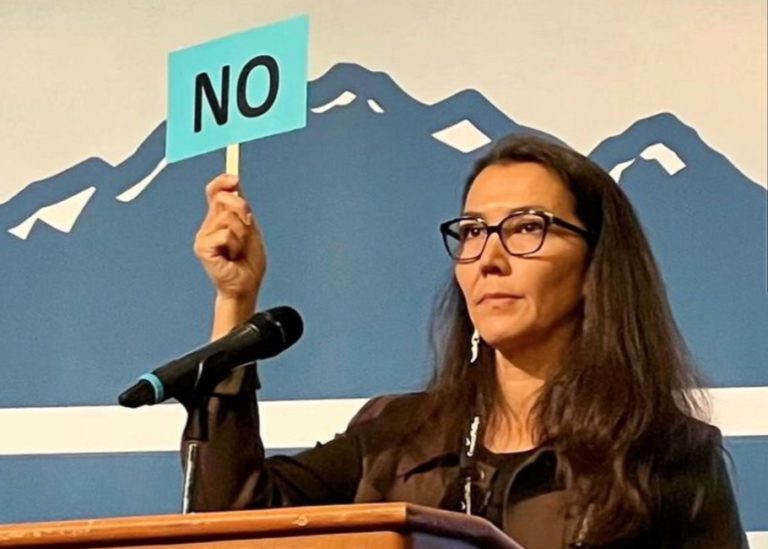
Alaska’s Rep. Mary Peltola joined Democrats in voting against a bill that would end the national Covid emergency declaration.
House Joint Resolution 7 passed 229 to 197 on Feb. 1, with some Democrats voting with Republicans to end the emergency immediately. Peltola, however, voted with The Squad, as well as Reps. Nancy Pelosi, Jerry Nadler, Adam Schiff, and other hardliners. Eleven Democrats voted to end the emergency.
The joint resolution, which is not likely to be considered by the Democrat-controlled Senate, would terminate the national emergency concerning Covid-19 declared by President Donald Trump on March 13, 2020, which has been renewed every 90 days subsequently by Trump, and by Biden. The country has been under the public health emergency declaration for nearly three years.
Earlier, Peltola had voted against allowing health care workers the freedom to choose whether to get a Covid vaccination and boosters.
Meanwhile, President Joe Biden has declared he will continue the emergency until May 11, because he says that ending it earlier would be too abrupt for hospitals and health care providers.
The joint resolution is not complicated. In fact, it’s just one sentence: “Resolved by the Senate and House of Representatives of the United States of America in Congress assembled, That, pursuant to section 202 of the National Emergencies Act (50 U.S.C. 1622), the national emergency declared by the finding of the President on March 13, 2020, in Proclamation 9994 (85 Fed. Reg. 15337) is hereby terminated.”
According to a summary by Kaiser Family Foundation, the Covid health emergency declaration gives the government flexibility to waive or modify requirements in Medicare, Medicaid, and CHIP programs, as well as private health insurance regulations. The president can quickly allow authorization of medical countermeasures to provide limited immunity to providers who administer services, such as vaccinations.
The early days of the COVID-19 pandemic were marked by several emergency declarations made by the federal government, under several broad authorities, each of which has different requirements related to expiration, Kaiser wrote.
Part II: Roosevelt’s approach to aiding the Soviets was cautious but intuitively optimistic
To help the Western Allies fight the Nazi war machine in Europe, in early 1941 U.S. President Franklin D. Roosevelt introduced in the Congress a Lend-Lease bill titled “An Act Further to Promote the Defense of the United States.”
The bill was intensely debated throughout the United States, with the most strident opposition coming from isolationists and anti-Roosevelt Republicans.
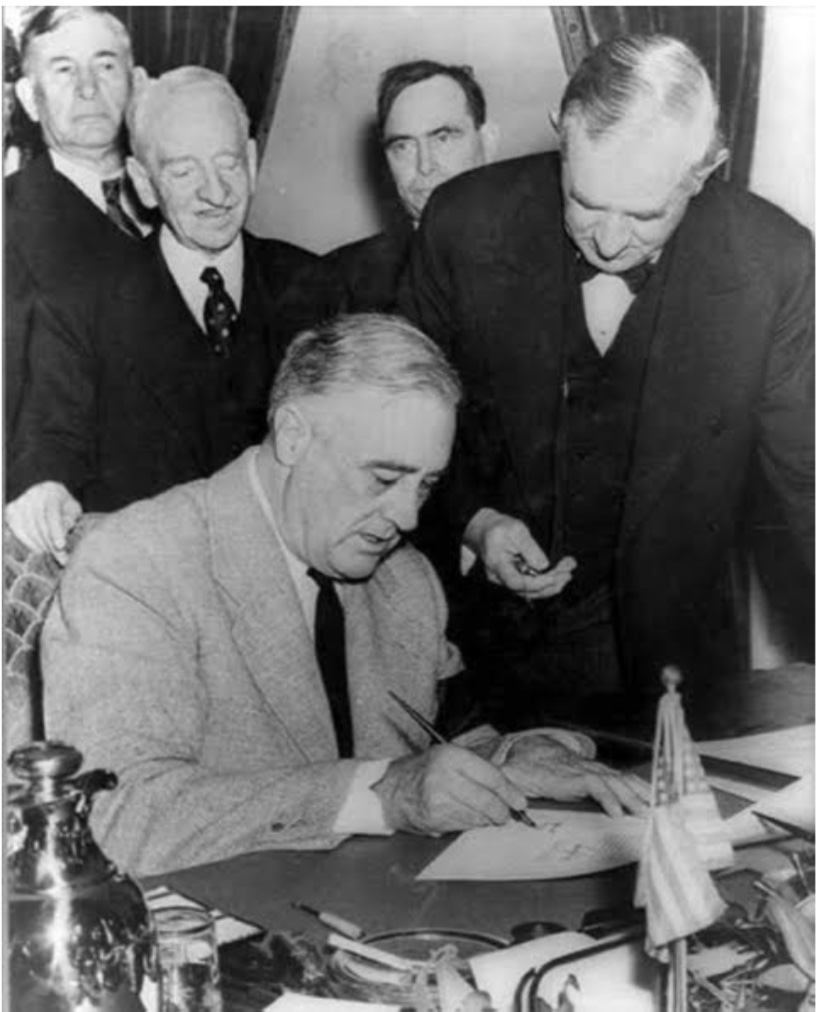
Nevertheless, on March 11, 1941, Congress approved the Lend-Lease Act, granting to the president the plenary powers to sell, transfer title to, exchange, lease, lend, or arrange in whatever manner he deemed necessary the delivery of military materials or military information to the government of a friendly country, if its defense against aggression was vitally important for the defense of the United States.
Roosevelt signs the lend-lease agreement.
The passing of the Lend-Lease Act was in effect an economic declaration of war against Nazi Germany and its Axis partners. Most Americans were prepared to take that risk rather than see Britain collapse, leaving the United States to face the Axis powers alone.
After the Nazi German invasion of the Soviet Union, the governments of Britain and the United States declared their support for the USSR in its struggle against fascist aggression.
On June 22, 1941, Winston Churchill, speaking over the radio, announced, “Hitler’s invasion of Russia was only a prelude to an invasion of the British Isles,” and, on June 23, 1941, President Franklin D. Roosevelt made the statement to the media that “Hitler’s armies are today the chief dangers to the Americas.”
Roosevelt’s statement contained no distinct promise of aid to the Soviets but stated clearly the State Department’s policy. The next day, on June 24, 1941, the President announced at a press conference that the United States would give all possible help to the Soviet people in their struggle against Nazi Germany and its Axis partners.
That same day, Roosevelt released Soviet assets in American banks, which had been frozen after the Soviet attack on Finland on November 30, 1939; this enabled the Soviets immediately to purchase 59 fighter aircraft. Preliminary discussions between US, British, and Soviet officials on deliveries of arms and other vital supplies began on June 26, 1941.
A British credit line was subsequently opened on August 16, 1941, and arms deliveries from England were immediately initiated, with the American Lend-Lease principles as guidelines. Soon after the U.S.–Soviet Lend-Lease agreement was signed on June 11, 1942, Britain’s ongoing provision of materials to the Soviet Union was formalized in a British–Soviet Lend-Lease agreement signed on June 26.
Many conservatives in the United States argued vociferously against the U.S.–Soviet Pact, asserting that America’s aid should be disbursed only to proven friends, such as Great Britain and China. In congressional debates on the subject in late July and August, isolationists insisted that to aid the Soviet Union was to aid communism.
In June of 1941, U.S. Senator (later President, 1945‒54) Harry Truman expressed common American sentiments on Hitler’s invasion of the Soviet Union: “If we see that Germany is winning, we ought to help Russia, and if we see Russia is winning, we ought to help Germany, and that way let them kill as many as possible.”
At the same time, others thought the Russian front might be America’s salvation. In July of 1941, a public opinion poll indicated that 54 percent of Americans opposed Soviet aid, but by September those opposed registered only 44 percent, and those who favored helping the Soviet Union had risen to 49 percent.
Roosevelt’s approach to aiding the Soviets was cautious but intuitively optimistic. He distrusted them but did not think that they, in contrast to the Germans, intended to conquer Europe. He viewed Hitler’s armies as the chief threat to the Americas. Roosevelt calculated the Soviets would resist the German assault longer than anyone anticipated, which would help the British to fight the war, and perhaps preclude America’s entry into Europe and North Africa. The President relied heavily on the assessment of senior advisers Harry Lloyd Hopkins and Averell William Harriman, who urged him to bring the Soviet Union under Lend-Leaseagreement. But Roosevelt still held back.
In July of 1941, Roosevelt appointed two American special assistants, Harry Hopkins and Melvin Purvis, and Soviet Ambassador to the United States Constantine Oumansky to an intergovernmental committee on Soviet aid; he also dispatched his trusted aide Harry Hopkins to go to the Soviet Union in order to assess the Soviet military situation and talk with Soviet officials. After meeting with Stalin and other Soviet authorities, Hopkins came to the conclusion that the Soviets would withstand the German attack and cabled Washington his opinion to that effect. In early September of 1941, Roosevelt decided to send Averell Harriman, a significant investor in the Soviet Union since 1918, to Moscow as a special adviser on Lend-Lease matters. Harriman, along with British representatives, was charged with working out a temporary aid program.
Negotiating the US–Soviet Lend-Lease Agreement
From September 29 to October 1, 1941, representatives from Britain, the Soviet Union, and the United States attended a conference in Moscow. There, a plan was drawn up for delivery of armaments, equipment, and foodstuffs to the Soviet Union. The USSR in turn agreed to provide strategic raw materials to Britain and the United States.
During the conference, Harriman for the first time suggested delivery of American aircraft to the Soviet Union via Alaska and Siberia, using American crews. Stalin initially rejected this idea outright, perhaps to avoid provoking Japan. Despite political tensions at the Moscow conference, on October 30, 1941, Roosevelt approved, and, on November 4, Stalin accepted, $1 billion in aid, to be repaid in 10 years, interest free.
Although the Soviet government was pleased with the aid package, its diplomats still complained that the Allies had taken no serious military actions against Germany, leaving the Soviet Union to continue to bear the brunt of the war alone.
The Soviets suggested that Britain and the United States open a second front in France or the Balkans or send troops through Iran, which the Soviets and British had jointly occupied in August of 1941 in order to preclude Germany from attacking Ukraine from the south. The Soviet government continued to insist that opening a second front in Europe would relieve pressure from enemy attacks on the Eastern Front.
The Allies, however, were reluctant to initiate this plan at the time because of lack of available forces for a second front, due to Allied involvement in the Pacific and North African theaters. Churchill, Stalin, and Roosevelt, in tacit acknowledgment of the fact that they had not yet reached agreement on joint war or peace aims, thus limited their 1941 pact to Lend-Lease support to the Soviet Union.
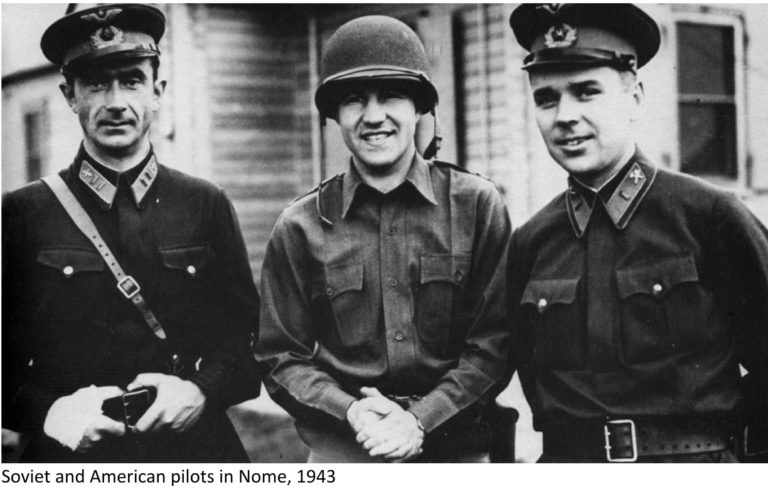
On July 7, 1941, a Soviet delegation flew from Vladivostok to Nome and then on to Kodiak and Seattle for secret talks with American officials regarding aircraft deliveries to the USSR and the feasibility of Pacific supply routes. The Soviet and American delegations discussed several possible routes for shipping planes and war materials to the USSR. The first was a sea route across the North Atlantic and around the North Cape to the ice-free Arctic ports of Murmansk and Archangelsk. This route was shorter but, by far, the more dangerous of those considered because of regular patrols in the area by the German Kriegsmarine (navy) and Luftwaffe (air force).
Another discussed route would transport the materials by ship across the Atlantic Ocean, around South Africa’s Cape of Good Hope, and then north to the Iraqi port of Basra, where supplies would be loaded onto trains and trucks and transported to Soviet Central Asia and Azerbaijan via Iran. This route, too, had serious drawbacks—not only would the goods take too long to reach the USSR, the desert sands in Iran were notorious for infiltrating and ruining aircraft engines.
On October 1, 1941, the United States and the USSR signed their first Lend-Lease Protocol, eeffective from October 1, 1941, through June 30, 1942. The Soviet Union accepted most of the lend-lease terms, but specific details had yet to be worked out. On May 29, 1942, Vyacheslav Molotov, the Soviet Foreign Affairs Commissar and the right hand of Joseph Stalin on foreign affairs, arrived in the United States to discuss Lend-Lease matters.
It was the Soviet dignitary’s first official visit on American soil. Being cautious and uncertain in this formerly hostile country, Molotov carried in his luggage some sausages, a piece of black bread, and a pistol to defend his person if the need arose.
During Molotov’s visit, President Roosevelt raised two possibilities: (1) that American aircraft be flown to the USSR via Alaska and Siberia; and (2) that Soviet ships pick up Lend-Lease supplies from America’s West Coast ports for ferrying across the Pacific to Vladivostok and other Soviet Far Eastern ports—in addition to two other routes (the northern run to Murmansk and the Iran route) proposed earlier in July 1941. Roosevelt noted that by using the Alaska–Siberia air route, which would connect to the Trans-Siberian Railway, Lend-Lease supplies could more quickly and safely reach the Ural industrial complex around Magnitogorsk.
After careful consideration of various proposals, the best route for planes seemed to be via the US, Canada, Alaska, and Siberia. Although great distances were involved and the worst possible weather conditions would be encountered, the planes would be delivered in flying condition and the possibility of enemy interference would be remote. American support for the Alaska–Siberia (ALSIB) route was also based on the hope that, eventually, Siberian air bases would be used for bombing raids on Japan.
The Soviets, however, were hesitant to use this route, believing it to be too dangerous and impractical. It was also thought that remote Siberian cities would not be able to accommodate the busy air traffic and that the presence of Americans in the Soviet Far East would be unwanted. The Soviets were also afraid that the Pacific supply routes, and the ALSIB route in particular, might provoke Japanese military actions against the Soviet Union.
Nevertheless, faced with mounting losses on the sea run to Murmansk, and given the great distances involved in the Middle East route, in October 1941, the Soviet Union’s State Defense Committee decided to begin necessary preparatory work for the ALSIB Air Route and finally agreed to open it on August 3, 1942.
Two months prior to the opening of the ALSIB Air Route, the final Soviet–American Lend-Lease Agreement was signed in Washington, D.C., on June 11, 1942. The Agreement, titled “Agreement between Governments of the USSR and USA on Principles Employed to the Mutual Assistance in Fighting a War Against the Aggression,” stipulated:
The government of the United States will continue to supply the Soviet Union, in accordance with the United States Lend-Lease Act of March 11, 1941, with a defense material, services, and information. The USSR, after the completion of the war, must to return to the United States all those defense material that have not been destroyed, lost, or unused. On the other side, the USSR is obligated to assist the defense of the United States in providing a necessary material, services, privileges and information to the extent it is possible.
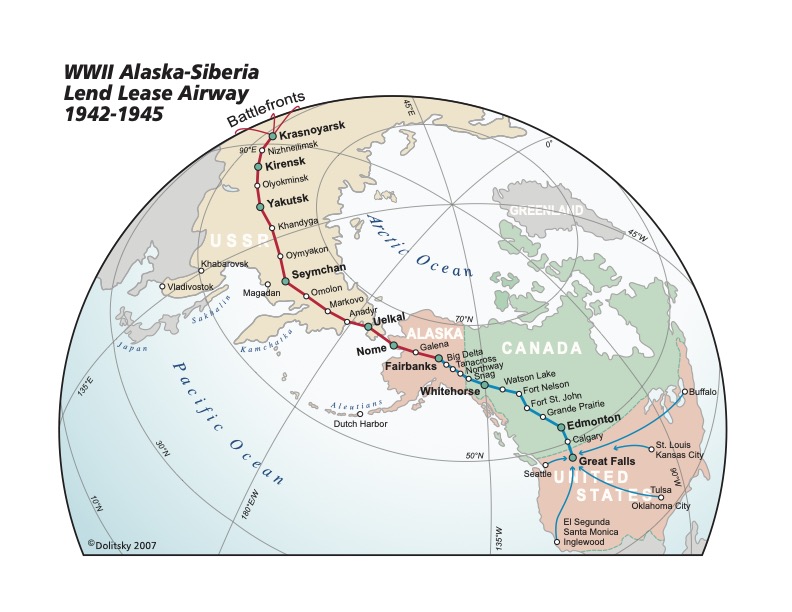
The ALSIB delivery route finally became a reality in August of 1942. A North American air transport route connecting Great Falls in Montana, Edmonton and Whitehorse in Canada, and Fairbanks, Galena, and Nome in Alaska was established and operational by mid-October. A major airfield constructed in Nome served as the jumping-off point for airplanes headed for Siberia. Once inside Siberia, planes continued on their long trip from Uelkal through Markovo, Seymchan, Yakutsk, Kirensk, and finally to Krasnoyarsk.
In Krasnoyarsk, pilots from combat units took over, flying the newly arrived aircraft westward via Omsk, Sverdlovsk, and Kazan to the Russian battlefronts. Over the program’s three years of operation, nearly 8,000 aircraft would be sent through Great Falls to Fairbanks’ Ladd Army Airfield for transfer to the Soviet Union, each crossing a total distance of almost 6,050 miles in harsh sub-Arctic and Arctic conditions. The distance over which combat planes were ferried from the manufacturing sites to the warfronts in Europe was even greater: 8,000–10,000 miles across 12 time zones.
Part 1 of this series is below. Part 3, Lend-lease and the Soviet mission in Alaska, will appear on Monday.
Alexander B. Dolitsky was born and raised in Kiev in the former Soviet Union. He received an M.A. in history from Kiev Pedagogical Institute, Ukraine, in 1976; an M.A. in anthropology and archaeology from Brown University in 1983; and was enroled in the Ph.D. program in Anthropology at Bryn Mawr College from 1983 to 1985, where he was also a lecturer in the Russian Center. In the U.S.S.R., he was a social studies teacher for three years, and an archaeologist for five years for the Ukranian Academy of Sciences. In 1978, he settled in the United States. Dolitsky visited Alaska for the first time in 1981, while conducting field research for graduate school at Brown. He lived first in Sitka in 1985 and then settled in Juneau in 1986. From 1985 to 1987, he was a U.S. Forest Service archaeologist and social scientist. He was an Adjunct Assistant Professor of Russian Studies at the University of Alaska Southeast from 1985 to 1999; Social Studies Instructor at the Alyeska Central School, Alaska Department of Education from 1988 to 2006; and has been the Director of the Alaska-Siberia Research Center (see www.aksrc.homestead.com) from 1990 to present. He has conducted about 30 field studies in various areas of the former Soviet Union (including Siberia), Central Asia, South America, Eastern Europe and the United States (including Alaska). Dolitsky has been a lecturer on the World Discoverer, Spirit of Oceanus, andClipper Odyssey vessels in the Arctic and sub-Arctic regions. He was the Project Manager for the WWII Alaska-Siberia Lend Lease Memorial, which was erected in Fairbanks in 2006. He has published extensively in the fields of anthropology, history, archaeology, and ethnography. His more recent publications include Fairy Tales and Myths of the Bering Strait Chukchi, Ancient Tales of Kamchatka; Tales and Legends of the Yupik Eskimos of Siberia; Old Russia in Modern America: Russian Old Believers in Alaska; Allies in Wartime: The Alaska-Siberia Airway During WWII; Spirit of the Siberian Tiger: Folktales of the Russian Far East; Living Wisdom of the Far North: Tales and Legends from Chukotka and Alaska; Pipeline to Russia; The Alaska-Siberia Air Route in WWII; and Old Russia in Modern America: Living Traditions of the Russian Old Believers; Ancient Tales of Chukotka, and Ancient Tales of Kamchatka.
Congresswoman Ilhan Omar, who expresses contempt for the United States, was removed from the House Foreign Affairs Committee on a vote of 218 to 211 in the House on Thursday.
Rep. Mary Peltola, who is Alaska’s only member of Congress, voted against removing Omar, a member of the radical caucus known as The Squad. Members of the Democratic Party stood and applauded Omar, who spoke on her own behalf, as did other members of The Squad.
The Republicans who spoke in favor of the resolution mentioned Omar’s many anti-semitic comments, her anti-Israel comments, and the disgrace she has brought to the U.S. House of Representatives. The Foreign Affairs Committee has numerous classified briefings that are closed to the public because of their national security sensitivities.
Rep. Jan Schakowsky, an Illinois Democrat angrily lashed out on the floor of the House: “I stand before you as a proud Jew and a proud friend and colleague of Ilhan Omar. I don’t need any of you to defend me against anti-semitism.”
Representative Alexandria Ocasio-Cortez, screamed racism and gesticulated as she bashed Republicans and called them hypocrites.
Alexandria Ocasio-Cortez went into full meltdown mode Thursday morning, when she spoke from the House floor and discussed the expulsion of Ilhan Omar from the Foreign Affairs Committee. https://t.co/Lewr4ooCAx Oh, Sandy… pic.twitter.com/96V7IFoKzP
“It’s so painful to watch,” said Rep. Rashida Tlaib of Michigan, a Democrat of Palestinian descent who is a member of The Squad. “To Congresswoman Omar, I am so sorry that our country is failing you today through this chamber. You belong on that committee.”
Rep. Michael McCaul of Texas, who chairs the Foreign Intelligence Committee, said, “It’s just that her worldview of Israel is so diametrically opposed to the committee’s. I don’t mind having differences of opinion, but this goes beyond that.”
Speaker Kevin McCarthy has also blocked Reps. Adam Schiff and Eric Swalwell, California Democrats, from membership on the the House Intelligence Committee for similar reasons of them being untrustworthy to have access to national security documents.