Tuesday, August 11, 2026
Home Blog Page 744

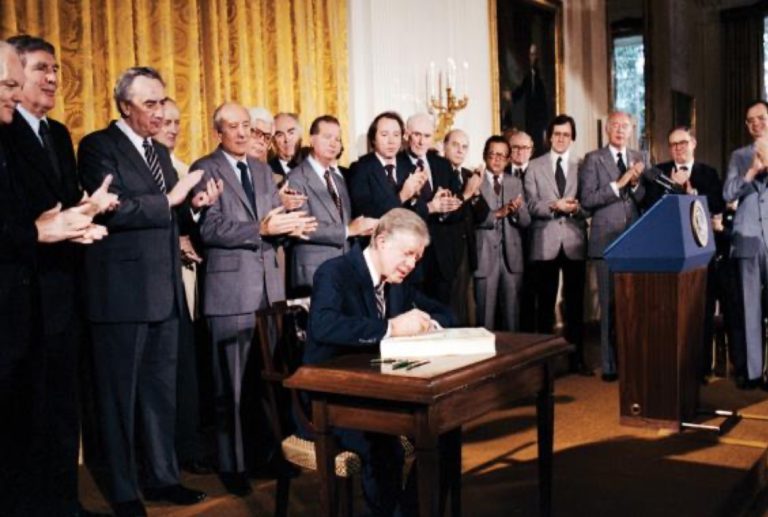
Former President Carter, who signed ANILCA in 1980, brings in hospice care

35

Ninety-eight year old former President Jimmy Carter has chosen to receive hospice care at his home, according to an announcement by the Carter Center on Saturday:

“After a series of short hospital stays, former U.S. President Jimmy Carter today decided to spend his remaining time at home with his family and receive hospice care instead of additional medical intervention. He has the full support of his family and his medical team. The Carter family asks for privacy during this time and is grateful for the concern shown by his many admirers.”

Carter, a Democrat born in Plains, Ga. who had served as the governor of Georgia from 1971-1975, was president from 1977 to 1981. America’s 39th president, he served one term and lost to Republican Ronald Reagan in 1980.

Carter made an indelible impression on Alaska’s future when he used the Antiquities Act to temporarily designate 56 million acres as 17 national monuments by executive order on Dec. 1, 1978. 

In 1980, he signed the Alaska National Interest Lands Conservation Act. ANILCA established more national parks, national wildlife refuges, and wilderness areas than any in history and “has been called our country’s most significant conservation law. It was my honor to work with Congress and citizens throughout our great nation on the passage of ANILCA,” Carter said. There are many Alaskans who disagreed with ANILCA and has been the subject of legal disputes over the decades over the “no more” clause, which said the federal government would withdraw no more lands.

The signing of ANILCA was a historic time for Alaska. Sen. Ted Stevens, Sen. Mike Gravel, and Congressman Don Young were in office at the time; all three have passed in the past 13 years.

Carter and his wife Rosalynn were longtime volunteers and supporters of Habitat for Humanity.

In recent years he has suffered from cancer, both liver and brain, and he fell and broke his hip in 2019. Carter is the first U.S. president to reach the age of 95, and in 2017 was the oldest former president to attend a presidential inauguration, which was on the 40th anniversary of his own inauguration. He was born the same year as the late President George H.W. Bush, who died in 2018.

Jamie Allard: Washington, Lincoln were trailblazers; it’s time for us to blaze a new trail in education

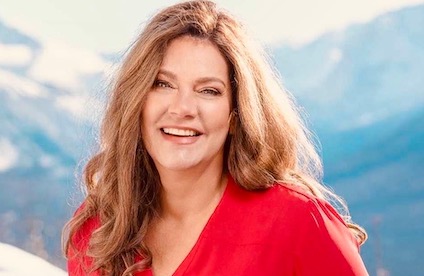
By REP. JAMIE ALLARD

When I was a little girl, I always thought it was pretty cool that my own birthday was a day before Abraham Lincoln’s birthday. We wrote essays about our favorite president, and I couldn’t help but be drawn to Lincoln. I liked thinking I had something in common with him. We have such active minds as children, and what connects and draws us to others is so amazing. That’s what national holidays and long weekends and school parties and essays about presidents are for: Celebrating the things that connect us and make us Americans, delighting in our common bonds, honoring the past, and looking to the future.

Presidents’ Day celebrates the birthdays and lives of President George Washington and President Abraham Lincoln, and honors all of those who have served as our nation’s leader. Widely considered the two best presidents in our nation’s history, Washington and Lincoln were humble, respectful, and wise. Their demeanor won the hearts of the American people. Their leadership guided us through two wars that shaped the identity of our nation and changed the course of world history.

Lincoln gave us one of the most famous and eloquent speeches in U.S. history. Washington gave us a foundation of moral fortitude and the triumph of a common cause in our fight for freedom. These men were trailblazers who fathered our independence and liberty. They are the quintessential role models of leadership and service.

And I find it very interesting that amongst all of their accolades, you won’t find a college degree. From humble means, they both had minimal formal education. And yet no one could argue that they were uneducated. Their thirst for knowledge motivated their life long journeys of self-education.

It wasn’t long ago that a school day in America started with the Pledge of Allegiance. Values like “liberty and justice for all” were the pillars of high quality education and strengthened our communities. Children were taught how to read and write and how to think for themselves, not what to think nor programmed with  ideological indoctrination that violates the rights of parents. Education is the springboard to that American “pursuit of happiness.” It inspires us to reach new heights, like the moon, or the presidency.

Education also reminds us to not repeat the mistakes of the past. A solid foundation can prepare you for life’s inevitable difficulties, and pave the way to a brighter future.

Thomas Jefferson said, “Whenever the people are well-informed, they can be trusted with their own government; …whenever things get so far wrong as to attract their notice, they may be relied on to set them to rights.” Well, we are noticing.

I think Jefferson, Washington, and Lincoln would agree that we have a crisis in our public education system. They might weep at the state of our high school seniors graduating unable to read. A strong nation can be brought to its knees when an entire generation is crippled by a failed education system.

However, across the country there is a movement of parents and students alike who, like Jefferson, recognize the immeasurable value of an excellent education, and know that power is in their own hands.

Public schools are failing. Alaska is nearly dead last in the nation. It is time for us to look for solutions that create real results. Market competition, school choice, accountability for every tax payer dollar spent, reducing bloated administrations and supporting teachers, there are many avenues to explore. But none of the solutions are throwing other people’s money into a hole of problems and expecting different results.

I find the best way to honor those who came before us is to learn from their stories. Washington and Lincoln were some of the most revered and admired men in our history, and they educated themselves.

We can trust parents to know what is best for their children. We can flip school budgets upside down, investing the money where it belongs with school vouchers for students. We can get back to the basics of reading, writing, and arithmetic. It’s time for radical solutions. It’s time to be trailblazers like the great presidents before us, honoring the past, looking to the future.

As you enjoy a day off this holiday weekend, please take a moment to consider…how would you  solve the education crisis? The future of our nation depends on it.

Rep. Jamie Allard serves in the Alaska Legislature on behalf of the people of Eagle River.

Alaska AG Treg Taylor joins letter asking Biden to label Mexican drug cartels as terrorist organizations

17

Virginia Attorney General Jason Miyares is leading a coalition of 21 states, including Alaska, that are calling on President Joe Biden and Secretary of State Antony Blinken to designate drug cartels as foreign terrorist organizations under federal law. Doing so will free up resources to confront the deadly opioid crisis with the seriousness it deserves.

The opioid crisis has affected every state, county, city, town, and community in the United States, the group of top law officers said. Last year, more than 100,000 Americans died from drug overdoses—and synthetic opioids like fentanyl were responsible for more than half of those deaths.

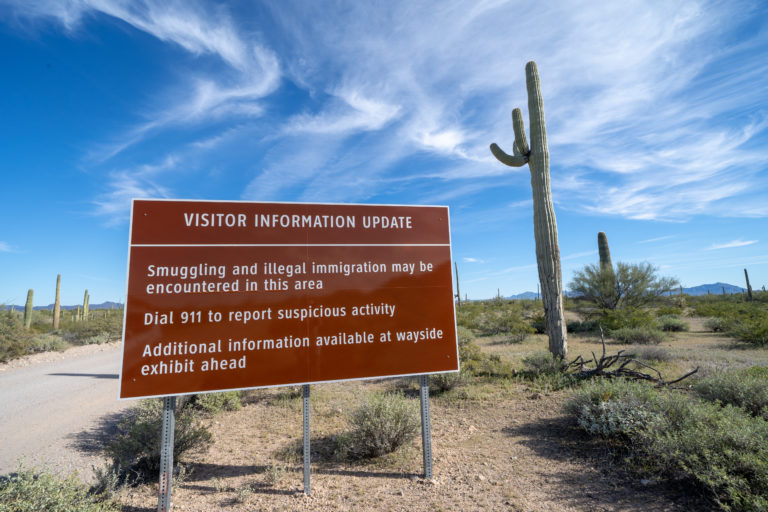
In the letter sent Feb. 8, the attorneys general say that the federal government knows precisely how the drugs are entering the country. Cartels like the Sinaloa cartel and Cartel Jalisco New Generation import raw materials from China, use them to produce deadly synthetic opioids at low cost, and traffic those poisons across the southwestern border and into American communities.

Between October 2021 and June 2022, U.S. Customs and Border Protection seized 8,425 pounds of fentanyl smuggled into the United States.

“These cartels are doing much more than just smuggling poison into the United States. They are assassinating rivals and government officials, ambushing and killing Americans at the border, and engaging in an armed insurgency against the Mexican Government,” the law officers said.

Last year, Texas Gov. Greg Abbott designated two cartels — Sinaloa Cartel and Jalisco New Generation Cartel — as foreign terrorist organizations, and asked the federal government to do the same. He asked the president that illicit fentanyl be designated a weapon of mass destruction. But in his State of the Union address, the president all but ignored the crisis at the border with Mexico and the flood of fentanyl coming over the border.

Federally designating major cartels as foreign terrorist organizations would give state and federal law enforcement agencies increased authority to freeze cartel assets, deny entry to cartel members, and allow prosecutors to pursue stricter punishments against those who provide them material support, the attorneys general wrote in their letter to the president.

Attorney General Miyares was joined by his counterparts in Alabama, Alaska, Arkansas, Florida, Georgia, Indiana, Iowa, Kentucky, Louisiana, Missouri, Montana, Nebraska, New Hampshire, Ohio, Oklahoma, South Carolina, Tennessee, Texas, Utah, and West Virginia.

Read the letter at this link.

Michael Tavoliero: Johnson Amendment and the restrictions on political speech

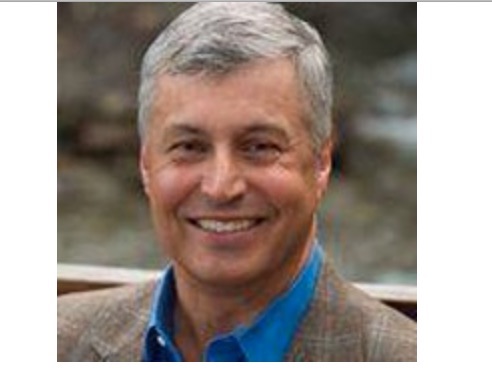
By MICHAEL TAVOLIERO

In 1954, an amendment to the newly revised Internal Revenue Tax code was added: The Johnson Amendment.

This amendment restricted the political activities of tax-exempt organizations, including churches. The amendment prohibited tax-exempt organizations from endorsing or opposing political candidates or contributing to political campaigns. While it does not prevent them from engaging in issue advocacy or expressing opinions on public policy issues, it does restrict their ability to engage in certain types of political speech. 

It remains in effect today.

Our government has no compelling interest in this amendment. It is unconstitutional and violates the First Amendment. 

The Johnson Amendment was introduced by Sen. Lyndon B. Johnson, a Texas Democrat, who later became president and brought us the “Great Society” and the “War on Poverty.”

Supporters of the amendment argue that it maintains the integrity of the nonprofit sector and prevents tax-exempt organizations, including churches, from being used for partisan political activity. However, the first organization described in the code is religious, indicating that the amendment specifically targets churches.

It is noteworthy that the Johnson Amendment was introduced as a reaction to the Facts Forum and the Committee for Constitutional Government. Both organizations at the time worked to campaign against politicians like Lyndon B. Johnson. The Johnson Amendment was introduced to shut down this political zeal.

But why churches and religious organizations?  It’s important to understand the history behind it first.

Even before the dream of the establishment of an American culture and society, early colonialists came to the New World for many reasons. Large numbers sought freedom from religious and political persecution, risking their lives and the lives of their families to travel thousands of miles over unfamiliar oceans and hostile territory to find it.

Religion played a significant role in the lead-up to the American Revolution, and many churches and religious leaders were actively involved in the movement for independence from England. The church provided a moral and intellectual foundation for the revolution and played a key role in organizing and mobilizing support for the revolutionary cause. Religious groups and leaders provided practical support for the revolution, providing funding and supplies for the Continental Army and serving as chaplains and spiritual advisors to the troops.

In the subsequent years of this constitutional republic, religious groups and leaders were involved in debates over the meaning and interpretation of the Constitution. They continued to use religious language and imagery to promote their views and shape public opinion. 

The church played a key role in shaping American culture and society in the 19th and early 20th centuries. Churches and religious organizations were involved in efforts to establish public schools and universities, promote literacy and education, and provide social services and support for the poor and disadvantaged.

In addition, the church continued to be an important voice in American politics and public life. Many religious leaders and groups have been involved in debates over issues such as civil rights, women’s rights, slavery, government corruption, and other issues. They used their platforms to promote their views and advocate for policy changes in working through political dynamics.

If not for the church’s commitment to the abolitionist movement, slavery might have perpetuated for much longer than it did. The church not only preached the gospel; it lived it, addressing societal issues the Gospel stands against.

Eric Metaxas, in his new book, “Letter to the American Church,” asks, “Have we forgotten that pastors in the eighteenth century spoke boldly from their colonial pulpits against the tyranny of King George III, and opposed him by name? Was it not their voices that helped us to gain our freedoms and that helped us to create a Constitution in which all of our freedoms were enshrined in a way that has been the envy of the whole world ever since? Were pastors from their American pulpits in the nineteenth century not allowed to speak against those candidates who expressed racist and pro-slavery views? Did they not even have an obligation to educate their congregations on such things and to encourage them to choose leaders who shared God’s views? Finally, were pastors in the twentieth century not allowed to speak out against candidates who advocated for Jim Crow laws? Do we think they ought to have been?”

Because of the Johnson Amendment, the voice of American churches has been intentionally gagged. The Johnson Amendment has done more than restrict First Amendment rights in America. Over time, the Johnson Amendment has removed the will, faith and courage of churches and religious organizations to participate in these important debates and to have an actively meaningful voice in shaping public policy. By restricting their political activities, the amendment has silenced religious groups and leaders, denying them the opportunity to advocate for policies and candidates that align with their beliefs and values. 

Today, the church is blind, deaf, and dumb, and focused solely on money. It must return to debating the public policies that wove our national fabric, to vetting political candidates who will support our Constitution, to addressing the critical issues which are repressed by the mainstream media, and to critiquing the “woke” agenda which intentionally damages our children and divides us as a society.

In conclusion, Eric Metaxas says it best:

“There are a host of reasons—and excuses—for the behavior of many pastors and Christian leaders…. The American Christians of our own time have taken to using the term “the Gospel” in a new way, as though by doing this they hope to set religious and theological issues apart from all else, as though this were possible.

And so now, when many American church leaders shrink from taking a particular stand, they often say that they are doing so “for the sake of the Gospel.” It is “for the sake of the Gospel” that we will not contest these things, they say, that we will assiduously avoid taking sides in these terribly divisive “culture wars,” and will even more assiduously avoid being identified with any political party or candidate.

The idea is that anything that might conceivably be accused of “being political” is manifestly out of bounds. When is speaking against injustice “merely political”?

When and how did “Gospel-related” issues retreat to where they can only be those issues of justice that fall on one side of the political spectrum? Are we to be hoodwinked so easily? Who decided that being political means we are not being Gospel-oriented?

Michael Tavoliero is a realtor in Eagle River, is active in the Alaska Republican Party and chaired Eaglexit.

Sullivan named vice chair of Senate Western Caucus

7

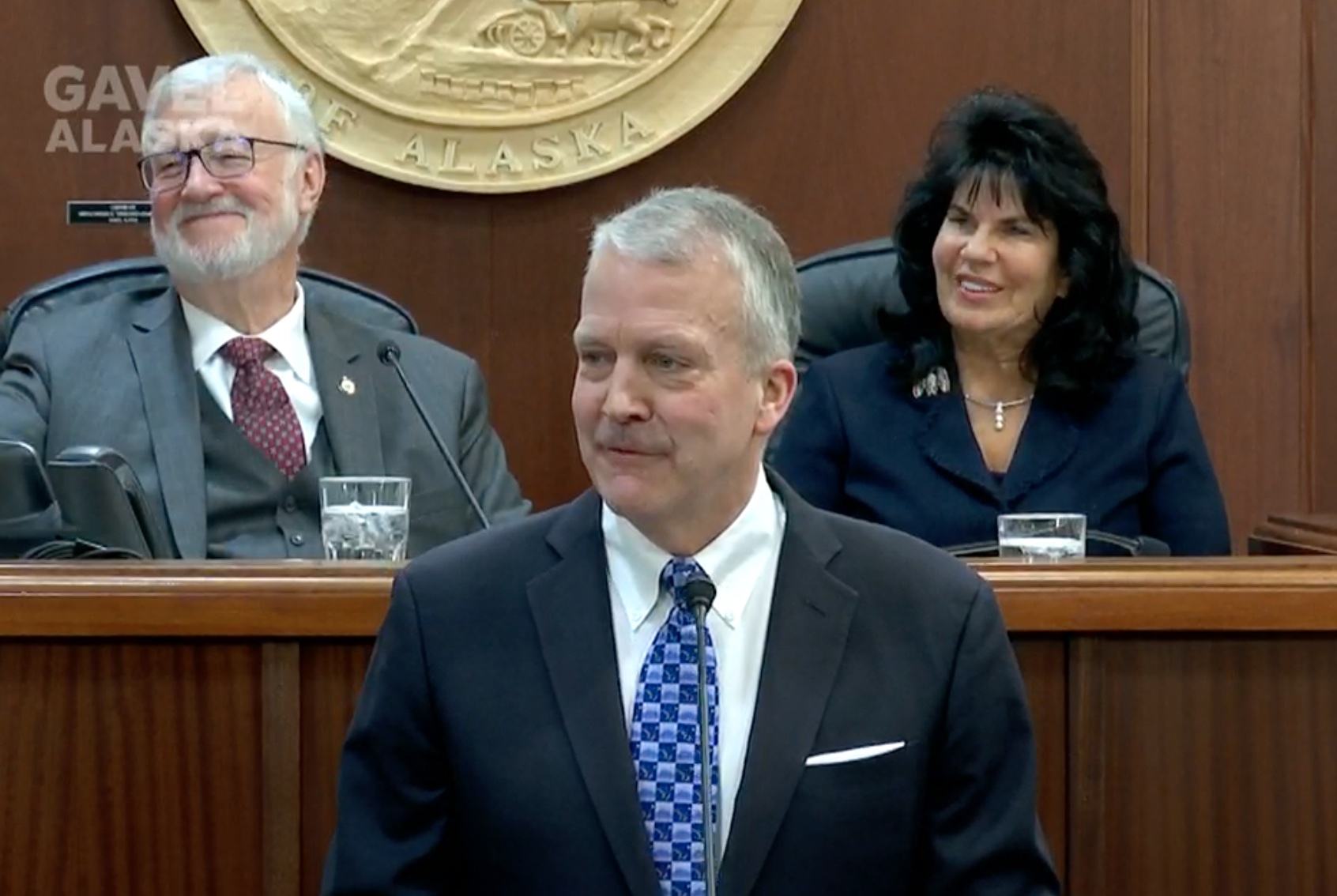
U.S. Senate Western Caucus Chair Cynthia Lummis (R-Wyo.) announced that Alaska Sen. Dan Sullivan will serve as the vice chair of the Senate Western Caucus in the 118th Congress.

“Senator Sullivan knows the west and issues unique to the states we represent, which is why I am honored to have him join me in leading the Senate Western Caucus,” said Sen. Lummis. “The Senate Western Caucus focuses on everything from natural resources and energy to broadband and economic development, which is why there is a need for a vice chair to help champion our priorities. From energy to timber, rural health care to economic development, Senator Sullivan has established himself as a leader on issues that greatly impact western states, and I’m thrilled to work alongside him to defend the western way of life.”

“It’s an honor to serve alongside Senator Lummis as the new vice chair of the Senate Western Caucus in the 118th Congress,” said Sen. Sullivan. “Since my time as Alaska’s attorney general, I’ve recognized that Alaskans face many of the same challenges and share many of the same priorities as Americans in other western states. We all want to be able to access our federal lands, grow our economy with opportunities for upcoming generations, and elevate the voices of our indigenous communities, which are conveniently ignored by this administration. But we face a federal administration, beholden to far-left radical environmental groups, trying to shut us down at every turn and centralize authority with bureaucrats in D.C. Alaska is ground zero for this battle, having endured 43 executive orders and actions targeting our great state by the Biden administration. I look forward to working with Chair Lummis and my fellow caucus members to fight back against the unlawful actions of the Biden administration and to stand up for our constituents’ right to have an economy and responsibly develop our resources.”

Prior to serving in the U.S. Senate, Sullivan was commissioner of the Alaska Department of Natural Resources where he managed one of the largest portfolios of oil, gas, minerals, renewable energy, timber, land and water in the world. During his tenure, he developed numerous strategies that spurred responsible resource development, energy security and a dramatic increase in good-paying jobs across several critical sectors in the Alaska economy. He also developed a comprehensive plan to streamline and reform the state’s regulatory and permitting process. He was also the Alaska Attorney General.

Murkowski re-introduces abortion-for-all legislation

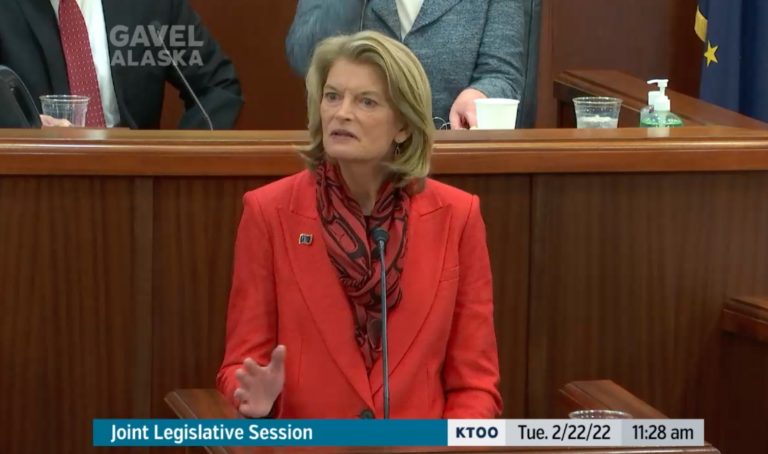
Sen. Lisa Murkowski of Alaska joined with Sen. Kyrsten Sinema (D-AZ), Sen. Tim Kaine (D-VA), and Susan Collins (R-ME) in reintroducing abortion legislation that would reinstate abortion as it was regulated under Roe v. Wade, which was overturned by the U.S. Supreme Court because it was unconstitutional.

The bill is called the Reproductive Freedom for All Act and is the same bill the four introduced last August, but which gained no traction in the Senate before the midterm elections, as many senators did not want to run with a vote on abortion on their scorecard.

“This would undo the damage of Dobbs v. Jackson Women’s Health Organization, the Supreme Court decision overturning Roe v. Wade after almost 50 yearsand would enshrine in federal law the fundamental right to reproductive freedom,” the press release from Murkowski’s office said, exactly the words she used in August, when first introducing the bill.

“Following the Supreme Court’s decision in Dobbs, we’ve seen significant erosion of women’s reproductive rights in numerous states across the country—changes that have taken away rights and regressed access to women’s healthcare by decades. Now, it’s up to Congress to help restore and protect women’s reproductive rights. I’m proud to reintroduce bipartisan legislation with my colleagues to continue the access to contraception provided in Griswold and to make permanent the protections provided through Roe and Casey,” Murkowski said. “Unless we enshrine reproductive healthcare autonomy into law, we risk a future where generations of women will grow up with fewer rights than their mothers.”

Jim Minnery, executive director of Alaska Family Council, differs from the senator on the subject of the rights of unborn Americans: “Murkowski’s relentless pursuit of and fascination with ending the lives of as many weak and defenseless preborn babies as possible is nothing short of barbaric. Every other human right she professes to care about is meaningless if the right to life, clearly spelled out in our Federal and State constitutions, is dismissed as a ‘choice.’ Her priorities are sad to watch unfold and damaging to our cultural psyche.”

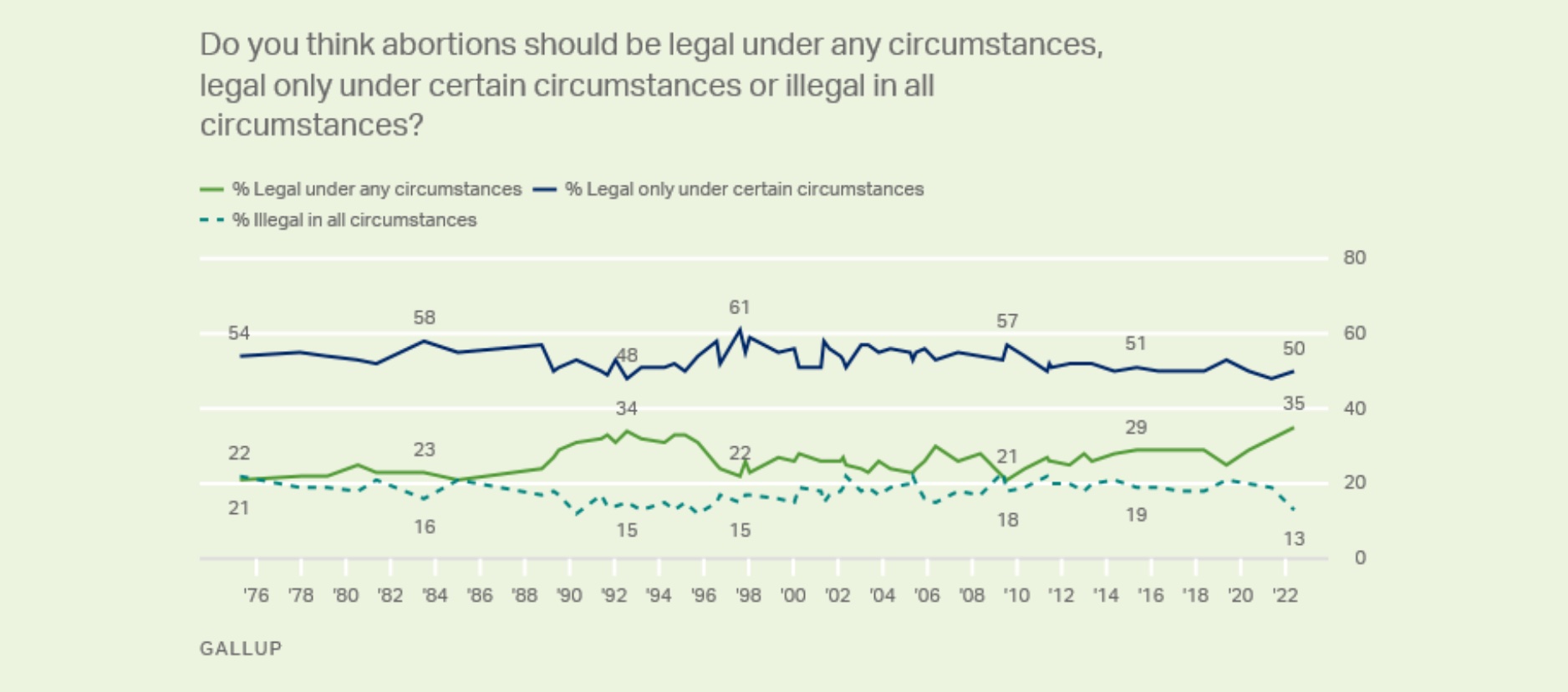
Murkowski, who was recently reelected to a six-year term, reflects the views of many Americans in the current era, according to an ongoing survey by Gallup, which shows that the support for some level of abortion right has remained fairly steady since the 1990s:

Peltola continues mythology of Alaska’s oil as a ‘gap’ fuel, challenged on her carbon credit conflict

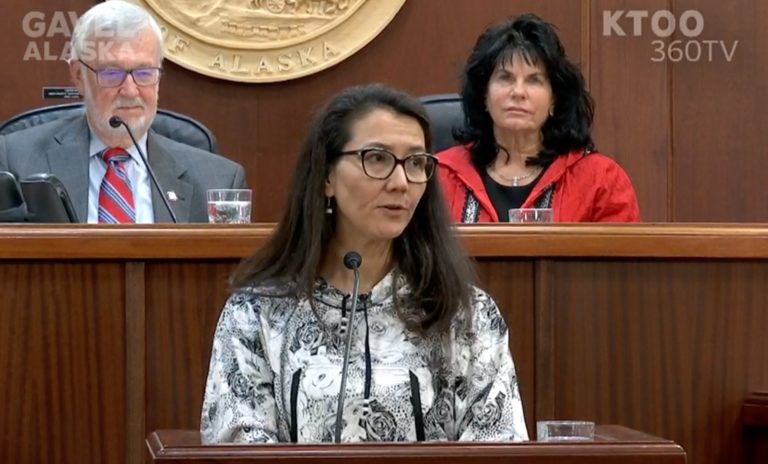
Rep. Mary Peltola appeared before the Alaska Legislature today to make her first formal speech to the joint session. It was short and sweet, a chance to create a photo opportunity for her files, get some complimentary stories out of the press, and make friends in the Legislature.

She started her remarks praising the House and Senate on their bipartisanship and said that the “Alaska Model” is something she is asked about in Washington, D.C., as she considers the Alaska Legislature a model for the nation, and others she speaks with do too.

That may have seemed odd to lawmakers such as Sen. Mike Shower, Sen. Shelley Hughes and Sen. Rob Myers, who were excluded from the majority caucus that includes hardline leftists such as Sen. Forrest Dunbar and Sen. Loki Tobin in the Senate. The Senate has excluded the conservative members, and accepted the leftists, creating a Democrat-controlled Senate, excluding most of the Mat-Su and some of Fairbanks-North Pole.

Peltola asked the Legislature to pass a resolution in favor of the Willow Project, the oil project for the National Petroleum Reserve-Alaska that is teetering on possible approval by the Biden Administration. She said that although some Alaskans don’t want it to be approved, there is wide “social license” consensus in the communities of northern Alaska that it’s a good project.

Peltola repeated the Biden Administration’s newest terminology for Alaska’s oil: “Gap oil,” which she and the Biden Administration describe as the bridge to a renewable energy future. None of the legislators challenged her on her view of Alaska’s largest industry and tax base. She didn’t touch on how Alaska will pay for government after she and the Biden Administration shut down oil.

At the end of Peltola’s remarks, Rep. Jamie Allard of Eagle River asked Peltola to give her thoughts about the carbon credits and carbon sequestration, which is major legislation coming from Gov. Mike Dunleavy. Peltola said she knows little about carbon trading but is interested in new things that can bring more revenue to state government. Her husband Gene Peltola, who was sitting in the gallery during her remarks, is part of a company that could stand to make millions of dollars from the sale of carbon credits in Alaska.

Later, in speaking to reporters, Peltola said she was scheduled to sit down and speak with the governor about his carbon legislation. In mid-2022, Gene Peltola and his new company colleagues had a meeting with the Dunleavy Administration to talk about how they could get a piece of the action, if carbon credits became a traded commodity in Alaska.

Journalist says Peltola called Capitol Police on her as congresswoman tried to walk toward a chauffeured SUV

USA Today: Rep. George Santos and Mary Peltola have something in common — resumes that don’t hold up

Alaska Attorney General Taylor joins lawsuit against Dept. of Justice, ATF over pistol brace rule affecting thousands of Alaskans

Alaska Attorney General Treg Taylor joined a coalition of 24 states in a lawsuit against U.S. Attorney General Merrick Garland and the Bureau of Alcohol, Tobacco, Firearms and Explosives (ATF) that seeks to stop a new regulation requiring gun owners to register pistol braces, also known as stabilizing braces.

Pistol braces are commonly used by gun owners in Alaska, but the Biden Administration is now classifying these pistols, when they have a brace attached, as short-barreled rifles.

“This is another example of this administration blatantly attacking the constitutional rights of our citizens” said Alaska Governor Mike Dunleavy. “For over 10 years, shooters have used these braces in accordance with the law. They should not now be penalized with an invasion of privacy or criminal action because this President has such disdain for citizens who exercise their right to bear arms.”

Pistol braces were originally designed to assist disabled shooters, many who are veterans, by allowing them to support the firearm with their forearm.

The ATF specifically approved pistol braces as legal in 2013 and reaffirmed the decision multiple times. But with the new rule change, American gun owners will now have to register all guns with a pistol brace attachment and pay a $200 fee each, or be committing a felony in violation of the National Firearms Act.

What qualifies as a pistol brace will be decided by the ATF as it chooses, according to the agency’s own description of the rule.

“ATF’s new definition for stabilizing braces is arbitrary. The bureau is declaring that they will effectively decide on a case-by-case basis whether a firearm is subject to the NFA. Every American gun owner is in danger of potentially facing felony charges at the whim of these bureaucrats and without any new statute in place. The NRA believes this rule will fail for the same reasons the bump stock rule failed — ATF can only apply federal statutes; it can’t rewrite them,” said Jason Ouimet, executive director, National Rifle Association Institute for Legislative Action.

“In sum, ATF’s factors are little more than window dressing for the agency to reach whatever outcome it wants, regardless of the facts,” according to the lawsuit.

Although the rule went into effect Jan. 31, gun owners have until May 31 to register their firearms with braces.  

“Many Alaskans who purchased these firearms with braces, did so with the knowledge that the ATF had approved their use and they were legal accessories,” said Attorney General Taylor in a statement provided by the Department of Law. “Using the ATF rule is a blatant attempt by this administration to bypass Congress and create de-facto laws. Not only will allowing this rule to be enacted hurt many Alaskan gun owners, but it will also create a dangerous precedent in our nation.”

The lawsuit asks the United States District Court for the District of North Dakota Western Division to declare the rule unlawful and set it aside.

Attorney General Taylor joined in the lawsuit led by West Virginia along with Alabama, Arkansas, Florida, Georgia, Idaho, Indiana, Iowa, Kansas, Kentucky, Louisiana, Missouri, Mississippi, Montana, Nebraska, New Hampshire, North Dakota, Oklahoma, South Carolina, South Dakota, Tennessee, Utah, Virginia and Wyoming.

The other plaintiffs are Firearms Regulatory Accountability Coalition Inc. (an advocacy group), SB Tactical (a brace manufacturer), B&T USA (a firearms importer and manufacturer) and Richard Cicero, a retired police firearms instructor and a wounded warrior who uses stabilizing braces.

In addition to the states that are suing, veterans from Texas and Wisconsin have sued over the new rule that affects up to 40 million pistols in America. The National Rifle Association is also suing. Gun Owners of America, the Gun Owners Foundation, and Texas Attorney General Ken Paxton filed a separate lawsuit against ATF on Thursday over the pistol brace rule. That suit was filed in U.S. District Court for the Southern District of Texas.

Downing: Twitter-warrior FCC nominee Gigi Sohn would be a bad cop to police America’s airwaves

By SUZANNE DOWNING, PUBLISHER

In Gigi Sohn’s world, police officers are armed goons.

The law-enforcement-hating nominee who is fighting to join the Federal Communications Commission, if confirmed, would be in charge of the nation’s airwaves, and she’s shown time and again that she doesn’t have the judgment to police our news and our views.

The FCC, created in 1934 as a nonpartisan regulatory body, rules over interstate and international communications by radio, television, wire, satellite, and cable. Governed by a board of five, there are currently two conservatives and two liberals on the commission. 

Sohn has been nominated by President Joe Biden to serve in the fifth seat, where she could tip the balance of power to the worst inclinations of the Left, which these days prefers to dictate what speech is acceptable. 

Yes, the federal regulatory agency has the power to have a chilling effect on news reporting, as it has a limited role in governing news coverage and accepting and reviewing complaints about bias on the airwaves.

President Biden could not get this radical, defund-the-police nominee through the confirmation process in 2021 and 2022, and for good reason. Sohn’s history of statements deeply offensive to at least half of America’s voters shows that she is not ready to protect conservatives, because, in fact, she’s on a mission — a partisan mission.

Sohn has, on the record, called Fox News “state-sponsored propaganda,” that is “dangerous to democracy.” She called police, who have opposed her nomination, “armed goons.”

Sohn shared a Twitter post that called former President Donald Trump a “raggedy white supremacist president.” She called Supreme Court Justice Brett Kavanaugh an “angry white man” during his confirmation hearing. We can only imagine the response from Democrats if a nominee had called President Barack Obama a “raggedy black supremacist president” or had called him an “angry black man.” These are racist comments on their face and show that Sohn doesn’t have the judgment needed to serve in this important role.

Sohn once called on the FCC to investigate whether Sinclair Broadcast Group, a conservative-leaning local TV network, deserved a broadcast license. Judgments like that should matter very much to upstart broadcasters such as OAN or NewsMax. 

How offensive is Sohn? She’s so partisan, she’s even become an embarrassment to Democrats. Last year, although she made it through Sen. Maria Cantwell’s Senate Commerce, Science and Transportation Committee, Senate Majority Leader Chuck Schumer didn’t bring Sohn’s name to the floor for confirmation. He could not muster the votes among members of his own party. That is saying something. What do they know about Sohn that the rest of us don’t know?

Sen. Dan Sullivan (R-AK) sits on the Commerce, Science and Transportation Committee and believes Sohn is unfit for this powerful role in regulating communications. 

“You’re baffled that [police] are opposing you after you called them armed goons?” Sullivan asked the nominee, who made her appearance before the committee on Tuesday. Sullivan was responding to Sohn saying she was baffled that the National Association of Police Organizations opposes her nomination.

NAPO wrote, “It’s profoundly concerning to us that a nominee for a commissioner of the FCC has harbored such an openly hostile and defamatory view of the police.”

In response, Sohn said she was baffled because out of 18,000 Twitter messages she had written or reposted, there are only 11 that she believes have raised concerns. 

“Those 11 tweets, most of them were ‘Police brutality is bad,’ ‘Police shouldn’t have tanks and be in an armored vehicle.'” She was taking editorial license and Sullivan was having none of it.

Sullivan pushed back, “Armed goons?”

Sohn responded, “Again, that’s one tweet out of 18,000.”

Sullivan pointed out that an FCC commissioner has “enormous power, particularly as it relates to free speech, particularly as it relates to liberty in our country.” 

As for Sohn’s past statements about Fox News, Sullivan said, “You are now up for confirmation of one of the most powerful positions on free speech. I think that disqualifies you completely.”

Sen. Ted Cruz (R-TX) warned that the FCC can’t afford to capitulate to the movement among Big Tech to deplatform conservatives: “Putting Ms. Sohn on the Commission would create deep mistrust of the FCC among half our population.”

The FCC has the power to throttle how America communicates, what news citizens can access, and it needs to be nonpartisan. Gigi Sohn isn’t just highly partisan, she’s an extremist.

The people of America deserve better. There are hundreds, if not thousands, of communications experts who would be qualified as nominees for this position and who would not have the biased baggage. 

We can’t trust Gigi Sohn with her own Twitter hot takes, and we sure cannot trust her to regulate the airwaves.

Suzanne Downing is publisher of Must Read Alaska.