Tuesday, August 11, 2026
Home Blog Page 745

Win Gruening: Escalating landfill rates are a wake-up call for Juneau

By WIN GRUENING

Capitol Disposal Landfill (CDL), a subsidiary of Waste Management (WM), is a private company that owns and operates Juneau’s only landfill.  Their recent announcement hiking residential and commercial rates for disposal at Juneau’s landfill underscores a serious issue that impacts Juneau’s livability in terms of environmental health and safety as well as cost-of-living.

On Feb. 1, household garbage rates increased 10% from $180/ton to $198/ton and the minimum charge zoomed from $49.50 to $141.19 – a near tripling of the rate most residential users will pay. 

But that only tells half the story.  

In 2020, landfill disposal fees averaged $54/ton nationally, while in the Pacific region the average was $72/ton. At WM/CDL’s newly announced rates, Juneau’s rates increased from 235% to 268% above the 2020 national average.

Additionally, Waste Management is restricting residential customers to four hours per week to dispose of garbage at the landfill – from 8 am to noon on Saturday.

Waste Management justified these charges as “necessary for public safety” and as a way to pay for improvements at the landfill.

Unlike Alaska Waste, a separate, unrelated company that picks up commercial and residential trash receptacles, WM/CDL is free to charge whatever they want whether residents can afford it or not.  Landfill rates are unregulated, unlike other city utilities whose rates are approved by the Regulatory Commission of Alaska.

Juneau City Manager Rorie Watt, in a memo to the Assembly Finance Committee, stated the obvious.  While the change will likely benefit WM/CDL financially, Watt declared that Juneau residents can “expect an increase of dumped garbage at the ends of roads, on remote properties and in facility dumpsters.”  He predicts an increase of $50,000 in municipal budgets will be required to manage the increased workload and disposal fees.

Solid waste disposal is not a new problem. It’s a smelly, messy and complicated problem that’s not going away on its own.

Despite the best efforts of environmentally conscious residents who recycle, compost and reuse grocery bags, the community of Juneau still generates a lot of trash.

To the credit of the Juneau Assembly and city officials, solid waste issues have not been ignored but this latest action should give them even greater urgency.  An Assembly subcommittee, the Juneau Committee on Sustainability (JCOS) authored a comprehensive March 2021 report outlining the challenge and steps to address it.

According to the Alaska Department of Conservation, the landfill is approaching the end of its useful life and is predicted to last just 17 – 26 more years.

While some wish our incinerator was operational again, current EPA regulations and Juneau’s relatively low waste volume (about 100 tons/day) do not make incineration a practical solution.  Shipping our garbage south has its own downside given Juneau’s onerous freight rates.

In the short term, Juneau must reduce its solid waste stream and, in the long term, decide how to replace the existing landfill, an effort that will likely cost tens of millions of dollars.  It might be prudent to be setting money aside for that now.

As the JCOS report outlines, there are three avenues to pursue now: waste reduction, reuse, and recycling.

Waste stream diversion into recycling programs is on-going and supported by the city and Waste Management.  Also, a private company, Juneau Composts!, claims to have redirected over 1.2 million pounds of food scraps plus yard waste since their inception.  These programs need to be expanded as they currently only comprise a fraction of WM/CDL’s estimated annual landfill tonnage.

In the last year, the city reached agreement with the cruise industry to minimize landfill waste from ships.  Also, a $2.5 million federal grant was awarded to Juneau for designing and constructing a commercial-scale compost facility.  This will help address both environmental and health concerns by reducing waste that contributes most to greenhouse-gas emissions and noxious odors at Juneau’s landfill.

There’s no silver bullet to fix this problem.  It cannot be solved by city government alone. While city leaders can begin setting aside funds for landfill replacement, residents can do more to embrace conservation, reuse, and recycling.

Future cutting-edge technology will help provide solutions, but it’s everyone’s responsibility to be more creative, more cost-conscious, and less wasteful. Solid waste management isn’t just an environmental issue, but a social and economic one as well. It affects our community’s quality of life, its health, and its future. We cannot afford to ignore it or postpone it any longer. 

After retiring as the senior vice president in charge of business banking for Key Bank in Alaska, Win Gruening became a regular opinion page columnist for the Juneau Empire. He was born and raised in Juneau and graduated from the U.S. Air Force Academy in 1970. He is involved in various local and statewide organizations.

Florida Surgeon General: 1,700% increase in vaccine adverse event reporting after Covid-19 vax rollout

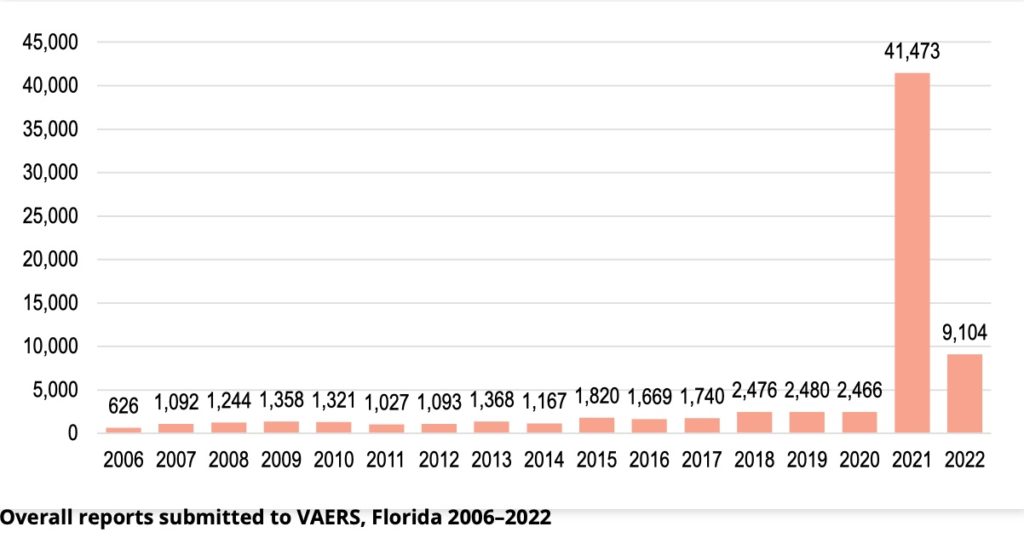
Florida’s surgeon general is advising the health care sector of a “substantial increase in Vaccine Adverse Event Reporting System (VAERS) reports from Florida after the COVID-19 vaccine rollout.”

Doctors and patients, or guardians of patients, can report adverse reactions from vaccines to the VAERS website. The primary objectives of VAERS data collection, which is co-sponsored by the Centers for Disease Control and Prevention and the Food and Drug Administration are to:

  • Detect new, unusual, or rare vaccine adverse events;
  • Monitor increases in known adverse events;
  • Identify potential patient risk factors for particular types of adverse events;
  • Assess the safety of newly licensed vaccines;
  • Determine and address possible reporting clusters (e.g., suspected localized [temporally or geographically] or product-/batch-/lot-specific adverse event reporting);
  • Recognize persistent safe-use problems and administration errors;
  • Provide a national safety monitoring system that extends to the entire general population

In Florida, one of the first states to roll out the vaccine program for its older-than-average population, the spike in adverse events is up 1,700%.

Florida’s Surgeon General Dr. Joseph A. Ladapo issued commentary about the exponential increase in reports of adverse events:

“In Florida alone, there was a 1,700% increase in VAERS reports after the release of the COVID-19 vaccine, compared to an increase of 400% in overall vaccine administration for the same time period.

“The reporting of life-threatening conditions increased over 4,400%. This is a novel increase and was not seen during the 2009 H1N1 vaccination campaign. There is a need for additional unbiased research to better understand the COVID-19 vaccines’ short- and long-term effects.

“The findings in Florida are consistent with various studies that continue to uncover such risks. To further evaluate this, the Surgeon General wrote a letterto the U.S. Food and Drug Administration (FDA) and the Centers for Disease Control and Prevention (CDC) illustrating the risk factors associated with the mRNA COVID-19 vaccines and emphasizing the need for additional transparency.

“According to a study, Fraiman J et al, Vaccine. 2022, mRNA COVID-19 vaccines were associated with an excess risk of serious adverse events, including coagulation disorders, acute cardiac injuries, Bell’s palsy, and encephalitis. This risk was 1 in 550 individuals, which is much higher than other vaccines.

“A second study, Sun CLF et al, Sci Rep. 2022, found increased acute cardiac arrests and other acute cardiac events following mRNA COVID-19 vaccination.

“Additionally, Dag Berild J et al, JAMA Netw Open. 2022, assessed the risk of thromboembolic and thrombocytopenic events related to COVID-19 vaccines and found preliminary evidence of increased risk of both coronary disease and cardiovascular disease.

“While the CDC has identified safety signals for stroke among individuals 65 and older following the bivalent booster administration, there is a need for additional assessments and research regarding safety of all mRNA COVID-19 vaccines.

“To support transparency, the State of Florida reminds health care providers to accurately communicate the risks and benefits of all clinical interventions to their patients, including those associated with the COVID-19 vaccine as additional risks continue to be identified and disclosed to the public.

“The State of Florida remains dedicated to protecting communities from the risks of COVID-19 and other public health concerns, specifically by promoting the importance of treatment and promoting prevention through healthy habits. We encourage our health care partners and providers to do the same.”

Lapado was appointed as Florida Surgeon General in 2021 by Gov. Ron DeSantis. Dr. Ladapo graduated from Wake Forest University and received his medical degree from Harvard and PhD in Health Policy from Harvard Graduate School of Arts and Sciences. He completed his clinical training in internal medicine at the Beth Israel Deaconess Medical Center, where he received the Harvard Medical School Class of 2012 Resident Teaching Award and the Daniel E. Ford Award in Health Services and Outcomes Research from John Hopkins University.

Art Chance: History of the value of a college degree

By ART CHANCE

We and the English have developed an elaborate mythology and vocabulary about our schools. My generation refers to our schools as “alma mater,” Latin for “nourishing mother,” the entity that brought us up. “Alumna” means “foster daughter” in Latin. The nourishing mother adopted you and saw you to adulthood. 

I still remember the words of “the alma mater” song of my high school from 60 years ago and get a lump in my throat if I run across an old video of the Georgia “Dixie Redcoat Band” playing “Tara’s Theme,” although these days you’d probably have the FBI at your door if you played that song.

I think it is fair to say that all of that is pretty much gone except in nostalgic memories of aging “Boomers.”  Colleges and universities are not “nourishing mothers” anymore; they’re factories. With unlimited student loans, no entry standards, and “studies” degrees that only require paying and maybe showing up occasionally, a huge percentage of college students shouldn’t be any closer to a college classroom than the grounds crew or custodial closet, but when they showed up occasionally and paid, they got to hear “Pomp and Circumstance.”

You can trace much of this to the U.S. Supreme Court’s 1971 decision in Griggs v. Duke Power Company. In 1971, the South was still very segregated. Mr. Griggs was a Black, low-level worker who sought a promotion. The qualifications the company set for the job bore no relation to the skills required for the job, and so Griggs sued. Griggs’ case was clearly meritorious and the Supreme Court found in his favor, and in so doing upset the whole traditional hiring system in the country, and not just in the segregated South.

In 1971 most companies of any size had fairly elaborate screening processes in hiring. It was a world of writing and math tests, typing test, and specific skills tests in specialized areas. Griggs held that a company had to demonstrate the business necessity of any desired skill or qualification. It didn’t take long for the Plaintiffs’ Bar to turn that into a cash cow. It didn’t take many six figure verdicts to cause the employers to almost totally abandon employment testing and detailed, probing interviews weren’t far behind. 

Enter needing “a degree” as a minimum qualification for jobs.

Corporate and government human resources and legal departments scrambled to set the minimum qualifications for all the jobs they dared at “a degree,” no particular degree, just “a degree.”   States with some political or ethical sensitivity to discrimination claims, Alaska among them, kept a lot of jobs open to starting at the bottom and working your way up, but even there soon “a degree” would give you about a five year advantage over the person who had worked their way up and actually knew the work.

The universities jumped on this and invented the “Studies” degrees for people who shouldn’t have been near a college class.    So, the lefty snowflake with a degree in “Environmental Studies” can come right out of school, basically with a middle school education and a lot of indoctrination, and go straight to work at the technical/lower supervisory level of a government’s environmental protection function.   If s/he can show up and more or less do as instructed, s/he will be a section chief; that’s just one warm bed or nice check at a fund raiser from a politically appointed division director.

Once there, it is just making friends with the right candidate for governor, and you’re running the department with your seventh grade education.

So, I applaud the notion of doing away with the “a degree” qualification. Of course, I’ve been advocating it in my writing for the better part of 20 years. Now we can talk about how the Dunleavy administration can screw up even a good idea?

I don’t know which idiot in Law, Administration, or the Governor’s Office wrote the implementing Administrative Order, but that person has no idea how state government works. They give elaborate instructions to Admin to make personnel rule recommendations to the State Personnel Board to carry out this change. The personnel rules and the Personnel Board have nothing to do with carrying out this change.    The director of Personnel and the Classification manager can revise any class specification at their discretion. All it takes is a signature.

Now the geniuses have given the opponents, and there will be many in the bureaucracy, endless opportunities to challenge every action Admin takes. It’s a lot like the same stupidity that took them to the wrong court house over implementing the Janus decision. I’m glad I’m older than most, maybe all, of the Dunleavy Administration; at least I can read.

Nota bene: There is a provision for submitting the state classification plan and revisions thereto to the Legislature for approval but, to the best of my knowledge, that hasn’t been done in 30 years.

Art Chance is a retired Director of Labor Relations for the State of Alaska, formerly of Juneau and now living in Anchorage. He is the author of the book, “Red on Blue, Establishing a Republican Governance,” available at Amazon.

Art Chance: Palin is finishing what she started, as every Democrat’s favorite Republican

Art Chance: The 1609 Project and the indentured servitude of immigrants

APOC filings: Bronson raising for ’24 campaign, while Chris Constant appears to have forgotten what year it is

Required financial reports at the Alaska Public Offices Commission website show that Anchorage Mayor Dave Bronson, who has already filed as a candidate for reelection for 2024, has raised over $53,000 for his campaign, an impressive start for a race that is a year away.

That bodes well for a mayor who has been repeatedly attacked by the Anchorage Daily News and the Anchorage Assembly majority. Minus his campaign expenditures, such as paying for a campaign post office box, office supplies, and printing, he has $50,000 cash on hand.

For the 2023 Anchorage Municipal Election, which ends April 4, Assembly candidate Brian Flynn, running for the open seat in West Anchorage, has raised enough campaign funds to mount a serious race against liberal candidate Anna Brawley.

Flynn raised $43,365, nearly all from small donors, and nearly all from people in the private sector. View Flynn’s financial report here.

Brawley, who was handpicked by liberal Assemblywoman Austin Quinn-Davidson to replace her, has donations from the liberals on the Anchorage Assembly. She has raised $35,150, with many large union contributions, and the remainder of her donations coming from government workers and the nonprofit sector. View her financial report here.

Brawley had spent $9,000 and had $25,072 cash on hand when the report deadline came and went.

Assemblyman Felix Rivera has raised just $9,912, and much of it comes from $1,000 checks from unions, as he makes his run for reelection to represent midtown.

Alaska AFL-CIO Putting Alaska First PAC, IBEW Political Action Committee, IUOE Local 302 PAC Account, and Teamster ALIVE – Gaming each contributed $1,000, and another union contributed $500, which means nearly half of his donors are the big labor unions. Read his financial report here.

Travis Szanto, running against Rivera, has raised barely $400, but he had only a couple of days of donations since he filed for office just before the reporting deadline at APOC.

John Trueblood, who is challenging Assemblyman Chris Constant, reported raising $100, but he also was a latecomer to the race, and had not started raising funds. In fact, the $100 he reports is his own check to his campaign.

As for his opponent, Assemblyman Constant, the campaign veteran apparently forgot to file his APOC report for 2023, or rather it appears he mistakenly filed it instead for 2022. Constant ran for Congress last year but was beat in his own district by Santa Claus, a Democrat from North Pole. It’s unclear why he put himself in violation of APOC reporting, since he is an experienced candidate. He has $29,835 for income for his campaign.

In East Anchorage, George Martinez has raised a pile of money for his Assembly race. His campaign income of $36,751 has come from a long list of regular liberal donors. But he’s spent a lot and had just $20,530 cash on hand as of the filing cutoff. Martinez filed his letter of intent to run for the seat in April of 2022 and has been raising money ever since.

His opponent in the race, Spencer Moore, filed for office just before the filing deadline in January and has raised a not-insignificant $5,193 in just five days.

For the Eagle River seat on the Anchorage, Scott Myers has raised $30,678, and his opponent Jim Arlington seems to have let the filing deadline slip by him and is possibly in violation.

Leigh Sloan, running for East Anchorage, filed a the last minute and raised $250, and her opponent, Karen Bronga raised $21,306.32. Her campaign disclosure can be seen at this link.

For South Anchorage, Rachel Ries has reported $16,595, Her reported can be read here.

Ries’ main opponent Zac Johnson has raised $24,728. His report is here. Candidate Mike Insalaco appears to have missed the financial disclosure deadline.

Alaska sues feds over bearded and ringed seal critical habitat designation area that is larger than state of Texas

45

The State of Alaska filed a complaint Wednesday against the National Marine Fisheries Service, asking a U.S. District Court to vacate the critical habitat designations for ringed and bearded seals, some of the most common mammals in Alaska marine environments.

The area designated for the two seal species is much larger than the state of Texas and includes approximately 324,105 square miles of coastal waters along the North Slope and the adjacent Outer Continental Shelf.

Ringed seal.

Alaska Gov. Mike Dunleavy said that science giving way to politics.

“Washington D.C. continues to see our state as the nation’s sole wildlife preserve, to the detriment of the opportunities we were promised at statehood to be able to build a robust economy,” Dunleavy said. “Nearly the entire Alaska coastline and vast offshore areas are designated as ‘critical’ for one species or another, ranging from whales to sea ducks to seals and sea lions. No other state is burdened by the same level of federal overreach created by unnecessarily large critical habitat designations. If other states had the same level of federal designations, the law would be rewritten.”

Alaska Attorney General Treg Taylor said the designation is not based on reason. “These ice seals are important to the State, and actually are among the most common marine mammals found in the Arctic. However, to designate virtually all of the seals’ range within the U.S. as ‘indispensable’ to the recovery of the species is an abuse of federal power,” said Taylor. “These designations of vast areas, beyond what could ever reasonably be considered ‘critical’ to a species’ recovery, was not intended by the drafters of the Endangered Species Act. Unfortunately, though, designations such as these have all too often been the norm for endangered species in Alaska.”

Under the Endangered Species Act only those specific areas that are “indispensable” to the conservation of the species can be considered “critical habitat.”

There is no accurate population count at this time, according to the National Marine Fisheries Service, but it is estimated that there are probably over 500,000 bearded seals worldwide. The Alaska stock is the only stock of bearded seals in U.S. waters. There are at least 250,000 ringed seals in Alaska waters, and 6-7 million worldwide. They are a prey for polar bears.

Alaska Commissioner of Fish and Game Doug Vincent-Lang refuted the species’ listings. “I struggle to believe that a species with a healthy, robust population of millions can be considered threatened with extinction.” said Vincent-Lang. “The best available scientific information indicates ringed seals are resilient and adjust well to varying conditions across their enormous range and are likely to continue. ESA listings should be reserved for imperiled species.”

The complaint lays out how:

  • NMFS failed to articulate how these geographic areas meet the definition of critical habitat.
  • NMFS contradicts the very purpose of designating critical habitat; its final rule asserts that no project changes or other critical habitat protections will result from the designation of critical habitat.
  • NMFS’ designation shows that the critical habitat designations were not necessary for the animals’ recovery and that the designations are not essential to their conservation.

Read the complaint Alaska vs. National Marine Fisheries Service here.

Murderer Yurel Nichols sentenced to 35 years for killing Paula Zorawski in 2016

16

Yurel Nichols, 24, was sentenced by Anchorage Superior Court Judge Jack McKenna to serve 35 years in prison for the first-degree murder of Paula Zorawski in the Russian Jack neighborhood of East Anchorage in 2016, when Nichols was just 18. Nichols pleaded guilty to first-degree murder on Oct. 19, 2022.

On Sept. 22, 2016, Nichols and his accomplices, Savon Berry, Michael Fitzgerald, Tommy Higgs III, and Alonzo Steward attempted a home-invasion robbery to steal marijuana and money from Zorawski. After Zorawski answered the door, she was shot and killed by Nichols. He and the other teens, ages 18 and 19, fled the scene. Surveillance camera caught the entire incident and the footage was presented as evidence.

In 2019, Higgs was sentenced to 18 years but has been paroled to supervised custody. Berry was sentenced to nine years for manslaughter, and is on parole, and Fitzgerald to nine years for first-degree robbery; he is also on parole. Steward pleaded guilty to second-degree murder and was sentenced in 2019, with a scheduled release date of 2028.

Nichols originally fled to Converse, Texas, which is part of greater San Antonio, where he was tracked down by U.S. Marshals and the Lone Star Fugitive Task Force. Today’s sentence was for 80 years with 45 years suspended, and with supervised felony probation for 10 years. Nichols was in the Class of 2016 at East Anchorage High School, where he was a quarterback and wide receiver on the varsity football team.

Dunleavy’s supplemental budget tackles needs in law and order, ferries, and food stamp management

Gov. Mike Dunleavy introduced $117 million in supplemental budget items to the current year’s budget as part of his request to the Alaska Legislature. There were no unexpected items, as additional needs have arisen in the Office of Public Advocacy, the Public Defender Agency, the Department of Health’s Division of Public Assistance, and the Alaska Marine Highways.

“Today’s amended budget proposal reflects that we are listening and responding to Alaskans in real-time,” Dunleavy said. “This budget will fortify that effort by adding resources to the Office of Public Advocacy, the Public Defender Agency, the Department of Health Division of Public Assistance, and the Alaska Marine Highway System match. We are also adding resources for public safety, renewable energy grants, 404 Primacy, Medicaid rates, and more to better the lives of Alaskans.” 

Office of Public Advocacy and the Public Defender Agency

The governor’s amended budget includes $8.3 million across two fiscal years to increase the hourly pay and case caps for contract attorneys to become competitive in the current job market. This provides the same 20 percent raise to contract attorneys as given to state attorneys. 

Department of Health, Division of Public Assistance 

Dunleavy is amending $9 million for the Division of Public Assistance in the Operating Budget to increase capacity for eligibility determinations to help address the backlog in the SNAP program (food stamps). Also, $54 million is included in the Capital Budget to fully finish migrating the Division’s eligibility system from the outdated legacy system and into AIRES, a database, for full implementation into one, more modern system. 

Alaska Marine Highway System Match (AMHS) 

The Administration is using three sources to match the AMHS federal funding: matching the federal grants related to building new vessels with money in the vessel replacement fund, matching the operating costs with existing revenues, and matching capital projects with a toll credit system in federal law.  

Other Notable Amendments 

$7.5 million for a Department of Public Safety patrol vessel replacement $10 million ($5 million each) to Alaska Seafood Marketing Institute and Alaska Travel Industry Association, $7.5 million for Alaska Energy Authority (AEA) Renewable Energy Grants, $8 million for wildfire suppression, $24.4 million for Medicaid rates, $5 million for State assumption of Section 404 permitting primacy, $2.8 million for 10 more village public safety officers and housing allowances, and $250,000 to assign a dedicated Alaska State Trooper to investigate in-custody inmate deaths and reported felony and misdemeanant criminal cases within the correctional facilities. 

View the Fiscal Year 2024 Amended Budget page here.View the FY24 budget page here.

Murderer Denali Brehmer pleads guilty to killing ‘friend’ Cynthia Hoffman at Thunderbird Falls

20

Twenty-two-year-old Denali Brehmer pleaded guilty on Wednesday to murder in the first degree for charges stemming from the June 2, 2019, murder of 19-year-old Cynthia Hoffman near Thunderbird Falls in Chugiak.

Brehmer admitted the facts contained in the complaint initially filed in the case. The case was investigated by the Anchorage Police Department and the Federal Bureau of Investigation, with the assistance of multiple other State and federal law enforcement agencies.

The murder of Hoffman involved a group of three young adults who were “catfished” by an Indiana man to commit the crime for money. Catfishing is a term relating to people who adopt false identities online to lure or trick people. In this case, the friends of Hoffman lured her to a remote place near Thunderbird Falls, tied her up, and executed her. They rolled her body into the Eklutna River.

Darin Schilmiller, the man allegedly behind the murder-for-hire scheme, has pleaded not guilty to charges against him, which included him posing online as a self-described millionaire named Tyler and offering Brehmer $9 million to “rape and murder someone in Alaska.”

He is housed at Goose Creek Correctional Center. Schilmiller has been in court numerous times since his arrest and extradition from Indiana, and has a trial-setting hearing on March 15. Kayden McIntosh, who was 16 at the time and accused of pulling the trigger, has a trial-setting hearing on that date, as does Caleb Leyland, who was 19 at the time, and who is accused of driving the get-away car.

During the investigation of Hoffman’s death, Anchorage police confiscated the cell phone of suspect Brehmer, who was then 18 and who police said was intimately involved in the death and disposal of “CeCe” Hoffman’s body.

In Brehmer’s phone, investigators found clues to the murder, and also found child pornography involving Denali sexually abusing two children, which federal investigators said she had done at the behest of Shilmiller.

There is no agreement between the parties regarding a specific term of imprisonment. Judge Peterson may sentence Brehmer to a term of imprisonment of no less than 30 years and no more than 99 years. Sentencing is scheduled to begin Aug. 22, in front of Judge Peterson in Anchorage and is anticipated to last three days.

The charges against Brehmer for conspiracy to commit murder in the first degree, solicitation of murder in the first degree, tampering with physical evidence and two charges of murder in the second degree were dismissed. It’s unclear why there are no state charges against Brehmer related to rape and child pornography.

New Division of Elections director: Carol Beecher

Alaska Lt. Gov. Nancy Dahlstrom appointed Carol Beecher as the new director of the Division of Elections. Beecher’s first day was Wednesday.

“After considering several candidates from across the state, I am pleased Carol has agreed to accept the position of director for the Division of Elections,” Dahlstrom said. “Her professionalism and extensive experience will ensure that Alaska is ready for the 2024 election cycle and beyond. I have every confidence that she is the right person for the job, and she will exceed all expectations.”

Beecher grew up in a logging camp on Zarembo Island in Southeast Alaska. She began her state service in 2005, working for Lt. Gov. Loren Leman. From there, she was intern in John Coghill’s office and then worked as a special assistant at the Department of Administration, and as the scheduler for Gov. Sarah Palin. 

She became deputy director of the Child Support division in 2011 and has served there as a director since 2014. Beecher graduated from Wrangell High School and has a bachelor’s degree in Justice and a master’s degree in Public Administration, Policy Analysis from the University of Alaska Anchorage. She lives in Anchorage, has four grown children, and enjoys spending time with her five grandchildren and family.

I have loved being the director of the child support division and the wonderful staff who work so diligently for Alaska’s families,” Beecher said. “Being selected to work in the Division of Elections is an honor and I am proud to serve in this new role. The Division is dedicated to ensuring secure, accurate and fair elections for all Alaskans and I am confident that this will continue under the Lt. Governor’s leadership. Over the next few months, I will be meeting with staff in the various regions and will continue their efforts to ensure that Alaskans can trust Alaska’s election process.”