By Jack Thompson
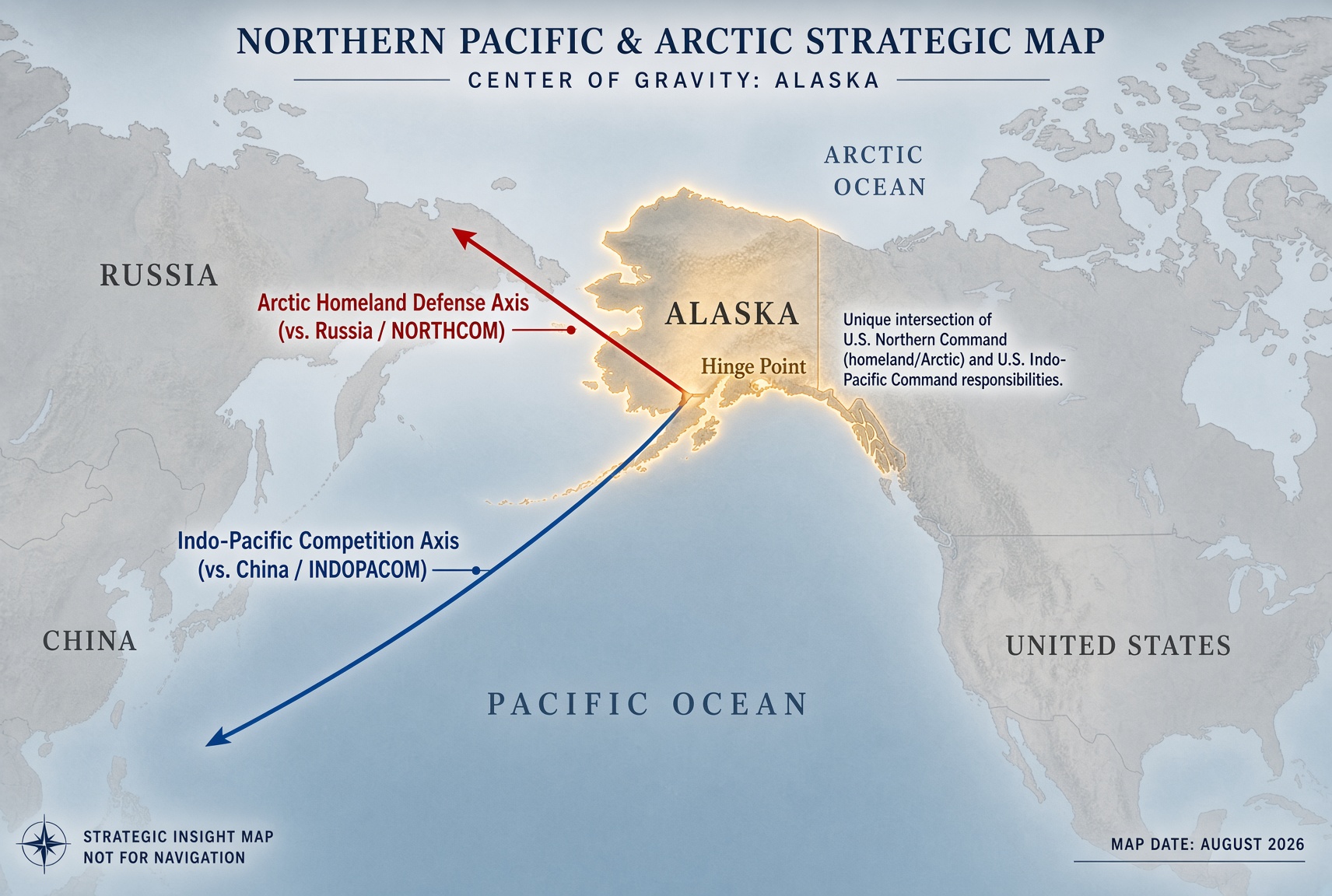
Look at a map of the Pacific long enough, and something in Alaska stops looking like an edge and starts looking like a hinge point. Draw one line for where the United States plans to defend against Russia in the Arctic, and another for where it plans to compete with China across the Pacific. In every other state in our union, those two lines run nowhere near each other. In Alaska, they directly cross.
That isn’t conjecture; it’s built into the Pentagon’s own command structure, and almost nobody outside a base fence line has ever been asked to picture what it would mean if Alaska actually acted on it.
Almost every discussion of Alaska’s future potential and place in the world misses this: a governor’s office that does not just get a phone call when Indo-Pacific strategy gets written, but actually shapes it, because Alaska is the only place in the country where Arctic strategy and Indo-Pacific strategy are the same question. No other state can make that claim.
Hawaii sits inside the Indo-Pacific theater. Washington and California sit along its edge. Only Alaska sits inside both the Arctic and the Indo-Pacific at once, hosting the exact strategic command structures built to run each—the single strongest geopolitical asset the state has, and one that most Alaskans of my generation have never once been told to see that way.
Since 1990, Alaska’s own 11th Air Force has answered to Pacific Air Forces, the same command running American airpower from Hawaii to the Taiwan Strait, while many of those same units also anchor Arctic defense. The Army rebuilt the 11th Airborne Division at JBER and Fort Wainwright in 2022 explicitly as its primary Arctic and Indo-Pacific response force, a dual mandate no other Army division in the country carries. This spring, the four-star admiral who runs the entire Indo-Pacific theater asked Congress to reopen a Navy air station in the Aleutians, a request that only fully makes sense with the understanding of the Aleutians as the literal hinge between the two theaters.
Alaska is not adjacent to either debate. It is the only place facing both of them at the same time. That fusion is exactly what the rest of the country’s strategic apparatus still treats as two separate problems, run out of different committees and different regional commands that only occasionally talk to each other. Alaska is the state built to force them together.
Political scientists call it paradiplomacy when a state builds its own sustained relationships abroad instead of leaving foreign policy entirely to Washington, and it is a well-worn playbook. Dozens of U.S. states run their own overseas trade offices today. Two very different examples show what it can actually deliver: Quebec built an entire ministry around the idea decades ago, and Georgia has run a continuously staffed office in Seoul since 1985, worth more than $17.5 billion in trade with Korea in a single recent year.
Neither faces what Alaska faces, nor has the opportunity Alaska has: an unprecedented and integral strategic seam running straight through the state that almost nobody else in the country is positioned to harness, let alone lead.
Other nations are not waiting on Alaska’s schedule. China has not slowed its Arctic ambitions while Juneau’s majority fights over how much of the Permanent Fund to spend, and the next flashpoint in the Taiwan Strait will not pause to check whether Alaska ever got around to updating a law that’s been sitting on the books for decades.
The clearest sign Alaska once understood its own position is sitting, half-forgotten, in a state law that requires the governor to maintain trade offices in Tokyo and Seoul but never got around to adding Taipei, let alone the Arctic side of the equation. Fixing and advancing that is a page of legislative housekeeping, not the point of this piece. The point is the doctrine and opportunity underneath it—which is unique to Alaska.
Leading that effort takes conviction, not new constitutional authority. Nobody is arguing that Alaska should run its own foreign policy; that job belongs to Washington, and any case for a bigger Alaska role has to say so plainly or it is not a serious case at all. What Alaska can claim is the ground within that authority that nobody else is standing on— starting with the statute already on the books.
Reopen the Tokyo and Seoul offices it already promises. Add Taipei. Call them what they actually are: Alaska’s own embassies in everything but name. Host an annual summit in Anchorage modeled on what Halifax, Nova Scotia—a mid-size coastal city, not a national capital—already proved works: seventeen years of pulling senior officials, trade leaders, and military planners from dozens of countries into the same room every November. Anchorage could do the same for the Arctic and the Pacific.
Do that, and Alaska stops being an afterthought, however integral, on someone else’s map. It becomes proof that geography, used on purpose, can turn a state of fewer than a million people into the foundation of Arctic and Indo-Pacific grand strategy—and a partner in whatever it builds toward. It becomes something this state can keep building on for whatever comes next, and something my generation does not have to leave to face the circumstance of the unknown.
None of this costs Alaska money it does not have a real path to earning back many times over. Georgia’s Seoul office helped land a $12.6 billion Hyundai investment generating up to 40,000 jobs, on top of billions more from SK and other Korean firms—real proof the model works. But Georgia’s path was not easy, and it is not Alaska’s path exactly. It spent decades competing against Alabama, South Carolina, and Tennessee for the same automotive investment, competing on logistics and labor costs.
Alaska does not have to compete for the same deal. It holds something none of those states, or Georgia, can offer: critical minerals and natural resources the United States is actively trying to pull out of Chinese-controlled supply chains, an energy sector already courting Pacific buyers, and a logistics position no other state can match. Georgia built its relationship for the economy of the last thirty years. Alaska is positioned to build for the one already taking shape around it, which makes this a substantially bigger opportunity than the one Georgia had.
A governor’s office running real Arctic and Indo-Pacific strategic and paradiplomatic relationships is not a cost competing against the Permanent Fund fight in Juneau. It is one of the strategies on the table that grows what Alaska has instead of arguing over how to divide it—generating new revenue without touching the dividend or raising a tax.
Alaska’s own delegation has already proven Washington will listen. Senator Sullivan sits on Armed Services, has led bipartisan Senate delegations into the region, and pushed legislation this year to deepen Indo-Pacific security cooperation. What Alaska needs now is a state government that turns that federal opening into an actual Alaskan international doctrine—one Alaska writes first instead of waiting for an increasingly stagnant federal process to get there on its own timeline.
This is the decision my generation will live inside, and it is not theoretical. It is the difference between building a career in a state that watches other people draw the lines on the map, and building one in a state that finally picks up the pen—not just for what it wins Alaska, but because a hinge nobody reinforces is a hinge that eventually fails, and the whole alliance is safer with Alaska leading in this geopolitical theater than with Alaska waiting to be used.
No other state can offer the fused Arctic-Indo-Pacific perspective Alaska has by fate of geography. The only question left is whether we become the international leaders and pioneers our allies actually need or release that strategic opportunity from our grasp.
Alaska has spent decades being the place where other people’s lines happen to cross. We already have everything we need to draw the next ones ourselves.
Jack Thompson, 19, is the youngest Alaskan to work as a staffer in the State’s 34th Legislature. He has also served on the Anchorage Municipal Historic Preservation Commission, the Executive Board of the South Addition Community Council, and interned with the Alaska World Affairs council. He is currently working for a statewide campaign and studying International Relations at the University of Alaska Anchorage.