For years American conservatives have suspected the intentional infiltration of communist ideas in American mainstream media. New investigative reporting by Must Read Alaska and independent journalist Natalie Winters reveals the names of the American journalists who sold out to the Chinese Communist Party’s interests and the millions spent by China to deliberately shape American minds.
For 30 years, the Better Hong Kong Foundation has elected six to eight American journalists and paid for them to meet with key Chinese government leaders and businessmen in an effort to spread positive views of China and the Chinese Communist Party in American mainstream media.
American journalists who participated in the program met with Chinese leaders and representatives from the Chinese People’s Political Consultative Conference (CPPCC). According to a 2023 report from the U.S.-China Economic and Security Review Commission, the CPPCC is “an ‘advisory’ body the Party-state uses to coordinate between itself and important social groups—such as leaders in business, academia, and religious organizations outside of the Party—to carry out United Front work.”
China’s United Front seeks to advance “relationships with important groups and individuals outside of the CCP” and “encapsulates the various activities of CCP organs, Chinese government agencies, and their affiliates to coopt or coerce groups outside of the CCP—including but certainly not limited to foreigners—into comporting with the Party’s demands and advancing Chinese national interests as the CCP defines them.”
In 2005, Chief Executive of the Better Hong Kong Foundation George Yuen praised the program as “such a success in providing a platform for different bodies to convey a positive message to the international community that Hong Kong remains as a vibrant and free economy, a centre of international trade and investment, a pivot of neighboring PRD and regional integration, as well as a regional hub of broadcasting and telecommunication.”
Sarah Monks, Director of Communication for the Hong Kong Trade Development Council (TDC), stated, “We were able to highlight to the US decision-makers and media the enduring institutional strengths of Hong Kong… The mission yielded valuable insights that will help to inform TDC’s upcoming outreach activities in key US cities.”
On August 10, independent journalist Natalie Winters published a complete list of the 54 American journalists who have participated in China’s program designed to instill CCP values in American media. The list includes high-level journalists and editors of mainstream media outlets such as Associated Press, NPR, The Washington Post, The New York Times, CNN, Politico, the Los Angeles Times, NBC, Reuters, ABC, USA Today, The Economist, and others.
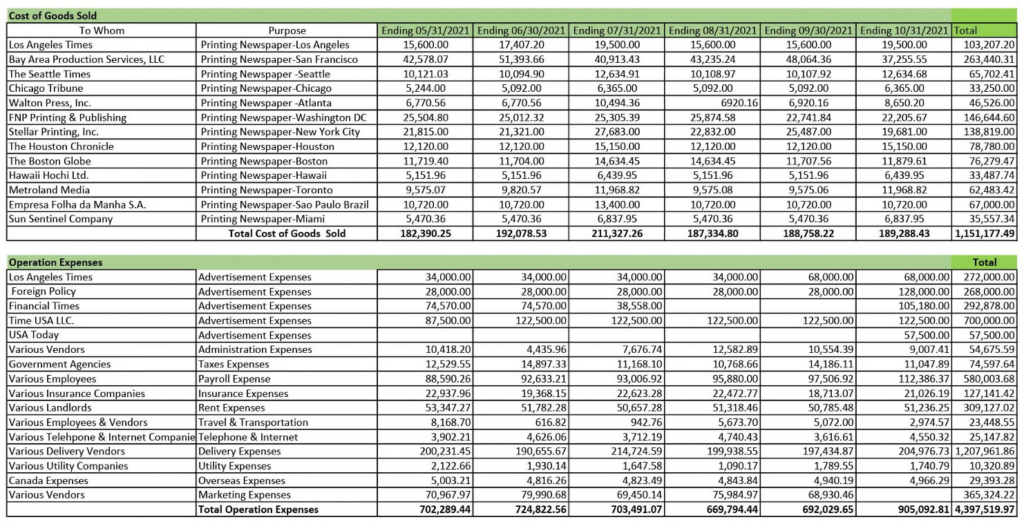
Chinese Expenditures to Influence American Media in 2021
A supplemental statement filed by the China Daily Distribution Corp with the U.S. Department of Justice in 2021 enumerates expenditures by China to influence American media. According to the statement, China spent over $5 million just that year on “advertising campaigns in Foreign Policy, Los Angeles Times. Financial Times, Time Magazine and USA Today” and “distribution of China Daily newspaper pursuant to an exclusive distribution rights contract.”
Survey of American Views Toward Communism, Socialism, Capitalism
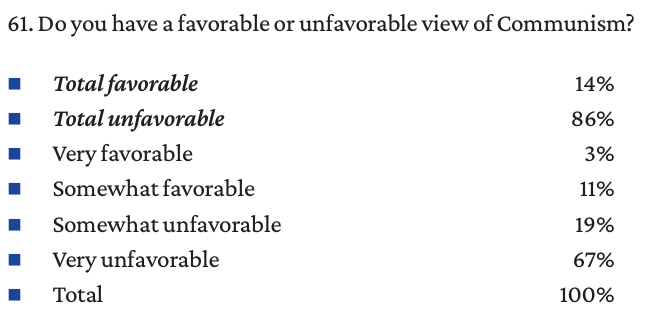
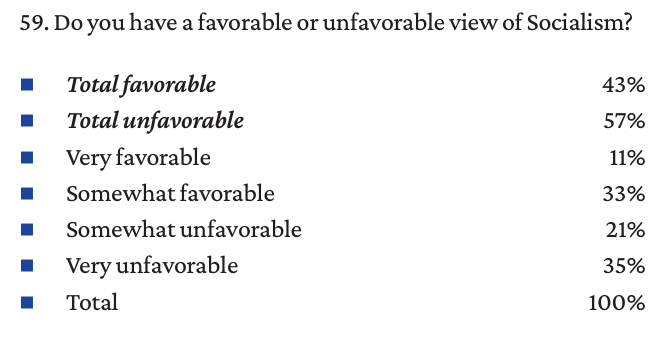
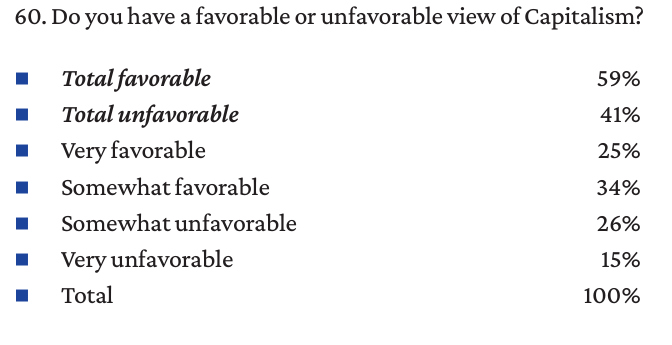
According to a survey conducted by the Cato Institute in 2025, 14% of Americans view communism favorably, 43% view socialism favorably, and 59% view capitalism favorably.
Chinese Governance and What America Could Become
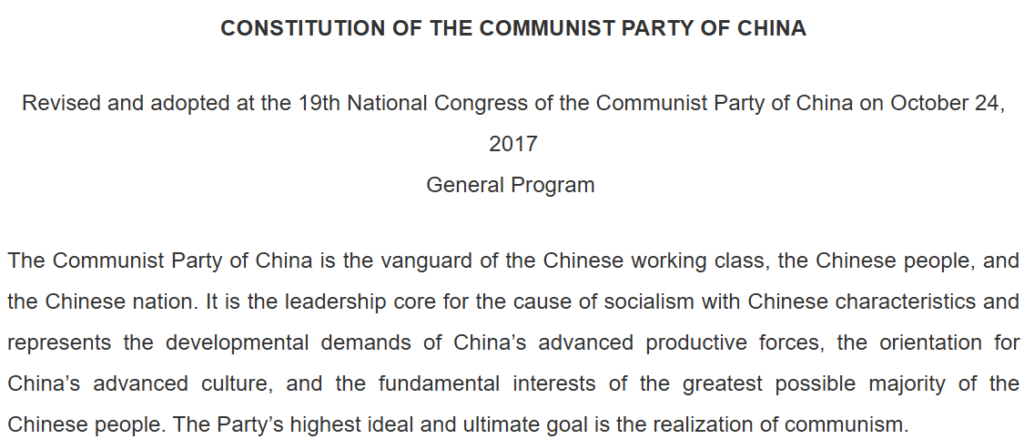
The People’s Republic of China is a socialist state under the leadership of the Chinese Communist Party (CCP). Its Constitution (as amended, including in 2018) defines it as “a socialist state governed by a people’s democratic dictatorship that is led by the working class and based on an alliance of workers and peasants.” The socialist system is the fundamental system, and “the leadership of the Communist Party of China is the defining feature of socialism with Chinese characteristics.” Although the CCP says that the power belongs to the people through the National People’s Congress system, the CCP controls all political action in the country.
The Constitution of the Chinese Communist Party states that the Party is the vanguard of the Chinese working class, the Chinese people, and the Chinese nation. Its highest ideal and ultimate goal is the realization of communism. It is guided by Marxism-Leninism, Mao Zedong Thought, Deng Xiaoping Theory, the Theory of Three Represents, the Scientific Outlook on Development, and Xi Jinping Thought on Socialism with Chinese Characteristics for a New Era. The Party exercises absolute authority over the state, military, and society.
The Chinese people are subject to authoritarian governance: the CCP monopolizes political power, controls nominations and key institutions, and maintains extensive oversight of media, speech, civil society, and security. Dissent is restricted under laws protecting state security and social stability.
The Chinese government employs a social credit system to police citizens’ daily activities. The State Council’s Planning Outline for the Construction of a Social Credit System (2014–2020) aims to build credit records of citizen activity, promote loyalty to the CCP, and create mechanisms that reward trustworthiness while constraining untrustworthiness as defined by the CCP. It focuses on government, commercial, social, and judicial conformity through shared public credit information, blacklists, and disciplinary measures. China also extensively uses surveillance infrastructure to enforce social order.
According to the Planning Outline for the Construction of a Social Credit System: “Accelerating the construction of a social credit system is an important basis for comprehensively implementing the scientific development view and building a harmonious Socialist society, it is an important method to perfect the Socialist market economy system, accelerating and innovating social governance, and it has an important significance for strengthening the sincerity consciousness of the members of society, forging a desirable credit environment, raising the overall competitiveness of the country and stimulating the development of society and the progress of civilization.”
List of American Journalists Who Sold Out to CCP Interests
Source: Natalie Winters, “REVEALED: China-Linked Influence Group Paid to Cultivate Dozens of U.S. Journalists and Manufacture “Positive” Coverage of the Chinese Communist Party. Here Are Their Names.” Published August 10, 2026.
- Saeed Ahmed: supervising news editor at CNN. Now: vice president of news for digital platforms at the Associated Press, leading APNews, social media and other direct-to-audience platforms.
- Robert Little: senior investigative editor at NPR. Now: leads NPR’s investigations team across its broadcast and digital platforms.
- Stephen Stromberg: editorial writer at The Washington Post. Now: New York Times opinion editor for politics and economics.
- Juliet Lapidos: staff editor at The New York Times. Now: deputy editor at The Atlantic.
- Autumn Brewington: op-ed page editor at The Washington Post.
- Holly Yeager: Middle East and Asia editor at The Washington Post.
- Carrie Halperin: producer for CNN’s Fareed Zakaria GPS.
- Elizabeth Ralph: deputy editor of Politico Magazine. Now: ideas editor at the San Francisco Standard, where she leads opinion and ideas coverage. She previously became editor-in-chief of Politico Magazine.
- Doyle McManus: Washington columnist for the Los Angeles Times.
- Rebecca Davis: senior video producer at NBC News.
- Kevin Beesley: Asia editor at NPR.
- Leslie Norton: Asia editor at Barron’s. Now: editor-at-large at Morningstar.
- Brian Wingfield: energy and trade reporter at Bloomberg.
- Valerie Volcovici: correspondent at Reuters. Now: Reuters correspondent covering energy, climate and environmental policy.
- Diane Bartz: reporter at Reuters.
- Alan Wirzbicki: editorial-page writer and editor at The Boston Globe.
- Alexander Kingsbury: deputy ideas editor at The Boston Globe.
- Michael Freedman: senior editor at Newsweek.
- John Schoen: senior producer at MSNBC.com.
- Adam Behsudi: trade reporter at Politico.
- Michael Stratford: reporter at Politico. Now: covers economic policy, financial regulation, the Treasury Department and student debt for Politico.
- Mariana Keller: senior video producer at NBC News.
- Jake Heller: producer and host at NBC News.
- Jesus Ayala: producer at ABC News.
- Oren Dorell: foreign-affairs correspondent at USA Today.
- Joshua Keating: staff writer at Slate. Now: senior correspondent at Vox covering foreign policy and international conflict.
- Evelyn Cheng: staff writer at CNBC. Now: CNBC’s Beijing correspondent covering China’s economy and financial markets.
- Mary Childs: senior reporter at Barron’s.
- Benjamin Bartenstein: emerging-markets reporter at Bloomberg.
- Jessica Schulberg: foreign-affairs reporter at HuffPost.
- Alexander Kaufman: reporter at HuffPost.
- Don Lee: economics reporter for the Los Angeles Times and Tribune Washington Bureau.
- Alexander Travelli: Asia online editor at The Economist.
- Erica Grieder: Southwest correspondent at The Economist.
- Roya Wolverson: senior writer at Time.
- Kopin Tan: senior editor at Barron’s.
- Sandra Ward: senior editor at Barron’s.
- Joe Schatz: senior writer at Congressional Quarterly.
- Patricia Hill: chief economic correspondent at The Washington Times.
- Jeffrey Chu: articles editor at Fast Company.
- Nathan Bomey: reporter at the Detroit Free Press.
- Daniel Beekman: reporter at The Seattle Times.
- Lomi Kriel: reporter at the Houston Chronicle.
- Andy Curliss: state-government editor at The News & Observer.
- Janet Cho: business reporter at The Plain Dealer.
- Liz Jones: reporter at KUOW Public Radio.
- Robert Chaney: staff writer at the Missoulian.
- David Whiting: Page One columnist at the Orange County Register.
- Marc Stewart: reporter and substitute anchor at KMGH-TV, Denver’s ABC affiliate.
- William Luckie: news anchor and reporter at KLTV.
- Pia Lopez: associate editor at The Sacramento Bee.
- Robert Ballenger: editor and producer at NPR.
- Tom Waseleski: editorial-page editor at the Pittsburgh Post-Gazette.
- Karin Caifa: producer at CNN Newsource.