Late Tuesday, without much fanfare, the U.S. Army Corps of Engineers’ Pacific Division ruled that its Alaska Division erred when it denied the Pebble Limited Partnership’s permit to develop the copper, gold, molybdenum and rhenium mine in Southwest Alaska.
Noting that the rejection was based on faulty science, the Pacific Command returned the process to Alaska, ordering that team to review and correct the errors.
While noting that this doesn’t mean Pebble’s entire mine plan — one which received a clean Final Environmental Impact Statement from the Corps — should be approved, the order does bring to question whether the ultimate decision to deny Pebble’s permit was political in nature, as groups like ours believe, or scientific, as radical environmentalists claim.
Pebble still faces a pre-emptive veto of its project by the Environmental Protection Agency, who, working in conjunction with environmental organizations and wealthy ideologues, halted the established permitting process with clear political shenanigans. That move is still under legal and regulatory scrutiny by mine proponents.
Still, yesterday’s announcement is good news for Pebble, its trillion-dollar deposit, the hundreds of jobs an operating mine would bring and the State of Alaska, as Pebble’s landholder.
We’ll continue to update this story, unabashedly promote Pebble and jeer the hijacking of a non-political permitting process for purely political purposes.
Rick Whitbeck is the Alaska State Director for Power The Future, a national nonprofit organization that advocates for American energy jobs and opportunities. Contact him at [email protected] and follow him on Twitter @PTFAlaska.
Maybe that’s because the Right side has @DC_Draino, the social media name for Rogan O’Handley, who has taken the art of political memes to a whole new level. He’s the king of the political meme and no Leftist seems to be able to match him.
O’Handley was the guest on the Must Read Alaska Show on April 26, and he’ll appear in the Mat-Su and Anchorage on June 1 and 2, as a keynote speaker for the Alaska Young Republicans. Ticket information is here:
‘OHandley didn’t start out as a national political force. In fact, after law school, O’Handley went to Hollywood and started putting together deals for movies and movie stars.
But it was an extremely liberal environment, where conservatives must hide their opinions or be shunned. When he started his Instagram and other media accounts, he used a pseudonym — “DC_Draino,” a reference to draining the “DC swamp.” He had to keep his identity secret, but the success of his memes rocketed him to having 50,000 followers in just six months, and he knew that eventually the small world of entertainment would discover who DC-Draino really was.
And thus, Rogan went rogue. In 2017, he sold his house, moved to Florida, and now has over 4 million followers across social media platforms, where he provides commentary and savage observations about the politics of the day. He is closely associated with former President Donald Trump and has made many trips to Mar-a-Lago.
O’Handley’s Instagram content regularly surpasses 150,000 “likes” and he has had more than 1.5 million views of his Instagram reels. He has one of the highest engagement ratios in the industry and his account is ranked among the top 50 most influential in the world.
O’Handley has regularly appeared on the Tucker Carlson Tonight show, is an invited CPAC speaker and Turning Point USA speaker. He has done hundreds of local and national conferences, speaking engagements and political and community events.
Listen to O’Handley talk about his bold career move and why conservatives had better get active before the nation devolves into a Marxist dystopia, at Spotify, iTunes, GooglePlay, Amazon, Pandora,iHeart, and wherever you listen to podcasts.
Americans are getting used to failures by government experts. Government economists have a dismal forecasting record. Government actions and advice during the pandemic were often misguided. And dozens of former government intelligence experts got the Hunter Biden laptop story wrong.
A less recognized but also important failure may be in nutrition. Federal experts appear to have issued faulty advice for decades, even as American obesity exploded from 15 percent in the 1970s to 42 percent today. Federal guidance on nutrition has a large influence on health practice across society. Some researchers argue that Americans have generally respondedto the guidance, yet obesity has nonetheless soared.
A clue to shortcomings in federal nutrition guidance comes from calorie data. A new U.S. Department of Agriculture (USDA) study shows that average daily calorie intake increased 21 percent from 1977–78 to 2003-04, and then started trending down. By 2017–18, calories were up 15 percent from the 1970s, but as the study notes, “the rise in obesity rate outpaced the increase in calorie intake.”
In a 2022 article, Professor of Nutrition Dariush Mozaffarian noted that “over the last 20 [years] we are not eating more calories, nor exercising less, but are still becoming more obese.” As average calories have dipped, the obesity rate rose from 31 percent in 2001–2002 to 42 percent today.
How can that be? Obesity is caused not just by the amount we eat but also what we eat. Generally, the government advised us to emphasize carbohydrates and deemphasize protein and fat, as shown in thefood pyramid. But some nutritionists are now saying that was backwards. As a libertarian, I don’t want the government telling us what to eat, and our diets may have been better if that had been the case.
Like government experts, private‐sector experts get things wrong. But the government uses mandates and subsidies to impose its will, and its strong positions often displace other views. In a presentation at Cato, author and science journalist Nina Teicholzdiscussed the government’s flawed nutrition standards and the harm she believes they caused.
She observed, “the level of certainty you need to have for public policy of an entire population ought to be very high,” and federal directives on nutrition fell far short of that level.
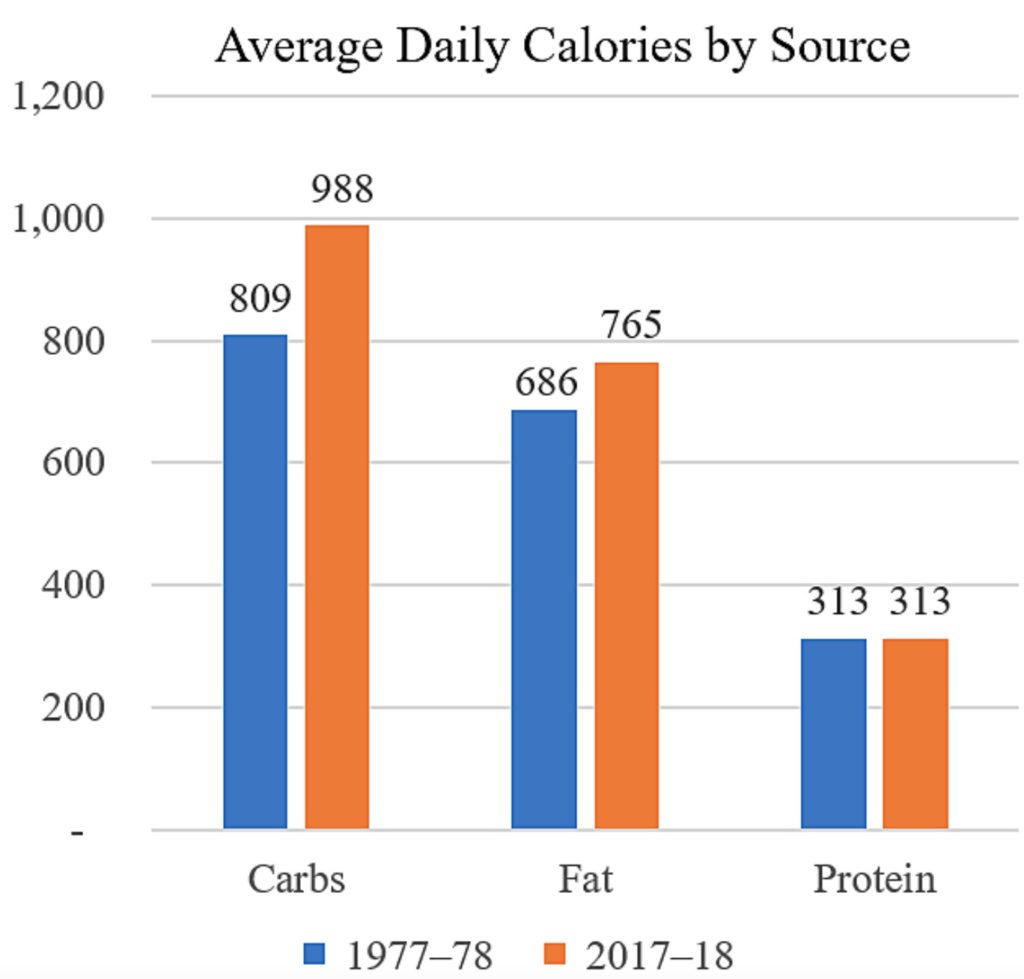
The chart shows average daily calorie intakes of Americans, based on the new USDA data. Carbohydrates are up 22 percent since the late 1970s, fat is up 12 percent, and protein is unchanged. It appears that we mainly want to look at carbs to explain the rise in obesity.
Below I excerpt from two studies that sync with Nina Teicholz’s views about the record of faulty government advice on protein, fats, and carbohydrates. I understand that other experts have conflicting views. Nutrition is a complex field and scientists have not figured it all out yet.
However, the costs of bad diets to individuals, the medical system, and society are huge, so we should pay close attention to government interventions. This is particularly true this year because Congress is set to consider another large farm and food subsidy bill, which may adversely influence American diets.
First, an excerpt from a 2015 study by Evan Cohen and colleagues in Nutrition. Note that the latest USDA data show fat calories up somewhat since this study was published.
Americans in general have been following the nutrition advice that the American Heart Association and the US Departments of Agriculture and Health and Human Services have been issuing for more than 40 [years]: Consumption of fats has dropped from 45% to 34% with a corresponding increase in carbohydrate consumption from 39% to 51% of total caloric intake. In addition, from 1971 to 2011, average weight and body mass index have increased dramatically, with the percentage of overweight or obese Americans increasing from 42% in 1971 to 66% in 2011.
… Since 1971, the shift in macronutrient share from fat to carbohydrate is primarily due to an increase in absolute consumption of carbohydrate as opposed to a change in total fat consumption. General adherence to recommendations to reduce fat consumption has coincided with a substantial increase in obesity.
… Since the late 1970s, the US government, following the American Heart Association (AHA) and much of academia, has consistently recommended lowering the dietary percentage of fat and saturated fat, as well as the absolute levels of dietary cholesterol, based on a theoretical link between those food components and higher risk for coronary heart disease. This government guidance suggested that the reduction of dietary fat would be accompanied by a concurrent increase in the dietary share of carbohydrate. Taken together, these recommendations were also considered to be beneficial for the prevention of overweight and obesity, along with diabetes, cancer, and other chronic diseases.
… In 1961, spurred by emerging medical and epidemiologic research, the AHA issued dietary recommendations to ‘reduce the intake of total fat, saturated fat, and cholesterol. In 1977, the US Senate Select Committee on Nutrition and Human Needs issued Dietary Goals for the United States, which recommended that fat consumption be reduced to 30% of energy intake, and that carbohydrate consumption be increased to account for 55% to 60% of energy intake.
Following this report, Dietary Guidelines for Americans, issued by the USDA and the US Department of Health, Education and Welfare (now the Department of Health and Human Services; DHHS) in 1980, recommended a reduction in the consumption of the share of total macronutrients attributable to fat and saturated fat, and a reduction in the absolute consumption of cholesterol. To compensate, the guidelines recommended increasing consumption of carbohydrate as a share of total calories because “carbohydrates contain less than half the number of calories per ounce than fats.”
During the 1980s, the federal government continued to issue reports and recommendations encouraging Americans to limit fat consumption. In 1982, the Committee on Diet, Nutrition, and Cancer of the National Research Council issued Interim Dietary guidelines that recommended fat intake be lowered from 40% to 30% of total calories in the diet, officially endorsing the AHA’s recommendations from 1961 and the Senate committee’s recommendations from 1977. The USDA and DHHS recommendations have remained largely unchanged since 1980. In 1992, the Food Guide Pyramid was released, urging Americans to use fats, oils and sweets “sparingly,” and to consume between 6 and 11 servings of bread, cereal, rice, and pasta.
… There is a strong relationship between the increase in carbohydrate share of total intake and obesity.
… this study demonstrated that general adherence to government dietary recommendations to decrease fat share of total dietary intake has been accompanied by a rapid increase in obesity rates.
Second, an excerpt from a 2022 study by Joyce Lee and colleagues in Frontiers of Nutrition:
[From 1800 to 2019] processed and ultra‐processed foods increased from <5 to >60% of foods. Large increases occurred for sugar, white and whole wheat flour, rice, poultry, eggs, vegetable oils, dairy products, and fresh vegetables. Saturated fats from animal sources declined while polyunsaturated fats from vegetable oils rose. Non‐communicable diseases (NCDs) rose over the twentieth century in parallel with increased consumption of processed foods, including sugar, refined flour and rice, and vegetable oils. Saturated fats from animal sources were inversely correlated with the prevalence of NCDs.
… Ancel Keys’ Diet‐Heart Hypothesis posited that the mid‐nineteenth century heart disease epidemic resulted from “a changing American diet”: increased consumption of fats, especially saturated fatty acids (SFAs), and decreased grain consumption.
… The unprocessed elements of our nineteenth century diet–animal fats, whole fat dairy, fresh vegetables, and fresh fruits—were progressively replaced with more processed elements, including industrial seed oils, HFCS, and ready‐to‐eat snacks and meals. The data do not support the widely publicized [Ancel Keys’] “changing American diet” of increasing animal‐derived SFAs over the first 60 years of the twentieth century.
Rather, polyunsaturated fats and partially hydrogenated fats from vegetable oils progressively replaced lard, butter, and other animal‐derived fats. Across the twentieth century, rising rates of obesity, diabetes, heart disease, and cancer were associated with stable SFA consumption. Yet, large increases in sugar and refined carbohydrate consumption and more modest increases in total calories make refined carbohydrates and total calories more likely factors than SFA in NCD pathogenesis.
… The increased consumption of red meat and SFAs as the cause of the heart disease epidemic was one foundation for Keys’ Diet‐Heart Hypothesis, strengthened by authoritative repetition, including McGovern’s Senate Select Committee’s Dietary Goals for America (1977), Science in the Public Interest’s (1978) monograph The Changing American Diet, the New York Times columnist Jane Brody’s (1985) Good Food Book, Surgeon General Koop’s Report on Nutrition and Health (1988), and the World Health Organization’s Diet, Nutrition, and the Prevention of Chronic Diseases (1990). However, neither the USDA nor other data supported this narrative.
… The alleged increase in American SFA consumption in the twentieth century was considered the cause of the dramatic rise of non‐communicable diseases (NCDs) … [But] our findings suggest that SFAs are unlikely to drive obesity, diabetes, or other NCDs.
… US and international agencies and medical associations strongly supported a low‐fat/low‐SFA, high‐carbohydrate diet for everyone over age 2 years, and through 2008, advocated sugar as healthy for diabetics and the general population.
… Evidence supports both the roles of energy balance and refined carbohydrates‐insulin mechanisms in obesity, with their relative roles likely varying based on genetics and other factors.
… our findings suggest that increased sugar and refined carbohydrate consumptions during the twentieth century in America may have played a larger role than total calories or physical activity, although this remains a speculation without accurate data on all variables.
Data Notes: The chart shows average daily calories for all Americans over age two. USDA data on grams were converted to calories using 4 grams per calorie for protein and carbohydrates and 9 grams per calorie for fat. Using this approach, the sum of calories in the chart matches the USDA total for 1977–78 but understates the total for 2017–18 of 2,093 calories. More on nutrition and the farm bill here and here. The Nutrition Coalition explores these issues here.
Anchorage Assemblyman Chris Constant is now a heartbeat away from becoming mayor of Anchorage. He was sworn in on Tuesday as the chairman of the Assembly. Assemblywoman Meg Zaletel, who runs the Anchorage homeless industrial complex, is now vice chair.
Sworn in as new members of the Assembly were Scott Myers, Anna Brawley, Karen Bronga, Zac Johnson, and George Martinez.
Constant has been working in the background since Mayor Dave Bronson was elected in 2021, and has been holding the threat of impeachment over the head of the mayor. Constant has been keeping a file on Bronson, starting from the time when the mayor turned off the city’s fluoride temporarily, after an employee had complained about it causing respiratory irritation. Last year, Constant and the liberal Assembly members passed an ordinance that will make it easier for them to simply remove the mayor if they choose. The mayor is up for reelection in 2024 and has filed to run for a second term.
The ordinance allowing the Assembly to simply remove a mayor pertains to these actions:
Acceptance of cash gifts from one doing business with the municipality
Violation of chapter 1.15
Perjury
Falsification of records
Filing false reports
Nepotism
Making personal use of municipal or school district property
Destruction of municipal or school district property
Actual or attempted official misconduct, as defined by state law
Ordering a municipal employee or contractor employed by the supervisory board to undertake an unlawful act
Substantial breach of a statutory-, Code- or Charter-imposed duty
Failure to faithfully execute the directives of a duly enacted 9 ordinance.
Currently, the mayor is in jeopardy with the Assembly because Bronson wants to pay a contractor for work done last year, and the Assembly won’t authorize it. If Bronson pays Roger Hickel, he’ll probably be impeached. Hickel will probably have to sue the city for the payment.
But on Tuesday, Constant played the statesman: “This election, now certified, comes at a crucial time in our city’s history, as we emerge from a long and dark period of the pandemic, and enter a new day of what I hope will be characterized as collegial accountability from the Assembly.”
It’s unclear if Constant was sideswiping former Assembly Chairwoman Suzanne LaFrance with that comment about a long and dark period. LaFrance, Pete Peterson, Austin Quinn-Davidson, Joey Sweet, and Robin Dern are now off the Assembly. Six of the 12 members are newly sworn in.
Alex Ortiz, formerly chief of staff and longtime aide to the late Republican Congressman Don Young, has been pushed aside by Rep. Mary Peltola, after serving as her chief of staff since she was elected in September to finish Congressman Young’s term.
The official story is that Ortiz, raised in Ketchikan, is going to start a career in government relations and will assist Peltola as her campaign representative in Southeast Alaska, as well as doing outreach to Republicans on her behalf.
In his place, Peltola’s former campaign manager, Anton McParland, will be chief of staff when Ortiz leaves next week. He now serves as deputy chief of staff and is a Democrat.
The process of rotating Republicans out of her office comes as Peltola has gotten criticism from Democrats for hiring Ortiz as her chief of staff. Other Republicans she hired were Josh Wilson, who was her interim communications director, and Josh Revak, who is her stateside director. All are Republicans. Wilson exited in January, and now Ortiz is out, leaving just Revak as the last Republican on her staff.
McParland has a background as a union operative for Service Employees International Union and the National Education Association of Oregon, Illinois, and Virginia. Although he is not an Alaskan, he moved to the state to work on Peltola’s campaign last year and became her deputy chief of staff in January. He has brought a strong union messaging strategy to her office.
Ortiz was quoted in a statement saying, “The office is in good hands with a strong staff that is ready to serve Alaskans, just like Congressman Young’s team did. I am ready to pursue a new career in government relations and continue to build Republican support for Mary’s Pro-Fish, Pro-Family, Pro-Freedom, and Pro-Jobs agenda in 2024 and beyond.”
Anchorage-based Pacific Dataport is gearing up to launch its first purpose-built satellite, named “Aurora 4A” (also known as Arcturus), on Wednesday.
The launch will take place from the Kennedy Space Center in Cape Canaveral, Florida, aboard the sixth SpaceX Falcon Heavy from pad 39-A, with the scheduled launch window set for 3:29 pm Alaska time, after being postponed from its original date of April 18.
Pacific Dataport is a satellite communications company that was created by Alaskans for Alaskans, with significant investment and interest from Microcom, Space Partnership International, and others.
The company aims to bridge the current digital divide in Alaska by utilizing the expertise and experience of Microcom in satellite communications in rural Alaska, as well as Space Partnership International’s satellite system design and development capabilities.
“The Aurora 4A will enable all Alaska providers to offer broadband at substantially lower prices and much faster speeds, with and without data caps,” says Shawn Williams, vice president of government affairs and strategy for that Anchorage firm. “Pacific Dataport customers include telecoms, ISPs, tribes, governments, schools, and health clinics.”
Pacific Dataport is committed to carrying on Microcom’s legacy of being a pioneer in bringing new and innovative communications technology to Alaska, the company said. They’re doing so with satellites that weigh about 800 pounds — relatively light.
The satellite launch has been in the works for five years, and the SpaceX Falcon Heavy, known as the second most powerful rocket in history, will be used for the sixth time in its history for this launch, according to the Anchorage-based provider.
The goal of Aurora 4A is to provide satellite TV and broadband services to rural areas of Alaska.
Chuck Schumann, CEO of Pacific Dataport, expressed the urgency of addressing the growing digital divide in Alaska, stating, “We just couldn’t take it any longer. The digital divide was growing every month in Alaska, and we knew that utilizing the newest innovations in satellite technology was the answer. So, we set our course and put that ship in motion.”
Aurora 4A follows a series of satellites with similar names that were launched decades ago to help connect Alaskans. This new satellite boasts cutting-edge technology, including on-board processing and a smaller physical size. It also has “high-throughput” capabilities, allowing for significantly more data capacity than older satellites. Aurora 4A will be used for transmitting both broadband and cellular backhaul data, showcasing its advanced capabilities.
For those hoping to view the launch online, a live video feed can be found at the SpaceX YouTube page HERE. A livestream will begin about five minutes before liftoff. The event will look similar to this video of the most recent Falcon 9 launch of a month ago, its 8th mission:
There has been unparalleled testimony on HB105, the Alaskan Parents Rights in Education Act, to the House Education Committee. Supporters and opponents of the bill have inundated the House Education Committee, co-chaired by Rep. Jamie Allard and Rep. Justin Ruffridge.
Anyone listening to the oral testimony which began on March 30 would have believed that there was little to no support for this legislation. The opponents seemed to have had a monopoly on the phone lines. The first public testimony lasted for nearly 5 hours.
It was nearly impossible to get online to testify as was noted in the written testimony by various people. I waited three hours and 45 minutes on hold before I was able to give my two minutes of “freedom” testimony.
The oral testimony on March 30 was probably 90% opposed and 10% in favor of the bill. Many of these testifiers were from the local Juneau area and many were from the Education Industry.
While many were on phone hold for hours, local Juneau residents were able to walk into the committee room and within minutes asked if they wanted to testify.
To get a better picture of the support/opposition for this bill, one needs to review the written testimony. I reviewed 28 documents listed under HB105. These documents ranged from 25 to 91 pages. There were some duplicate emails that were not counted.
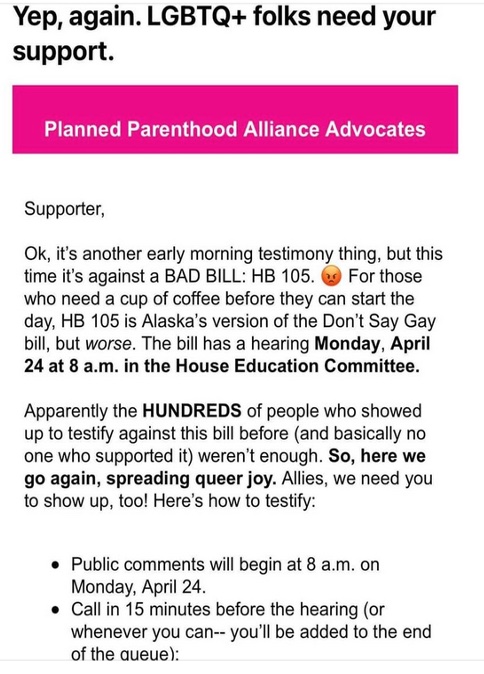
There were also many boilerplate or template emails which opposed the bill. These template emails merely required one to sign their names without really thinking about the bill’s contents.
At least 189 of these template emails were sent in by those who opposed HB105. These emails demonstrated that these opponents may have failed to read and understand the bill and resorted to a preformed template to voice their opposition.
This template email apparently came from a Planned Parenthood group which has allied with the teachers’ unions to control your children. They believe they know what is best for your child.
If one discounts the 189 template emails, Alaskans strongly support parents having the right to raise their children as they see fit.
These rights, as listed in HB105, include:
The right of a parent to opt-in their child for sex education, rather than opt-out
The right of a parent to know what is in their child’s school records. Prohibits schools keeping two sets of records, one for parents and one for the school
The right of parents to designate the official name for their child.
Sex education classes cannot begin until after a child is in 5th grade.
The right of a student to sex-based privacy in restrooms and locker rooms.
These rights are affirmed by the Alaska Supreme Court in Treacy v. Municipality of Anchorage stating, “that parents have a fundamental right to control the upbringing of their children.”
The bill states that schools must have “written permission from a parent before the name or pronoun used by a public school to address or refer to the parent’s child in person, on school identification, or in school records is changed; (8) requiring that a parent be informed in writing of the right to pursue legal action against a school district if the parent’s rights have been violated.” In other words, schools cannot call your child a girl if she is in fact a boy, without your written consent. They cannot call him “Mary” if his name is “Mark,” without a parent’s written consent.
The supporters of HB105 are backed up by the Federal Education Records Privacy Act, which states, “Parents or eligible students have the right to inspect and review the student’s education records maintained by the school.”
It would seem that if a school district maintains two sets of records — one for parents and one for the school administration as the Anchorage School District does — it would be a violation of federal law.
Districts should be aware that they may be jeopardizing millions of dollars of federal funding if they violate FERPA law.
While oral testimony is powerful, you can email your testimony to: [email protected].
That was fast — the IBEW and the AFL-CIO endorsed President Joe Biden and Vice President Kamala Harris on the very day that he announced his reelection bid, making it that much harder for any Democrat primary challengers to build strong campaign war chests.
International Brotherhood of Electrical Workers International President Kenneth W. Cooper said that Biden-Harris have led the most pro-union administration of his lifetime. He did not mention the president’s failure to make America energy independent or the increasing reliance on China for critical minerals needed for advanced technologies.
“The IBEW represents approximately 775,000 active members and retirees who work in various fields, including utilities, construction, telecommunications, broadcasting, manufacturing, railroads and government. The IBEW is the most established and comprehensive energy union in the world dedicated to promoting members’ welfare, safe working conditions and interests, fighting for fair wages, and for the dignity and rights of all workers in America,” Cooper said.
“When the IBEW endorsed candidate Joe Biden in 2019, it was because of his commitment to creating good union jobs, protecting secure retirements, addressing climate change responsibly and investing in American manufacturing. President Joe Biden has delivered on all of these pledges: promises made and promises kept,” Cooper said.
“Throughout his first term, President Biden has been a steadfast ally of unions and American workers. I am confident that support will continue in his second term. The Biden-Harris administration has consistently advanced policies that empower workers, created opportunities for everyday people, and promoted the well-being of working families. As a direct result of these efforts, the Biden-Harris administration has overseen robust economic growth, increased worker wages and the lowest unemployment rate in 50 years.”
“Within the first week of taking office, President Biden and Vice President Harris began appointing into the administration union officials who have dedicated their lives to advancing the labor movement’s core principles and worker’s rights, including a card-carrying union member for Secretary of Labor and a chief counsel for the NLRB who supports collective bargaining.
“President Biden has issued executive orders to reverse policies that have eroded unionists’ strength for decades, including industry-recognized apprenticeship programs (IRAPs) and rules that gutted federal employees’ collective bargaining rights. And then the Biden-Harris Administration went on the offense: mandating project labor agreements (PLAs) on federal construction projects, establishing the first-ever White House Task Force on Worker Organizing and Empowerment, and ensuring that skilled American workers benefit from historic federal investments.
The AFL-CIO also issued a quick statement: “The record is clear: Joe Biden is the most pro-union president of our lifetime. In the first two years of his presidency, Biden has delivered time and again for working people on the most critical issues we face, including making historic investments in good jobs, rebuilding our crumbling infrastructure, bringing manufacturing home to the United States, supporting educators and other public service workers, and strengthening the right to organize.
“The future of our country hangs in the balance—and like President Biden, we know there is much more to do. Over the next few weeks, the AFL-CIO and our unions will build on more than a year and a half of engaging our 12.5 million members as we gear up for 2024. We look forward to building on the progress of the past two years and finishing the job of creating an economy that puts working people first.
“We are working to build on the progress of the Biden–Harris administration’s past two years and finish the job of creating an economy that puts working people first,” the AFL-CIO said in a statement.
















#/media/File:USDA_Food_Pyramid.gif)