Friday, August 14, 2026
Home Blog Page 701

Peltola endorses Biden, while Vivek Ramaswamy says the president’s campaign is a case of ‘elder abuse’

Joe Biden officially announced that he’s running for president and the responses have been from soup to nuts all week.

The Democratic Party is on record saying it has no plans to host any primary debates for Biden, much to the ire of Robert F. Kennedy Jr. and Marianne Williamson, the two other announced Democrats. Insiders are understandably concerned Biden can’t hold his own in a debate at this point.

Alaska Rep. Mary Peltola immediately endorsed Biden, saying she appreciates his support for the ConocoPhillips Willow project in the National Petroleum Reserve-Alaska and the fact that he listens to Alaskans.

That might not be how some Alaskans see it. Biden, in allowing the Willow project to move forward, also locked up 16 million acres of the NPR-A, saying he would not allow any other projects in the region that was set aside for oil. He’s also shut down timber and mining in the state. He canceled leases in Cook Inlet.

An early endorsement of Biden may be strategic, with Peltola’s team hoping it will be forgotten by voters later. But polls show most Democrat voters across the country do not want the 80-year-old president to run. They’d support him reluctantly if he becomes the party’s nominee. According to the latest Wall Street Journal poll, just 42% of voters approve of the job President Biden is doing compared with 56% who disapprove.

Others endorsing Biden include a long list of elected and appointed Democrats, such as Vermont Sen. Bernie Sanders, Rep. Nancy Pelosi of California, Rep. Ilhan Omar of Minnesota, former President Barack Obama, California Gov. Gavin Newsom, Illinois Gov. J.B. Pritzker, and Michigan Gov. Gretchen Whitmer; Sec. of Transportation Pete Buttigieg has announced his endorsement. So far, the Boston Globe is the only major newspaper to publish its endorsement.

Republican Vivek Ramaswamy, a businessman who is running for president, says Biden’s candidacy is a case of elder abuse.

“He’s not *really* running – it’s just the managerial class using Joe Biden as a front to advance its own agenda. To them Biden’s cognitive impairment isn’t a bug. It’s a feature,” Ramaswamy said in an email to potential supporters.

“The administrative state more effectively controls its puppets when they are hollowed-out husks of themselves. The fact that it’s elder abuse is just a cost of doing business for Biden’s handlers. It’s revealing that the DNC refuses to host primary debates this year; they’re spitting in the face of their grassroots base,” he wrote.

Alaskans voted for Donald Trump over Biden in 2020, with 53% for Trump to Biden’s 43%, but Biden narrowly won Anchorage that year, the first Democrat to do so since Lyndon Johnson in 1964. Trump was the first president of either party to win statewide in Alaska without winning the majority in Alaska’s largest city, which has drifted to the Left over the past four yeas.


Three die, one injured in Army helicopter crash near Healy

Three soldiers died and another was injured when two AH-64 Apache helicopters based at Fort Wainwright collided in flight Thursday near Healy, about 10 miles north of the entrance to Denali National Park, according to the 11th Airborne Division. The two aircraft were returning from a training mission.

“This is an incredible loss for these soldiers’ families, their fellow soldiers, and for the division,” said Maj. Gen. Brian Eifler, commanding general of the 11th Airborne Division. “Our hearts and prayers go out to their families, friends and loved ones, and we are making the full resources of the Army available to support them. The Fort Wainwright community is one of the tightest military communities I’ve seen in my 32 years of service. I have no doubt they will pull together during this exceptional time of need and provide comfort to our families of our fallen.”

Two of the soldiers died at the scene and the third died en route to Fairbanks Memorial Hospital. The fourth is being treated for injuries at the hospital. Each helicopter had two individuals on board. Names of the deceased soldiers are being held until their families are notified.

The Apaches were from the 1st Attack Battalion, 25th Aviation Regiment.

In March, two Black Hawk helicopters collided during a training mission along the Kentucky-Tennessee border, killing nine. In February, an Apache helicopter rolled and crashed after takeoff from Talkeetna, killing two.

Photo: AH-64 Apache near Fort Wainwright in 2021, by Eve Baker, Fort Wainwright Public Affairs

Win Gruening: Admiral Richard J. Knapp, RIP

By WIN GRUENING

On Jan. 2, 2023, Admiral Richard J. Knapp, 93, crossed the bar in Haines, Alaska. Our nation and our state lost a loyal servant and a true patriot. 

Admiral Knapp, known by his friends as Dick, packed more into his life than most of us could ever hope to in several lifetimes. After a career in the U.S. Coast Guard, Dick embarked on and flourished in three more careers in state government and private enterprise.

Dick’s knowledge, experience, and civic involvement enriched and benefited his adopted home state of Alaska and the community of Juneau, where he lived for over 40 years.

After graduating from the U.S. Coast Guard Academy, Dick served aboard six Coast Guard ships and was commander of four of them, two of which were icebreakers. 

His wartime service included a tour in Vietnam as the commander responsible for a fleet of 82’ patrol boats charged with interdicting enemy weapons and materiel being smuggled into South Vietnam. That successful combat mission later became the model for riverine warfare waged by the better-known Navy Swift Boats.

As a senior officer, Dick was instrumental in the expansion of the traditional USCG mission from search and rescue to fisheries law enforcement and drug interdiction. He was promoted to the two-star flag rank of Rear Admiral in 1978, the highest rank awarded and maintained by the U.S. Coast Guard in peacetime. 

In his final assignment, serving as commander of the 17th Coast Guard District headquartered in Juneau, Knapp supervised and coordinated the successful rescue of 519 passengers and crew aboard the cruise ship Prinsendam, which caught fire in the Gulf of Alaska on Oct. 4, 1980. 

The dramatic rescue was particularly noteworthy because of the distance traveled by rescuers, the difficult coordination of many organizations, the deteriorating weather and high seas, and the fact that all aboard were rescued without loss of life or serious injury.

After his 1984 Coast Guard retirement, Dick served as  Alaska Commissioner of Transportation under Gov. Bill Sheffield, then as Vice President of the Alaska Railroad, and finally as Senior Vice President for Harbor Enterprises, Inc., the holding company for Petro Marine Services. His competence, calm leadership, and humor were hallmarks of his tenure in those organizations.

He remained active in civic affairs serving on the Juneau Chamber of Commerce board, the Marine Transportation Advisory Board, as Chairman of the CBJ Docks and Harbors Board, and as Commodore of the Juneau Yacht Club..  He was an unapologetic advocate for the proposed Lynn Canal Highway and chaired the organization Citizens Pro-Road. In 2009, in recognition of his contributions, Dick was named Juneau Citizen of the Year.

Never shy about expressing his opinion about any subject, Dick was self-deprecating, modest to a fault, and always willing to debate you with a twinkle in his eye.

Dick’s military bearing belied his more fun-loving side.  He treasured his cars and loved driving them. He babied his Audi so much that he insisted on driving it to Anchorage for maintenance at an authorized dealer. He had an ear for music and, as a 10-year-old old wonder, had a gig playing the accordion on a local radio show.

But his friends didn’t discover his talent until, on a cruise with them through the Panama Canal in 2017, he sang all the lyrics to songs he knew while dancing late into the night after everyone else had long gone to bed.

On that same Holland America cruise, the ship’s captain accorded him special treatment and a tour of the bridge in recognition of the role he played in the rescue of their sister-ship 37 years before. Predictably, Dick was abashed about all the attention he received but accepted it gracefully.

He considered his greatest achievement in life his successful courtship of his wife, Pamela. She was his greatest cheerleader and he hers.  He was extremely proud of his three sons and his daughter and often wondered aloud how an “old crusty sailor” like him ever got so lucky as to deserve such a wonderful life and family.

Fair winds and following seas, Admiral. You will be missed.

A celebration of the Admiral’s life will be held at the Juneau Yacht Club on Friday, May 5.  His ashes will be interred along with his wife, Pamela at the U.S. Coast Guard Academy in New London, Conn., at a later date.

After retiring as the senior vice president in charge of business banking for Key Bank in Alaska, Win Gruening became a regular opinion page columnist for the Juneau Empire. He was born and raised in Juneau and graduated from the U.S. Air Force Academy in 1970. He is involved in various local and statewide organizations.

Win Gruening: Legislature dives into perilous waters with state workforce, retirement issues

Win Gruening: Education funding is complicated, political

Reasons for ballot rejection: Signatures, postmarks

Win Gruening: Juneau muni elections outcome should give the Assembly pause about new City Hall

Win Gruening: Juneau muni elections outcome should give the Assembly pause about new City Hall

Win Gruening: Juneau muni elections outcome should give the Assembly pause about new City Hall

Win Gruening: School boards must learn to adapt to changing demographics

Murkowski disappointed that ERA didn’t pass in time, deadline expired

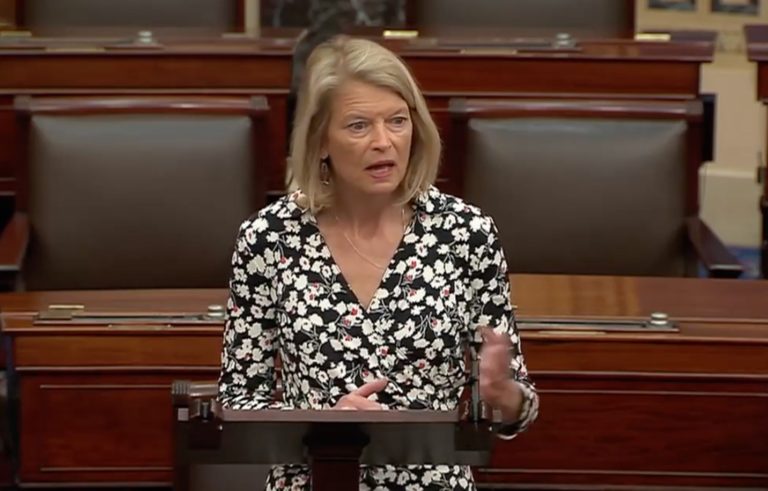
U.S. Sen. Lisa Murkowski expressed her disappointment after the U.S. Senate failed to pass Senate Joint Resolution 4, aimed at affirming the ratification of the Equal Rights Amendment.

The resolution, co-led by Sen. Ben Cardin from Maryland, sought to eliminate the arbitrary deadline for ratification and recognize the amendment as a valid part of the Constitution, given that the 38-state threshold needed for ratification of the ERA has been met.

“It’s pretty simple. ‘Equality of rights under the law shall not be denied or abridged by the United States or by any State on account of sex.’… That’s it. That’s the full substance of the Equal Rights Amendment,” she said on the Senate floor.

The matter of the ERA may be complicated by transgender ideology, which has inserted uncertainty into who qualifies as female.

Sen. Murkowski, who has co-led this resolution in three Congresses, emphasized the urgency of removing the deadline for ratification of the ERA by the states, which she feels is long overdue. She stressed that men and women should be treated equally under the law, and that there should be no time limit on equality.

Despite the setback, Murkowski assured advocates that she remains committed to the cause and will never give up the effort.

“Women are a majority of the U.S. population, but continue to be underrepresented in elected office, the courts, the business world, and in so many other areas,” she said.

Downing: Republicans in Congress vote to end solar panel ‘carve out for communists,’ but Peltola is a ‘nay’

Rep. Mary Peltola and Democrats could side with American ‘Union made,’ but instead support China’s slave labor

By SUZANNE DOWNING

It wasn’t even a year ago that President Joe Biden declared a national electricity emergency. In doing so, the president used the flimsiest of national security rationales to affix his seal of approval to well-documented genocide, ethnic cleansing, and slavery in communist China, where more than 80% of solar energy components are made, much of them through forced labor.

There was no electricity emergency in America, if not for the one Biden and Democrat governors like California’s Gavin Newsom created with their anti-energy policies designed to end America’s reliable supply of oil and gas. 

There was no emergency until Biden drained of the Strategic Petroleum Reserve, which resulted in America’s sudden return to dependence on anti-democracy nations, such as Venezuela, Iran, and Saudi Arabia. He never refilled the tanks, and today, the SPR is at the lowest level since the 1980s.

As he signed the edict, Biden specifically gave China the privilege of exporting billions of dollars worth of solar cells, panels, and modules to the United States,  without normal tariffs. His order says even if those components are laundered through any intermediary country in Southeast Asia, specifically Cambodia, Malaysia, Thailand, and the one-party, communist Socialist Republic of Vietnam, no regular tariffs apply. 

Instead of focusing his efforts on strengthening the grid through other means, Biden hobbled the ability of America’s free market to scale up and provide solar energy, because this tariff suspension is, in every conceivable way, a taxpayer subsidy to China. 

This week, House of Representatives Republicans voted to end the “carve-out for communists,” who use oppressed minority slaves in faraway provinces to build solar components for Americans, who are then purchasing solar systems with taxpayer-funded subsidies. 

Not a single Democrat got behind the resolution to restore normal tariffs and take a stand against forced labor and ethnic cleansing.

Not a single Democrat, not even — not even Alaska’s Rep. Mary Peltola, New York’s Rep. Alexandria Ocasio-Cortez, or California’s Nancy Pelosi — stood against genocide and cultural annihilation of the Uighur population in Xinjiang, the far-flung region of China where the government has detained, imprisoned, and oppressed the Muslim minority, including through forced labor and concentration camps. 

It’s all out of sight, and out of mind for Democrats, yet the atrocities they choose to ignore are well documented by the Center for Strategic and International Studies, the New York Times, and even Human Rights Watch, to name a few. These are all reliably left-of-center organizations that recognize the horrors committed, while America plays dumb.

Democrats, who want solar farms in every field without having to pay union wages for their manufacture at home, are whistling past the graveyard of millions of slaughtered Chinese ethnic minorities.

This comes as no real surprise; historically Democrats have supported slave labor for a large chunk of America’s history. It took a new party, called the Republican Party, to end it in America in the 1860s.

Let’s look at just a couple of the laws that Biden is overriding with his two-year “electricity emergency.” 

Section 307 of the Trade Act of 1930 “prohibits importing any product that was mined, produced, or manufactured wholly or in part by forced labor, including forced or indentured child labor.” That seems like an American value. 

But our enforcement agency, U.S. Customs and Border Protection, has its hands tied by the president’s Green New Deal emergency.

The president also ignores the Uyghur Forced Labor Prevention Act, which was passed by a bipartisan majority in Congress and signed by Biden in December of 2021, prohibiting the importation of products manufactured by forced labor.

Yet just six months after he signed that bill, Biden flipped hard and declared the electricity emergency, revealing that his commitment to human rights was nothing more than political theater.

The religion of climate change orthodoxy and the Green New Deal doxology has become the highest priority for the Left, for whom the ends justify the means.

China is expected to dominate over 90% of the solar component market in two years. Ironically, at the same time, China is building six times the number of coal plants than any other country – two coal plants a week in 2022. 

Biden’s policies make no sense for American energy independence, security, environment, or international human rights.

 By threatening to veto the restoration of normal tariffs, he maintains his devotion to China and the Green New Deal, and continues his war on America’s sovereignty as he weakens what is left of our country’s moral high ground.

Rep. Mary Peltola, Alaska’s only member of Congress, is complicit, as usual.

Suzanne Downing is publisher of Must Read Alaska.

Can Sec. Haaland double-cross King Cove? State asks 9th Circuit to dismiss

On Wednesday, the State of Alaska opposed the Department of the Interior’s motion to dismiss an appeal before the 9th U.S. Circuit Court of Appeals that proposes a life-saving road between King Cove and the State’s all-weather airport at Cold Bay.

Interior’s motion is based on Interior Secretary Deb Haaland’s March 14 decision to withdraw from the binding land exchange agreement between Interior and the King Cove Corporation that was approved in 2019. Haaland’s decision was presented as a final and unreviewable termination of the agreement.

Gov. Mike Dunleavy of Alaska said, “Secretary Haaland’s decision to halt the land swap means King Cove residents will remain at the mercy of the weather if they need lifesaving medical treatment.” He said the residents of King Cove deserve access to medical care just as much as any other American.

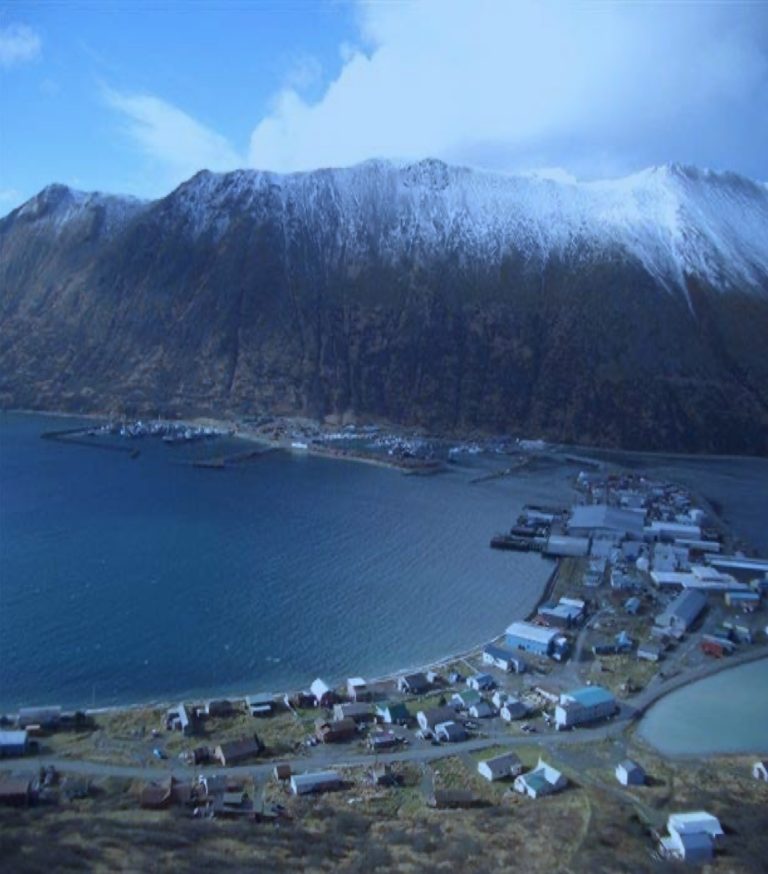
The remote village of King Cove, located on the Alaska Peninsula, has a population of 850 and has argued for a road across the refuge to reach an airport in Cold Bay for medical emergencies.

Opponents argue that a road will harm the refuge. King Cove Corp., a long-term partner with the State in developing a safe and reliable connection across the Izembek National Wildlife Refuge, filed a motion for preliminary injunction with the 9th Circuit to prohibit Interior from taking any actions to implement Secretary Haaland’s March 14, 2023 decision.

King Cove Corp. is a village corporation under the Alaska Native Claims Settlement Act, and it intends to enforce the binding KCC-DOI agreement to finalize the land exchange. The village corporations motion for injunction asks the 9th Circuit to enjoin Interior from taking any actions under Sec. Haaland’s recent decision until after the 9th Circuit issues its decision on the pending appeal.

The State’s opposition to Haaland’s motion to dismiss requests that the 9th Circuit denies her the request and issues its decision on the pending appeal, and then remands to the district court all issues relating to Haaland’s recent decision to withdraw from the land exchange. Before Haaland threw a wrench in it, the land exchange with KCC was nearly completed, with the litigation being the only cause of delay. The only remaining task before the exchange of deeds is for Interior to complete environmental surveys of the exchange lands, which had to wait until the completion of litigation.

Rick Whitbeck: Senate Bill 114 is reactionary, anti-energy, and anti-Alaska economy

By RICK WHITBECK | POWER THE FUTURE

Same song, different day. Alaska’s legislators are about to overhaul the state’s oil tax laws based on the worst government policy known to man: the need for more spending money. 

We would like to think our elected officials set policy targeting Alaska’s most important private sector industry based on what would lead to more oil production, more investment dollars coming into the state, or what would ensure the energy security of most of the state’s population. Now, the policy being considered in the State Senate appears to be nothing more than a cash grab. 

Anti-oil legislators have consistently cried about how the State could be getting more from producers, and over the years, have introduced bills to increase government’s portion. 

This year’s iteration – Senate Bill 114 – is reactionary, over-the-top legislation, as not only does it substantially increase costs for the various oil producers and change the way fields are looked at from an accounting standpoint, but it would change the tax status for a number of Alaska’s small producers, as well as one of its two majors.

That change, where “S-corporations” would pay the same amount of income tax as the “C-corporations” doing business in Alaska, would supposedly raise $100-200 million annually.

Sounds rational, right? Ah, but as we all know, the devil is ALWAYS in the details. So, let’s look at what those millions might really cost us Alaskans.

Increased costs have proved time after time to lower investment, risk jobs and actually bring in less revenue in previous tax schemes. In this case, we are certain history will repeat itself, and Alaska will once again face accelerated decline in the Trans Alaska Pipeline, which is good for no one besides extreme environmental activists.  

But here is the punchline that should scare us the most: The instability associated with changing tax structures will be felt most heavily in Cook Inlet, which already faces fights from environmental zealots looking to thwart leasing and exploration activities in an area that produces much of Southcentral Alaska’s natural gas, which is used for both heat and power for residents and businesses.

Alaska’s utilities have already said publicly they are anxious about where to get their energy in the next ten years; without serious new investment in Cook Inlet, the “old faithful” oil basin that has kept energy costs relatively cheap in Southcentral for decades won’t be able to meet demand.

So, the Alaska Legislature has some explaining to do about why its members think enacting a huge new tax on the Inlet’s largest natural gas producer will help that situation. It is not complicated, and not hard to see how disastrous such a policy would be for natural gas consumers, who will see energy bills spike when gas runs low and gaps must be filled with crazy-expensive alternatives like imported LNG. 

Here’s a better idea: Instead of asking current companies to pay more, Alaska should be helping grow the number of producers by creating a stable, win-win environment that grows the overall barrels of oil and cubic feet of gas, rather than threatens their production.

With 25 percent of Alaska’s private-sector employment directly or indirectly tied to oil and gas development, anything that threatens production and future investment also threatens jobs.  If jobs go away, the consistent outmigration from Alaska to more stable resource environments will continue, and those jobs and families who leave take with them philanthropic activity, community involvement and begin to shred the fabric they helped create throughout the Great Land.

With this much risk, and such little potential gain, it is amazing the Legislature hasn’t rejected outright this year’s legislation. 

There’s still time to send a message that Alaska is going to continue to be fully open for business, that economic stability is more important than budget gluttony, and that SB 114 would be horrible for Alaska.

Rick Whitbeck is the Alaska State Director for Power The Future, a national nonprofit organization that advocates for American energy jobs and opportunities. Contact him at [email protected] and follow him on Twitter @PTFAlaska.

Analysis: House, Senate wrestle with education funding

By DAVID BOYLE

One of the most controversial issues facing the Alaska Legislature is whether K-12 education funding should be increased, and by how much.  The Senate and House leadership disagree on the amount.

In the past few weeks, the House Democrat minority wanted a $321 million increase of education, which would result from a base student allocation formula increase of $1,250 per student, as seen in HB 65. Importantly, this would be a recurring expense because it is proposed for the funding formula going forward.

The House Republican majority offered a $175 million increase, but put it outside the per-student funding formula.  Thus, it would be a one-time increase, not a recurring cost.  

During the House floor debate this increase in funding would have to come out of the Constitutional Budget Reserve, which requires a three-quarter vote of the Senate and the House.

The final House vote on funding K-12 from the reserve fund failed by one vote. Thus, the House sent the operating budget to the senate with no increase in the education formula.

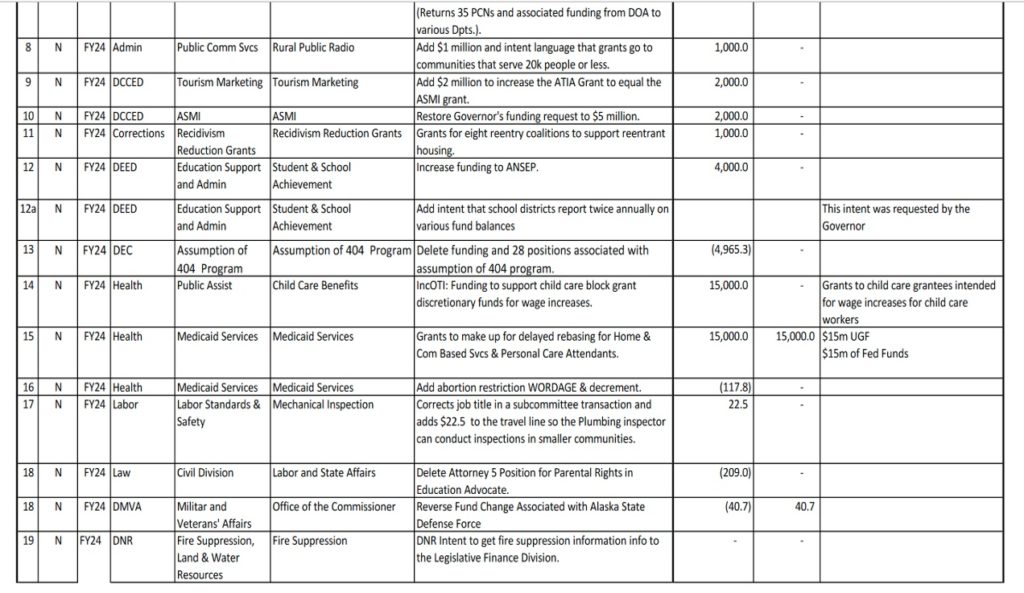
On April 26, the Senate Finance Committee made several changes to the operating budget, which can be seen below. The Senate decided to fund K12 at approximately $175 million, the same as the original House figure.

The Senate did not put this money into the education funding formula. Like the original House budget, the Senate decided to fund this outside of the formula, as a one-time allocation. Here is a look at the senate’s final budget changes to the house budget:

Note that the nearly $175 Million increase is a $680 BSA equivalent increase. This is because the $175 Million increase is divided by the magnified student number of 257,000.  Remember, the actual number of students enrolled in brick-and-mortar schools is about 107,000 and the 257,000 number of students that is used in calculating the funding results from the the funding formula multiplier effect.

In reality, if the K12 funding is increased by $175 Million, the per student increase is about $1,635. This would be a 27% increase in per student funding, not the 14% a Senate Finance member stated.

If the entire Senate votes for this budget, then it will go to the House for approval. If the house approves, then it’s done. If the house disapproves, then the operating budget goes to a conference committee made up of members of the House and Senate leadership, including Finance Committee leaders.

One budgetary plus for the teachers’ unions is the Senate sent a message to its allies in the education industry and the governor, when it deleted $209,000 from the Department of Law for a Parental Rights in Education Advocate, as seen in the budget detail below:

But the big question is, “Will this increase in K12 funding improve academic outcomes?”.   There is no accountability required from the school districts for how to spend the extra funds.  Will it be spent on salary increases?  Will it be spent on more Diversity, Equity & Inclusion training?  Will it be spent on bonuses for district administration personnel?  

Or will the extra funding actually go to the classroom to improve student outcomes?

Senate budget: Conservative, with small surplus and $1,300 PFD

The Senate Finance Committee has released its version of the Alaska state operating budget, which includes a split of the Alaska Permanent Fund’s earnings.

Under the proposal, the government would receive 75% of available oil revenue earnings, while Alaskans would receive 25% in the form of Permanent Fund dividends of approximately $1,304. Additionally, the Finance Committee has budgeted a one-time allocation of $174.9 million for education, which amounts to $680 per student.

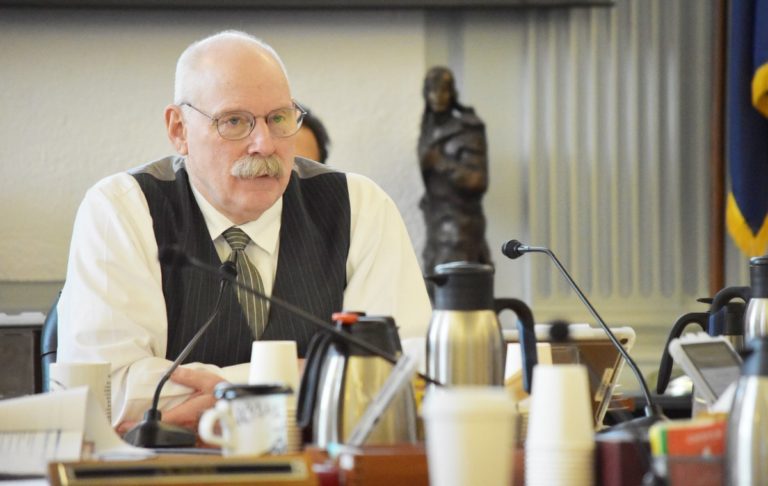
Sen. Bert Stedman of Sitka said the budget lives within the state’s means, is balanced, and does not dip into the Constitutional Budget Reserve, which is the account the Legislature may borrow from to meet demands. The fund is reaching the bottom after having been borrowed from repeatedly over the past decade, and never replenished. It has just $2.4 billion left.

“The constitution mandates us to deliver to the governor a balanced budget. Within the confines of the spring revenue forecast and not dipping into our perilously low reserves, we balance the budget with the potential opportunity of revisiting it next January to deal with further maintenance and capital needs,” Stedman said.

The committee used the spring oil revenue forecast of $73 per barrel for the next fiscal year. The budgeters were conservative in that they also left a $93 million surplus, which is a rounding error in a budget, but gives the State a little wiggle room if the price of oil dips.

If oil comes in higher than forecasted, the Senate is proposing replenishing the Constitutional Budget Reserve with the first one billion dollars, and after that, it would up up to $1.1 billion toward the Public Education fund to forward-fund education.

Alexei Painter, director of the Legislative Finance Division, told the Senate Finance Committee on Wednesday that the surplus could be swallowed up by even a small drop in oil prices below the $73-per-barrel forecast.

At the same time, the Senate is weighing a permanent increase to the base student allocation, with is the funding formula for schools. If it comes to an agreement on making the $680-per-student increase a permanent fixture for future legislatures, the senators will back out the one-time increase.

On the House side, the budget proposal has a $600 million deficit and a nearly $2,700 dividend, which is still not a statutory PFD, but is what the House offered as a compromise to the governor’s proposal of a $3,500 PFD.

The Senate also produced a new version of the capital budget — spending on construction and maintenance around the state. SB 41 has $30 million for school maintenance and $32 million for the University of Alaska capital improvements and repairs. The Finance Committee set four goals: Capture as much federal matching money as possible and provide grant writers for communities so they can apply for federal funds, establish food security and resource preservation, strengthen statewide energy programs, and deal with deferred maintenance items.

“We have limited resources to work with, making this capital budget one of the smallest we have seen in a long time. But we have focused on putting in money for major maintenance for schools and the university system to prioritize our existing structures,” said Sen. Lyman Hoffman, capital budget chair of the Senate Finance Committee. “We’ve chosen not to do any individual district projects, but are concentrating on shoring up statewide existing infrastructure.”

The Senate budget totals about $6.2 billion and, unlike the House version, does not require a three-quarters vote of the entire Legislature to access the Constitutional Budget Reserve funds, which is always a major hurdle for lawmakers.

Gov. Mike Dunleavy’s budget, with its $3,500 dividend, has no increases to education, and would require dipping into the Constitutional Budget Reserve to get $900 million needed to balance.

The House and Senate budget differences are normally ironed out through a negotiation in an appointed conference committee at the very end of the session.