Tuesday, August 18, 2026
Home Blog Page 566

Pro-Hamas vandals shut down a Starbucks store in Seattle; three Palestinians shot in Vermont

The Starbucks Reserve Roastery in the Capitol Hill neighborhood of Seattle was left vandalized after what employees said were pro-Hamas protestors spray-painting and breaking glass at the location, which was subsequently closed for repairs. Employees who were in the building at the time escaped through the back door. The vandals scrawled, “Starbucks supports genocide” and “Enter if you support genocide” in front of the store.

Earlier this fall, Starbucks Workers Union put out a statement in support of Hamas.

The Friday vandalism incident leading to the Saturday closure at the Starbucks store followed a pro-Hamas group of several dozen protesters who occupied the traditional tree-lighting ceremony at Westlake Center in downtown Seattle on Friday. The protesters took over the stage and children and their parents who were there for the festivities felt threatened, as police did not arrest the disrupters of the sanctioned event.

On Thursday, pro-Hamas protestors glued themselves to the pavement during the Macy’s Thanksgiving Day Parade in New York.

On Saturday night in Vermont, three men who were dressed in Palestinian-style scarves were shot by a man on foot. The three men, all college students, were on their way to a Thanksgiving Day dinner in Burlington. This violent crime has been labeled a hate crime by authorities, while the vandalism crime against the Starbucks and the fear caused at the Christmas tree ceremony in Seattle was not labeled a hate crime.

The Department of Justice has reported a strong uptick in threats against both Muslims and Jews since Hamas attacked Israel on Oct. 7, leading to a conflict that has become the deadliest war for Israel since the Yom Kippur War of 1973.

Child’s body found in landslide debris in Wrangell

4

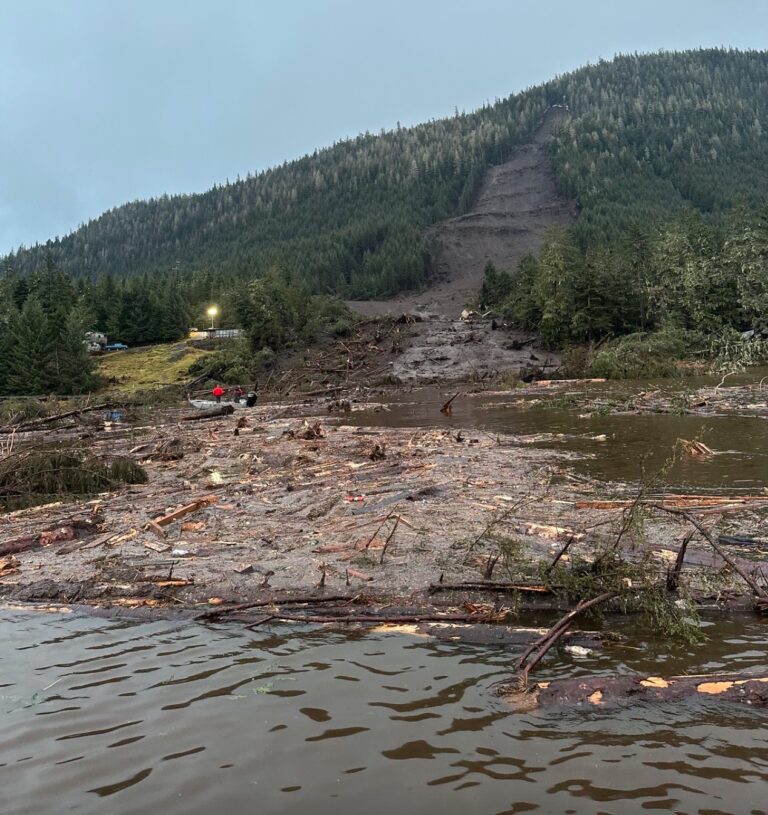
On Saturday evening, the body of 11-year-old Kara Heller was recovered from the landslide debris in Wrangell, the small town of 2,127 people on Wrangell Island in Southeast Alaska. A search has gone on for days since the Nov. 20 landslide across Zimovia Highway, and the discovery of Kara’s body leaves just two people known to be still missing, but presumed by most in the community to also be deceased: Otto Florschutz, 65; and Derek Heller, 12.

A scent detection dog signaled to searchers to look in an area of the debris and with the assistance of an excavator, led to Kara’s remains. Next of kin and the State Medical Examiners Office have been notified. A scent detection K9 team remains on standby and will resume searching if new information or evidence leads to a specific search area, the Department of Public Safety said.

The entire Heller family of five appears to have been taken by the disaster.

Doctors vs. State of Alaska and Lower-48 insurers: Lawsuit filed over ’80th percentile rule’

32

In 2004, Alaska introduced a regulatory measure known as the “80th Percentile Rule,” requiring health insurers to reimburse medical providers at least up to the 80th percentile of billed charges within the same geographical area. However, this rule is set to be repealed by the Alaska Division of Insurance on Jan. 1.

A consortium of medical providers, representing a significant portion of the healthcare community, has taken legal action against the state in an effort to preserve this rule. Their argument says that without it, insurers will refuse to negotiate with providers and could attempt to coerce providers into joining insurance networks.

“After months of attempting to communicate with the Alaska Division of Insurance on the dangers of repealing the 80th Percentile Rule without a replacement, we have reluctantly filed suit to protect the countless Alaska families, workers and patients impacted by this misguided regulatory repeal. Every downstream result of abolishing the 80th percentile rule and its consumer protections means less access to care, fewer doctors to see, bigger bills for patients, and the return of the predatory insurance practices that the rule successfully worked to eliminate,” said Dr. John Morris, Chair of the Coalition for Reliable Medical Access.

Premera Blue Cross, on the other hand, has vigorously advocated for the elimination of the 80th Percentile Rule. It asserts that the original intent of this regulation was to shield patients from balance billing (when a provider bills you for the difference between the provider’s charge and the allowed amount), but it has actually contributed to Alaska’s escalating healthcare costs. According to Premera Blue Cross, the rule allows providers to gradually raise charges with limited motivation to control expenses or join insurance networks.

The Division of Insurance has determined that the 80th Percentile Rule is a driving factor behind the rising medical costs in Alaska.

Medical professionals and providers argue that without adequate reimbursement, many doctors may opt to leave the state.

The coalition of healthcare entities filing suit contends that repealing the rule without implementing a suitable replacement would expose doctors and providers to unfair treatment by profit-driven insurance companies. The absence of this rule could grant insurance companies the power to dictate the winners and losers within the healthcare system, potentially leading to smaller provider networks and reduced access to medical care for certain individuals.

“Repealing the 80th Percentile Rule without a replacement turns back the clock on the significant progress Alaska has made in expanding our healthcare system over the last 20 years and hands complete control over to out-of-state insurance companies,” said Dr. Steven Compton, President of the Alaska State Medical Association. “This ill-conceived regulatory change only magnifies the control big, lower-48 insurance companies continue to hold over patients and their ability to choose the medical provider of their choice. Sadly, in their effort to quietly push this repeal forward, the Division of Insurance and their insurance industry allies continue to misinform Alaskans, misstate facts, and ignore the harm they’re doing to Alaska patients.”

The 80th Percentile Rule protects patients from balance billing and out-of-pocket costs for healthcare, and encourages insurers to work with providers in good faith, the Alaska doctors said. Further, according to the coalition, the federal No Surprises Act applies only to emergent care and does not replace patient protections in the 80th Percentile Rule.

The 80th Percentile Rule does not apply to Alaska Native and American Indian healthcare, which is covered by the federal government, nor to Veterans Administration patients. However, it does affect those covered by major insurers such as Premera Blue Cross and Moda, some of the the largest insurers in the state and in America

The lawsuit was filed in Anchorage Superior Court by the Coalition for Reliable Medical Access, made up of various organizations, including the Alaska State Medical Association, the Alaska Medical Group Management Association, the Alaska Podiatric Medical Association, the Alaska Physical Therapy Association, and the Alaska Chiropractic Society.

Los Anchorage: Four gunshot deaths in one week

41

Early Saturday morning, Anchorage police and first responders raced to the 3400 block of Greenland Drive in the Spenard neighborhood, where one man was found dead of gunshot wounds, and another was taken to the hospital with life-threatening gunshot holes.

A third man went to the hospital on his own, where he was treated for a gunshot wound and is expected to live.

“The motive and any relationship between the parties involved is under investigation,” police said in a statement. “Detectives believe this is an isolated incident and not random.”

There have been four gun incidents, ending in four deaths, and at least two wounded by gunshot in one week in Anchorage.

On Nov. 22, an officer discharged his service weapon when an agitated man on 36th Avenue and Latouche Street was walking on the road waving a machete. The man brandished another weapon and pointed it at the officer. The man was taken into custody. Details on the weapon he brandished were not provided by police.

On Nov. 21, 29-year-old Saina Fa’atoafe fatally shot a woman in the South Anchorage Walmart parking lot and then took his own life. 

On Nov. 19, police were called to the area of North Bragaw Street and Thompson Avenue regarding a shooting. An adult man victim, 33-year-old Matagiofa J. Sione, was taken to a hospital, where he died of a gunshot wound. Police have not released the suspect’s name, but he was reportedly detained.

Alaska is first in nation for financial health of state budget, says Truth in Accounting report for 2023

34

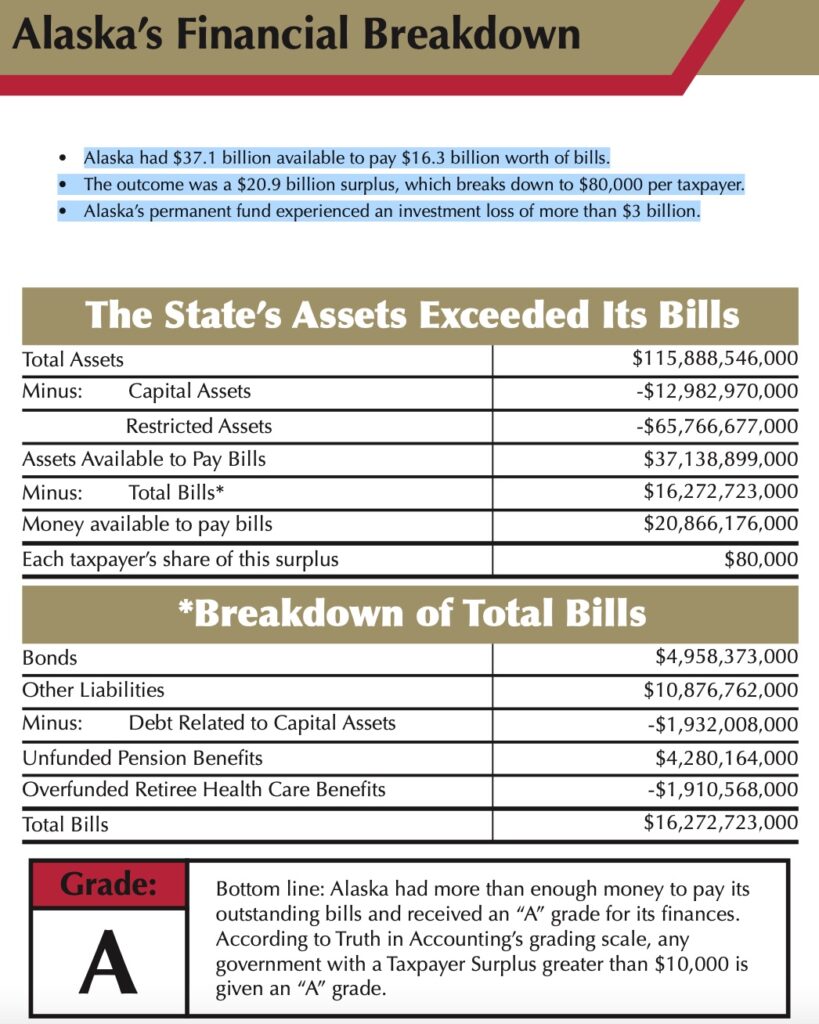
Alaska’s state budget condition was the strongest in the nation in 2022, with a surplus of $20.9 billion, according to the state’s latest audited financial report for fiscal year 2022.

The findings come from Truth in Accounting, a non-profit organization dedicated to providing citizens with clear, reliable, and transparent government financial information. The organization assigned Alaska an “A” grade for its financial performance.

The solid financial footing can be attributed to a combination of factors. Federal funding aimed at Covid-19 relief played a role, alongside an increase in economic activity linked to a growth in tourism.

  • Alaska had $37.1 billion available to pay $16.3 billion worth of bills, giving it a nearly $21billion surplus, coming out to $80,000 per taxpayer.

In comparison, California’s budget health received a D from Truth in Accounting. The Democrat-dominated state requires more than $18,000 from every taxpayer to pay its bills. Connecticut received an F, needing $50,700 from each of its taxpayers to pay all of its outstanding bills. Connecticut ranked #49, just behind the worst state — New Jersey, coming in at #50; New Jersey would need $53,600 from each of its taxpayers to pay all of its outstanding bills.

According to the organization, at the end of fiscal year 2022, 28 states did not have enough money to pay all of their bills. In total, debt among the states was $938.6 billion, down from $1.2 trillion at the end of fiscal year 2021.

State debt decreased mostly due to tax revenue increases due to the Covid lockdowns ending, and millions, if not billions, of dollars in federal Covid funds received by the states. That money added to the national debt, however, which is now over $33 trillion.

Every state except Vermont has a balanced budget requirement. This means that to balance the budget—as the law requires in 49 states—states should not carry any debt.

“However, we found that most states could not pay all of their bills. When states do not have enough money to pay their bills, TIA takes the money needed to pay bills and divides it by the estimated number of state taxpayers. The resulting number is a Taxpayer Burden™. Conversely, a Taxpayer Surplus™ is the amount of money left over after all of a state’s bills are paid, divided by the estimated number of taxpayers in the state,” said Truth in Accounting’s summary of the report.

The entire report can be found at this link.

Another killer of Cynthia Hoffman gets plea deal: Murder in second degree

13

On Thanksgiving eve, 24-year-old Caleb Allen Russell Leyland pleaded guilty to the murder of 19-year-old Cynthia “CeCe” Hoffman, who in June of 2019 was lured to the Thunderbird Falls trail, where she was bound and gagged with duct tape, shot once in the back of the head and thrown into the Eklutna River by five who had plotted to murder her.

Appearing before Anchorage Superior Court Judge Andrew Peterson, Leyland admitted to just one count of murder in the second degree. Second-degree murder is typically murder with malicious intent but not premeditated. Charges of first-degree murder and conspiracy to commit first-degree murder were dropped in exchange for the second-degree guilty plea.

The crime orchestrated by the group of teenagers was masterminded by an out-of-state man named Darin Schilmiller, who conned the teens into committing the murder in exchange for money. Leyland was 19 at the time he took part in the crime.

The plot was locally hatched by CeCe Hoffman’s friend, Denali Brehmer, in her online relationship with Schilmiller, who was going by the name of “Tyler” and who said he was from Kansas. “Tyler” sent Brehmer a photograph of another young male, saying the photo was of himself: “Tyler” also convinced Brehmer that he was a millionaire.

Darin Schilmiller

As Schilmiller and Brehmer continued chatting online, they developed a plan to rape and murder someone in Alaska. Schilmiller offered Brehmer $9 million to carry out the murder and to have photographs or videos of the murder sent to him. Brehmer agreed to commit the murder and solicited four friends, including Leyland, 16-year-old Kayden McIntosh and two other juveniles to assist her in planning and carrying out the murder.

“Digital evidence and statements show Brehmer was communicating with and sending videos and/or photographs of the events surrounding the incident to Schilmiller at his directive throughout the duration of the event,” the Alaska Department of Law wrote.

McIntosh is the one who is accused of actually pulling the trigger on the weapon. He has had several court appearances since February; the next court appearance is scheduled for Dec. 6.

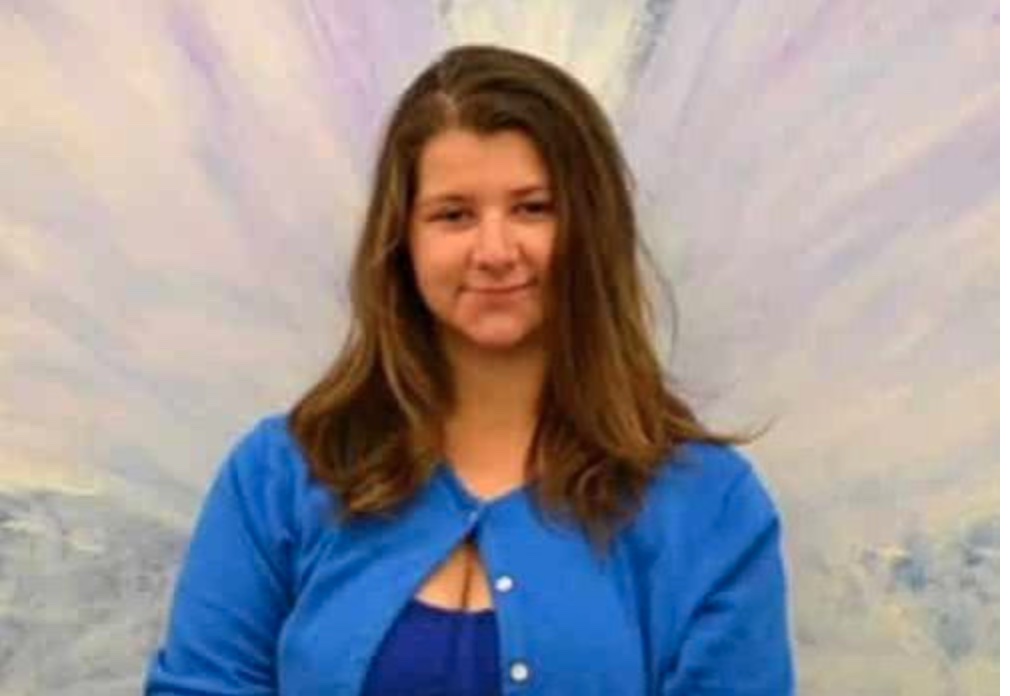
Murder victim Cynthia Hoffman. Photo source: Facebook.

Schilmiller, of New Salisbury, Indiana, took a plea deal in August when the first-degree and second-degree murder, and conspiracy to commit first-degree murder charges were dropped, as he pleaded to first-degree solicitation of murder. There is wasn’t an agreement at the time between the prosecutors and Schilmiller regarding any specific term of imprisonment.

Judge Peterson may sentence Schilmiller to a term of imprisonment of no less than five years and no more than 99 years. Sentencing for Schilmiller is scheduled to begin Jan. 8, 2024, in front of Judge Peterson.

The terms of the Leyland’s plea agreement allow for a maximum term of imprisonment of 75 years, with 25 years suspended, potentially leading to a 50-year sentence. The sentencing phase is scheduled to start on June 10, 2024, with Judge Peterson presiding.

Leyland remains in the custody of the Alaska Department of Corrections, with no possibility of release under any conditions.

New Biden rule for foster parents forces them to affirm LGBTQI+ identities — or be charged with child abuse

The Biden Administration has set a deadline of Monday, Nov. 27, for public comment on a significant proposed regulation regarding foster care.

The U.S. Department of Health and Human Services Administration for Children and Families quietly introduced the rule, “Safe and Appropriate Foster Care Placement Requirements for Titles IV–E and IV–B,” on Sept. 28.

The proposal is part of the Biden Administration’s continued interest in pushing children into alternate sexual identities and lifestyles, specifically lesbian, gay, bisexual, transgender, queer, and intersex identities.

Key aspects of the proposed rule include:

  1. Mandatory affirmation of gender expression: Foster parents will be required to affirm the gender expression of LGBTQI+ children. Non-compliance with this rule could be considered child abuse.
  2. Specific requirements for agencies: Agencies must implement processes to ensure safe and appropriate placements for LGBTQI+ children and provide necessary support services.
  3. Addressing risks and adverse outcomes: The rule aims to mitigate the risks LGBTQI+ children face in foster care, such as mistreatment, stigma, and discrimination.
  4. Prohibitions on conversion therapy: The rule explicitly bans all practices aimed at changing a child’s sexual orientation or gender identity. Foster parents can only affirm identity, and cannot question or provide an alternative view of a child’s stated identity. Conversations that a foster parent has with a LGBTQI+ child may be subject to litigation, if the child reports it to authorities as unsupportive.

The ACF rule will force foster parents to use the name the child prefers, and the pronouns the child insists on as part of creating a “safe home environment.” If the foster parent refuses, he or she may be charged with child abuse.

While the Biden Administration aims to protect and support LGBTQI+ children in foster care, it has raised several questions and concerns:

  • Definition of key terms: Terms like “hostility,” “mistreatment,” or “abuse” are not explicitly defined, leading to potential ambiguity in enforcement.
  • First Amendment concerns: The inclusion of talk therapy in the definition of ‘conversion therapy’ and its legal implications under the First Amendment are unclear. In Anchorage, a similar ordinance prohibiting “conversion therapy” has the same First Amendment violations already in local law.
  • Lack of specific training curriculum: While training for providers is mentioned, no specific curriculum is proposed.
  • Role of biological parents: The proposal does not address the involvement of biological parents in decisions regarding the services and activities provided to their children, while the children are being fostered. Not all children enter foster care because of misdeeds of their parents, although the vast majority of foster children have suffered physical abuse, psychological abuse, or sexual abuse.
  • Medical interventions: The rule is ambiguous when it comes to medical interventions like puberty blockers, cross-sex hormones, or surgeries.

Critics of the new rule say that, rather than prevent homelessness and institutionalization for LGBTQI+ youth, this new rule will cause foster families to not accept these children, because of the risk of being accused of the crime of child abuse if they inadvertently cross some undefined line set forth by the federal government.

Read the entire proposed rule at the ACF link.

Steve Goreham: California mandates electric trucks, but 19 states sue to block

By STEVE GOREHAM | MASTER RESOURCE

Earlier this year, California passed regulations that would turn the trucking industry upside down. New mandates for zero emissions trucks would disrupt the industry, raise shipping costs, and put trucking companies out of business. A group including 19 states and several trucking organizations recently filed suit to block the California regulation.

California’s Advanced Clean Fleets (ACF) Regulation goes into effect on Jan. 1, 2024. The ACF requires that truck operators buy only Zero Emissions Vehicle (ZEV) trucks for medium-duty and heavy-duty trucking operations as early as January 2024. The ACF also requires that trucking companies transition their fleets to 100 percent ZEV trucks by 2035 to 2042, depending upon class of truck.

On Nov. 3, 19 state attorneys general and several trucking organizations filed a brief in the US Court of Appeals for the District of Columbia Circuit to block ACF. The suit argues that the ACF regulation is unconstitutional and highlights the negative consequences of forced electrification of the heavy truck fleet.

ZEV trucks are plug-in battery electric trucks and hydrogen fuel-cell trucks. The goal of ACF is to remove all trucks with internal combustion engines from California roads by as early as 2035.

According to the regulation, new trucks for drayage, high priority truck fleets, and public fleets must be ZEV trucks as of January. Drayage trucks operate at California ports or transport containerized freight to and from intermodal rail yards. High-priority fleets belong to private companies with more than 50 trucks or over $50 million in annual revenue. Public fleets are owned by state and local governments.

For practical purposes, ACF will require half of all new heavy-duty truck sales to be electric trucks, instead of diesel trucks. Few new trucks would be hydrogen fuel-cell trucks, which are not competitive at this time.

Under the Clean Air Act of 1967, Congress preempted states from adopting emissions standards for motor vehicles. But in Section 209 of the Act, California was permitted to seek a waiver from this preemption. In March of 2023, the Environmental Protection Agency granted a waiver to allow California to establish the ACF emissions standard for heavy trucks. If this waiver stands, the Advanced Clean Fleets Regulation may allow California to try to force a national transition to electric trucks.

The suit filed against Advanced Clean Fleets regulation argues that the EPA should not have granted the waiver. It argues that the ACF crosses state lines, and that California should not be allowed to regulate trucking for the nation.

Eight other states, Colorado, Maryland, Massachusetts, New Jersey, New York, Oregon, Vermont, and Washington, have already adopted California’s ACF rules. Another six states are expected to join. But can electric trucks do the job? 

Electric trucks suffer major disadvantages when compared to diesel trucks. Diesel trucks can travel about 1200 miles after filling the tank in 15 minutes. The range of electric trucks is about 150-330 miles and recharging may take hours, even on a high-speed charger.

Electric truck cabs cost two to three times as much as diesel cabs, an incremental cost of as much as $300,000 per truck. Electric cabs also weigh about 10,000 pounds more than comparable diesel versions. This can reduce net freight carried by as much as 20 percent. 

Few heavy truck charging stations exist, and the power requirements are huge. The new heavy-duty truck charging station in South El Monte, California can charge up to 32 trucks in about 90 minutes. The South El Monte site was funded through the Joint Electric Truck Scaling Initiative, funded by California state and local agencies. But six megawatts of electricity will be needed to simultaneously charge these trucks, more than the power consumed by 200,000 homes or used in a small California city, such as San Bernardino or Huntington Beach.

But the South El Monte site is one of very few heavy truck charging sites. The California Energy Commission estimates that 157,000 medium- and heavy-duty chargers will be required by 2030. If these are built, the peak electricity draw could be as much as an additional 5,000 cities the size of San Bernardino. It’s very unlikely that the California grid could deliver this much power. Heavy duty charging sites would also need to be built all over the nation.

The California Air Resources Board, which established the ACF, claims that the regulation is needed to “protect the public health and welfare of Californians.” But ACF benefits to Californians will be negligible. Particulate air pollution in California has been reduced to such low levels that a single large wildfire exhausts more particulate pollution in a few days than all California vehicles exhaust in an entire year. China emits more greenhouse gases in a day than California trucks emit in a year.

California’s Advanced Clean Fleets regulation, if adopted, will be a disaster for trucking and consumers. The jump in truck costs will put small truckers out of business. Freight delivery times will increase because of long charging times. Longer delivery times and smaller loads will require 20 to 50 percent more trucks to move the same amount of freight.

In 2022, trucks moved 73 percent of US domestic freight. Forced adoption of electric trucks will boost the cost of food, medicines, clothing, and materials for consumers and businesses, put upward pressure on inflation, and provide negligible pollution control benefits. The US Court of Appeals and other states should reject California’s ACF regulation.

Steve Goreham is a speaker on energy, the environment, and public policy and the author of the new bestselling book Green Breakdown: The Coming Renewable Energy Failure. Originally published in Master Resource.

Oliver Anthony, singer-songwriting sensation, will appear in person at Alaska State Fair in 2024

12

Alaska fans of singer-songwriter Oliver Anthony will have a reason to applaud next summer, as the country music sensation best known for “Rich Men North of Richmond,” is set to perform at the Alaska State Fair on Sept. 1, 2024.

The performance offers an opportunity to experience the gritty working class music of Anthony and to be part of his journey from being an unknown artist to a nationally known star in weeks.

In August 2023, he released his overnight hit “Rich Men North of Richmond” independently, and it debuted at number 1 on the Billboard Hot 100, making Anthony the first artist to debut atop the chart without having any songs on any charts previously.

The video of Anthony performing “Rich Men North of Richmond” was uploaded to YouTube on Aug. 8 and immediately went viral. Some have described it as an indictment of politicians, welfare abusers, and other issues, all coming from the perspective of a working-class man who pays the taxes to support a country going insane. Leftists describe Anthony as promoting white supremacy and racism, according to the World Socialist website.

But Anthony says he is right down the middle politically: “I sit pretty dead center down the aisle on politics and always have. I see the right trying to characterize me as one of their own, and I see the left trying to discredit me, I guess in retaliation. That shit’s got to stop,” he said in Variety.

Born and raised in the Piedmont area, rolling foothills and river valleys between the Coastal Plain and the Blue Ridge Mountains of Virginia, Anthony as of August lived with his wife and two children in a $750 camper on property that he intends to raise livestock on. He dropped out of high school in 2010 and later earned a general educational diploma and worked at a paper mill in North Carolina. Anthony fractured his skull in a work accident in 2013, which caused him to be unable to work for several months.

Tickets for this performance are bound to go fast. They can be purchased at the Alaska State Fair website.