Tuesday, August 18, 2026
Home Blog Page 565

Dan Sullivan for vice president? Radio host Hugh Hewitt says Alaska’s senator should be on the list

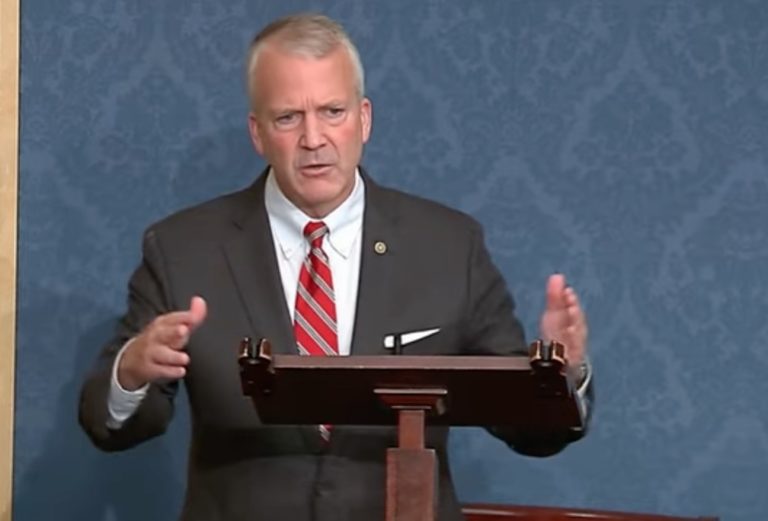
Hugh Hewitt, a nationally syndicated radio host on the Salem Radio Network and law professor at Chapman University School of Law, says that Alaska Sen. Dan Sullivan should be on the list for any of the Republican candidates for president as a vice presidential pick.

Why Sen. Sullivan? Sullivan’s dedication to national security.

Hewitt’s column, which appeared in the Washington Post last week, put Sullivan on a short list for consideration as vice president or at least in a high cabinet position, along with these other Hewitt favorites: Sen. Tom Cotton (Ark.), Sen. Joni Ernst (Iowa), Rep. Mike Gallagher (Wis.), former secretary of state Mike Pompeo, and former national security adviser Robert C. O’Brien.

“All are serious about the state of the world; all are serious about national security,” Hewitt wrote at the end of his column that was primarily about the war between Israel and Hamas, and the sharp left turn that the Democrats in America have taken.

“Anyone watching what has happened on U.S. college campuses in the past seven weeks has to objectively evaluate the young left’s direction and consider its advance guard already in the House (in “the Squad”) or in the bureaucracy and objecting to President Biden’s support of Israel. They must conclude that the Democratic Party is not simply drifting leftward; it runs a real risk of heading to the hard left,” Hewitt wrote.

He pointed out that among Democratic voters age 18 to 34, a NBC poll shows that 70% of them disapprove of President Joe Biden’s handling of the war.

“This is a generational shift, and a dire one for Israel. It isn’t a huge leap to imagine that this hard left will shape the future of the Democratic Party. If Democrats win in 2024 or 2028, there would be an ever-increasing number of powerful people who are committed to the poisonous ‘oppressed/oppressor’ framework for interpreting the entire world,” Hewitt noted.

“Israel is engaged in what ultimately amounts to a war for survival against a genocidal enemy — Hamas is just its vanguard. The war right now is being waged in Gaza, but Hezbollah’s terrorist legions await on Israel’s northern border with Lebanon, and Iran, the deadliest threat, bides its time. There isn’t a middle ground here, any more than there is a middle ground regarding Russia’s invasion of Ukraine or China’s genocide of the Uyghurs. In fact, this is one confrontation — whether the front line is Gaza, or Ukraine or, eventually, Taiwan,” Hewitt wrote.

That’s why all the Republican nominees should start detailing who would be included in key positions in their administrations.

“Let’s compare that list with the new generation of Democrats, the voices who will likely shape the party for years to come,” Hewitt said. For him, the U.S. Marine Reservist from Alaska should be included in the next Republican Administration, possibly as vice president.

Hewitt writes for the Washington Post about law, politics, media bias, and society in general. He is a former official in the Ronald Reagan Administration, and former president and CEO of the Richard Nixon Foundation. Sullivan is a regular guest on his nationally syndicated radio show.


House hearing Thursday: Weaponization of federal government and ‘Censorship Industrial Complex’

49

The House Select Subcommittee on the Weaponization of the Federal Government will hold what could be an explosive hearing on Thursday at 10 am Eastern Time in the Rayburn House Office Building, with witnesses linking government censorship efforts back to the Obama White House.

The hearing takes place one year after the first Twitter Files report that showed how Twitter censored conservative Americans up until Elon Musk bought a majority stake in the company, now called X. The committee, chaired by Rep. Jim Jordan, will examine the federal government’s involvement in social media censorship, as well as recent attacks on independent journalism and free expression.

Witnesses include Matt Taibbi, Twitter Files independent journalist and author; Michael Shellenberger, Twitter Files independent journalist, author, and environmentalist; and Rupa Subramanya, Canada-based journalist for The Free Press.

The hearing can be watched live on YouTube at this link:

So far, at least six releases from the Twitter Files show how Twitter censorship worked for Democrats under the old management of Jack Dorsey, former Twitter CEO:

  • Twitter Files Part 1 shows how under the old management of Twitter, content moderation employees made decisions about allegations involving Hunter Biden’s laptop, prior to the 2020 presidential election, swaying the public and likely manipulating the election.
  • Twitter Files Part 2 demonstrates that Twitter used tools to lower the visibility of some accounts that liberals disagreed with. 
  • Twitter Files Part 3 revolves around Twitter’s decision to remove President Donald Trump from the platform after the Jan. 6 protest at the U.S. Capitol.
  • Twitter Files Part 4 includes more about Twitter’s banishment of a sitting president, Trump.
  • Twitter Files Part 5 contains more details on how Twitter decided to ban Trump.

In advance of the hearing on Thursday, Shellenberger has revealed that he has another damning trove of information on X/Twitter, that is even bigger than the Twitter Files.

“Many people insist that governments aren’t involved in censorship, but they are,” Shellenberger wrote on X/Twitter. “And now, a whistleblower has come forward with an explosive new trove of documents, rivaling or exceeding the Twitter Files and Facebook Files in scale and importance.”

The whistleblower explained there is an “anti-disinformation” group called the Cyber Threat Intelligence League, or CTIL, started by data scientists and defense and intelligence veterans whose tactics over time “appear to have been absorbed into multiple official projects, including those of the Department of Homeland Security (DHS).”

The CTIL documents, Shellenberger said, “offer the missing link answers to key questions not addressed in the Twitter Files and Facebook Files. Combined, they offer a comprehensive picture of the birth of the ‘anti-disinformation’ sector, or what we have called the Censorship Industrial Complex,” that is traced back to the Obama White House, when the whistleblower says she received instructions to create a counter-disinformation project to stop “a repeat of 2016.”

The Shellenberger story on this new trove of documents is found on his Substack website, “Public.”

In his report, he alleges that the U.S. Department of Homeland Security’s Cybersecurity and Information Security Agency (CISA) has been at the center for much of the censorship, “with the National Science Foundation financing the development of censorship and disinformation tools and other federal government agencies playing a supportive role.” He also fingers the Election Integrity Partnership, which in 2020 involved the Stanford Internet Observatory and other U.S. government contractors. EIP and its successor, the Virality Project, urged Twitter, Facebook and other platforms to censor social media posts by ordinary citizens and elected officials alike.

Shellenberger testified before this special committee in on March 30, but at the time, there was an entire year’s worth of information that was still missing.

Now, a large trove of new documents, including strategy documents, training videos, presentations, and internal messages, reveal that, “in 2019, US and UK military and intelligence contractors led by a former UK defense researcher, Sara-Jayne ‘SJ’ Terp, developed the sweeping censorship framework. These contractors co-led CTIL, which partnered with CISA in the spring of 2020,” Shellenberger wrote.

“In truth, the building of the Censorship Industrial Complex began even earlier — in 2018,” he wrote.

“I look forward to providing testimony to Congress, this Thursday, about the Censorship Industrial Complex’s clear and present threat to the United States of America and other liberal democratic Western democracies, and how we can shut it down,” Shellenberger wrote on X/Twitter on Tuesday, as he prepared his testimony for the nation to hear.

Link to the House Judiciary Committee.

EPA action over air quality could cost Fairbanks transportation funds

34

By KIM JARRETT | THE CENTER SQUARE

Despite federal assurances that the change would have no significant impact, the Fairbanks-North Star Borough could lose state transportation dollars after the U.S. Environmental Protection Agency rejected part of a plan to reduce winter pollution.

The EPA issued a conformity freeze that affects the 20-year Long Range Transportation Plan and 4-year Short Range Transportation Improvement Program, according to Jackson Fox, executive director of Fairbanks Area Surface Transportation Planning, or FAST.

“When these planning documents are frozen we cannot add any new transportation projects to these plans or significantly modify funding amounts for existing projects (anything that would trigger a Plan Amendment),” Fox told The Center Square. “We can only implement the projects that are already on the books with little to no modification. The nature of transportation projects, however, is a constant moving target with frequent funding and schedule changes so it will inhibit our ability to implement our program effectively and possibly even lose transportation dollars in some cases.”

The EPA said in a news release that state and local officials should have an air quality plan approved in July, and “formal approval of that plan would eliminate any practical impact of a freeze.”

However, Alaska has a short construction season due to winter weather. Without approved funding, projects slated to begin in spring could be sidelined.

The conformity freeze is part of the Clean Air Act, first enacted in 1970, when things were different, Fox said in a letter to the EPA sent earlier this year.

“The Clean Air Act of 1970 was passed to protect public health and welfare at a time when pollution from vehicles was serious problem in urban areas and included a correlated sanction for withholding Federal highway funding, yet in present time the EPA touts major successes in vehicle pollution control in the U.S. by stating vehicles today are 99% cleaner for most tailpipe pollutants than in 1960s and 1970s; thus, making the 53-year old sanction no longer relevant,” Fox said in the letter.

Vehicle emissions are responsible for only 6.8% of emissions in the area, according to Fox.

“The sanction would severely impact the Alaska Department of Transportation & Public Facilities and FAST Planning, which have no control or influence over other emission sources (i.e. woodsmoke) that are actually causing the problem,” Fox said in his letter. “These punitive measures on transportation make the appearance the EPA is not truly focusing on helping solve the problem (i.e. efforts where progress can be made in the highest emission source categories).”

The State of Alaska had one victory in the EPA’s ruling. The agency will not require the State to mandate ultra-low sulfur diesel for home heating. The move was considered “neither practical nor affordable” after further analysis, EPA said in its report.

David Boyle: Anchorage School District digs deeper budget hole with dishonest Inlet View Elementary School bond strategy

23

By DAVID BOYLE

At its most recent board meeting, the Anchorage School Board decided to ask voters to build a brand-new Inlet View Elementary School at a cost of $50 million. 

For several years the debate has centered on whether to remodel the current Inlet View School or build a completely new school.

In the previous 2022 election Anchorage citizens cast their votes against building this new school.  It seems voters did not like the total cost of the bond.

The 2022 election had an ASD bond on it that totaled $111 million, including $31 million for a new Inlet View School.  Other vital projects included roof repairs and necessary security updates such as secure vestibule entries. 

Unfortunately, the district jeopardized these vital maintenance and security projects by combining them with a new Inlet View School.

However, in the 2023 election voters did approve a $38 million school bond for the necessary roof repairs and security improvements.  

At a school board meeting, several people testified for and against the rebuild of the Inlet View Elementary School. One person questioned the wisdom of building a two-story school in the highest earthquake zone, Zone 5, in Anchorage.

State Rep. Zack Fields opined that, “There are anti-education special interest groups that will use any opportunity to attack public schools.  The haters will interminably repeat the lie that remodeling is cheaper.”

Yet the numbers say exactly that — $24 million remodel vs $50 million rebuild. 

You read that correctly: The alternative to building a new Inlet View School is to remodel the current school at a cost of $24 million — less than half of the cost to build a new school.

But the administration stated that if the school were remodeled, there would be added costs in the next 15 years. These additional costs would bring the total to about $48 million. 

Of course, the administration offered no data to back up this opinion and board members did not ask the question.

Now, the school board is going down the same road with its strategy of combining necessary and vital roof repairs and security upgrades with the building of a new Inlet View School.

The choice given voters is a Hobson’s choice — take the bad project with the good project.

This will be a very hard sell to voters.  They rejected the Inlet View rebuild in 2022. And yet the district risks vital upgrades to appease the Inlet View neighborhood.

What the district may not tell voters is the total cost of the Inlet View rebuild. That will be nearly $50 million. The bond will only list $18,998,200. Here is a breakdown from the ASD capital project list:

Board member Dave Donley offered an amendment that would provide the voters with information about the total cost ($50 million) and the specific funding sources. Donley’s amendment failed due to no second. 

Why wouldn’t the district want to honor one of its values — transparency?

In the above chart, board memo 151s allocates $26,158,119 of remaining State funding to the rebuilding of a new Inlet View School.  This money could also be used to fill in the very deep budget hole, which is $95 million, according to the district, rather than building a new school.

Board member Donley moved to separate the bond into two bonds. One would be the rebuild of the Inlet View School and the other would be the remaining vital roof repairs/security upgrades. Donley is concerned that combining the Inlet View School with the other projects would jeopardize the entire bond, just as it did in the 2022 election.

His motion did not receive a second, so it failed.

So, the board will present the bond to the Assembly in December. This is similar to the one two years ago with a higher cost and a nicer ribbon wrapped around it.  

And the rest will be up to the voters.  

Would you rather dig a deeper budget hole for the school district by spending $50 million on building a new elementary school while the number of students is declining rapidly?

Or would you rather remodel the current elementary school at half the cost?  The decision is up to you, Anchorage voters.

David Boyle is the education writer for Must Read Alaska. 

Sullivan’s judicial council receives 16 applications for federal judgeships

10

The Alaska Federal Judicial Council, convened by Sen. Dan Sullivan in September, has received 16 applications from Alaskans who want to be considered for a federal judgeship, Must Read Alaska has learned. Six of the 16 had not previously been identified as interested in a judgeship.

The Federal Judicial Council is led by Chair Sean Parnell, former governor of Alaska and current chancellor of the University of Alaska Anchorage. The group will interview the applicants, rank them, and then make a recommendation to Sullivan. The deadline for applying was Nov. 20.

Sen. Lisa Murkowski has been unfriendly to the process, preferring the bar association. Murkowski is on record saying the judicial council process will delay filling a vacant Alaska U.S. District Court seat.

But 26 states have separate councils to ensure that the bar associations do not have undue influence on judge selection. Before Sullivan convened the panel, the vacancy had already been in existence for two years, since Judge Timothy Burgess retired in 2021.

In addition, Sullivan said he was looking for the new council to “identify federal judiciary candidates of character, experience, and an unflinching commitment to the rule of law.”

The council is an alternative to the Alaska Bar Association, which is also accepting applications and has been the traditional go-to group in Alaska for such recommendations. The bar association, dominated by Democrats, received just 14 applications.

Senators forward recommendations to the White House, which gives the names significant weight when making a nomination for a vacancy. This tradition is based on the Senate’s “blue slip” practice and the Senate’s “advice and consent” role in the U.S. Constitution.

Read who is on the Federal Judicial Council for Alaska at this link:

Mayhem like me? K-9 Ray takes on arsonist ax man

22

A standoff between Anchorage police and a wanted felon unfolded at an encampment on the 1700-block of A Street on Sunday, when 42-year-old T J Walker attempted to set an occupied tent on fire and then threatened officers with an ax.

The incident occurred late at night, when Anchorage Police Dispatch received a call reporting that Walker was trying to set a tent on fire and was threatening its occupant with an ax. The caller told Dispatch that Walker had an outstanding felony warrant and was making threatening statements.

K-9 units and patrol officers encountered Walker, who was armed with an ax and who advanced toward them. Officers, in a bid to de-escalate the situation, identified themselves and repeatedly ordered Walker to drop the ax.

After several tense moments, Walker finally relinquished the ax but continued to move aggressively toward officers, despite multiple warnings and commands. K-9 Ray was called into service after Walker appeared determined not to cooperate. The police dog engaged with Walker, biting him on the arm. Walker fought back, attempting to choke K-9 Ray with his other arm.

Officers then took Walker to the ground to subdue him. Despite more resistance, Walker was ultimately handcuffed and taken into custody. Following the incident, Walker was transported to a hospital for treatment of the dog bite. Once medically cleared, he was remanded to the Anchorage Jail on his existing felony warrant.

In addition to his prior charges, Walker now faces new charges, including Assault III, Harm to a Police Dog II, and Resisting arrest.

Neither K-9 Ray nor any of the other officers involved in the incident sustained injuries during the confrontation. The person inside the tent, who had reason to fear immediate physical harm, emerged unscathed. Authorities discovered that the victim and Walker were known to each other, though the motive behind Walker’s aggressive actions toward the victim remain under investigation.

Passing: Mike Barton, former DOT commissioner

7

Mike Barton, who served twice as the commissioner of the Department of Transportation during the administrations of Gov. Walter J. Hickel and Gov. Frank Murkowski, passed away Nov. 21 after a long illness. He was a longtime resident of Juneau.

Born in Lincoln, Neb., Barton’s professional career began in 1959 when he joined the U.S. Forest Service as a research technician, while pursuing his education at the University of Michigan.

In 1961, he earned a bachelor’s of science degree in forestry, followed by military service in the U.S. Army. His dedication to the field of forestry led him to complete a master’s in forest hydrology in 1965, also at the University of Michigan.

Barton’s career within the U.S. Forest Service included work as a watershed scientist on the Superior National Forest for three years before advancing to the role of chief of the Water Quality Section in the Eastern Region. From 1971 to 1974, he served as the Deputy Forest Supervisor of the Ottawa National Forest in Minnesota.

In 1974, Mike Barton moved to Washington, D.C., where he held various critical roles within the U.S. Forest Service. He served as a water rights and water quality specialist, a program evaluation and system development specialist, and eventually became the director of watershed management.

In 1979, Barton’s work took him to Juneau, where he served as the Deputy Regional Forester for the Alaska Region. He rose to the position of Regional Forester in 1984, overseeing the vast Tongass and Chugach National Forests, covering 22 million acres.

Throughout his career, Barton received numerous awards for his exceptional natural resource management skills. His role as team leader on the National Fisheries Task Force was instrumental in revitalizing and strengthening the Forest Service fisheries program.

Barton played a vital role in the restoration of Prince William Sound following the Exxon-Valdez oil spill. As a founding member of the Oil Spill Trustee Council, he represented the Secretary of Agriculture in efforts to mitigate environmental damage. He also served on the Federal Subsistence Board, which established the subsistence program for federal lands in Alaska.

Beyond his government roles, Barton was deeply involved in other organizations. He actively participated in the Society of American Foresters, the Soil and Water Conservation Society of America, the American Forestry Association, the American Fisheries Society, the National Woodland Owners Association, Ducks Unlimited, the Rotary Club, and the Little League Baseball Program.

He served on the Alaska Mental Health Trust Authority for five years and chaired the group from 2013 to 2015.

In 1994, Mike Barton retired from the U.S. Forest Service and was named by Gov. Hickel to be commissioner of the Department of Transportation and Public Facilities. Hickel did not run for reelection in 1994, and he was succeeded by Joe Perkins.

Barton was later named commissioner of DOT by Gov. Frank Murkowski. His guiding motto throughout his career was, “Never pass up an opportunity to take on more responsibility.”

Lt. Gov. Loren Leman and his wife, Carolyn, at the dedication of the new Alaska Marine Highway vessel, the M/V Lituya in 2003.
DOT&PF Commissioner Mike Barton is on the left. Photo credit: Sharon Gaiptman, Alaska Marine Highway System.

In addition to being a Rotarian, Barton was a longtime member of the Capital City Republicans. His widow is Sharon Barton, a longtime Juneau civic leader. More details will be added to this report, including the time and place of a memorial service, as they become available.

Sunday set an air travel record

10

Sunday set a record for airline travel in America. The Transportation Security Administration reports that it screened the most people in a single day — 2,907,378 travelers went through security stations at airports.

“It was also an incredibly smooth day of travel with fewer than one-half of one percent of 51,332 scheduled flights canceled,” according to FlightRadar.com, a real-time flight tracking website.

In spite of a major snowstorm that moved across the nation’s heartland, only three flights through Chicago O’Hare International Airport were canceled, although more than 900 were delayed. Some 230,000 passengers passed through O’Hare on Sunday.

Seven of the top 10 busiest days in TSA history have been recorded in 2023. Before Sunday, June 30, 2023 was the busiest day for passenger screening, with 2.884 million passengers, the TSA said.

Who is really behind ranked-choice voting? The usual suspects

By TRENT ENGLAND and JASON SNEAD

Democracy is not “heads I win, tails you lose,” but some left-leaning reformers want it that way. When they disagree with election outcomes, they demand wholesale changes to the process. Ranked-choice voting, or RCV, is the latest example.

Normal elections are “one person, one vote”— each voter casts one vote in each race, with a single, simple process for counting votes. But in RCV elections, voters can rank multiple candidates and there may be many rounds of counting, adjusting and recounting votes.

The mess this creates is not theoretical. This summer, Arlington County, Virginia, experimented with RCV in a primary election. The Washington Post noted “emerging pushback” before election day, with “frustration … focused on the wonky, hard-to-follow way that votes are counted.” Civil rights groups raised concerns about disenfranchisement. After the election, Arlington officials announced the county will go back to normal elections.

RCV has been historically rejected. The system was invented in Victorian England but failed to gain traction there. It was tried in various American cities early in the 20th century, but every one of them subsequently repealed it. More recently, Utah created a pilot program for local governments to use RCV. Half of those that tried it have already ended the experiment and returned to a normal process.

So who really wants RCV? And why? Most of the push comes from a network of advocacy organizations on the political left. They claim RCV will reduce partisanship, make campaigns less negative, and give voters more choices. None of that seems likely. In fact, the system has flipped two congressional seats — in Alaska and Maine — from Republican to Democrat.

The leading proponent of RCV is FairVote. The Maryland-based think tank identifies itself as “the driving force for RCV.” Founded in 1992, the group pushes RCV at the local and state levels. Supporters are a who’s who of far-left donors, including George Soros’s Open Society Foundations, other Soros-connected foundations, the Arnold Foundation, and the Tides Foundation.

Another group pushing RCV is Unite America. Despite claims to bipartisanship, its leadership leans way left. For example, its board has three former members of Congress — two Democrats and one Republican. The latter is former Rep. Carlos Curbelo, who was the most liberal Republican in Congress at the end of his time in office, according to American Conservative Union rankings.

The founder of Unite America, Charles Wheelan, ran unsuccessfully for Congress as a Democrat and has contributed to numerous Democratic Party causes. The co-chair of Unite America’s board, and one of its major funders, is Kathryn Murdoch. She also gives almost exclusively to Democratic candidates and campaign committees. In 2019, The New York Times reported that Murdoch and her husband had “already invested millions” in Unite America. Since then, Unite America has pushed RCV in at least 17 states.

Another major backer of RCV is Katherine Gehl, who advocates a more comprehensive — and radical — change to elections called “final-five voting.” She previously worked for Chicago Mayor Richard Daley and was an Obama appointee. She has served on the board of Unite America and runs her own national nonprofit, the Institute for Political Innovation.

Gehl’s final-five proposal incorporates RCV into a scheme that would also eliminate political parties from the nominating process. Instead, a preliminary election would include all candidates regardless of party. It would be open to all voters, with each casting a single vote, and then the five candidates with the most votes would advance to a final RCV election.

A version of this plan became law in Alaska in 2020. Voters in Nevada passed it as a state constitutional amendment in 2022, with supporters outspending opponents more than ten to one. Gehl, the top donor, gave more than $6 million. Kathryn Murdoch gave $2.5 million. Because Nevada requires amendments to pass in two successive general elections, it will only take effect if passed again next year.

RCV is often part of the larger agenda to reduce or eliminate the role of political parties. Gehl says the parties have “plagued and perverted” our politics and is hard at work bankrolling a shift to a system where major donors would have even more power.

Ranked-choice voting is a particularly dangerous proposal. By making elections more complicated and less transparent, RCV threatens to accelerate distrust in democratic processes. This can only drive down participation and feed suspicions—held by voters on both sides—that elites are rigging the game. And in the case of RCV, these suspicions may be close to the mark.

Trent England and Jason Snead are coauthors of  The Case Against Ranked-Choice Voting, from which this article is adapted. This column first appeared in The Daily Caller.