More passengers have joined a lawsuit against Alaska Airlines over a midair door plug blowout of a Boeing 737-9 MAX last month. Attorney for the plaintiffs Mark Lindquist say that passengers from a previous flight reported hearing “a whistling sound” from the “vicinity” of the door plug.
But no known further action was taken after the pilot checked cockpit instruments, “which purportedly read normal,” Lindquist said in a statement, in which he cited that the National Transportation Safety Board preliminary report found the cockpit door was designed to blow out in a depressurization situation. Pilots and crew were not informed of the design feature, which created “shock, noise, and communication difficulties” that contributed to strained communication between the flight crew and passengers, which intensified confusion and stress..
“Boeing is still cutting corners on quality,” Lindquist said in his statement. “The company is cutting so many corners, they’re going in circles.”
The NTSB preliminary report found Boeing delivered the plane to Alaska Airlines with four retaining bolts missing, which resulted in the eventual door plug blowout.
“This plane was a ticking bomb,” Lindquist said. “A blowout could have happened at a cruising altitude where it would have been catastrophic.”
“We have also considered that, at trial, Mr. Biden would likely present himself to a jury, as he did during our interview of him, as a sympathetic, well-meaning, elderly man with a poor memory.”– Robert Hur, special counsel
President Joe Biden is an elderly, forgetful man, writes special counsel Robert Hur, who released a report on Thursday about Biden’s retention of classified materials throughout his 36 years in the Senate and eight years as Vice President.
Biden “willfully retained and disclosed classified materials,” that he kept in cardboard boxes in his garage in Wilmington, Del., in piles of things that contained “household detritus.” He also stored classified documents in other locations, according to the 388-page report to the Justice Department.
Among the junk in Biden’s garage were documents that “remains classified up to the Top Secret level and includes Sensitive Compartmented Information, including from compartments used to protect information concerning human intelligence sources,” the report says.
Many of the documents were marked classified documents about Afghanistan.
“These documents from fall 2009 have classification markings up to the Top Secret/Sensitive Compartmented Information level. They were found in a box in Mr. Biden’s Delaware garage that contained other materials of great personal significance to him and that he appears to have personally used and accessed.
As president and Vice President, he was entitled to have classified materials. Not as a private citizen, however.
“The best case for charges would rely on Mr. Biden’s possession of the Afghanistan documents in his Virginia home in February 2017. when he was a private citizen and when he told his ghostwriter he had just found classified material,” the report says.
The problem is, the report says, Biden can’t remember things. He can’t remember the dates when he was vice president.
“Mr. Biden’s memory was significantly limited, both during his recorded interviews with the ghostwriter in 2017, and in his interview with our office in 2023. And his cooperation with our investigation, including by reporting to the government that the Afghanistan documents were in his Delaware garage, will likelyconvince some jurors that he made an innocent mistake, rather than acting willfully-that is, with intent to break the law-as the statute requires.”
Mark Zwonitzer, who was Biden’s ghostwriter, said that Biden’s memory was “painfully slow, with Mr. Biden struggling to remember events and straining at times to read and relay his own notebook entries.”
Hur says Biden did not remember the dates he was vice president when his son Beau died, “even within several years.” Her says Biden “appeared hazy when describing the Afghanistan debate that was once so important to him.”
Hur says Biden’s legal council would “emphasize these limitations in his recall” if the case went to trial.
Given Biden’s “limited precision and recall during his interviews with his ghostwriter and with our office, jurors may hesitate to place too much evidentiary weight on a single eight-word utterance to his ghostwriter about finding classified documents in Virginia, in the absence of other, more direct evidence. We searched for such additional evidence and found it wanting. In particular, no witness, photo, e mail, text message, or any other evidence conclusively places the Afghanistan documents at the Virginia home in 2017.”
Hur was appointed by former President Donald Trump to serve as U.S. attorney for the District of Maryland in 2017. With a shortage of evidence, he says that Biden would not be a credible witness.
“We have also considered that, at trial, Mr. Biden would likely present himself to a jury, as he did during our interview of him, as a sympathetic, well-meaning, elderly man with a poor memory,” the report says. “Based on our direct interactions with and observations of him, he is someone for whom many jurors will want to identify reasonable doubt. It would be difficult to convince a jury that they should convict him — by then a former president well into his eighties — of a serious felony that requires a mental state of willfulness.”
Last month, Sen. Lisa Murkowski announced that her state director was leaving for the private sector. Today, it’s her Chief of Staff Kaleb Froehlich who is leaving.
“Kaleb has led my office for well over three years, and while I’m sad to lose him, I’m grateful he will have this opportunity to spend more time in Alaska with his family. Kaleb is a strong and talented leader and has been a valuable asset for the Alaskans we all serve. I wish him, Annie, and their three children well in their next chapter.”
Murkowski will announce her new Chief of Staff in the weeks ahead, she said in a press release.
Froehlich came on as chief of staff in January, 2021, upon the departure of Michael Pawlowski, who had served since 2011, when Ed Hild left for other opportunities.
Froehlich was born and raised in Juneau and is the son of retired Alaska District Judge Peter Froehlich.
The U.S. Senate moved along what is now a $95 billion bill to aid package for Ukraine and Israel on Thursday. Missing from it was a $20 billion amendment that would have been used for security along the U.S. border with Mexico.
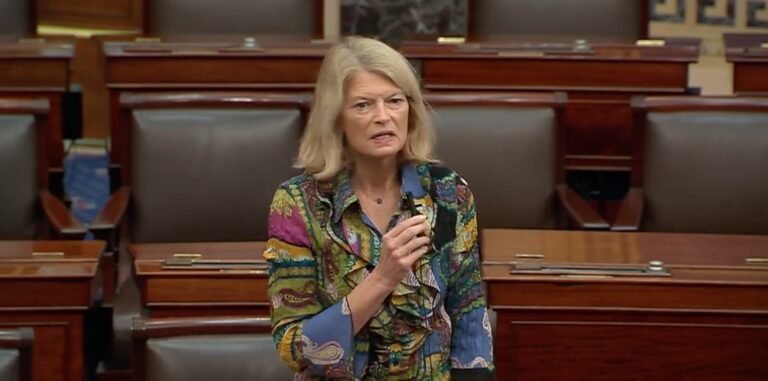
Earlier, Sen. Lisa Murkowski expressed frustration with her fellow Republicans for blocking the advancement of the bill on Wednesday over conservatives’ concerns for how the border section of the bill was worded and whether it would actually help secure the border or just guarantee a continuing crisis. She described herself as “pissed off.”
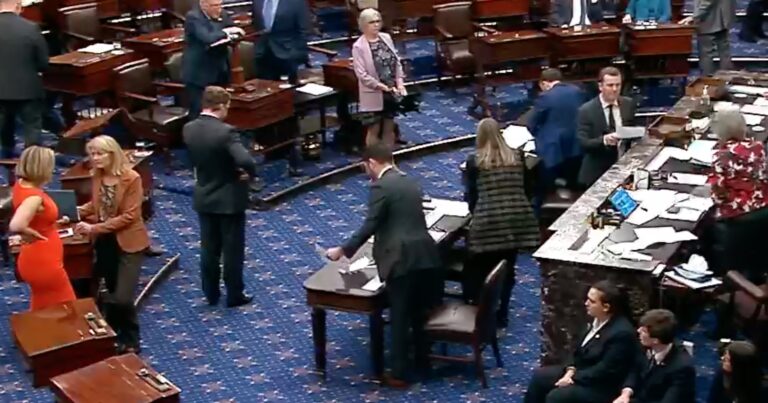
After hours of negotiation, the Senate voted just after noon on Thursday to keep the bill alive, 67-32. The majority of Senate Republicans opposed it, but during this round of voting, Sen. Dan Sullivan joined Lisa Murkowski in voting yes on a procedural motion that allows negotiations to continue.
The bill. now has $60.1 billion for Ukraine, $14.1 billion for Israel, and $10 billion in humanitarian aid for civilians being caught up in global conflicts.
Republicans are still negotiating to get meaningful border security back in the bill. This is a developing story and is likely to change rapidly.
Meanwhile, the White House has blamed Donald Trump and Republicans for the border crisis, and said Immigrations and Customs Enforcement agency will reduce deportations of illegal immigrants if the bill isn’t passed.
White House Press Secretary Karine Jean-Pierre told a gaggle of reporters that Republicans were “choosing partisan politics over our national security” because they do not support the bill.
“Here is what that means — ICE would be forced to reduce its removal operations, its total detention capacity, and more,” Jean-Pierre said. “When ICE can’t conduct these operations, our national security and public safety will be harmed.”
The response from conservative Sen. Marsha Blackburn of Tennessee was to the point: “Is Biden the President or a mobster? Attempting to shake down Republicans for a bad immigration bill won’t secure our southern border. It shows Biden can fix the problem that he created.”
Sen. Mike Lee of Utah called the White House statement “extortion.”
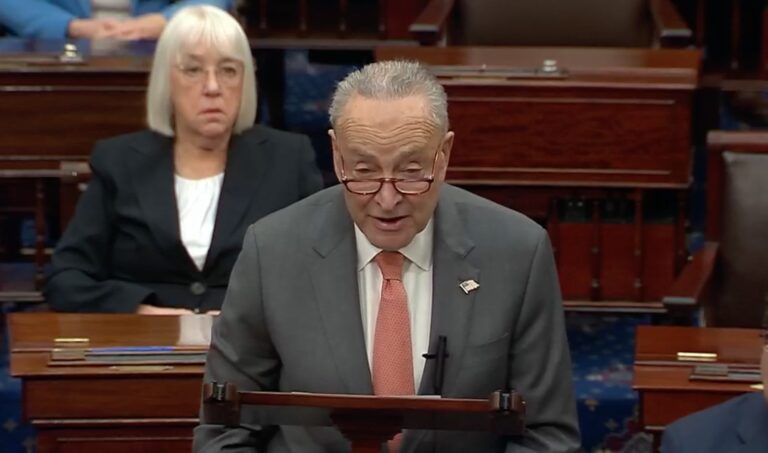
Senate Majority Leader Chuck Schumer, on the floor of the Senate, said, “We’re going to keep working on this bill until the job is done.”
Alaska Sen. Lisa Murkowski, one of four Republicans who voted in favor the massive Ukraine-Israel-Taiwan-border bill that failed on Wednesday, is having a hard time with her Republican colleagues who voted against it, presumably including Sen. Dan Sullivan, who was a “no” vote.
“I have a difficult time understanding again how anyone else in the future is going to want to be on that negotiating team — on anything — if we are going to be against it,” Murkowski told a CNN reporter.
“I’ve gone through the multiple stages of grief. Today I’m just pissed off,” Murkowski told reporter Manu Raju.
The bill failed in the Senate, even though Republican Sen. James Lankford of Oklahoma was one of the lead negotiators on behalf of the Republicans.
Murkowski lingered on the Senate floor during the hours-long vote, spending her time chatting with Sen. Krysten Sinema, the Arizona independent (formerly Democrat) who was one of the sponsors of the foreign aid package that would have provided $118 billion in taxpayer money for Israel, Ukraine, and Taiwan.
Just $20.2 billion was set aside for the border security that Americans have become so concerned about, but the language was concerning and appeared to actually set no real parameters for the Biden Administration in securing the border.
Credit: USA TODAY
As the vote appeared to be going against the bill, Sen. Sinema lashed out:
“If you want to continue to use the southern border as a backdrop for your political campaign, that’s fine, good luck to you,” she said. “But I have a very clear message for anyone using the southern border for staged political events: Don’t come to Arizona. Take your political theater to Texas. Do not bring it to my state.”
But conservatives have cautioned that the bill is a border sieve, allowing millions of illegals to come through unimpeded.
Liz Wheeler, host of the Liz Wheeler Show, wrote, “Hilarious coordinated narrative from all Democrats: ‘Republicans demanded a border bill & when we gave it to them, they killed it!’ No, you idiots. Conservatives demand border SECURITY. Your monstrosity of a bill allows ~2M illegals in every year, gives $60B to Ukraine (versus only $20B to the border), enables phony asylum claims, & allows Biden to stop a border shutdown if he wants to. THAT is not border security. That’s open borders & it’s dangerous.”
Vivek Ramaswamy, entrepreneur and former presidential candidate, said, “The first “border bill” allocated 3x more money to protect Ukraine’s border than our own. Now that failed, so they’re trying to push the same funding bill for Ukraine to while allocating ZERO to protect our border – which reveals what the whole game was about the 1st time anyway.”
Sen. Ted Cruz of Texas said, “Democrats kept their border bill text secret for four months because of the terrible provisions that don’t fix the border crisis. It would have normalized 1.8M illegal aliens per year, taxpayer-funded lawyers for illegals, and immediate work permits. This is why the bill was dead within 24 hours.”
Schumer just admitted that he threw in border provisions into the Ukraine bill because Republicans demanded it. But instead of working on a stand alone deal that could actually secure the border, their first pivot is to do a Ukraine stand alone vote—which has been their goal all… pic.twitter.com/1TL6u53iq9
“Since September, a revolving group of senators have been negotiating behind closed doors on a supplemental funding bill that would tie Ukraine, Israel, and Indo-Pacific aid to border security. For months, members of the Republican conference were asking for more clarity and detail on what was going to be included in the overly-hyped border deal. Claims made in various statements, leaks, and reports on the negotiations—which primarily involved Senators James Lankford of Oklahoma, Kyrsten Sinema of Arizona, and Chris Murphy of Connecticut—were wide ranging. One day, reports would claim talks were heating up or progress was being made. The next, negotiations were on ice and negotiators were at an impasse, particularly when it came to the president’s parole powers, which ultimately were not addressed in the final version of the bill.
“All of a sudden, negotiators dropped the full text of the bill like an atomic bomb on Capitol Hill. The final product spanned 370 pages and would cost American taxpayers $118.3 billion. Sixty of the $118.3 billion supplemental was directed towards supporting Ukraine. Another $14 billion was for aid to Israel, and $20 billion was to ostensibly secure the southern border,” Devlin writes.
Gov. Mike Dunleavy, who was a decades-long teacher and school superintendent before going into politics, pulled no punches at a press conference on Wednesday, telling reporters that Alaska has tried to fix its bad education system by increasing the base amount that school districts get from the state coffers per student, known as the BSA. And yet, school districts don’t respond with improved outcomes at neighborhoods schools.
The press conference was unusually long, running for an hour. The governor was unusually animated. Reporters asked about 20 questions in all, on things like Cook Inlet gas shortages and other topics. But Dunleavy’s heart was set on helping Alaska students, and that was clear from the outset.
“We’re deeply involved in an educational discussion right now, which personally I think is fantastic,” Dunleavy said, calling education one of the most crucial issues of our time. He described the urgency around education as feeling like “the last couple of days of the session,” presumably because of the intensity of the energy in the Capitol right now.
“And that’s the way it should feel, that we’re involved and we’re engaged in heavy-duty issues that I think can help Alaska, certainly can help our kids and help our teachers.”
Dunleavy has been pushing a bill he offered that has bonuses for teachers for up to $15,000, but the education industry is rejecting those bonuses and instead wants lump sum payments to districts to use however they want, in the form of a base student allocation increase.
That increase has been suggested by Democrats and education industry lobbyists at anywhere between $300 to $1,500 per student more than the current BSA, which gives districts $5,960 for each student. Districts also collect local taxes and get major support from the federal government, and spending on students in Alaska is over $20,000 per student per year.
Dunleavy turned his attention to charter schools and a recent Harvard study of these schools, which are part of the public school system, and are not private schools, as some education union members have characterized them.
“Unbeknownst to a lot of folks, because this is the first study that’s ever been done that measures outputs through the NAEP scores — lo and behold, we’re tops in the nation! You would think you’d hear parade music and people dancing in the streets,” Dunleavy said.
“But in some sectors, this has cause a problem because it doesn’t fit the narrative.”
Then, he verbally channeled the thinking of the education industry: “How could this be? How could Alaska be performing well? This is going to screw things up because we have our usual approach to education in Juneau: Don’t do much about it until the last couple of weeks. Turn up the heat. Declare it a disaster if a large sum of money is not deposited somewhere. And then once that happens, everything goes back to normal, things are good now.”
But things aren’t good, Dunleavy told the small band of reporters in the conference room on the third floor of the Capitol.
Part of the funding issue is that Alaska is in a demographic challenge — losing student population.
“We need more people. We need more kids. We need better performance … And I gotta tell you, for the life of me, I am stunned at this idea that you have the best performing charter schools in the world … Any moment I’ll be called to go talk somewhere nationally about our charter schools,” Dunleavy said.
But the educational establishment is trying to torpedo his education bill in favor of the fixed increase to school districts that education unions prefer.
In the end, Dunleavy said, if he just shoved money into the BSA, “I would be lauded as a hero.”
“But I didn’t run on that ticket … I didn’t knock on people’s doors and say ‘Hey this is Gov. Dunleavy, I’m running for governor and I want to give a ton of money to the educational establishment, and we’re not going to worry about your kids, they’ll be fine. I didn’t run on that.”
Dunleavy had held forth at the microphone for over 8 minutes, and was now reminding reporters that he has more educational experience than any other previous governor.
“In some corners that’s a problem. Why? Because I know education. I know it inside out. And I can tell you this, and I would bet my retirement: If you just put money in the BSA, there will be no change of performance. Because we’ve done that year after year,” he said.
It’s time to target to problems like getting more money to classroom teachers, and helping grow more charter schools.
“This idea that people are speaking on behalf of the parents, the teachers, and the kids of charter schools, that aren’t part of charter schools, [and saying] that charter schools are somehow a negative? That’s insane. We know we have performance issues in our neighborhood schools,” he said. “It’s not the parents’ fault. It’s not the kids fault. These schools have become politicized over the decades. It’s a fact,” he said, adding that if Alaskans want more charter schools, they should be able to have them.
The entire press conference can be viewed at this link:
The Anchorage School Board on Tuesday approved a one-year contract extension of Superintendent Jarrett Bryantt. The item was initially put on the “consent agenda,” so that it would automatically be swept through in a batch approval with a dozen other routine items, and a separate vote would not be required.
A consent agenda is a meeting tool used to streamline meetings by collecting routine, non-controversial items into a group, and all are passed with a single vote. Anything that is non-routine goes on the regular agenda.
Board President Margo Bellamy sets the agenda and would have had to know that she buried the controversial superintendent’s contract extension in a place on the agenda where the public would not be provided the opportunity to comment.
Board member Dave Donley asked that the item be pulled from the consent agenda and place on the regular agenda so members would at least have to vote on the contract extension.
Bryantt’s current contract doesn’t expire until June 30, 2025 — a year and a half from now. Why was the board in such a hurry to extend his contract?
When hired in 2022, Bryantt did not meet the minimum qualifications to be a superintendent. He had only two years of classroom teaching. In Alaska, three years are required by Alaska Administrative Code 4 AAC 12.345.
To get around meeting the minimum requirements, the Department of Education & Early Development issued Dr. Bryantt a Limited Type B certificate. This Limited certificate is only valid for two years. Bryantt must complete the Alaska studies and multicultural education if he wants his Limited Type B certificate extended.
Why didn’t the school board note this in the discussion of his contract extension? There was no public discussion at all on his contract extension and whether Bryantt had met the state requirements.
The board was forced to vote on the matter separately.
Voting “yes” were Bellamy, Andy Holleman, Dora Wilson, Kelly Lessens, Pat Higgins and Carl Jacobs.
Donley was the lone “no” vote.
The contract extension has a couple of notable errors. The contract extension memo states “The Superintendent shall be employed through June 30, 2026, subject to earlier termination of this agreement as set forth in Section 13 and any other provisions of the Employment Agreement”.
However, Section 13 covers indemnification, not termination. Section 12 addresses termination as noted in the contract extension.
Another error in the current contract is paragraph 8, “Mutual Obligation to Communicate”, states, “The Superintendent is also responsible for timely informing the Board or individual Board Members of any concerns shemay have about Superintendent/Board relations or Board Member conduct.” Note the pronoun “she.” It may be a cut-and-paste from the contract of the previous superintendent, Deena Bishop.
One of the board’s five stated values is accountability to the public: “The board believes the district should be open, transparent, and accountable to the public, ensuring a high-quality education while remaining fiscally responsible. Our budget, policies, guidelines, curriculum, and district performance data will be easily accessible (unless protected by law) and understandable. Parents will always have access to what their child is learning and how they are progressing. The district will promote strong community partnerships and public involvement.”
If the board is not proficient in transparency in hiring a superintendent, perhaps it will be proficient in student achievement at some point in the future.
Only 42% of Anchorage School District students are able to read proficiently at grade level, the second-lowest district in the nation. The district has a goal of reaching 80% proficiency in reading by 2026, according to goals set in 2020, but recent test scores show little progress toward that goal.
Bryantt, who made $250,000 a year at the time of his hiring, was brought into a district that spends over $19,000 per year per student, according to the ASD’s audited report at the time of his hire in 2022. His contract is now $280,000 plus an $8,400 auto allowance.
It was a “no” in the Senate on Wednesday to a massive Lernaean Hydra of a bill that would have provided weapons for Ukraine, aid to Israel, support to Taiwan, and a border package that many said was intentionally flawed in a way that would allow millions of illegals to continue to cross the border.
It started out as a border bill, but before it hit the Senate floor, there was something for everyone, including a $118 billion bill for American taxpayers.
The bill needed 60 votes to pass, but only received 49. Among the Republicans who voted for the bill was Sen. Lisa Murkowski of Alaska, along with the Republicans’ lead bill negotiator Sen. James Lankford of Oklahoma, Susan Collins of Maine, and Mitt Romney of Utah.
Some Democrats voted against it: Sens. Alex Padilla of California, Bob Menendez of New Jersey, Elizabeth Warren of Massachusetts, Ed Markey of Massachusetts, and Bernie Sanders, who is technically an independent, of Vermont.
Credit: USA TODAY
Sen. Dan Sullivan of Alaska issued a statement about the bill and why he voted against it.
“On day one, the Biden administration created this border crisis with their self-imposed open border policies,” Sen. Sullivan said. “In the last three years, Americans in all fifty states have felt the impacts of this administration’s decision to do nothing, month after month, year after year, as the crisis on our southern border quickly became the largest invasion of illegal aliens in American history. It is a humanitarian, health, and national security crisis of epic proportions. President Biden has refused to act and use the tools already at his disposal, and now, Senate Democrats have refused to force his hand.”
He said the time frame for evaluating the bill was inadequate for lawmakers.
“Despite the hard work of Senator Lankford, this bill appears to give broad discretion to the President, leaving open the possibility that President Biden will not secure the border as intended by this bill. Indeed, the last three years are strong evidence that he won’t,” he said.
Biden told reporters that it was Donald Trump’s fault that the bill didn’t pass.
It’s doubtful that the bill could have passed the House, where support for Ukraine is a contentious issue.
We are about five weeks from the Municipal Clerk (who works for the Assembly) mailing out ballots for the Anchorage Municipal Election in 2024. Voters will have until April 2 to return them for tabulation, so it is time to start considering candidates for mayor this year.
Mayor Dave Bronson completes his first term in office. He has nine challengers as of this writing. While I don’t want to discuss the entire field, I do want to mention a couple Democrats running this time around.
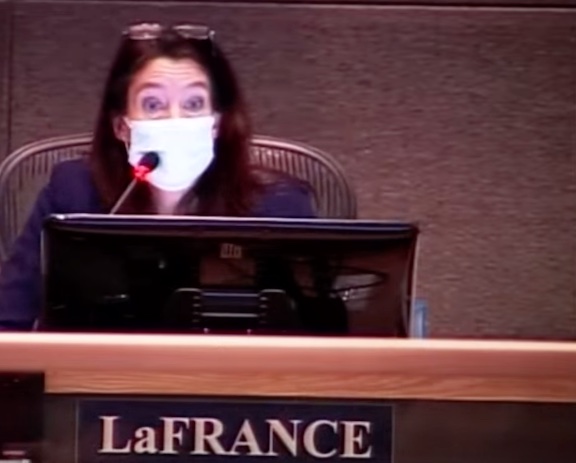
The two democrats with the best name recognition are former legislator Chris Tuck and former Assembly Member Suzanne LaFrance (who is technically independent). Both have strong union support. Both present well and are not publicly the typical frothing at the mouth Democrat we’ve come to know and love in recent years (Forrest Dunbar, Zack Fields, Chris Constant, you know who you are).
But any time we elect a seemingly moderate Democrat, awful things seem to happen. Our last Democrat mayor, Ethan Berkowitz, was one such example, needlessly locking down Anchorage for over a year, forcing mask mandates, social distancing, presiding over the wanton, senseless destruction of small businesses across town during that time, creating the current Homeless Industrial Complex, and spending as much money as humanly possible, all before resigning in disgrace over a sexual peccadillo that went public.
What has Suzanne LaFrance done to demonstrate that she would be a decent mayor? As with any political question, it all depends on which side of the political divide you are working. While on the Assembly, she did very little outside showing up for the meetings and being a reliable leftist vote until installed asAssembly chair in 2021.
LaFrance distinguished herself three ways during her two years as Assembly chair. She presided over contentious public comments triggered by the shutdown and attempts to put homeless shelters in residential neighborhoods. She also spent a lot of time conferring with her vice chair at the time, Chris Constant.
Public pushback against the Berkowitz hunker-down and masking mandates was significant and grew over time, especially when it became apparent that the public was simply being told to sit down, shut up and color.
Small businesses in town were particularly hard hit (Kriner’s Diner became a flashpoint), something of little matter to the union-backed Democrats supporting Berkowitz and his Assembly majority.
One of the few ways available to express that displeasure was public comments at Assembly meetings. The Assembly majority wasn’t much interested in public testimony that called them out and the Assembly took every avenue to limit or eliminate it. Assembly Chair LaFrance, in consultation with her vice chair, spent a lot of effort obstructing public testimony so they wouldn’t have to hear any or it.
The Berkowitz-Assembly effort to install a number of homeless shelters in various neighborhoods also triggered significant public pushback which expressed itself as very contentious comments by the public at numerous Assembly meetings, and two unsuccessful recall attempts for Assembly members. LaFrance and her majority weren’t much interested in this sort of feedback and did everything they could to make sure they didn’t have to hear it.
Somehow, it never occurred to LaFrance, her majority, or Mayor Berkowitz that if you don’t want the public to yell at you, don’t intentionally do what they don’t want you to do. What a concept.
Most notable during her time as Assembly Chair was LaFrance’s endless consulting her Vice Chair during meetings, particularly before ruling on anything. It gave the impression that she was not Assembly Chair at all. Rather, she appeared to be a conduit, a “Mini Me,” for whatever Chris Constant wanted her to do at the time.
From here, it looks like the Assembly majority and the unions that installed it are attempting to use LaFrance as their vehicle to regain control of the Hill Building. As her political career has paralleled that of Peter Sellers’ Chauncey Gardner character in Being There, I predict she would bring little to the office other than another compliant Democrat at the beck and call of the Assembly and the unions that put them in office.
If you want an actual mayor, there are a few good candidates this time around, starting with the current one, Dave Bronson. If you want a potted plant in office, Suzanne LaFrance would be a good, albeit expensive, choice.
Alex Gimarc lives in Anchorage since retiring from the military in 1997. His interests include science and technology, environment, energy, economics, military affairs, fishing and disabilities policies. His weekly column “Interesting Items” is a summary of news stories with substantive Alaska-themed topics. He was a small business owner and Information Technology professional.A