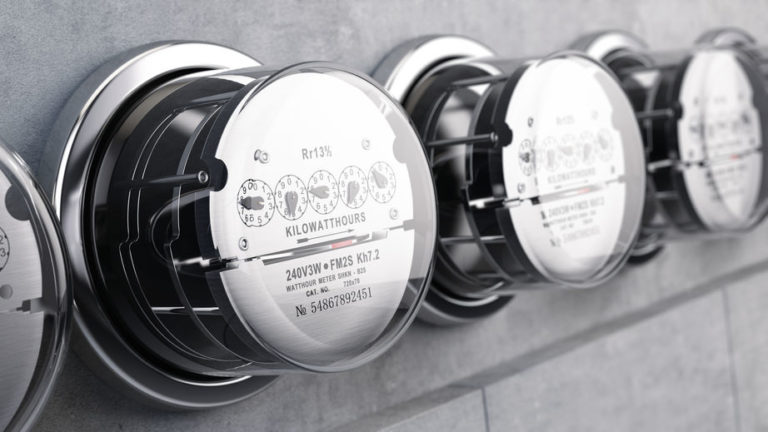
Senate Bill 101 and House Bill 121, left over from last year are again being touted by those who want to rush into adoption of renewable energy sources whether the Railbelt can properly accommodate them or not.
Until there is a real plan for the modification of the Railbelt energy system, a RPS (Renewable Portfolio Standard) will be of no practical value, and in fact would be quite harmful to the ratepayers for the Railbelt utilities. There needs to be a plan for moving forward and not just some scenarios of possibilities, but with some specific plans for the replacement base source of energy and the particular long term energy storage that would provide storage for all the excess renewable energy generated.
In consideration of possible energy storage for excess renewable energy, I have been following various studies and reports concerning the Eklutna Lake Hydroelectric project over the last five or six years. I attended one of the recent hearings about the Elune Lake project and was greatly disappointed that no effort was given to the idea put forth by Kerry Williams for the Eklutna Complex to be a Rechargeable Battery, (a hydraulic battery).
Kerry Williams and his co-authors, Ceal Smith and Bretwood Higman, published a report (Feb 3, 2020) at the request of Gov. Mike Dunleavy, entitled “Pumped Energy Storage for Alaska.” When I enquired about how the report and concept of the Eklutna complex was accepted, I was told that it was too expensive and there was no current renewable source to run the pump, so it was given no real consideration.
In my opinion, the Eklutna Lake complex is a much more positive incentive than Susitna Dam could ever be. The Eklutna project could begin storage excess wind and solar energy no matter where on the Railbelt system it might be generated. This would provide good incentive for further wind and solar installation.
The authors of the report laid out a plan so that it would be a four-part project, so that the full expense did not have to be made at the front end of the project. It should not have to be considered as too expensive, just to study how it could be fit into the overall energy plan for the State. One of the benefits of the proposal is that Eklutna Lake would be able to maintain a higher level than it does now as it would be filled from below by the pump. This might allow the salmon to return to Eklutna Lake, a consideration definitely worth looking at.
Looking at costs, converting the existing system to pumped energy storage was estimated to be $29 million. This first step would be necessary to allow excess renewables to immediately be saved for use much later. The estimate for the total conversion of Eklutna Lake and the upper lakes to form a pumped energy storage complex was $855 million. Such an investment in long term energy storage would go a long way to provide encouragement to private sector IPP (Independent Power Producers) to install more wind and solar farms. With this positive motivation, there should be no need to resort to mandates (such as the Renewable Portfolio Standard), and fines and extra rates for exceeding demand limits. The study also included two more proposed pumped energy storage facilities, which would add another 300 megawatts to the Eklutna Complex power.
The capacity of the Eklutna Complex was estimated to be 426 MW power and 507 GWh energy storage. This would be an excellent start to a long term energy plan, and might have been the easy way to get salmon back into Eklutna Lake. There are currently plans for more than 300 MW of wind and solar energy projects in the near future, so with such progress in the works why do we need the Renewable Portfolio Standard?
So as we develop our long term energy plan, the first two things that need to be done are 1) Secure future Cook Inlet natural gas production and distribution and 2) Get a start on pumped hydro installation. These steps will help secure our energy reliability and resilience, and allow proper engineering for whatever the future Railbelt system needs to be. Encourage you legislators to find solutions to our Cook Inlet gas supply problem and to resist entanglement with an Renewable Portfolio Standard for our Railbelt electrical utility.
Robert Seitz, PE, is an Electrical Engineer and lifelong Alaskan.
On May 31, 2023, I wrote a commentary emphasizing the need for more public notice when the Anchorage School Board takes major spending actions. I am again calling for more transparency from the school board.
Months ago, the school board leadership decided to change the way meeting minutes are prepared. They suggested going to “action minutes” to reduce the burden on the board’s secretary. In the future, only “actions” would be mentioned in the minutes. This seemed like a reasonable idea at the time. However, the board majority’s definition of an “action” differs from the common meaning of the word.
It was recently announced that from now on only motions that are seconded will be recorded in the minutes. This is problematic because having a complete public record of what happens at school board meetings is vital. Many times, extremely significant motions die from the lack of a second member voting in support. During the past six years, dozens of my budget amendments to reduce administrative spending have died for want of a second. Amendments I have offered to protect parents’ rights have also failed this way. From now on, it will appear in the minutes as if these types of actions never occurred.
The Anchorage School Board uses Robert’s Rules of Order regarding meetings. The Robert’s Rules Association is the nationally recognized interpreter of RRO. On the Robert’s Rules Association’s website, Interpretation 2006-7 states:
Question: It is my understanding that a main motion that dies for lack of a second is not to be recorded in the minutes because it never really came before the assembly and, therefore, need not be recorded. Is this correct?
Answer: No, it is not correct. Under the rule as stated in (Robert’s Rules of Order Newly Revised), on page 452, lines 21 to 23, minutes should record all main motions except, normally, any that were withdrawn.
Interpretation 2006-7 goes on to explain that:
We tried to state it a bit more forcefully in (Robert’s Rules of Order Newly Revised In Brief) where, on page 148, we said:
“All main motions which are moved during the course of a meeting (excepting only those which are withdrawn by the maker) should be recorded in the minutes.”
William J. Puette, Ph.D., Professional Registered Parliamentarian, states on his website that minutes should include: “all main motions (10) or motions to bring a main question again before the assembly (6:25–27; 34–37) that were made or taken up — except, normally, any that were withdrawn.”
Even “Robert’s Rules for Dummies” states that minutes should include: “All main motions (except ones that are withdrawn), along with the name of the member making the motion.”
In the past, the Anchorage School Board has used a Seattle-based group to help interpret Roberts Rules of Order. That group conflicts with the nationally recognized experts and believes unseconded motions do not need to be shown in minutes if the organization decides, but adds that to do so requires a vote by a two-thirds majority to not follow RRO. But according to a recent search, no such official vote is in the records of the Anchorage School Board.
The Fairbanks, Juneau, Ketchikan, Mat-Su, Sitka, and Kenai Peninsula school boards all record unseconded motions in their minutes. I have been advised that the Alaska Association of School Boards (AASB) may suggest other boards follow the Anchorage example. But in a recent conversation, a representative of the AASB denied that.
In fairness to the school board, I have learned that the Anchorage Assembly also does not record motions that die without a second. But there are important distinctions between the two bodies. The Assembly has 12 members elected from districts, while the school board has only seven members elected citywide. Failing to record motions by a member, only because they are not seconded, can seriously distort the record. This effectively disenfranchises one-seventh of the Board and the people who voted for them.
In fact, some Roberts Rules of Order experts opine that smaller boards of less than 12, should not even require a second for motions. A seven-member board is considered just large enough to possibly require a motion to be seconded. The danger of requiring a second on a small board is obvious — if there is a political imbalance you can effectively shut out a minority opinion.
The only justification I have heard articulated as to why seconded substantive motions should not be recorded in the minutes has been that people can watch the meetings on YouTube. Does that surpass the importance of a complete and fair written public record? The voters deserve to have an accurate historical record of the actions their elected school board members took.
Of additional concern is that as of Feb. 1, the November and Oct. 17, 2023, board meetings were not available on YouTube. The Dec. 5 meeting was a partial recording of the work session that day. The Oct. 17 meeting forced the viewer to wait through more than four minutes of commercials to access an incomplete recording of not the meeting, but instead the work session for that day. Most of these deficiencies have now been corrected, but clearly, relying on YouTube is failing to adequately provide a reliable official record.
At the Dec. 19, 2023, meeting, I moved to amend the Nov. 21, 2023, meeting minutes, to include two amendments I offered to the upcoming April 2024 bond proposition. One was to reduce the bonds by more than $19 million. The other was to ensure full information was provided to the voters about the cost of the new Inlet View Elementary School.
Unfortunately, my motion to include these amendments in the minutes and the debate regarding it will not be recorded in the minutes because they failed without a second.
Former Alaska Sen. Dave Donleyis a lifelong Anchorage resident who served 16 years in the Alaska Legislature. The father of twins in the Anchorage School District, this is his third and final term on the Anchorage School Board. He writes this as a member of the Anchorage School Board, not on behalf of or intended to represent the School Board or the Anchorage School District.
Sen. Jesse Kiehl complimented Gov. Mike Dunleavy on his teachers’ bonus bill and thinks it is doable, if Dunleavy was open to a couple of tweaks.
The bill, a pilot program that would pay teachers bonuses of up to $15,000 a year, is something Dunleavy sees as an investment in the classrooms across Alaska. Some education leaders say they would rather have a per-student investment in the form of “base student allocation” money.
Kiehl says he understands the conservatives’ perspective as it relates to more money for districts, without accompanying accountability. As an example, someone in the Juneau schools misappropriated money (and was fired subsequently).
This new episode of the Must Read Alaska Show with host John Quick features an in-depth conversation with Sen. Kiehl, shedding light on the distinctive role and experiences of representing Alaska’s capital city, Senate Seat Q, which also covers the northern half of Southeast Alaska, including communities of Haines, Gustavus, Klukwan, and Skagway.
Kiehl discusses the unique challenges and advantages of serving in a location only accessible by air and sea, emphasizing the importance of the Alaska Marine Highway for connectivity.
Sen. Kiehl outlines his key objectives for the legislative session, and elaborates on the urgency of enhancing Alaska’s energy infrastructure. The conversation also covers Juneau’s path to tourism resurgence post-pandemic, particularly the impact of the absence and return of cruise ships on the local economy.
This dialogue offers a look into Sen. Kiehl’s legislative priorities, the intricacies of governing Alaska’s capital, and the broader implications for the state’s future.
Gov. Mike Dunleavy issued an administrative order on Monday prohibiting state contracts with entities that support or participate in boycotts against the Jewish state of Israel. The order asserts the State of Alaska’s commitment to its longstanding relationship with Israel and its stance against discrimination based on ethnicity, religion, race, or nationality.
The order begins with a preamble outlining the close ties between the State of Alaska and Israel, emphasizing their mutually beneficial relationship. Dunleavy highlights that Alaska will not condone any actions that seek to boycott or isolate Israel economically or socially, citing such actions as discriminatory and against the values of the state.
The State of Alaska “has a longstanding and broad policy to refrain from contracting with business entities that unlawfully discriminate in the solicitation, selection, hiring, or treatment of its employees or customers,” the order reads.
The administrative order mandates that all future contracts entered into or approved by the State of Alaska or its public agencies must include a provision stating that support or participation in a boycott of Israel will be grounds for termination of the contract. Additionally, any requests for information, proposals, bids, or similar requests related to contracts must include a provision disqualifying any entity found to support or participate in an Israel boycott from participating in the procurement process.
However, the order provides exemptions for contracts with entities employing fewer than 10 people or contracts with a value less than $100,000. It also assigns responsibility for implementing the order to the commissioners of Administration and Transportation and Public Facilities.
The order defines “person” as any organization, business, association, corporation, or entity, excluding natural persons. It clarifies that “public agency” refers to various administrative units of the executive branch of state government, excluding specified entities such as the University of Alaska and the Alaska Railroad Corporation.
Dunleavy’s order asserts that if any provision of the order conflicts with existing state, federal, or local anti-discrimination laws, those laws will take precedence.
This administrative order, effective immediately upon issuance, signals Alaska’s unwavering support for Israel and its commitment to combatting discrimination. It aligns with similar measures adopted by other states in support of Israel and against the Boycott, Divestment, and Sanctions (BDS) movement.
For our republic to survive, it must be sustained by free and fair elections. This means our elections must be transparent and verifiable—auditable by the loser. The voters must have confidence in our election system, or they give up and don’t vote.
Unlike despotic regimes that hold onto power through sham elections and imprisonment of their adversaries, Americans do not have to take up arms to force a change in leadership. How lucky we are to live in a democracy. But sadly, the USA is quickly sliding farther down this slippery slope than I’ve ever imagined we could.
Thomas Jefferson said, “The tree of liberty must be refreshed from time to time with the blood of patriots and tyrants.” While he lived in different times, the foundation of liberty in a free republic is the right to elect our representatives freely and fairly. An open and transparent election system is the only way we can guarantee a change in leadership without chaos or anarchy.
The invasion of the southern border is tearing our country apart, but it’s not a battle over immigration–it’s about “stuffing the ballot box.” It’s not about race, or privilege or moral duty to comfort the hungry. These are media memes. It’s all about power and winning elections by stacking the deck.
The Democrats clearly favor having 20 million illegal aliens voting in our country. Their strategy is to loosen voting laws to the point where anyone can register the same day to vote, without an ID, with no proof of residency or even citizenship. If their party cannot win the hearts and minds of Americans with their policies, then their plan is to qualify strangers to vote.
Democrats call voter ID requirements “racist” and “voter suppression” but in truth these safeguards secure the opposite result. Why? Because preserving democracy and freedom puts an end to these evils, while free flowing borders do not. Laws that strengthen election integrity secure the rights of every person, regardless of race–provided they are a U.S. citizen. The Democrat’s objectives of loosening voter ID laws and promoting same-day registration thus undermine true democracy.
In this legislative session, watch what Democrats do, not what they say. They will have pre-drafted amendments ready to attach in “Christmas tree” fashion on any moving election legislation. Astute legislators must be alert to “poison pills” or intent-altering language that is slipped into bills outside the public view. Such tactics allow Democrats to proclaim: “I voted for election reform” when in fact they voted to kill it.
What will ultimately save us from these shenanigans is to restore integrity to our election laws, which will increase voter confidence that their vote counts. Artificial Intelligence (AI) is a looming threat that few can fully comprehend. It would be an interesting question to ask AI: “How can I cheat utilizing Alaska election laws?” I think I know at least some of the answers.
What safeguards exist to authenticate a voter’s ID before electronic absentee voting? Answer: the same compromised security identifiers that are now in the possession of hackers. Why do hackers want to steal election security identifiers?
The only plausible answer: to steal an election. What is an election worth to certain political elites? Answer: As much as their power can yield.
Former Rep. Gabrielle LeDoux’s delayed trial accusations are child’s play compared to potentially thousands of inactive voters having their ballots stolen. Meanwhile, the Division of Elections’ response has been lackluster.
Voter rolls contain confidential personal data for most Alaskans, including security identifiers which are used by the Division of Elections to confirm that a voter is who they claim to be. On Dec 3, 2020, one month after the November election, Lt. Gov. Meyer disclosed that the Division’s voter data had been hacked a month before the prior election. Rank choice voting was polling “neck to neck” a month before the election. Inexplicably, he withheld disclosing it until one month after the election.
Concurrently, the Department of Administration wrote a white paper with 18 recommendations for improving our elections system. To-date, the only copy publicly available of this document has redacted all 18 recommendations. Why? The report may have pointed out that a bad actor, armed with the hacked voter security identifiers, could have easily applied on-line for absentee ballots using the identity of inactive voters. The public deserves to see this report.
We know from tight races in our state that voter fraud, applied strategically, can change the outcome of an election—and the balance of power in the Legislature, or with a ballot initiative. The risk of being discovered is low, and the potential reward is great; thus, the incentive to cheat is high. With unlimited dark money underwriting many Alaska issues, do you think we might have a problem? One could plausibly contract with a foreign firm to aid in such efforts, keeping prosecution out of reach.
Here are Ogan’s Election Integrity Recommendations, based on the principle of,“making it easy to vote, but hard to cheat.”The lieutenant governor can implement these changes administratively but to-date has not, leaving the ball squarely in the Legislature’s court.
– Employ best practices to clean up voter rolls and to purge inactive voters to the greatest extent allowed by federal law.
– Create a separate voter roll for US citizens entitled to vote in a presidential election but are no longer eligible to vote in local elections. Currently all are on one list.
– Tighten the weak domicile provision that allows too many non- residents to vote illegally and to remain on the rolls indefinitely.
– Adopt ballot chain of custody protocols. Account for every ballot that goes out to make sure all ballots come back.
– Utilize a water mark or unique identifier to eliminate counterfeit ballots.
– Set up a cross-check system of intra and interstate databases.
– Follow the Public Interest Legal Foundation’s best practice election security protocol recommendations.
– Scrap the compromised Division of Elections security identifier system and replace it with a modern Multi-Factor Authentication system. Virtually every business uses MFA and many citizens utilize it.
– Utilize non-proprietary open-source voting hardware and software. Proprietary systems like Dominion prevent a full forensic audit. They undermine voter confidence, and at worst, hide digital manipulation.
– Maintain redundant electronic and paper ballots to cross-check electronic tabulators. Do not go to “paper only” ballots.
Statutory Changes Requiring Legislative Action:
– Absentee ballots are the preferred tool of the fraudster (One reason they have increased). Limit absentee voting in state elections to only cases of valid hardship.
– Disallow party affiliation on the outside of absentee ballot envelopes.
– Strengthen the worthless verification signature on absentee ballots. Copy the signature verification process for PFDs by requiring a known, verifiable second signature, with criminal penalties for violations.
– When applying for a PFD, change the automatic voter registration to opt-in, rather than opt-out.
– Require a positive government ID for every voter.
– Eliminate weak ID provisions like presenting a utility bill, or “someone known to an election worker.”
– Tighten ballot harvesting rules. Two dangers of ballot harvesting are counterfeit ballots and disposal of ballots.
– Incorporate electronic ballot tracking and minor error correction as an opt-in. If we can track your pizza or your Amazon package, why not ballots? This reduces fraud and uncounted ballots.
– Say no to signature verification. It’s expensive and unreliable. Instead, implement Multi Factor Verification. 100% accurate.
– Create an election fraud unit within the Department of Law, with fraud detection and prevention investigators. Possible via executive order.
– Avoid mail-out ballots at all cost. They openly invite fraud.
My synopsis of election bills:
HB 37 (Schrage) – A bad bill that reflects the Democrats’ insistence on same day voter registration—a “sound bite” argument used by Democrats as a poison pill because they really don’t want reform. This bill also codifies a very time consuming, inaccurate, expensive voter signature verification process but ignores Multi Factor Authentication (MFA) as a 100% effective verification system.
HB 129 (House Judiciary, Vance) – A good bill that requires the Alaska DOE to improve voter rolls, and to verify voter identity and registration, pursuant to a third-party complaint or tip that a person may not be eligible to vote.
HB 130 (House Judiciary, Vance) – A great bill that creates a felony charge for “election fraud” applying to anyone attempting to alter the outcome of an election by interfering with the results. Anyone caught hacking electronic equipment or opening an absentee ballot without approval would be prosecuted.
HB 131 (House Judiciary, Vance) –A good bill that will restore confidence in our elections by utilizing open-sourced, nonproprietary election tabulation equipment. Say “Goodbye” to Dominion.
HB 132 (House Judiciary, Vance) –A good bill that should gather bi-partisan support for its ballot curing provisions, which will allow voters to fix technical errors so their vote is not arbitrarily disqualified, and it implements electronic tracking.
HB 210 (Eastman) – A well-intended but unnecessary bill mandating that voting machines must be USA built. The solution of open-source tabulators and computers makes this moot, but if proprietary closed-source voting machines continue, it’s a good precaution.
SB 1 (Shower) – A great bill because it requires the Division of Elections to incorporate best practice chain of custody protocols and codifies ballot tracking and curing. It also creates a voter fraud hotline so citizens can immediately report suspected irregularities.
SB 5 (Shower) – A great bill because it requires the Division of Elections to canvass registered voters to see if they still want to be registered and increases voter roll maintenance protocols.
SB 6 (Shower) – A great bill because it scraps Dominion voting machines in favor of non-proprietary open-source vote tabulator systems.
SB 7 (Shower) – A great bill because it increases penalties for unauthorized tampering with voting machines or ballots.
SB 138 (Senate State Affairs, Kawasaki) – A bad bill that attempts to accomplish too many things, so consequently it’s easy to hide last minute changes and “poison pills.” It merges many of Senator Shower’s common-sense proposals with troubling provisions like drop boxes, same day voter registration, loose residency confirming provisions, no tightening of voter ID provisions, and promotes expensive and inaccurate signature verification.
Scott Ogan served in the Alaska State House of Representatives and Senate and was a senior policy advisor for Sen. Mike Shower.
Power The Future took legal action against the Biden Administration over its refusal to disclose public information surrounding the office of former Climate Czar John Kerry.
The Freedom of Information lawsuit, filed in the Washington, D.C. U.S. District Court, outlines the Biden Administration’s numerous failures to disclose names of people who work in the Biden climate office and their titles.
Since he was appointed to the position three years ago and up until he stepped down last month, John Kerry continually withheld this information from the public and Congress, claiming that he only reports to President Joe Biden. In other words, the public doesn’t have a right to know who is working in the climate office.
“For nearly three years, John Kerry has been jet-setting on the international climate conference circuit while sending taxpayers the bill,” said Power The Future’s Founder and Executive Director Daniel Turner. “Today, we begin the process of teaching John Kerry and Joe Biden that they work for the taxpayers. No one should have to waste resources on litigation, but that is our only option since John Kerry thinks he can keep his office off the books. The American people are on the receiving end of countless green mandates and rules, gas stove bans and skyrocketing utility bills, with no opportunity for consent or input, and many of these decisions are hatched in John Kerry’s office. That is why it is our hope that this litigation will finally bring to light the information we deserve to know: the staff names, the office goals and budgets, the outside partnerships that peddle influence on Joe Biden’s green agenda.”
Less than a year ago, members of Congress threatened to subpoena Kerry for refusing to disclose basic information.
The Boston Herald has reported it was able to extract some information through a Freedom of Information Act request, and it shows Kerry’s staff, including policy analysts and senior advisors, cost the taxpayer’s $4.3 million a year, with some making as much as $186,680 per year.
Last month, Kerry announced he would soon be leaving the administration in order help tell the climate story in the context of Biden’s campaign for reelection.
Power The Future’s entire court filing against the Biden Administration can be found here.
According to a breathless report in the New York Times, Republican National Committee Chairwoman Ronna McDaniel will resign from the party after the South Carolina Republican primary, which is scheduled for Feb. 24.
The newspaper cited as sources “two people familiar with the plans.”
A new election would need to take place, with those same sources saying that former President Donald Trump is backing North Carolina Republican Party Chairman Michael Whatley to ascend to lead the RNC.
McDaniel is blamed by some party members for uninspired leadership and underwhelming fundraising. She was held to account for not being able to restore the Senate to Republican control in 2020, and for various mid-term election disappointments. Losing the White House to Joe Biden in 2020 also came under her watch. Fundraising has been lackluster.
The Washington Post reports that the discussion she was said to have with Trump is just that — a discussion, and no decision has been made about her stepping down.
“Mr. Trump likes Mr. Whatley for one overwhelming reason, according to people who have discussed him with the former president: He is ‘a stop the steal guy, as one of the people described him. He endorses Mr. Trump’s false claims about mass voter fraud and Mr. Trump believes he did a good job delivering North Carolina, a 2020 swing state, to him,” the New York Times reported.
Whatley is from conservative Gaston County, and is running for reelection as North Carolina State Party Chairman.
“With the help of Republican activists all across our great State, we can deliver the votes in North Carolina to elect a Republican President, expand our majorities on the NC Supreme Court, protect our supermajorities in the legislature and elect a Republican Governor in 2024,” he writes on his website.
In 2023, McDaniel won her fourth term as party chairwoman. She was first elected in 2017 with Trump’s support.
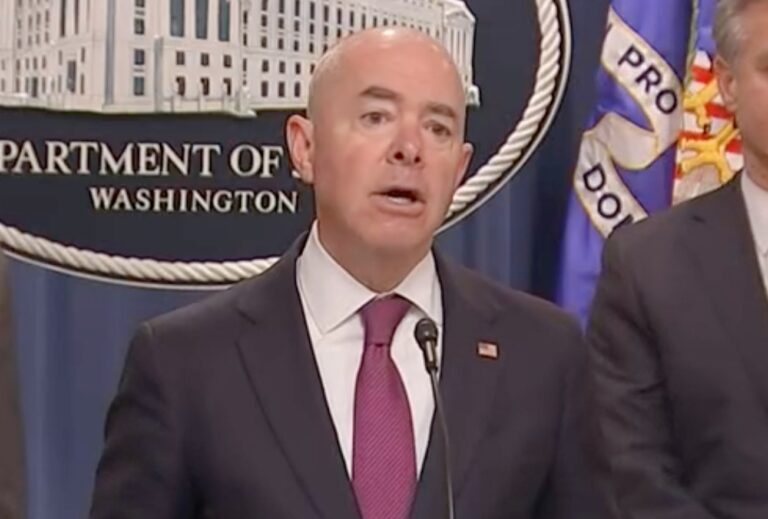
Alaska Rep. Mary Peltola voted with all Democrats and four breakaway Republicans against the impeachment of Alejandro Nicholas Mayorkas, Secretary of Homeland Security, for high crimes and misdemeanors relating to his refusal to enforce security at the southern border, where thousands of illegal immigrants have poured through daily since President Joe Biden took office.
During one period in December, over 10,000 illegals surged through the border from Mexico, although some are from other countries, including those that export terrorists.
Normally, a measure of that magnitude in Congress would not reach the floor for a vote unless the Speaker had counted how many votes were in hand. But Speaker Mike Johnson came up short: On a vote of 216-214, the impeachment went down.
America is experiencing the worst border crisis in its 248-year history, with Biden and his Homeland Security secretary seemingly intent on bringing in a record number of undocumented and unaccounted-for aliens.
Peltola had the chance to fire Mayorkas, but voted to save Biden the embarrassment in an election year, said the NRCC, a Republican congressional organization.
“Mary Peltola cares more about saving Joe Biden’s Secretary of Open Borders than securing Alaskans and Americans’ safety from terrorists, fentanyl traffickers and criminal illegal immigrants. This is just the latest extreme, anti-border security vote from Peltola,” said NRCC Spokesperson Ben Petersen.
The four Republicans who voted against impeachment were Rep. Tom McClintock of California, Rep. Ken Buck of Colorado, Rep. Mike Gallagher of Wisconsin, and Rep. Blake Moore of Utah.
The vote may come up again on Wednesday, when Rep. Steve Scalise returns; he has been undergoing cancer treatment.
Here is the National Transportation Safety Board’s preliminary report on the Boeing 737-9 MAX aircraft that lost its door plug at 16,000 feet over Portland on Jan. 5, 2024: