Friday, August 14, 2026
Home Blog Page 512

Sullivan explains vote on Ukraine aid package: Due to Biden Administration, we live in dangerous times of dictators and despots

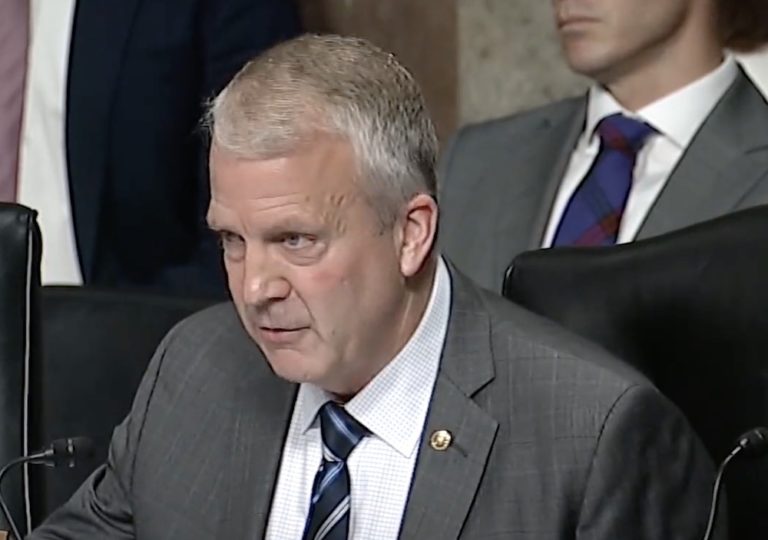
U.S. Sen. Dan Sullivan of Alaska explained why he voted in favor of the nearly $100 billion aid package to Ukraine, Israel, and Taiwan, reminding his fellow Alaskans of the despots who are causing wars to pop up around the glob:

“The United States is in one of the most dangerous periods since World War II,” Sullivan said. “Authoritarian dictators—Xi Jinping, Vladimir Putin and the Ayatollahs in Iran—are on the march and working together across the globe to weaken and challenge America’s national security and that of our allies. Our ability to defend our nation has dramatically atrophied due to the Biden administration’s lack of seriousness on national security issues and America’s declining capacity to produce weapons.

Sullivan noted that the primary focus of the aid package is to enhance America’s industrial capacity to build weapons systems and produce ammunition.

“This has to be our number one priority during these dangerous times. Tens of billions of dollars will go to our country’s capacity to rapidly produce an entire array of weapons—everything from nuclear submarines to 155-millimeter artillery rounds,” he said.

“That’s why I believe this bill should be called the ‘Revitalizing America’s Defense Industrial Base’ supplemental. Helping our allies defeat unprovoked authoritarian aggression by providing them much-needed weapons and intelligence is also critical. The citizens of Israel, Taiwan, and Ukraine all face true existential threats posed by dictators that want to crush them,” Sullivan said.

“I was heartened to see 70 U.S. senators come together to support this important legislation that will bolster our defense industrial base, create thousands of good-paying jobs, and help America and our allies deter authoritarian aggression and, if necessary, fight and win wars,” Sullivan said.

Whether the measure will pass the U.S. House of Representatives is another matter. Speaker Mike Johnson of Louisiana has rejected the Senate proposal.

Alaska Sen. Lisa Murkowski urged the House to vote in favor of the bill.

“Today the Senate delivered an important message to our allies around the world – you can count on the United States. With the Senate’s support of this comprehensive national security bill crafted through months of bipartisan negotiation, our allies in Ukraine, Israel, and Taiwan will be one step closer to receiving much needed and overdue support. It is also an investment in U.S. military readiness in an increasingly chaotic world. There is a military saying that ‘The only thing more expensive than deterrence is actually fighting a war.’ I urge the House to carefully consider this package as a strong deterrence to our enemies in Russia, Iran, and China. If we are to preserve freedom both home and abroad, the time to act is now,” she said.


Senate passes nearly $100 billion in aid for Ukraine, Israel, Taiwan, but carves out border funding

By CASEY HARPER | THE CENTER SQUARE

The U.S. Senate passed a $95 billion foreign aid bill for Ukraine, Israel and Taiwan after days of delay from Republicans who did not want to pass the funding without provisions to secure the southern border.

The legislation passed early Tuesday morning after a filibuster largely led by U.S. Sen. Rand Paul, R-Ky., ended.

Now the legislation goes to the House, where it remains unclear if they can get the votes.

“This morning the ‘America Last’ caucus got a $61 billion aid package out of the Senate. But they paid dearly for this small win. The House won’t pass the current bill,” Sen. J.D. Vance, R-Ohio, wrote on X, formerly known as Twitter, Tuesday morning. “We must fix our country before devoting more resources to Ukraine. That’s our message, and the fight goes on.”

The bill includes $60 billion for Ukraine, about $14 billion for Israel and roughly $4 billion for the Indo-Pacific region, which will help Taiwan, a small but economically important island experts fear could be invaded by China at any time.

The bill also includes about $9 billion in humanitarian aid, much of it for Gaza. Republican critics of the bill were vocal after its passage, but it will likely have broad Democratic support, meaning only a portion of House Republicans will have to defect. President Joe Biden is expected to sign the bill if it makes it to his desk.

“Borrowing money from China to give it to Ukraine, at rising interest rates, does not make America stronger,” U.S. Rep. Matt Gaetz, R-Fla., wrote online. “I can’t even believe I have to say this.”

Ukrainian leader Volodymyr Zelensky thanked the U.S for its support online Tuesday morning.

“The decision by the United States Senate to continue the support for our country and our warriors has been anticipated not only by us, but also by many other nations, particularly those in Europe,” Zelensky wrote on X. “The world is looking for American leadership to remain steadfast, help protect lives, and preserve freedom. “This truly contributes to confidence and motivation.”

Republican senators were nearly split in half on the vote, half in favor and half opposed. Both senators from Alaska voted in favor of the bill.

“In the early morning when nobody was watching, the Senate voted to plow another $60 billion of your money into Ukraine,” U.S. Sen. Josh Hawley, R-Mo., wrote on X. “Not a penny for Missouri. Not a penny for radiation victims. But the Big War machine gets its billions. What a betrayal.”

The vote came after a previous foreign aid bill failed last week. That $118 billion bill included a litany of border measures negotiated by Senate Republican leadership with Democrats.

When the text of the bill was released a little over a week ago, though, a large contingent of the Republican party immediately rejected the deal. The bill tightened restrictions on amnesty and put in place a measure to close the border immediately if it becomes overwhelmed.

Republicans said the bill included loopholes allowing the head of the Department of Homeland Security to grant asylum at large. They also said that the border is already overwhelmed and should be shut down immediately.

Former President Donald Trump warned Republicans, “don’t fall for it,” and U.S. House Speaker Mike Johnson, R-La., said that bill would be dead on arrival.

Several Republican senators publicly critiqued the bill as well, helping kill the legislation almost immediately. After the failed border and foreign aid compromise, Senate Majority Leader Chuck Schumer, D-N.Y., brought up the nearly $100 billion piece of legislation.

“With the passage of this national security bill, the Senate is telling Putin he will regret the day he questioned America’s resolve,” Schumer wrote on X. “With the passage of this national security bill, the Senate is sending a clear bipartisan message of resolve to our allies in NATO.”

Apologize!!! Indignant Democrats pile on Republican woman representative over her use of the ‘W’ word

Rep. Sarah Vance of Homer was trying to add context to a meeting, saying that Native women aren’t the only victims of sexual and domestic violence, and that all victims deserve justice.

But she forgot about the Democrats’ playbook and how it could come into play in the House Tribal Affairs Committee, where week after week, Alaska Natives testify about the terrible conditions of their lives and how awful things are for Natives in the 49th state, what with the lack of justice and funds.

Vance’s mistake was to say the phrase “white women” in reference to others who have been victims of violence.

On Monday, the House Democrats shamed her and used their go-to standard — performative “gotcha” politics — to score points against the representative from Homer.

It’s straight out of Saul Alinsky “Rules for Radicals” Rule No. 13: Pick the target, freeze it, personalize it, and polarize it.

Here’s what Vance had said last Wednesday that spun the Democrats into mobilizing the Rules for Radicals playbook:

“What I hear in this committee is that Alaska Native women feel that it’s exclusive to your experience. Because it sounds exactly what I have heard of white women in my community. It’s the same thing. But what I continue to hear in this committee, over and over again, as if you’re the only one. And I know that’s not your heart,” Vance had said in committee. She said that “white sisters” go through the same thing.

“There’s clearly a mass of Alaskan Native women who have been abused at very high rates, but I can tell you, there are innumerable white women who have the same internal experience of the trauma that Native women have expressed,” Vance said last week.

The Democrats demanded an apology. They issued a lengthy press release filled with indignation.

It was “Rules for Radicals: Rule No. 3: Whenever possible go outside the expertise of the enemy.

“I can’t say how much it hurt my heart to hear of the violence and disparities of violence for indigenous Alaskans, and while the suffering is the same for victims, the causes of that violence are not the same, and the response to that violence is not the same, and the justice for the victims is not the same,” said Rep. Ashley Carrick, a Fairbanks Democrat, in the press release. “Until it is, we have a lot of work left to do. Comments such as those made by Rep. Vance fly in the face of the brave indigenous women who testified before the Tribal Affairs Committee and she should apologize for her words.”

Other Democrats said essentially the same thing: “Apologize!”

It was “Rules for Radicals” Rule No. 4: Make the enemy live up to its own book of rules.

Vance bent to their wishes and issued a heartfelt apology on the House floor on Monday.

“What I should have said is evil does not discriminate,” Vance said, as she attempted to apologize to a group that was making hay at her expense. Although the House minority had been advised that she would apologize during the floor session, they had issued their demand anyway, just moments before the floor session.

Radicals’ Rule No. 8: Keep the pressure on.

“Numerous Alaskans traveled from across the state to visit legislators and advocate for MMIWG2S legislation and were in the room during Rep. Vance’s insensitive and harmful comments which neglected the immediate crisis facing Alaskan Natives,” the Democrats said in their release, which was unusually long for a press release.

The Tribal Affairs Committee had been told by Native testifiers that over half of Native women report having experienced sexual violence at some point in their lives

Vance wasn’t wrong: According to the Centers for Disease Control and Prevention, over half of all American women and one in three American men have experienced sexual violence.

The righteous indignation of the Democrats and the drama created for the media was reminiscent of when Republican Women of Juneau posted an ad that said anyone voting for Jesse Kiehl for senator would be handing over their wallets. The Democrats accused the women’s club of being anti-semitic and created a flurry of media attention. That attack on Republicans made it all the way to the Washington Post, with this headline: “Republicans attack Jewish candidates across the U.S. with an age-old caricature: Fistfuls of cash.”

It’s Alinsky’s Rule No. 6: A good tactic is one your people enjoy.

The Democrats enjoyed picking on the Homer Republican this past week, and forcing her to apologize to them was a demonstration of the successful tactic of Alinsky’s Rule No. 1: Power is not only what you have but what the enemy thinks you have.

Chugach Electric Board sorts through what it would take to extend decision on Eklutna dam removal

19

Removing a major source of energy by dismantling the Eklutna Dam was the topic of both an open and a closed meeting of the Chugach Electric Association Board of Directors on Monday. The meeting had been abruptly called, poorly advertised, and the board went into executive session for at least a half an hour.

The board, which is the governing body for Anchorage’s electric coop, considered recent policy pronouncements by the Anchorage Assembly.

The Assembly majority, including the chairman of the Assembly Chris Constant, wants to remove the dam and restore salmon runs, but also wants to postpone the decision until there is a governor in place that might be more supportive of the idea. Although the Assembly has not stated that as their motive, Gov. Mike Dunleavy has the authority over the dam’s future, and the Anchorage Assembly is on opposite ends of the political spectrum.

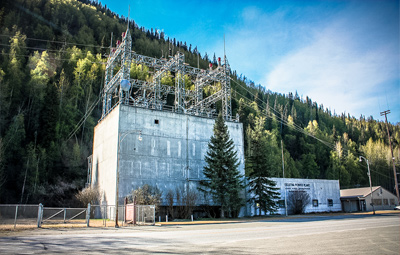
Eklutna provides a major amount of electricity used in Anchorage and the Mat-Su Valley. It was constructed by the U.S. Bureau of Reclamation between 1951 and 1954 for less than $30 million and provides 177,438 megawatt hours energy, enough energy to power more than 24,600 residential homes for an entire year.

The project has proven durable and after the March 27, 1964 mega-earthquake, returned to partial operation within about 30 minutes.

Environmentalists want the dam removed because the river was once a minor salmon run. But even if the owners of the dam — Matanuska Electric Association, the Municipality of Anchorage, and Chugach Electric Association — removed the dam, it would only return the flow of the Eklutna River to what it was before the dam went up, and that means no fish, because there were no salmon swimming upstream before the dam went in. That’s because hydro projects downstream in prior years had already modified the river to the point where it was not a salmon run.

The Project was sold in 1991 to the Municipality of Anchorage, Chugach Electric Association, and Matanuska Electric Association. The municipality sold off its utility to Chugach and is now owner of 52% of it through the ML&P and Alaska Waste and Water Utility. When the sale of ML&P went through, the Municipality was supposed to designate a liaison for the Eklutna Dam, and didn’t. So the Muni is an owner but has no representation.

As part of the 1991 sale, the utilities entered into an agreement with the U.S. Fish & Wildlife Service to develop and propose to the governor a program to protect, mitigate damages to, and enhance fish and wildlife impacted by the development of the hydroelectric project. The governor appears to be under no obligation to agree with whatever the proposal might suggest. For this reason, the liberals on the Anchorage Assembly are working to get a delay, while they work on electing a Democrat governor in 2026.

Notes from the Chugach open meeting on Monday:

1. Chugach Electric Board’s legal counsel appears to disagree with the Anchorage Assembly on several issues.

2. Chugach Electric does want to establish year round flows and restore habitats.

3. Board Member Susanne Fleek-Green stated that all parties can agree to extend, as the Assembly has requested, because there is no specific rule that says all parties cannot agree to an extension. 

4. The 1991 agreement with USFWS will likely be enforced in federal courts.

5. Technically, Anchorage Municipality has no representative to come to the table and vote and agree on all alternatives because it is no longer an owner. 

6. CEA would like to make sure owners agree together.

7. There were 380 copy-and-pasted letters sent in favoring dam removal, with 275 of them from out of state.

8. The public may continue to provide comment on the proposal to remove the dam until Feb. 19 by writing [email protected].

Carmela Warfield announces she is a candidate for Alaska Republican Party chair

Carmela Warfield, currently an officer in the Alaska Republican Party as its Region 5 representative, has announced her intention to seek to lead the party when it elects a new chairperson at its statewide convention in Anchorage, April 19-21.

She already has the endorsement of the Mat-Su Republican Women’s Club, the Valley Republican Women of Alaska, the Anchorage Young Republicans, and Mat-Su Young Republicans, as well as many personal endorsements from around the state from those who will be attending the convention.

Warfield said, “In this critical time, we must strive to be, as President Reagan said, the shining city upon the hill. Our Party must be well-organized, professional, knowledgeable, and well-funded. Through our efforts, we will serve as an example to our communities and our fellow Republicans.”

Warfield has served in her Hillside Community Council in Anchorage and briefly filed a letter of intent to run for Anchorage Assembly in 2023, but withdrew.

Already announced for Alaska Republican Party chair is Nikki Rose and Mike Robbins, both of Anchorage.

The Alaska Republican Party has over 143,000 registered voters in what is is the largest political organization in the state.

Denali Brehmer gets 99 years for murder of Cynthia Hoffman at Thunderbird Falls

15

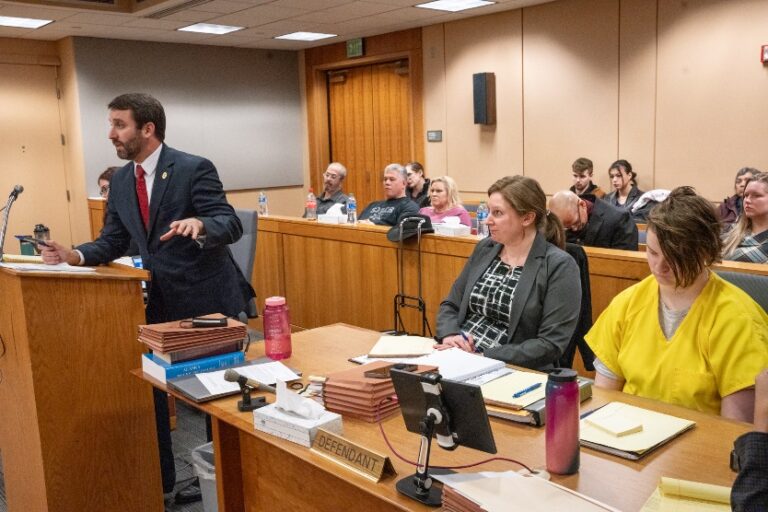
Denali Dakota Skye Brehmer, of Anchorage, now 24 years old, was sentenced by Anchorage Superior Court Judge Andrew Peterson for the murder of Cynthia Hoffman near Thunderbird Falls in Chugiak. The murder was committed on June 2, 2019.

Brehmer had pleaded guilty a year ago to one count of Murder in the First Degree.

Hoffman, who thought Brehmer was a friend, was lured by Brehmer and other friends to the banks of the Eklutna River and shot near Thunderbird Falls. Then, Brehmer and the accomplices dumped her body into the river. Investigators later learned that Darin Schilmiller had solicited the murder of Hoffman from Brehmer.

Schilmiller also solicited child pornography from Brehmer, conduct that led to additional federal charges.

Brehmer’s sentencing occurred over three days. The court was permitted to sentence Brehmer to a sentence of active imprisonment between 30 and 99 years.

The State requested a sentence of 99 years with none suspended and a “worst offender” finding.

Brehmer requested a sentence of 80 years with 20 years suspended.

“The Court should find that Miss Brehmer engaged in one of the most serious crimes that we have in Alaska,” said Anchorage Assistant District Attorney Patrick McKay. “She executed Cynthia Hoffman in a murder-for-hire plot. She conspired with numerous other individuals in and outside of Alaska, including juveniles, forever altering everybody’s life. She may not have pulled the trigger, but this never would have happened it if it weren’t for Denali Brehmer.”

The murder of Hoffman was a premeditated, and was a murder-for-hire, Peterson said, calling Brehmer’s conduct “cold, calculated, and carried out to a ‘T’.”

Judge Peterson said he found that Brehmer’s conduct was among the most serious first-degree murder cases and among the most serious contract killing cases. Judge Peterson described watching a video of Cynthia Hoffman’s last moments where she was observed duct taped on the ground at Thunderbird Falls “…one of the most difficult pieces of evidence I’ve had to watch in this position.”

Judge Peterson said Brehmer showed no remorse after the murder and, in fact, went on to engage in other criminal conduct.

Although Brehmer was a youthful offender and “youth matters,” Peterson said Brehmer clearly knew what she was doing and that this was not merely “youthful indiscretion.”

Brehmer was sentenced to 99 years with none suspended and was found to be a “worst offender.”

Darin Schilmiller, of Indiana, was sentenced to 99 years with none suspended for his role in the murder.

Caleb Leyland’s sentencing is scheduled for June 10, 2024, in front of Judge Peterson.

Kayden McIntosh’s case is pending trial. McIntosh is the one who is accused of actually pulling the trigger on the weapon. He has had several court dates over the years.

This case was investigated by the Anchorage Police Department’s homicide unit, the Federal Bureau of Investigation based out of Alaska and Indiana, and the Indiana State Police. Brehmer is in the custody of the Alaska Department of Corrections.

Rick Whitbeck: Thanks to fossil fuels, Anchorage averted a crisis this winter

By RICK WHITBECK | POWER THE FUTURE

A recent joint hearing of the House and Senate Resources committee I attended in Juneau laid bare the importance of natural gas to Southcentral Alaska residents and businesses.

The brutality of this winter has been a wake-up call for Southcentral Alaskans about the importance of reliable energy. When temperatures collapsed to the -20s in parts of Anchorage and -40s in parts of the Mat-Su, reliability was the difference between life and death other companies were looking for.

In a nutshell, natural gas saved the day in our moment of need. During the coldest week of winter, Cook Inlet Natural Gas Storage Alaska, a gas storage system managed by Enstar, started experiencing issues with a portion of its reservoir network, compromising its ability to supply a full complement of gas to utility customers throughout Southcentral Alaska.

Thanks to fossil fuels, a crisis was averted. Even as we used a record amount of natural gas on Jan. 31 — 268 million cubic feet, versus a typical January demand of 160 million cubic feet — our heat and power systems remained intact. Hilcorp, Alaska’s dominant natural gas producer, increased its production beyond its contracted volumes. Other Cook Inlet producers ran full throttle. This was the difference between heat and light in our homes instead of cold and darkness.

It should be a moment to celebrate. Traditional energy solutions worked, as they have in Southcentral Alaska since the Swanson River field was first developed in the 1950s.

Instead of a simple thank-you, lawmakers were more interested in scoring political points to advance their green agenda. Sen. Bill Wielechowski harangued Hilcorp over its profit margins rather than focusing on assisting producers to be able to drill gas. Rep. Donna Mears’ questioning of presenters took on a “petroleum is bad” tenor. It was language consistent with a state Democratic party platform considering a call for an end to all oil drilling and fracking.

The level of indignation toward the very companies capable of solving any supply shortages was astonishing. Rather than learn from the experience, the legislators were content to have avoided the bullet while acting as if nothing had happened and the threat had been permanently averted.

That’s not the way to govern. Turning away from reliable energy sources is no future.

Alaska is blessed with abundant natural resources. We have a century’s worth of coal reserves in Healy, nearly 150 years of Railbelt-wide demands of natural gas waiting to be brought down from the North Slope and nearly two trillion cubic feet of gas waiting to be produced in Cook Inlet.

Look at all the progress underway in our state from traditional sources of energy. Companies like Santos are hard at work extracting oil from the Pikka oil field. Ditto with ConocoPhillips Inc. and its Willow project on the North Slope. Hilcorp has revitalized the Prudhoe Bay area, and there are other companies looking to begin production in the coming years.

Another boom could be just around the corner. The issue isn’t a shortage of supply. It’s a lack of willpower to invest in projects and producers. Finding paths to get those supplies to market should be the priority for lawmakers the rest of this session. This mission most certainly should take priority over anti-market renewable portfolio standards.

Without reliable, affordable energy for Southcentral — and all of the Railbelt — people living on the margin from inflation and higher prices are at risk of falling off the financial cliff. Outmigration will explode, businesses will close, homelessness will increase, and social unrest won’t be out of the question.

Renewables are not the answer and won’t be anytime soon. In the recent cold snap, hydro, wind, and solar accounted for less than one-seventh of our power. If we are to survive another rough winter storm, our government officials should be calling for more of what works — Alaska natural gas — and not appeasing their green donors who reside in warm San Francisco and balmy Seattle who invest in failed wind and solar.

If we had listened to those pushing a not-ready-for-prime-time renewables “solution,” the result could have been widespread burst pipes in homes and businesses. The damage to the underlying infrastructure could have taken months or even years to fix. Even worse, under those conditions, widespread blackouts and even loss of life could have occurred. These are very real — and tragic — consequences if we don’t have heat and power available when we need it.

But we did because fossil fuels delivered. They are the good guys. Thankfully, they are in plentiful supply in our state. They deliver, they work, they power our everyday lives, and will for decades.

Rick Whitbeck is the Alaska state director for Power The Future, a national nonprofit organization that advocates for American energy jobs. Contact him at [email protected]and follow him on X (formerly Twitter) @PTFAlaska. This originally appeared in the Anchorage Daily News.

Arctic Man, the wildest, fastest race in Alaska, canceled in ’24 due to state bureaucratic slowdown

“Go fast or go home” is the motto of Arctic Man. This year, the race is staying home. The delays and jacked up costs from the Department of Natural Resources became so unreasonable for Arctic Man, a ski, snowboard, and snow machine race that has taken place for decades, that the race has been canceled this year, organizers said.

It’s been canceled before, due to weather and one year because of the Covid pandemic, but this time it was because by the time DNR came up with the promised five-year permit structure, the cost was a surprising $100,000 a year, and the organizers said they couldn’t do it — there was too little time left to raise the money.

DNR disputes that characterization. In a note, the agency said, “The first renewal option was exactly the same as previous permits (annual $6,480 multi-day commercial land use permit plus $4 fee for each registered event participant. In 2019 the total cost for permitting the 4-day event on State of Alaska land was $6,640). The second permit option could reach $10,000 annually based on the number of attendees ($1,440 multi-day commercial land use permit plus $4 visitor day use fees for each registered parking spot and each registered event participant).”

The race is a much-loved event for extreme sports enthusiasts all over the world. Skiers or snowboarders begin at 5,800 feet and dropping 1,700 feet to a canyon where they meet up with their snow machine partner-driver and catch a tow rope while on the go, pulling the skier 2.4 miles up hill at speeds of up to 86 mph. Then the skier drops over the side of a second mount and skis down 1,200 feet to the finish line.

When organizers couldn’t get DNR to act on their permit fast enough, they eventually went straight to Gov. Mike Dunleavy.

“He and his team were fantastic and they got it all straightened out,” said one of the organizers. But by then, it was too late. The organizers have to have everything coming together for the big gathering no later than December; the event is in April.

Thousands of people converge on the race area for the event each year. In 2022, there were 13,000 spectators, who camp and party for a few days in the Hoo-Doo Mountains at Summit Lake, near Paxson, which is about 3 or 4 hours south of Fairbanks down the Richardson Highway.

“The area the race is held is some the of the best snowmachine riding country in the world. The snowcapped peaks and beauty make this spring event one that you will treasure for a lifetime,” Arctic Man’s website states.

But all is not lost.

“We’ll resurrect it in 2025,” said Jeremy Wise, one of the event organizers. “But for this year, it’s shot.”

Watch this 2016 documentary of Australians as they tackle the world’s craziest race:

Alaska AG Treg Taylor and coalition side with Gov. Abbott on border security in Texas

By CASEY HARPER | THE CENTER SQUARE

A coalition of state attorneys general sent a letter Monday to Department of Homeland Security Secretary Alejandro Mayorkas backing Texas in its border battle with the Biden administration.

Texas Gov. Greg Abbott defied the Biden administration last week, making clear he would continue to put up concertina wire fencing at the southern border to help stop the flow of illegal immigration, which has soared since Biden took office.

The U.S. Supreme Court ruled on the issue last week, saying federal agents could continue to remove the concertina wire, but the ruling did not prohibit Texas from installing the border defenses. Abbott said after the ruling that the federal government had broken its pact with the states for not stopping what more than 50 Texas counties have declared an “invasion.”

That court case is the latest touchpoint for the ongoing immigration crisis and frustration of many border states and Republicans who argue Biden is willfully aiding millions of illegal immigrants get into the U.S.

“Since the Biden Administration has failed to do its job and secure the border, states like Texas have stepped up to protect their citizens,” the letter said. “A federal district court found that Texas’s border defense wires reduced illegal border crossings by more than two-thirds. Those barriers protect not just Texans from millions of illegal border crossings, but the rest of the nation.”

More than 10 million illegal immigrants have entered the U.S. since Biden took office, more than the population of about 40 U.S. states.

An impeachment effort is underway in the House for Mayorkas, the recipient of the letter, over similar concerns about the lack of border enforcement and Mayorkas policies.

The Biden administration has blamed Republicans, saying they have not passed the needed funding to secure the border. Republicans have pushed back, saying Biden’s changes to things like asylum policies have turned border agents into a processing and entry program instead of deterrence.

The Monday letter sided with Texas and said states “have an independent duty to defend against invasion.”

The letter was signed by attorneys general from Alabama, Alaska, Arkansas, Florida, Georgia, Idaho, Iowa, Indiana, Kansas, Kentucky, Louisiana, Mississippi, Missouri, Montana, Nebraska, New Hampshire, North Dakota, Oklahoma, Ohio, South Carolina, South Dakota, Tennessee, Utah, Virginia, West Virginia, and Wyoming. The leadership of the Arizona state legislature signed as well.

Earlier this month, Taylor joined forces with 26 other states to support Texas’s border defense efforts in a separate letter addressed to the Biden Administration. The letter, spearheaded by Iowa and Utah, highlights growing concerns about the ongoing border crisis and urges the federal government to take decisive action to secure the southern border.

Governor Mike Dunleavy expressed his support for Gov. Abbott’s efforts to address the border crisis, stating, “The lack of resolve by the federal government under the current administration is causing a catastrophe at the border that is impacting law-abiding Americans across our country. The current administration in Washington is failing its citizens and has completely abrogated its responsibility to secure our borders.”

Border Patrol agents, following the Biden Administration’s directives, have reportedly cut Texas’s border defense wires more than 20 times in just one month. In a shocking incident, a forklift was used to raise the wire, allowing over 300 individuals to enter the country. Due to the lack of proper vetting, it remains uncertain how many of these new arrivals are peaceful migrants seeking a better life and how many may be associated with criminal networks.