Wednesday, June 17, 2026
Home Blog Page 488

Aniak trying to contain fuel spill

5

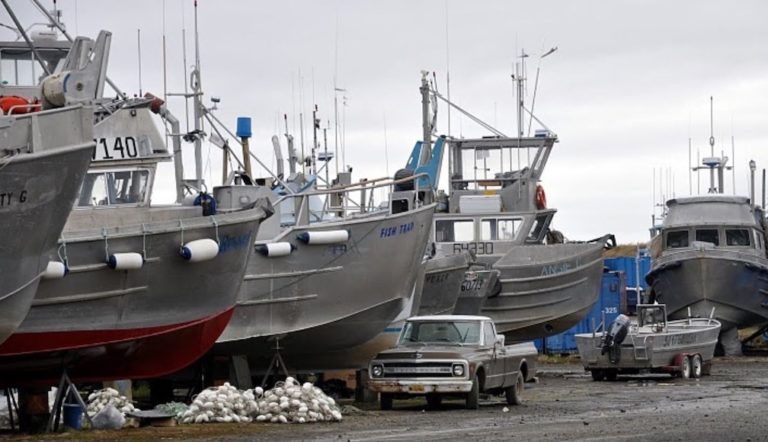
The City of Aniak, Alaska is working to manage a Feb. 16 fuel spill that has drenched one property and crossed a main roadway, Boundary Ave., not far from the Kuskokwim River.

Aniak, population about 500, is 170 miles upriver from Kwigillingok, which has a major diesel fuel spill of over 8,000 gallons that the Kwig community is trying to keep from reaching the Kuskokwim River.

The spill in Aniak seems to have originated from property referred to as the “Moffitt property,” by the City of Aniak. Doug Moffitt is a contractor in Aniak with heavy equipment operations.

City officials blocked off Boundary Ave. to prevent vehicles from driving over the spill and spreading the fuel. The amount of spilled fuel has not been estimated, but City Manager Lenore Kameroff told KYUK radio that more than 150 gallons had been recovered from the spill with absorbent materials. It’s unclear if some of that recovered liquid was associated snow or water. The City of Aniak and tribal organizations, along with community members, are working to contain the fuel, which will not be able to be fully cleaned up until spring, the city said.

A Facebook photo posted by the City of Aniak shows the area of Boundary Ave. that has been blocked off with traffic cones and surrounded by snow berms that were pushed into place to help contain the fuel. The area is several hundred square feet — or more. The Alaska Department of Environmental Conservation has been advised of the situation.

Such spills in urban Alaska are easier to contain, but in rural areas of the north, the equipment is not always adequate and weather is a factor.

The Kuskokwim River, still frozen at this time of year, originates on the western slope of the Alaska Range and drains into the Bering Sea through the Yukon-Kuskokwim Delta. The river is of significant concern to Alaskans due to low salmon returns for many years. The 2023 Kuskokwim season-end salmon report from Alaska Department of Fish and Game can be seen at this link.

The weather in Aniak this week is in the 20s but expected to reach 30 degrees on Thursday and Friday before dropping back down into the teens and below over the weekend.

Ranked-choice voting proves a lightning rod issue in several states

By KIM JARRETT | THE CENTER SQUARE

Bills to ban ranked-choice voting are causing passionate debate over a method to cast ballots that some say is fairer and some say is confusing and could lower voter turnout.

Ranked-choice voting allows people to rank the candidates, with “one” being their favorite. The votes are tallied in rounds. After the first round, the candidate with the lowest votes is eliminated. The voter’s second preference is then added to the tally. The process continues until a winner is determined.

Idaho, Tennessee, Montana and Florida have banned ranked-choice voting in their states. Maine was the first to conduct a statewide election using the counting method in 2018. Alaska used ranked-choice voting first in a statewide special election in 2022 to replace the late U.S. Rep. Don Young and again a few weeks later in its general election.

Iowa is one of several states considering banning ranked-choice voting this year. The ban is part of a sweeping election bill that also eliminates drop boxes for absentee ballots. House and Senate subcommittee meetings were packed with people asking lawmakers to reconsider banning ranked-choice voting.

“Just keep the conversation going,” said David J. Gion, executive director of Better Ballot Iowa, a group that advocates for ranked-choice voting. “There is no reason to stifle the conversation and ban ranked-choice voting today.”

Gion said about 90% of Iowans do not know what ranked-choice voting is. And when they learn about it, they are generally supportive.

Rachel Hutchinson, a senior policy analyst for FairVote, a group that advocates for ranked-choice voting, told The Center Square in an interview that 50 cities and counties use ranked-choice voting. A task force in Illinois is studying it, she said.

“I think that’s because people are waking up and seeing that it is our “choose one” elections that are depriving voters of meaningful choices, creating these increasingly toxic campaign cycles, advancing candidates who lack broad support and really just leaving voters feeling like our voices aren’t heard,” Hutchinson said.

The Foundation for Government Accountability calls ranked-choice voting a disaster in a research paper published in October.

“While there’s some that think ranked-choice voting has this ability to solve, maybe whatever ails our political system now, if you’re dissatisfied with the individuals running at the top of the ticket, in reality it doesn’t actually have real bearing on what we see unfolding in state capitals across the country, which is really not the type of drama we see in Washington, D.C.,” Brian Sikma, senior fellow at the organization, told The Center Square in an interview. “I think it’s really an interesting idea that evolved into maybe we can use this to solve problems in our political system, but in reality, the problem that it is trying to solve doesn’t really exist, particularly at the state and local level.”

Ranked-choice voting is confusing and sometimes awards candidates that did not receive the most votes, the Foundation for Government Accountability said.

The research paper cites Alaska’s special congressional election, which Democrat Mary Peltola won.

“Republican candidates received 60 percent of the vote in the first round, but the Democrat won because of the ranked-choice voting process,”the report read.

Hutchinson said Alaska’s general elections were an overall success.

“I think the results of the election were really consistent with Alaska’s independent streak,” Hutchinson said. “Alaska elected a conservative Republican governor, a moderate Republican senator and a moderate Democratic congresswoman,” Hutchinson said.

And she said voters do not find it confusing. Eighty-five percent of Alaskans said it was simple their first time.

“After New York used it for the first time in 2021, 95% said it was simple,” Hutchinson said.

While some state legislatures are considering bans, Oregon and Nevada are considering ballot measures to implement ranked-choice voting. Groups in Alaska are petitioning for ballot measures to overturn ranked-choice voting.

Americans for Prosperity Alaska promotes Alaskan to government affairs role

Americans for Prosperity, the nation’s largest grassroots advocacy group has put Strategic Director Quincy Azimi-Tabrizi in charge of the government affairs folder for the Alaska chapter. In her new capacity, Quincy will work with lawmakers and AFP-Alaska grassroots activists to further AFP policy priorities in Juneau.

Azimi-Tabrizi has led a group of grassroots activists to the Alaska capital city this week to talk to lawmakers about education.

Americans for Prosperity Alaska grassroots volunteers visited Gov. Mike Dunleavy and legislators this week in Juneau.

An Anchorage native, Azimi-Tabrizi has vast legislative experience at the federal and state levels, having worked for several elected officials, including Gov. Mike Dunleavy. She joined Americans for Prosperity in 2022.

While attending Brigham Young University, Azimi-Tabrizi was part of the team that pushed for passage of a lower income tax and comprehensive school choice in the state legislature.

AFP-Alaska State Director Bethany Marcum said, “With her continued work on Alaska state legislative issues, AFP-Alaska is lucky to have Quincy at the helm of our government affairs work. Alaska faces a critical junction in our legislature on important policies like stopping disastrous defined benefits plans.”

Azimi-Tabrizi said, “I’m thrilled to be a part of the work advancing AFP’s limited government mission in Alaska as the chapter’s strategic director. Our track record in this state is one that I’m proud of, and it demonstrates the impact of leading with consistent, principled, conservative policy. We have an incredible team, and Alaska is well positioned to lead the country in addressing our greatest challenges and unlocking more freedom and opportunity for every individual and future generations.”

Dunleavy bill is aimed at those who would glue their hands to runways and roads in protest

On Fireweed Lane in Anchorage this week, a group of anti-Israel protesters took over the street and blocked traffic, repeating a pattern seen in cities across the country these days. Seattle has endured multiple protest takeovers of freeways over environment and the war in Gaza, causing nightmares for drivers who can’t get to their destinations.

Climate activists have blocked runways by gluing their hands to the runways. A few years ago, kayakers protested Shell by blocking a the St. John’s River, so an icebreaker could not leave. It is happening increasingly in Alaska, as radical environmental activists learn from earth other.

On Wednesday, Alaska Gov. Mike Dunleavy introduced legislation that addresses the trend of protesters obstructing access to public places, and puts penalties on organizations that organize the protesters or conspire with them.

The legislation seeks to enhance public safety by imposing penalties for obstructing highways, navigable waterways, airport runways, and other public places specifically in situations where there is a significant risk of physical harm or interference with emergency response efforts.

HB 386 [SB 255] addresses civil liability of persons and organizations that conspire with or encourage anyone who engages in public obstruction. 

“This legislation ensures that our public spaces remain safe and accessible for all Alaskans,” Dunleavy said. “It is important to distinguish between peaceful expression of rights and actions that pose risks to public safety and emergency response efforts.”

Key provisions of the bill include:

  • – Increased penalties for obstructing highways and navigable waterways.
  • – Criminal liability for obstructing airport runways.
  • – Establishment of a new crime of obstruction in public places
  • – Creation of a new civil cause of action for individuals obstructed in public places, with provisions for damages in addition to compensatory and other damages.
  • – Extension of liability to persons and organizations that conspire with or encourage obstruction in public places.

Joe Geldhof: Juneau school enrollment has been shrinking for decades. Status quo is not going to solve our budget problem

By JOE GELDHOF

The numbers are bad. Really bad. Even dire.

Juneau is losing population. Our school enrollment has been shrinking for decades, even as we built new schools.

Continuation of the status quo where our community maintains excess school capacity for a diminishing number of students is certain to harm our student’s education.

The decline in enrollment was ignored by Juneau’s previous school administrations and school boards who refused to apprehend demographic trends.

Having inherited a hugely problematic situation, the current school board is committed to consolidating schools. Support for these long-overdue acts warrants support from everyone in our community, and the City and Borough of Juneau Assembly.

Unfortunately, support for the inevitable is being hindered by a faction within Juneau who continue to ignore the reality of current situation.

Everyone who cares about the students in our community seeks better educational opportunities. But, a big chunk of the opposition to school closures comes from older residents clutching their yearbooks or still trying to squeeze into their varsity jackets.

Making decisions about educational opportunity should be concentrated on educational needs, not nostalgia. The hot-house narratives being spewed by geriatric graduates who identify with the Crimson Bears mantra should be subordinated to the educational needs of current and the coming generation of students in our community. Issues like having multiple sports teams and extracurricular activities or the location of the schools in which our student’s education takes place cannot drive education policy if we are serious about learning.

School consolidation and closure isn’t about spending. It’s about saving and better education.

For decades, empirical evidence illustrates the relationship between big spending and successful outcomes is not guaranteed. Cultural factors, more than spending, are the key indicator of educational success. To be sure, minimal funding for adequate educational outcomes is necessary, but the notion that unlimited budgets will lead to splendid educational outcomes has not been validated empirically.

To maximize educational opportunity, we should focus on saving teacher jobs, not buildings and begin by first consolidating the two existing high schools and at least temporarily mothballing one existing middle school.

Given the age of the newest high school in the Mendenhall Valley and the fact that at least two-thirds of our students live closer to the Valley than downtown, the school board should proceed to combine all 10th through 12th grade education in Thunder Mountain. And, at least for 2 or perhaps 3 years, a junior high school model should be adopted where all 7th through 9th grade students receive instruction at the downtown High School.

The existing middle school in Lemon Creek should be repurposed to house the school district’s alternative programs and the school district offices.

Down the trail in the not-too-distant future when school enrollments drop further (as they are by about 4% every year), the downtown high school can be successfully re-purposed to house the bureaucracy necessary to operate our local government and serve as a performing arts center. We might even consider relocating the existing underutilized downtown library on top of a parking garage to the new civic complex in the old high school. Or perhaps move the city museum to the high school library space. Additional parking for this new civic center can be easily created by demolishing the old Marie Drake building and repurposing the soccer practice field.

Juneau’s City and Borough Assembly has an important role in fulfilling a move to a better and more cost-efficient future. The assembly should work carefully and in a coordinated manner with the Juneau School District, starting with not signing a long-term lease for city offices. Repurposing existing structures that can be used for efficient government services is the best thing the assembly can do for this community. With a stagnant population, we can’t afford new buildings and we shouldn’t get locked into long-term leases for property when we have surplus property that can meet our needs.

The time to act on school consolidation and closure is long past due.

The focus should be on efficient basic service delivery for both education and local government. This has to be done according to a budget that is under control and realistic; one that includes paying off the debt inherited by the current school board and local government administration. The only way this can happen is by merging and closing schools, something that should have happened years ago.

It has to happen now.

Joe Geldhof lives in West Juneau with Corine. The two of them raised two daughters who attended Juneau’s public school system.

Biden Administration to require head of federal subsistence board to be Alaska Native

It’s the latest iteration of blood-quantum laws, as understood by the Biden Administration. The Departments of the Interior and Agriculture this week announced a proposal to add a quota minimum for Alaska tribal representation on the Federal Subsistence Board, the body that manages subsistence use on federal lands and waters in Alaska.

The departments propose adding three additional public members to the board who will be nominated by federally recognized tribal governments in Alaska.

The three additional members will be required to have personal knowledge of and direct experience with subsistence uses in rural Alaska, including Alaska Native subsistence uses, and will be appointed by the Secretary of the Interior with the concurrence of the Secretary of Agriculture.

In addition, the chair of the board will be required to have personal knowledge of and experience with rural subsistence uses. In other words, these positions have Native blood quantum requirements.

“For thousands of years, subsistence practices have been immensely important for Alaska Native communities, and remain deeply intertwined with their lifeways, food security, and cultures,” the departments said in a news release.

The Federal Subsistence Management Program is jointly managed by both departments and is overseen by the Federal Subsistence Board, which administers the subsistence priority and manages regulations for the use of fish and wildlife resources for subsistence purposes on federal public lands and waters in Alaska. The board is currently made up of five members from federal agencies and three public members.

“Since time immemorial, subsistence practices have played a central role in meeting the nutritional, social, economic, spiritual and cultural needs of Alaska Native people,” said Secretary Deb Haaland, who discussed the proposal in remarks at the National Congress of American Indians Executive Council Winter Session this week.

“By strengthening indigenous representation on the Federal Subsistence Board, we seek to not only preserve these important traditions, but to fully recognize tribal sovereignty and ensure the inclusion of Indigenous Knowledge for future subsistence-related planning. When indigenous communities are at the table, everyone who enjoys a subsistence lifestyle has more opportunities to thrive,”  she said. 

“Incorporating indigenous knowledge that has been gained over millennium into our Federal Subsistence decision-making is an important step in that effort,” said Agriculture Secretary Tom Vilsack.

Strengthening nation-to-nation relationships is a priority of the Biden-Harris administration. The proposed changes to the board are described as reflecting the “meaningful role Tribal consultation holds and the Administration’s commitment to speaking with and listening to Tribal leaders when making decisions that impact their communities.” 

Comments compiled from these listening sessions with Native groups in 2022 are in the Federal Subsistence Policy Consultation Summary Reportwhich describe the adverse impacts that a changing climate is having on Alaska Native subsistence practices and Alaska Native and rural communities; the desire to expand tribal partnerships and the incorporation of Indigenous Knowledge into subsistence management; and the desire for greater tribal representation within the federal subsistence management system. 

“Tribes and Tribal consortia also requested that the chair of the FSB be required to possess personal knowledge and experience with subsistence uses in rural Alaska to ensure that they understand the scope and impact that the board’s decisions have on all subsistence users. This enhanced input and perspective will safeguard subsistence opportunities for all federally qualified subsistence users,” the departments said.

However, whoever is the chair will have some tribal ties that could lead to a conflict of interest, an unintended consequence not imagined by the administration.

The proposal may be met with some skepticism from the general hunting and fishing community that is not part of a tribe. The Federal Register will open soon for people to provide comments. Tribal leaders will get a separate notice sent to them to urge them to comment, the departments said.

Linda Boyle: California, Oregon quietly drop CDC guidance on Covid isolation, but Alaska?

By LINDA BOYLE

In California, the Covid isolation requirements have dramatically changed recently.

Are you positive for Covid and no symptoms?   No need to isolate.  

If you test positive with minor symptoms, then isolate until your symptoms improve and you have no fever for 24 hours without any medications. 

No more isolating for five days, which was down from the previous 10-day isolation and even more restrictive 14-day isolation. Read the current guidance here.

California state guidance also says its priorities are focused on protecting those most at risk, while diminishing social disruption so people can live their lives.  

Remember those same recommendations over four years ago by the doctors who were harshly and unfairly accused of “misinformation”?  Simply stated, these doctors thought healthy people didn’t have to isolate, children could go to school, stores could remain open and people could be outside.

For that, these doctors were deemed radicals and extreme right-wingers. They have had their licenses suspended, and were dismissed as “tinfoil hat” people. 

Where did the five-day isolation requirement come from? The Centers for Disease Control and Prevention changed it from 10 days to five days in the latter part of 2021. Harvard University epidemiologist Bill Hanage stated, “It was not a reflection of evidence-based” science, he said. “It was there to stop everything from falling apart.”  

Dr. Anthony Fauci, who was director of the director of the National Institute of Allergy and Infectious Diseases, repeatedly said, “trust the science.” Yet, we find out many of the decisions made were not based on science but were nothing more than Silly Wild A** Guesses (SWAGS). 

The government and public health had destroyed our economy, raised our children to be afraid of everything,  destroyed businesses, all based on SWAGs.   

To instill fear and tell us, we were told the only way out of this “horrible pandemic” was to line up and take jabs without proper scientific research backing. All of this was pushed by the jabs as the only solution — using Emergency Use Authorizations — ignoring side-effects and making drug companies rich. 

California’s guidance is like Oregon’s.  The Oregon Health Authority also said those with Covid do not need to isolate a set number of days. If you have a fever, stay home, and stay away from those people who are considered high risk for 10 days.

Chunhuei Chi, professor of Health Management and Policy at Oregon State University, stated, “We have to develop effective, safe ways to live with Covid-19 but not let Covid-19 hijack our life or work anymore”.

Jonathan Modie, communications officer for the Oregon Health Authority, stated that the change of policy so far has not led to an unusual increase in illness and the old rules had placed a huge burden on businesses and school children.

Alaska has been sticking with the Centers for Disease Control five-day recommendations.

The Centers for Disease Control currently has no plans to change its five-day rule that has been in existence since August 2022, despite what California and Oregon are doing, and despite many doctors encouraging the CDC to do so.

Dr. William Schaffner, an infectious diseases expert at Vanderbilt University Medical Center, and some of  his colleagues have had private conversations with CDC suggesting it drop that five-day isolation requirement.  Dr. Schaffner stated it should be dropped, “in part because there’s little evidence it’s stopping the spread of Covid.”

CDC’s name does have “Control” in it.  I guess after scaring us for four years, it is difficult to give up that control, no matter what science says.  

As Jane Fonda once stated, “Consistency can be a trap, especially if it leads to being consistently wrong rather than to stopping, admitting your mistake, and changing course.”

Our government shows control is more important than changing course. It keeps using the hammer even is a different tool is needed.

Linda Boyle, RN, MSN, DM, was formerly the chief nurse for the 3rd Medical Group, JBER, and was the interim director of the Alaska VA. Most recently, she served as Director for Central Alabama VA Healthcare System. She is the director of the Alaska Covid Alliance.

Bob Griffin: While funding is adequate for Alaska schools, results are still disappointing

By BOB GRIFFIN

We’ve seen a huge battle erupt in Juneau over school funding this year — when our energy should be focused on how we re-allocate our education dollars into programs that produce the results our parents demand and our kids deserve. 

A January 2024 joint  Rutgers/University of Miami study ranked Alaska 2nd in the nation in overall best funding adequacy in 2021, with a score of 95 out of a possible 100. Florida was ranked last in the study with a funding adequacy score of score of 12 out of 100. Despite that enormous difference in fiscal effort, 28.8% of 2022 Florida high school graduates scored a 3 or higher on at least one AP exam (3rd highest in the US), compared to 11.9% in Alaska (45th in the US).

The Rutgers study accounts for cost of living differences between different locations and judges funding adequacy based primarily on the percentage of a states economy that is dedicated to funding K-12. Alaska was also ranked fourth in the nation in improving funding adequacy since 2009 and first in the nation in improving funding adequacy since 2018 by the study. 

Alaska was also judged to have a very equitable K-12 funding system according to Rutgers.  There was some mild equity criticism from the authors that Alaska slightly underfunds students who come from families in the top 20% of income levels compared to exceptionally high funding levels for students in lower income brackets.

One factor that makes our K-12 system even better funded that the Rutgers study reveals, is the effect of the additional dollars that go to neighborhood schools because of Alaska’s very high rate of very inexpensive correspondence programs. Over 16% of Alaska K-12 students participate in correspondence school programs at a cost of $5364/student compares to over $22,000/student for the state average.

Those correspondence students get very little (if any) local or federal funding, and only consume only about 4% of overall K-12 spending. This results in the remaining 96% of funding concentrated in the 86% of kids in non-correspondence programs. The additional funds per student is not insignificant—around an extra $3,000 dollars per student per year available in brick-and-mortar public schools than would otherwise be available if those funds had to be shared with the 21,000 kids in correspondence programs. 

Some have argued that kids in correspondence programs actually make district poorer — taking state K-12 dollars away from school districts. This would be true, if all the costs of educating a child were “fixed costs.” In actuality, the vast majority of cost of educating a child are “variable costs”.  For every group of approximately 25 students the district needs another teacher.

More kids eventually mean more payroll clerks, bus drivers with additional busses, more psychologist and other support staff, etc. A little thought experiment: If the fixed cost model had merit, we would be able to add 1,000 new students to a district with little or no additional funding. 

While our funding is adequate – results are still disappointing. Alaska does have some isolated pockets of success — like our best-in-the-country public charter school results, as pointed out in a recent Harvard Study. However, our test results for more traditional programs, for kids rich and poor, lags far below the US average for comparable demographics, according to the US Department of Education National Assessment of Educational Progress (NAEP).       

The conversation about the number of dollars we can or should dedicate to K-12 in Alaska has been taking up most of the oxygen in Juneau, yet I’m looking forward to moving past that debate and being able to collaborate with all K-12 stakeholders in analyzing how we refocus our significant fiscal effort into better outcomes.

Our kids are just as bright, our teachers are just as dedicated and our parents love their kids just as much as in Florida or anywhere else. The only thing holding us back from producing better outcomes is the courage to make the public policy changes that better focus our resources.  

Bob Griffin is on the board of Alaska Policy Forum and serves on the Alaska Board of Education and Early Development, but writes this in his own capacity.

Justice Dept. sets up task force to chase down Covid-19 financial aid fraud

13

U.S. Attorney S. Lane Tucker for the District of Alaska announced this week the existence of an interagency Covid-19 Fraud Task Force and said she is pursuing other white-collar financial crimes in Alaska.

“White-collar and other financial crimes devastate families, communities and organizations. This task force brings together key law enforcement personnel to continue our ongoing efforts to combat all types of white-collar crime, including Covid-19 related fraud,” said U.S. Attorney S. Lane Tucker for the District of Alaska. “My office will remain steadfast in our work with law enforcement to find, investigate and prosecute any individual who chooses to commit these crimes.”

 The task force agencies include:

  • – U.S. Small Business Administration, Office of Inspector General Western Region Office
  • – IRS, Criminal Investigation Seattle Division Office
  • – FBI Anchorage Field Office
  • – U.S. Department of Treasury, Inspector General for Tax Administration

“White-collar crimes are not violent, but they are not victimless,” said Assistant Special Agent in Charge Brandon Waddle of the FBI Anchorage Field Office. “By collaborating with our partners and utilizing intelligence-driven strategies, the FBI has been working diligently to tackle white-collar crimes and to hold fraudsters accountable.”

The task force will identify, investigate, and prosecute those whose defraud economic aid programs intended to help individuals and small businesses negatively impacted by the Covid‑19 pandemic, such as the Paycheck Protection Program, Economic Injury Disaster Loans, Restaurant Revitalization Funds, Shuttered Venue Operator Grants, State and Local Fiscal Recovery Funds, Coronavirus Farm Assistance Program, Emergency Rental Assistance Program, and Unemployment Insurance.

The office said that people created fake businesses, committed identity theft, falsely reported their criminal history, and inflated the size and scope of their actual businesses, and then many had used federal funding for personal gain.

Tucker also announced charges and recognized milestones in a number of financial crimes cases, including charges in cases investigated by the task force.

Since September 2023, three cases alleging fraud charges related to Covid-19 programs have been indicted following investigations by the Task Force. The cases are as follows (by date of indictment):

  • – Rosaline Natazha Mavaega, 41, and Esau Malele Fualema Jr., 44, of Anchorage, were indicted in September 2023 on major fraud, wire fraud, money laundering and identify theft charges related to an alleged scheme to steal millions of dollars through Covid-19 recovery funds. The indictment alleges they stole over $1.6 million.
  • – Lloyd Pennebaker, 58, of Anchorage, was indicted in October 2023 on wire fraud charges related to false statements regarding his criminal history he allegedly made on EIDL loan applications from April 2020 to May 2021. The indictment alleges he received $122,500 in federal funding from the EIDL loans.
  • – Cheryl Labrie, 36, of Anchorage, was indicted in January 2024 on wire fraud, bank fraud and money laundering charges related to an alleged scheme to obtain and launder nearly $1 million she received through multiple EIDL and PPP loans and advances over a year.
  • Tucker also highlighted other financial crimes her office has investigated:
  • – Garett Elder, 30, of Anchorage, was sentenced to 10 years in prison on Nov. 13, 2023, after defrauding more than $26 million from over 170 victims in a large-scale investment fraud scheme.
  • – The U.S. will collect over $350,000 in treble damages and penalties after a default judgement was ordered in the False Claims Act case against Michael Hanzuk II, 31, of Anchorage. Hanzuk was a former co-owner of Arm Rippin Toys Inc. and was convicted of conspiracy to violate the Clean Air Act in August 2022. In 2020, Hanzuk applied for an EIDL loan of over $100,000 and falsely certified that he and Arm Rippin Toys were not engaged in “any illegal activity,” despite their active conspiracy to violate the Clean Air Act.
  • – Saray Consuelo Sarmiento Angarita Lockwood, 58, of Kenai, was sentenced to one year in prison on Dec. 18, 2023, after she and her late husband made a materially false statement in a bankruptcy case.
  • Melissa Dobbs, 50, of the Matanuska Valley, was indicted in January 2024 on charges of healthcare fraud and allegedly making false statements on a loan application.
  • – Jayel Jean Lane, 34, of Anchorage, was sentenced to nine months in prison on Feb. 7, 2024, after she stole and misused Social Security benefits for roughly seven years. Lane stole over $76,000 in benefits that she applied for on behalf of a minor and spent the money for her own personal use.