Wednesday, June 17, 2026
Home Blog Page 489

Trump trial analysis: Democrats destroying democracy to ‘save democracy’

By RICHARD PORTER

The news broke in quick succession: New York’s district attorney, a Democrat, will attempt to jail Donald Trump in a trial starting next month; a Democratic Party judge ordered Trump and his affiliates to “disgorge” $450 million in a novel civil case brought by New York’s Democratic attorney general—and Russian opposition leader Alexei Navalny died in a Siberian prison.  

Democrats want to strip Trump of his assets and send him to jail to die like Navalny; that’s how ruthless they have become. Why? Donald Trump represents a democratic threat to Democrats – their power, their narratives, their culture, and their coalition. So, Democrats decided to wage war in the friendly confines of their home courts to destroy their nemesis and short-circuit democracy.  

Justice Arthur F. Engoron’s opinion in the civil action brought by Attorney General Letitia James is premised on the idea that Trump fraudulently obtained lower rates on money he borrowed by offering lenders recourse to more of his assets, some of which he overstated.

Engoron glosses over the most salient fact of this case – there was no victim – and he does so in a decidedly schoolmarmish preface: “Timely and total repayment of loans does not extinguish the harm that false statements inflict on the marketplace,” the judge wrote in his order. Without bothering to do much explaining regarding this expansive theory, the judge added, “Here, despite the false financial statements, it is undisputed that defendants have made all required payments on time.”

So, then, a $450 million fine for inflating the size of Donald Trump’s portfolio. It makes one wonder what the judge would have ordered if Trump had defaulted. Summary execution?

Deutsche Bank offered Trump two credit options: nonrecourse and full recourse. When Trump borrowed to renovate the Old Post Office in D.C., the Doral in Miami, and to build the iconic Trump Tower in Chicago, Deutsche offered Trump a credit facility that would be secured only by that project. A nonrecourse loan is riskier for the lenders, safer for Trump, and therefore carried a much higher interest rate.

Deutsche Bank also offered Trump a full recourse credit facility for each project, backed by a personal guarantee from Donald Trump and his various entities. This is a safer loan for lenders because it is backed by more assets, riskier for Trump (because he put the whole empire on the line for each of these projects), and so carried a much lower interest rate. 

Trump chose to put all of his assets at risk in exchange for the lower interest rate. Therefore, the bank wanted more information, and had covenants in the loan, about his other assets too.

The judge held that Trump and his affiliates overstated the value of certain of his assets, and therefore suggests (without corroborating testimony in his 92-page opinion) that Deutsche would not have offered the full recourse loans but for the overstatement of these particular assets.   

It’s not disputed that Trump had other assets or that his net worth on a conservative basis runs into the billions. However, the value of Trump’s assets, almost all of which are privately held and for which there is not a ready market, is a matter of judgment. Not surprisingly, promoters ascribe higher values to their own assets and ideas – and Trump is a promoter.  

Deutsche Bank’s witnesses testified that the bank assumed the value of the assets and liabilities were “broadly accurate,” then assumed Trump’s aggregate asset portfolio was worth one half of its stated value (and one asset, which the judge also held was significantly overvalued, was only worth 25% of its stated value) before agreeing to proceed with the full recourse loan.  

The judge held that the New York AG (who campaigned on going after Trump) was not required to show either that the overstatement of particular assets was material to the lender or to the overall value of his assets, or that the lenders actually relied on the statements. On the other hand, the judge asserts that “the frauds found here leap off the page and shock the conscience” – his conscience, but not the banks’.

Remember: No one in these deals alleged fraud; the loans were paid off and everyone in the deal made money; Trump still had billions in assets backing his guaranty after writing down asset values that were misstated; and the bank assumed the value was half what he said anyway.

It shocks millions of Americans that a Democrat who ran for attorney general promising to go after a Republican president of the United States is allowed to use the power of the state to go after political opponents, and then take nearly half a billion dollars without proving any financial harm from the misstatements. 

The judge arrived at the high “disgorgement” amount by holding both that the bank would not have made a full recourse loan, but would have only made the higher risk, higher cost, nonrecourse loan, and that the deals would not have happened at all but for the fraud – ordering as disgorgement both what interest would have been at the higher rates and all the profits Trump earned on the sale of two of the successful projects.

Further, the judge enjoined Trump and others from serving as officers or directors of any New York corporation or any legal entity in New York for three years – and prohibits Trump and his companies from applying for any loans for three years, which forces the Trump Organization to sell to cover the extraordinary damages found in this case.

And just like that, the N.Y. Democrats have taken a step toward stripping him of his wealth. But, there’s more to come.  

Next up in just over a month, another Democrat prosecutor will try to take away his freedom and put him in jail in a “home court” venue, with two more Democrats standing by in “home court” venues hoping for their shot at putting Trump in the gulag.

All of these cases involve novel theories that break new ground – and that also cause tens of millions of Americans to question the good faith of Trump’s opponents generally, the neutrality of courts, and the rule of law itself.

Navalny died a martyr for democracy; his death stains Putin. Democrats enamored with using the law for partisan purposes should beware: Trump’s a promoter, his opponents are venomous, and their tactics are perniciously undemocratic; and the American people are watching.

Richard Porter is a lawyer in Chicago and National Committeeman to the RNC from Illinois. This analysis first appeared in Read Clear Politics and is reprinted with permission of the author.

Tim Barto: Allard bill holds physicians liable for mutilating children’s bodies

By TIM BARTO

Rep. Jamie Allard of Eagle River is taking a courageous stance by introducing a bill to protect minors who had gender transition procedures done to them by medical professionals.

The legislation, House Bill 338, reads, in part:  

“Civil liability for gender transition procedures performed on minors. A person who, as a minor under 18 years of age, received a gender transition procedure may maintain a claim for recovery of damages against the physician who performed the procedure for an injury or condition suffered as a result of the procedure. An action brought under this section must be commenced within 20 years after the accrual of the cause of action. In this section, “physician” means a person licensed as a physician under AS 08.64.”

What makes her introduction of this bill courageous is the inevitable torrent of hate and accusations of transphobia that will be thrown at her and anyone else who supports the legislation. And that’s a shame, because standing up for children and holding medical professionals accountable for destroying children’s bodies is noble. 

It shouldn’t be controversial; in fact, it shouldn’t really have to take place at all or be labeled a courageous act, but in today’s society common decency is portrayed as indecent and is accompanied by any number of “phobic” labels the unhinged crowd can throw.

The question now becomes, “which legislators will support such legislation?” 

The tide is turning on the issue of transgender matters, especially when it comes to minors. People are seeing the damage it causes and the true evil it doesn’t just represent but actually embodies. The screeching mobs who get all the attention from their allies in the mainstream media are finally beginning to see people fighting back.

The issue has reached a point where even those on the left side of the aisle will have to start paying attention, and we owe it to some brave young women who have led the fight: Riley Gaines, the All-American swimmer who has led the charge to expose the unfairness of men competing as women and how it endangers Title IX and women’s sports as a whole; and Chloe Cole, a young lady who at the age of 15 was allowed to have her breasts removed in her premature decision to try and become a boy.

Their publicity of these issues has begun to open the eyes of people who either looked the other way or just didn’t want to deal with the vitriol and threats that come with espousing thoughts other than those deemed enlightened by the self-proclaimed enlightened.

Sen. Shelley Hughes of Palmer is continually asking decent people to speak up and let their voices be heard. During an appeal to an Association of Mature American Citizens gathering last week, Senator Hughes said that 80% of the people who call or email their legislators, or testify to legislative committees, are from the left side of the political aisle, a figure that does not mirror reality. It’s just that the leftists are committed to their causes. Wrong though they may be, they are passionately committed.

Now it is time for those legislators who are passionately committed to saving children from being mutilated by medical practitioners who get their permission to do so from submissive parents who feel that a child has the maturity to make decisions to alter their bodies. 

This legislation will hold physicians accountable for the irreversible damage they do to children. Sex change procedures, now known as gender affirming care in Orwellian doublespeak, is becoming more common and is a growing source of revenue for medical institutions and physicians. Holding them accountable, as Chloe Cole is attempting to do by suing the medical practitioners who prescribed her hormone blockers when she was only 13 and removed her breasts at 15, should wake them up. 

Allard’s bill means that physicians will have to weigh the potential hit in their pocketbooks when deciding to alter a child’s body. Her fellow legislators will now have to make known if they think children should be able to make life-altering decisions regarding their own bodies. 

Tim Barto is vice president of Alaska Family Council and a regular contributor to Must Read Alaska.

House bill would make doctors liable for genital mutilating surgeries on Alaska children

Rep. Jamie Allard introduced legislation aimed to safeguard children from the aggressive gender-switching surgeries being pushed by a financially incentivized medical community and ideologically driven parents.

House Bill 338 addresses the issue of life-altering sex organ mutilation procedures performed on children without their consent, ensuring that physicians are held to the highest standards of accountability.

The bill introduces guidelines for civil liability in cases where minors undergo gender transition procedures and later decide that they had been duped. Specifically, the bill allows individuals who received such procedures as minors to seek recovery of damages against the physicians responsible.

“This will provide legal recourse for those affected by these life-altering medical decisions made before reaching adulthood,” Allard said.

“Protecting our children is a bipartisan issue. Through HB 338, the Legislature will take a major step forward in ensuring that the welfare of our kids is placed above all else. This bill is about safeguarding the future of children and ensuring that they are given the opportunity to make such decisions with the maturity
and insight that comes with being adults,” she said.

HB338 has been referred to the House Judiciary Committee.

Omnibus education bill stopped by Democrats, and a flurry of bills introduced in House

8

The Democrat minority in the House, plus Republican Rep. David Eastman, stopped Senate Bill 140 from moving forward in the House on Monday, to the dismay of half the body. On a vote of 20-20, the House version of the education bill was stuck.

It started out as a bill that would award grants to broadband companies through rural Alaska school districts, ended up being a vehicle for myriad Republican education priorities, such as support for correspondence education and charter schools, help for deaf and hard-of-hearing students, teacher pay incentives, and more.

The House majority and minority appear to be continuing to work together to resolve differences over the bill.

Pending for floor votes are two bills:

HB 143 – Advanced recycling and facilities

HJR 7 – Constitutional amendment regarding the Permanent Fund dividend calculation

On Tuesday, the House briefly met and several bills were read into the record and assigned to committees. Most of the bills introduced this late in session will not make it through both the House and the Senate before the 120-day session ends around May 15, but the bills may end up getting reintroduced next year. Some of them have been introduced in years past, such as the bill establishing a law school at the University of Alaska, and they have not made progress through committees. The bills introduced Tuesday before the body took an “at ease to the call of the chair,” are as follows:

HB 332SALE OF ALASKA RAILROADREPRESENTATIVE SUMNER(H) TRA
HB 333TAX CREDIT CHILD CARE/UTILITY/HOUSE/FOODHOUSE RULES BY REQUEST OF THE GOVERNOR (H) L&C
HB 334BLOOD DONATION TESTING AND DISCLOSUREREPRESENTATIVE EASTMAN(H) HSS
HB 335CIVIL LIABILITY FOR PROVIDING ALCOHOLREPRESENTATIVE FIELDS(H) L&C
HB 336ATHLETIC TRAINER SCOPE OF PRACTICEREPRESENTATIVE FIELDS(H) HSS
HB 337ESTABLISHING 4-H DAYREPRESENTATIVE FIELDS(H) CRA
HB 338PHYSICIAN LIABLITY: GENDER TRANS PROCEDURE;MINORSREPRESENTATIVE ALLARD(H) JUD
HB 339SCHOOL GRANTS AND BOND DEBT REIMBURSEMENTREPRESENTATIVE ALLARD(H) EDC
HB 340DURATION OF DRIVERS’ LICENSES & ID CARDSREPRESENTATIVE MINA(H) STA
HB 341NAMING: MARVIN THURMOND GALENA MAINT. STATIONREPRESENTATIVE CRONK(H) TRA
HB 342CRIM. CONV. OVERTURNED: RECEIVE PAST PFDREPRESENTATIVE TOMASZEWSKI(H) JUD
HB 343SCHOOL DISTRICT MEDICAL ASSISTANCEHOUSE RULES BY REQUEST OF THE GOVERNOR (H) HSS
HB 344MEDICAL ASSIST. DEMONSTRATION PROJECTSHOUSE RULES BY REQUEST OF THE GOVERNOR (H) HSS
HB 345HARBOR FACILITIES AND SAFETY LADDERSREPRESENTATIVE STORY(H) CRA
HB 347PROPERTY ASSESSMENTREPRESENTATIVE COULOMBE(H) CRA
HB 348MINIMUM VETO AMOUNTREPRESENTATIVE GROH(H) STA
HB 349RENEWABLE ENERGY PROJECT LEASESREPRESENTATIVE GROH(H) RES
HB 350BINDING VOTES AS CRIME; BRIBERY/COERCIONREPRESENTATIVE EASTMAN(H) JUD
HB 351JURY TRIALS FOR TERM. OF PARENTAL RIGHTSREPRESENTATIVE EASTMAN(H) JUD
HB 352DEFINITION OF PERSONREPRESENTATIVE EASTMAN(H) JUD
HB 353JURY INSTRUCTION: JUDGE LAW & FACTSREPRESENTATIVE EASTMAN(H) JUD
HB 354RESTRICT RESTAURANT USE OF POLYSTYRENEREPRESENTATIVE JOSEPHSON(H) HSS
HB 355STATEWIDE PUBLIC & COMMUNITY TRANSIT PLANREPRESENTATIVE MINA(H) TRA
HB 356PAYMENT OF CONTRACTSREPRESENTATIVE HIMSCHOOT(H) STA
HB 357OUTSTANDING NATL. RES. WATER DESIGNATIONREPRESENTATIVE MCCORMICK(H) CRA
HB 358PROHIBIT AI-ALTERED REPRESENTATIONSREPRESENTATIVE CRONK(H) JUD
HB 359ONE-TIME PFD PAYMENTREPRESENTATIVE CRONK(H) RES
HB 360HOME CARE EMPLOYMENT STANDARDS ADV BOARDREPRESENTATIVE PRAX(H) L&C
HB 361BENEFIT REQS: MENTAL HLTH & SUBST ABUSEREPRESENTATIVE PRAX(H) HSS
HB 363FOSTER CHILDREN PSYCHIATRIC TREATMENTREPRESENTATIVE GRAY(H) HSS
HB 364CRIMES AGAINST MINORSREPRESENTATIVE GRAY(H) JUD
HB 365POWER COST EQUILIZATIONREPRESENTATIVE MCCABE(H) ENE
HB 366MINORS & RESIDENT PSYCH TREATMENT CENTERSREPRESENTATIVE DIBERT(H) HSS
HB 367JUVENILE FACILITIES: COMPUTER SCI. PROG.REPRESENTATIVE STORY(H) EDC
HB 368ELECTRICAL ENERGY & ENERGY PORTFOLIO STDSHOUSE ENERGY(H) ENE
HB 369MUNICIPAL DEVELOPMENT AUTHORITIESREPRESENTATIVE ORTIZ(H) CRA
HB 370REPEAL REAL ID IMPLEMENTATIONREPRESENTATIVE EASTMAN(H) STA
HB 371MEDICAL REVIEW ORGANIZATIONSREPRESENTATIVE RUFFRIDGE BY REQUEST(H) HSS
HB 372PROHIBIT STATE ENFORCE FED GUN LAWSREPRESENTATIVE EASTMAN(H) CRA
HB 373SERVICE OF ARMED FORCES OF THE STATEREPRESENTATIVE EASTMAN(H) MLV
HB 374TEACHER/STATE EMPLOYEE STUDENT LOAN PRGRMREPRESENTATIVE STORY(H) EDC
HB 375ENERGY SOURCES OF MOTOR VEHICLESHOUSE TRANSPORTATION(H) L&C
HB 376DELIVERY NETWORK COMPANIESHOUSE TRANSPORTATION(H) TRA
HB 377VPSO GRANTS TO BOROUGHSREPRESENTATIVE MCCABE(H) CRA
HB 378ORG. RETAIL THEFT/FUND;MKTPLACE SALES TAXREPRESENTATIVE FIELDS(H) L&C
HB 379DUI DIVERSION PROGRAMREPRESENTATIVE PRAX(H) STA
HB 380CHILD REMOVAL REVIEW BOARDREPRESENTATIVE EASTMAN(H) HSS
HB 381HEALTH CARE PROVIDER TAXHOUSE WAYS & MEANS(H) W&M
HB 382PARENT/TEACHER EDUCATION BILL OF RIGHTSREPRESENTATIVE CARPENTER(H) EDC
HB 383EARLY CHILDHOOD LITERACYREPRESENTATIVE GALVIN(H) EDC
HB 384GRAND JURY CRIMINAL COURT RULESREPRESENTATIVE EASTMAN(H) JUD
HB 385OCCUPATIONAL LICENSING FEESREPRESENTATIVE EASTMAN(H) L&C

In addition, several House committee resolutions were introduced on Tuesday:

HCR 10PERMANENT FUND COMMITTEE: UNIFORM RULESREPRESENTATIVE GROH(H) RLS
HCR 11ALCOHOL CANCER AWARENESS MONTHREPRESENTATIVE EASTMAN(H) HSS
HCR 12PORNOGRAPHY AS PUBLIC HEALTH CRISISREPRESENTATIVE EASTMAN(H) HSS
HCR 13RECOGNIZING NCSL ON 50TH ANNIVERSARYREPRESENTATIVE SADDLER(H) STA
HCR 14UAA LAW SCHOOL; LAW SCHOOL PARTNERSHIPSREPRESENTATIVE JOSEPHSON(H) EDC

House joint resolutions introduced on Tuesday include:

HJR 22RESIDENT SUBSISTENCE USE OF FISH/GAMEREPRESENTATIVE BAKER(H) RES
HJR 23CONST. AM: GOVERNOR VETOREPRESENTATIVE GROH(H) JUD
HJR 24CONST. AM: LIEUTENANT GOVERNORREPRESENTATIVE EASTMAN(H) STA
HJR 25CONST. AM: MEMBERSHIP OF JUDICIAL COUNCILREPRESENTATIVE EASTMAN(H) STA
HJR 26STATE JURISIDCTION OVER COASTAL WATERREPRESENTATIVE VANCE(H) FSH

Diesel spill in Kwigillingok is 36% larger than first estimated, according to latest DEC report

10

A spill of diesel heating fuel onto the frozen tundra at the village of Kwingillingok is now estimated to be more than 36% larger than it was in the first official estimate, which was done Feb. 12.

The early estimate of the Feb. 7-8 spill put the amount at 6,467 gallons. It’s now thought that more than 8,827 gallons escaped the tank farm containment.

“This estimate is based on tank inventory levels taken by Kwik Inc. tank farm operators before and after the transfer was shut down. The spill volume was recalculated to 8,827 gallons after the USCG [Coast Guard] and ADEC [Department of Environmental Conservation] personnel completed examinations of the facility oil records during the on-site investigation February 12, 2024,” according to a report by the Department of Environmental Conservation.

The spill occurred after a worker at the Kwik Inc. tank farm apparently forgot to turn off a valve, and workers left the premises, after which oil poured onto the frozen tundra. It is considered human error.

“The release was discovered after the Kwik Inc. staff returned to work on February 8, 2024. The Native Village of Kwigillingok reported the spill at 12:03 p.m.,” DEC said inits earlier report. The fuel that overflowed from a 10,000-gallon horizontal tank occurred during a tank-to-tank transfer operation. 

The state and Coast Guard arrived on Feb. 12 and DEC was able to deliver some cleanup materials from the City of Bethel’s cache of spill response items.

The leading edge of the spill is now approximately 50 yards from the Kwigillingok River and no heavy equipment in th village to help with containment. Workers are using hand tools.

“Kwik Inc. response work has been limited to recovery of free product with hand tools and small portable pumps. Resolve [Marine] is checking on availability and feasibility of mobilizing a compact excavator and/or skid steer from Kongiganak,” the DEC reported.

The Coast Guard has determined there is an actual threat to the river and issued an administrative order for Kwigillingok Inc. and Kwik Inc. to find and fund an adequate response. But that response was deemed inadequate by the Coast Guard on Feb. 15, and the Coast Guard issued a notice of federal assumption, which means it is taking over the cleanup.

Resolve Marine oil spill response contractor sent three personnel and the Coast Guard has two personnel on site conducting studies, including additional plume delineation, drone imagery, and sampling for a more refined assessment of the spill and for development of how it can be recovered from the soil. Resolve has also mobilized additional recovery materials on Feb. 19 from the company’s Bethel staging area.

Kwik Inc. response operations have been slowed by several weather holds and accumulation of an additional two feet of snow since Feb. 14, the state reported. As of this latest report from DEC, issued over the weekend, approximately 1,000 gallons of oil and oily water has been recovered. It is unclear how much of the actual oil has been recovered.

There have been no reports of injuries to Kwik Inc. personnel involved in the initial response operation, DEC said.

Winter weather in the area is going to make cleanup difficult. The area is windy and snowy, with SE winds at 15 to 25 mph and snow of up to 1-3 inches forecast for Tuesday, with temperatures around 30 degrees.

What was the basis for Senate Bill 140? Follow the money to higher speed internet in rural Alaska favoring cable fiber, not satellite speeds

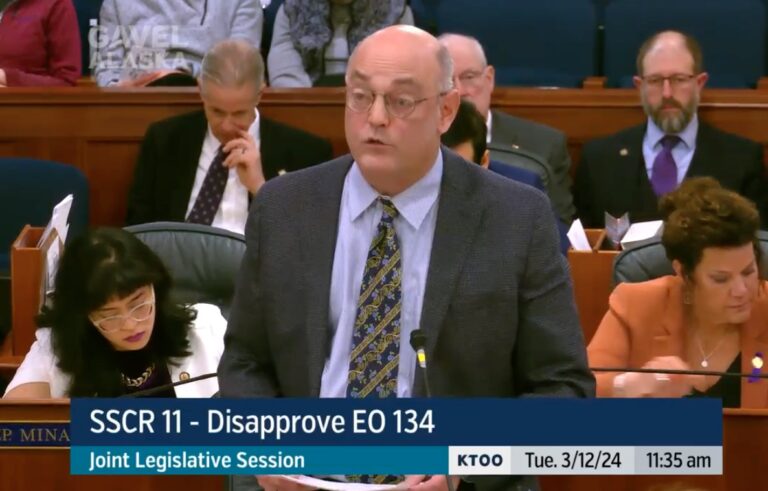
Although Senate Bill 140 is now a comprehensive education package with provisions for student transportation, correspondence schools, charter schools, teacher bonuses, help for deaf and hard-of-hearing children, and basic funding for school districts, it started out as a simple bill: Higher speed internet for schools in rural Alaska.

The text of the original bill is simple, and just 56 words:

“Each fiscal year, a district in which one or more schools qualify for a discounted rate for Internet services under the federal universal services program is eligible to receive an amount for each school that is equal to the amount needed to bring the applicant’s share to 100 megabits of download a second of the Internet services.”

What those 56b words mean is that rural schools with internet speeds of under 100 megabits of download time will be eligible for massive federal-state grants. Before, those grants were for rural schools that were only at 25 megabits.

But then, because it was an education bill, it got the Christmas-tree treatment in the House, which has a Republican majority that wanted to tackle a number of education issues, not the least of which is dealing with funding for schools. With a new majority in charge, now was the time to act on a variety of education priorities. The bill is now 19 pages long.

A look at the underlying bill doesn’t reveal much, until one looks at who may benefit: The bill’s prime sponsor is Sen. Lyman Hoffman, who is the paid board president of Bethel Native Corporation, a for-profit village corporation that, during the last round of rural fiber-optic grants, was a big player and made millions of dollars. He’s also co-chair of Senate Finance. He’s also on the Statewide Broadband Advisory Board.

Bethel Native Corporation in 2022 was awarded a $42.4 million grant from the National Telecommunications and Information Administration Tribal Broadband Connectivity Program to lay a 405-mile fiber optic network from Dillingham to Bethel.

“The project, to be completed in partnership with Alaska telecommunications provider GCI, will bring urban-level 2 gig internet service to consumers in Bethel and Yukon-Kuskokwim (Y-K) communities along the fiber route,” said the announcement in 2022, when the grant was awarded to BNC.

The BNC/GCI fiber project will follow a submarine route from Dillingham, where it will join an eventual Nushagak Electric & Telephone Cooperative long-haul fiber project, to the mouth of the Kuskokwim River, then follow an overland route the remainder of the way to Bethel. GCI was to be upgrading its local access network in Bethel and installing fiber to homes in Platinum, Eek, Napaskiak and Oscarville.

Bethel Native Corporation is a Hoffman family enterprise. Sen. Hoffman’s niece-in-law, Ana Hoffman is the CEO. Members of his family — a brother, a sister, and first cousins all make up the board of directors. There are only two or three members of the board not related to the Hoffmans in some way. The for-profit company has subsidiaries involved in the fiber-optic expansion business, such as AIRRAQ.

Read more about GCI’s partnership with AIRRAQ.

If SB 140 passes, school districts all across rural Alaska will be paying hundreds of thousands of dollars each to “last mile” companies like GCI to provide the higher-speed internet service. That cost will get passed along to the state of Alaska, as schools clamber for more money to pay for higher speeds.

“The Alaska School Broadband Assistance Grant (BAG) program was created to assist schools to increase internet download speeds. Established in 2014 by the Alaska State Legislature, this grant originally allowed schools to reach download speeds of 10 Mbps. In 2020, the State Legislature revised the statute to help schools reach 25 Mbps download speeds. SB 140 seeks to increase the download speeds to 100 Mbps,” wrote Sen. Hoffman in his sponsor statement last year.

In other words, the section now buried in 19 pages of other legislation is a gift to companies like GCI.

“New and improved technologies and increases to internet services have allowed for more and faster delivery of internet services. Because the cost of internet in some rural districts has decreased, the annual internet costs have fallen below benchmarks established by state law. To allow school districts to utilize these advances, SB 140 will increase the minimum requirement of Mbps from 25 to 100 which will increase the amount of Broadband Assistance Grants (BAG) to help school districts reach increased download speeds. Increasing the funding available through the BAG program in future years will allow schools to leverage more E-Rate funds to bring Alaskan schools in line with national standards for broadband connectivity,” Hoffman wrote.

In 2023, 151 Alaskan schools in 27 school districts benefited from the school BAG awards, many of them in the Bethel Native Corporation work zone.

Because of Hoffman is co-chair of the Senate Finance Committee, and because he is a member of the majority, little attention has been paid to the original bill and whether he has a financial conflict of interest, with Bethel Native Corporation deeply involved in fiber-optic internet. The mainstream media has ignored this section of SB 140 and who gets the money.

And Sen. Hoffman doesn’t seem to care what else is in SB 140 — he just wants it passed immediately.

The way megabits are paid for in Alaska is unique. The schools could already get the higher speeds, but in Alaska, broadband companies have a system where they get paid for every single megabit that goes through their lines. The amount they get paid per megabit is astronomical, compared to the Lower 48. This could be seen as a megabit hostage taking — they could release those megabits but will only do so if paid for them.

All the while, none of this funding goes to a cheaper and faster alternative: Satellite-based internet such as Starlink, which is designed for places like rural Alaska. Must Read Alaska has learned that in one far-west village in Alaska, teachers are not using the fiber-optic cable internet, but are bringing their Starlink dishes to work with them, setting them up outside the building, and running a line inside to their class.

In Scammon Bay, GCI provides 10 Mbps, while Starlink, for a fraction of the cost, provides 50-220 mbps to homes, although they have different speeds for the school. GCI could offer faster internet at the school, because it gets paid more.

Residential rates in Scammon Bay.

During a recent bid to provide service to the Lower Yukon-Kuskokwim School District, Microcom won the bid using Starlink terminals over GCI. Microcom came in at about one-tenth of the price.

But SB 140 favors fiber optic for some companies, while others, already providing satellite internet at high speeds and low prices, are not part of the money trail from the federal and state governments.

Murder trial to begin Tuesday in case of slain former legislator Dean Westlake

10

The trial of Tallon Westlake begins Tuesday morning. Westlake was indicted in the 2022 murder of his father, former Rep. Dean Westlake.

Dean Westlake, of Kiana and Kotzebue, was killed at a residence on Rovenna Street in Anchorage on Aug. 20, 2022. He had gone to the residence owned by his girlfriend, where his son was staying. He had planned to evict Tallon, but instead a fight ensued, and Dean Westlake was “pummeled,” according to the court record.

Tallon Westlake is now 38 and being held in Cook Inlet Pretrial Facility in Anchorage.

He was indicted by a grand jury on multiple counts in connection with the death, including first- and second-degree murder because he showed “extreme indifference” to his father’s life when he allegedly beat him to death.

Officers said when they arrived at the apartment, there were blood marks on hallway walls, kitchen cabinets, on Dean Westlake’s hands and feet, and on Tallon Westlake’s clothes. There was also a strong smell of bleach and evidence, including a mop, of an apparent attempt to clean the floor of blood. A bloody towel was found in the car outside, which belonged to Tallon.

Dean Westlake, age 62 at the time of his death, was elected in 2016 and resigned from the Legislature in 2017, after women in the Capitol accused him of sexual harassment; it was at the height of the #metoo movement, a time during which women were making lots of public accusations against men. It later became public that he had fathered a child with a 16-year-old girl in 1988, when he was 28 years old.

He was the Democrats’ pick to replace Barrow’s Rep. Ben Nageak, who chose to caucus with Republicans, who were in the majority.

The trial is scheduled for the courtroom of Judge Michael Wolverton at 8:30 am. Earlier this month, Tallon Westlake’s lawyers requested that the defendant be able to cover his facial tattoos during the trial or to “Preclude Evidence, Comment, or Reference to Mr. Westlake’s Tattoos,” according to the court record.

Kelly Tshibaka: Beyond politics to post-partisan solutions with Seneca Scott

By KELLY TSHIBAKA

This Black History Month, we reflect on how polarized America has become, whether racially, politically, religiously, or otherwise divided. In such divisive times, is unity even possible? Thought leaders are emerging to answer this question and forge a path of new unity.

One such leader is Seneca Scott, a cousin of the late Coretta Scott King, Rev. Martin Luther King Jr.’s wife. Following his family’s legacy of service, Seneca is the founder of a non-profit called Neighbors Together Oakland, a member of NAACP Oakland, a former candidate for mayor of Oakland, California, and a successful community organizer. 

Scott describes himself as a “post-partisan solutionary,” envisioning an America where politicians pursue policies that result in thriving neighborhoods and empowered citizens, regardless of which party promotes them.

“When you look at our two parties, they are coalescing into a very dangerous uniparty of sorts where they’re completely aligned when it comes to any interest of the elite and they’re leaving behind the masses of Americans … solutionaries means that we’re here to have a solution,” Scott said. “Leadership is action, not position.”

However, Scott did not always hold his views of a post-partisan America. Formerly a union leader, Scott describes his transition to becoming a grassroots organizer on Kelly Tshibaka’s podcast STAND.

In his interview, Scott states the post-partisan solution to many problems communities across the country face lies in how local residents choose to live and engage in their respective neighborhoods and communities. 

For example, Scott revealed that one tactic of the uniparty elite to maintain control is by disempowering voters through an intentional lack of education. He said liberal cities “like low information voters,” and went on to describe several tactics they use. “There’s very little education… but a direct move to emotion,” Scott said. “That’s what you saw with the Black Lives Matter and Antifa Uprising in 2020.” 

Scott’s experiences as both a community advocate and candidate for Oakland mayor provide a rare, dual perspective on the trials and tribulations of America’s communities.

He offered an analysis of the Defund the Police movement as it relates to his city: “Defund the Police in Oakland–when you have no rule of law, when 9-1-1 doesn’t work, and you don’t even have a cop to drive the street–it’s absolutely idiotic! …[Defund the Police] is the luxury politics of the elite.”

Scott calls for a move towards a post-partisan society, where integrity and results take priority over political affiliation, and can empower citizens to engage in community problem-solving. One solution he prioritized was addressing the root causes of homelessness. Scott attributed the rise in homelessness in Oakland to “drug tourism” rather than the cost of living. 

“Oakland had the longest standing eviction moratory in the United States of America. …Three-year eviction mortuary… We have over $100 million owed to small property owners … So if you didn’t have to pay rent and no one could be evicted, how does your homeless population skyrocket by 28%?” 

If you’re looking for inspiration from an effective community-change agent, you won’t want to miss Scott’s interview on STAND. You can also view the episode on YouTube, Rumble, and your podcast streaming platform. Seneca Scott is a former Democrat with thoughtful and innovative ideas, spearheading solutions that lead communities forward. 

Kelly Tshibaka is the host of the podcast, TV, and radio show STAND, and the 2022 Alaska Republican candidate for U.S. Senate. She co-hosts the show with her husband, Niki Tshibaka.

Kevin McCabe: Good legislation deserves honest dialogue, not rhetoric

By REP. KEVIN MCCABE

Primum non nocere, originally a medical maxim, translates to “first, do no harm.” This principle of ethics is the medical establishment’s guiding belief in virtually every country and is the hallmark for ethical medical practice, requiring healthcare providers to weigh risks and benefits carefully.

Whether prescribing medications, performing procedures, or making treatment decisions, the imperative to avoid harm guides every step. In the legislature the same ethical decision making must apply.

If we do apply the same principle to the Alaska State Legislature, it highlights our duty to preserve and protect the well-being of all Alaskans. As we navigate complex budgetary landscapes, this well-known maxim should shape our responsible care for the future of Alaska.

While it is essential to weigh the future risks our current budget decisions create, we must not forget the programmed funding increases that already plague our budget. This includes the $7 plus billion-dollar pension liability (from the previous defined benefits program) that remains unfunded, and the current education foundation formula spend.

Healthcare professionals are also cautioned to consider the potential harm any intervention from them might cause. When faced with a choice, it may be better to refrain from action if the risk of harm outweighs an uncertain benefit. This same principle must underly every decision, bill, and monetary choice the legislature makes. We must consider what any legislative decisions will cost Alaska in the next decade or century.

Just as physicians prioritize patient safety, legislators must prioritize the wellbeing and future welfare of their citizens when crafting legislation. Much like doctors tailor treatments to individual patients’ needs, legislators create laws and policies, through debate and deliberation, that directly impact Alaskans current welfare as well as the future health of Alaska itself.

Likewise, do no harm thinking should inform the various groups that are advocating for huge, programmed spending increases. With our current dependency on oil revenues, where is the money going to come from now, as well as in the future?

How is this spending going to affect our children and our grandchildren? Is there a quantifiable and measurable return on investment? Or just an uncertain benefit with a murky fiscal note? And if the benefit is uncertain, would we be better to refrain from passing a bill or spending the money?

Two bills currently in play that highlight what should be our process are SB 140 (the so called “BAG” bill which contains the possibility of a significant BSA increase); and SB 88, the Defined Benefits bill. 

SB 140 currently has an increase of $300 in the Base Student Allocation. This is not education funding as everyone seems to want to call it. It is school district funding. It goes to fund the business end of the school districts and will not necessarily filter quickly to the classroom in any great quantities. 

In some districts, such as the MatSu borough school district, increased funding does translate into current increased outcomes for our children. But does such an increase also create possible future harm to Alaska? At a price point of $27 Million for every $100 dollar increase to the BSA, a $300 increase will add $81 million dollars to every single budget going forward – a programmed increase to an already huge $2.7 Billion dollar education budget. 

Can future Alaska — our children and grandchildren — afford that? The return on investment might be obvious. But in our current budget crisis, what other program, that might contribute to the health and wellbeing of Alaska gets cut to afford this increase now, and how do we afford it in the future? What will future legislatures be unable to pay for because we have increased the BSA to this level.

Likewise, SB 88 has a very cloudy outlook, with possible huge financial implications for future Alaskans. With the current generation workforce attitudes against working for a single agency or company for their entire lifetime, the benefits SB 88 are intended to provide seem unlikely. In short, it has no decent return on investment for Alaska. The potential damage to Alaska, however, could be huge. It is a risk we should not take. 

As with any legislative action, whether bills or budgets, honest open dialogue is important from all sides. The sales pitches and social media memes, particularly from the groups pushing for a huge BSA increase and defined benefits, have been anything but truthful.

Their emotional rhetoric is designed to trigger and activate certain segments of Alaskans without really providing any factual data. It is also specifically designed to pit Alaskans against their elected representatives, without any dialogue or discussion, by ascribing untrue motives and actions to a legislature that, by and large, is trying to do no harm.

Rep. Kevin McCabe represents District 30 Big Lake (formerly known as District 8), and is a 747 captain.