For the fourth year, President Joe Biden has sent Congress a budget that cuts defense spending. It comes at a time when the Chinese Communist Party announced another 7.2% increase in their defense budget.
Alaska U.S. Sen. Dan Sullivan, a member of the Senate Armed Services Committee and chairman of the International Republican Institute, responded to Biden’s Fiscal Year 2025 budget request:
“Since President Biden assumed office, global chaos has spread, with the dictators from Russia, China, and Iran acting with greater impunity. In each of those four years, President Biden has proposed inflation-adjusted cuts to defense spending.
The budget significantly underfunds key enabling capabilities for the Pacific; cuts a submarine after the Department of Defense said the industrial base needed stability and budget growth; fails to maximize production rates of more than a dozen key munitions; decreases the purchase rate of tactical fighters; and slow the development and purchase of missile defense programs.
“This latest budget proposal thrusts the United States into even more dangerous territory—it puts the United States on track for our defense spending to drop below three percent of GDP for only the fourth time since World War II, which occurred in the years following the end of the Cold War,” Sullivan said.
“The President proposes using budget gimmicks and accounting tricks to spend billions above spending caps for non-defense programs, but makes significant cuts to, among other programs, the Missile Defense Agency and our submarine fleet, and slashes new orders of fighter jets—including F-35s. Meanwhile, he’s funding more than one hundred million dollars to cater to his far-left base—including a diversity, equity, and inclusion office in the Pentagon that has nothing to do with winning wars and lethality.
“If there ever was a time for this White House to reverse course on these weak defense proposals and deter global aggression, it is now. Jimmy Carter did this in his last year in office. We need our Commander in Chief to lead,” Sullivan said. “We need a defense budget that reflects global threats—with real increases, not cuts, that improve our military readiness, and project strength, not weakness, in an increasingly dangerous world.”
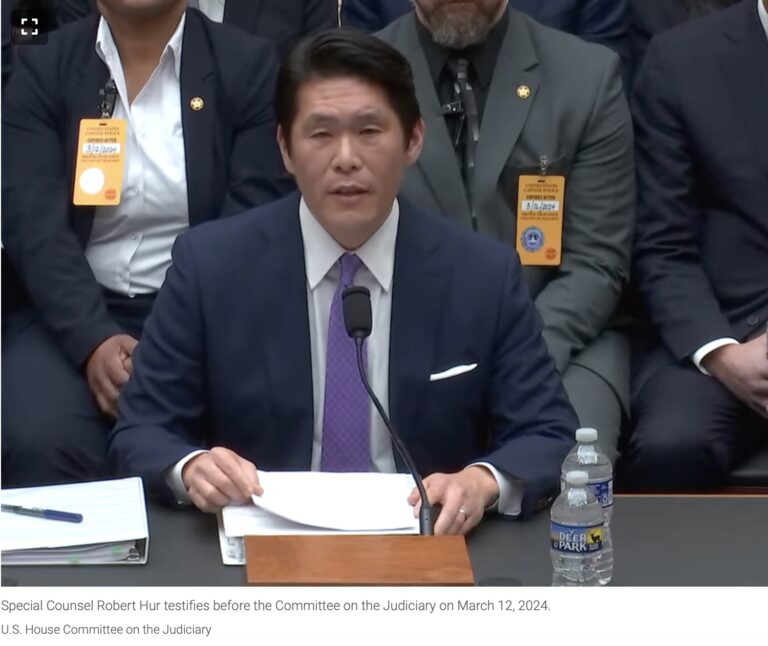
Special Counsel Robert Hur told the GOP-led House Committee on the Judiciary that his report was fair in both its assessments of President Joe Biden’s handling of classified documents and his memory issues.
Hur defended his 388-page report in his opening statement on Tuesday before the Judiciary Committee.
“There has been a lot of attention paid to language in the report about the President’s memory, so let me say a few words about that. My task was to determine whether the President retained or disclosed national defense information ‘willfully’ – meaning, knowingly and with the intent to do something the law forbids,” Hur said. “I could not make that determination without assessing the President’s state of mind. For that reason, I had to consider the President’s memory and overall mental state, and how a jury likely would perceive his memory and mental state in a criminal trial. These are the types of issues prosecutors analyze every day. And because these issues were important to my ultimate decision, I had to include a discussion of them in my report to the attorney general.”
Hur said given his assignment, it was important to show his work and how he reached his conclusions.
“My assessment in the report about the relevance of the President’s memory was necessary and accurate and fair,” Hur said. “Most importantly, what I wrote is what I believe the evidence shows, and what I expect jurors would perceive and believe. I did not sanitize my explanation. Nor did I disparage the president unfairly. I explained to the attorney general my decision and the reasons for it. That’s what I was required to do.”
Although a grand jury indicted Tallon Westlake for first degree, second degree, manslaughter, and evidence tampering in the death of his father, former Rep. Dean Westlake, an Anchorage jury acquitted him Monday on the first degree murder charge. The jury was hung on the other charges, however.
The death of Dean Westlake, who briefly represented District 40 out of Kotzebue, occurred Aug. 20, 2022, in what has been reported as a dispute over Tallon’s refusal to leave an apartment owned by Dean’s girlfriend on Rovenna St. in Anchorage.
Tallon was reportedly behind in rent and was being evicted by his father on behalf of his father’s girlfriend. Just before 7 a.m., Anchorage police received a call and arrived at the apartment with medics, who found Dean dead.
Officers said when they arrived, there were blood marks on hallway walls, kitchen cabinets, on Dean Westlake’s hands and feet, and on Tallon Westlake’s clothes. There was also a strong smell of bleach and evidence, including a mop, of an apparent attempt to clean the floor of blood. A bloody towel was found in the car outside, which belonged to Tallon.
Dean Westlake, age 62 at the time of his death, was elected in 2016 and resigned from the Legislature in 2017, after women in the Capitol accused him of sexual harassment; it was at the height of the #metoo movement, a time during which women were making lots of public accusations against men. It later became public that he had fathered a child with a 16-year-old girl in 1988, when he was 28 years old, which would have been indications of a sexual crime.
Dean was the Democrats’ pick to replace Barrow’s Rep. Ben Nageak, who chose to caucus with Republicans; at the time Republicans were in the majority and the Anchorage campaign team at Ship Creek Group was working to flip the House to Democrat control. Dean Westlake was one of the group’s first clients.
Tallon, now 38, faces the other charges, and the state may open a new trial, but won’t be able to retry him on first-degree murder. He is still in custody but his attorneys may ask for him to be released on bail and the state may ask for a retrial on the second-degree, manslaughter, and evidence-tampering charges.
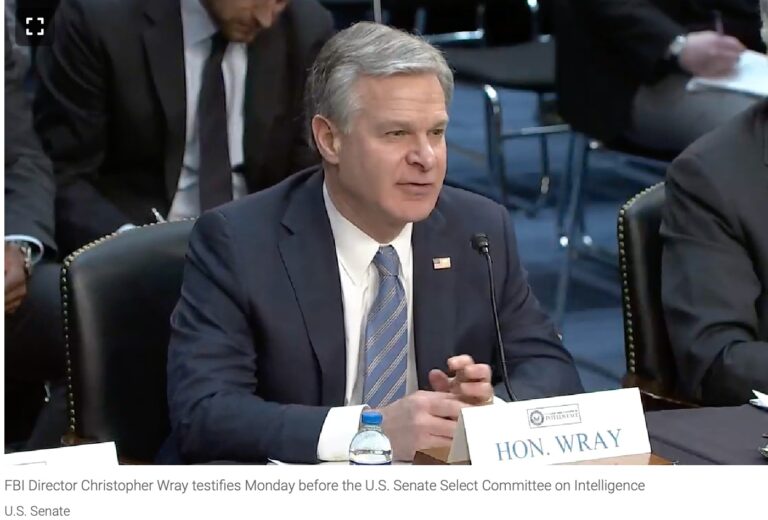
FBI Director Christopher Wray on Monday confirmed that a smuggling organization working with the terrorist organization ISIS is funneling criminals through the U.S. border. He also said the FBI is currently investigating its operations that “we’re very concerned about.”
In a U.S. Senate Select Committee on Intelligence hearing held on Monday on worldwide threats to the United States, U.S. Sen. Marco Rubio, R-Florida, asked Wray about threats coming through the U.S. border.
“Over the last three years, millions of people crossed the U.S. border illegally and many have been released into the country,” Rubio said, asking first about “people with ties to dangerous gangs.”
“Are we now seeing crimes from people that entered the country over the last three years, some of them with ties to gangs or other criminal organizations?” Rubio asked.
“From an FBI perspective, we are seeing a wide array of very dangerous threats that emanate from the border, and that includes everything from the drug trafficking” to violent crime, Wray said.
“But there’s no doubt people that were criminals in their country of origin have crossed that border and are now in the U.S. committing crimes?” Rubio asked.
Rubio also asked if Wray was familiar with “a black market emerging … to sell fake Social Security cards, fake Green Cards.” Wray said he was, and “there is a significant marketplace for different kinds of stolen identity” on the darknet.
Rubio then addressed human smuggling, saying, “There are smuggling networks all over the world that specialize in moving people from all over the world, including from the Middle East, Central Asia, and so forth. Are we aware of any of these smuggling organizations run by, or are conducted by, people that have ties, for example, to ISIS or other terrorist organizations?”
In response to questions asked by Sen. Marco Rubio, R-Florida, @marcorubio@FBI Director Christopher Wray acknowledged a smuggling organization with ties to ISIS is involved in funneling criminal aliens illegally into the U.S. through its borders at a U.S. Senate Select Committee… pic.twitter.com/19G46uINVZ
“I want to be a little bit careful how far I can go in an open session,” Wray said, “but there is a particular network that has where some of the overseas facilitators of the smuggling network have ISIS ties that we’re very concerned about. What we’ve been spending enormous amount of effort with our partners and investigating exactly what that network is up to, is something that’s again, the subject of our current investigation.”
“But there is a network we’re concerned about that has facilitators involved in it that have ties to ISIS?” Rubio asked.
“Correct,” Wray replied.
Wray’s testimony comes after 10 retired FBI directors and experts in counter intelligence warned congressional leaders in January that President Joe Biden’s border policies have facilitated a “soft invasion” into the U.S. of military-age men coming from terror-linked regions, China and Russia. They also warned a terrorist attack is likely imminent but preventable.
His testimony also comes after Border Patrol and Customs and Border Protection agents have apprehended the greatest number of known or suspected terrorists (KSTs) in U.S. history, with the greatest number of apprehensions occurring at the northern border.
In fiscal 2023, the greatest number of KSTs were apprehended in a fiscal year in U.S. history, 736, The Center Square first reported. A significant majority – 66% – were apprehended at the northern border, 487. By comparison, 249 were apprehended at the southwest border.
In the first quarter of fiscal 2024, KST northern border apprehensions continued to outpace those at the southwest border by a similar margin, The Center Square reported on Feb. 1.
At that time, fiscal year to date, 144 KSTs had been apprehended, according to data last updated Jan. 26.
That number has since increased to 168, with the majority, 104, being apprehended at the northern border, according to CBP data last updated Feb. 14.
Former CBP and Border Patrol chief Mark Morgan and former ICE chief Tom Homan have both told The Center Square, Biden’s “open border policies have created the greatest national security crisis since 9/11.”
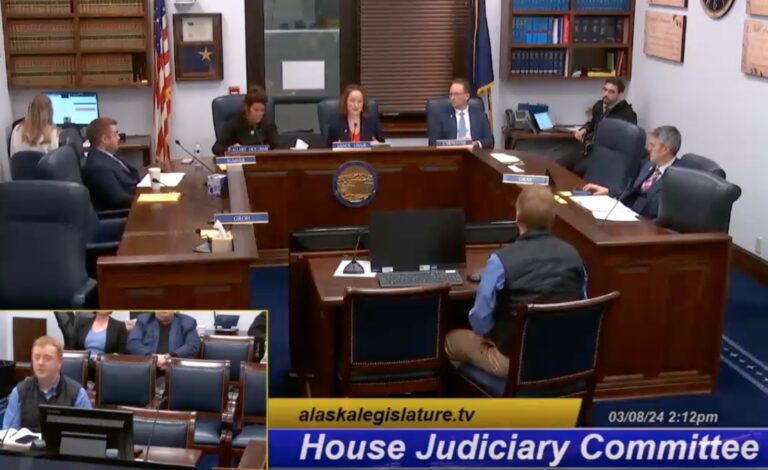
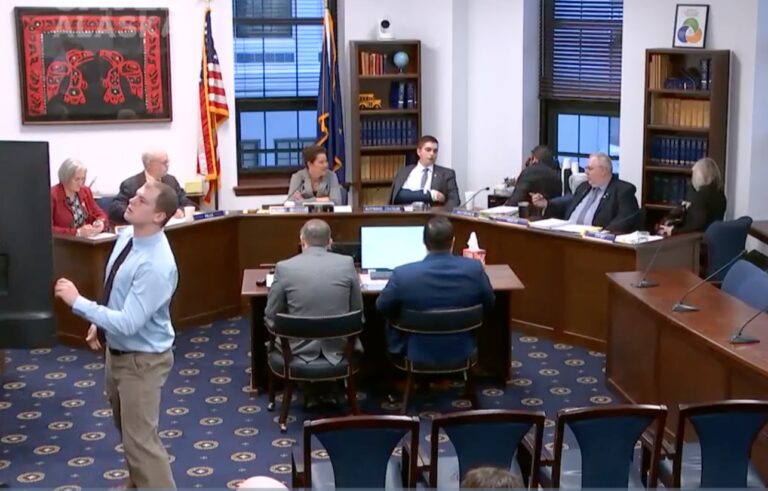
The legislature recently held confirmation hearings for three appointees to the hyper-partisan Legislative Ethics Committee. I highly recommend watching the first hearing, as it offers a rare glimpse into why it is not at all surprising to legislators that Alaska was just again ranked the #1 most corrupt state in the union.
By the end of the hearing, Democrats on the committee were in full blown damage control mode.
For years, the unelected members of the Legislative Ethics Committee have operated as highly partisan quasi-legislators who have never actually been elected to any office.
Because they were never elected and are therefore not subject to recall, they don’t represent voters. Nominally, they represent the chief justice of the Alaska Supreme Court, who appoints them to 3-year terms. However, since most of the public members have worked with the committee for well over twenty years, for all practical purposes, they simply represent themselves.
This is what was on full public display during yesterday’s confirmation hearing.
While the committee is supposed to be politically neutral, of the six individuals currently appointed to the committee by the chief justice, four participated in the effort to recall Governor Dunleavy (a no-no for appointees to the committee), the fifth appointee has teamed up with the ACLU in her current lawsuit against the Division of Elections and received a $50,000 contract from the Ethics Committee itself (a clear no-no for appointees to the committee), and the sixth appointee is a Democrat megadonor with frequent donations to groups like “Stop Republicans” and the Alaska Senate Democratic Campaign Committee (again a clear no-no for appointees to the committee).
According to testimony from the returning appointees, they see nothing wrong with the current makeup of the committee and would like it to continue “for the sake of continuity”. Democrat legislators on the Judiciary Committee were also quick to applaud their “many years of service” on the Ethics Committee, despite the fact that all three appointees have participated in clear ethics violations since their appointment.
While the recall petition and lawsuit were each mentioned in passing, the bulk of the committee’s questions related to the fifth appointee, Joyce Anderson. She received the $50,000 contract from her long-time fellow members of the Ethics Committee (a no-no for an appointee to any committee, least of all an appointee to the ethics committee).
Her fellow members of the Ethics Committee saw nothing wrong with this arrangement. She asked the attorney they hired and he said it was ok.
Even so, when she was asked during her confirmation hearing what her hourly rate was under the contract she refused to answer.
It is an interesting study in human psychology to watch as individuals who have been sitting on the Ethics Committee, enforcing public transparency requirements for decades, come finally to view those same public transparency requirements as entirely optional in their case.
Imagine the state of mind required to have an hourly state contract of up to $50,000, paid by taxpayers, then to come before the legislature for a confirmation vote and refuse to answer questions about how much you were getting paid for your work.
The irony here is that when this contract was about to be voted on by the ethics committee a fellow member of the committee asked her on the record what her hourly rate was, and she declined to answer then as well. At the time, she dodged the question by saying that she didn’t know what her hourly rate was, but that her hourly rate had been approved by the committee at their previous meeting. Only, it never was.
The hourly rate for each of the committee’s contracted staff were discussed in detail and approved at a previous meeting; that is, the hourly rate for every contract, except hers.
The Contract That Never Was
The missing details from the contract sparked questions over how the contract had come to be approved in the first place, and by whom. Notably, when the Judiciary Committee requested a copy of the missing contract they were informed that a copy of the contract was unavailable because no such contract actually existed.
The contract that the public was told had been approved by the Ethics Committee turned out not to be a contract at all. The chair of the Ethics Committee, whom Ms. Anderson had worked closely with for the last twenty-three years, and whom she anticipated continuing to work closely with for another 3-year term, arranged for her to instead be hired as a legislative employee with full benefits.
Of course, state law (that same law the Ethics Committee is supposed to be enforcing) explicitly bars a legislative employee from being appointed to, or serving on, the Ethics Committee.
“A legislative employee may not serve in a position that requires confirmation by the legislature.” (AS 24.60.030(f))
“A committee employee, including a person who provides personal services under a contract with the committee, may not be…an elected or appointed official…” (AS 24.60.130(f))
“Public members of the committee serve without compensation for their services…” (AS 24.60.130(f))
Ms. Anderson, while serving as a voting member of the Ethics Committee, was also hired as a legislative employee of the Ethics Committee on July 17, 2023. At the August 10th meeting of the Ethics Committee, she sought blanket, retroactive approval of her employment, described then as a contract, She also requested a retroactive “temporary leave of absence” beginning on July 17th. As a voting member of the committee, when the vote was taken she abstained from voting on her own request.
Because of the inherent conflict of interest associated with hiring someone with whom you are currently working on a board (and in this case had served with on the same board for many years and intended to serve with on the same board for many years to come), our state ethics laws explicitly bar you from continuing to hold your appointed seat on that same board. This would be true for any legislative committee, least of all an ethics committee.
It is noteworthy that none of the permanent members of the ethics committee noticed anything inappropriate with this arrangement at the time. It is perhaps even more notable that when Ms. Anderson and Mr. Cook were questioned about it they continued to insist that retroactive approval from their fellow members on the committee fully resolved the conflicts.
Ms. Anderson’s employment with the committee began on July 17th and continued through February 21st. While employed by the legislature, Ms. Anderson continued to serve alongside other committee members on the committee’s official subcommittee. While employed as a legislative employee, she also went to meet with the chief justice and lobby him to reappoint her to the Ethics Committee, which he did. When questioned about the propriety of this, she did not see anything wrong with this.
As there were some concerns that the legislature might not immediately confirm appointees who had already served on the committee literally for decades, the committee requested that the chief justice delay reappointing members of the committee until their current terms of office had already expired. By intentionally delaying the reappointments until later in the legislative session, current members of the committee could stay on the committee an extra year, even if the legislature flatly rejected their reappointment. The chief justice did so. Again, when questioned, Ms. Anderson did not see anything concerning about this.
As Ms. Anderson reported, she appraised the chief justice of the circumstances surrounding her continued employment with the committee and he saw nothing wrong and went ahead and reappointed her, despite the fact that she was legally barred from accepting an appointment to the committee while continuing to be employed by the legislature.
“A legislative employee may not serve in a position that requires confirmation by the legislature.” (AS 24.60.030(f))
No doubt a retroactive leave of absence from some of her long-time colleagues on the committee will be in the works for this latest appointment as well.
After all, the hyperpartisan character of the committee could be put in jeopardy if even one member of this committee ever retires.
Given that the four longest-serving members of the committee, including Ms. Anderson, average more than twenty years a piece with the committee, efforts to retain the current political orientation of the committee are likely to grow increasingly difficult over time.
Sen. Lisa Murkowski has found her inner-Justice Anton Scalia, and suddenly is a strict constitutionalist.
Last week, during votes on an amendment to require the U.S. Census to only consider actual citizens of the United States when determining population shifts that lead to changing political boundaries, Alaska Sen. Lisa Murkowski was the only Republican to vote “nay.”
The question is whether the U.S. Census should ask the question: Are you a citizen? It matters, since over 7 million illegals have entered the country in just three years of the Biden Administration. Illegals in just those three years equal more than the population of 36 states.
As of June 2023, approximately 16.8 million illegal aliens live in the United States. “This is significantly higher than our January 2022 illegal alien population estimate of 15.5 million,” according to the Federation for American Immigration Reform. That’s over 5 of every 100 people living in America, and they are concentrated in places where it could lead to greater congressional representation.
Counting those individuals and assigning congressional boundaries based on them helps Democrats. All other Republicans appeared to understand it that way, but Sen. Murkowski does not apparently see this as a problem for Congress to solve. She’s going by the strict meaning of the word “persons.” Criminals who come across the border and murder joggers like Laken Riley? They are persons to be counted in order to redraw political boundaries.
The apportionment of seats in Congress is detailed in the U.S. Constitution, which says the census is used to divide the House of Representatives “among the several States according to their respective numbers, counting the whole number of persons in each State,” except for slaves, who were counted as three-fifths of a person until the late 1800s.
The amendment she voted against was Tennessee Republican Sen. Bill Hagerty’s motion to concur with a House amendment that said the census should determine the number of citizens as those who are actually citizens, not just illegals who illegally punched through the porous border.
Hagerty said, “I think most Americans are shocked to find out that today illegal migrants are used in the calculation of the number of people in a given state to allocate congressional districts and electoral college votes to that state. Lara [Trump] is exactly right; Democrats are basically harvesting electoral power on the backs of these illegal migrants. It shouldn’t be happening, and when I put a simple vote forward that only citizens can be counted for the purposes of allocating congressional districts and electoral votes, the Democrats just went nuts.” Hagerty made the statement on Fox News’ “Mornings With Maria” show.
“[Senator] Chuck Schumer threatened to shut the government down; we ground it down to the very last hour. Finally—I think they had an important event that they needed to attend—they agreed to put it to the floor for a vote. And as you said, every single Democrat voted to not allow just citizens alone to be counted, but to also include the counting of illegal migrants,” he said.
“Now, think about where people are fleeing in this nation. Citizens are leaving New York. They’re leaving Illinois. They’re leaving California, where the sanctuary city [is] located. New York City, Chicago, San Francisco, Los Angeles, they’re actually creating these magnets so they can backfill and create more ‘bodies’ to count so that they can get more electoral votes,” he said.
“And we got one of the U.S. [Congresswomen] from Brooklyn, Yvette Clark, said the quiet part out loud just the other day. She said, ‘I need these illegal migrants for purposes of redistricting.’ And you know what’s so rich, Maria? Her district, the same one that Chuck Schumer used to have when he served in the Congress, her district, the school, to go home and study [on] Zoom because they needed that schoolhouse to house illegal migrants. That’s what’s happening here in America; that’s the motive behind the crime at our border.”
Sens. Bill Cassidy, of Louisiana and Hagerty, along with other Republican colleagues had earlier introduced a stand-alone bill called the Equal Representation Act, to ensure that only legal citizens are factored into the count for congressional districts and the electoral college map that determines presidential elections.
“The current method of counting illegal immigrants for purposes of representation serves as a perverse incentive for open borders to boost the relative political power of the states and voters that court it,” his office said. “It is unconscionable that illegal immigrants and non-citizens are counted toward congressional district apportionment and our electoral map. While people continue to flee Democrat-run cities, desperate Democrats are back-filling the mass exodus with illegal immigrants so that they do not lose their seats in Congress or their electoral votes for the presidency, hence artificially boosting their political power and in turn diluting the power of other Americans’ votes. I’m pleased to introduce this legislation that would require a citizenship question on the census and will ensure that only citizens are counted in congressional redistricting.”
And so it begins in earnest. Super Tuesday’s results, expected though they may have been, bring us the 2024 presidential campaign, and it looks like it’s going to be an ugly eight months.
The incumbent can’t stand his predecessor and there’s absolutely nothing Democrats want more than to keep Donald Trump out of the White House; so much so that they will stick with their party leader despite his obviously advancing dementia, low popularity, and embarrassingly unqualified vice president.
Perhaps because Biden’s clouded mind makes him easy to handle, or because there’s no other Democrat on the national stage that can rally the collective, the president’s party is staying with him, gambling that either Trump hatred runs deeper than party lines or the bevy of legal complaints by Democratically-controlled prosecutors will keep their man propped up at the podium.
Similarly, Trump supporters can’t fathom a second Biden term. The difference between the two party’s attitudes seems to be that the Democrats’ distaste for #45 is personal while the Republicans’ complaints are political. Democrats hate Trump with a passion never before seen in American politics. And that’s saying something. Trump supporters, on the other hand, want Biden gone because his presidency has been an unmitigated disaster and they fear the very survival of our republic is at stake.
Nikki Haley’s dreams of a Bill Mazeroski* miracle fizzled on Tuesday, and Robert Kennedy Jr.’s presidential bid is coming down to a long-shot third party (possibly as a Libertarian?) bid.
So, if Biden can fend off forced admission to a senior citizens’ home and Trump can fend off forced admission to a federal penitentiary, then our presidential choices this November will be the same as they were four years ago.
Allow me, please, to now completely anger many of my fellow conservatives.
I voted for Donald Trump twice, the second time being much more hesitant than the first, and I will fill in the oval for The Donald again, but would rather not be in the position to have to do so. Trump’s record as president was impressive. He curtailed the influx of illegal aliens and was constructing a wall that would have curtailed it even more. The economy was doing well prior to the Covid hysteria that swept the nation with the help of the mainstream media. Our enemies abstained from invading fellow Slavs or despised Semites.
If Donald Trump had articulated his accomplishments clearly and with a sense of decency, he would still be in office. Instead, his bombastic demeanor and constant tweets provided fodder for his opposition, and great distaste for those important voters sitting on the fence.
It is perfectly understandable that conservatives find Trump’s confidence and acerbic oratory motivating. Republican presidential candidates over the previous three decades – Bush 41, Bob Dole, John McCain, and Mitt Romney – were anything but combative, despite the extraordinary military records of the first three. Democrats and non-partisans found Bill Clinton and Barack Obama charismatic and full of inspiring rhetoric. Sure, large doses of political correctness, racial guilt, and a desire to set precedents helped them (especially Obama), but they articulated their messages clearly and with vigor.
Perhaps Ronald Reagan spoiled it for those of us on the right. Republicans longed for a candidate who could communicate like the Gipper, or at least stand up to the attacks from the left. Trump doesn’t get his point across like Reagan, but he certainly stands up to the left and – even more so – to his critics.
This is refreshing and invigorating, but it is also Trump’s biggest weakness; not among his diehard supporters (the MAGA crowd, as they have derisively become known) but among those who want to support him and see him succeed, but find his mannerisms off putting.
Donald Trump has a unique opportunity. His opponent is unpopular and inarticulate. If Trump can compare his administration’s record to Biden’s record, and do so in a manner that comes across as presidential and not petty or condescending, then hesitant conservatives and centrists will have feel more comfortable voting for him. Many of us are praying he does so.
_____________________
*In 1960, Bill Mazeroski hit a home run in the bottom of the ninth inning to win Game Seven and give his Pittsburgh Pirates a World Series victory over the heavily favored New York Yankees, despite the Yankees outscoring the Pirates 55 to 27 during the Series.
_______________________
Tim Barto is a regular contributor to Must Read Alaska, and is holding his breath for the next eight months.
One of the most contentious pieces of legislation this year has been Senate Bill 140, a bill chock full of changes in K12 education.
The battle lines have been drawn between the governor and the Education Industry concerning who can start (who may authorize) a charter school.
The governor wants to increase the number of charter schools, which are public schools, by allowing the State Board of Education to authorize them, in addition to the existing districts that are authorizing bodies.
Gov. Mike Dunleavy points to areport from Harvard University that says Alaska has the best charter schools in the nation.
And he is correct.
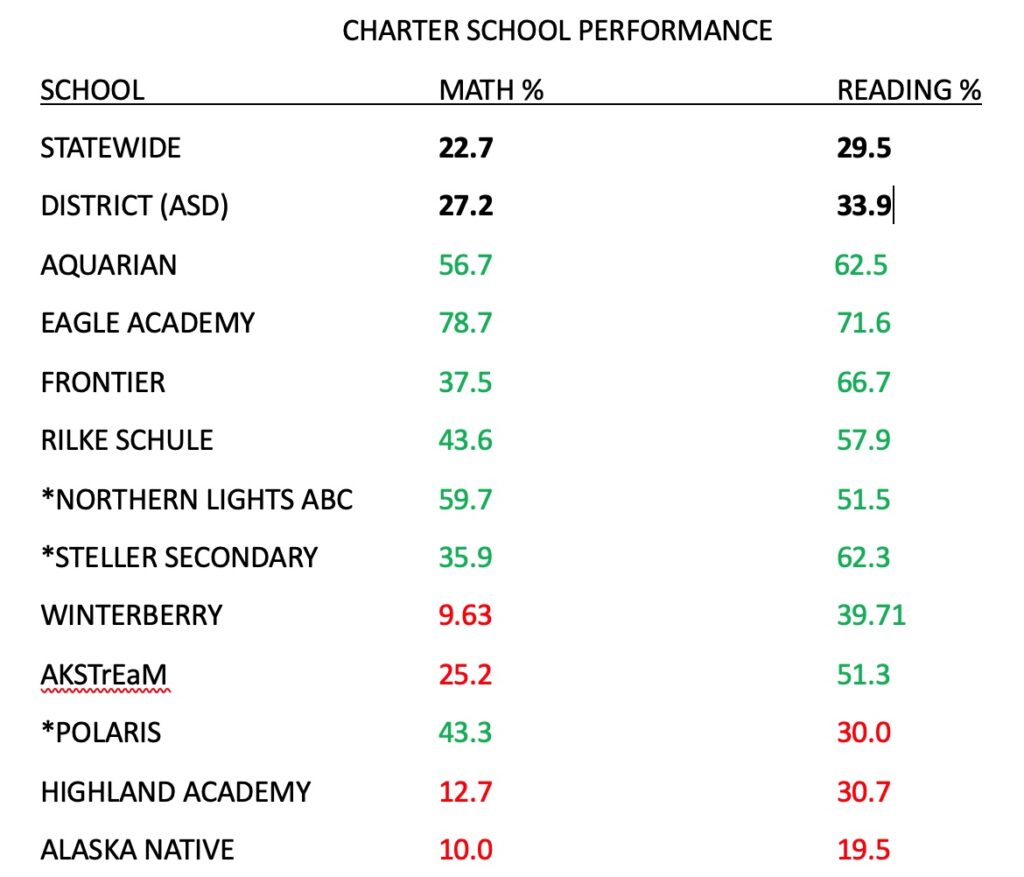
In the Anchorage School district our charter schools have performed well above the state’s and district’s student achievement. Here is a list of ASD charter schools’ test scores compared to the State and ASD. Scores are for all students in all grades:
The green indicates above district average scores; the red indicates below district average scores.
Northern Lights ABC, Steller Secondary, and Polaris schools are not charter schools but there is strong demand and keen competition for entry from parents. In that regard, they are similar to Anchorage charter schools.
As one can see, the charter schools, excepting one, perform well above the Anchorage neighborhood schools in reading. The Alaska Native Charter School is a Title I school and does perform well above the other Title I schools in the district.
That is why there is, and always has been, a strong demand by parents to enroll their children into these better performing schools.
And that is why there has always been a long wait list for many of these schools.
School
Waitlist
Alaska Native Cultural Charter
3
Aquarian Charter School
201
Eagle Academy Charter School
146
Frontier Charter School
0
Highland Academy Charter School
0
Rilke Schule German School
0
STREAM Charter School
23
Winterberry Charter School
154
Northern Lights ABC
48
Birchwood ABC
19
Polaris K-12
603
Steller Secondary School
25
Parents know which schools perform well and want their children to attend.
They are engaged in their kids’ education.
If the demand is high, why doesn’t the district meet the demand with more charter schools?
For one, the ASD does not make it easy to start a charter school. However, when the district wants to start a new neighborhood school, it merely floats a bond and builds the school.
To start a charter school, parents must form a team with many different talents, write a 100-plus page business plan, find a building, and then get it approved by the school board.
You see, the district has all the power. It sets the criteria for approval and stifles innovation-just what the charter schools are meant to do-innovate. It limits the number of students that can attend a charter school. And it can limit the number of years a charter can exist.
That is exactly why Gov. Dunleavy wants to provide more charter school choice for parents by allowing the State Board of Education to authorize charter schools.
He wants to meet the demand with a supply, just what a private business would do.
The governor wants to loosen the shackles of district control and grow the number of charter schools, so parents have more choice for their kids.
Many other states have multiple charter school authorizers. Only five states, including Alaska, limit authorizers to local school districts. Twenty-nine states allow other entities to authorize charter schools
Guess what? Those 29 states have not lost local control.
And 16 states allow their universities to start charter schools. The University of Alaska could even be an authorizer of its charter schools for employees and staff.
But the Education Industry still yells foul. It cries, “We would lose local control!” That would be code for “losing monopolistic control over education.”
Let’s compare the K-12 monopoly to the current Kroger/Albertson’s grocery store merger.
Twenty-four of our 60 legislators have opposed that merger, crying foul to the Federal Trade Commission.
They said, “We cannot, in good conscience, support the unnecessary cost increases that place barriers on Alaskans’ ability to put food on the table.”
Now let’s reword that phrase in K12 education terms: “We cannot, in good conscience, support the unnecessary costs that place barriers on Alaskan students to achieve their maximum potential.”
Why oppose a private monopoly yet support a public monopoly?
Instead of “local control,” let’s have parental control.
Let’s give parents more choices to educate their children. If there are fewer choices, the K-12 public school system may see parents leaving the system for better education options.
When the Anchorage School Board revoked the charter of the Family Partnership Charter School, more than 750 parents voted with their feet and left the school.
When a school district removes a school’s charter, the parents have no legal recourse to appeal the removal. In theory, a district could approve a charter school and the next year revoke that same charter.
Recently, Larry Persily wrote an op-ed which harshly criticized Gov. Dunleavy’s position on charter schools. He doesn’t seem to know that charter schools are public schools.
He states, “Charter schools pull the most promising students with the most engaged parents out of our schools, further weaking public education.” Mr. Persily, Alaska charter schools are public schools. Parents are clamoring to get their kids into these schools. This is why there are wait lists.
Why would anyone want to keep “the most promising students” down?
Persily further says that charter schools are not required to provide transportation, making it harder for single parents and low-income parents to get their kids to charter schools.
We do agree with Persily on that count. But here’s the rest of the story—school districts get state funding for transporting all students, including the charter students.
The ASD gets $481 per student for transportation. This includes the charter students. But it doesn’t transport the charter students. The district gets $1,108,705 to transport all 2,305 charter students, but leaves them at the bus stop.
That can be fixed by the Legislature and should be fixed. In the name of equity, charter school students should not be discriminated against when it comes to providing transportation.
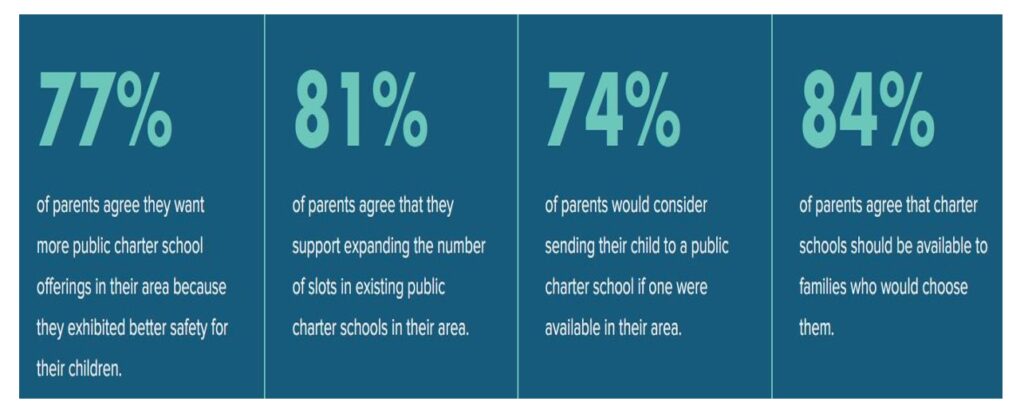
The Harris Poll conducted a survey of 5,000 parents in 2022. Parents overwhelmingly want their freedom to choose the best education option for their children. That is true across all races, political ideologies, and geographies.
Here is a graphic summary of the poll (source: The National Alliance for Public Charter Schools):
Gov. Dunleavy knows that charter schools perform above their neighborhood counterparts. He is also aware that parents, not K-12 bureaucrats, know what’s the best education fit for their children.
So, let’s meet the demand for more charter schools by allowing the State Board of Education to start/authorize new charter schools.
Let’s allow the University of Alaska system to also authorize its charter schools.
Give parents a choice. Give students a chance to maximize their futures.
It’s past time to break up the school district monopoly over charter schools and provide more charter school options to Alaskan children.
The National Alliance for Public Charter Schools gave a presentation to the House Education Committee on March 11, 2024. Here is a link to learn more.
David Boyle is Must Read Alaska’s education writer.
Pacific Fishing, a Seattle publication serving the North Pacific commercial fishing industry from Alaska to Hawaii for more than 40 years, has stopped publication, it was announced Sunday by editor Wesley Loy.
“The owner and publisher of Pacific Fishing magazine is retiring. We are actively pursuing a new owner to carry on the publication,” the magazine announced, according to Loy’s Deckboss.com blog. He said the magazine’s last issue was in December.
The daily Fish Wrap news service also will be suspended, Loy said.
Pacific Fishing provided “news and features for predominantly commercial fishermen readers engaged in a dangerous and often economically tumultuous industry,” according to the announcement by Loy, who previously wrote for the Anchorage Daily News.
“Pacific Fishing is the premier monthly magazine serving owners and operators of commercial fishing boats throughout the world’s most profitable ocean, from Alaska to the tropical Pacific. Our readers include crew members, processors, fisheries managers, suppliers, seafood brokers and distributors, educators and others who want serious information about the business of hauling up – and selling – food from the Pacific,” the magazine says on its “About” page.
The magazine’s owner and publisher is Mike Daigle, of Seattle.