The Juneau Police Department was following up on an assault that occurred on July 14, when an officer contacted a downtown well-known homeless vagrant, 35-year-old Steven Kissack. The entire incident, involving JPD and an officer, was captured by people nearby on video and posted on social media. Various people in Juneau held a candlelight vigil for him.
At the Juneau Assembly meeting, city manager Katie Koester called it a tragedy. Others said it was a tragedy the man had been enabled to live as he did for so long, camping on downtown Juneau sidewalks. He has a long criminal record involving trespass, illegal camping, and violation of conditions of release.
Alaska Department of Public Safety provided an account: While trying to get Kissack to submit to an investigation, Kissack, , during the contact Kissack produced a knife and refused to follow orders from the officer. The Juneau Police Officer requested additional law enforcement officers in the area to respond for assistance, and a Juneau-based Alaska Wildlife Trooper and several JPD Officers responded to the scene.
Officers negotiated with Kissack for several minutes encouraging him to drop the knife he was brandishing, however, he continued to refuse commands. Juneau Police Officers deployed less-lethal bean bag-style rounds to encourage Kissack to comply with the orders of the officers.
Kissack soon charged officers while brandishing the knife. Multiple law enforcement officers discharged their weapons, striking Kissack. Several shots were fired. Despite lifesaving efforts by law enforcement on the scene and EMS, Kissack was declared deceased at a Juneau area hospital. No law enforcement officers or bystanders were injured. Kissack’s body will be sent to the State Medical Examiner’s Office for autopsy. His next of kin have been notified.
The Juneau Police Officers who discharged their weapons have been placed on administrative leave. The Alaska Wildlife Trooper who discharged their weapon has been placed on 72 hours of administrative leave in accordance with DPS policy, and their names will be released in three days.
The Alaska Bureau of Investigation is the lead investigating agency. Once their investigation is complete, it will be independently reviewed by the Alaska Office of Special Prosecutions to determine if the lethal use of force was justified.
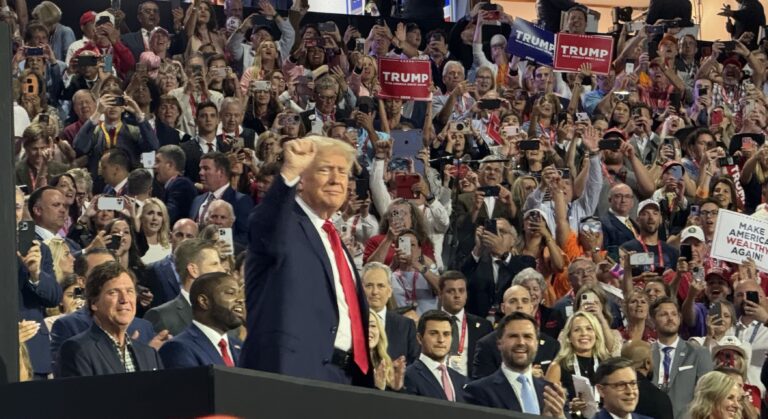
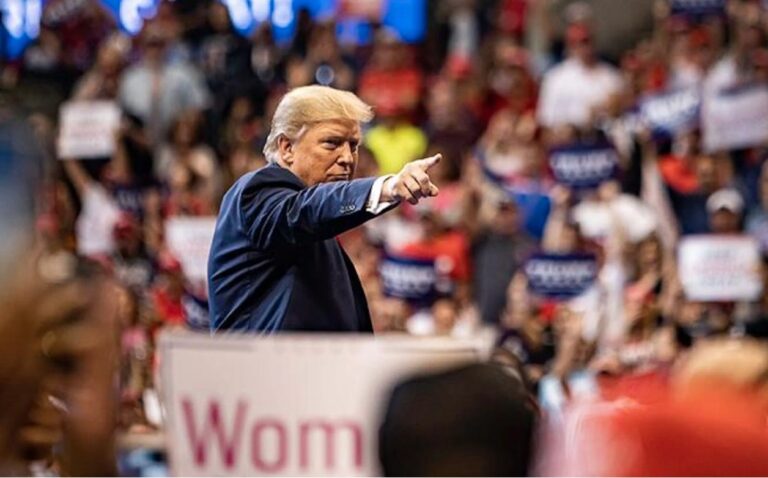
Former President Donald Trump entered the Republican National Convention in Milwaukee, Wisconsin to a roaring welcome from the crowd of thousands of Republican delegates, only two days after barely surviving an assassin’s bullet in Pennsylvania.
One of his ears was covered by a rectangular bandage as he entered Fiserv Forum on Monday, while people chanted “USA! USA!” and “Fight! Fight!” Hours earlier, he had received the official nomination from the party, after all state and territorial delegations announced their votes.
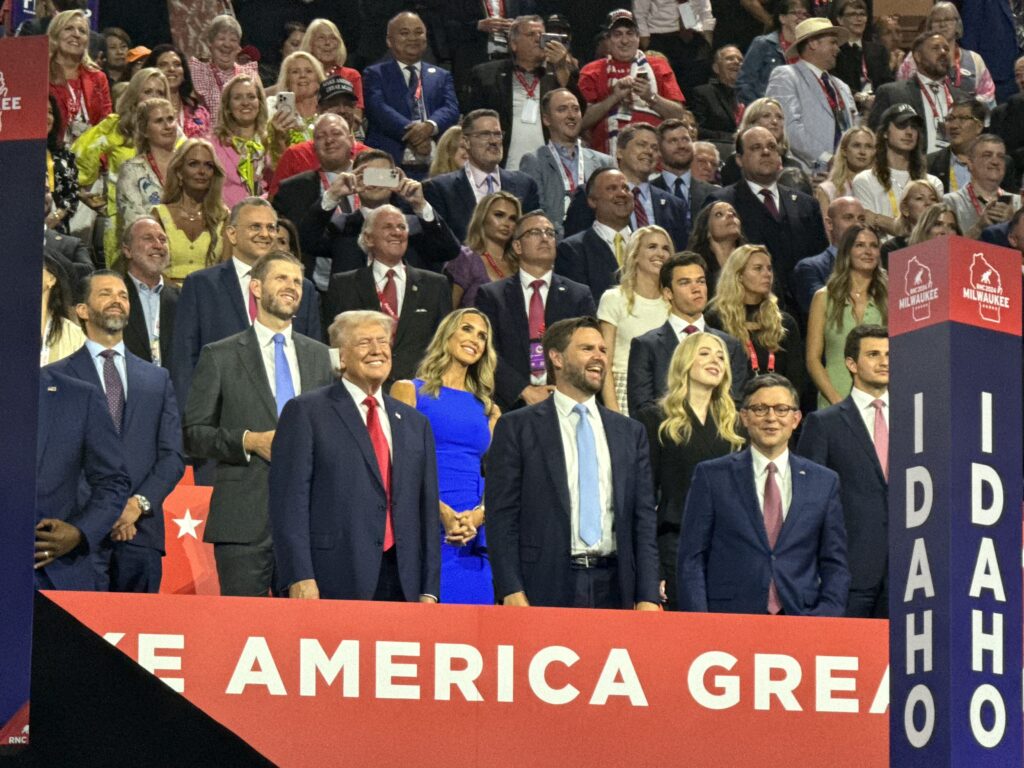
Donald Trump and J.D. Vance react to the enthusiasm of the crowd in Milwaukee, Wisconsin. Photo credit: Carmela Warfield, Alaska Republican Party chairwoman.
“Our Alaskan delegation and the arena as a whole erupted when the President came into the building. It was truly a hero’s welcome. We have the energy, we have the enthusiasm, and we have the candidate to lead our country into the future,” said Alaska Republican Party Chairwoman Carmela Warfield, who leads the Alaska delegation.
Nick Begich commented on how the arena was filled with emotion.
“Donald Trump was very clearly emotionally affected by the overwhelming support of thousands from across the country. Here is a man who only two days prior survived an attempted assassination and who knows undeniably it was by divine providence alone that he is alive today. America supports Donald Trump. America needs Donald Trump and we are united behind him,” Begich said.
Watch the scene in this video sent to Must Read Alaska by Nick Begich, candidate for Congress, who is in the arena:
Congressional candidate Nick Begich raised $311,000 in the second quarter of 2024, a 44% increase over his previous quarter and his best showing yet for the 2024 campaign.
Overall, Begich’s campaign has raised about $919,000 with nearly 60% of it coming from Alaskans since he filed one year ago on July 13, 2023. Campaign money is used to help him travel around the state, connect with and listen to Alaskans, and pay for campaign expenses leading up to the Aug. 20 primary election.
Nancy Dahlstrom, a Republican candidate who filed in November, has raised about $860,000 in all, with more than 80% of it coming from outside Alaska, mostly from Washington, D.C. political groups.
But the fundraising behemoth in this campaign is incumbent Rep. Mary Peltola, who has raised some $2.4 million this quarter alone, primarily from Democrat groups outside Alaska, such as Planned Parenthood.
It’s an example of how the Republican vote is being split and weakened in Alaska by having two Republican candidates in the race. Combined, Begich and Dahlstrom have raised an amount competitive with incumbent Peltola, but those who donate to Republican campaigns have held back because there is not certainty as to who will come out ahead in the primary, and with an open primary, the same candidates will be seen on the November ballot, unless one of the Republicans drop.
At this point, polling shows Begich to be in a strong position to take on Peltola in November, but that when the ranked-choice voting scenario presents another challenge to Republicans, whereas Democrats only have one viable candidate.
Nevertheless, momentum continues to build in the Begich campaign, and his fundraising efforts prove it. His latest financial report for the second quarter of 2024 is his best quarter yet — a sign that Alaskans continue to rally around his message. Over 5,000 donations were from small-dollar contributors, and he is the only candidate who can make this claim.
“National Democrats and Outside special interests are determined to to keep this seat and continue to flood the state with money. But it’s clear who Alaskans want to represent them and I’m honored to have their support. When elected, it’s Alaskans I’ll represent,” said Begich. “I will not be a Representative who forgets where they come from or who they represent.Together we will move our state and nation forward, giving new hope and opportunities for future generations.”
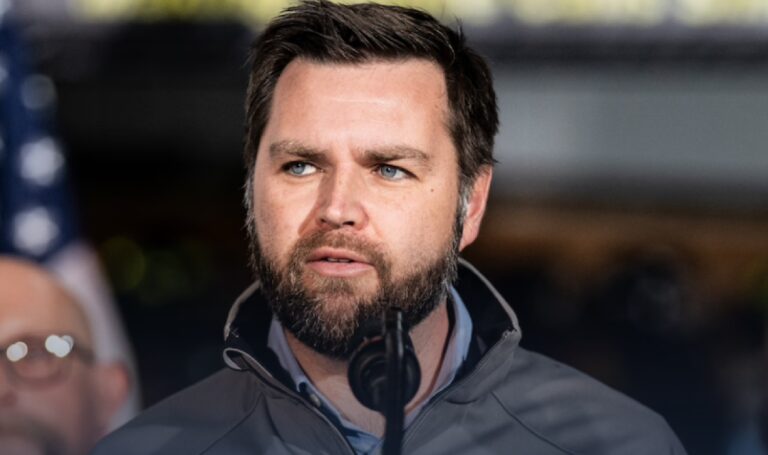
Sen. J.D. Vance will be Donald Trump’s vice presidential nominee.
Vance, age 39, was born and raised in Middletown, Ohio. He served in the U.S. Marine Corps in the Iraq War, graduated from The Ohio State University and Yale Law School.
He wrote a bestselling book, Hillbilly Elegy, which was turned into a Netflix movie. He also started a business dedicated to growing jobs and opportunity in the Midwest.
Vance launched his first campaign for Ohio’s Senate seat in 2021 and won after being endorsed by former President Donald Trump. He defeated Democratic nominee Tim Ryan in the general election.
The Alaska delegation is on the floor of the Republican National Convention, which opened this afternoon in Milwaukee, Wisc.
In the photo above, sent to Must Read Alaska by congressional candidate Nick Begich, Alaska Gov. Mike Dunleavy can be seen next to Alaska Republican Party Chairwoman Carmela Warfield. Also spotted in the photo are Cheryl Markwood, Patty Wisel, and Rep. Jamie Allard.
The first order of business for the day has been adopting rules for convention, determining the convention’s chair, and adopting the platform for the party. And the big news is that Donald Trump told Fox News he will announce his vice presidential pick today.
Fox News is reporting it is not Gov. Doug Burgum or Sen. Marco Rubio. Rumors are swirling that it may be J.D. Vance, and a motorcade was seen leaving his home this morning. Trump is supposedly meeting with Robert Kennedy Jr. this morning, according to Benny Johnson.
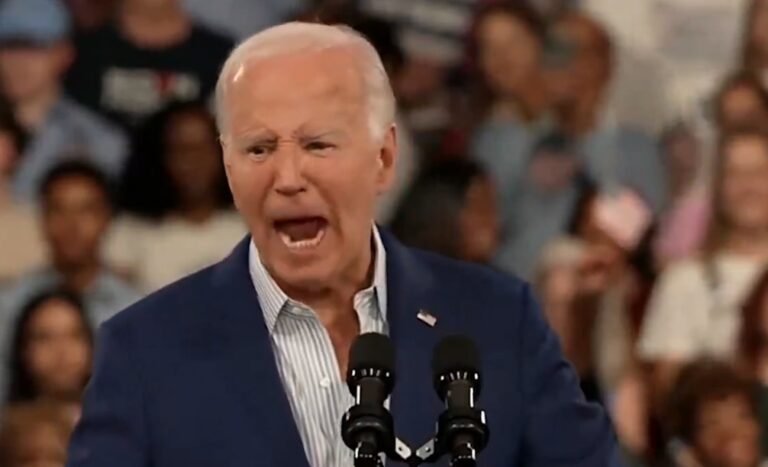
President Joe Biden read lines on a teleprompter on Sunday, imploring Americans to cool the political rhetoric. But on his own campaign website, he is still calling for people to “stop Trump before it’s too late.” And he is raising campaign money by using that slogan.
His surrogates are using the same inflammatory language.
Rep. Alexandra Ocasio-Cortez called Trump a “fascist” on Monday. Her comment came in response to Jake Tapper pointing out that staffers in the White House are resigned to the fact that there will be another Trump presidency.
“If you’re a ‘senior Democrat’ that feels this way, you should absolutely retire and make space for true leadership that refuses to resign themselves to fascism. This kind of leadership is functionally useless to the American people. Retire,” Ocasio-Cortez wrote.
Matt Walsh, author and podcaster, said the unity being called for by Biden and Donald Trump isn’t realistic.
“There are calls for unity, but unity is not possible. The forces that at a minimum set the stage for Trump’s assassination — the same ones that have been trying to destroy him, and you, for years — are still at work. The only unity is in their defeat. The only way out is through,” he said.
A federal judge in Florida dismissed the classified documents-related criminal case against former President Donald Trump on Monday, saying the appointment of Special Counsel Jack Smith violated the Constitution.
The case could be appealed and go all the way to the U.S. Supreme Court. Many legal experts considered the classified documents case to be Trump’s most difficult legal hurdle, and its removal comes on the first day of the Republican National Convention in Milwaukee and two days after the former president survived an assassination attempt in Butler, Pa.
“As we move forward in Uniting our Nation after the horrific events on Saturday, this dismissal of the Lawless Indictment in Florida should be just the first step, followed quickly by the dismissal of ALL the Witch Hunts — The January 6th Hoax in Washington, D.C., the Manhattan D.A.’s Zombie Case, the New York A.G. Scam, Fake Claims about a woman I never met (a decades old photo in a line with her then husband does not count), and the Georgia ‘Perfect’ Phone Call charges,” Trump wrote on Truth Social Monday morning. “The Democrat Justice Department coordinated ALL of these Political Attacks, which are an Election Interference conspiracy against Joe Biden’s Political Opponent, ME. Let us come together to END all Weaponization of our Justice System, and Make America Great Again!”
“As we move forward in Uniting our Nation after the horrific events on Saturday, this dismissal of the Lawless Indictment in Florida should be just the first step, followed quickly by the dismissal of ALL the Witch Hunts — The January 6th Hoax in Washington, D.C., the Manhattan D.A.’s Zombie Case, the New York A.G. Scam, Fake Claims about a woman I never met (a decades old photo in a line with her then husband does not count), and the Georgia ‘Perfect’ Phone Call charges,” Trump wrote on Truth Social Monday morning. “The Democrat Justice Department coordinated ALL of these Political Attacks, which are an Election Interference conspiracy against Joe Biden’s Political Opponent, ME. Let us come together to END all Weaponization of our Justice System, and Make America Great Again!”
Cannon said the process for prosecuting Trump violated the separation of powers by kicking Congress out of the equation.
“The bottom line is this: The Appointments Clause is a critical constitutional restriction stemming from the separation of powers, and it gives to Congress a considered role in determining the propriety of vesting appointment power for inferior officers,” the ruling said. “The Special Counsel’s position effectively usurps that important legislative authority, transferring it to a Head of Department, and in the process threatening the structural liberty inherent in the separation of powers.”
The ruling suggests that Trump could still be prosecuted, but this delay will almost certainly push the case beyond the election and may kill it altogether.
“If the political branches wish to grant the Attorney General power to appoint Special Counsel Smith to investigate and prosecute this action with the full powers of a United States Attorney, there is a valid means by which to do so,” the ruling said. “He can be appointed and confirmed through the default method prescribed in the Appointments Clause, as Congress has directed for United States Attorneys throughout American history … or Congress can authorize his appointment through enactment of positive statutory law consistent with the Appointments Clause.”
While appointing special counsels has become more common, Cannon argues the practice does not have solid legal footing.
“In the end, it seems the Executive’s growing comfort in appointing ‘regulatory’ special counsels in the more recent era has followed an ad hoc pattern with little judicial scrutiny,” the ruling said.
The case began when federal authorities raided Trump’s Mar-a-Lago estate in 2022 because he allegedly held on to classified documents and stored them there after leaving the White House.
Notably, President Joe Biden also held on to classified documents after leaving the White House but was not prosecuted. Trump’s critics point out that Biden was quick to hand the documents over when authorities requested them, whereas Trump delayed in complying with the same request.
One-quarter inch. That is how close we came this weekend to an unfathomable future.
One-quarter inch. That was the distance separating two antipodal histories –- one, potentially calamitous.
The actions of an evil, would-be assassin reminded us that our republic is fragile. But the response of an indomitable leader, President Donald Trump, reminded us that our nation is resilient.
While millions of good-hearted Americans on both sides of the political aisle are rightly rejoicing President Trump survived the attempted assassination, and appropriately grieving the fatality and casualties that resulted, we must remember the cancerous hatred that led to last weekend’s tragic turn continues to metastasize.
For years, many of us have voiced our concerns that the vitriolic and hyperbolic rhetoric of Leftist leaders and media talking heads would lead to an attempt on President Trump’s life, especially when many of them indulged in demented fantasies of his demise. Consider:
President Biden’sassertion that “Trump’s assault on democracy isn’t just part of his past … It’s what he is promising for the future” and his call last week “to put Trump in a bullseye”;
Vice President Kamala Harris’ irresponsible claim, last Tuesday, that “Donald Trump wants to turn our democracy into a dictatorship”;
Congresswoman Maxine Waters’statement at an event in New York City in October 2017 that she would “go and take Trump out tonight”;
Comedienne Kathy Griffin’sreposting of her infamous picture of a beheaded President Trump, after he questioned the 2020 election results;
The Washington Post article in December 2023 entitled, “Yes, it’s okay to compare Trump to Hitler. Don’t let me stop you”;
The New Republic, in June 2024, merging President Trump’s face with Hitler’s and using the title “American Fascism: What It would Look Like”; and
The Lincoln Project’s Rick Wilson stating on MSNBC that “[t]hey’re still gonna have to go out and put a bullet in Donald Trump. And that’s a fact.”
Those, of course, are just a smattering of thousands of such examples we all have seen and heard over the last 7+ years. It would be fatal and foolish for us to presume that such deep hatred of President Trump and his supporters was defeated last weekend. Indeed, while the overwhelming response of President Trump’s opponents last weekend reflected genuine concern and humble introspection, the reactions of others indicate the attempt on his life has only temporarily slowed, not stopped, the destructive vitriol.
Colorado State House Representative Steven Woodrow’s statement that, “[t]he last thing America needed was sympathy for the devil but here we are”;
The New York Post’scataloguing of the fury of some Leftists that President Trump survived; and
The unseemly and indecorous New York Times’ Sunday Opinion page, one day after the assassination attempt, with these words: “He failed the tests of leadership and betrayed America.”
Although we were spared a national tragedy on Saturday, a beautiful family was not –- a daughter lost her father, a wife her husband. Former fire chief, Corey Comperatore, heroically sacrificed his life shielding his family from an assassin’s bullet. His death and the wounding of two others, David Dutch and James Copenhaver, are tragic reminders that the attack on President Trump was also an assault on those who support him – we are, and have been, in the crossfire, too.
A quarter inch. That is how close we are, and how close we came, to what could have been a dark descent into civil unrest our country has not experienced since, perhaps, the Civil War. We must not miss this moment, this opportunity to change course permanently – not just for a few days or weeks.
While we are understandably enraged by the attempt on President Trump’s life, and by the reckless rhetoric that inspired it, the only way we will defeat the hatred that is eroding our republic one heart at a time is through a resolute and relentless love of our neighbor and our nation. No one has described the winning strategy more beautifully than First Lady Melania Trump did in her July 14 letter to America:
“Let us not forget that differing opinions, policy, and political games are inferior to love. … Dawn is here again. Let us reunite. Now.”
This morning, ascend above the hate, the vitriol, and the simple-minded ideas that ignite violence. We all want a world where respect is paramount, family is first, and love transcends. We can realize this world again. Each of us must demand to get it back.
This week, President Trump’s challenge will be to remind us, as President Abraham Lincoln once did, that “[w]e are not enemies, but friends” and that “[t]hough passion may have strained it must not break our bonds of affection.” I believe he will more than rise to the challenge and will show our nation he can be more than a great commander-in-chief, but also a great healer-in-chief and uniter-in-chief.
Let us pray he succeeds. Because if he does not, the distance between the success and failure of the American Experiment may remain just a quarter inch.
Niki Tshibaka is an ordained minister, attorney, and co-host of the podcast, TV, and radio show STAND.
The political season has been chaotic in America. History itself descended upon the race for the presidency and shattered all hyperbole into superficial squawking.
It is hard to overstate what has taken place in the past five weeks. The sitting leader of the free world, President Joe Biden, before billions of people and without any ability to mitigate otherwise, exposed his clear unfitness to run the most powerful country and military force in the history of humanity.
For nearly a month, the representatives of Biden’s party have been engaged in a kabuki theater, trying to first convince Americans to disbelieve, then finally disregard what they saw on a national debate.
The ruse has not worked. A Democratic Party Convention in Chicago beckons. Until Saturday, the only question on the minds of inside-ball political viewers was which Chicago would show up: 1944 or 1968?
The ’44 convention, in the throws of World War II, had Democratic Party bosses facing a massive dilemma: Their president was dying, and not interested in stepping down. Who would be vice president went from being a backup to a ramp-up to the near certainty of the Oval Office, and the smoke-filled rooms knew it.
That’s how America got Harry Truman, over a rancorous floor fight, as the bottom of the ticket in Franklin Delano Roosevelt’s fourth, and final, run for the White House.
It was a prescient move. FDR did not last a year, dying in Warm Springs, Georgia at the age of 63. Truman had to step up to wind down the war effort, ramp up the Cold War posture, throw Communist China back out of South Korea, and keep Europe from descending into anarchy.
We live in a world built by that convention.
Then there was the spring and summer of 1968. President Lyndon Johnson abdicated his privilege to run for re-election as the Democratic Party’s standard bearer, convulsing the national election into chaos. Rev. Martin Luther King was felled by bullets in Memphis. In the middle of a contentious primary, the new Democratic front-runner, Robert Kennedy, was also assassinated by a gunman, just like King, and like his brother, President John Fitzgerald Kennedy, had been assassinated nearly five years earlier.
Chicago in 1968 became a warzone, with protesters objecting to Vietnam on one end, and police of Mayor Daley battling them on the other side of the streets. While the city was up for grabs outside the convention, the Democratic Party tore itself apart over its contradictions in policy and pursuit of holding onto power. The convention ended, and its nominee, Vice President Hubert Humphrey, was considered a safe bet to take on Republican nominee Richard Nixon. Nixon told America to look at Chicago, and asked what it preferred: hippies in the parks, riots on the roads, disrespect abroad, or law and order?
We know how the story ended.
The Democratic Party of 2024 seemed, until this week, to be see-sawing between these two historic reference points. Would the nation see President Joe Biden give up his party’s throne, deign to appoint a successor, or would he, crackled, misspoken and broken as he is, limp to the ballot box, hoping disdain for the alternative was enough to give him and his allies four more years of power.
That was going to be the story of the summer, answering what would happen on the shores of Lake Michigan in August.
Until Butler, Pennsylvania.
Popping sounds that gun owners know very well rang out. A former president and current leading presidential contender went to the ground in front of thousands of supporters and millions of viewers around the world, almost instantaneously followed by Secret Service agents.
Donald Trump emerged from that throng, defiant, blood smeared, and still managing to calm a crowd that elsewhere in America might have descended into chaos. He made a fist and spoke to the crowd, “Fight! Fight! Fight!”
To be very clear, since many in the press corps have a problem for some reason doing so, it is important to state the obvious: Donald Trump, a past President of the United States who could very well return to running the country, evaded an assassin’s bullets by fractions of an inch. A deliberate attempt was made to kill someone who has and may continue to lead America. This has not happened in generations.
History also trails President Trump to the Republican National Convention in Milwaukee this week. Another former president, also from New York, also running to regain the office, also considered a dangerous populist by the elites yet beloved by the common people, was struck by a bullet intended to silence him. Like President Trump, Theodore Roosevelt, the older cousin to FDR, in 1912 responded with élan, continuing to speak even after being hit, and nearly dying. His courage was such that even his most hated opponents had to acknowledge President Theodore Roosevelt’s energy.
Republicans are now gathered to formally nominate their choice for November. Butler has changed everything. The contrast was sharpened by the frailty and confusion of Biden and dissonance of the Democratic Party. Now, the Republican Party is not just an alternative to weakness, it is a party with a leader who has survived attempted assassination and is roaring.
Every, single, election in living memory has been categorized as “historic.” There may be truth in each one of those labels. But this year takes the cake. Americans, as members of the oldest and most continuous democratic republic on earth, do not get to sit on the sidelines. In Asia, in Latin America, in Africa, and even in Europe, billions of people and their leaders, many of whom would love to do us harm, are waiting to see what happens next. We cannot afford to ignore that reality.
The hippies in Chicago said one thing right in 1968: The whole world is watching. And it’s watching us. Don’t forget it.
Suzanne Downing founded Must Read Alaska in 2015 and is the current editor.