Wednesday, August 5, 2026
Home Blog Page 397

Democrats in chaos after Biden prematurely ejects and endorses Kamala Harris

With President Joe Biden having formally dropped from his race for reelection on Sunday afternoon, the words of Republican Sen. J.D. Vance, now vice presidential nominee, have even more meaning:

“If Joe Biden doesn’t have the cognitive function to run for re-election, then he certainly doesn’t have the cognitive function to remain as Commander-In-Chief. How can any Dem pushing him to drop out of the presidential race, argue in good faith that he should stay on as POTUS?” Vance asked last week.

Today, Vance wrote: “If Joe Biden ends his reelection campaign, how can he justify remaining President? Not running for reelection would be a clear admission that President Trump was right all along about Biden not being mentally fit enough to serve as Commander-in-Chief. There is no middle ground.”

Operatives at the highest levels of the Democratic Party have been conducting a backroom coup to erode the ground under President Biden, who is sequestered due to having contracted Covid last week. By Sunday, the tide had tuned and the rumored “withdrawal” letter that had been drafted for him to sign turned out to be one rumor of many that ended up being accurate, in a month of many rumors and speculations following Biden’s disastrous performance in the debate against Donald Tump on June 27.

In his letter, Biden said it was in the best interest of the “party” for him to drop out. But Biden’s leaving the race is his admission that he has already lost to Trump. Polls for both Democrats and Republicans show it, and Biden’s campaign has also access to polling done on his behalf but not revealed to the public. The down-ballot impact of him remaining on the ballot was serious for the Democrats, who could have faced a wipe-out in the Senate and House races in November, if he had stayed.

The person Biden has designated to replace him on the ballot is a person who could not win even one delegate when she ran for president in 2020: Kamala Harris. Harris may face challengers who have been warming up in the bullpen for weeks: Michigan Gov. Gretchen Whitmer, Pennsylvania Gov. Josh Shapiro, former Sen. Hillary Clinton, and California Gov. Gavin Newsom are no doubt having war room meetings on Sunday to determine if there is a path forward against the war chest that Harris inherits from Biden.

Biden’s campaign had $91.6 million on hand by the end of May, according to its most recent report to the Federal Election Commission. By early July, the Biden campaign had $240 million, which included new funds from the Democratic National Committee. Presumably, the majority of that will go to Harris’ campaign.

She will have to pick a vice presidential nominee before the Democratic National Convention. Harris may choose someone like Gov. Shapiro, to help lock up the Pennsylvania swing-state vote and attract the Jewish vote. The same holds true for Gov. Whitmer, who also leads the swing state of Michigan.

But then there’s Team Barack Obama, who is highly influential behind the scenes. Obama may throw his weight behind Hillary Clinton, who in 2016 won the national vote when she ran against Trump. She lost the electoral vote and claimed the election was stolen. Although Hillary won 2.9 million more votes than Trump, he worked the map, and ended up with 304 electoral votes, more than the minimum 270 electoral votes needed. Clinton won 227 electoral votes that year, in spite of all her baggage. She is a nationally known candidate and could make the case to Democrats that, as a person who took on Trump directly, she’s the stronger candidate to win this time.

While the Democrats spin, Biden is lounging at his beach house at Rehoboth Beach, Del. He has nothing on his public schedule on Sunday, which is true to his usual schedule. He is set to meet with Israeli Prime Minister Benjamin Netanyahu on Tuesday, a day before Netanyahu is due to address a joint session of Congress. The White House has not yet announced if it has canceled the meeting.

Biden’s physician, Dr. Kevin O’Connor, released a health report on Sunday: “President Biden completed his eighth dose of PAXLOVID this morning. His symptoms [which were not disclosed by O’Connor] have improved significantly. His pulse, blood pressure, respiratory rate and temperature remain absolutely normal. His oxygen saturation continues to be excellent on room air. His lungs remain clear.”

There was no report about whether Biden was alert or how his cognitive functions are.

Matt Walsh, podcaster and political writer, observed, “Every Republican needs to go on the record right now calling for Biden to be immediately removed from office. If he is not competent to run for re-election then he is not competent to remain in the White House.”

Vivek Ramaswamy, in a post on X/Twitter, reminded people that he had predicted this exact scenario 18 months ago:

On Truth Social, Donald Trump wrote his reaction to the news: “Crooked Joe Biden was not fit to run for President, and is certainly not fit to serve — And never was! We will suffer greatly because of his presidency, but we will remedy the damage he has done very quickly. MAKE AMERICA GREAT AGAIN!”

Kelly Tshibaka, chair of the Trump campaign for Alaska, said, “No new information has arisen about President Biden. Predictably, Democrat elites forced him out, despite his unanimous selection through a democratic, primary process. Biden’s withdrawal from the race shows either that Democrat Party leaders are willing to reject the will of their own voters because they know their candidate can’t win, or it proves they have known President Biden has not been fit to fulfill the duties of his office. Either way, this decision reflects the anti-democratic impulses that have corrupted the party’s leadership ranks. And, make no mistake, Kamala Harris has been part of this anti-democratic cover-up to subvert democracy and the will of primary voters. Et tu, Kamala?”

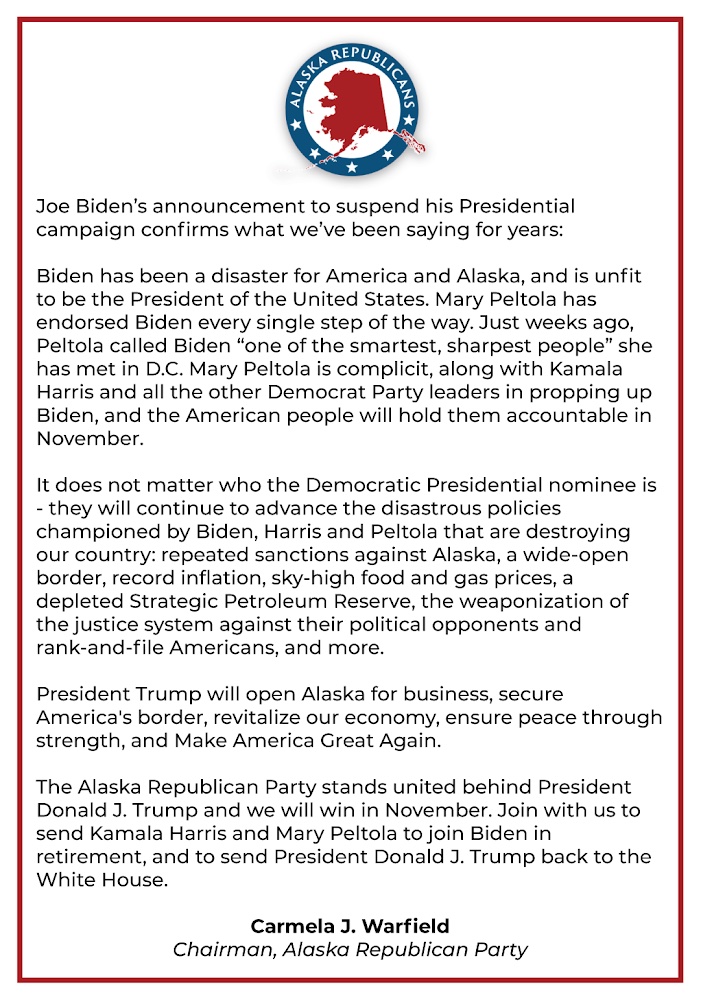
Although neither the Alaska Democrats or Rep. Mary Peltola issued no statement about the news, the Alaska Republican Party did:

Breaking: Biden drops from race

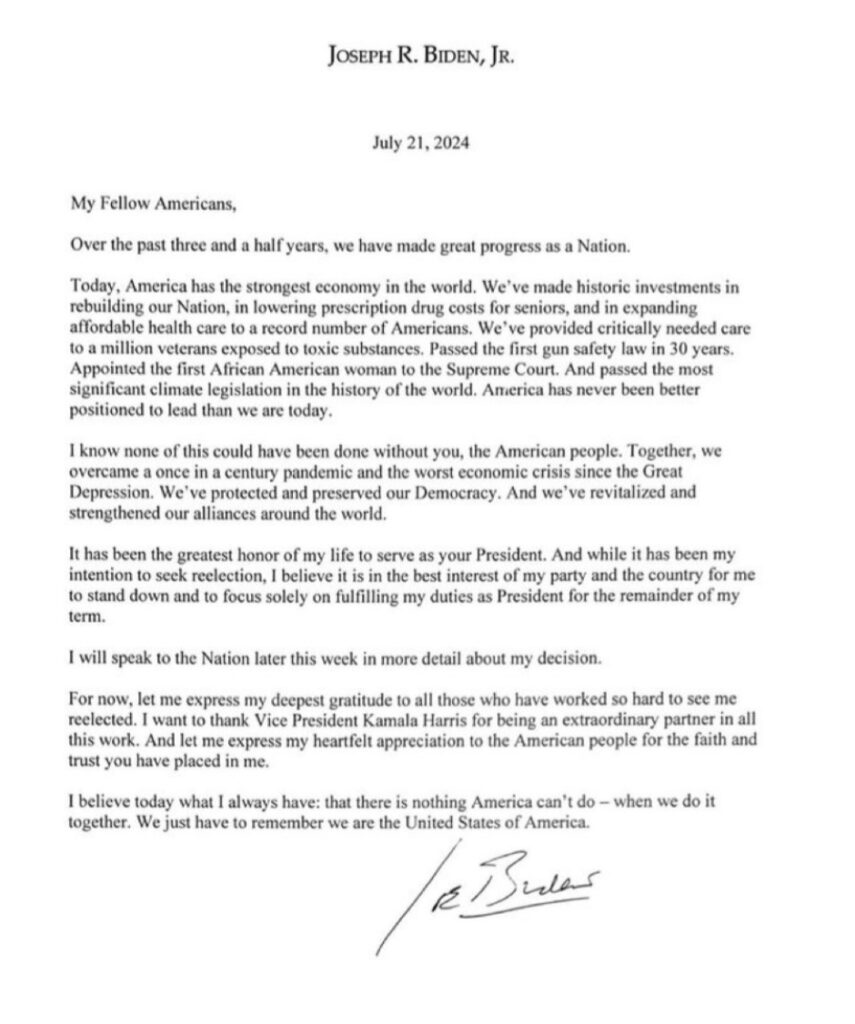
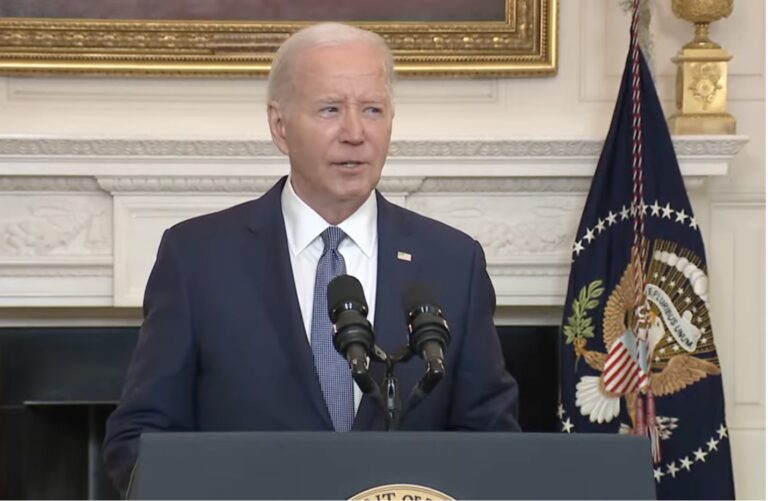
President Joe Biden has dropped from the race for reelection, he announced in a letter on Sunday.

“It has been the greatest honor of my life to serve as your President,” Biden wrote in a post on the social media site X. “It has been the greatest honor of my life to serve as your President.”

“And while it has been my intention to seek reelection, I believe it is in the best interest of my party and the country for me to stand down and to focus solely on fulfilling my duties as President for the remainder of my term,” Biden wrote.

Notably, he then endorsed Vice President Kamala Harris. California Gov.Gavin Newsom, Hillary Clinton, and Michigan Gov. Gretchen Whitmer are being discussed by Democrats, along with Gov. Shapiro of Pennsylvania are being discussed, as is an open nomination process at the Democratic National Convention.

His resignation letter, which was said to have been drafted for him earlier this week, was posted Sunday:

The announcement came the same day that eight state Democrat parties, including Alaska’s Democrat Party, had affirmed their support for Biden, while over 35 congressional Democrats had already told him they could not support him any longer.

The National Republican Congressional Committee posted a challenge for Alaska Rep. Mary Peltola, who has gone silent over the past month after sticking by her endorsement of Biden.

“Extreme House Democrats, including Mary Peltola, have been twisting themselves in knots trying to ignore the question on everyone’s minds: “Is Joe Biden fit to serve as President?”  the Republicans wrote.

“Democrats can’t have it both ways. If Joe Biden can’t handle a debate or a rally, he can’t stand up to Putin or have access to the nuclear codes,” the NRCC wrote. Peltola needs to answer the question, ‘Is the President fit to serve the rest of his term?'”

The presidential race is less than four months away and the Democratic National Convention in Chicago is August 19-22, when the nomination officially takes place.

Alaska Democrat Party and seven other state Democrat parties, sticking with Biden

The state Democratic parties of Alaska, along with those of Georgia, Arizona, Nevada, North Carolina, Pennsylvania, Michigan, and Wisconsin, have affirmed their support for Joe Biden continuing as the presidential nominee for the Democrats.

According to a report in USA Today, Democratic Party chairs of seven key battleground states Sunday reaffirmed their support for Biden in a letter, and urged fellow Democrats to focus on beating former President Donald Trump, who the chairs called a looming “dictatorship.”

Separately, the Alaska Democratic Party told KTUU that it stands behind Biden and is focused on beating Donald Trump.

“But right now, many voters aren’t hearing that from our party. We understand the anxiety. But the best antidote to political anxiety is taking action,” the seven state chairs wrote in their letter. “When we all lend our voices to contrasting the Democratic vision — from Biden-Harris straight down the ticket — with the MAGA nightmare, we win.”

The list of Democrats in Congress asking Biden to drop now includes Sen. Joe Manchin, a moderate Democrat-turned-independent from West Virginia and a close ally of Sen. Lisa Murkowski, who herself is on record for not supporting Biden or Trump.

After Biden’s disastrous debate performance last month, the number of congressional Democrats who have called for the frail and addled 81-year-old Biden to stop campaigning for reelection has risen dramatically. The Democratic Party is flailing as a behind-the-scenes coup is underway to remove Biden — and for some Democrats Kamala Harris, too — from the ticket, so the party can start fresh, with someone like Michigan Gov. Gretchen Whitmer or California Gov. Gavin Newsom. Some Democrats object, since Biden has won the right to be on the ticket as the winner of primaries in nearly all states.

Democrats in Congress calling for Biden to exit the race do not include Alaska Democrat Rep. Mary Peltola, who has not only gone silent on the Biden race but who has largely disappeared from the public eye for the past month, not making public appearances and reducing her social media posts.

The Democrats in the Senate and House who have gone on the record are, as of Sunday morning:

  • Sen. Sherrod Brown, Ohio
  • Sen. Martin Heinrich, N.M.
  • Sen. Jon Tester, Mont.
  • Sen. Peter Welch, Vt.
  • Sen. Joe Manchin, W.Va. (Manchin left the Democratic Party registered as an independent in May.)
  • Rep. Earl Blumenauer, Ore.
  • Rep. Ed Case, Hawaii
  • Rep. Kathy Castor, Florida
  • Rep. Sean Casten, Ill.
  • Rep. Jim Costa, Calif.
  • Rep. Angie Craig, Minn.
  • Rep. Lloyd Doggett, Texas
  • Rep. Jesus “Chuy” Garcia, Ill.
  • Rep. Raul Grijalva, Ariz.
  • Rep. Jim Himes, Conn.
  • Rep. Jared Huffman, Calif.
  • Rep. Greg Landsman, Ohio
  • Rep. Mike Levin, Calif.
  • Rep. Zoe Lofgren, Calif.
  • Rep. Seth Moulton, Mass.
  • Rep. Betty McCollum, Minn.
  • Rep. Morgan McGarvey, Ky.
  • Rep. Scott Peters, Calif.
  • Rep. Brittany Pettersen, Colo.
  • Rep. Mark Pocan, Wis.
  • Rep. Mike Quigley, Ill.
  • Rep. Pat Ryan, N.Y.
  • Rep. Adam Schiff, Calif.
  • Rep. Brad Schneider, Ill.
  • Rep. Hillary Scholten, Mich.
  • Rep. Mikie Sherrill, N.J.
  • Rep. Adam Smith, Wash.
  • Rep. Eric Sorensen, Ill.
  • Rep. Greg Stanton, Ariz.
  • Rep. Mark Takano, Calif.
  • Rep. Marc Veasey, Texas
  • Rep. Gabe Vasquez, N.M.

Golden Days Parade in Fairbanks: Which candidates showed up?

Nick Begich, the Republican running for Congress, was the only candidate for that office who was present in the Golden Days Parade — the largest parade in Alaska that takes place in Fairbanks each July. Rep. Mary Peltola had a group walking for her but did not show up; neither did Nancy Dahlstrom.

Nick Begich greets thousands of Alaskans at the Golden Days Parade on Saturday. On Sunday, he said he will be at the Deltana Parade in Delta Junction.

Other candidates who had entries includes a large group with Republican state Rep. Frank Tomaszewski, who is running for reelection for District 34.

A curious combination of candidates were using a Fairbanks fire truck as their support vehicle in the parade. The candidates, all liberals, and the truck made it appear as though the Democrats have the official endorsement of the fire department, when it is actually a truck owned by the fire department union. Pictured with the truck were signs for Democrat Grier Hopkins for mayor, Democrat Rep. Maxine Dibert for House and false-flag Republican Beth Cottle for House District 34.

Rep. Maxine Dibert, Beth Cottle, and Grier Hopkins, along with a truck that appeared intended to give them the appearance of the official endorsement of a government agency.

Also in the parade with his family was Republican Rep. Will Stapp, whose kids wore shirts that said “Vote for my Dad.” Stapp’s shirt said: “Vote for me, I’ve got cute kids.” His wife’s shirt said “Vote for my husband.”

“Best campaign slogan by Will Stapp! And cutest family!” commented Senate candidate Leslie Hajdukovich, about State Rep. Will Stapp at the Golden Days Parade.

Mike Cronk of Tok, who is a state representative running for Senate to replace retiring Sen. Click Bishop, attended in Carhartt coveralls and a float that had the skins of animals he’s harvested over the years.

Rep. Mike Cronk is running for Senate Seat R, and showed off his subsistence harvest and farmer’s tan at the parade.

“I didn’t ‘study’ subsistence, I live subsistence every day!” Cronk said.

Savannah Fletcher, a Democrat who was running for mayor but then dropped out of that race to run for Senate Seat R, was not spotted at Golden Days, but was seen at the Deltana Fair in Delta Junction, where she will be in the parade on Sunday.

Democrat Sen. Scott Kawasaki did not have an entry in the parade but his Republican challenger Leslie Hajdukovich did, with about 20 people and a couple of vehicles with her under the hot Fairbanks sun.

Leslie Hajdukovich had a large group walking with her in the Golden Days Parade in Fairbanks.

Murray Walsh: Ranked-choice voting serves the obedient Democrats, hurts Republicans

By MURRAY WALSH

I usually ignore Juneau columnist Rich Moniak’s excursions into misdirection, although most are written well enough to seem logically convincing to the unwary.  

His most recent Juneau Empire column about ranked-choice voting is different.  It is not a well-reasoned point-by-point defense of RCV and that may be because it is not possible to present such a thing.

Rather, he offers an inaccurate and idealized explanation of ranked-choice voting and then wanders off to criticize the people who organized the petition against it. He goes further afield to attack the electoral college, then targets Trump (obligatory, these days, I guess) and finally gets back to where he started. 

Moniak says that America’s problems stem from the political parties having direct control (except in Alaska, for now) over the primary process –- the process by which candidates are chosen to be on the general election ballot. 

Ranked-choice voting and its ugly sister, the “open” primary, (RCV/OP hereafter) are not the creations of a well-meaning but largely hidden group of academic process nerds. No, these foul creatures are the product of Democrats operating behind dark money organizations and who present themselves as noble unaffiliated experts seeking to improve the system, tamp down partisanship, and reduce party control. 

While I am a Republican and want my party to be able to choose our nominees for the general election ballot for any state or federal office, I do not want to control or influence the selection of nominees for any other party. Such behavior is considered ill-mannered among Republicans.  

Democrats do enjoy messing around in Republican business. They got Bill Sheffield elected governor in 1986 by crossing over to vote in the Republican primary.

Democrats are far more organized, disciplined, and devious than Republicans. The Democrat rank and file are more gullible and obedient than the Republican base. They hoodwinked Alaska into voting RCV/OP into existence and then, in 2022, made darn sure there was only one prominent Democrat on the June 11 special election primary ballot.  

Al Gross, a fake Independent, ran in that election to fill Congressman Don Young’s remaining few months in office. In that special election primary, Sarah Palin netted 43,601 votes; Nick Begich 30,861; Al Gross 20,392 and Mary Peltola 16,265 votes.  

Gross then mysteriously disappeared from the scene, leaving two major Republicans and one Democrat to advance to the August special general election ranked choice ballot where Palin and Begich split their votes and Peltola won. The same thing happened again in the regular primary and general elections. 

Under the old primary system, there would have been just one Republican and one Democrat on the ballot.  

The Democrats are continuing to show rank-and-file discipline: There are 10 state Senate seats up in 2024.  In eight of those 10 primary races, the disciplined Democrats are running just one candidate in each race. Multiple Republicans, however, are running in six of those 10 state Senate primary races. 

All 40 Alaska State House seats are up in 2024. Out of those 40 races, only three of them feature more than one Democrat running in the open primary.  

Democrats lecture us that competition is healthy, but to win elections in a state with 143,599 registered Republicans and 73,539 registered Democrats, they needed a workaround.  With RCV/OP, they can watch Republicans bleed money to cannibalize each other while they prohibit competition within their own party.  This leaves them with ample resources and just one Democrat candidate for each race on the November RCV ballot.

It is satisfying to note that national Democrats avoidance of competition has left them with Joe (the Doomed One) Biden as their apparent nominee for 2024.

To be clear: RCV/OP is not the manifestation of some benevolent third party or mysterious force of political nature. It is a Democrat-produced contrivance that gives that party more leverage because of the obedience of its members.  

We have a chance this fall to throw it out.  If you have any sense of fair play and any hope of transparent government, you will join me in voting to do just that.

Walsh is a semi-retired consultant in Juneau.

As predicted: Washington state’s push for all-electric leads to higher power bills in Seattle

By SPENCER PAULEY | THE CENTER SQUARE

The City of Seattle is expecting rates for City Light customers to rise 5.4% next year due to increasing demand, extreme weather, and impacts of low-water flow on hydroelectric generation capacity, even as the state continues to push for a total transition to clean energy.

A 5.4% increase is about $4.88 more a month for a typical residential bill or $1.95 more a month for a typical residential Utility Discount Program [subsidies for poor people] bill.

According to Seattle City Light CEO Dawn Lindell, retail demand from building electrification is growing three times faster than projected in 2022, and transportation electrification demand has increased 70% above 2022 estimates. 

“In a matter of years, demand will outpace energy savings from efficiency,” Lindell said at a Seattle City Light Strategic Plan update.

During a presentation to the Seattle Sustainability, City Light, Arts & Culture Committee on Friday, Seattle City Light officials revealed that the estimated grand total of needed resources in 2022 was 696 megawatts over 20 years. This year, the grand total of needed resources over the next 20 years is 2,563 MW. That is a 268% increase in estimated resources.

City Light’s admission of electrical capacity not reaching the demand exemplifies the obstacles facing Washington as it works to transition its counties and cities to clean energy.

In March, Gov. Jay Inslee signed House Bill 1589, which is a “planning bill” that consolidates Puget Sound Energy’s strategy for both electrical and natural gas in the future. 

The State Department of Commerce also published its Energy Strategy in 2021, which was designed to provide a roadmap for meeting the state’s need for affordable and reliable energy supplies and outline a path to a clean, inclusive energy economy by 2050.

Washington Department of Commerce Energy Policy Office Director Glenn Blackmon said that the state’s energy strategy does anticipate the need for significant investments by electric utilities as the state transitions from fossil fuels to clean energy sources.

“The strategy also identifies the need to make sure overburdened communities and low-income customers are not harmed by this transition,” Blackmon told The Center Square in an email. “Energy transition investments will yield long-term benefits, both economic and environmental. For example, investments in the electric distribution system and battery charging stations will enable consumers to save money by switching from gasoline to electric vehicles.”

Blackmon noted that state agencies do not regulate the rates of Seattle City Light or other electric utilities operated by local jurisdictions.

The state Legislature created the Clean Energy Fund in 2013 Legislature for projects that revolve around the development and deployment of clean energy technologies, save energy, lower energy costs, and reduce harmful air emissions. The Legislature has provided $231 million in biennial appropriations to the CEF.

Proponents are working to place Initiative 2066 on the November ballot, which would bar cities and counties from prohibiting, penalizing or discouraging “the use of gas for any form of heating, or for uses related to any appliance or equipment, in any building.”

The Seattle Sustainability, City Light, Arts & Culture Committee is expected to vote on the approval of the City Light Strategic Plan Update on Aug. 2. It would then go to the full city council for a final vote with the expectation to raise rates for City Light customers.

Secret Service denied security to Trump for two years. Why?

The U.S. Secret Service, after denying it for days, admitted on Saturday that it refused requests for additional security sought by Donald Trump for two years prior to the attempted assassination on July 13.

Last Sunday, the spokesman for the Secret Service took to X/Twitter to deny the allegations being made that Trump had been starved of federal security.

“We did not divert resources from FPOTUS Trump & protection models don’t work that way. As far as ‘field office teams’ these are the candidate nominee operations teams that are added during election years for the heavy travel tempo,” wrote Anthony Guglielmi last Sunday, in response to something written by a RealClearPolitics White House correspondent Susan Crabtree.

“There’s an untrue assertion that a member of the former president’s team requested additional resources and that those were rebuffed,” he wrote on X later.

On Monday, Secretary of Homeland Security Alejandro N. Mayorkas also said the accusation that he had issued the denials was “a baseless and irresponsible statement and it is one that is unequivocally false.”

But by Saturday, July 20, the official tune had changed. Guglielmi now admits, in a report first published in the New York Times, the Secret Service turned down requests for additional federal security for Trump.

According to the newspaper, which is historically hostile to Trump, two officials who spoke on condition of anonymity because they were not authorized to speak publicly confirmed that the Trump campaign had been seeking additional resources for the better part of the time that Trump had been out of office.

The denied requests for additional resources were not, however, specifically for the rally in Butler.

According to other officials, the Secret Service had actually added security for Trump at Butler due to intelligence it had received about an Iranian plot to assassinate Trump.

Questions still remain about why the rooftop that was clearly a possible danger to Trump was left unguarded and why the gunman, who was identified as suspicious, was not contained before he took his shots. Director of the Secret Service Kimberly Cheatle will face those questions and others during a hearing called by Rep. James Comer, the chairman of the House Oversight and Accountability Committee, on Monday.

The Secret Service also released a defensive statement about the use of women in its protection details, even after extensive video from Butler, Penn. showed the women assigned to Trump did not perform to expectations.

“In the days following the attempted assassination of former President Trump, some people have made public statements questioning the presence of women in law enforcement, including in the United States Secret Service,” the agency wrote in a statement on its website.

“These assertions are baseless and insulting,” said the official statement.

“Every single day, in communities big and small across our great country, women are serving in federal, state, local, tribal, territorial, and campus law enforcement. They are highly trained and skilled professionals, who risk their lives on the front lines for the safety and security of others. They are brave and selfless patriots who deserve our gratitude and respect,” the agency continued.

“We in the United States Department of Homeland Security — the largest law enforcement organization in the federal government — will, with great pride, focus, and devotion to mission, continue to recruit, retain, and elevate women in our law enforcement ranks. Our Department will be the better for it, and our country more secure,” the Secret Service said, without providing data to support its assertion that women Secret Service agents are being placed in jobs because of merit, rather than because of “diversity, equity, inclusion” goals that the agency has prioritized under President Biden.

The hearing on the Butler, Pennsylvania assassination attempt takes place at 10 a.m. Eastern Time on Monday, and can be watched at this link or here:

On Saturday, Mr. Guglielmi acknowledged that the Secret Service had turned down some requests for additional federal security assets for Mr. Trump’s detail. Two people briefed on the matter, who spoke on condition of anonymity because they were not authorized to speak publicly, confirmed that the Trump campaign had been seeking additional resources for the better part of the time that Mr. Trump had been out of office. The denied requests for additional resources were not specifically for the rally in Butler, Mr. Guglielmi said.

U.S. officials previously said the Secret Service had enhanced security for the former president before the Butler rally because it had received information from U.S. intelligence agencies about a potential Iranian assassination plot against Mr. Trump.

A first: Israel strikes oil storage at major port in Yemen in retaliation for drone strike

The Israel Defense Forces said Saturday it struck the “Houthi terrorist regime” in Yemen via la long-distance airstrike on the Al Hudaydah Port. IDF said the port was the location of the origin of a drone that had attacked Tel Aviv on Friday, killing one Israeli and wounding as many as 10 others.

The military exchange may indicate a widening of the war that Israel is fighting against Muslim terrorists, and may indicate higher world oil prices ahead. In January, after U.S. and British airstrikes against Houthi rebels in Yemen in response to Houthi attacks of ships in the Red Sea, crude oil prices spiked 4.3%.

Israeli Defense Minister Yoav Gallant said the attack on Yemen was intended to be a message to all in the Middle East that would dare attack Israel.

“The fire that is currently burning in Hodeidah is seen across the Middle East and the significance is clear,” he said. The strike targeted oil storage tanks and the blaze that resulted can be seen from satellites in space.

Yemeni officials said the attack would not stop Yemen from supporting Palestinian Hamas, who are battling Israel from their positions in Gaza.

Houthi Supreme Political Council responded, saying the attack would be answered by a counter attack.

“This aggression will not pass without an effective response against the enemy,” it said in a statement.

Houthi spokesman Mohammed Abdelsalam said the “brutal Israeli aggression against Yemen” intended to “pressure Yemen to stop supporting Gaza” is a “dream that will not come true.”

Arab coalition troops had stormed the airport in Hodeidah on Tuesday and had captured assets, including the airport.

“The Western-backed alliance launched the onslaught on Hodeidah on June 12 to try to turn the tables in a long-stalemated proxy war between Saudi Arabia and Iran that has exacerbated turmoil across the Middle East,” according to the account from Canadian Broadcasting on Friday, at this link.

The latest strike by Israel may mean the war between the terrorists and Israel is widening in the region. As of MRAK publication time, President Joe Biden has issued no statement regarding the attack on Tel Aviv or the counter attack.

Biden is scheduled to meet Israeli Prime Minister Benjamin Netanyahu next week, as early as Monday, while Netanyahu is in Washington for July 24 address to a joint session of the Congress. The meeting may be postposed due to Biden’s health. Vice President Kamala Harris is also on the schedule to meet Netanyahu.

The conflict began on Oct. 7 when Hamas attack Israel, killing over 1,300, including 764 civilians and 373 Israeli security personnel, and taking 251 persons, including many Americans hostage. As of June 8, 120 hostages remain in captivity in the Gaza Strip, including as many as eight Americans, although it’s unclear if they are still alive.

Greg Sarber: Dahlstrom’s dilemma

By GREG SARBER

Alaska Lt. Gov. Nancy Dahlstrom has a tough choice to make. She must choose between being a possible congresswoman or likely governor.

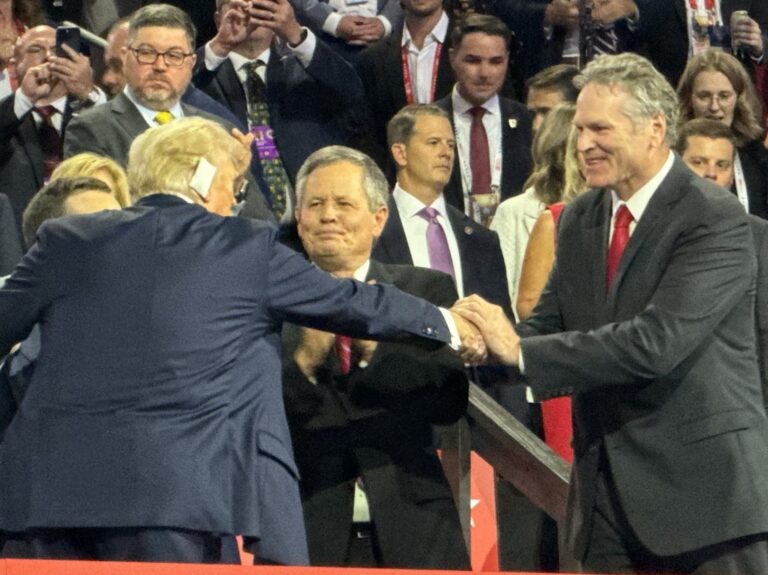
As reported in Must Read Alaska, Alaska Gov. Mike Dunleavy attended the Republican National Convention last week.  He did more than represent Alaska, he met with President Donald Trump and was seated three chairs away from Trump during the last night of the convention speeches. 

This is a bit surprising; sitting with the former president is a place of honor, and of all the Republicans at the convention, Dunleavy was the person to receive it. This raises Dunleavy’s visibility in the Republican world and tells you that Dunleavy is held in high favor by Trump. 

The close association might confirm the rumors that have been circulating for the past year, in which Dunleavy has been mentioned as a potential secretary of the Interior in a future Trump administration. Dunleavy’s proximity to Trump at the convention lends credence to that idea if Trump wins the presidential election in November.

For an ambitious politician, that would be a wise political step.  The governor’s current term will end in 2026, and he is term-limited meaning he cannot run for governor again. Dunleavy’s options after his current term is over are limited.  He could go back to teaching school, or if he wishes to remain in politics, he could run for the U.S. Senate in 2028 against Sen. Lisa Murkowski, who will be up for reelection in that year. Neither of these choices looks like a smart career choice. Dunleavy’s best chance to advance his political career is in national politics as part of the Trump administration.

How does that impact Lt. Gov. Dahlstrom? Dahlstrom is currently running for the U.S. House in a closely contested race for Alaska’s congressional seat against Nick Begich and the incumbent Mary Peltola.

Polling for Alaska political offices is notoriously difficult, but according to the polling site “Data for Progress,” the most recent polling data shows the following for the congressional race:

Mary Peltola (D) – 44%

Nick Begich (R) – 35%

Nancy Dahlstrom (R) – 10%

Chris Bye (L) – 2% (Bye is not a candidate)

The website also forecasts a near tie in the election results after the rank choice voting automatic runoff, with Peltola and Begich coming down to a near 50/50 split in voting after Dahlstrom and Bye are eliminated.  This doesn’t bode well for Dahlstrom’s chances in the congressional general election.

So, if you are Dahlstrom, and see the current governor sitting next to Donald Trump at the convention and have the benefit of seeing the recent polling results for your own race, you have to be thinking about your political future and what is the best course of action.

Dahlstrom can continue to battle it out with Begich and Peltola up until the Aug. 20 primary. It is an election after all, and she does have Donald Trump’s endorsement, so she might do better than the polling suggests, but if the primary results reflect current polling, she will come in third. 

At that point, Dahlstrom can hope for a miracle and foolishly remain in the race as the RCV system allows her to do. The top four vote-getters in the primary will make it through to the general election.  Nancy Dahlstrom will certainly make the top four and will be on the general election ballot. 

Both Republicans tried that strategy in 2022, and ended up splitting the Republican vote which gifted Democrat Mary Peltola an election victory in a race she should never have won. 

Should Dahlstrom try that again this year, it would mean that she would be running against Peltola, Begich, and Bye in the general election, which would probably split the Republican vote giving the election to Peltola again. 

That’s exactly what Peltola and the Democrats are hoping for, but Dahlstrom has options that were unavailable to Sarah Palin and Nick Begich in the 2022 election. Dahlstrom can drop out if she loses the primary, graciously give her support to Nick Begich, and act magnanimously in defeat. This action would endear her to Alaska Republicans. 

Then Dahlstrom could hold her breath and hope that Trump wins in November and makes Dunleavy part of his cabinet. If Dunleavy resigns as governor to take a job in the Trump administration, as the lieutenant governor, Dahlstrom would then be appointed to fill his place for the last two years of Dunleavy’s current term.

By dropping out after the primary election and helping Nick Begich, Dahlstrom might cement her standing with Alaska Republicans, and by getting the governorship with Dunleavy’s departure, Dahlstrom could win two additional terms as governor, setting herself up for a potential 10 years as governor going forward. 

Even if Dunleavy is not part of the next Trump administration, Dunleavy can’t run for reelection in 2026 and Dahlstrom has raised her visibility with the current congressional race.  She would be in a good position to run for governor in two years. That sounds like a pretty wise choice for a long-time Alaska politician looking to extend her career.

It is ironic how Dahlstrom’s career is shaped by vacancy appointments.  Dahlstrom got her first seat in the Alaska House by being a replacement for Lisa Murkowski after Murkowski was promoted to fill her father’s Senate seat. Dahlstrom could become governor by filling Dunleavy’s vacancy if he joins the Trump administration. 

Stranger things have happened. You have to love Alaska politics, never a dull moment.

Greg Sarber is a board member of Alaska Gold Communications, the parent company to Must Read Alaska. He writes in his own capacity as a resident of Alaska. This column first ran in Seward’s Folly.