This past week, I appeared on the Amy Demboski Show to talk all things energy. I took a call from someone named Bruce, who asked me what I’d do to help Alaska’s energy economy and future if I was in charge for a day.
It was a great question, and as I answered it, I thought about the myriads of opportunities this great state has under its crust. So many of them have been stymied from moving forward under the Biden/Harris administration.
Each of them have the potential for dozens, if not hundreds, of full-time, six-figure jobs. Those could bring qualified employees and their families to our state and help reverse the outmigration trends of the past decade. Many of the jobs would be filled by rural residents, who could then balance traditional lifestyles with employment opportunities not found in their villages.
They’re worth listing for the purposes of discussion and to act as a roadmap for a potential second Trump administration.
To begin with, let’s once again authorize exploration and leasing activities in ANWR’s (the Arctic National Wildlife Refuge) Coastal Plain. Those activities were first paused, then cancelled, as part of Biden’s 2020 campaign pledges brought to life. Legally-binding leases were voided, and Congressionally-mandated activities ordered reversed. The potential for decades of jobs and billions of barrels of oil were negated; sacrificed at the altar of a fake “climate crisis”.
The blowback from eco-radicals over the one “win” we had under the Biden administration – with Willow’s reauthorization – led Biden to shut down areas the size of Indiana in the NPR-A to further development activities over the last six months. If I had the power, I’d reverse those immediately, as most of those areas had already been through environmental and permitting approval processes.
The Ambler Mining District in Northwest Alaska is an area rich in copper, cobalt and other critical and strategic minerals. Even with Congressional mandates guaranteeing access to the area, Alaska’s Congressional delegation was unable to offset the extremist voices cajoling Biden to shut down access through the 16 miles of the Gates of the Arctic National Park. He heard the eco-left, ordered the areas closed, and in doing so, put domestic supply chains of those materials at-risk. I’d re-open the permitting process, and believe Ambler represents one of the greatest opportunities in the nation for securing domestic supply chains of those minerals.
Projects with clean environmental impact statements – especially ones with an ability to change markets and supply chains alike – should be given expedited approval status. That’s the case with the Pebble Mine, and I’d sign permits to allow its development. Especially with Pebble’s final environmental impact statement coming back clean, with the science and studies debunking the eco-left’s fears that opening Pebble would decimate the Bristol Bay fishery over 200 river miles away, there’s zero reason not to bring the trillion dollars of product to market and create the 700+ jobs in the region.
There are many other opportunities that Alaska has to offer American energy security. The AK-LNG pipeline has federal loan guarantees and a supplier of natural gas, but still faces significant headwinds. Let’s figure out how to make that happen, and soon!
The GraphiteOne mine near Nome would supply nearly the entire national demand for graphite. A coal plant in the Mat-Su Valley could help supply hundreds of megawatts of power to Alaska’s key population centers. The Ucore/Bokan Mountain rare earth elements project on Prince of Wales Island in Alaska’s Southeast Panhandle would be game-changing in an effort to establish domestic supply chains.
Simply put, Alaska can be the tip of the spear in helping America become energy dominant; a stated goal of Trump’s during his acceptance speech at the Republican National Convention.
If I had 24 hours to make things move forward, these are the projects I’d focus on. I’d be exhausted at the end of the day, but Alaska’s energy future would be bright, jobs would last for generations and America would be more energy secure.
Thanks, Bruce, for the question on Amy’s show this past week. It gave me a lot to think about, and man, it’d be fun to have that power for the day, for sure!
Rick Whitbeck is the Alaska State Director for Power The Future, a national nonprofit organization that advocates for American energy jobs. Contact him at [email protected] and follow him on X (formerly Twitter) @PTFAlaska.
The long, drawn-out case of former Rep. Gabrielle LeDoux, accused of voter fraud stemming back to her activities in 2018, may have reached a new juncture.
Lisa Simpson, formerly Lisa Vaught, has signed a plea agreement. Simpson is the former chief of staff and campaign manager for LeDoux, who may face a jury trial next week — unless it is delayed yet again.
The court record shows that Simpson signed the plea agreement earlier this month. She faced five charges of voter misconduct, several of them felony charges. This may mean she has agreed to testify against LeDoux.
In 2020, LeDoux and Simpson had been charged with voter misconduct and unlawful interference with voting after an investigation by the FBI and the Alaska State Troopers stemming from the registration of Simpson’s son and other voters as voters in LeDoux’s district, part of East Anchorage that was then District 15.
“On June 2, 2021, an Anchorage grand jury indicted Gabrielle LeDoux, Lisa (Vaught) Simpson, and [her son, who was exploited] on multiple counts of voter misconduct in the first degree. These charges stem from the investigation that started in 2018 after the Division of Elections identified some irregularities in some of the absentee ballot applications and absentee ballots returned for the primary election for House District 15. The Alaska State Troopers, in conjunction with the Federal Bureau of Investigations, conducted the investigation,” the Department of Law wrote.
The trial has been delayed dozens of times.
The next court date for LeDoux is July 23, which is a jury trial status meeting and oral arguments, with a jury trial set for July 25. Such calendar events have come and gone in the past for LeDoux, but with Simpson’s plea agreement, it’s possible that LeDoux will also make a plea agreement. Other charges relating to fraud in the 2014 election had already been dismissed by the judge.
In the years that have passed, at least one witness has died. Charlie Chang, a Democrat who LeDoux paid and brought in as a consultant from California to help her interface with the Hmong community in her district, died in California, according to LeDoux.
A list of all the court dates and delays in this case shows the numerous times this has been delayed. With a plea agreement from Simpson, however, it seems almost certain that there will be movement in the case this coming week. That could include LeDoux getting her own plea agreement to lesser charges.
04/03/2020 09:00 AM
Courtroom 204, Nesbett Courthouse
Arraignment: State District Court (Out of Custody)
The Alaska Permanent Fund Corporation’s Board of Trustees will hold a regular meeting on July 24 in Fairbanks. Agenda items include reports from the Audit and Governance Committees, Private Equity asset class presentations from internal and external managers, and updates to the Personnel Management Plan.
During the meeting, the group will retreat to an executive session devoted to “security review” issues. Leaked emails earlier this year have raised concerns about how someone was able to get damaging emails, which were provided to the Alaska Landmine.
It has been a tumultuous season for the trustees of the Alaska Permanent Fund, with revelations that one trustee member has possibly used undue influence and pressure on the professional staff who manage the fund, by being overbearing in steering investment decisions. Questions have been raised about the propriety of Trustee Ellie Rubenstein’s meddling in the day-to-day business, with even more questions raised about whether she has attempted to steer investments to funds that she has a personal interest in or that her father has an interest in. Rubenstein is the daughter of David Rubenstein, founder of the Carlyle Investment Group, the world’s sixth largest private equity firm by capital raised over the previous five years.
The emails that were published put an uncomfortable spotlight on trustee Rubenstein, who is the vice chair of the board and the chair of the governance committee. Emails showed that she may have also tried to influence Gov. Mike Dunleavy to not reappoint Ethan Schutt to the board; Schutt is chair of the board of trustees and if he was not reappointed, it’s likely Rubenstein would then become chair. This week he was reappointed by the governor.
The board of trustees has a clear rift between its members, much of it revolving around Rubenstein’s behavior.
The public may attend this meeting in person, virtually via Teams Webinar (registration information listed in the agenda linked above), or by phone.
There will be an opportunity for public comment and participation at 8:30 a.m. at the beginning of the meeting. Those wishing to sign up for public comment should register via Teams and email [email protected] by noon on July 23.
As I write this article, I find myself wondering if anyone’s successes and accomplishments ever result solely from their own efforts and talents? Or are those who achieve greatness and world recognition always helped by less visible supporters and collaborators?
Would Michelangelo have become one of the greatest artists of the Italian Renaissance period―and arguably of all time―without the support and sponsorship of the art patron Lorenzo de’ Medici?
Would prominent Russian writer Leo Tolstoy have produced his epic War and Peace―regarded by many to be the greatest novel ever written―without laborious secretarial help from his wife Sophia Behr?
Could young athletes become Olympic champions without their parents’ or coaches’ support and encouragement?
The answer is most likely that no major undertaking―whether fiction writing, creative work, or scientific discovery―ever gets finished without the help of supporters and collaborators. It is certainly true of my essays, which could not have been completed and ultimately published without the interest and advocacy of Suzanne Downing, an editor of Must Read Alaska.
In one of his narratives, At the beginning of the United Nations Conference in San Francisco, Victor Glazkov, the Soviet Union on-board radio operator of a C-47 transport aircraft and a direct participant in the Alaska-Siberia Lend-Lease ferrying operations, recollects the events of those years (1942–1945).
The original handwritten Glazkov’s memoirs was gifted to the Pioneer Air Museum in Fairbanks in June 1992 on the 50th anniversary of the opening of the Alaska-Siberia Air Route.
The full memoirs’ text, including this article below, were first released in English under my editorship and published in Pipeline to Russia: The Alaska-Siberia Air Route in World War II by the U.S. National Park Service in 2016.
Major James Gebhardt, a US commissioned officer of the Soviet Foreign Area Division, translated Glazkov’s rare first-person account from Russian into English, with my editing assistance.
Excerpt of Victor Glazkov’s memoirs:
“In the last days of April 1945, instructions were issued by Soviet authorities to select an experienced crew and, in a passenger-configured aircraft, fly to Moscow to execute an exceptionally important mission. The commander V.A. Pushchinsky formed a crew from aircraft commander V.L. Bratash, co-pilot B.S. Osipov, flight engineer V.A. Bukarov, and I, on-board radio operator V.D. Glazkov. From Moscow, we were to execute the sortie from 19th International Air Squadron, which was commanded by A.I. Semyonov.
“They [Soviet authorities] informed us that we would deliver the Ukrainian delegation, headed by the People’s Commissar of Foreign Affairs of Ukraine, Dmitry Manuilsky, to the first conference of the United Nations in San Francisco. Bratash, assigned to co-pilot duties, remained in his left [commander’s] seat and fulfilled the actual function of aircraft commander all the way to San Francisco and back. The honorary commander, Beskodarov, did not interfere with Bratash’s functions; sometimes, to give Bratash a rest, he took over piloting the aircraft himself.
“We departed from Moscow on April 29, 1945. Two additional C-47 aircraft followed us at 15 to 20-minute intervals. In one of these aircrafts was the Soviet delegation, headed by Vladislav Molotov, and in the other was a delegation from Belorussia with the People’s Commissar of Foreign Affairs, K.V. Kiselev.
Editor’s note: Vyacheslav Molotov was a Soviet politician, diplomat, and revolutionary who was a leading figure in the government of the Soviet Union from the late-1920s to the mid-1950s, as one of Joseph Stalin’s closest allies.
“Our crew laid down the first leg of the air route. The flight of all three aircraft to Fairbanks proceeded normally with minor delays at airports designated in the flight plan. From Fairbanks to San Francisco, the route passed through Edmonton and Seattle―a city famous for the aircraft assembly plants of the enormous Boeing Company. This portion of the route was unfamiliar to the crew. We conducted pre-flight preparation together with an American guide pilot and an interpreter by the name of Kargin. Our navigator was in shock over the American flight charts, since everything that the crew required in flight was precisely marked on them.
“We arrived in San Francisco on May 6, and our delegations attended the conference on May 7. I recall that our delegations [i.e., Russian, Ukrainian, and Belorussian] for the most time stayed together. Andrey Gromyko, then an ambassador of the USSR to the United States, was acting chief of the USSR Delegations. At the end of the conference, in June, the San Francisco delegates of 50 nations adopted the United Nations Charter and, with it, laid down the basis of the existence of this organization.
“The city of San Francisco made an enormous impression on us. It was very beautiful. The city is located on a hilly peninsula to the south of the Golden Gate Bridge, where San Francisco Bay joins with the Pacific Ocean. The city had an artistic, uneven relief, with many parks, theaters, and entertainment venues. In addition to familiarizing ourselves with the city of San Francisco, we also visited the neighboring cities of Oakland, Berkeley, and Richmond.
“I recall meeting with an American of Armenian ancestry. We were walking through the commercial district. Suddenly, we heard a voice in Russian: “Stalingrad! Russian officers! Hitler is kaput!” We had to respond to this emotional greeting and accept an invitation to visit the speaker’s small store of household goods. In the center of a market hall, above a writing desk, was proudly displayed a portrait of Soviet General Ivan Bagramyan [Soviet of Armenian ancestry] in uniform.
Editor’s note: Ivan Bagramyan (1897–1982) held several high staff and command positions during the Great Patriotic War (1941-1945), including command of the 1st Baltic and, later, the 3rd Belorussian fronts. He was promoted to the rank of Marshal of the Soviet Union in 1955.
“The store owner was very proud that among Armenians there were also great people. He suggested that we might wish to purchase items from his store. We, of course, had no need for any of his merchandise. But to walk out without making a purchase was impolite, so we each selected a folding knife. The flight-engineer also picked out a padlock. When I asked how much the bill was, the owner smiled and, excusing himself, took from our hands our intended purchases and placed them on the desk chair, then invited us to pass through the door behind the desk.
“We all had been stuffed full of instructions in the Soviet Union regarding the rules governing our behavior as Soviet citizens abroad, about vigilance, and so on. In this case, our safety was hardly threatened, and I was the first to cross the threshold. We ended up in the kitchen-dining area of the living quarters of the building. A middle-aged Armenian lady, the wife of the store owner, came to greet us. At the table sat two young girls 16–17 years of age, who, upon our appearance, quickly jumped up from behind the table and disappeared with laughter to their rooms.
“First the store owner introduced us to his wife, and then to his daughters. The conversation between them was conducted in Armenian. They invited us to sit at the table, which was already set. I will not describe the dishes and linen, in order not to embarrass my children and grandchildren, since they will not see such a table in their entire life, even after 2,000 years. At the table, we raised a toast to our Victory over Hitler! And a toast to peace in the entire world, which the newly created international organization―the United Nations―would ensure!
“We asked the owner if his daughters knew the Russian language. He responded that his wife knew a little bit of Russian but, over the many years she had lived in the United States, had forgotten it. The children knew Armenian very well. They say Armenians have dispersed throughout the entire planet and must know their own language. Without a language, there is no nation.
“We stood around the table for a relatively brief time. When we were saying our goodbyes, the owner declared to us that our purchases were his souvenirs [gifts] for us. He would not take money. We were placed in a difficult situation. We had also to offer the owner a souvenir, and we had nothing to give him. I had to part with my miniature pipe mouthpiece, made from porcelain in the shape of a female head. The flight engineer took the red star from his garrison cap, which the owner immediately attached to the portrait of the Soviet General Ivan Bagramyan.
“In order not to wander around the streets of a large and unfamiliar city, we decided to get a taxi, which quickly dropped us at the store of the well-known commercial company, Wood. They said that one could purchase absolutely anything he desired at this store. If you needed something and they didn’t have it, they would take an order and over the course of 24 hours fill it, even if the item had to be delivered from another country. The customers, of course, were responsible for shipping charges, in the presence of a pre-purchased agreement.
“The store surprised us in its dimensions: it had large merchandise halls with high ceilings, and escalators in place of stairs. We walked into the fabric department, where we discovered so many fabrics that our eyes could not take it all in. There were few customers. The salesgirl came out to greet the customer and offered her assistance in the selection of goods. I explained to the young lady, as best I could in English, that I needed to purchase a cut of cloth for a dress for my mother and two sisters. But it was very difficult for me to make my selection. Clearly, several words were spoken to the senior sales ladies in the hall and, immediately, five or six female salespersons approached us. They told me that I should select from this group a woman who was like my mother and sisters in size, body shape, and color of hair and eyes. Then they began to measure out fabric of various colors on them. I relied on the taste of these ladies and, with common approval, made purchases that turned out to be quite successful.
“I also recall the purchase of a pair of men’s shoes. I selected the shoes based on my own taste, tried them on, and walked over to the clerk to pay for them. He shook his head “No” and asked me to walk with him to some kind of wooden bedside table. He had me put on the shoes and place my feet beneath this table. Glancing down at this table from above, he said that these shoes did not fit me. I needed to select a different pair. I understood that this table was some sort of X-ray device that illuminated my foot so he could see where my foot was in the shoes.
“We took a taxi back to our hotel with our purchases. Having paid the taxi driver, we walked into the lobby of the hotel and there a Black man ran up to us. He was two meters [about six and a half feet] tall and grabbed the purchases from my hands to carry them to our room. I knew that I had to give him a gratuity for his services. Because we were short on American currency, I explained to this Black man that I did not need his assistance. But he brazenly pulled the purchases from my hands and carried them to my room. In my room, I gave the Black man a half dollar. He twirled it in his fingers, muttered something, and then tossed it in my direction.
“I thought to myself that here is a smart Aleck: he provided me with his services against my will, and even more, insulted a Soviet officer. It had been drummed into my head during my school days that in America Black people had no rights. Right away, the question arose, why did they conduct themselves like lotus with foreigners, with a white person, if they were without rights and every day white people abused them?
“Several minutes later, there was a knock on the door. The flight engineer opened it. At the threshold was the same Black man. The flight engineer asked, “What do you need?” The Black man answered, “A ration of vodka.” So, I led him to the kitchen and poured him a glass of vodka. He tossed it down, in Russian style. I could tell that his stomach was distorted in a cramp and his eyes just about jumped out of their sockets. I pointed to some sandwiches that he could nibble on. He refused the offer. Then, I shook his hand and he left.
“An hour later, the Black man again knocked on our door. “What’s going on?” I asked. It turned out that he had violated one of the provisions of his labor contract, that is, he consumed alcohol during duty hours, and for this violation he was subjected to dismissal. Our desire to assist him did not have any success. In America, labor discipline is the law, and no labor union could help him.
“As pilots, we did not participate in any of the conference sessions. We did not even have a pass to get in. But we had information that the sessions were progressing loudly, with many contradictions and disagreements on almost each point of the UN Charter. Rumors had it that Vyacheslav Molotov was leaving the conference early as previously was planned. According to information from the Soviet side, Molotov had to be in Moscow for the resolution of important state issues. According to information from foreign sources, Molotov was abandoning the international conference in San Francisco because of various approaches to the invitation of Poland and Argentina to membership in the United Nations. Molotov’s deputy, Andrey Vyshinsky, was left in his place at the conference.
“After adoption of the UN Charter and designation of permanent representatives from fifty (50) nations, all the delegations began to leave for home. We flew out with the delegation of Dmitry Manuilsky to the Motherland [Soviet Union] and on June 2 were already in Moscow. On June 5, we delivered the Ukrainian delegation to Kiev.”
The UN Charter was signed on June 26, 1945, by the representatives of 50 countries; Poland signed the UN Charter on October 15, 1945. Thus, there were 51 Founding Members in 1945. Currently, the United Nations made up of 193 Members States; the UN and its work are guided by the purposes and principles contained in its founding Charter of June 26, 1945.
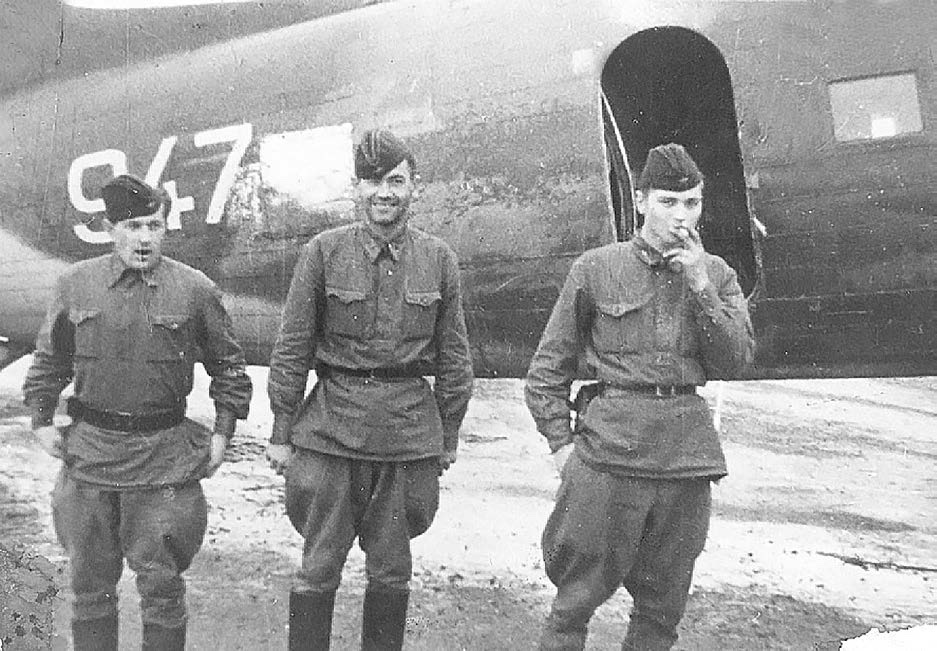
Soviet “enlisted pilots” at Ladd Army Airfield near a Russian-built Li-2. On the right is radio operator Victor Glazkov. Fairbanks, fall of 1942.
Alexander B. Dolitsky was born and raised in Kiev in the former Soviet Union. He received an M.A. in history from Kiev Pedagogical Institute, Ukraine, in 1976; an M.A. in anthropology and archaeology from Brown University in 1983; and was enroled in the Ph.D. program in Anthropology at Bryn Mawr College from 1983 to 1985, where he was also a lecturer in the Russian Center. In the U.S.S.R., he was a social studies teacher for three years, and an archaeologist for five years for the Ukranian Academy of Sciences. In 1978, he settled in the United States. Dolitsky visited Alaska for the first time in 1981, while conducting field research for graduate school at Brown. He lived first in Sitka in 1985 and then settled in Juneau in 1986. From 1985 to 1987, he was a U.S. Forest Service archaeologist and social scientist. He was an Adjunct Assistant Professor of Russian Studies at the University of Alaska Southeast from 1985 to 1999; Social Studies Instructor at the Alyeska Central School, Alaska Department of Education from 1988 to 2006; and has been the Director of the Alaska-Siberia Research Center (see www.aksrc.homestead.com) from 1990 to present. He has conducted about 30 field studies in various areas of the former Soviet Union (including Siberia), Central Asia, South America, Eastern Europe and the United States (including Alaska). Dolitsky has been a lecturer on the World Discoverer, Spirit of Oceanus, andClipper Odyssey vessels in the Arctic and sub-Arctic regions. He was the Project Manager for the WWII Alaska-Siberia Lend Lease Memorial, which was erected in Fairbanks in 2006. He has published extensively in the fields of anthropology, history, archaeology, and ethnography. His more recent publications include Fairy Tales and Myths of the Bering Strait Chukchi, Ancient Tales of Kamchatka; Tales and Legends of the Yupik Eskimos of Siberia; Old Russia in Modern America: Russian Old Believers in Alaska; Allies in Wartime: The Alaska-Siberia Airway During WWII; Spirit of the Siberian Tiger: Folktales of the Russian Far East; Living Wisdom of the Far North: Tales and Legends from Chukotka and Alaska; Pipeline to Russia; The Alaska-Siberia Air Route in WWII; and Old Russia in Modern America: Living Traditions of the Russian Old Believers; Ancient Tales of Chukotka, and Ancient Tales of Kamchatka.
”He who occupies the high ground… will fight to advantage.” —Sun Tzu
For over a half century the proponents of Diversity, Equity, and Inclusion (DEI), and its intellectual precursors have fought from high ground, not from a moral position, but a tactical and strategic one secured by Marxist indoctrination that has pervaded nearly every corner of society.
The deliberate and methodical campaign has successfully muted public criticism, although privately most Americans felt that there is something terribly wrong with a philosophy that prioritizes appearance over ability. DEI’s commanding role in all branches of the military has resulted in no tangible benefits but a myriad of failures—falling morale and standards, recruitment shortfalls, plummeting public confidencein the military, poor leadership, and with the exception of the Marine Corps, the inability to fulfill basic mission requirements at an acceptable level.
The armed forces have not experienced a graphic, seminal event that aroused extensive public sentiment and exposed the deterioration of all branches of the military. Even the Afghanistan withdrawal debacle, which defied nearly every axiom of military doctrine, resulted with every responsible general’s career intact, and the disaster was soon lost in the mainstream media news cycle.
The few who understood the ramifications of DEI observed, “The emperor has no clothes,” were muted and repudiated as racists to be bombarded by relentless personal attacks or suffocated by outright censorship.
But within an instant in front of a worldwide live audience, the attempted assassination of President Trump laid bare the outright incompetence of the U.S. Secret Service, a once elite organization led by an unqualified director who has made DEI the Secret Service’s cornerstone.
Napoleon understood the importance of personal security and the need for elite cadres to protect him and intimidate potential adversaries and assassins. The Imperial Guard, known for loyalty and extreme competence, stood at least 6 inches taller than the average height of the times and wore prominent bearskin hats to appear even taller.
The Swiss Guards, who have served the Pope since arriving at the Vatican in 1506, have a long tradition of bravery and personal sacrifice. From the Sack of Rome in 1527 when 3/4 of the guard died defending Pope Clement VII, to standing firm against Nazi forces in World War II, to thwarting the assassination attempt of Pope John Paul II in 1981, and to this day the standards of guard remain impeccable.
The Secret Service under the leadership of Kimberly Cheatle, a political appointee with inadequate leadership experience, has made DEI a top prioritywithin the organization. It is reported that there is turmoilwithin the ranks of the agency and concerns relating to its operational capabilities.
The once vaunted standards of the elite Secret Service are now an apparition, as candidates are selected by quotas defined by group identity. The results of this foray into the realm of selection processes meant to bolster self esteem resulted in disaster. Rather than staff the agency with hardened professionals, who display the physical attributes necessary to protect the president in a crisis and possess the experience to prevent the assassination in the first place, the Secret Service relies on thoselessqualified to serve.
The assassin was not the savvy professional whose mission was to assassinate Charles de Gaulle in Forsyth’s book, Day of the Jackal, but a rank amateur who was able to avoid theinept USSSand secure thehigh ground that offered a close-range, direct shot at the president.
Any competent rifleman with an adequate weapon could have succeeded, yet Director Cheatle, oblivious to the inadequacies of the organization she controls, praised the USSS’s performance. She states the “buck stops” with her but refuses to resign, secure in the fact that as a DEI appointee she is granted great latitude with regard to performance.
Once again, no one in the upper echelons of leadership is held accountable for massive failures. President Trump owes his life to a random head movement at precisely the right instant. Whether it was luck or divine intervention, he survived in spite of the Secret Service. The members of the Secret Service who were hired by DEI criteria did not pull the trigger of the assassin’s AR-15, but their lack of judgment, training, professionalism, and timing makes them culpable.
The Battle of Gettysburgdemonstrated the military imperative to control the high ground, and this lesson applies to ideological battles that will be won by those who command the moral advantage and maintain their constitutional right to free speech to convey this message. The horrific assassination attempt meant to deprive millions of Americans the choice of their preferred presidential candidate serves as an opportunity to breach the defenses of DEI and end its pernicious assault on America’s institutions.
Lincoln’sGettysburg Address honors sacrifice in defense of liberty and the principle that all men are created equal. These cherished rights have been defended on the battlefield against tyranny since the republic’s inception. What a tragedy to spill so much blood, only to succumb to DEI and other Marxist ploys that insidiously suck the life from society.
Scott Sturman, MD, a former Air Force helicopter pilot, is a graduate of the United States Air Force Academy Class of 1972, where he majored in aeronautical engineering.This article was originally published by RealClearDefense and made available via RealClearWire.
The attempted assassination on President Donald J. Trump last Saturday was clearly part of a plan to get him out of the presidential race. People on both sides of the political aisle are calling for a thorough investigation into the shooting.
Of course, the assassination attempt has shaken countless Americans, leading many to ask questions such as “Was it God’s plan for Trump to get shot?” “Why didn’t God stop the shooter?” “Is this a sign from God on who to vote for?”
Kelly Tshibaka addressed these questions in a sermon at Unite Church in Anchorage one day after the shooting, using the Bible as the foundation for her answers.
“God’s plans are always redemptive,” Tshibaka stated. “The thief…comes only to steal, and to kill, and to destroy. I have come that they may have life, and live it to the full,” she said, quoting John 10:10.
“So, is God up there saying for those people who might not like Trump, ‘Kill him’? No. Would God say ‘Kill Biden’? No.” Tshibaka declared.
If God doesn’t want people killed and death is not part of his plan, then why didn’t He prevent the shooting? Tshibaka had an answer for that as well.
“Though God could impose His will on everyone, He could not do so without stealing our own will away from us…God wants a relationship, an equal relationship with us where we are sons and daughters. It’s a choice. So, if He takes that choice away from us, if He just stops the shooter … then He also takes away the choice to love. You can’t take one without taking the other.”
Finally, Tshibaka addressed whether or not Trump’s survival should be considered an endorsement from God. While she admitted that the shooter missing Trump is an undeniable miracle, she warns against the danger of basing one’s theology on circumstance rather than in the Bible. “Otherwise, you will put God in your image instead of letting God shape you in His image”, she explained.
She emphasized the importance the Bible places on civic duty, and the authority God entrusted to people by explaining the application of the prophecy about Jesus, “the government will rest on His shoulders.” (Isaiah 9:6)
Tshibaka concluded with 1 Timothy 2:1-2, which tells us to pray for all those in authority, and told the congregation to love one another despite differing political stances.
“It pleases God to pray for our presidents. It literally says that in the Bible…it’s our job to sustain [our leaders] in prayer,” she said.
Pray for your leaders, your opponents, and your presidents. God transcends politics, and we must lead by His example.
Kelly Tshibaka is the host of the podcast, TV, and radio show STAND, and the 2022 Alaska Republican candidate for U.S. Senate. She co-hosts the show with her husband, Niki Tshibaka. She is also the chair of Trump’s 2024 campaign in Alaska.
The annual Golden Days Parade and street fair takes place Saturday in Fairbanks. And there’s also the rubber duck race in the Chena River.
Since 1952, Fairbanks has celebrated its founding with Golden Days, including the biggest parade in Alaska, which starts at 10 a.m. at the Carlson Center and winds through downtown.
The parade usually has more than 100 entries, including marching bands, clowns, politicians, antique cars, and floats. You can purchase your Rubber Duckie Race tickets from ticket sellers on the parade route.
Golden Days finishes Sunday with the annual Fairbanks Igloos of the Pioneers of Alaska gathering at Felix Pedro’s Discovery Claim to honor his place in Fairbanks history. The event is free; Pedro Monument is located at the site of Felix Pedro’s Discovery claim at milepost 16.6 on the Steese Highway.
On Sunday at 2-3 p.m., the annual Golden Days Great Bathtub Race takes place at Pioneer Park.
Teams of five, with one member sitting in a tub or something that holds water and bubbles, race in Pioneer Park. AT the end of the race, there must be at least one gallon of water left in the tub. Required props that must be part of the race are one bar of soap, one towel, one wash cloth and one bath mat. No motorized or mechanical “tubs” are permitted.
Chances are, if you’re in the Port Alsworth, Lake Clark area this weekend, you may run into Greta Van Susteren, host of The Record with Greta van Susteren on Newsmax.
She was on a jet to Alaska on Friday, coming directly from the Republican National Convention in Milwaukee, where she was reporting, heading north to work on a project that she started over a year ago in Alaska.
Susteren has been a regular visitor and volunteer at the Samaritan’s Purse Heal Our Patriots lodge in Port Alsworth, which was started by Franklin Graham in 2012. It’s a retreat that ministers to military couples with at least one spouse wounded or injured.
“Couples come to Alaska looking for a way to fix what’s broken—broken relationships and marriages on the brink. Often they feel far from God,” the group explains on its website.
“But as they step away from daily life and distractions, many couples find hope awakening again as they go through six days of chaplain-led, Biblically based marriage enrichment training. Coursework and spiritual care are integral parts of their week, as are once-in-a-lifetime wilderness experiences in Lake Clark National Park and surrounding areas. They also connect with other couples who have faced a lot of the same struggles. Perhaps for the first time, they don’t feel so alone,” Operation Heal Our Patriots says.
Susteren has been a journalist, lawyer, television news anchor for CNN, Fox News, MSNBC, and now Newsmax.
The weather looks favorable for the Arctic Thunder Open House and air show at Joint Base Elmendorf-Richardson, scheduled for Saturday and Sunday.
Past events have brought in as many as 300,000 visitors to the base to see over 40 static displays across 30 acres, with aircraft and other inventory from the Department of Defense and Department of Homeland Secret. There will be at least seven international partners taking part in some capacity, and seven hours of flying demonstrations, including six military aerial demonstrations, eight civilian aerial demonstrations and joint force demonstrations.
Access to the base during the show is limited. Gates open at 9 a.m. Civilian access is at the Boniface and Richardson gates only, but no ride-sharing drivers (Uber or Lyft) or taxis will be allowed, and neither will recreational vehicles, trailers or oversized vehicles. Department of Defense ID cardholders can access shuttles to reach the open house through Muldoon and Government Hill gates. Admission and parking is free, but parking is extremely limited.
The schedule:
11:15 a.m. National Anthem/opening ceremony with the 211th and 212th rescue squadrons
Followed By (order subject to change)
Melissa Dawn Burns (Edge 540)
The Pacific Air Forces C-17 Demonstration Team
Undaunted Airshows (RV-7, RV-8)
The Pacific Air Forces F-16 Demonstration Team
T-33 Acemaker
Undaunted Airshows (RV-7, RV-8)
German Air Force PA-200 Tornado
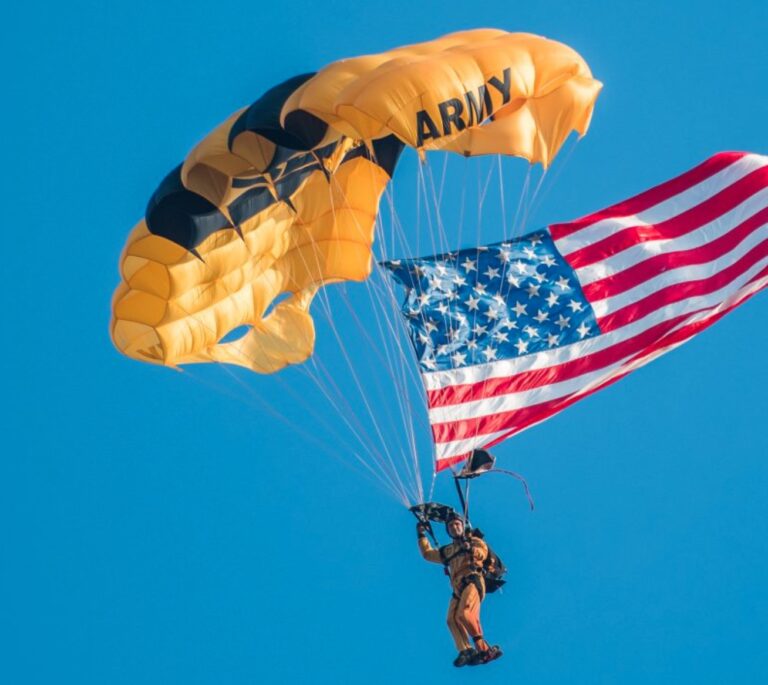
The U.S. Army Golden Knights
The JBER Joint Forces Demonstration
Melissa Dawn Burns (Edge 540)
The U.S. Air Force F-22 Demonstration Team
The U.S. Air Force Demonstration Team, the Thunderbirds
All the information about the airshow is at this JBER link.