On Monday morning, Ketchikan High School students were dismissed at 10:45 am, with plans to reopen the school no earlier than Wednesday. All practices and after school activities are canceled until at least Wednesday.
The school had “two additional covid cases” that prompted the closure decision, which is based on a matrix the schools in Ketchikan are using.
All students, staff, and families were advised by Principal Jason House to watch for symptoms of Covid, wear a mask, and practice social distancing.
Because the phrase “Ladies and Gentlemen” is not perceived as inclusive by some, Alaska Airlines has advised its flight attendants to stop using it when making onboard announcements. The airline sent a reminder to its flight attendants that says:
“As Flight Attendants, we are used to certain routines and habitual behaviors when it comes to how we do our job. The processes of performing the safety demo, setting up our galleys and carts for service, and many others are second nature to us, and we don’t give them a second thought. One of those deeply ingrained habits for many is starting our cabin announcements with the phrase ‘ladies and gentlemen’.”
The advisory memo continues: “What you may not know, however, is that ‘ladies and gentlemen’ is no longer part of our announcement scripts. Section 10 of the Flight Attendant Manual (FAM) and the announcement section of Block2Block no longer include any gender-specific references. Though it may take some effort to drop the habit of using the phrase, doing so is important in creating an inclusive environment for all our fellow Flight Attendants, other co-workers, and passengers.”
“Our MEC adopted a resolution on gender equality in December, 2020. The resolution affirms the MEC’s support of the right to recognition, acceptance, and inclusion of people of all gender identities and expressions both in and out of the workplace. As not everyone identifies as male or female, preceding cabin announcements with the term ‘ladies and gentlemen’ does not support a welcoming atmosphere for everyone. Let’s work together to create an inclusive environment by using language that is welcoming to all!”
Alaska Airlines isn’t alone; Delta, Japan Airlines, Brussels Airlines, and Lufthansa are some of the other carriers that have dropped the terminology that refers to well-behaved passengers.
The phrases that they are using may be “everyone” or “passengers,” or perhaps just a term like “Good morning.”
With all the air rage these days, perhaps the dropping of the phrase is an accurate representation of the seemingly fewer ladies and gentlemen flying than in years past, when people generally behaved better onboard.
Former Sen. Anna MacKinnon has been named the director of the Alaska Permanent Fund Division, the agency in charge of determining who is qualified to receive the annual dividend that is paid to Alaska residents from investment earnings of mineral royalties.
MacKinnon had been serving in the Department of Revenue in a special assistant position appointed by the governor. During her time in the Senate, she had served as co-chair of Senate Finance. She also served in the House for several years. Formerly of Eagle River, she now lives in Juneau with her husband, John MacKinnon, who is the commissioner of Transportation and Public Facilities.
The annual dividend payment allows for Alaskans to share in a portion of the State minerals revenue in the form of a dividend to benefit current and future generations. Eligibility to receive a Permanent Fund Dividend is defined by the Alaska Legislature through statute and regulation.
The statutory dividend calculation is based on the number of eligible Alaskan applicants in a dividend year and half of the statutory net income averaged over the five most recent fiscal years. The available funds are also reduced by prior-year dividend obligations, PFD operation expenses, and other state agency program appropriations. But the Legislature has broken the law for several years and arrived at an arbitrary number. So far, this year, that number is zero, because the Legislature approved $525 and the governor vetoed that amount, calling it an insult to Alaskans.
The division is completely separate from the Alaska Permanent Fund Corporation, which is responsible for investment of the fund’s principal balance.
“These hearings are the first meaningful actions in the House since convening the third special session.”
Three Alaska House Republicans did something no one could have anticipated on Monday: They complimented Democrats in charge of important committees in the House, specifically, Rep. Matt Claman, chair of House Judiciary, and Rep. Ivy Spohnholz, who chairs the House Ways and Means Committee.
Why the praise? They’re evidently just happy to see ant activity on critical legislation in what is now the third week of the third special session of the year, when much of the House leadership seems bogged down, unable to do anything.
Rep. Sarah Vance of Homer, a member of the House Judiciary Committee stated, “These hearings are the first meaningful steps toward a comprehensive long-term fiscal plan since convening the third special session.”
The House Judiciary Committee is scheduled to take up Gov. Mike Dunleavy’s HJR 7 on Tuesday. The bill proposes amendments to the Alaska Constitution regarding the future of the Permanent Fund and the dividend.
If passed by the Legislature, HJR 7 would be placed before Alaska voters in the 2022 general election.
“These hearings and the consideration of these important pieces of legislation are truly encouraging,” said Rep. Cathy Tilton of Chugiak-Mat-Su, who is the Republican Minority leader. “I’d like to thank my colleagues for their political courage and bipartisanship.”
Rep. Mike Prax of North Pole, a Republican member of Ways and Means committee and alternate on the Fiscal Policy Working Group, said: “I came to Juneau for this special session, prepared to work. I’ve been disappointed by the lack of meaningful progress thus far. We have many difficult and complicated issues to work through. I sincerely appreciate Chair Spohnholz’s willingness to start these critical conversations.”
The House Ways and Means Committee, chaired by Rep. Ivy Spohnholz, has scheduled more than a week of hearings, starting Monday at 9 am, to brief the committee on the recommendations of the Fiscal Policy Working Group and later hear legislation that could become part of a comprehensive package.
Included in the legislation to be considered by Spohnholz’s committee are HB 3001, sponsored by Rep. James Kaufman of Anchorage and HB 3002, sponsored by Rep. David Eastman of Wasilla.
I am a student of all of the 20th Century environmental movements and a participant in many of them. This is the first in a series of four columns to first clarify the global climate change movement – why it is different from the others – and to propose an approach to satisfy both those who are ardent in reducing carbon emissions and those who just want to live their lives in peace and breathe clean air.
Climate change, previously called global warming, is different because there is such a gulf between those who want to prevent further warming by reducing carbon emissions and those who resist such an effort. The “Resisters” are either:
Those who don’t believe climate change is a valid, world-wide, public issue deserving of attention by society; or
Those who might be open to concern over the climate but who are skeptical about the solutions being proposed and actions taken so far.
This gulf is huge and it prevents communication among the parties and it has generated vilification on both sides, and no small amount of contempt to go around.
Previous environmental movements were not like this. The meat-packing contamination at the dawn of the 20th Century began with a journalistic exposure of industry practices that caused revulsion across America and led to pretty swift (for the times) government action to address the matter. There was no pro-contamination counter-movement (although this might have been the beginning of the vegan movement) and no general outcry at this new intervention in commerce by the government.
The national parks movement was also blossoming in the early part of the last century and there was no anti-park resistance worthy of note at the time, probably because there weren’t many people affected by the designations. The parks movement happened across the country and was stable until Alaska statehood when a new round of park designations was set in motion. This did engender resistance and does so to this day, but that is a subject to address in another column.
And so, we go to the latter half of the century in the 1960s and 1970s when air quality, water quality, endangered species, habitat protection, wetlands protection and management of coasts and riverbanks and flooding all took center stage.
There was little resistance to creating these programs and an amazing amount of cooperation for the granddaddy of them all: conversion to unleaded gasoline. That is a story worth looking into all by itself. There was lots of squabbling over how to achieve the goals of these programs but there was no serious objection to any of the goals themselves.
This is what makes climate change so different from the other issues. There is no broad social agreement that climate change is real and urgent, whether human caused or not.
In addition, those who are adamant about such change, and its urgency, are demanding that all of society adhere to their views and do what they want done, even if it requires sacrifice of personal rights, desires and comforts.
Some anti-climate change objectors add a bit of political seasoning to it, claiming that the movement is actually a socialist or Marxist energized endeavor. That is, to save the planet, we have to go to an authoritarian top-down model to get people to do what needs to be done. I am not asserting this but many are and it is a very important reason you will hear for resisting the climate change advocates: They want too much change in society in order to save the world.
However, the most divisive aspect of the climate change advocates is the call to eliminate the fossil fuel industry. This was the basis of President Biden’s killing of the XL Keystone Pipeline Project. He believed that allowing it was to foster an industry that must be replaced.
The public’s general support of fossil fuel is largely due to the fact that the public depends upon it, generally understands it, and does not see a reasonable way to replace it.
It is not like the fossil fuel industry hasn’t been trying to reduce carbon and other emissions. The US emits far less of these gases and particulates now than ever before and this is largely due to the creation or conversion of power plants that burn natural gas as opposed to fuel oil or coal.
This does not satisfy the climate advocates. While gas burns cleaner than other fuels, it still emits some carbon and thus cannot be tolerated. There is also concern over methane releases during the extraction and management of natural gas apart from the burning of it. I am not sure of the extent of this issue but it sure seems like it could be dealt with. The whole industry has gotta go, the climate folks say.
Well, I am not a believer in the specific belief that bad climate changes are occurring and getting worse because of human activity. However, I am a clean air advocate and so is just about every other American, or anyone on the planet for that matter. So, there can be common cause between society in general and climate advocates if we can agree that air that is free of contaminants is what we all want.
Is carbon dioxide, CO2, a “contaminant?” Well, plants breathe it and we need plants, correct? So, it must be a matter of how much CO2 is in the air that we need to sort out. That could be hard to do. The climate activists argue that the natural world, animals and people, exhale all the C02 that world needs and that artificial means of CO2 production is what is tipping the balance into a climate-destroying process. By “artificial” we mean from combustion rather than from breathing. Combustion is burning whether in a car engine or a brushfire.
We could quibble over this approach but let’s run with it for now and adopt a societal goal of reducing the amount of carbon production from burning as much as possible.
Automotive combustion does produce carbon dioxide and other carbon-containing emissions. The use of unleaded gas and catalytic converters has reduced auto exhaust a great deal, especially the harmful particles, but not entirely. Auto engines, whether gas or diesel, are also not especially efficient users of fossil fuel. About two thirds of the energy potential of either fuel goes out the exhaust or into the cooling system as waste heat. Electric cars are far more efficient energy users.
The question is how to generate, and store, the electricity we want to put into the electric cars. Hydro is one way. The storage part is holding the water in place until you need it. Until recently, it was widely believed that the only other way you could do that – with no emissions – was with nuclear fission.
Another way to say this is that there was no hope of using easily produced and stored fossil fuels to generate electricity without emissions. That is no longer true. There are at least two ways of using fossil fuel to generate emission-free energy and the whole point of this column, and it soon-to-come sisters, is to demonstrate that this is in fact possible and that the climate activists can get what they want by cooperating with the fossil fuel industry.
In the second part of this series, we will set the stage further by reviewing the use of fossil fuel around the world and the issues associated with it. In the third, we will explore the two technologies that are the basis for this fossil fuel is good assertion and in the fourth, we will look at implementation of this strategy (yep, I finally used the word strategy. Didn’t want to put you off by throwing it in too soon.)
Want to get ahead of me? Put NET power in a browser and prepare to feel some hope.
Murray Walsh is part of the extended MRAK writing staff in Juneau. Check back for Part 2.
The mainstream media has spoken, and has declared Kenai Borough Mayor’s comments about the drug Ivermectin to be outrageous, and further declared that the drug has been debunked as a treatment for Covid-19.
The media inferred that Mayor Charlie Pierce was encouraging people to use the tried-and-true parasite medication Ivermectin, when what he said was to talk to your doctor. In an interview with Must Read Alaska in early August, he called for medical freedom, and for doctors to be able to use medicines they feel are effective against Covid-19. He also advised people to at least do their research.
Must Read Alaska did do some of their own research. research.
The federal National Institutes of Health, in a published article about Ivermectin in an article years before Covid-19 was the disease in question, called the drug a “wonder drug” for treating parasites in humans.
“Discovered in the late-1970s, the pioneering drug ivermectin, a dihydro derivative of avermectin–originating solely from a single microorganism isolated at the Kitasato Institute, Tokyo, Japan from Japanese soil–has had an immeasurably beneficial impact in improving the lives and welfare of billions of people throughout the world. Originally introduced as a veterinary drug, it kills a wide range of internal and external parasites in commercial livestock and companion animals. It was quickly discovered to be ideal in combating two of the world’s most devastating and disfiguring diseases which have plagued the world’s poor throughout the tropics for centuries. It is now being used free-of-charge as the sole tool in campaigns to eliminate both diseases globally. It has also been used to successfully overcome several other human diseases and new uses for it are continually being found. This paper looks in depth at the events surrounding ivermectin’s passage from being a huge success in Animal Health into its widespread use in humans, a development which has led many to describe it as a “wonder” drug,” NIH wrote in 2011.
In 2008, when Ivermectin was just 25 years old, the NIH published a paper that posited how beneficial the drug has been, and how human uses are expanding.
“Ivermectin is a drug that many people will never have heard of. Yet thousands of villagers of all ages in communities scattered throughout the remotest parts of Africa and Latin America know its name, and some experts regard it as one of the greatest health interventions of the past 50 years. Ivermectin was brought to the commercial market place for multi-purpose use in animal health in 1981. Six years later it was registered for human use. This remarkable compound has improved the lives and productivity of billions of humans, livestock and pets around the globe, and promises to help consign to the history books two devastating and disfiguring diseases that have plagued people throughout the tropics for generations–while new uses for it are continually being found,” NIH wrote.
But in the Associated Press story that ran in USA Today, the mainstream media says Pierce “has promoted a debunked treatment for COVID-19 that is intended more for farm animals.”
That doesn’t sound like a good idea to the general public.
“Kenai Peninsula Borough Mayor Charlie Pierce has publicly backed the use of ivermectin, an anti-parasitic deworming drug, the Peninsula Clarion reported Wednesday,” the Associated Press reported.
The story went on to say that livestock supply stores in the borough have received numerous inquiries about the drug in the recent weeks.
“Pierce has twice defended use of the drug, first at last week’s borough meeting and on Monday during a radio show on KSRM,” the mainstream media reported.
“What I’m asking for is that the … world view of the various treatments that are being researched and looked at outside of and including vaccinations be looked at from a more open perspective,” Pierce said during the show. “Let the doctors experiment with perhaps some things that haven’t been signed off by the Food and Drug Administration.”
In an interview on Sunday, Pierce explained the world needs more than vaccines — it needs treatments because it’s clear that the Covid-19 virus is not going away.
“I don’t think the vaccines are 100 percent. There are some who can’t have the vaccine and some who won’t have it, and so I think we need treatments,” he said.
He also said that big pharmaceutical companies are making so much money off of vaccines that they appear to have no interest in treatments.
“Doctors are turning people way until they have ‘blue lip syndrome,’ (indicating cyanosis, or low blood oxygen), telling them to come back. I quoted the FrontlineMDS.com site, where you can seek a doctor for treatment. There is a group of doctors using Ivermectin, hydroxychoroquine, and Z-Paks (an antibiotic)” he said. There are other preventative and nutraceuticals like Zinc, Vitamin C, D, and Quercetin.”
Pierce takes exception to how he was characterized, but says he is not surprised. “No, I’ve never referenced any animal treatments, it was misleading and took my comments out of context, but that’s what they do. They try to deflect and try to take you away from focusing on what might work, and apply a bit of fear that you could hurt yourself. Again, I’ve never ever encouraged anybody to go on your own” with the medication, he said.
The NIH statement earlier this year said the jury is out on Ivermectin: “As such, the Panel has determined that there are insufficient data to recommend either for or against the use of ivermectin for the treatment of COVID-19.
“Since the last revision of the Ivermectin section of the Guidelines, results from several randomized clinical trials and retrospective cohort studies of ivermectin use in patients with COVID-19 have been published in peer-reviewed journals or made available as non-peer-reviewed manuscripts. Updates to the Ivermectin section that are underway will include discussion of these studies. Because many of these studies had significant methodological limitations and incomplete information, the Panel cannot draw definitive conclusions about the clinical efficacy of ivermectin for the treatment of COVID-19,” NIH said.
“results from adequately powered, well-designed, and well-conducted clinical trials are needed to provide further guidance on the role of ivermectin in the treatment of COVID-19.”
National Institutes of health
“Perhaps with this change, patients won’t need a court order to get a lifesaving drug,” stated American Association of Physicians and Surgeons executive director Jane Orient, M.D.
She described a patient in Buffalo, N.Y. who was dying on a ventilator, and was reported to have been greatly improved once she started Ivermectin, at the advice of her family and emergency doctors. “But doctors refused to allow further doses when her condition declined. State Supreme Court Judge Henry A. Nowak ordered the drug to be re-started, and the patient again improved,” Dr. Orient said.
Mayor Pierce is not backing down.
“Japan is using it. Africa is using it. India is using it, and it appears to be preventing hundreds of thousands of cases from becoming cases,” Pierce said. “Here’s the bottom line, I don’t care about the pharmaceutical companies’ stock prices. I care about the people. I have friends who died just last week, and I wish we could have gotten to them sooner.”
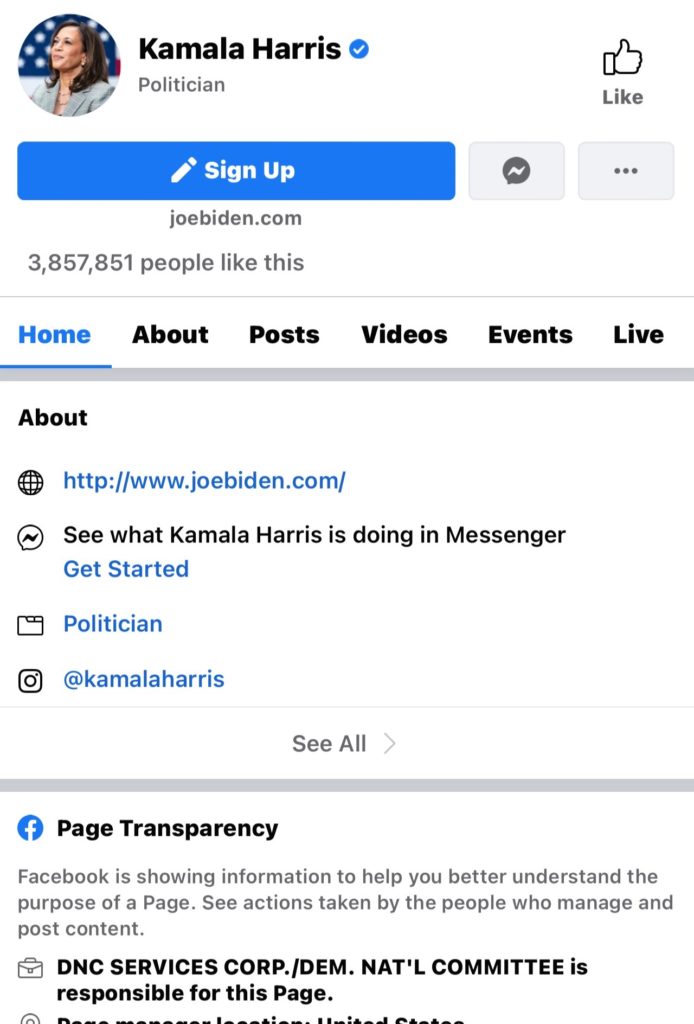
Most politicians have two Facebook pages — one is their campaign page, and they have a separate one if they win election and take office.
Such is the case for President Joe Biden and Vice President Kamala Harris.
But Harris, rather than tend to her “politician” page, has turned it over to the Democratic National Committee, and its army of operatives at the DNC Services Corp, a political action committee of the DNC.
Although Harris has relinquished control of her own Facebook Page, Facebook has not caught up with her and awards her the coveted “blue check,” which is the verification of veracity.
Under the “page transparency” tab, it’s clear that whatever is going on on the Kamala Harris page, it’s the Democrats who are in charge of it.
This is an oddity, but rules are different for some political leaders. While Facebook and Twitter have banned Donald Trump, we could find no other instance where a politician had given up their page and their personal brand to the political party they represent.
“Sounds like she has a future with the party, but he doesn’t,” said Tuckerman Babcock, former chair of the Alaska Republican Party.
In February of 2013, then-Sen. Mike Dunleavy introduced SJR9, a resolution amending the Alaska State Constitution relating to state aid for education.
Specifically, the resolution would amend, through a vote of the Alaska people, Section 1 of Article VII and Section 6 of Article IX of the Alaska State Constitution.
These amendments would have deleted the prohibition allowing public funds to be used for the direct benefit of any religious or private educational institution. The sections of the Alaska State Constitution in question are called the “Mini-Blaine Amendments”.
The Mini-Blaine Amendments were a result of a Republican U.S. congressman’s efforts to amend the U.S. Constitution to prevent public funds from going to the Catholic Church for education purposes back in the late 19th Century.
His prejudice against religious freedom was so great that when his efforts failed, he convinced Congress to require the installation of this language to prohibit public funds from being used for private and sectarian education purposes in new states’ constitutions as a requirement to enter the union.
As a result, and a requirement for union entry, in the late 1950’s the State of Alaska included these Mini-Blaine Amendments in its state constitution.
With the adoption of SJR9, Alaskans for the first time, since statehood, would have had the opportunity to vote on the question of providing public funds for private and sectarian educational institutions. The Alaska State Legislature decided this would not happen and SJR9 died in the state legislature.
The arguments against and the defeat of this resolution were and still are corporatist. Those in labor and industry who control and benefit from the Alaska political machinery would not allow this resolution to pass just as most of the attempts to allow the Alaska people to vote on the question of individual liberty have been usurped by their heavy control over the Alaska state legislature.
The surprise was Republican Senators John Coghill and Click Bishop were responsible for the procedural death of this resolution.
Why does the Alaska Legislature continue to deny the Alaska people the opportunity to vote on fundamental issues?
Subsequently, the slow death of the Alaska public education system continued its anguish as the lifestyle opportunities of Alaska’s progeny result in the lowest scholastic performance in the nation at the highest cost per student in the nation. Look up performance in the Alaska Department of Education and Early Development Performance Evaluation of Alaska’s Schools (PEAKS).
Contrary to the Marxists who control the Alaska political echo chamber, the result would not be “School Choice” or a “Voucher System.” The result would be for the first time in Alaska’s history, “Competitive Education”.
Competitive Education is the greatest and perhaps the final defeat to Marxist controlled public education. It is also their greatest fear, because it stops them from having access and complete control of billions of education dollars.
Why? Because public funds will follow the child through the education process, thus enabling parents to determine the education opportunities for their children and not the special interests of the unions, the education industry and the health care industry.
Novel idea.
What’s more critical is that public funds could go directly to the parents, who would be the only ones to attach “strings” to the subsequent distribution to whatever schools the parent chooses for the child.
Private and sectarian educational institutions would not have the onerous regulatory realities state government would attempt to impose on them. The state gets out of the public education regulation business and trusts the parents to make the best decisions for their children by opening the door for all private educational institutions to compete head-to-head with all public educational systems for public education funds.
Any bets on who would have better performance results?
Novel idea!
Any bets on a more cost effective and efficient education expense benefit to the state and the Alaska people?
Novel idea!
On June 30, 2020, the United States Supreme Court ruled through Espinoza v Montana Department of Revenue that the Mini-Blaine amendments in 38 states were unconstitutional.
Marxists will readily argue that it did not, but I’ll leave it up to the author of SJR9 to decide and consider implementing Espinoza.
Justice Roberts in his opinion for the Court concluded, “That ‘supreme law of the land’ condemns discrimination against religious schools and the families whose children attend them. They are ‘member[s] of the community too,’ and their exclusion from the scholarship program here is ‘odious to our Constitution’ and ‘cannot stand.’”
Justice Thomas in his concurring opinion stated, “Returning the Establishment Clause to its proper scope will not completely rectify the Court’s disparate treatment of constitutional rights, but it will go a long way toward allowing free exercise of religion to flourish as the Framers intended.”
Justice Alito brilliantly nailed the Mini-Blaine amendments for what there were and still are. “Backers of the Blaine Amendment either held nativist views or capitalized on them.” In Alaska, the only beneficiaries of the Alaska Mini-Blaine amendments are the unions, education industry and the health care industry, not Alaska’s children.
Justice Gorsuch in his concurring opinion establishes, “The [US] Constitution forbids laws that prohibit the free exercise of religion. That guarantee protects not just the right to be a religious person, holding beliefs inwardly and secretly; it also protects the right to act on those beliefs outwardly and publicly.”
And “If the government could intrude so much in matters of faith, too, winners and losers would soon emerge.”. Sound familiar Alaska?
And “Effectively, the [Montana’s Supreme] court told the state legislature and parents of Montana like Ms. Espinoza: You can have school choice, but if anyone dares to choose to send a child to an accredited religious school, the program will be shuttered. That condition on a public benefit discriminates against the free exercise of religion. Calling it discrimination on the basis of religious status or religious activity makes no difference: It is unconstitutional all the same.”
It is time to implement Espinoza and save the children of our state from Marxism, mediocrity and a desolate future.
If this is not enough for the Alaska state government to understand, then wait forCarson v. Makin. Here, the court will be asked to decide whether Maine violated the Equal Protection or Religion Clauses of the U.S. Constitution in preventing students from using their grant-in-aid money to attend schools that provide sectarian education.
Michael Tavoliero is a realtor in Eagle River, is active in the Alaska Republican Party and chairs Eaglexit.
We’ve had a lot of purported experts paraded before us as we’ve endured now almost two years of semi-house arrest. What started out as “two weeks to flatten the curve” has turned into two years to flatten the country.
For the most part. Americans have supinely accepted the opinions of the “experts” that we were to sacrifice our liberty and for many our livelihood based on their opinions. If you haven’t already done so, it is time to examine who we really consider to be an expert and just what qualifies them to claim expertise.
The most famous expert in the U.S. these days is Dr. Anthony Fauci. Let’s examine what tests would be applied should the government call Dr. Fauci as an expert witness in a lawsuit and the opposing counsel objected to his accreditation as an expert on the grounds that he was not competent to express an opinion.
I can tell you from my own experience, if you’d like to send a purported expert witness out through the overhead of the hearing room, as soon as s/he is called, you ask for voir dire, an examination of the witness’ competence to render an opinion, and then after voir dire, you object to the witness’ testimony on the grounds that they are not qualified to offer opinions. Even if you lose the objection, you will have caused most witnesses to lose their mind in a fit of apoplexy, and angry people don’t think clearly.
To underpin this a bit, there are two kinds of witnesses. The first is fact or ordinary witnesses, who can only testify to what they saw, touched, heard, smelled or otherwise directly observed. An ordinary witness cannot express an opinion.
Then, there are expert witnesses who must be accredited and accepted as capable of expressing an opinion due to their expertise. A prolonged course of study or experience in the specific area to which s/he will testify will generally result in accreditation as an expert.
If you’re trying a use of force case involving a cop, the plaintiff calls some former cop who trained cops in the force continuum and asks his opinion on the propriety of the use of force. Assuming he really has taught the courses and is familiar with the particular department’s force policies, his testimony as to his expert opinion will be accepted. Then the accused cop’s lawyer calls his expert who is equally well-accredited and who testifies that the plaintiff’s expert is merely a paid shill. Whomever gets believed becomes a matter of which advocate can tell the best story and which “expert” was more personable.
In the real world unless an expert is spectacularly good or spectacularly bad, experts just moot each other and it comes down to a question of whose story is more believable. The government “expert” such as Fauci is another matter altogether. When Dr. Fauci, or Secretary of State Antony Blinken, or Chairman of the Joint Chiefs of Staff Mark Milley steps up to the lectern and in front of the cameras, there is no nasty-tempered guy like me just itching to say, “Voir dire, please.”
The media, even at the highest levels of the White House Press Corps social club, are for the most part just pretty people with at most a bachelor’s or master’s degree in communications or journalism.
Let’s be honest, those are degrees for people who can’t or won’t do demanding academic work. Since the late 1960s and early 1970s, the schools have dumbed down college both out of avariciousness and to avoid the plaintiffs’ bar. They developed degree programs for people who shouldn’t be any closer to a college classroom than the custodial closet or the grounds crew.
The effect of the dumbing down of college and the “studies” and other general degrees is worst in government and corporate America. In 1971 the U.S. Supreme Court handed down its decision in Griggs v. Duke Power, in which Willie Griggs alleged that Duke Power’s minimum qualifications for a promotion that he had been denied lacked business utility and had a discriminatory impact on minorities.
Any reasonable reading of the record will reveal that Mr. Griggs was right; the minimum qualifications didn’t relate to the job and were clearly designed to discriminate against blacks, and so the U.S. Supreme Court agreed. In one fell swoop, almost all skills testing and specific minimum qualifications for employment went away; it was simply too difficult and expensive to prove that your requirements were not discriminatory.
Government and big businesses mostly relied on “a degree” as the minimum qualification because that at least proved that you could show up at one place every day for four years. Jobs where “a degree” couldn’t be justified relied on long probationary periods during which an employee could more easily be dismissed. The colleges responded by making sure that anyone could get “a degree.” The problem is that the person with “a degree” today has what would have been about an Eighth Grade education in the 1960s, but has been told that they are the smartest, best-educated person the World has ever produced.
Back to Dr. Fauci. He’s old enough to have received a decent education and is a degreed medical doctor from a once good school, Cornell University. He completed his residency at Cornell Medical Center in 1968 and went to work for the federal government at the National Institutes of Health and has been in leadership positions in various federal health agencies ever since.
“Doctor” Fauci last practiced medicine as most of us understand that phrase as a resident, a doctor in training, at Cornell in 1968; he’s been a bureaucrat ever since. In just what is Dr. Fauci an expert? My own view of appointee-level bureaucrats who can survive multiple political administrations is that they are simply prostitutes; they’ll do anything for money, and Fauci has done very, very well at making money.
In addition to being the highest paid federal employee, he and his pals at CDC/NIH et al. managed to lobby Congress to give them the right to hold ownership in process and pharmaceutical patents developed under the auspices of their agencies; no other federal employees can do that. Fauci’s $400K is just the tip of his economic iceberg.
Then the Government puts people like Blinken and Milley in front of us to impart their expertise; in just what does either have any real expertise? Blinken is Democrat, Ivy League, and government royalty, but other than a year or so “practicing law” in the ‘80s has never been anything other than a political operative or appointee. He has a bachelor’s degree in “social studies” from Harvard University and edited The Crimson.
Later, he wrote for “The New Republic,” which removes all doubts about his politics. He has a law degree from Columbia University. His upper-class liberal credentials are impeccable, but what about that resume tells you that he actually knows how to do anything other than pay the tuition and show up occasionally. Since he left college he has never run anything or produced anything, yet he is considered an “expert” on international affairs and is in charge of the foreign policy of the United States.
General Milley is a general officer of the U.S. Army and the Chairman of the Joint Chiefs of Staff. He looks every inch the military man and has enough “fruit salad” on his jacket to pass for a Third World dictator. Though he looks the part of the military man, he is a bureaucrat.
The popular image of the military commander is the service academy graduate who came out as a 2nd Lieutenant, commanded a platoon, and if he lived long enough made his way up through the ranks to ultimately command an army.
Milley went to Princeton and graduated with a bachelor’s degree in politics. He got his military commission from being in the ROTC at Princeton University. He went on to get masters degrees in International Relations from Columbia and National Security and Strategic Studies from the Naval War College. His biography also notes that he was an attendee at an MIT seminar on National Security. That makes me feel special because I have a MIT/Harvard certificate for my attendance at a seminar on Interest Based Collective Bargaining. All it takes is money, preferably somebody else’s money.
General Milley skipped that step where you got dirty, slept on the ground, and got shot at; he went straight from his academic endeavors to the command level in the military. He’s the equivalent of the MBA/MPA who shows up at your worksite fresh out of school and proceeds to tell you how to do what s/he doesn’t know how to do. He spent his career in a dress uniform unless he needed to look the part of a combat soldier. When he was in Class As, you can bet his creases were razor sharp and the knot in his tie had fearful symmetry. In his whole career if he heard a shot fired in anger it was from a great distance and he certainly never heard a bullet whizzing past his ear.
So, a couple of weeks ago, Gen. Milley was holding forth on understanding white rage, understanding Critical Race Theory, and holding forth about eliminating “white supremacy” from the ranks of the military. Who could have imagined that someone like that could totally screw the pooch and get people needlessly killed in withdrawing from Afghanistan?
There is going to be a bloodbath in Afghanistan, and it was Milley’s job to make sure that didn’t happen. He stands before the cameras as an expert, but he’s never done anything but write memos and sign purchase orders. From whence cometh his expertise in military strategy and tactics?
The experts and the credentialed class in America are simply a national disgrace. We just saw it in Anchorage with the library director kerfuffle in recent weeks. A masters in library science is just another “studies” degree and a fake credential pushed by an interest group, the American Library Association. Lots of “professions” have such associations that spend money and lobbying effort to make sure that only those they have chosen can practice their profession. The Ivy League is just such an association, and you need your head examined if you hire an Ivy graduate from outside the STEM areas, and be careful with those.
Art Chance is a retired Director of Labor Relations for the State of Alaska, formerly of Juneau and now living in Anchorage. He is the author of the book, “Red on Blue, Establishing a Republican Governance,” available at Amazon.