The primary crisis hotline for veterans experienced a 98 percent increase in the number of texts that it received during the last two weeks of August compared to the same two weeks last year, according to Stars and Stripes.
Calls to the Veterans Crisis Line increased 7 percent and online chats increased by nearly 40% during the same time period, from Aug. 13 to 29. Department of Veterans Affairs officials attribute the increase to multiple factors, including the withdrawal of U.S. forces from Afghanistan and the upcoming 20th anniversary of the 9/11 terrorist attacks.
The Veterans Administration said there’s an increased awareness of the hotline since last year and there’s not as much stigma about utilizing the resource. Read more at Stars and Stripes.
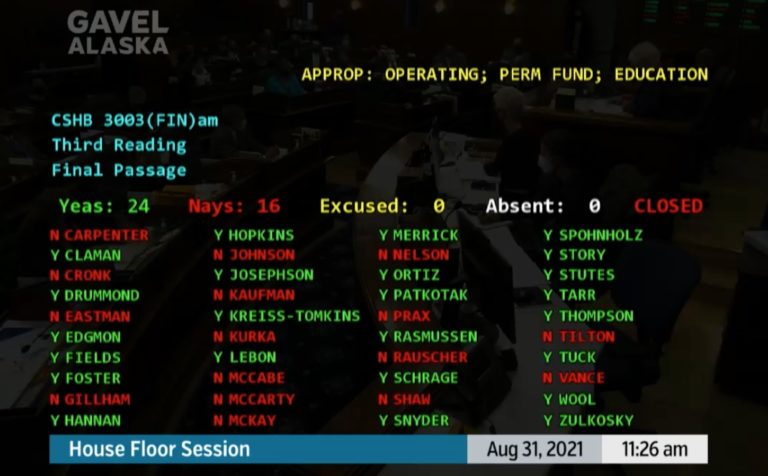
The bill to fund the Permanent Fund dividend may have the governor’s name on it, but it’s not his bill anymore. HB3003 pays Alaskans less than one third of the legal amount for their annual dividend, as set by Alaska Statute.
The $1,100 PFD is also not the compromise suggested by the governor — the 50-50 plan, which would come with a constitutional amendment that voters would decide on: Should the formula for the PFD be placed in the Alaska Constitution – yes or no?
There’s a problem with it, and it all comes down to color of money. The Legislature has deviated from past law that said the Permanent Fund dividend source was the Permanent Fund Earnings Reserve Account that was transferred into dividend fund.
This year, the House majority is re-upping what passed two months ago, when the dividend is paid from different monies. One is general fund, not the ERA, and the other is the Statutory Budget Reserve.
Here’s where it gets tough: The money the House is trying to use to pay the dividend — the SBR– is not there. Money available in the SBR in June was vetoed by the governor. On June 30, any money not vetoed in the SBR was swept in to the Constitutional Budget Reserve. So the money the House is using for the dividend is not in one of the funds it’s using.
Barring anything else, such as a judge’s order, the check will bounce.
The money available for the dividend in the General Fund is only about $600 per dividend recipient, a fact pointed out by Rep. David Eastman. The vote was a gaslighting operation, to try to make this the governor’s fault if the PFD is only $600.
This is coming at time when the Permanent Fund is just shy of $83 billion.
On Monday, a proper solution for the permanent fund dividend — paying a full PFD as established by Statute — failed narrowly.
As for the Fiscal Plan Working Group, which was supposed to come up with a plan going forward, it saw its suggestions to allow the people of Alaska to vote on a new PFD formula ignored.
The 50-50 plan, as it is called, was accepted by many “full PFD’ legislators as their compromise.
“I thought it was our first step toward compromise. It was our step for those who might not be a full PFD person. It was a huge compromise,” said Rep. Kevin McCabe of Big Lake.
“There’s no impetus to put the PFD into a constitutional amendment. Leadership has said it will not happen,” he said. “Many of us thought it might be good. Many of us thought it might be bad. There was a path forward. The path has to start with putting it out to the voters. We have seen none of that. In fact, we have heard, ‘Don’t even try.'”
“The bill doesn’t contain a PFD. It’s not a Permanent Fund dividend. It’s just a check from the SBR and the General Fund. It’s not what we were sent down here to do. I’ll be voting no,” said Rep. Chris Kurka of Wasilla.
Rep. Adam Wool, a Democrat representing Fairbanks argued that the money is there. “I guess another court case might be happening, I don’t know,” he said. “This Permanent Fund needs to last infinitely, oil will not last infinitely,” he said, and mentioned global warming as a problem for oil in Alaska.
Rep. Liz Snyder, who ran for office and spent $750,000 to win House District 27 away from former Rep. Lance Pruitt, ran on a full statutory Permanent Fund dividend. Now that she is the representative for East Anchorage, everything is different.
On Aug. 30, she voted against the formula, which is the law.
Here’s what Snyder told the Anchorage Daily News before the 2020 election:
“I share the same view as our incumbent, based on past public comments. I support full pfd payments based on the original formula, but recognize that we need to have a collective conversation about the sustainability of this approach and agree to any necessary changes. And in light of our current budgetary shortfall, I do not support back pay of previously reduced pfds. I would prefer to see us grow the Permanent Fund — some have targeted $100 million — so that we then have an incredible, sustainable resource to support current and future generations of Alaskans. With such a resource, we would be the envy of the rest of the US.”
The House of Representatives on Monday night voted down the legally established dividend, but has offered no legal substitute for what would be about a $3,800 payment to qualified Alaskans this year.
Her Democrat colleague, Rep. Geran Tarr, was the only Democrat who voted in favor of the full PFD.
As an elected State Representative who has been in the middle of the big debate about the fiscal policy of the State of Alaska, including the PFD and how we fund our state government, I thought that I should provide some context to my recent votes on HB 3003.
I am a Republican, with a bit of libertarian in me. I have looked at the PFD issue closely and seriously. In doing so, I have determined that the future of larger than recent PFD’s would require the creation of new bureaucracy and new taxes.
This creates a challenge, because during my campaign, anyone that met me at their door, my events or heard me on television, radio, zoom meetings, etc. knew that my beliefs were (and still are) as follows:
I am not anti-PFD, but the state’s ability to pay according to the historical formula has been diminished by shifting and declining revenue, combined with a government that needs reformation to provide a higher quality product at a more reasonable cost.
Without reductions in total cost of government, PFD’s larger than those recently issued will require new taxes.
I am not yet in favor of ramping up taxes to feed a government that has not implemented a coherent set of improvement initiatives to get more value out of the cash being burned.
We need to build consensus and fix the conflicting statutes.
I developed my positions by paying attention to the voices of my constituents and the past decisions which led us here. I was honored to have won without promising anything specific about PFD amounts, but rather that I would approach problems methodically while trying to drive our state government towards higher efficiency, better results, and more accountability.
During the Aug. 30 House floor session, I voted to support an $1,100 dividend as opposed to larger dividends including the $2,350 amount calculated by the Governor’s proposed 5% POMV 50/50 plan and the original statutory amount which would yield more than $3,700.
I voted the way I did because we have not yet resolved the source of the conflict, our structural fiscal imbalance. I feel that I would be breaking a campaign promise if I were to support an unbalanced budget or new broad-based taxation to close the gap. However, even with these constraints we can still have a dividend that is above recent status quo at about $1,100 and growing into the future.
We have the recommendations of the latest Fiscal Policy Work Group, but those recommendations have not been completely agreed upon, and none of the recommendations have been implemented. Larger dividends have not been paired with possible new sources of revenue, who would pay and how tax collection would be administered. There has been talk of cost reductions but realizing those reductions will be painful and hard to achieve unless we can learn how to improve our management systems and rethink some of our processes and assumptions.
I am not in favor of new or increased taxes if we don’t first improve how the state manages spending during periods where revenue increases. I believe that the most important and first steps are to establish a functional limit on government spending and then begin implementing improvement projects to drive out waste and increase performance.
HJR 301/HB 3001 are my proposed policy solutions for implementing cost control by linking appropriation limits to our private sector performance. I will continue to introduce other legislation aimed squarely at my core policy focus of improving operational and quality management systems and practices within the executive branch of the State of Alaska.
In making these suggestions to avoid new taxes until we cap spending and improve government operations, I have not moved away from my conservative roots or my campaign promises, which guide me towards trying to build our private sector, promoting responsible fiscal policies, and seeking to continuously improve the quality of Alaska’s government.
Rep. James Kaufman serves in the Legislature for Alaska House District 28.
History teaches us that nations can be like people. While having many things in common, each is unique. As with people, a nation’s behavior is often understood in terms of the psychological attitudes and style that characterize its personality. Failure to understand cultural complexity and a nation’s psychological behavior in the historical context creates tension between governments and often leads to political and military conflicts.
Recently, the concept of nationalism has been interpreted by various political groups and mass media as a form of racial extremism associated with German and Italian Nazism of the 1930s and 1940s. This view is far from the factual truth. Let’s look at the term nationalism in the historic context.
Nationalism was mentioned for the first time in 1409 in Germany at Leipzig University. However, it was in the late 18th century, with the American Declaration of Independence (July 4, 1776) and with the French Revolution (May 5, 1789 to November 9, 1799),) that the term began to be used in the sense of national egoism (self-interest).
Nationalism was a force that caused Italian states to unify into one nation in the 19th century. This unification happened several ways. One, the nation’s geography served to isolate the people—a factor that helped them develop their own ways. Two, Italy was the home of Renaissance, and its people were proud of their heritage. Finally, Italy had been shamed by its defeat at Napoleon’s hands. So, to prevent such conquest, Italians pursued the creation of the strong united nation.
Nationalism was also responsible for the unification of Germany in the 19th century. In the 1860s, Otto von Bismarck, then President of Prussia, initiated wars against Denmark, Austria, and France, aligning the smaller German states behind Prussia in its defeat of their adversaries. In 1871, Bismarck unified Germany into a nation–state, forming the German Empire, as it is today (approximately).
On the other hand, the Austrian Empire was composed of many nationalities, each of which wanted its own national identity and political independence. Such disparate ideals led to division between Austrians and Hungarians. The Holy Roman Empire was the major political entity in the Central Europe between 1500 and 1806. Austrian Empire begin in 1814 and the Austro-Hungarian Empire after 1867. The Austro-Hungarian Empire lasted until the end of World War I in 1918.
European nations, after 1815, attempted to keep nationalism and liberalism in check. One of the most important results of the Napoleonic Wars in Europe was the revival of a spirit of nationalism—a sense of common identity that was felt deeply by people who share the same history, language, and cultural traditions and moral values.
Spurred by French control of most Europe during Napoleonic wars (1803–1815), people developed feelings of national identity and a desire to overthrow foreign rule. However, the nationalists, liberals and radicals posed threats to the old ways, and they alarmed conservatives. As a result, conservatives resisted the idea that people had natural rights—a contract between citizens and rulers.
I would like to stress that a nationalism of the early 20th century in Europe aroused feelings of patriotism (devotion to and vigorous support for one’s country). Imperialism promoted an exploitation of colonies. Militarism encouraged an arms race that prepared nations for World War I (1914–1918), and secret alliances engendered distrust among world’s nations.
U.S. nationalism is civic, cultural, economic and ethnic. Essentially, it indicates those aspects that characterize and distinguish the United States as an autonomous political entity. The term often serves to explain efforts to reinforce our national identity and self-determination within the U.S. national and international affairs. All four forms of nationalism have found expression throughout our country’s history, depending on the historical period.
In my opinion, Alaska nationalism (from the patriotic point of view) is represented by the Alaskan Independence Party (AIP), with today’s registered members of nearly 19,000 Alaskans. The Alaskan Independence Party advocates positions similar to those of the Constituion Party, Republican Party and Libertarian Party, supporting gun-rights (second amendment), privatization, school choices (including home schooling and vouchers), and limited government.
Founded by Joe Vogler on June 14, 1984, today the AIP has radically changed with respect to the issue of secession from the United States. It does not support secession, as it did at its founding. In 1973, Joe Vogler began arguing about the validity of the Alaskan statehood vote on January 3, 1959.
Early in that year, he began circulating a petition seeking support for secession of Alaska from the United States. Joe Vogler was in the 1973 issue of the Alaska Magazine: “I’m an Alaskan, not an American. I’ve got no use for America or her damned institutions.”
Today, nationalism is no longer merely historic or poetic feelings, but the true practical expression of daily life, commerce and economic development, free-market competition, territorial rights, natural resources, ethnic integrity and national cohesiveness and unity. But it also often leads to the regional conflicts, such as in Yugoslavia, Somalia and Russia in the 1990s, Second Sudanese Civil War (1983–2005) and, more recently, between Israel and Palestine.
Nevertheless, today’s nationalism also could be a positive expression of nations’ unity, cohesiveness, achievements and pride—think Olympic Games, Nobel Prize winners, and accomplishments in literature, science and technology.
Alexander B. Dolitsky was born and raised in Kiev in the former Soviet Union. He received an M.A. in history from Kiev Pedagogical Institute, Ukraine, in 1976; an M.A. in anthropology and archaeology from Brown University in 1983; and was enroled in the Ph.D. program in Anthropology at Bryn Mawr College from 1983 to 1985, where he was also a lecturer in the Russian Center. In the U.S.S.R., he was a social studies teacher for three years, and an archaeologist for five years for the Ukranian Academy of Sciences. In 1978, he settled in the United States. Dolitsky visited Alaska for the first time in 1981, while conducting field research for graduate school at Brown. He lived first in Sitka in 1985 and then settled in Juneau in 1986. From 1985 to 1987, he was a U.S. Forest Service archaeologist and social scientist. He was an Adjunct Assistant Professor of Russian Studies at the University of Alaska Southeast from 1985 to 1999; Social Studies Instructor at the Alyeska Central School, Alaska Department of Education from 1988 to 2006; and has been the Director of the Alaska-Siberia Research Center (see www.aksrc.homestead.com) from 1990 to present. He has conducted about 30 field studies in various areas of the former Soviet Union (including Siberia), Central Asia, South America, Eastern Europe and the United States (including Alaska). Dolitsky has been a lecturer on the World Discoverer, Spirit of Oceanus, andClipper Odyssey vessels in the Arctic and sub-Arctic regions. He was the Project Manager for the WWII Alaska-Siberia Lend Lease Memorial, which was erected in Fairbanks in 2006. He has published extensively in the fields of anthropology, history, archaeology, and ethnography. His more recent publications include Fairy Tales and Myths of the Bering Strait Chukchi, Ancient Tales of Kamchatka; Tales and Legends of the Yupik Eskimos of Siberia; Old Russia in Modern America: Russian Old Believers in Alaska; Allies in Wartime: The Alaska-Siberia Airway During WWII; Spirit of the Siberian Tiger: Folktales of the Russian Far East; Living Wisdom of the Far North: Tales and Legends from Chukotka and Alaska; Pipeline to Russia; The Alaska-Siberia Air Route in WWII; and Old Russia in Modern America: Living Traditions of the Russian Old Believers; Ancient Tales of Chukotka, and Ancient Tales of Kamchatka.
A new Governor’s Office policy, intended to keep Covid-19 from spreading in the workplace, says that workers who are experiencing Covid-19 symptoms or who have been a close contact with a person who is Covid-19 positive, must be tested before returning to their duty station.
The State of Alaska considers someone a close contact if they were unmasked and within six feet of someone who was positive with Covid-19. If a person is fully vaccinated, unless that person is exhibiting symptoms, they are not considered a close contact, though they are encouraged to monitor their symptoms and consider getting testing four days after an exposure, the policy reads.
Staffers who have been a close contact should work remotely, monitor for symptoms and get tested four days after exposure. A negative test clears the staff person to return to work.
The Governor’s Office has contracted with SEARHC for testing in Juneau, and Beacon OHSS, Inc., for testing in Anchorage, where tests are done at the Anchorage Ted Stevens International Airport. The Alaska State Legislature has arranged for on-site Capitol Building testing during the Special Session.
Sen. Dan Sullivan, a member of the Senate Armed Services Committee, today released the following statement after the departure of the last U.S. military personnel from Afghanistan while hundreds of U.S. citizens remain behind in the country, now controlled by the Taliban.
“I never thought I’d see the day when the U.S. government would knowingly leave behind hundreds of its own citizens—who wanted to be rescued by the U.S. military—in one of the most dangerous countries in the world. For weeks, I’ve been trying to get senior members of the Biden administration to answer one question: Why not move back the August 31st deadline for the full withdrawal of U.S. military forces until allof our fellow Americans are able to get out from behind Taliban enemy lines? We had the U.S. military forces and leverage in place to save our fellow Americans, but our forces and that leverage departed today. The President of the United States clearly decided to forsake these Americans. I feel sick right now as an American citizen. I want all Americans and Alaskans to know, I am hellbent on getting these legitimate questions answered by the President and senior administration officials.”
Monday saw the last flight out of Kabul Airport with hundreds of Americans left behind to suffer at the hands of the Taliban, to whom the Biden Administration has handed the country.
A special meeting of the Anchorage Assembly has been scheduled for Tuesday for the purpose of overriding the mayor’s veto of a “houseless lived experience advisory board,” (HLEAB) which is a pet project of Assembly members Felix Rivera and Meg Zaletel.
The advisory board made up of homeless people and formerly homeless people was an ordinance passed during the last assembly meeting, and it was vetoed by the mayor, who said there are plenty of efforts underway to help the homeless, and there was no need for yet another board.
The Housing, Homeless and Neighborhood Development (HHAND) Commission is the group the municipality has to deal with homeless and other housing issues. It costs money to staff commissions and the mayor thinks that the HHAND Commission is adequate. The Assembly had 21 days to override the veto.
With the Assembly controlled by the liberal majority, it’s likely the veto will be overridden easily, with only the Chugiak / Eagle River Assemblywomen Jamie Allard and Crystal Kennedy likely to vote against the override.
The meeting takes place at City Hall at 3:30 p.m. on Tuesday.
The Bronson Administration has been in quiet negotiations with Assembly members Zaletel, Chris Constant, and John Weddleton to come up with an agreeable plan for moving forward on a homeless solution. The group, facilitated by Admiral Tom Barrett (ret.) has spent over 30 hours so far over the last two and a half weeks; the path forward should be announced in coming days.
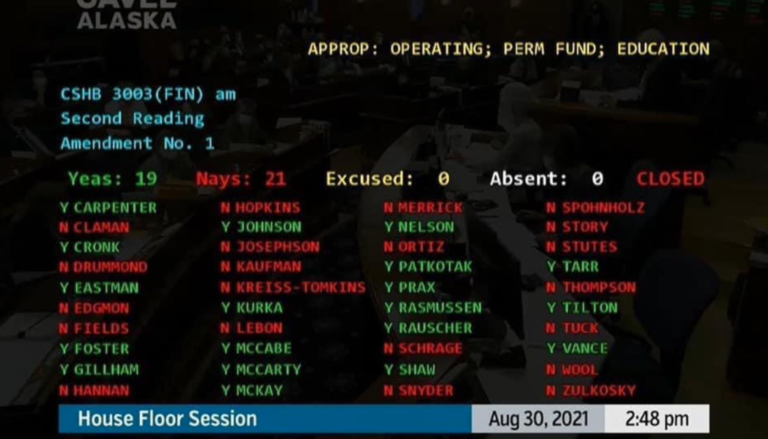
In a close vote, the Alaska House of Representatives today voted down an amendment to HB 3003 that would have funded the full statutorily required amount for the Alaska Permanent Fund dividend.
House Republicans voted largely in favor of following the law, but there were four breakaways: Bart LeBon of Fairbanks, Kelly Merrick of Eagle River, and Steve Thompson of Fairbanks and James Kaufman of Anchorage voted with the Democrats.
Rep. David Eastman introduced the amendment for the full PFD. He was asking the question: Do you follow the law or just pick and choose an amount for political expedience?
Rep. Sara Rasmussen openly disagreed with the statutory PFD, saying it is unsustainable but in the end voted for it because it is the law that is on the books.
The last time the law was followed by the Legislature was in 2015. The statutory formula would mean about a $3,800 dividend this year.
The dividend fight, which was tense at times with Speaker Louise Stutes calling Republicans our of order, took place just before she made a hasty decision to recess to the “call of the chair.”
Some Republicans said they would be happy with the 50-50 plan for the dividend, as proposed by the governor, but not until passage of the governor’s bill to allow the people of Alaska to vote on a constitutional amendment solidifying the 50-50 plan going forward.