Wednesday, April 29, 2026
Home Blog Page 1097

Trump says again he will campaign against Murkowski; Tshibaka goes on Hannity with Lara Trump

In a statement on Monday, former President Donald Trump said that he will be in Alaska to campaign against Sen. Lisa Murkowski in 2022. He said Murkowski did not prevent Biden from killing oil development in the Arctic National Wildlife Refuge, which he did starting the first day of his administration.

“Senator Lisa Murkowski has cost the great people of Alaska billions and billions of dollars by voting for Radical Left Biden appointees, which in turn led to the revocation of ANWR drilling, which Alaskans have been fighting to see happen for six decades. Not only did Murkowski kill the biggest economic stimulant for the State but also one of the biggest energy producing sites in the world. Nobody thought ANWR could be opened. We got it done, and she allowed it to be killed. She’s the best friend Washington Democrats ever had — and Alaska’s reward for that betrayal is an empowered Left coming after their wealth and jobs. I think she will be met very harshly by the Alaska voters in 15 months, and I will be there to campaign against her!”

Some observers say that the Biden Administration decided to defend the Willow oil project in Alaska to appease industry, but then traded it for killing oil drilling in the Arctic National Wildlife Refuge. Willow is in the National Petroleum Reserve-Alaska.

Murkowski’s main opponent for Senate, Kelly Tshibaka, appeared on the Sean Hannity Show on Monday with Lara Trump, the daughter-in-law of Donald Trump. During the show, Hannity said that Murkowski was not an asset to the Republican Party or Alaska.

“I would wrap it up as courage and common sense is missing … It is in the heart of every American and we definitely have it in the hearts of every Alaskan,” Tshibaka said.

“I’ve seen three waves of conservatism in my lifetime…,” Hannity continued. “One, Ronald Reagan. Two, Newt Gingrich. And three, Donald Trump. That to me is the modern conservative agenda. Republicans like Lisa Murkowski who are rhino Republicans who don’t fight for these principles, I don’t see any need for them in the Republican Party. They’re weak, they’re ineffective, and in the case of Lisa Murkowski, she’s not even fighting for her state.”

Lara Trump agreed with Hannity, saying “We’ve got to have people who are fighting for the future of America. Joe Biden and Kamala Harris are running this country into the ground. We need Republicans who are going to stand up and stand for Americans and fight, fight, fight.”

While Lara Trump didn’t endorse Tshibaka, it’s evident that Tshibaka is now on the radar of the Trump family, which could help rocket her name ahead across America as the Murkowski-Tshibaka race continues to shape up as the marquee race of 2022.

Will Senate Finance co-chairs ‘pocket veto’ the PFD constitutional amendment?

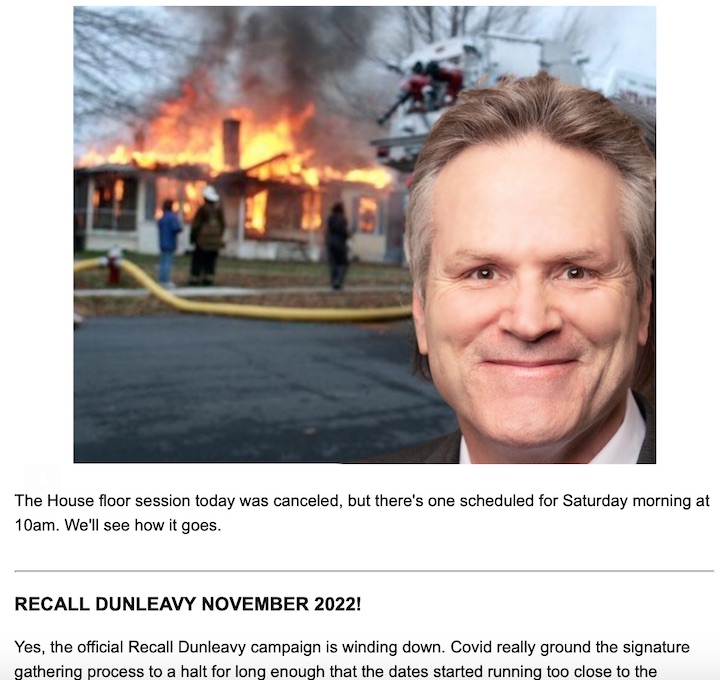
With only 10 days left in the legislative special session, the Senate Finance Committee has yet to hear SJR 6, the governor’s request that the Legislature allow Alaska voters to vote on a constitutional amendment for the Permanent Fund dividend calculation.

The resolution has been sitting in Senate Finance since May 14, with nothing on the schedule to indicate that the co-chairs Sen. Click Bishop and Sen. Bert Stedman plan to hear the governor’s proposal.

This is shaping up to look like a “pocket veto,” where a lawmaker just stuffs a bill into his/her proverbial pocket and it never sees the light of day.

The other legislators do have recourse. Uniform Rules says they can bounce SJR 6 out of Finance and into Rules, where it would either get locked down by the Rules Chair similarly, or proceed to the floor for a vote.

Bouncing a bill out of committee effectively means rolling the chair, which isn’t likely to happen in Finance, considering the makeup. But Uniform Rule 24 says that chairs are obligated to not just consider bills that come before them, but must act on them in some way. They don’t get to just sit on bills.

If they do sit on SJR 6, there’s also Rule 48, the “right to discharge” a bill from a committee. Either the majority of the committee can send a request in writing to the presiding officer, requesting the bill be scheduled, which it then must be within three days, Or a member of the body on the floor of the Senate can make an oral motion to have the bill discharged. That is not always successful, but can be.

In 2018, Sen. Mia Costello wanted the repeal to SB 91 (the lenient crime bill ) to move from Senate Judiciary Committee. Costello, Sen. Mike Shower, and Sen. Bill Wielechowski rolled Judicary Chair John Coghill, forcing the bill to move along.

The governor originally proposed HJR 7, which is currently in House Judiciary and does not reflect the improvements of SJR 6 made in Senate Judiciary. SJR 6 would take the annual calculation of the Permanent Fund dividend out of political hands and protect it in the Constitution. It would similarly protect the Power Cost Equalization Fund.

Ronald Reagan’s D-Day speech

By THE ANCHORAGE DAILY PLANET

On June 6, 1984, President Ronald Reagan spoke at the dedication of the U.S. Ranger Monument at Pointe du Hoc, France. In the audience were 62 of the surviving Rangers who attacked the cliffs of France 40 years before. These words are from Reagan’s speech that day.

We stand on a lonely, windswept point on the northern shore of France. The air is soft, but 40 years ago at this moment, the air was dense with smoke and the cries of men, and the air was filled with the crack of rifle fire and the roar of cannon. At dawn, on the morning of the 6th of June, 1944, 225 Rangers jumped off the British landing craft and ran to the bottom of these cliffs. Their mission was one of the most difficult and daring of the invasion: to climb these sheer and desolate cliffs and take out the enemy guns. The Allies had been told that some of the mightiest of these guns were here and they would be trained on the beaches to stop the Allied advance.

The Rangers looked up and saw the enemy soldiers at the edge of the cliffs shooting down at them with machine guns and throwing grenades. And the American Rangers began to climb. They shot rope ladders over the face of these cliffs and began to pull themselves up. When one Ranger fell, another would take his place. When one rope was cut, a Ranger would grab another and begin his climb again. They climbed, shot back, and held their footing. Soon, one by one, the Rangers pulled themselves over the top, and in seizing the firm land at the top of these cliffs, they began to seize back the continent of Europe. Two hundred and twenty-five came here. After two days of fighting, only 90 could still bear arms.

Behind me is a memorial that symbolizes the Ranger daggers that were thrust into the top of these cliffs. And before me are the men who put them there.

These are the boys of Pointe du Hoc. These are the men who took the cliffs. These are the champions who helped free a continent. These are the heroes who helped end a war.

Gentlemen, I look at you and I think of the words of Stephen Spender’s poem. You are men who in your “lives fought for life . . . and left the vivid air signed with your honor.”

I think I know what you may be thinking right now, you are thinking, “We were just part of a bigger effort; everyone was brave that day.” Well, everyone was. Do you remember the story of Bill Millin of the 51st Highlanders? Forty years ago today, British troops were pinned down near a bridge, waiting desperately for help. Suddenly, they heard the sound of bagpipes, and some thought they were dreaming. Well, they weren’t. They looked up and saw Bill Millin with his bagpipes, leading the reinforcements and ignoring the smack of the bullets into the ground around him.

Lord Lovat was with him — Lord Lovat of Scotland, who calmly announced when he got to the bridge, “Sorry I’m a few minutes late,” as if he’d been delayed by a traffic jam, when in truth he’d just come from the bloody fighting on Sword Beach, which he and his men had just taken.

There was the impossible valor of the Poles who threw themselves between the enemy and the rest of Europe as the invasion took hold, and the unsurpassed courage of the Canadians who had already seen the horrors of war on this coast. They knew what awaited them there, but they would not be deterred. And once they hit Juno Beach, they never looked back.

All of these men were part of a rollcall of honor with names that spoke of a pride as bright as the colors they bore: the Royal Winnipeg Rifles, Poland’s 24th Lancers, the Royal Scots Fusiliers, the Screaming Eagles, the Yeomen of England’s armored divisions, the forces of Free France, the Coast Guard’s “Matchbox Fleet” and you, the American Rangers.

Forty summers have passed since the battle that you fought here. You were young the day you took these cliffs; some of you were hardly more than boys, with the deepest joys of life before you. Yet, you risked everything here. Why? Why did you do it? What impelled you to put aside the instinct for self-preservation and risk your lives to take these cliffs? What inspired all the men of the armies that met here? We look at you, and somehow we know the answer. It was faith and belief; it was loyalty and love.

The men of Normandy had faith that what they were doing was right, faith that they fought for all humanity, faith that a just God would grant them mercy on this beachhead or on the next. It was the deep knowledge — and pray God we have not lost it — that there is a profound, moral difference between the use of force for liberation and the use of force for conquest. You were here to liberate, not to conquer, and so you and those others did not doubt your cause. And you were right not to doubt.

You all knew that some things are worth dying for. One’s country is worth dying for, and democracy is worth dying for, because it’s the most deeply honorable form of government ever devised by man. All of you loved liberty. All of you were willing to fight tyranny, and you knew the people of your countries were behind you.

The Americans who fought here that morning knew word of the invasion was spreading through the darkness back home. They thought — or felt in their hearts, though they couldn’t know in fact — that in Georgia they were filling the churches at 4 a.m. In Kansas they were kneeling on their porches and praying, and in Philadelphia they were ringing the Liberty Bell.

Read more at the Anchorage Daily Planet.

Blind spot: Who is influencing the people who write the news in Alaska? There’s an app for checking the news echo chamber

A new tool by the website Ground.News reveals how people with Twitter accounts are interacting with news sources, and who is influencing them on Twitter. It is revealing when it comes to Alaska journalists, who dominate the Twitter universe in Alaska, and who also shape the narrative of the news.

Ground News’ main emphasis is to analyze news reports from across the globe. Readers can see results from an algorithm that shows whether left-leaning media has a blindspot to the story, and which stories right-leaning media is ignoring.

In addition, readers can use a tool on the site to analyze Twitter and Reddit accounts for who their account owners “like,” “share,” and otherwise interact with.

Must Read Alaska analyzed the accounts of many of the people who shape the mainstream media coverage in Alaska to see if they are interacting mostly on one end of the spectrum.

The results may not surprise readers:

Dave Hulen, the editor of the Anchorage Daily News, interacts 98 percent of the time with left-bias news sources on Twitter, including the newspaper he edits.

Must Read Alaska used the “blindspot” tool to compare Hulen to Must Read Alaska’s account which interacts with 75 percent right-leaning Twitter sources.

Hulen’s top three news sources are the ADN, USA Today, and the Los Angeles Times. His top three news influencers are Marc Lester, ADN photographer; Dr. Anne Zink, Alaska’s chief medical officer; and Charles Ornstein, of ProPublica.

Downing’s top three news sources include NewsMax, where she writes a column; Fox News; and BitChute. Top influencers are Kevin Showalter, who regularly badgers Dr. Anne Zink on Twitter over state Covid policy; Jack Posobiec, who is described by Wikipedia as an “alt-right and alt-lite political activist, conspiracy theorist, television host, journalist, and Internet troll;” and Paul Thacker, an X Games X Games medalist and outdoor enthusiast.

Here are the results for a handful of other journalists in Alaska who are on Twitter regularly:

Rebecca Palsha, Alaska’s News Source: 62% of the news @RebeccaPalsha interacts with on Twitter is centrist, 37% is left. Top three sources are: ADN, New York Times, Washington Post. Top three influencers are Kyle Hopkins, WasillaWarlock, and Charles Ornstein.

Kyle Hopkins, ADN’s Pulitzer Prize winner: 98% of the news @kylehopkinsAK interacts with on Twitter leans left, 2% is centrist. Top three sources are: ADN, ProPublica, New York Times. His top three influencers are Charles Ornstein. of ProPublica; Elizabeth Harball, of Alaska Public Media’s Energy Desk; and Hopkins’ wife, Rebecca Palsha, of Alaska’s News Source.

Elizabeth Harball, Alaska Public Media Energy Desk: 94% of the news @ElizHarball interacts with on Twitter leans left, 6% is centrist. Top three sources are: ADN, Washington Post, New York Times. Top three influencers are Kyle Hopkins, David Hulen, Michelle Theriault Boots.

Michelle Theriault Boots, ADN: 95% of the news @Theriault_Boots interacts with on Twitter leans left, 5% is centrist. Top three sources are: ADN, New York Times, Washington Post.

Tom Hewitt, editorial page editor for ADN: 100% of the news @tomhewittnews interacts with on Twitter leans left. Top three news sources are ADN, New York Times, Washington Post. Top three influencers are Henry Cole, Will Muldoon, Ben Matheson.

Ryan Binkley, publisher of the ADN, isn’t a regular Twitter user, but his biggest influencers on Twitter are Howard Weaver (former ADN editor), Tom Hewitt, and Kyle Hopkins.

James Brooks, ADN: 95% of the news @AK_OK interacts with on Twitter leans left. Top three sources are: ADN, CBC News, New York Times. Top three influencers are National Weather Service Juneau, Matt Buxton (leftist political blog), David Reamer (historian).

Matt Buxton, Midnight Sun AK blog: 100% of the news @mattbuxton interacts with on Twitter leans left. Top three news sources are ADN, CBC News, CNN. Top three influencers are Alaska Landmine (blog), Andrew Kitchenman (KTOO), James Brooks (ADN).

Alaska Landmine: Not enough data. Top three influencers are James Brooks, Matt Buxton, Dave Stieren.

Amanda Bohman, Fairbanks Daily News-Miner: 40% of the news @FDNMborough interacts with on Twitter leans left, 20% leans right, 40% is centrist. No top three news sources listed. Top three influencers are Tom Hewitt (ADN editorial page editor), ZubyMusic, and Samantha Godwin.

Nat Herz, Alaska Public Media Energy Desk: 96% of the news @Nat_Herz interacts with on Twitter leans left. Top three news sources are ADN, Indian Country Today, Associated Press. Top three influencers are Alaska Public Media, Alaska Landmine, Tegan Hanlon (Alaska Public Media).

Tegan Hanlon, Alaska Public Media: 96% of the news @teganhanlon interacts with on Twitter leans left. Top three news sources are ADN, New York Times, Washington Post. Top three influencers are Alaska Public Media, Liz Ruskin (APM), and KTOO.

If all the journalists in Alaska seem to be heavily left leaning, there is one bright spot: Becky Bohrer, AP reporter in Juneau. The algorithm rates her 100 percent centrist.

Try the Twitter Blindspotter tool yourself at this link.

Chris Nyman: Inflation, national debt, suspending the dividend

By CHRIS NYMAN

As I reflect on our situation post-pandemic and wonder “what the heck just happened? Was it worth all this suffering to defeat President Trump?” I also see that inflation is now an undeniable statistic.

We’ve been told that it didn’t exist before due to the new way they measure it – even though prices were increasing for average Americans. It is great that the stock market has been performing so well for investors, but it may also portend increases in consumer prices.

Which brings me to the subject of the national debt. It has always seemed to me that the only way out of this massive debt is inflation is to make the money we owe worth less. But in theory inflation causes interest rates to rise, which would increase the interest on the national debt to horrific levels and perhaps cause taxes to rise in order to sustain the federal kleptocracy. Alternatively, interest rates can never rise due to this conundrum and inflation will eat us alive. This is the downside of not balancing the budget and printing “money” at will.

The politicians always say, “Future growth will pay our way out of this.” That might be true only if the economy grows faster than the rate of government growth.

Which brings me to our own fiscal situation: the State of Alaska budget.

I read the opinion letter from Speaker Louise Stutes. She seems sensible and in touch with our fiscal reality (although I will never forget she once supported income taxes to continue paying deficit dividends). I do appreciate the House’s position on this to not over-draw the Permanent Fund Earnings Account. So the usual range of options is there for us: Reduce the dividend, impose new income and/or sales taxes, or increase taxes on our most valuable industry. We are fortunate that oil prices have recovered somewhat so the situation is not as bad as it could be.

Nonetheless, the choice could not be more clear: The dividend must be ”suspended” until our fiscal accounts are in order. For instance, we have depleted our emergency reserve account the Constitutional Budget Reserve. The Alaska Constitution requires that we repay those borrowed funds. Do you think the Alaska Supreme Court will allow us to continue borrowing money from any source to continue dividends?

Regarding new taxes the ultimate issue would be whether the dividend is a legitimate “public purpose” (Re: Alaska Constitution Article 9 Paragraph 6: Public Purpose) on a par with basic services such as public safety and economic development, I don’t think so.

The reality is the Legislature will likely figure out some way to pay a reduced “dividend” by sleight of hand or an honest assessment of what we can actually afford.

In the long run, suspending the dividend for a few years would be best. We are not that far away from getting our accounts in order and having sustainable revenue from our oil-derived  trust fund (the Permanent Fund) to have surplus funds for a dividend of some type again.

Read: Chris Nyman It’s time to suspend the dividend

Sand moves fast through hourglass as Legislature high centers on budget, PFD

The Alaska Legislature is into the autumn of its 30-day special session and there seems to be little movement on the big pieces of legislation that should have been accomplished in the 90-day session, or even the 120-day session.

The regular extended session ended May 19. The first special session called by the governor this year ends on June 18.

Here’s what still hasn’t been done: There is no Operating Budget, the Mental Health Budget, the Capital Budget, the Permanent Fund Dividend. In other words, the funding of government for the year starting July 1 has not been decided since Jan. 19’s opening gavel.

That’s 139 days of legislating and no budgets to show for it. None.

It gets down to fighting over dollars, of course, but ultimately, it all hinges on what what Legislature plans to do with Alaskans’ Permanent Fund dividend this year.

The Permanent Fund dividend is a question that has vexed the Legislature since 2016, when Gov. Walker took half of the dividend and then proved, through a court decision, that it was merely an appropriation, not a royalty, as it had been envisioned by the Permanent Fund founders. Walker’s handling of the dividend was a major part of the public turning against him, as they also did against Sen. Cathy Giessel and Sen. John Coghill, and more than a few House members who didn’t solve the structural problem.

Appropriations are fought over year after year, and this year the fight looks more protracted than ever.

Here are some numbers to watch:

Zero: The amount the Alaska House of Representatives has appropriated for the Alaska Permanent Fund dividend. The House Majority tried for $500, but it was “no deal” from the Republican minority. They were not going to have a vote for a $500 dividend on their voting record.

$2,350: The amount the Alaska Senate has appropriated for the Alaska Permanent Fund dividend. This is roughly equal to the 50-50 split the governor has asked for in his constitutional amendment legislation, and he says he can live with that if the people can only be allowed to vote on SJR 6.

$1,000: The approximate amount that the dividend could be this year and not be in violation of the spending cap provided in SB 26, which creates a Percent of Market Value draw on the Earnings Reserve Account.

$81 billion: The balance of the Alaska Permanent Fund.

$18.3 billion: The amount in the Alaska Permanent Fund’s Earnings Reserve Account.

11: The number of Alaska State senators needed to agree to the Conference Committee compromise on the budgets and the dividend.

50-50: The governor’s proposal in SJR 6 to return to the formula that was historic, where half of a five-year rolling average of the fund’s annual investment income was dedicated to dividends for the people, and the rest could be used for government or reinvested into the principle.

That last number is key: If the Senate already had 11 senators in agreement, they’d have a deal struck, and the conference committee and rest of the Legislature would be heading home. But it’s apparent they don’t have 11 senators. There are those on both sides of the political fulcrum who want Alaskans to have a full PFD or at least a constitutional question on the ballot. And there are those who are philosophically opposed to the dividend altogether and want it as small as possible.

Conference Committee Chairs Sen. Bert Stedman and Rep. Neal Foster are trying to run out the clock a bit more and start the panic journalism machine going about government shutdowns, counting on the media to blame the governor and blame the Republicans for having no budget.

The conference committee also doesn’t want other legislators in Juneau, and most are, in fact, not there right now, since they would have to pay for their own room and board. The Legislature passed a law a couple of years ago saying if they don’t pass a budget, they can’t take per diem during special session.

It’s worth noting that those on the conference committee don’t need the legislative per diem — they are all pretty well off. They also don’t want all the other legislators in Juneau because idle hands get into mischief and bored legislators could make all sorts of trouble for leadership. Like a coup in the House, where Speaker Louise Stutes spends more time “at easing” than leading.

This week, there’s a meeting of the House Finance Committee. There’s a meeting of the House Judiciary Committee. And there is a clock ticking on all the functions of government:

  • HB 69, Operating Budget
  • HB 70 or SB 50: Capital Budget
  • HB 71: Mental Health Budget
  • HB 72, SB 52: Permanent Fund dividend
  • HJR 7 or SJR 6: Governor’s proposal to ask voters to decide if Permanent Fund dividend should be in constitution.
  • In other words, the only job the Legislature has, other than voting on gubernatorial appointments, is not done.

The leaders in the Legislature appear to want to kick the PFD can down the road to August, when there will be yet another special session. They don’t appear to want to give up 50 percent of the eligible earnings of the Permanent Fund, nor do they want Alaskans to be able to vote on it because they know how Alaskans will vote, if given the chance.

This puts Sen. Bert Stedman in an awkward position. After all, he was the one who proposed the 50-50 split in 2017 with SB 21, and it was then-Sen. Mike Dunleavy who supported his proposal and helped him move it.

Now Stedman has the chance to move his own proposal forward. Does Stedman have the courage to champion the 50-50 in 2021 as he did in 2017? Time will tell, but time is moving faster than ever with 11 days to go in the special session and three weeks until state government ceases to exist.

Read Gov. Mike Dunleavy: If we’re going to save the dividend, this is the year

Gov. Mike Dunleavy: If we’re going to save the dividend, it will have to be this year

By GOV. MIKE DUNLEAVY

Support for protecting the Permanent Fund dividend in the Alaska Constitution has reached unprecedented levels. Nearly 100 Alaskans called into the House Judiciary Committee hearing to voice their support and thousands more have sent letters of support.

The “let them eat cake” crowd comprised of the Anchorage Daily News editorial board and once-powerful former state senators are clearly getting nervous as they lash out at our increasingly bipartisan plan. To top it off, 17 out of 20 senators have now voted yes on a $2,350 PFD – the highest PFD amount in Alaska’s history. 

This support couldn’t come at a more critical juncture. Last year, the Legislature “gifted” Alaskans a $992 dividend. This year, the House proposed just $500, but ultimately, it failed to pass. Since my days in the Senate, I’ve consistently warned that the PFD is facing an existential threat from those who would rather see every penny of Alaska’s shared wealth used up by state government. The point of no return is rapidly approaching, and if we’re going to save the PFD, it must be this year.

That’s why Alaskans must be given the chance to vote on protecting the PFD in the constitution. A majority of the Legislature has made it abundantly clear that following the law is not an option, and in fact, the full statutory dividend failed to pass in both legislative bodies this year. As I’ve said hundreds of times before, we must follow the law or change it with a vote of the people.

That also means enshrining the PFD in the constitution so that it can never be tampered with again, and to ensure government cannot spend more from the Permanent Fund than what is owed to the people. A 50-50 split is not perfect, but it presents a path forward in a Legislature where most members are openly hostile to the dividend. The resulting $2,350 dividend is expected to increase to $3,263 over the next decade based on a conservative growth rate of 6.25%, and because the PFD will be in the constitution, that money can never again be touched by lawmakers without a vote of the people.

Some have rightly wondered why 50-50? Anyone who knows me is aware that no one has worked harder since 2016 to save the full PFD. But as I’ve said since my Senate days, without constitutionalizing the PFD, the shrinking dividends are a clear precursor to the ultimate end of the PFD program.

As a consistent defender of the PFD, I truly believe this may be our final chance. Last year’s $992 dividend represented only 20% of the Permanent Fund draw. If some in the Legislature had their way, your share would fall to about 10% or less this year. This is what’s driving me and many defenders of Jay Hammond’s vision to ask for your support of SJR 6. A $2,350 PFD in exchange for a guaranteed, and ever-increasing amount is something I can make peace with to secure the future of the PFD for our grandchildren, and most Alaskans I talk with feel the same.

Ultimately, Alaskans’ voices are the only ones that matter. As I’ve consistently stated, you must have the final say when it comes to making changes to your shareholder rights. This basic tenet of our democracy was ignored by the previous administration, and if we’re going to protect the Permanent Fund and the PFD, we must return these decisions to the hands of the people just like Alaskans did 45 years ago when they chose to establish the Permanent Fund in the constitution. This is exactly what SJR 6 does.

While recent history has demonstrated that hoping the Legislature does the right thing is a fool’s errand, we are fortunate now that there is a growing consensus among legislators that the Permanent Fund and the dividend must be preserved through a constitutional amendment and a vote of the people. This fickle window of support will not last forever. The time to act is now. 

Politicians have been saying for years, “We’ll get to this next year.” Enough is enough. We save the PFD now; we save it forever. Give the people a chance to solve this with a constitutional amendment so we never have to wonder if there will be a PFD this year.

If you’ve come to the same conclusion, I encourage you to contact your legislators and let them know that you support putting the PFD in the constitution forever. You can do so with our easy-to-use tool at akgov.us/pfd or by visiting gov.alaska.gov/pfd.

Regardless of your position on the plan, it’s been an honor serving as your governor. I will always fight for Alaskans to have the opportunity to vote on your Permanent Fund and PFD so that we can constitutionally protect them for generations to come. Thank you for all your support and prayers and I look forward to moving our state forward together. 

Mike Dunleavy is the 12th governor of Alaska.

Voting right denied to Anchorage man because ‘signature didn’t match’

For one Anchorage super voter, his vote for mayor in the recent mail-in runoff election wasn’t counted, even though he went to great lengths to “cure” his ballot.

And even though his signature matches the one that is on file with the State of Alaska, the same signature that is on his driver’s license.

And even though he has been a super-voter since at least 2012, only missing one municipal election and having missed no state or federal elections.

Must Read Alaska is protecting the voter’s name, but has verified his story through reviewing official documents he received from the Anchorage Division of Elections / Municipal Clerk’s Office. For the purpose of this story, we’re calling him Sig Signer.

Signer voted the Anchorage mail-in ballot, as he did in 2018 and 2019, when he didn’t run into trouble with his signature. He used the same signature in 2021.

A conservative, Signer is an avid voter. So when he received an email from the Municipal Clerk saying his ballot needed to be “cured” because the signature on the outside of the envelope did not match the one on file, he acted quickly.

On May 13, Signer sent an email back to the Division of Elections with a photo copy of his driver’s license, and the proper form requested by the Elections Office. The signatures matched.

That same day, he received an email from Brandy Yeates of the Election Office, stating that “We have received your Voter Declaration and ID and will get your ballot processed.” Signer assumed his civic work was done and that he had cured his ballot.

On June 4, the Election Office sent Signer a letter letting him know he had not been able to vote because his signature didn’t match. Municipal Clerk Barbara Jones suggested that he register a new signature with the State of Alaska.

Must Read Alaska has reviewed all of Signer’s email and printed communication from the Municipal Clerk’s Office, which had given him a deadline of May 21 to submit his “voter declaration” to “cure” his ballot. The election was certified on May 25. The Election Office had eight days to let Signer know that his ballot was still not accepted.

The story illustrates an unresolved problem with the mail-in balloting system used by Anchorage, which relies on a left-leaning Election Commission to review questioned ballots and make a final determination. It’s the kind of situation that would not have occurred if Signer had gone to one of the three in-person voting locations during the weeks leading up to the election, had shown his driver’s license, signed the register, and then voted a traditional ballot.

The story also illustrates that even as aggressive as the Bronson campaign was in looking over the work of the Election Office, and as much criticism as Municipal Clerk Barbara Jones lobbed at Bronson’s volunteer election observers, there was at least one vote that was not allowed to be cast due to a human decision that a signature didn’t match.

Read: Municipal Clerk insults election observers and Washington Post picks up story, blames Bronson volunteers

From the election observers’ perspective, they said they felt bullied by the Municipal Clerk, and that they were kept at such a distance, they could not clearly see what was going on during the adjudication of ballots.

Must Read Alaska wants to hear from readers who had a similar experience. If you were denied the right to vote by the Municipal Clerk’s Office and Election Commission, let us know in the comment section below.

Murkowski to vote no on controversial bill that could lead to more election fraud

Alaska Sen. Lisa Murkowski is reported to be a “hard no” for a radical overhaul of U.S. election law, known as the For the People Act, according to the Associated Press.

The proposed law, supported by President Joe Biden and Vice President Kamala Harris, passed the House along party lines. The bill would make voter fraud easier and change campaign finance laws. Every state would be required to set up 15 days of early voting and absentee ballots would have to be issued for any reason. All states would be required to provide same-day voter registration for federal elections, and allow voters to change their registration at the polls.

The bill would require automatic voter registration for all, vote by mail for all, and even though it would require vote by mail, it would make Election Day a federal holiday. It would require all states to adopt online voter registration (now adopted in 39 states), and require states to allow all 16- and 17-year olds to pre-register to vote in advance of becoming eligible to vote at age 18.

Under the bill, states would be greatly restricted in their ability to clean up their voter rolls, as the law would prevent purging of names six months before an election. The bill restores voting rights to felons who have completed prison terms.

HR 1 was originally introduced by Rep. John Sarbanes in 2019, as on behalf of the Democratic majority that took control of the House of Representatives in the 2018 election. It was the first official piece of legislation for the 116th United States Congress, but was blocked by the Republican-controlled Senate.

Now, the Senate is split but the Democrats are in charge because they control the White House, and the bill is said to be heading for a floor vote the week of June 21. It appears all Republicans are against the measure as is Sen. Joe Manchin, the West Virginia conservative Democrat.

A separate bill, called the John Lewis Voting Rights Advancement Act, would reauthorize provisions of the Voting Rights Act and is more likely to get bipartisan support.

Murkowski and Manchin wrote to the leaders of both the Senate and House on May 17, urging the reauthorization of the Voting Rights Act, and arguing that voting rights has “not been a partisan issue” since the bill was first passed 1965 and “we must not allow it to become on today.”

The John Lewis Voting Rights Advancement Act would reestablish Justice Department oversight over voting laws in states with a history of discriminatory practices. Those states that were once under Justice Department oversight included eight Southern states plus Alaska.

The U.S. Supreme Court struck down key provisions of the Voting Rights Act in 2013, lifting federal supervision of Alaska’s elections. The 5-4 ruling said that the VRA method for identifying states needing federal election oversight was unfair and arbitrary.