Beluga Point is an iconic place in Alaska. The rocky turnout along the Seward Highway jumbles into muddy flats and rushing waters that flow to and fro in Turnagain Arm. White beluga whales can often be seen as they feed, usually in mid-summer when the salmon are running. Windsurfers take to the breezes and long boarders ply the famous bore tide from spring to fall.
This week, however, it was the site of two events that, for hours at a time, shut down the Seward Highway that hugs the cliffs of Turnagain Arm and provides access to Girdwood and the Kenai Peninsula.
Alaska State Troopers shut down the highway at Beluga Point on Wednesday for over 12 hours, after they received a call about an armed man firing a handgun. They never did find the man.
On Friday, the highway was closed once again, this time for a diplomatic visit. China President Xi Jinping, on his way home from a visit with President Donald Trump, stopped in Anchorage and had dinner with Gov. Bill Walker and First Lady Donna Walker. There was a sightseeing visit to Beluga Point.
Troopers had issued an enigmatic message with no details other than the highway would be “closed for an event.”
Governor Bill Walker bows to China President Xi Jinping as the president’s China Air jet stops in Anchorage for refueling on Friday.
The Governor and First Lady Donna Walker hosted the Chinese president and his wife, China’s First Lady Madame Peng, at the Crow’s Nest restaurant, which is atop the Captain Cook Hotel.
During the time Walker had with President Xi, he talked up the state’s oil, fish, air cargo, mineral, and tourism industries. And he especially advocated for his gasline, for which he is looking for financial backing.
Alaska Gasline Development Corporation President Keith Meyer was able to make a pitch to the president about the gasline, Walker said.
“We have the opportunity to talk to them sovereign to sovereign. They could be a customer, they could be a financier, they could have a minority equity position. The entire value chain is available to them,” Walker said today during a press conference in Anchorage.
“It was a Chamber of Commerce day, if you will,” he said. “It was a beautiful day and they really enjoyed the time at Beluga Point.”
“He referred to it as a Shangrilaska,” Walker said.
The Chinese president arrived on a Boeing 747, which is still not made in China.
Rumor has it that China’s President Xi Jinping is making a quick stop in Anchorage on his way back to China to have dinner with Governor Bill Walker. President Xi is on his way back to Beijing after his first meeting with President Donald Trump at Mar-a-lago. What is on the docket for the Alaska dinner is not known, could it be that Walker is going to try and convince President Xi to help finance his gas line dreams?
It is happening all over rural Alaska at an increasing rate: Tribal councils get together, make a decision, and give some bad actor the boot. Law and order in Native villages is different when there’s no State Trooper post.
But in a new twist, Togiak Tribal Council banished a crusty older white Alaskan, a longterm resident of the community.
Togiak is a second class city of about 850 people. It’s also a village. It has a tribal council and a Village Public Safety Officer, which is a quasi-police officer.
Ronald Oertwich, 73, was accused by the council of bringing alcohol into the dry village, and was banished illegally, said his lawyer, David Henderson.
Oertwich runs a bed-and-breakfast in Togiak and makes his living off the sports fishing enthusiasts who come there to catch rainbow trout, dolly varden, silver and king salmon. His customers are non-Native.
The facts are murky but Oertwich has apparently been kicked out twice in recent weeks. The first time he ended up in the nearest town, Dillingham, which is where he called Anchorage personal injury lawyer Henderson for advice.
Henderson told him the village council had no authority to remove him from the village and that he should return.
After all, Oertwich has a tourism business to run and the season is ramping up.
Oertwich did return on Henderson’s advice, and that’s when community members detained him and kept him locked up in a holding cell, where he slept on a thin mat for six days. A diabetic, he had trouble getting the medicine he needs, Henderson said.
After six days, they bound him with duct tape, dragged him to an airplane, and sent him back to Dillingham.
There is no State Trooper post in Togiak, but according to Henderson, the Troopers were notified of the incident while it was under way. “I contacted the Troopers and they said they would not get involved, that I could contact the tribe, or FBI, and make a civil rights complaint,” he said.
There may be several entities that took part in the incident, which some critics say has important constitutional questions. The village council was allowed by the City of Togiak to use its jail. The Village Public Safety Officer may have been involved in hauling Oertwich into the jail. The Troopers knew of the case but may have decided it was a tribal matter. Henderson was told that the Attorney General’s office had been contacted, but didn’t take action.
While he was being held, Oertwich was not charged with a crime nor allowed an arraignment, according to Henderson, who is still trying to gather the facts on who all was involved, who knew what and when.
Within a few weeks, Oertwich may have a wrongful imprisonment or kidnapping case to file against several entities, including State agencies. At the very least, he has a civil rights case.
“The tribe had no lawful authority over a non tribal member,” Henderson said. “They locked him up in a jail cell, he had no due process, no attorney, no charges. The Supreme Court has ruled that tribes do not have lawful authority over nontribal members.”
RURAL JUSTICE: MOVE PROBLEM PEOPLE ALONG
Togiak is in Southwestern Alaska, and has banished others in recent years. But Togiak is not the only village to do so.
Back in 1994, two teens from the village of Klawock were banished to an uninhabited island for a year by their tribe. They had allegedly robbed and beaten a pizza delivery man in Snohomish, Wash. It made national news, but the two never spent their entire year on the island.
Quinhagak banished six people last year after heroin started showing up in the village, leading to several overdoses and one death.
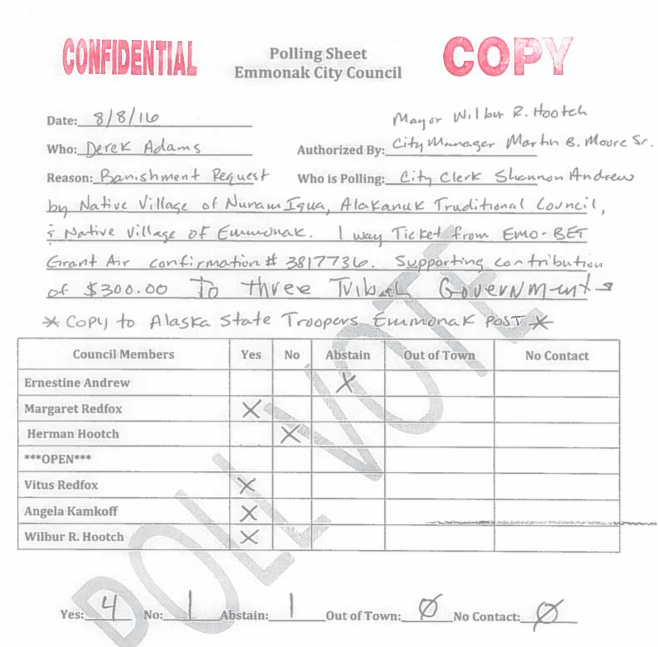
Last year, Derek Adams was banished from three communities — Nunam Iqua, Emmonak, and Alakanuk, after his involvement in an arson fire that led to three deaths in Nunam Iqua, a village at the mouth of the Yukon River.
This February, four people were kicked out of Allakaket, as they were reported to have brought methamphetamines into the Interior village.
The State of Alaska generally tries to stay out of tribal politics, but the case law is unclear on whether tribal justice supercedes the U.S. Constitution, and whether it applies to tribal members and nontribal members alike.
In 2003, Judge Peter Michalski refused to dismiss a 2001 injunction he had issued on behalf of Perryville, about 200 miles southwest of King Salmon.
The village had banned John Tague. In upholding his injunction, Michalski wrote, “The law allows a tribe to ‘regulate the internal affairs of its members.’ ”
He referenced a 1999 case, John vs. Baker, where the Alaska Supreme Court recognized the sovereignty of tribal courts. But that case has never been tested in a higher court.
The administration of Gov. Bill Walker in 2015 established an 11-member Governor’s Tribal Advisory Council and he told media this week that he would be meeting with the council to discuss the matter.
Must Read Alaska has asked Walker’s Chief of Staff Scott Kendall if that meeting took place, but did not get a response by publication this morning.
Must Read Alaska has asked the Attorney General’s office for an update on the case but did not get a response.
U.S. Sen. Dan Sullivan and former U.S. Secretary of the Army Fanning meet with Ft. Wainright-based soldiers of the 1st Brigade Combat Team, 25th Infantry Division, Stryker Brigade, in 2016.
‘AN IMPORTANT DAY FOR ALASKA’
In a reversal that has buoyed Alaska’s military community and recession economy, the U.S. Army announced today it will retain the full 5,000-soldier infantry brigade combat team at Joint Base Elmendorf-Richardson.
Two years ago, the Army announced it would dramatically reduce the 4-25th. As part of an overall downsizing of the U.S. military, the 4-25th would become a much smaller battalion “task force.” Thousands of Alaska soldiers would have been transferred and thousands of related jobs were at stake.
Today, those plans were cancelled, and the Army also announced that the 4-25th will deploy approximately 1,500 soldiers to Afghanistan in support of Operation Freedom’s Sentinel.
U.S. Sen. Dan Sullivan was jubilant: “Over the last two years my team and I have relentlessly advocated – in both Washington, D.C. and Alaska – for the Army to reverse its decision and keep its only airborne brigade combat team in both the Arctic and Asia-Pacific regions in Alaska. Today, I applaud the announcement that the Army has formally decided to keep the entirety of the 4-25 in Alaska for the foreseeable future. This is an important day for Alaska, and for the national security interests of the United States. This decision sends a clear message that our military leaders recognize the emerging security challenges in both the Arctic and the Asia-Pacific, and that our country remains committed to ensuring peace and security through strength in both of these critical regions.
Sullivan brought Army Chief of Staff General Mark Milley and (former) Secretary of the Army Eric Fanning to Alaska last year to tour the bases and hear more about the importance of the cold-weather brigade and Alaska’s military footprint.
The 4-25th is the only extreme cold weather and mountain-trained airborne brigade combat team in the Army, and is positioned to respond to threats in the Asia-Pacific and the Arctic, he said.
After his visit, Milley announced that the brigade would remain intact for another year.
Sullivan fought on. He also included an amendment in a defense bill requiring the Pentagon to develop an Arctic strategy and plan. Today, he thanked Sen. Lisa Murkowski and Congressman Don Young for their efforts to reverse the downsizing.
“Finally, I want to thank the men and women of the 4-25 and their families. I’ve gotten to know many of you over the past several years in Alaska and at training exercises outside the state. Despite the recent uncertainty of the 4-25’s status, you continued on with your mission. You and your families represent America’s finest. Godspeed on your next deployment,” Sullivan said.
Sen. Mike Dunleavy speaks to the press after leaving the Republican-led caucus this evening over a difference in the budget. (Photo from Senate Democrats’ social media.)
Sen. Mike Dunleavy stood tall on the Senate floor this afternoon and spoke with respect. With Dunleavy, standing tall is the only way. And respect comes naturally to him.
Knowing the consequences to come, the District E Republican told his colleagues he was breaking from the majority caucus. He needed to go his own way on the budget. He would be a “no” vote.
And then he voted against the majority’s budget and became a caucus of one.
It was no surprise to Senate leadership, as he had been negotiating with them for days over the spending plan.
But Dunleavy did vote in favor of tapping the Constitutional Budget Reserve, and then he accidently voted yes on the budget in a procedural confusion, although he said tonight that he had made a mistake and would vote no when the bill comes back from the House.
He appeared to be overtired during floor session and said he is fighting a serious cold that may have turned into pneumonia. He has had a persistent cough for weeks.
In an interview this evening, he told Must Read Alaska that during special orders on the Senate floor on Friday, he will reiterate his intent to be a no vote.
He expressed disappointment in the outcome of the budget, “that the collective outcome had less reductions than I would have hoped.
“Basically the funding for a reduced PFD embedded within the budget — I could not support that. I’ve been in negotiations with them for days, but in the end this caucus decided to go with this budget. I told them I would withdraw from the caucus before I voted. That was the right thing to do.”
Dunleavy said his constituents were different from those in other parts of the state, and it was getting harder for him to represent them within the confines of the caucus.
“It’s not my intention to throw any of my colleagues under the bus. We are friends. We are Republicans,” he said. But Dunleavy is known to be an individualist, not a natural joiner, and he’s certainly not a follower.
Dunleavy’s staff aide, Daniel George, wrote on Facebook: “I’m fairly certain I won’t have a job tomorrow because he has left the caucus. However, I told Mike, if the only reason you have to vote for this budget is to keep me employed as your staffer (which I have truly enjoyed doing), forget about it. I would rather you vote your conscience on this budget. I’m young still, sort of, and I’ll find my own way. Don’t let me be a human shield for state spending you can’t support. Once that burden was taken from him, he had no reason left not to vote the way his constituents want. That is how government should function.”
After hours of listening to amendment upon amendment from Democrat senators wanting to add back spending to the budget, all in the Alaska Senate were tired.
Democrats had a field day on Twitter, lauding the Dunleavy defection over a “bad budget.”
CAUCUS RULES
Being part of a majority caucus primarily means you vote as a group on the majority’s budget and some procedural votes. Most other votes are left to the discretion of the lawmaker, but to break from the budget vote comes with consequences. Usually defectors are stripped of their committee chairmanships.
That happened to Rep. Lora Reinbold two years ago, when she bolted from the House majority caucus, lost her committee chairmanships, was put in a reduced office and had, for some time, no staff. Some say the district she represents got short shrift during that time.
Whether the Senate majority will dish out the same treatment to Dunleavy remains to be seen. But he expects to lose staff, committee chairmanship, and perhaps office space. Enforcing the rules is the only way a caucus can stay together.
Dunleavy has presented his own fiscal plan, which includes making Alaskans whole on their Permanent Fund Dividends, and making $1.1 billion in cuts over the next four years. His cuts were aggressive — $300 million each year for three years, and $200 million the final fiscal year, for FY 18, 29, 20 and 21. Reserves of about $13 billion would make up the difference.
The Earnings, under his plan, would continue to grow, and the Permanent Fund Corporation agrees his plan will pencil out.
But some in Juneau think it’s too aggressive, the cuts that are assumed in order to make the plan pencil are too deep, hitting large programs such as education too hard. In any case, there’s little chance Dunleavy’s plan would pass the Democrat-controlled House, nor would it be signed by Gov. Bill Walker, who has said that he is done cutting, and now needs tax revenues to pay for government.
Dunleavy is considered a likely candidate for governor in 2018. He won’t say whether or not he has decided, but separating himself from the herd may also be a strategic move. He represents one of the more conservative areas of the state: Mat-Su, Delta Junction, Copper River Valley, and Valdez.
SENATE BUDGET
The Alaska Senate’s operating budget cuts state spending by $276 million, although it achieves some cuts through balance transfers.
The Senate’s version of the operating budget, House Bill 57, proposes $4.1 billion in unrestricted general fund spending.
“To help address the fiscal problem, we asked the state’s largest agencies to cut a nickel on the dollar,” said Sen. Lyman Hoffman, a Bethel Democrat who co-chairs Senate Finance Committee.
Jahna Lindemuth has been Alaska’s acting attorney general since the sudden exit of Gov. Bill Walker’s first attorney general, Craig Richards, in 2016.
But her confirmation is less than certain.
Jahna Lindemuth
In fact, this is a high-risk month for Lindemuth. She’s been walking through the Capitol legislative offices, talking with lawmakers who hold her future in their hands. She’s counting votes.
She doesn’t have them yet.
Lindemuth needs 31 votes for confirmation. She’ll get the House Democrat majority — 22, and the Senate Democrat minority — 4.
That means she needs to lock down five more green buttons when she faces the joint confirmation vote to be named the State’s top law officer and Gov. Walker’s attorney.
But before she faces that joint vote, Lindemuth has to head back to the Senate Judiciary Committee room, where her hearing will have been hung up for over month.
When she went before Senate Judiciary on March 9, lawmakers asked her about her closed-door settlement with Ahtna Corp. over road access to Klutina Lake. They sent her back to think about who she represents in this case. Senate President Pete Kelly of Fairbanks told her he was not comfortable with what he had heard from her so far.
Her next committee hearing will be Wednesday at 1:30 pm in Senate Judiciary. The public will be queued up to testify, and word on the street is they have a lot to say. Interest is higher than normal for an AG confirmation, although Walker’s last one, Craig Richards, also faced a grilling two years ago.
WHO IS LINDEMUTH’S TOP CLIENT?
The Alaska Outdoor Council and the Fairbanks Laundry House Gang have raised questions about whether Lindemuth really stands for the people of Alaska, or a private corporation who had given the governor a big campaign assist in 2014.
The Klutina Lake Road transects property owned by Ahtna Corporation, which donated $25,000 to Walker Mallott 1, and Your Future Alaska — groups that helped Gov. Walker get elected.
Now, Walker is directing his acting attorney general to give away a federally guaranteed right-of-way to Athna. The road was established in 1898. It has been perhaps the most important state road access right-of-way to defend for many years. It’s an area popular with Alaska outdoors enthusiasts — fishers, campers and boaters.
The case file on Klutina Road is hundreds of pages deep with documentation from the Department of Transportation and the Department of Law, which has fought for the access that is cryptically called RS-2477.
RS-2477 allows the public to stop, park, pick berries, gather firewood, camp, launch a boat, and swat mosquitoes.
Ahtna Corp. sued the State of Alaska about nine years ago and the case was to go to trial this month, when Lindemuth filed a pleading with the court to stay the case so she could negotiate a settlement.
What Ahtna wants is to control access for its shareholders and put limitations on the access rights of other Alaskans.
Lindemuth is negotiating down the access to something called a 17-b easement, which prohibits many of those public recreational activities and reduces the width of the right-of-way substantially.
However, no one outside the lawyers for the Department of Law knows what the terms of the settlement are, because it’s being done in secret.
And that’s one of the sticking points for outdoor advocates: Public access is being settled behind closed doors.
When asked by the Senate Judiciary Committee why she was negotiating away the public’s rights, Lindemuth said she had to decide whether or not to pursue the case and it was her judgment — and her right — as attorney general to settle. She was looking for a “win-win.” Sen. Pete Kelly told her he wanted a “win,” not a “win-win.”
Late last month, Gov. Walker bent to public pressure and issued a statement saying that the settlement terms would include a full 100-foot right-of-way “and opportunities for fishing, camping and boating.”
The Alaska Outdoor Council says that these are uses already protected by RS-2477, and it is leery of any agreement to limit those rights.
Walker also said that the settlement would provide “multiple areas along Klutina Lake Road…where the public can fish and launch boats into the river.”
The Alaska Outdoor Council argues that those rights are covered already under RS-2477.
Walker promised: “Areas will be provided for camping and overnight parking and any fee Ahtna charges must be reasonable and similar to fees charged in State campgrounds.”
But a 2002 opinion by the Attorney General’s office stated: “Ahtna has no legal authority to regulate the highway by requiring the purchase of permits or the payment of tolls or by prohibiting historic uses of the road by corporate fiat.”
Since Lindemuth’s somewhat contentious hearing on March 9, another case has arisen that may capture the interest of Senate Judiciary:
In the village of Togiak this week, a non-Native resident was bound with duct tape and put on a plane, banished from the community. There was no due process for the man, who operates an inn and was accused by tribal members of bringing alcohol into the village.
Tribal justice is something the Walker Administration has supported, including allowing communities to banish tribal members when they choose.
But for a village to banish a nonmember of a tribe? That raises constitutional questions, which committee members will want addressed by the attorney general. The Togiak man in question has hired an attorney who told the Alaska Dispatch News that the man’s constitutional rights had been violated.
Public testimony will be heard on Wednesday, April 12 at 1:30 at the Senate Judiciary confirmation hearing for acting AG Lindemuth. Alaskans may testify from their nearby Legislative Information Offices or call in their testimony (be prepared to wait) at 844-586-9086.
Once again, irresponsible spending by state lawmakers has left us with a multibillion-dollar budget deficit. This latest crisis underscores the need to tighten the state’s “spending cap” on annual expenditures, and a bill recently passed in the Alaska Senate is a good start.
Senate Bill 26 imposes a statutory spending cap of $4.1 billion in general fund appropriations each year, which would grow with inflation. A statutory cap — which can ultimately be set aside during the budget process — would be less effective than a constitutional limit, but it is a start. Whatever form it takes, a revised spending cap is desperately needed to put our fiscal house in order over the coming years.
Alaskans have been supportive of the idea for more than three decades. When the state’s current constitutional spending cap was put before voters in 1982, 61 percent voted in support. When given the option to overturn the limitation four years later, the margin in favor of the spending cap was even greater: 71 percent to 29 percent. More recently, a 2015 poll by the Alaska State Chamber of Commerce found a majority of the state remains in favor of spending caps.
Regrettably, the constitutional spending limit that voters approved in the 80s has proven to be woefully insufficient to address the budgetary challenges of 2017. Simply put, it is set too high to be useful. Under the current provision, which excludes certain types of government funds, the limit for this year’s budget is $10.1 billion — more than double the budget of $4.7 billion.
In the last decade, state appropriations have only come close to the current cap twice — once in 2009 and again in 2013. That in itself is alarming, given how high the spending limits are set. The cap will need to be drastically reduced if it is to serve as an effective check on government spending.
With a tighter spending cap in place, we would not find ourselves scrambling to cover a $3 billion budget shortfall. Historically, the state budget explodes when oil fetches a high price, leaving us vulnerable to massive cuts when prices fall. For instance, state spending in the years between 2004 and 2013 more than doubled, from about $3 billion to $8.7 billion. Since then, falling oil prices have forced the state to gradually cut back. An effective spending limit would compel lawmakers to preserve a leaner government that is more sustainable over the long term.
As we look for ways to cover this year’s deficit, our focus should be on cutting wasteful and unnecessary expenditures. Legislators have done an admirable job of reducing spending over the last few years, but plenty of bloat remains to be cut. The facts speak for themselves. Alaska has one of the biggest public sectors in the country, second only to Wyoming. 24.2 percent of Alaska workers are employed by the public sector (federal, state and local), compared to a national rate of 15.5 percent. In 2015, the state government spent more than $18,000 per resident, far more than any other state in the country and more than triple the national average, which is below $6,000.
In addition to instituting a new spending cap, Senate Bill 26 would use about $2 billion in investment earnings from the Permanent Fund to cover the budget shortfall. It’s regrettable that using those funds has become necessary, but doing so is preferable to raising taxes, as some lawmakers have proposed. New taxes would burden hardworking families and make the state less attractive to new businesses and workers, leading to a decline in economic growth.
Rather than squeeze more revenue from taxpayers, state lawmakers should prove they are responsible stewards of public funds by enacting an effective state spending cap. If successful, they could ensure fiscally-responsible budgets for decades to come. That’s a win for all Alaskans.
Jeremy Price is the Alaska State Director of Americans for Prosperity. Raised in Salcha, he now lives in Anchorage.
A special election to recall three Homer City Council members is now set for June 13.
The three had pushed to make Homer a sanctuary city, a place where illegal immigrants could find shelter from federal authorities.
Their actions this winter were documented in a series of emails that showed their intent to participate in a “resist Trump” style movement that would include creating sanctuary status for Homer via a resolution they were drafting with journalist-cum-citizen-activist Hal Spence.
Later, they modified their activities to create an “inclusivity” resolution, but by then their intentions were already public, as were the tracks they laid while they tried to re-brand their efforts.
A group of outraged Homer residents last month decided the three needed to face a recall election, and within two weeks had gathered the signatures needed. They delivered the signatures to the city clerk on Friday.
“After reviewing the petitions, and consulting with the City Attorney, I have determined that sufficient signatures have been submitted for each of the petitions,” wrote Homer City Clerk Jo Johnson in a memo today. “I have also found that some of the allegations in the statements for recall were sufficient. As a result, I certified the petitions on April 5, 2017.”
Larri Fancher, Larry Zuccaro, and Mike Fell delivered the petitions to City Clerk Jo Johnson on Friday.
Petition sponsors, Mike Fell, Larry Zuccaro, and Larri Fancher submitted 15 petition booklets for each of the council members they seek to remove. Johnson certified that there were sufficient names in each of the petitions to proceed to the next step of deciding if the allegations had merit. There were 437 signatures to recall Aderhold, 436 for Lewis, and 436 for Reynolds.
Johnson found that 24 signatures for Alderhold were of people not on current voter rolls, or the signatures were illegible, or the actual signature was left off, or the person signed more than once. The petition for Lewis had 23 names that were not eligible, and 27 on the Reynolds petition were tossed.
But in the end, the recall group only needed 373 signatures each and they had several to spare in reaching their goal.
“Given the sufficiency of the signatures, I next examined the sufficiency of the statement for recall, with substantial assistance from the City Attorney in interpreting the relevant statutes and common law principles. In the State of Alaska, there are three grounds for recall, 1) misconduct in office; 2) incompetence; and 3) failure to perform prescribed duties,” Johnson wrote.
She said the grounds for recall are liberally constructed to favor access to the recall process, and she concluded that the group had sufficient grounds to ask for the vote.
She also noted that “the statutes offer the targeted official an opportunity to make a rebuttal, which will be placed on the ballot alongside the petitioners’ statement of charges. This rebuttal statement is the proper forum in which accused officials may defend against the charges. Where the petition merely characterizes the law in a way different than the official (or his or her attorney) would prefer, he or she has an opportunity to put his or her rebuttal before the voters, alongside the charges contained in the petition. It is not the place of the municipal clerk…to decide legal questions of this kind.”
The Homer City Council will be advised of her decision at its Monday meeting. Johnson said early voting will start two weeks prior to the election, which comes in the middle of a busy fishing and tourism season for the community on Kachemak Bay.
Dan Fauske, who led the Alaska Housing Finance Corporation and the Alaska Gasline Development Corporation until his retirement in 2015, died this morning in Anchorage after a battle with cancer.
Former House Speaker Mike Chenault rose on the House Floor today to announce his passing. In a voice that was breaking, he announced Fauske’s passing:
“Mr. Speaker there are not many places across the state where Mr. Fauske is not thought of in a higher light. He was a great statesman and a great family man…my prayers and condolences to Elaine and the entire Fauske family.”
“Dan Fauske leaped tall buildings in a single bound. Like Superman, there was not a challenge he couldn’t take on. He grew the Alaska Housing Finance Corporation into what it is today after it was on the brink of closure,” Chenault said in a statement issued this afternoon. “He was a great Alaskan but more importantly a good man and friend.”
House Bill 143, naming the Alaska Housing Finance Corporation Building in Anchorage after Fauske, passed the Legislature last week. Governor Bill Walker will sign the bill into law on April 8 at 11 am in AHFC’s boardroom, 4300 Boniface Parkway.
Senator Pete Kelly issued this statement “Dan Fauske was one of the most competent men I ever met. His work with the Legislature on behalf of the Alaska Housing Finance Corporation and the Alaska Gasline Development Corporation brought immeasurable value to Alaskans.
“We loved his sense of humor, his reliance on relationships, and his ability to tell stories.”
Must Read Alaska editor Suzanne Downing remembered Dan Fauske as knowledgeable, helpful, and good natured. “Over the years I could always count on him to give the facts to me straight. He was a subject expert on so many things related to Alaska, and he knew how to keep things in perspective. He never overreached on a topic, but kept a steady, grown-up view of every situation. I will miss his counsel.”
Former Gov. Sean Parnell issued this statement this afternoon: “Sandy and I were deeply saddened to learn of Dan Fauske’s passing. We knew Dan to be a thoughtful, smart public servant as he led both AHFC and the Alaska Gasline Development Corp. We will miss his smile and wit–that spark of humanity that made Dan very special. Our thoughts and prayers are with Elaine and the Fauske family and the many friends who, like us, count Dan a special friend.”
Fauske served as the Chief Executive Officer of Alaska Housing Finance Corporation from 1995 to August 2013, and before that was chief financial officer, chief administrative officer and budget director of the North Slope Borough, in Barrow. He was a director at National Community Renaissance of California and a director of National Housing Development Corporation.
Fauske earned his masters degree in business administration from Gonzaga University. Fauske’s survivors include his wife Elaine, and adult children, D.J., Scott, Brad, Kathy and Marcie.
D.J. Fauske offered sentiments on behalf of the Fauske family through the Office of the Governor: “Dan lost the battle but not the war. We are grateful for the many friends and professional colleagues who have prayed for, and connected with my dad and our entire family since learning of his diagnosis.”
“I have known Dan for a long time. I had the privilege to be a part of his work for eight years as an AHFC employee and three more years as a member of the board. He built AHFC with heart, intellect, and a can-do attitude,” said AHFC President Bryan Butcher. “Dan was a force of nature, a mentor to many of us, and a dear friend. He will be immeasurably missed.”
U.S. Sen. Dan Sullivan spoke about Fauske on the floor of the Senate this evening:
Mr. President, for months I’ve been coming down to the floor each week to recognize someone in my state who has made a difference—someone who has devoted time and energy to making my state a better place to live for others.
I call these individuals our Alaskan of the Week.
As I’ve said repeatedly, my state is the most beautiful state in the country—I’d argue in the world. I urge everybody here in this room, and watching on television, to come and see it for yourself. It’ll be a trip of a lifetime. Guaranteed.
But it’s the people that truly make my state unique. People who are helping each other. Strong willed, warm hearted, tenacious people who have worked tirelessly for all of us who live there.
Mr. President, this week I’d like to honor Dan Fauske, one of the strongest willed, warmest hearted people I have ever known. All he’s done for us has made Alaska a better place for all of us.
Dan came to Alaska in 1974 after serving in the Army, like so many Alaskans. And like so many Alaskans, he arrived with the glint of steel in his eye and a mission to help build our state. Alaska is full of natural wonders, but our man-made wonders are also marvels. And Dan wanted to be part of building more of those marvels.
He first arrived in the North Slope Borough to help the community build up their infrastructure and strengthen the villages in the area.
It was a time of enormous change for all of Alaska, and particularly the North Slope. Oil from the North Slope’s Prudhoe Bay, the largest oil field in North America, had recently begun to flow. The largest lands claim Act in history, the Alaska Native Claims Settlement Act, had recently passed, and the governments of villages in rural Alaska were being formed and reformed.
After Dan went back to school to receive a master’s degree in business administration from Gonzaga, he made his way back to Alaska to serve as Chief Financial Officer and Chief Administrative Officer for Alaska’s North Slope Borough, where he launched an ambitious and ultimately successful capital plan to provide running water and sewer services to the villages throughout the Borough.
According to Bill Tracey, Sr. from Point Lay, who was a co-worker at the time, “Dan’s excellent work ethic and skills earned him the respect of the North Slope leaders… His accomplishments were remarkable.”
With his beautiful and spirited wife Elaine always by his side, Dan then moved his family to Anchorage to head up the Alaska Housing Finance Corporation. For 18 years, Dan managed AHFC’s nearly $5 billion in assets. It’s not an overstatement to say that he revolutionized that agency, doing remarkable things—including, and most importantly, helping thousands and thousands of Alaskans pursue their dream of buying an affordable home.
The Alaska Legislature just passed a bill to name the Alaska Housing Finance Corporation the Daniel R. Fauske Building. There will be a dedication ceremony in Anchorage this Saturday.
As his bio indicates, there is no doubt that for decades, Dan served Alaska with his hands, his heart, and his head.
But a bio, on paper, can only tell you so much about a person.
To really appreciate him, you have to have been with him and watched the energy and can-do spirit radiate off of Dan. You had to have watched him talk to people: with respect, with humor, understanding and keen intelligence.
He had a big laugh and told great stories. He also had that rare ability to genuinely connect with everybody he met, and was able to speak the language of a businessman, a builder, veteran, and a public servant. He spoke the language of a father, a husband, a friend, and a true Alaskan.
In so doing, he gained the respect of politicians, state workers, military members—people from all across Alaska. If you wanted something done and done right, you asked Dan Fauske to help do it. People trusted Dan Fauske. I trusted Dan Fauske.
Most importantly, Dan was a great father to three great boys: DJ, Scott, and Brad, and two daughters, Marcy and Kathy. And he was a great husband to his incredible, vivacious and very strong wife Elaine.
Mr. President, Dan passed away this afternoon, with his family and friends by his side. Our prayers, and the prayers of so many Alaskans, go out to all of them during this difficult time. For anyone watching, I humbly ask that they say a prayer too.
For all he’s done for all of us—and all his memory will continue to do for us–Dan Fauske is our Alaskan of the Week. He was also my very good friend. And my wife Julie and I will miss him greatly.
Earlier this session, legislators unanimously passed HB 143, naming the AHFC Anchorage headquarters the Daniel R. Fauske Building. Arrangements for a summer celebration of life are pending, and details will be made available by the family at a later date.